RHS Level 2 Certificate Week 16 – budding and grafting continued, review of Botanical naming conventions; Genetics and Inheritance and Plant Growth Regulators
Learning outcomes Define the terms: ‘budding’ and ‘grafting’. State the reasons for use of budding and grafting for the production of particular plants. Define ‘Compatibility’ in this context State the reasons why botanical/horticultural nomenclature is important. Define the meaning of ‘family’, ‘genus’, ‘species, ‘subspecies’, ‘variety’ and ‘cultivar’. Explain and apply the conventions for writing botanical names, including use of italics and standard script, cultivar and hybrid indicators etc. Define the terms ‘dominant’ and ‘recessive’ and explain how these are expressed in plant generations Complete a Punnett square for a mono-hybrid cross. State the significance of F1 hybrid seeds and explain the term hybrid vigour Identify the principle Plant Growth Regulators and their main influences on plant growth and development Describe two examples of how auxin influences plant growth. Describe what is meant by the term phototropism
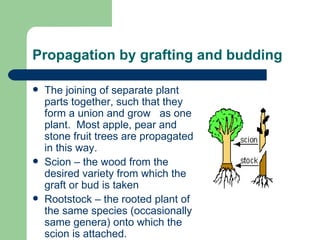
Propagation by grafting and budding The joining of separate plant parts together, such that they form a union and grow   as one plant.  Most apple, pear and stone fruit trees are propagated in this way. Scion – the wood from the desired variety from which the graft or bud is taken Rootstock – the rooted plant of the same species (occasionally same genera) onto which the scion is attached.
Reasons for grafting or budding Plants that cannot be produced by other means To obtain earlier cropping To obtain desirable characteristics of the rootstock e.g. dwarfing To change the variety of an established tree (topworking) To repair damage (bridge grafting) To create particular ornamental or useful forms (e.g. standard roses or family apple trees)
Stages of graft union formation It is essential that the cambium on the scion and stock is matched up 1)   Callus formation  by both stock and scion   2) Intermingling of callus  from stock and scion   3)   New cambium forms  in callus between stock and scion  4)   New secondary xylem and phloem  from new cambium to connect stock and scion 
FACTORS AFFECTING SUCCESS OF GRAFTING AND BUDDING  Plant type – scion and stock from same species (intra-generic grafts may be feasible – e.g.  Pyrus communis  scion onto  Cydonia oblonga  rootstock).  Only dicots and gymnosperms can be grafted. Incompatibility – due to physiological factors; virus infection; physical abnormality of the vascular tissues in the graft union. Season and growth state Environment – temperature, humidity.
Types of graft and budding Apical wedge graft T-budding Chip budding
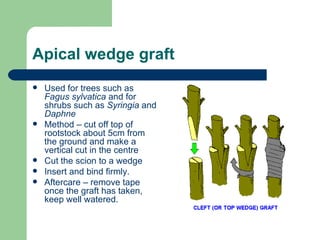
Apical wedge graft Used for trees such as  Fagus sylvatica  and for shrubs such as  Syringia  and  Daphne Method – cut off top of rootstock about 5cm from the ground and make a vertical cut in the centre Cut the scion to a wedge Insert and bind firmly. Aftercare – remove tape once the graft has taken, keep well watered.
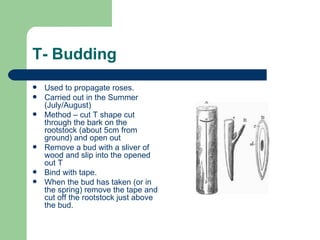
T- Budding Used to propagate roses.  Carried out in the Summer (July/August) Method – cut T shape cut through the bark on the rootstock (about 5cm from ground) and open out Remove a bud with a sliver of wood and slip into the opened out T Bind with tape. When the bud has taken (or in the spring) remove the tape and cut off the rootstock just above the bud.
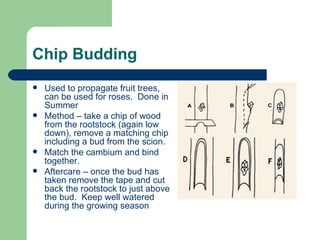
Chip Budding Used to propagate fruit trees, can be used for roses.  Done in Summer Method – take a chip of wood from the rootstock (again low down), remove a matching chip including a bud from the scion. Match the cambium and bind together. Aftercare – once the bud has taken remove the tape and cut back the rootstock to just above the bud.  Keep well watered during the growing season
Botanical names – naming structure Genus - A group of species that bear close resemblance to each other.  Species - A group of individuals that are very closely related structurally and functionally.  Individuals in a single species interbreed freely and breed true to type.  Variety – a naturally occurring distinct sub- population within a species that will either come true from seed or can be reproduced vegetatively (for example by cuttings).  Cultivar – a man made variety.
Botanical naming conventions Genus and species in  italics  (underlined when handwritten).  Genus name starts with a capital letter, species name starts lower case. Variety names are in italics Cultivar names are in inverted single commas and in normal script.  Not underlined when handwritten. Hybrids – indicated by an X.  Placed between the genus and species names in inter-specific crosses and before the genus name in inter-generic crosses.
Genetics and Inheritance Chromosomes are made up of pairs of genes Genes may be dominant or recessive for a given characteristic e.g. flower colour Each gene of a pair may be the same or different If both genes are the same the plant is homozygous for that characteristic If the two genes are different the plant is heterozygous If one gene is dominant and the other recessive the dominant trait is expressed in the appearance of the plant.
F1 Hybrids A cross between two pure bred parent lines – one homozygous for the dominant trait, the other homozygous for the recessive The offspring all show the dominant trait but are not all genetically the same F2 generation will not all show the dominant trait. The cross gives hybrid vigour to the offspring in the F1 generation whilst giving predictable appearance.
Plant growth regulators Auxin Cytokinins Gibberellins Ethylene Abscisic acid
Function of auxin In combination with cytokinins promotes the differentiation of callus cells into root initials in the base of cuttings.  Use of artificial auxin. The higher concentrations of auxins produced by the apical bud of a shoot suppress the growth of axial shoots; removing the apical bud allows these to grow. Pinching out The movement of auxins to the shaded side of a stem causes the cells to elongate so the plant grows towards the light – phototropism.
Learning outcomes Define the terms: ‘budding’ and ‘grafting’. State the reasons for use of budding and grafting for the production of particular plants. Define ‘Compatibility’ in this context State the reasons why botanical/horticultural nomenclature is important. Define the meaning of ‘family’, ‘genus’, ‘species, ‘subspecies’, ‘variety’ and ‘cultivar’. Explain and apply the conventions for writing botanical names, including use of italics and standard script, cultivar and hybrid indicators etc. Define the terms ‘dominant’ and ‘recessive’ and explain how these are expressed in plant generations Complete a Punnett square for a mono-hybrid cross. State the significance of F1 hybrid seeds and explain the term hybrid vigour Identify the principle Plant Growth Regulators and their main influences on plant growth and development Describe two examples of how auxin influences plant growth. Describe what is meant by the term phototropism

RHS Level 2 Certificate Year 1 Week 16

  • 1.
    RHS Level 2Certificate Week 16 – budding and grafting continued, review of Botanical naming conventions; Genetics and Inheritance and Plant Growth Regulators
  • 2.
    Learning outcomes Definethe terms: ‘budding’ and ‘grafting’. State the reasons for use of budding and grafting for the production of particular plants. Define ‘Compatibility’ in this context State the reasons why botanical/horticultural nomenclature is important. Define the meaning of ‘family’, ‘genus’, ‘species, ‘subspecies’, ‘variety’ and ‘cultivar’. Explain and apply the conventions for writing botanical names, including use of italics and standard script, cultivar and hybrid indicators etc. Define the terms ‘dominant’ and ‘recessive’ and explain how these are expressed in plant generations Complete a Punnett square for a mono-hybrid cross. State the significance of F1 hybrid seeds and explain the term hybrid vigour Identify the principle Plant Growth Regulators and their main influences on plant growth and development Describe two examples of how auxin influences plant growth. Describe what is meant by the term phototropism
  • 3.
    Propagation by graftingand budding The joining of separate plant parts together, such that they form a union and grow   as one plant.  Most apple, pear and stone fruit trees are propagated in this way. Scion – the wood from the desired variety from which the graft or bud is taken Rootstock – the rooted plant of the same species (occasionally same genera) onto which the scion is attached.
  • 4.
    Reasons for graftingor budding Plants that cannot be produced by other means To obtain earlier cropping To obtain desirable characteristics of the rootstock e.g. dwarfing To change the variety of an established tree (topworking) To repair damage (bridge grafting) To create particular ornamental or useful forms (e.g. standard roses or family apple trees)
  • 5.
    Stages of graftunion formation It is essential that the cambium on the scion and stock is matched up 1) Callus formation by both stock and scion  2) Intermingling of callus from stock and scion  3) New cambium forms in callus between stock and scion  4) New secondary xylem and phloem from new cambium to connect stock and scion 
  • 6.
    FACTORS AFFECTING SUCCESSOF GRAFTING AND BUDDING Plant type – scion and stock from same species (intra-generic grafts may be feasible – e.g. Pyrus communis scion onto Cydonia oblonga rootstock). Only dicots and gymnosperms can be grafted. Incompatibility – due to physiological factors; virus infection; physical abnormality of the vascular tissues in the graft union. Season and growth state Environment – temperature, humidity.
  • 7.
    Types of graftand budding Apical wedge graft T-budding Chip budding
  • 8.
    Apical wedge graftUsed for trees such as Fagus sylvatica and for shrubs such as Syringia and Daphne Method – cut off top of rootstock about 5cm from the ground and make a vertical cut in the centre Cut the scion to a wedge Insert and bind firmly. Aftercare – remove tape once the graft has taken, keep well watered.
  • 9.
    T- Budding Usedto propagate roses. Carried out in the Summer (July/August) Method – cut T shape cut through the bark on the rootstock (about 5cm from ground) and open out Remove a bud with a sliver of wood and slip into the opened out T Bind with tape. When the bud has taken (or in the spring) remove the tape and cut off the rootstock just above the bud.
  • 10.
    Chip Budding Usedto propagate fruit trees, can be used for roses. Done in Summer Method – take a chip of wood from the rootstock (again low down), remove a matching chip including a bud from the scion. Match the cambium and bind together. Aftercare – once the bud has taken remove the tape and cut back the rootstock to just above the bud. Keep well watered during the growing season
  • 11.
    Botanical names –naming structure Genus - A group of species that bear close resemblance to each other. Species - A group of individuals that are very closely related structurally and functionally. Individuals in a single species interbreed freely and breed true to type. Variety – a naturally occurring distinct sub- population within a species that will either come true from seed or can be reproduced vegetatively (for example by cuttings). Cultivar – a man made variety.
  • 12.
    Botanical naming conventionsGenus and species in italics (underlined when handwritten). Genus name starts with a capital letter, species name starts lower case. Variety names are in italics Cultivar names are in inverted single commas and in normal script. Not underlined when handwritten. Hybrids – indicated by an X. Placed between the genus and species names in inter-specific crosses and before the genus name in inter-generic crosses.
  • 13.
    Genetics and InheritanceChromosomes are made up of pairs of genes Genes may be dominant or recessive for a given characteristic e.g. flower colour Each gene of a pair may be the same or different If both genes are the same the plant is homozygous for that characteristic If the two genes are different the plant is heterozygous If one gene is dominant and the other recessive the dominant trait is expressed in the appearance of the plant.
  • 14.
    F1 Hybrids Across between two pure bred parent lines – one homozygous for the dominant trait, the other homozygous for the recessive The offspring all show the dominant trait but are not all genetically the same F2 generation will not all show the dominant trait. The cross gives hybrid vigour to the offspring in the F1 generation whilst giving predictable appearance.
  • 15.
    Plant growth regulatorsAuxin Cytokinins Gibberellins Ethylene Abscisic acid
  • 16.
    Function of auxinIn combination with cytokinins promotes the differentiation of callus cells into root initials in the base of cuttings. Use of artificial auxin. The higher concentrations of auxins produced by the apical bud of a shoot suppress the growth of axial shoots; removing the apical bud allows these to grow. Pinching out The movement of auxins to the shaded side of a stem causes the cells to elongate so the plant grows towards the light – phototropism.
  • 17.
    Learning outcomes Definethe terms: ‘budding’ and ‘grafting’. State the reasons for use of budding and grafting for the production of particular plants. Define ‘Compatibility’ in this context State the reasons why botanical/horticultural nomenclature is important. Define the meaning of ‘family’, ‘genus’, ‘species, ‘subspecies’, ‘variety’ and ‘cultivar’. Explain and apply the conventions for writing botanical names, including use of italics and standard script, cultivar and hybrid indicators etc. Define the terms ‘dominant’ and ‘recessive’ and explain how these are expressed in plant generations Complete a Punnett square for a mono-hybrid cross. State the significance of F1 hybrid seeds and explain the term hybrid vigour Identify the principle Plant Growth Regulators and their main influences on plant growth and development Describe two examples of how auxin influences plant growth. Describe what is meant by the term phototropism