Process in
Developing
Assessment
Instrument
TABLE OF
SPECIFICATIONS
(TOS)
Table of Specifications (TOS)
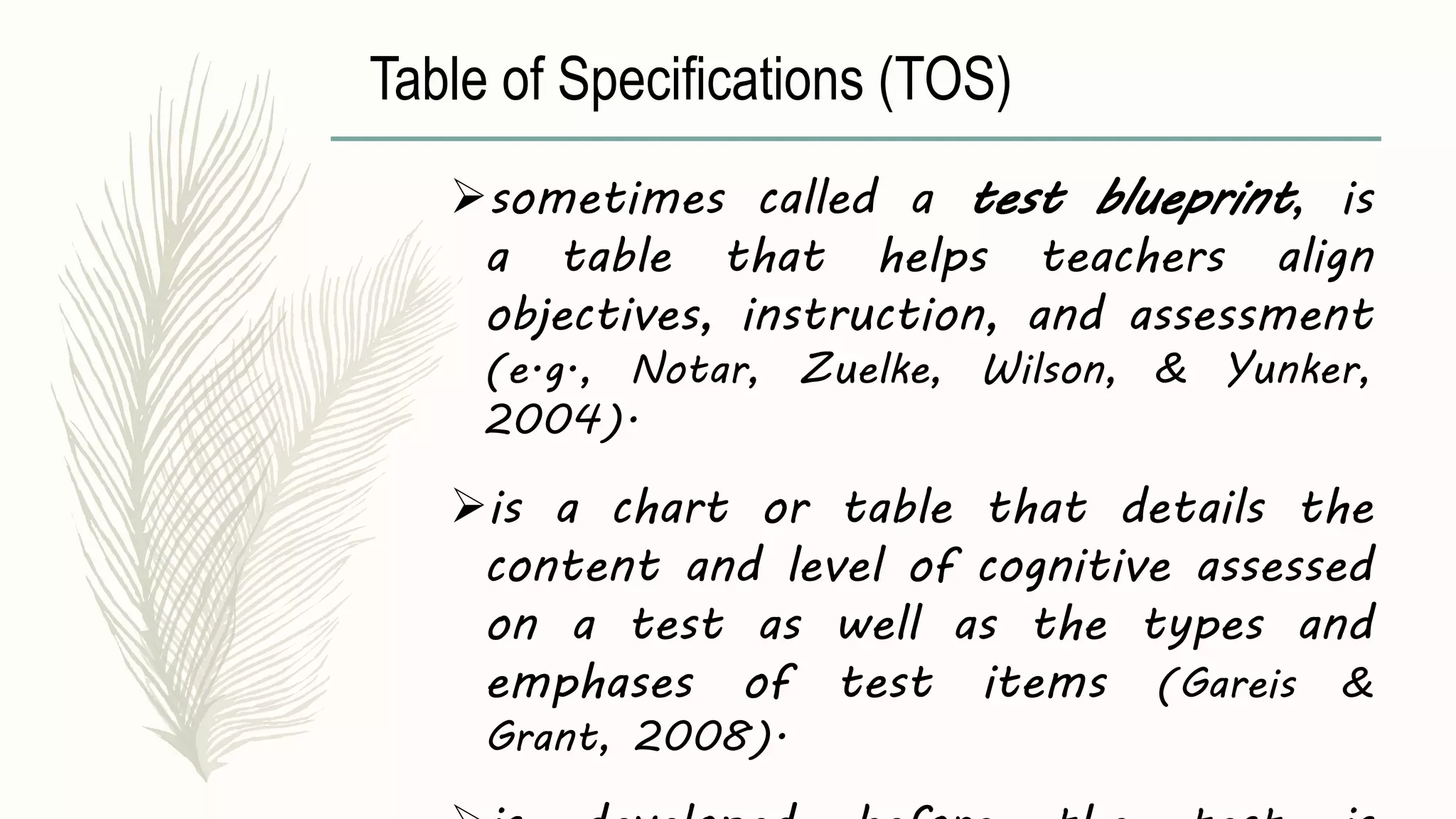
sometimes called a test blueprint, is
a table that helps teachers align
objectives, instruction, and assessment
(e.g., Notar, Zuelke, Wilson, & Yunker,
2004).
is a chart or table that details the
content and level of cognitive assessed
on a test as well as the types and
emphases of test items (Gareis &
Grant, 2008).
PURPOSE OF
TABLE OF
SPECIFICATION
Purpose of Table of Specifications
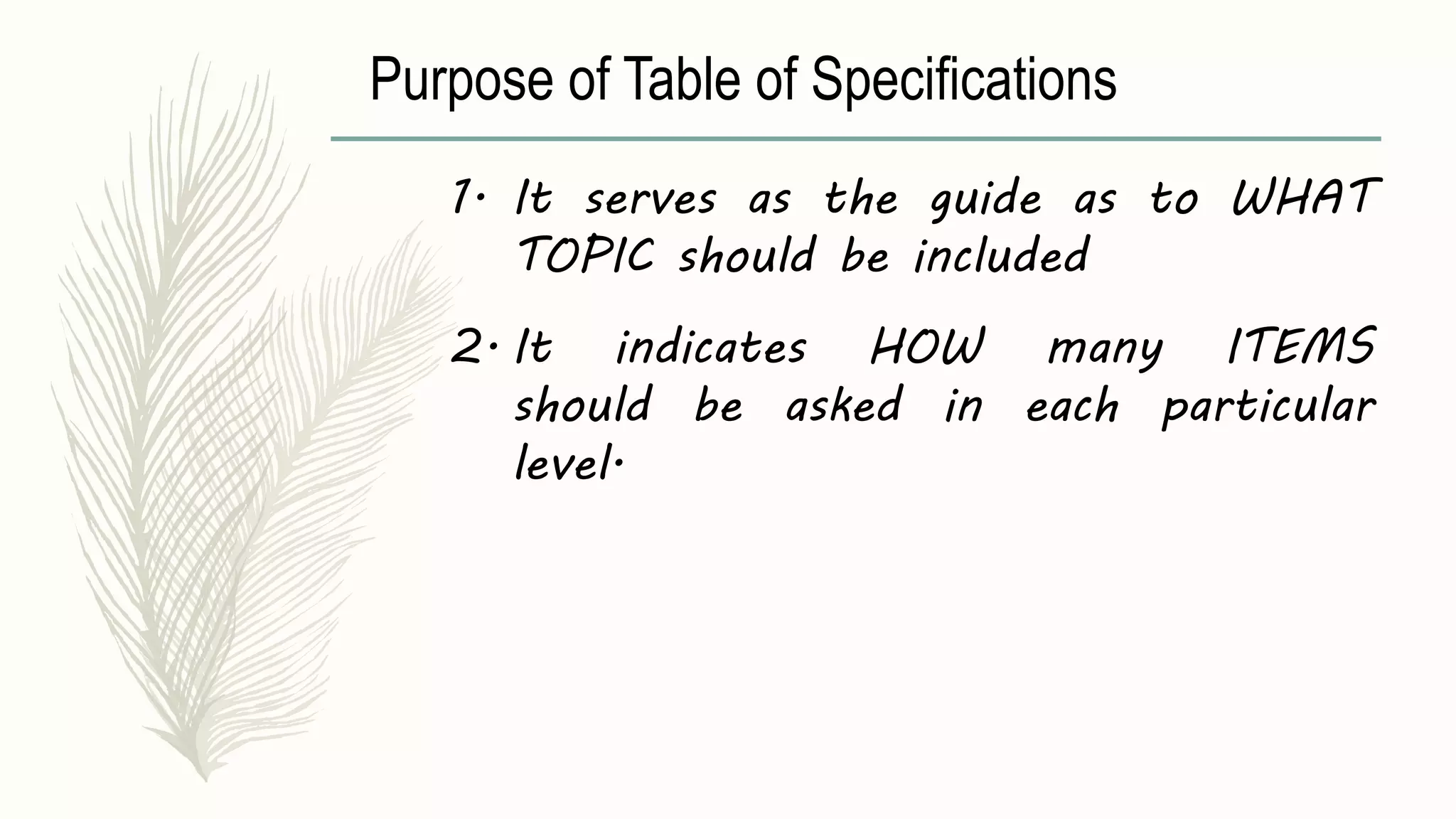
1. It serves as the guide as to WHAT
TOPIC should be included
2. It indicates HOW many ITEMS
should be asked in each particular
level.
PREPARING A
TABLE OF
SPECIFICATION
Preparing a Table of Specifications
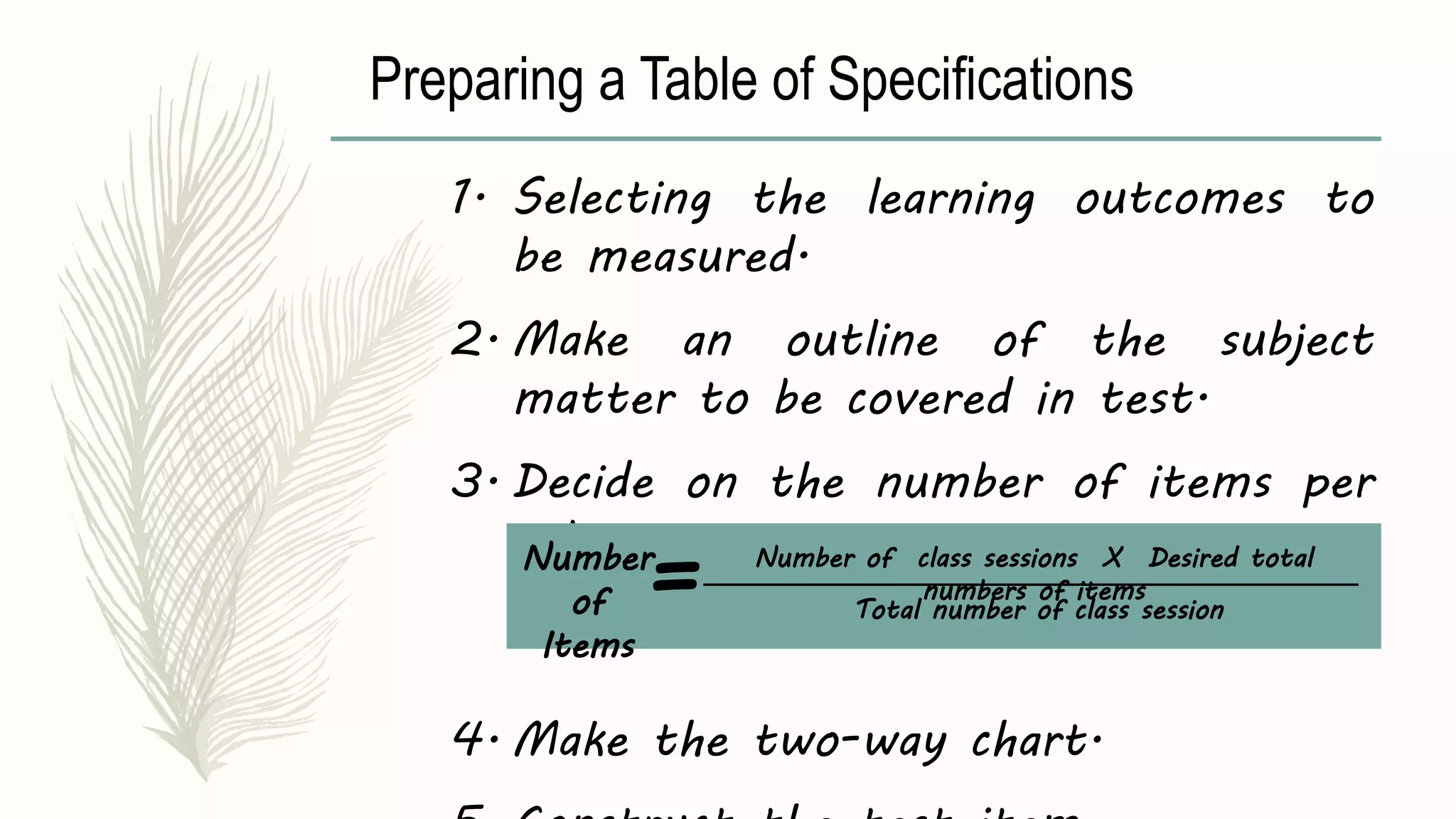
1. Selecting the learning outcomes to
be measured.
2. Make an outline of the subject
matter to be covered in test.
3. Decide on the number of items per
subtopic.
4. Make the two-way chart.
Number
of
Items
= Number of class sessions X Desired total
numbers of items
Total number of class session
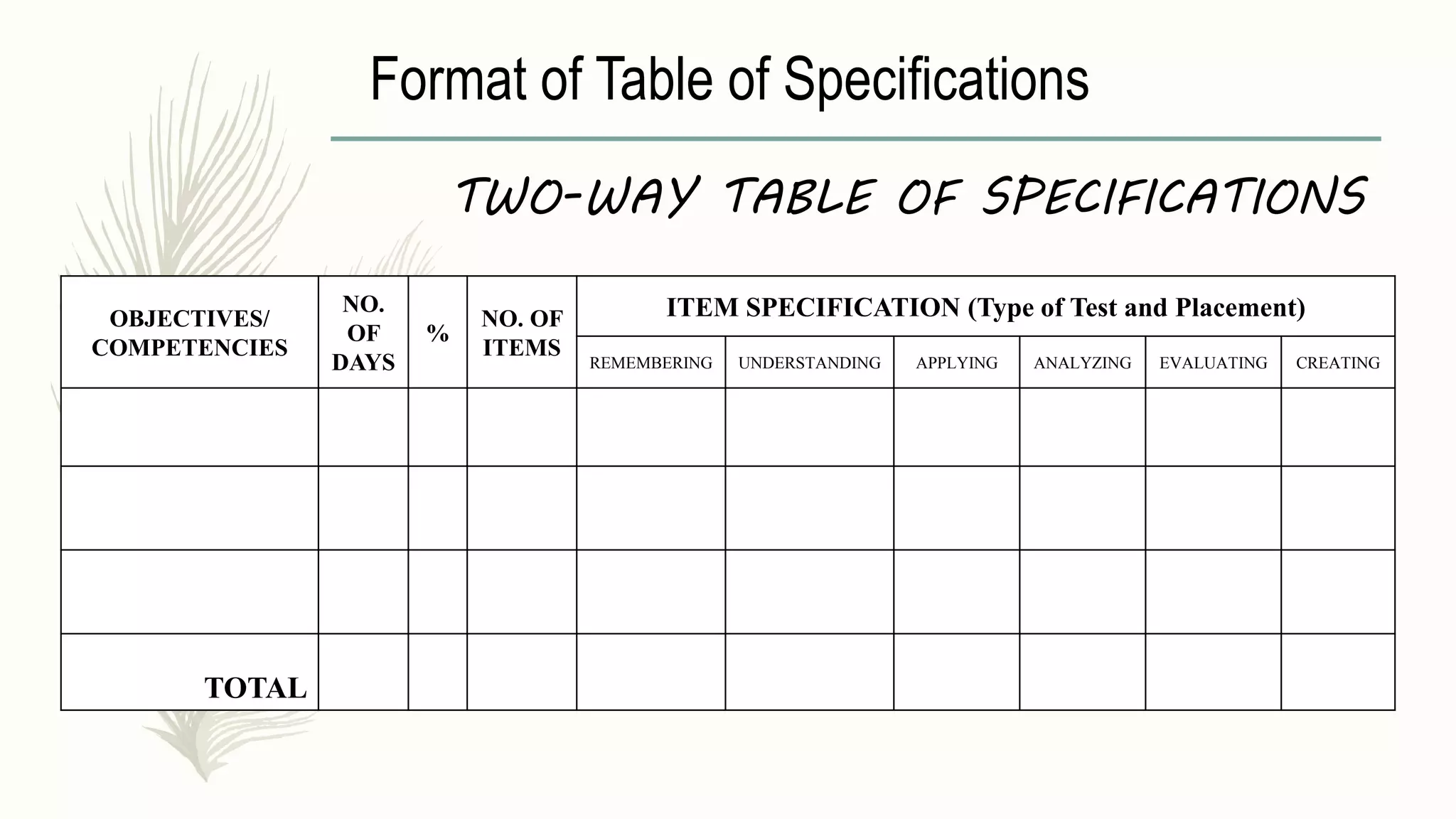
FORMAT OF TABLE
OF SPECIFICATION
Format of Table of Specifications
TWO-WAY TABLE OF SPECIFICATIONS
OBJECTIVES/
COMPETENCIES
NO.
OF
DAYS
%
NO. OF
ITEMS
ITEM SPECIFICATION (Type of Test and Placement)
REMEMBERING UNDERSTANDING APPLYING ANALYZING EVALUATING CREATING
TOTAL
Two-way Table of Specifications
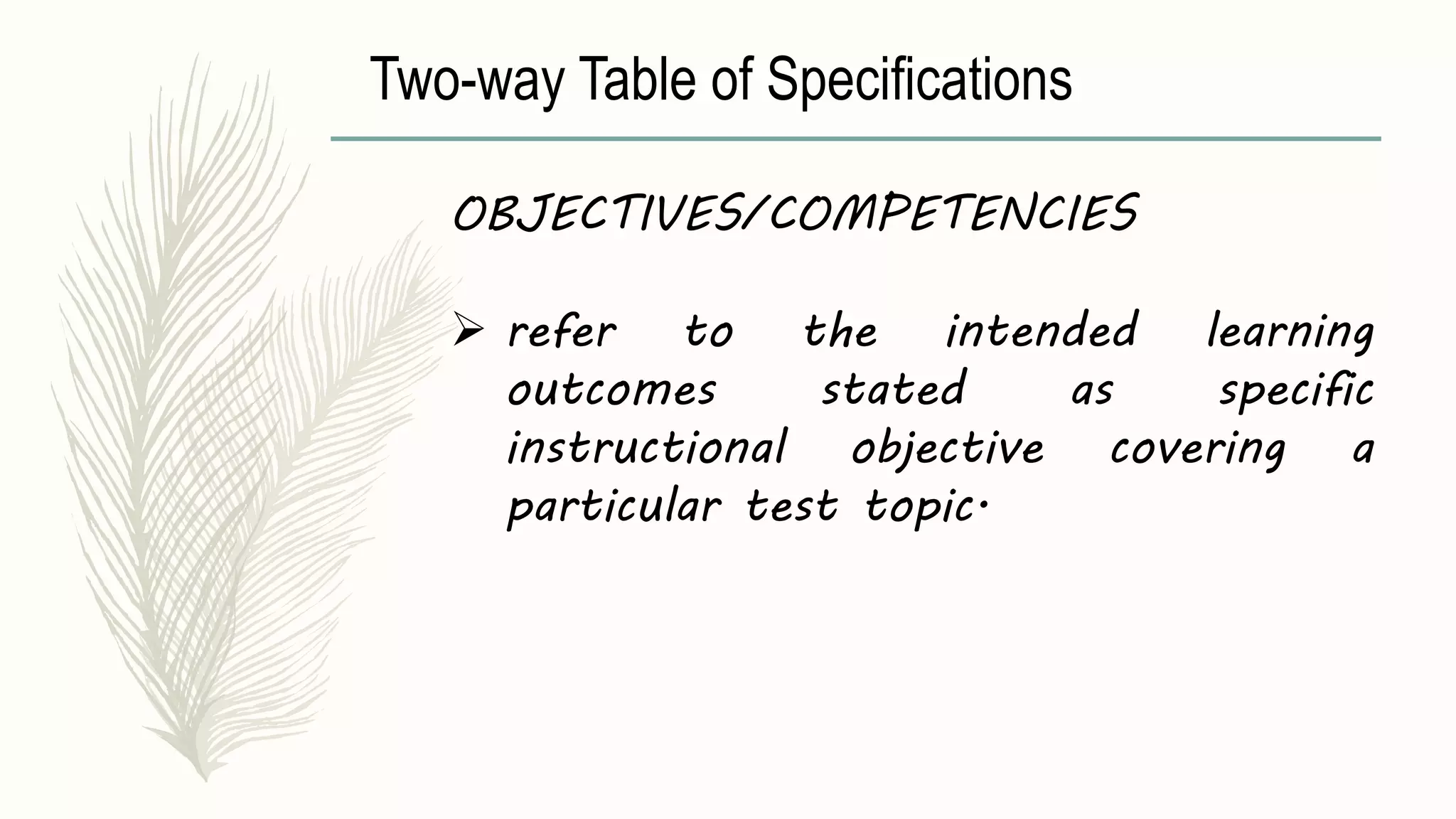
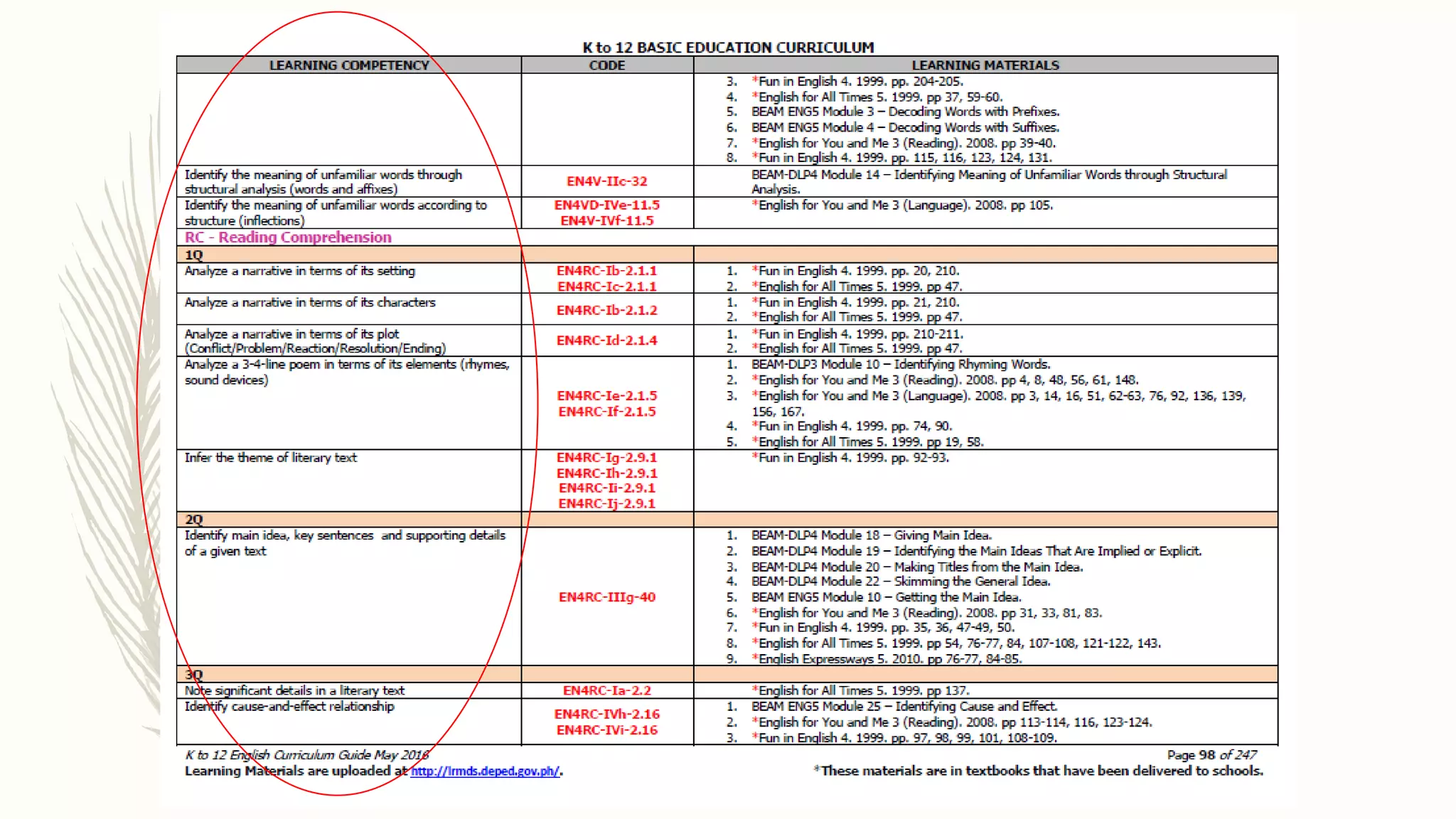
OBJECTIVES/COMPETENCIES
 refer to the intended learning
outcomes stated as specific
instructional objective covering a
particular test topic.
Two-way Table of Specifications
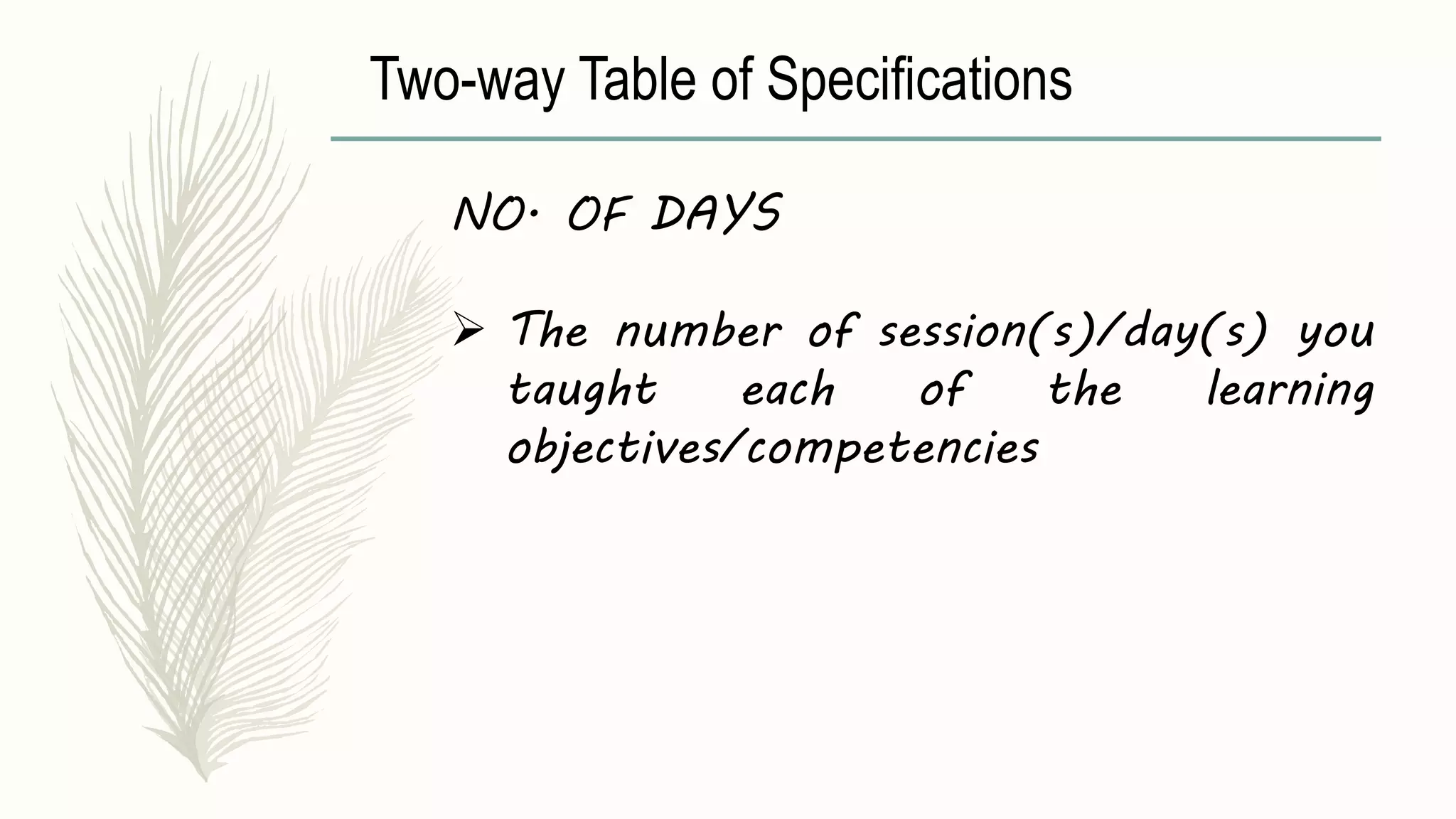
NO. OF DAYS
 The number of session(s)/day(s) you
taught each of the learning
objectives/competencies
Two-way Table of Specifications
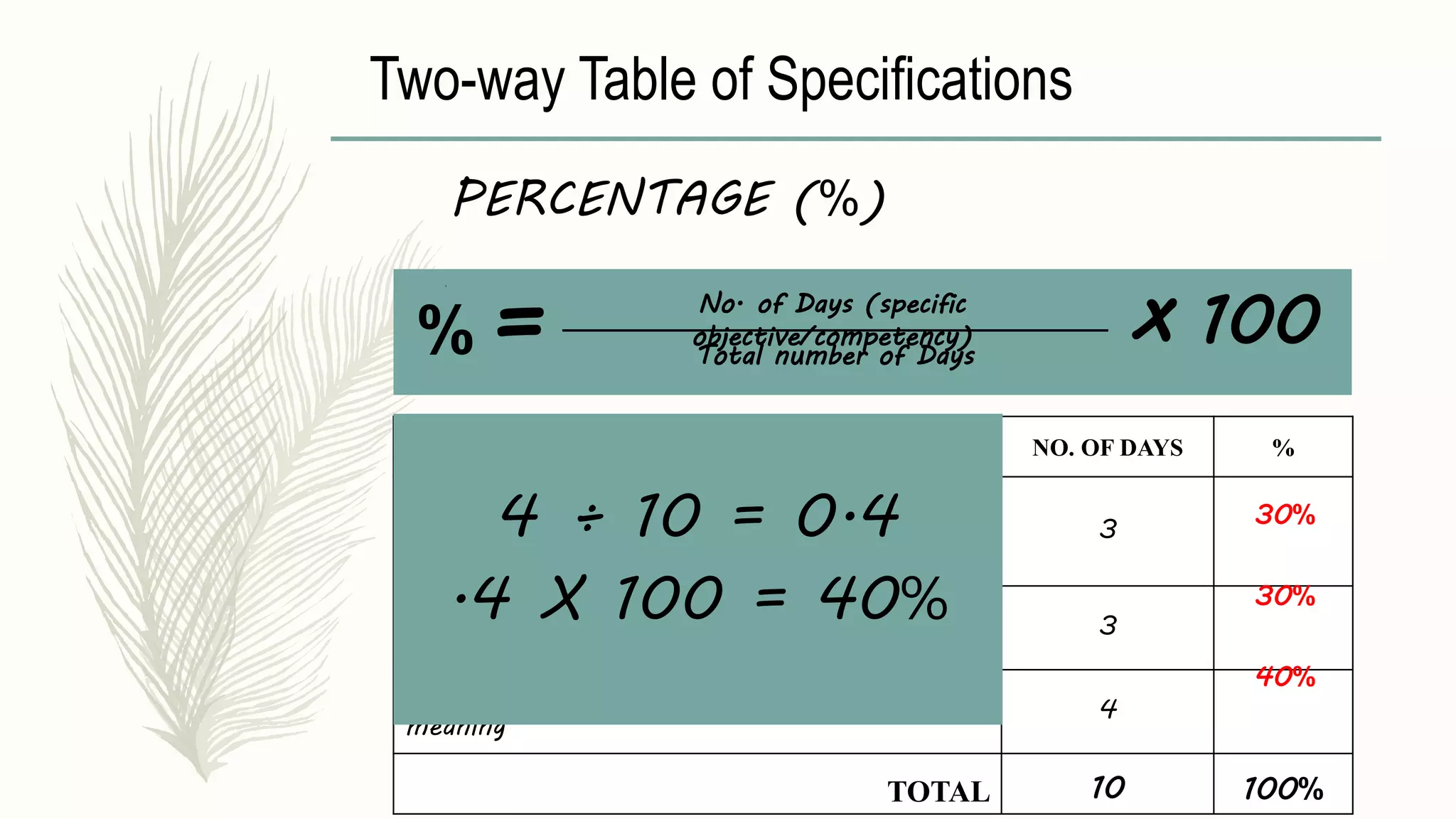
PERCENTAGE (%)

% = No. of Days (specific
objective/competency)
Total number of Days
x 100
OBJECTIVES/ COMPETENCIES NO. OF DAYS %
Identify the meaning of unfamiliar words
through structural analysis (words and
affixes)
3
Identify the meaning of unfamiliar words
according to structure (inflections)
3
Identify the meaning of words with multiple
meaning
4
TOTAL 10 100%
30%
30%
40%
3 ÷ 10 = 0.3
.3 X 100 = 30%
4 ÷ 10 = 0.4
.4 X 100 = 40%
Two-way Table of Specifications
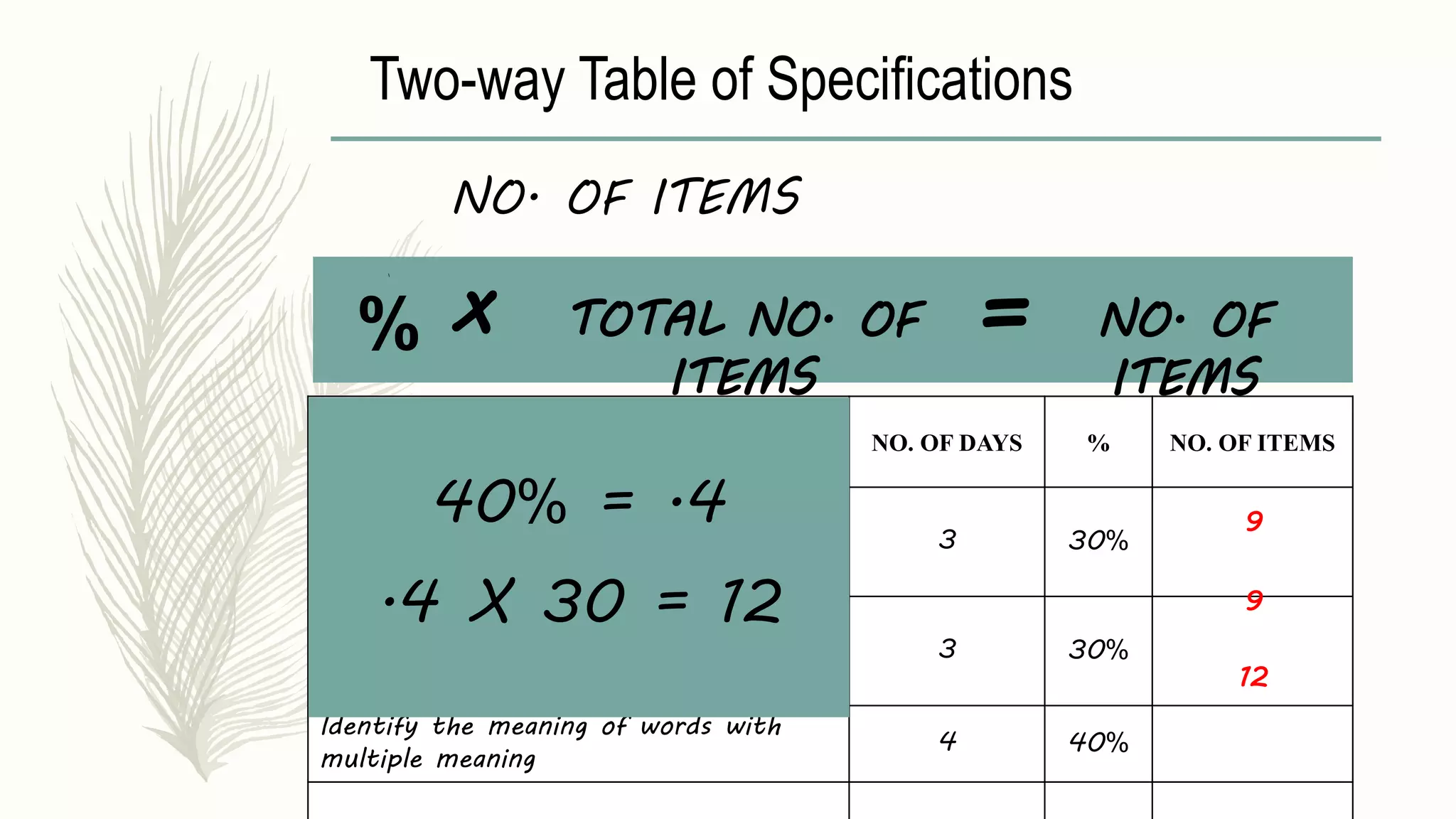
NO. OF ITEMS
OBJECTIVES/ COMPETENCIES NO. OF DAYS % NO. OF ITEMS
Identify the meaning of unfamiliar
words through structural analysis
(words and affixes)
3 30%
Identify the meaning of unfamiliar
words according to structure
(inflections)
3 30%
Identify the meaning of words with
multiple meaning
4 40%

% x TOTAL NO. OF
ITEMS
= NO. OF
ITEMS
30% = .3
.3 X 30 = 9
9
9
12
40% = .4
.4 X 30 = 12
Two-way Table of Specifications
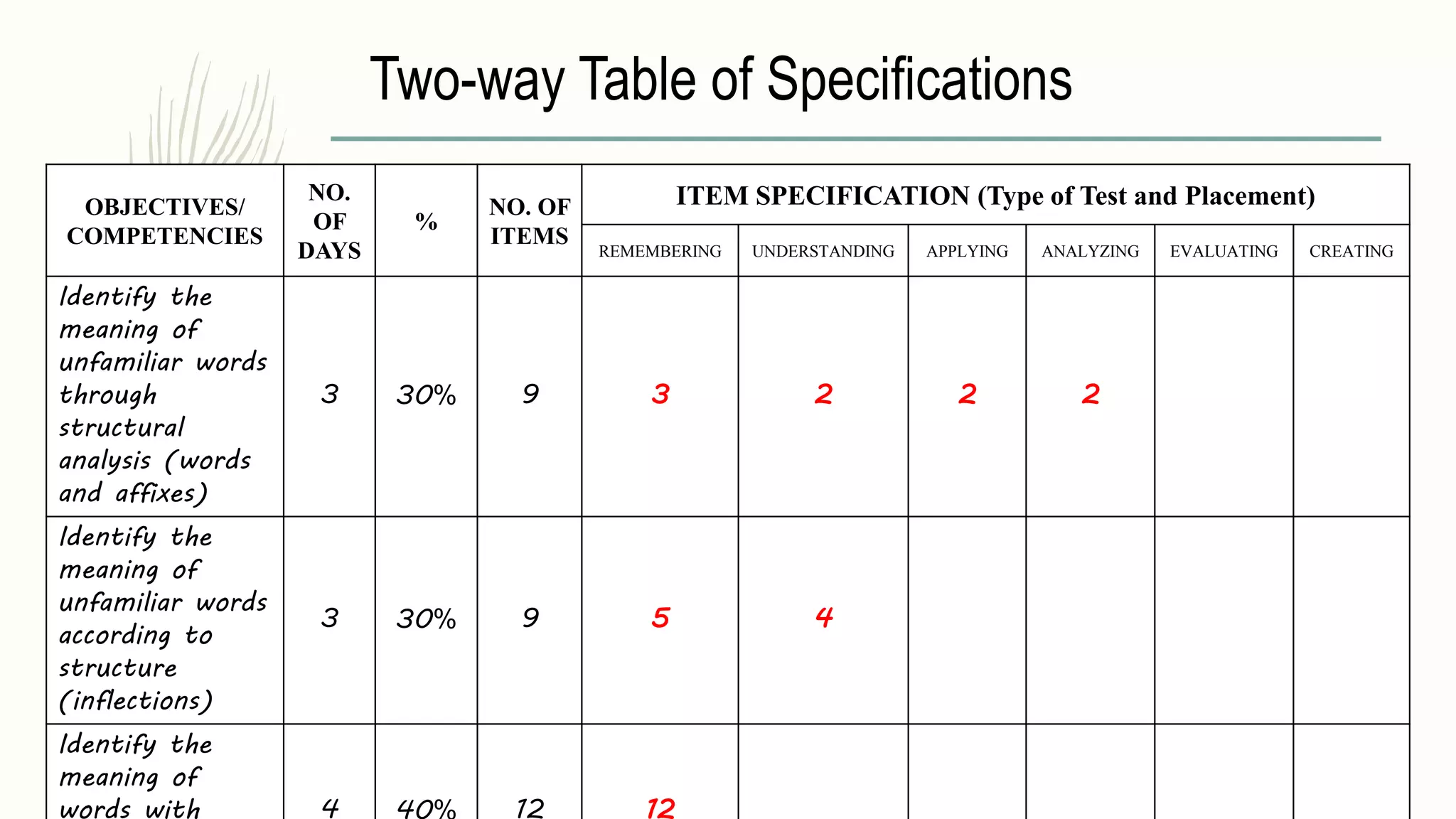
ITEM SPECIFICATION
 Pertains to the intellectual skill or
ability to correctly answer a test
item using Bloom’s Taxonomy of
educational objectives.
OBJECTIVES/
COMPETENCIES
NO.
OF
DAYS
%
NO. OF
ITEMS
ITEM SPECIFICATION (Type of Test and Placement)
REMEMBERING UNDERSTANDING APPLYING ANALYZING EVALUATING CREATING
Identify the
meaning of
unfamiliar words
through
structural
analysis (words
and affixes)
3 30% 9 3 2 2 2
Identify the
meaning of
unfamiliar words
according to
structure
(inflections)
3 30% 9 5 4
Identify the
meaning of
words with 4 12 12
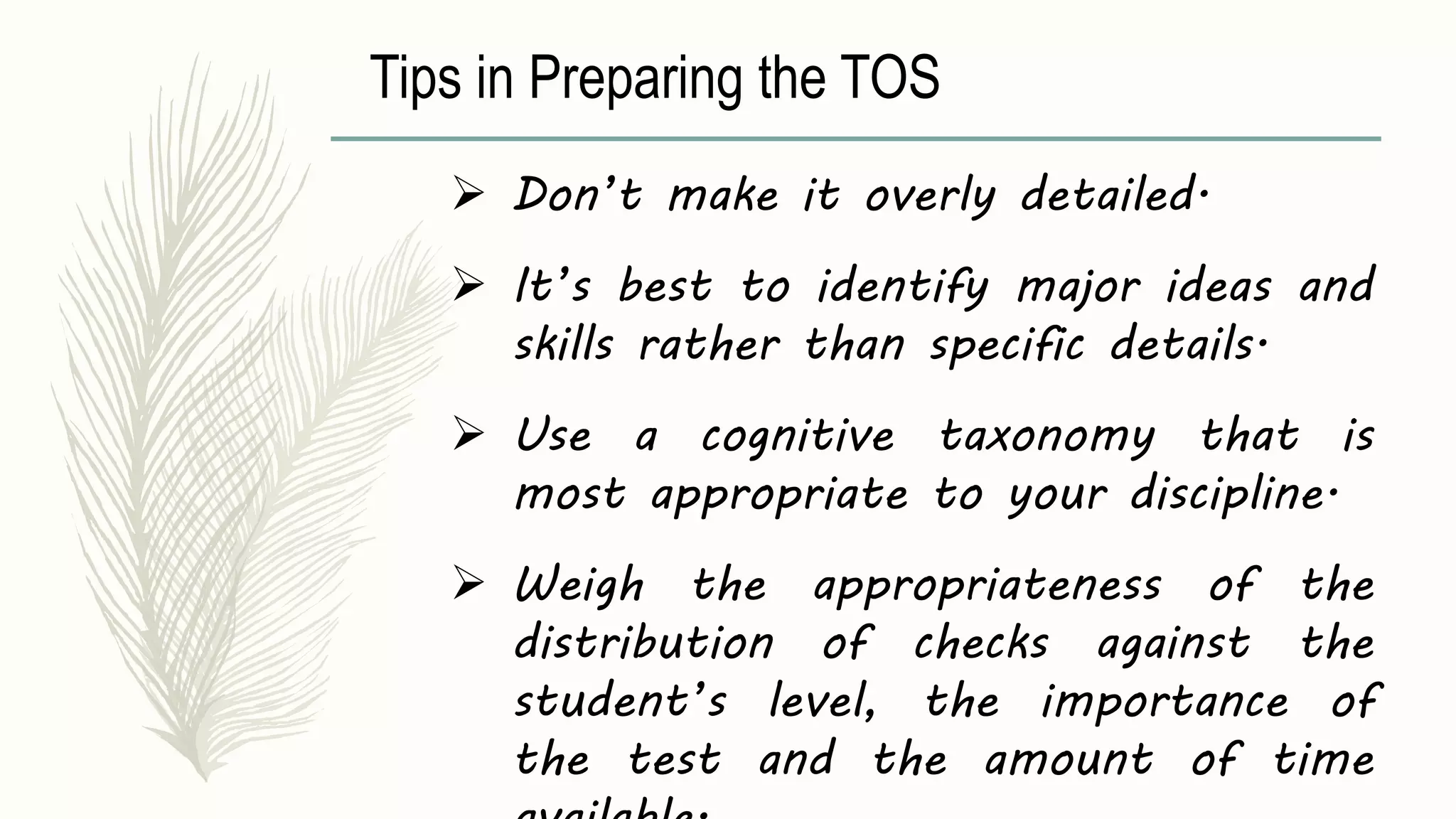
Tips in Preparing the TOS
 Don’t make it overly detailed.
 It’s best to identify major ideas and
skills rather than specific details.
 Use a cognitive taxonomy that is
most appropriate to your discipline.
 Weigh the appropriateness of the
distribution of checks against the
student’s level, the importance of
the test and the amount of time
- END -

Table of specifications

  • 1.
  • 2.
  • 3.
    Table of Specifications(TOS) sometimes called a test blueprint, is a table that helps teachers align objectives, instruction, and assessment (e.g., Notar, Zuelke, Wilson, & Yunker, 2004). is a chart or table that details the content and level of cognitive assessed on a test as well as the types and emphases of test items (Gareis & Grant, 2008).
  • 4.
  • 5.
    Purpose of Tableof Specifications 1. It serves as the guide as to WHAT TOPIC should be included 2. It indicates HOW many ITEMS should be asked in each particular level.
  • 6.
  • 7.
    Preparing a Tableof Specifications 1. Selecting the learning outcomes to be measured. 2. Make an outline of the subject matter to be covered in test. 3. Decide on the number of items per subtopic. 4. Make the two-way chart. Number of Items = Number of class sessions X Desired total numbers of items Total number of class session
  • 8.
    FORMAT OF TABLE OFSPECIFICATION
  • 9.
    Format of Tableof Specifications TWO-WAY TABLE OF SPECIFICATIONS OBJECTIVES/ COMPETENCIES NO. OF DAYS % NO. OF ITEMS ITEM SPECIFICATION (Type of Test and Placement) REMEMBERING UNDERSTANDING APPLYING ANALYZING EVALUATING CREATING TOTAL
  • 10.
    Two-way Table ofSpecifications OBJECTIVES/COMPETENCIES  refer to the intended learning outcomes stated as specific instructional objective covering a particular test topic.
  • 12.
    Two-way Table ofSpecifications NO. OF DAYS  The number of session(s)/day(s) you taught each of the learning objectives/competencies
  • 13.
    Two-way Table ofSpecifications PERCENTAGE (%) % = No. of Days (specific objective/competency) Total number of Days x 100 OBJECTIVES/ COMPETENCIES NO. OF DAYS % Identify the meaning of unfamiliar words through structural analysis (words and affixes) 3 Identify the meaning of unfamiliar words according to structure (inflections) 3 Identify the meaning of words with multiple meaning 4 TOTAL 10 100% 30% 30% 40% 3 ÷ 10 = 0.3 .3 X 100 = 30% 4 ÷ 10 = 0.4 .4 X 100 = 40%
  • 14.
    Two-way Table ofSpecifications NO. OF ITEMS OBJECTIVES/ COMPETENCIES NO. OF DAYS % NO. OF ITEMS Identify the meaning of unfamiliar words through structural analysis (words and affixes) 3 30% Identify the meaning of unfamiliar words according to structure (inflections) 3 30% Identify the meaning of words with multiple meaning 4 40% % x TOTAL NO. OF ITEMS = NO. OF ITEMS 30% = .3 .3 X 30 = 9 9 9 12 40% = .4 .4 X 30 = 12
  • 15.
    Two-way Table ofSpecifications ITEM SPECIFICATION  Pertains to the intellectual skill or ability to correctly answer a test item using Bloom’s Taxonomy of educational objectives. OBJECTIVES/ COMPETENCIES NO. OF DAYS % NO. OF ITEMS ITEM SPECIFICATION (Type of Test and Placement) REMEMBERING UNDERSTANDING APPLYING ANALYZING EVALUATING CREATING Identify the meaning of unfamiliar words through structural analysis (words and affixes) 3 30% 9 3 2 2 2 Identify the meaning of unfamiliar words according to structure (inflections) 3 30% 9 5 4 Identify the meaning of words with 4 12 12
  • 16.
    Tips in Preparingthe TOS  Don’t make it overly detailed.  It’s best to identify major ideas and skills rather than specific details.  Use a cognitive taxonomy that is most appropriate to your discipline.  Weigh the appropriateness of the distribution of checks against the student’s level, the importance of the test and the amount of time
  • 17.