ABCD METHOD OF WRITING INSTRUCTIONAL
OBJECTIVES
Dr. M. Balasubramaniam
INTRODUCTION
Some educators consider interest in
objectives to be only a recent phenomenon.
Objectives were used in the eight- year study
conducted in the 1930s.The objectives for
the instructional programs were written in
behavioral terms so that modification of the
student behaviors could be measured and
used in programs evaluation.
OBJECTIVES
What is an objective?
An objective answers the question what should the participant
be able to do.
Who needs Objectives?
An objective is for instructors and students; the former to
focus instruction and guide selection of methodologies and the
latter to know the end purpose of any learning activity.
Why do we want to write clear objectives?
An objective brings the content and participant together and
creates a road map for learning.
How do Objectives function?
An objective guides the evaluation tool that will measure the
successful completion of an educational activity
OBJECTIVE CATEGORIES
COGNITIVE DOMAIN
AFFECTIVE DOMAIN
PSYCHOMOTOR DOMAIN
COGNITIVE DOMAIN
A cognitive objective addresses
comprehension, application, or problem-
solving; thinking and expressing one's
thoughts.
AFFECTIVE DOMAIN
An affective objective addresses internal
feelings, attitudes, and values.
PSYCHOMOTOR DOMAIN
A psychomotor objective addresses the
performance of a physical skill like learning
to swim the back stroke or learning how to
balance a bicycle.
INSTRUCTIONAL OBJECTIVES
Instructional objectives may also be called
performance objectives, behavioral
objectives, or simply objectives. All of these
terms are used interchangeably. Objectives
are specific, outcome based, measurable,
and describe the learner's behavior after
instruction. So what does that mean? Let's
take a closer look.
SPECIFIC
. . . specific
Objectives are very specific. This
means that they should describe precisely
what the learner is expected to do.
OUTCOME BASED
. . .outcome based
Objectives are outcome based.
This means that the objective is going to
state what the learner should be able to do
after the instruction is complete. The process
of how the instruction happens is not
considered in an objective.
MEASURABLE
. . .measurable
Objectives are measurable. This
means that objectives should describe
learning outcomes that can be measured;
objectives should be seen or heard.
THE ABCD METHOD
In the early 1970s the United states office of
education supported the instructional
development Institute
Which promoted the ABCD approach to
writing behavioural objectives.
ABCD METHOD
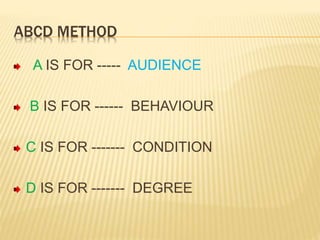
A IS FOR ----- AUDIENCE
B IS FOR ------ BEHAVIOUR
C IS FOR ------- CONDITION
D IS FOR ------- DEGREE
ABCD METHOD
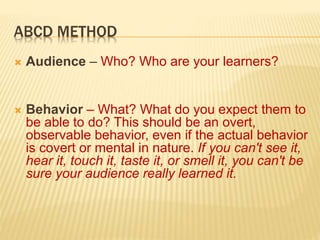
 Audience – Who? Who are your learners?
 Behavior – What? What do you expect them to
be able to do? This should be an overt,
observable behavior, even if the actual behavior
is covert or mental in nature. If you can't see it,
hear it, touch it, taste it, or smell it, you can't be
sure your audience really learned it.
ABCD METHOD
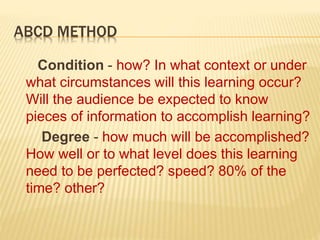
Condition - how? In what context or under
what circumstances will this learning occur?
Will the audience be expected to know
pieces of information to accomplish learning?
Degree - how much will be accomplished?
How well or to what level does this learning
need to be perfected? speed? 80% of the
time? other?
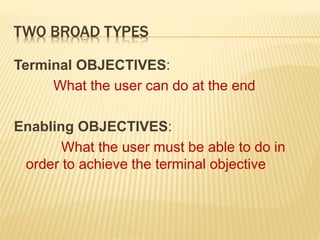
TWO BROAD TYPES
Terminal OBJECTIVES:
What the user can do at the end
Enabling OBJECTIVES:
What the user must be able to do in
order to achieve the terminal objective
TERMINAL OBJECTIVE BAESD ON ABCD METHOD
“The student in Art 103 will be able to form,
without assistance, a pot six inches high by
the tenth week of class. The pot will hold
water and its attractiveness will be judged by
the teacher”.
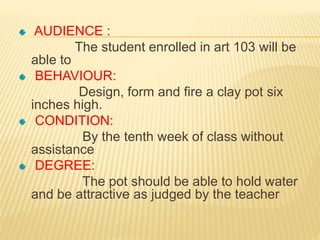
AUDIENCE :
The student enrolled in art 103 will be
able to
BEHAVIOUR:
Design, form and fire a clay pot six
inches high.
CONDITION:
By the tenth week of class without
assistance
DEGREE:
The pot should be able to hold water
and be attractive as judged by the teacher
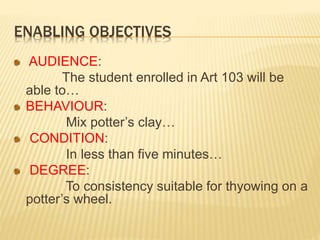
ENABLING OBJECTIVES
AUDIENCE:
The student enrolled in Art 103 will be
able to…
BEHAVIOUR:
Mix potter’s clay…
CONDITION:
In less than five minutes…
DEGREE:
To consistency suitable for thyowing on a
potter’s wheel.
AFTER TERMINAL OBJECTIVE-ABCD
After the terminal objective is written, it is
unnecessary to continually state the
audience statement.
The audience of the statement, may be
written as a part of the heading and the rest
of the objectives follows.
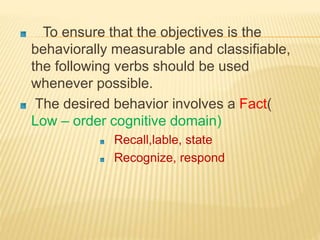
To ensure that the objectives is the
behaviorally measurable and classifiable,
the following verbs should be used
whenever possible.
The desired behavior involves a Fact(
Low – order cognitive domain)
Recall,lable, state
Recognize, respond
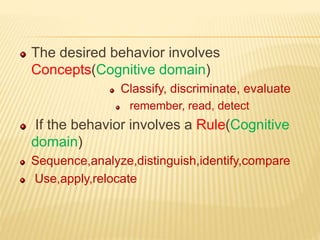
The desired behavior involves
Concepts(Cognitive domain)
Classify, discriminate, evaluate
remember, read, detect
If the behavior involves a Rule(Cognitive
domain)
Sequence,analyze,distinguish,identify,compare
Use,apply,relocate
If the behavior involves a Principle(High-
order cognitive domain)
Explain,interpret,predict
if the behavior involves an
Attitude(Affective domain)
Choose,offer,select
Acceptable
CONDITIONS
After the behaviors have been identified, it is
necessary to specify the Conditions and
Degree for each objectives.
Conditions are the “Givens”.
They describe the circumstances under
which the task is performed conditions, but
are not limited.
Environmental factors( sensory
conditions)
People factors( Alone, part of a team)
Equipment factors( Aids, tools)
Information factors
(Textbooks,notes,formulas)
Time ( Task duration, pacing)
DEGREE:
The degree statement should be able to what
standards the student should be able to
perform.
How completely, how accurate, the rate, the
time limit, to what degree of quality and with in
what safety consideration.
REMEMBER’S
A behavioral statement should can seen and
measured.
Non behavioral objectives don’t provide the
communication necessary to effectively
design, develop or evaluate instruction.
More behavioral objectives easier it is to
communicate its meaning to students,
teacher, parents and another ins.designer.
COMPLETE INSTRUCTIONAL OBJECTIVES
 SHOULD BE
observable
Clear
Unambiguous
Description of a learning outcome
CONCLUSION
The objectives of education is to prepare the
young to educate themselves throughout
their lives.
Today we continue to see interest in
objectives at all levels of education.
The ABCD is not only an alphabetic letter
but always better for writing instructional
objectives.

ABCD Method of writing Instructional Objectives

  • 1.
    ABCD METHOD OFWRITING INSTRUCTIONAL OBJECTIVES Dr. M. Balasubramaniam
  • 2.
    INTRODUCTION Some educators considerinterest in objectives to be only a recent phenomenon. Objectives were used in the eight- year study conducted in the 1930s.The objectives for the instructional programs were written in behavioral terms so that modification of the student behaviors could be measured and used in programs evaluation.
  • 3.
    OBJECTIVES What is anobjective? An objective answers the question what should the participant be able to do. Who needs Objectives? An objective is for instructors and students; the former to focus instruction and guide selection of methodologies and the latter to know the end purpose of any learning activity. Why do we want to write clear objectives? An objective brings the content and participant together and creates a road map for learning. How do Objectives function? An objective guides the evaluation tool that will measure the successful completion of an educational activity
  • 4.
  • 5.
    COGNITIVE DOMAIN A cognitiveobjective addresses comprehension, application, or problem- solving; thinking and expressing one's thoughts.
  • 6.
    AFFECTIVE DOMAIN An affectiveobjective addresses internal feelings, attitudes, and values.
  • 7.
    PSYCHOMOTOR DOMAIN A psychomotorobjective addresses the performance of a physical skill like learning to swim the back stroke or learning how to balance a bicycle.
  • 8.
    INSTRUCTIONAL OBJECTIVES Instructional objectivesmay also be called performance objectives, behavioral objectives, or simply objectives. All of these terms are used interchangeably. Objectives are specific, outcome based, measurable, and describe the learner's behavior after instruction. So what does that mean? Let's take a closer look.
  • 9.
    SPECIFIC . . .specific Objectives are very specific. This means that they should describe precisely what the learner is expected to do.
  • 10.
    OUTCOME BASED . ..outcome based Objectives are outcome based. This means that the objective is going to state what the learner should be able to do after the instruction is complete. The process of how the instruction happens is not considered in an objective.
  • 11.
    MEASURABLE . . .measurable Objectivesare measurable. This means that objectives should describe learning outcomes that can be measured; objectives should be seen or heard.
  • 12.
    THE ABCD METHOD Inthe early 1970s the United states office of education supported the instructional development Institute Which promoted the ABCD approach to writing behavioural objectives.
  • 13.
    ABCD METHOD A ISFOR ----- AUDIENCE B IS FOR ------ BEHAVIOUR C IS FOR ------- CONDITION D IS FOR ------- DEGREE
  • 14.
    ABCD METHOD  Audience– Who? Who are your learners?  Behavior – What? What do you expect them to be able to do? This should be an overt, observable behavior, even if the actual behavior is covert or mental in nature. If you can't see it, hear it, touch it, taste it, or smell it, you can't be sure your audience really learned it.
  • 15.
    ABCD METHOD Condition -how? In what context or under what circumstances will this learning occur? Will the audience be expected to know pieces of information to accomplish learning? Degree - how much will be accomplished? How well or to what level does this learning need to be perfected? speed? 80% of the time? other?
  • 16.
    TWO BROAD TYPES TerminalOBJECTIVES: What the user can do at the end Enabling OBJECTIVES: What the user must be able to do in order to achieve the terminal objective
  • 17.
    TERMINAL OBJECTIVE BAESDON ABCD METHOD “The student in Art 103 will be able to form, without assistance, a pot six inches high by the tenth week of class. The pot will hold water and its attractiveness will be judged by the teacher”.
  • 18.
    AUDIENCE : The studentenrolled in art 103 will be able to BEHAVIOUR: Design, form and fire a clay pot six inches high. CONDITION: By the tenth week of class without assistance DEGREE: The pot should be able to hold water and be attractive as judged by the teacher
  • 19.
    ENABLING OBJECTIVES AUDIENCE: The studentenrolled in Art 103 will be able to… BEHAVIOUR: Mix potter’s clay… CONDITION: In less than five minutes… DEGREE: To consistency suitable for thyowing on a potter’s wheel.
  • 20.
    AFTER TERMINAL OBJECTIVE-ABCD Afterthe terminal objective is written, it is unnecessary to continually state the audience statement. The audience of the statement, may be written as a part of the heading and the rest of the objectives follows.
  • 21.
    To ensure thatthe objectives is the behaviorally measurable and classifiable, the following verbs should be used whenever possible. The desired behavior involves a Fact( Low – order cognitive domain) Recall,lable, state Recognize, respond
  • 22.
    The desired behaviorinvolves Concepts(Cognitive domain) Classify, discriminate, evaluate remember, read, detect If the behavior involves a Rule(Cognitive domain) Sequence,analyze,distinguish,identify,compare Use,apply,relocate
  • 23.
    If the behaviorinvolves a Principle(High- order cognitive domain) Explain,interpret,predict if the behavior involves an Attitude(Affective domain) Choose,offer,select Acceptable
  • 24.
    CONDITIONS After the behaviorshave been identified, it is necessary to specify the Conditions and Degree for each objectives. Conditions are the “Givens”. They describe the circumstances under which the task is performed conditions, but are not limited.
  • 25.
    Environmental factors( sensory conditions) Peoplefactors( Alone, part of a team) Equipment factors( Aids, tools) Information factors (Textbooks,notes,formulas) Time ( Task duration, pacing)
  • 26.
    DEGREE: The degree statementshould be able to what standards the student should be able to perform. How completely, how accurate, the rate, the time limit, to what degree of quality and with in what safety consideration.
  • 27.
    REMEMBER’S A behavioral statementshould can seen and measured. Non behavioral objectives don’t provide the communication necessary to effectively design, develop or evaluate instruction. More behavioral objectives easier it is to communicate its meaning to students, teacher, parents and another ins.designer.
  • 28.
    COMPLETE INSTRUCTIONAL OBJECTIVES SHOULD BE observable Clear Unambiguous Description of a learning outcome
  • 29.
    CONCLUSION The objectives ofeducation is to prepare the young to educate themselves throughout their lives. Today we continue to see interest in objectives at all levels of education. The ABCD is not only an alphabetic letter but always better for writing instructional objectives.