Introduction to
RFID Technology
RFID (Radio Frequency Identification) is a
revolutionary wireless technology that enables the
contactless identification and tracking of objects. It
uses radio waves to read and write data to small,
embedded tags, revolutionizing supply chain
management, access control, and more.
Topic to Cover
What is RFID
Application of RFID
What is inside in RFID
How RFID Works ( Operating Principle
What is RFID? How RFID works? RFID Explained in Detail
WHAT IS RFID
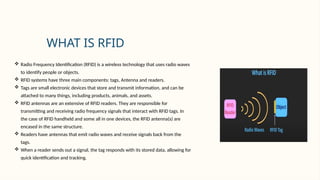
 Radio Frequency Identification (RFID) is a wireless technology that uses radio waves
to identify people or objects.
 RFID systems have three main components: tags, Antenna and readers.
 Tags are small electronic devices that store and transmit information, and can be
attached to many things, including products, animals, and assets.
 RFID antennas are an extensive of RFID readers. They are responsible for
transmitting and receiving radio frequency signals that interact with RFID tags. In
the case of RFID handheld and some all in one devices, the RFID antenna(s) are
encased in the same structure.
 Readers have antennas that emit radio waves and receive signals back from the
tags.
 When a reader sends out a signal, the tag responds with its stored data, allowing for
quick identification and tracking.
How RFID Works
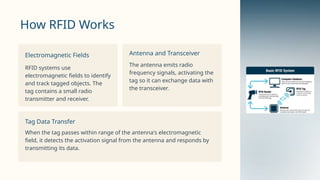
Electromagnetic Fields
RFID systems use
electromagnetic fields to identify
and track tagged objects. The
tag contains a small radio
transmitter and receiver.
Antenna and Transceiver
The antenna emits radio
frequency signals, activating the
tag so it can exchange data with
the transceiver.
Tag Data Transfer
When the tag passes within range of the antenna's electromagnetic
field, it detects the activation signal from the antenna and responds by
transmitting its data.
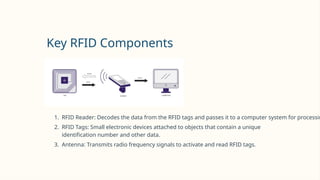
Key RFID Components
1. RFID Reader: Decodes the data from the RFID tags and passes it to a computer system for processin
2. RFID Tags: Small electronic devices attached to objects that contain a unique
identification number and other data.
3. Antenna: Transmits radio frequency signals to activate and read RFID tags.
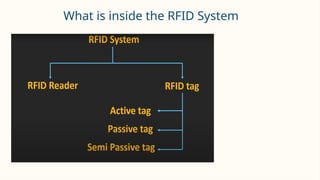
What is inside the RFID System
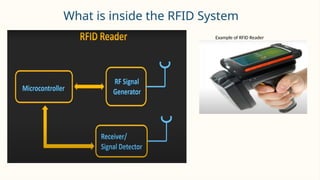
Example of RFID Reader
RFID Reader Components
It has three components (RF Signal Generator, Receiver/Signal
Detector and Microcontroller
RF Signal Generator: it uses by transmitting signal via antenna
Receiver Signal detector: it uses for receiving feedback from RFID tag
via receiver antenna
Microcontroller which is responsible to process, analysis received data
What is RFID? How RFID works? RFID Explained in Detail
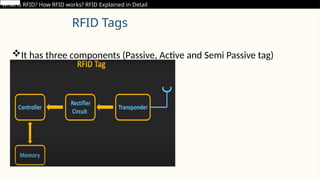
RFID Tags
It has three components (Passive, Active and Semi Passive tag)
What is RFID? How RFID works? RFID Explained in Detail
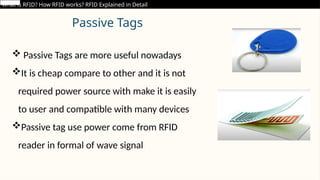
Passive Tags
 Passive Tags are more useful nowadays
It is cheap compare to other and it is not
required power source with make it is easily
to user and compatible with many devices
Passive tag use power come from RFID
reader in formal of wave signal
What is RFID? How RFID works? RFID Explained in Detail
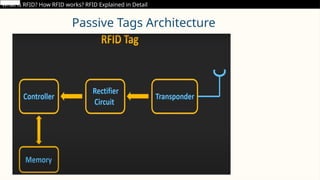
Passive Tags Architecture
What is RFID? How RFID works? RFID Explained in Detail
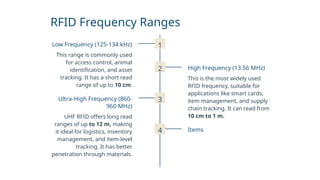
RFID Frequency Ranges
1
Low Frequency (125-134 kHz)
This range is commonly used
for access control, animal
identification, and asset
tracking. It has a short read
range of up to 10 cm.
2 High Frequency (13.56 MHz)
This is the most widely used
RFID frequency, suitable for
applications like smart cards,
item management, and supply
chain tracking. It can read from
10 cm to 1 m.
3
Ultra-High Frequency (860-
960 MHz)
UHF RFID offers long read
ranges of up to 12 m, making
it ideal for logistics, inventory
management, and item-level
tracking. It has better
penetration through materials.
4 Items
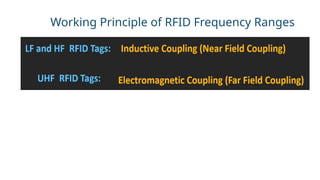
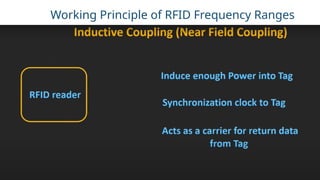
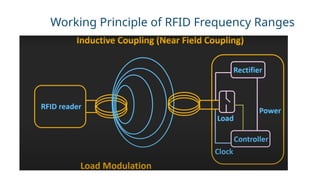
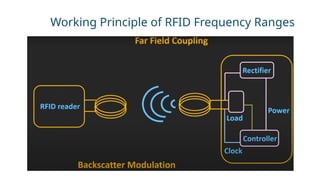
Working Principle of RFID Frequency Ranges
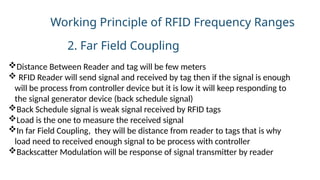
Distance Between Reader and tag will be few meters
 RFID Reader will send signal and received by tag then if the signal is enough
will be process from controller device but it is low it will keep responding to
the signal generator device (back schedule signal)
Back Schedule signal is weak signal received by RFID tags
Load is the one to measure the received signal
In far Field Coupling, they will be distance from reader to tags that is why
load need to received enough signal to be process with controller
Backscatter Modulation will be response of signal transmitter by reader
2. Far Field Coupling
Working Principle of RFID Frequency Ranges
Benefits of RFID
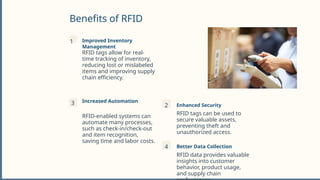
1 Improved Inventory
Management
RFID tags allow for real-
time tracking of inventory,
reducing lost or mislabeled
items and improving supply
chain efficiency.
2 Enhanced Security
RFID tags can be used to
secure valuable assets,
preventing theft and
unauthorized access.
3 Increased Automation
RFID-enabled systems can
automate many processes,
such as check-in/check-out
and item recognition,
saving time and labor costs.
4 Better Data Collection
RFID data provides valuable
insights into customer
behavior, product usage,
and supply chain
Disadvantages of RFID
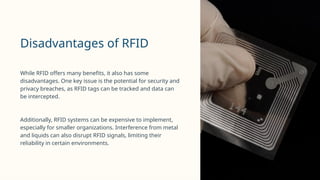
While RFID offers many benefits, it also has some
disadvantages. One key issue is the potential for security and
privacy breaches, as RFID tags can be tracked and data can
be intercepted.
Additionally, RFID systems can be expensive to implement,
especially for smaller organizations. Interference from metal
and liquids can also disrupt RFID signals, limiting their
reliability in certain environments.
RFID Applications
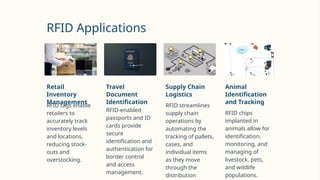
Retail
Inventory
Management
RFID tags enable
retailers to
accurately track
inventory levels
and locations,
reducing stock-
outs and
overstocking.
Travel
Document
Identification
RFID-enabled
passports and ID
cards provide
secure
identification and
authentication for
border control
and access
management.
Supply Chain
Logistics
RFID streamlines
supply chain
operations by
automating the
tracking of pallets,
cases, and
individual items
as they move
through the
distribution
Animal
Identification
and Tracking
RFID chips
implanted in
animals allow for
identification,
monitoring, and
managing of
livestock, pets,
and wildlife
populations.
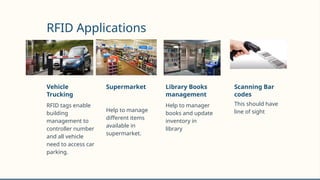
RFID Applications
Vehicle
Trucking
RFID tags enable
building
management to
controller number
and all vehicle
need to access car
parking.
Supermarket
Help to manage
different items
available in
supermarket.
Library Books
management
Help to manager
books and update
inventory in
library
Scanning Bar
codes
This should have
line of sight
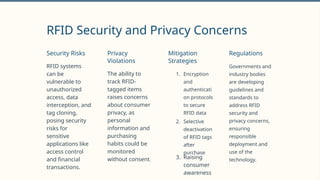
RFID Security and Privacy Concerns
Security Risks
RFID systems
can be
vulnerable to
unauthorized
access, data
interception, and
tag cloning,
posing security
risks for
sensitive
applications like
access control
and financial
transactions.
Privacy
Violations
The ability to
track RFID-
tagged items
raises concerns
about consumer
privacy, as
personal
information and
purchasing
habits could be
monitored
without consent.
Mitigation
Strategies
1. Encryption
and
authenticati
on protocols
to secure
RFID data
2. Selective
deactivation
of RFID tags
after
purchase
3. Raising
consumer
awareness
Regulations
Governments and
industry bodies
are developing
guidelines and
standards to
address RFID
security and
privacy concerns,
ensuring
responsible
deployment and
use of the
technology.
Future Trends in RFID
1
Increased Adoption
RFID will see wider adoption across industries,
from retail to healthcare.
2
Improved Performance
Advancements in chip technology and
antenna design will enhance RFID read
range and reliability.
3
Integration with IoT
RFID will become increasingly
integrated with the Internet of
Things, enabling smart supply
chains and asset tracking.
As RFID technology continues to evolve, we expect to see increased adoption,
improved performance, and deeper integration with the Internet of Things.
These advancements will drive new use cases and unlock even greater efficiency
and visibility for businesses across a wide range of industries.
Summary and Key
Takeaways
In summary, RFID technology has revolutionized the way we track,
manage, and automate various processes across industries. Its ability
to wirelessly identify, categorize, and monitor objects has unlocked
countless opportunities for improved efficiency, security, and data-
driven decision-making.
The key takeaways from this presentation are the versatility of RFID,
its growing adoption, and the need to address privacy and security
concerns. As RFID technology continues to evolve, organizations must
stay informed and adapt to harness its full potential while ensuring
responsible implementation.

RFID Technology and its operation system.pptx

  • 1.
    Introduction to RFID Technology RFID(Radio Frequency Identification) is a revolutionary wireless technology that enables the contactless identification and tracking of objects. It uses radio waves to read and write data to small, embedded tags, revolutionizing supply chain management, access control, and more.
  • 2.
    Topic to Cover Whatis RFID Application of RFID What is inside in RFID How RFID Works ( Operating Principle What is RFID? How RFID works? RFID Explained in Detail
  • 3.
    WHAT IS RFID Radio Frequency Identification (RFID) is a wireless technology that uses radio waves to identify people or objects.  RFID systems have three main components: tags, Antenna and readers.  Tags are small electronic devices that store and transmit information, and can be attached to many things, including products, animals, and assets.  RFID antennas are an extensive of RFID readers. They are responsible for transmitting and receiving radio frequency signals that interact with RFID tags. In the case of RFID handheld and some all in one devices, the RFID antenna(s) are encased in the same structure.  Readers have antennas that emit radio waves and receive signals back from the tags.  When a reader sends out a signal, the tag responds with its stored data, allowing for quick identification and tracking.
  • 4.
    How RFID Works ElectromagneticFields RFID systems use electromagnetic fields to identify and track tagged objects. The tag contains a small radio transmitter and receiver. Antenna and Transceiver The antenna emits radio frequency signals, activating the tag so it can exchange data with the transceiver. Tag Data Transfer When the tag passes within range of the antenna's electromagnetic field, it detects the activation signal from the antenna and responds by transmitting its data.
  • 5.
    Key RFID Components 1.RFID Reader: Decodes the data from the RFID tags and passes it to a computer system for processin 2. RFID Tags: Small electronic devices attached to objects that contain a unique identification number and other data. 3. Antenna: Transmits radio frequency signals to activate and read RFID tags.
  • 6.
    What is insidethe RFID System
  • 7.
    What is insidethe RFID System Example of RFID Reader
  • 8.
    RFID Reader Components Ithas three components (RF Signal Generator, Receiver/Signal Detector and Microcontroller RF Signal Generator: it uses by transmitting signal via antenna Receiver Signal detector: it uses for receiving feedback from RFID tag via receiver antenna Microcontroller which is responsible to process, analysis received data What is RFID? How RFID works? RFID Explained in Detail
  • 9.
    RFID Tags It hasthree components (Passive, Active and Semi Passive tag) What is RFID? How RFID works? RFID Explained in Detail
  • 10.
    Passive Tags  PassiveTags are more useful nowadays It is cheap compare to other and it is not required power source with make it is easily to user and compatible with many devices Passive tag use power come from RFID reader in formal of wave signal What is RFID? How RFID works? RFID Explained in Detail
  • 11.
    Passive Tags Architecture Whatis RFID? How RFID works? RFID Explained in Detail
  • 12.
    RFID Frequency Ranges 1 LowFrequency (125-134 kHz) This range is commonly used for access control, animal identification, and asset tracking. It has a short read range of up to 10 cm. 2 High Frequency (13.56 MHz) This is the most widely used RFID frequency, suitable for applications like smart cards, item management, and supply chain tracking. It can read from 10 cm to 1 m. 3 Ultra-High Frequency (860- 960 MHz) UHF RFID offers long read ranges of up to 12 m, making it ideal for logistics, inventory management, and item-level tracking. It has better penetration through materials. 4 Items
  • 13.
    Working Principle ofRFID Frequency Ranges
  • 14.
    Working Principle ofRFID Frequency Ranges
  • 15.
    Working Principle ofRFID Frequency Ranges
  • 16.
    Working Principle ofRFID Frequency Ranges Distance Between Reader and tag will be few meters  RFID Reader will send signal and received by tag then if the signal is enough will be process from controller device but it is low it will keep responding to the signal generator device (back schedule signal) Back Schedule signal is weak signal received by RFID tags Load is the one to measure the received signal In far Field Coupling, they will be distance from reader to tags that is why load need to received enough signal to be process with controller Backscatter Modulation will be response of signal transmitter by reader 2. Far Field Coupling
  • 17.
    Working Principle ofRFID Frequency Ranges
  • 18.
    Benefits of RFID 1Improved Inventory Management RFID tags allow for real- time tracking of inventory, reducing lost or mislabeled items and improving supply chain efficiency. 2 Enhanced Security RFID tags can be used to secure valuable assets, preventing theft and unauthorized access. 3 Increased Automation RFID-enabled systems can automate many processes, such as check-in/check-out and item recognition, saving time and labor costs. 4 Better Data Collection RFID data provides valuable insights into customer behavior, product usage, and supply chain
  • 19.
    Disadvantages of RFID WhileRFID offers many benefits, it also has some disadvantages. One key issue is the potential for security and privacy breaches, as RFID tags can be tracked and data can be intercepted. Additionally, RFID systems can be expensive to implement, especially for smaller organizations. Interference from metal and liquids can also disrupt RFID signals, limiting their reliability in certain environments.
  • 20.
    RFID Applications Retail Inventory Management RFID tagsenable retailers to accurately track inventory levels and locations, reducing stock- outs and overstocking. Travel Document Identification RFID-enabled passports and ID cards provide secure identification and authentication for border control and access management. Supply Chain Logistics RFID streamlines supply chain operations by automating the tracking of pallets, cases, and individual items as they move through the distribution Animal Identification and Tracking RFID chips implanted in animals allow for identification, monitoring, and managing of livestock, pets, and wildlife populations.
  • 21.
    RFID Applications Vehicle Trucking RFID tagsenable building management to controller number and all vehicle need to access car parking. Supermarket Help to manage different items available in supermarket. Library Books management Help to manager books and update inventory in library Scanning Bar codes This should have line of sight
  • 22.
    RFID Security andPrivacy Concerns Security Risks RFID systems can be vulnerable to unauthorized access, data interception, and tag cloning, posing security risks for sensitive applications like access control and financial transactions. Privacy Violations The ability to track RFID- tagged items raises concerns about consumer privacy, as personal information and purchasing habits could be monitored without consent. Mitigation Strategies 1. Encryption and authenticati on protocols to secure RFID data 2. Selective deactivation of RFID tags after purchase 3. Raising consumer awareness Regulations Governments and industry bodies are developing guidelines and standards to address RFID security and privacy concerns, ensuring responsible deployment and use of the technology.
  • 23.
    Future Trends inRFID 1 Increased Adoption RFID will see wider adoption across industries, from retail to healthcare. 2 Improved Performance Advancements in chip technology and antenna design will enhance RFID read range and reliability. 3 Integration with IoT RFID will become increasingly integrated with the Internet of Things, enabling smart supply chains and asset tracking. As RFID technology continues to evolve, we expect to see increased adoption, improved performance, and deeper integration with the Internet of Things. These advancements will drive new use cases and unlock even greater efficiency and visibility for businesses across a wide range of industries.
  • 24.
    Summary and Key Takeaways Insummary, RFID technology has revolutionized the way we track, manage, and automate various processes across industries. Its ability to wirelessly identify, categorize, and monitor objects has unlocked countless opportunities for improved efficiency, security, and data- driven decision-making. The key takeaways from this presentation are the versatility of RFID, its growing adoption, and the need to address privacy and security concerns. As RFID technology continues to evolve, organizations must stay informed and adapt to harness its full potential while ensuring responsible implementation.