FERLYN ANGELINA
32149150
AGENDA
<1> Introduction
<2> Current uses
<3> Future uses
<4> Issues
<5> Findings & conclusion
<6> Advice to firms
<7> References
Introduction
HISTORYBACKGROUND CONCEPT
How RFID was founded?
Phenomenon of
traditional activities
without RFID before
What is RFID?
What is the components
of RFID?
RFID vs Barcode
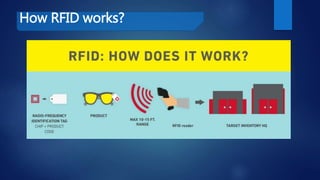
How RFID works?
What is benefits of RFID?
Benefits of RFID
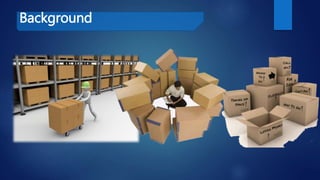
Background
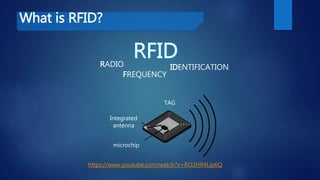
What is RFID?
RADIO
FREQUENCY
IDENTIFICATION
microchip
Integrated
antenna
TAG
https://www.youtube.com/watch?v=RO2HR4Lip6Q
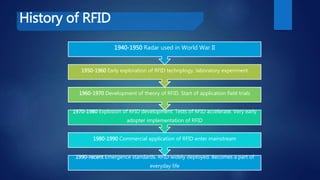
History of RFID
1990-recent Emergence standards. RFID widely deployed. Becomes a part of
everyday life
1980-1990 Commercial application of RFID enter mainstream
1970-1980 Explosion of RFID development. Tests of RFID accelerate. Very early
adopter implementation of RFID
1960-1970 Development of theory of RFID. Start of application field trials
1950-1960 Early exploration of RFID technplogy, laboratory experiment
1940-1950 Radar used in World War II
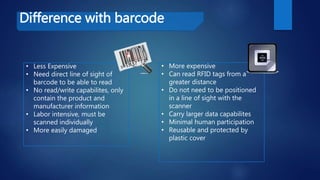
Difference with barcode
• Less Expensive
• Need direct line of sight of
barcode to be able to read
• No read/write capabilites, only
contain the product and
manufacturer information
• Labor intensive, must be
scanned individually
• More easily damaged
• More expensive
• Can read RFID tags from a
greater distance
• Do not need to be positioned
in a line of sight with the
scanner
• Carry larger data capabilites
• Minimal human participation
• Reusable and protected by
plastic cover
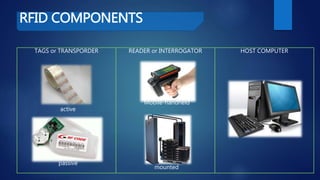
RFID COMPONENTS
TAGS or TRANSPORDER HOST COMPUTERREADER or INTERROGATOR
active
passive
Mobile-handheld
mounted
How RFID works?
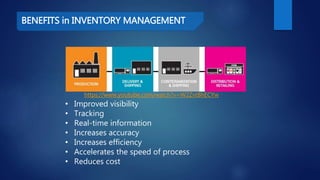
BENEFITS in INVENTORY MANAGEMENT
• Improved visibility
• Tracking
• Real-time information
• Increases accuracy
• Increases efficiency
• Accelerates the speed of process
• Reduces cost
https://www.youtube.com/watch?v=W2ZvtBhECYw
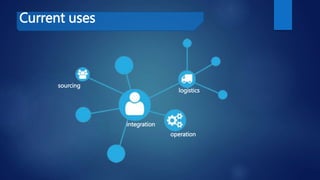
Current uses
sourcing
operation
logistics
integration
Current uses
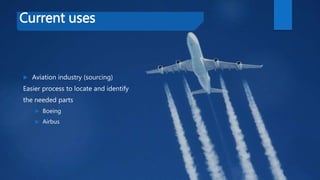
 Aviation industry (sourcing)
Easier process to locate and identify
the needed parts
 Boeing
 Airbus
Current uses
 Health care (Operation)
Taiwanese Chang-Gung Memorial Hospital
 Monitoring
 Obtaining data
 Updating or modifying data
Current uses
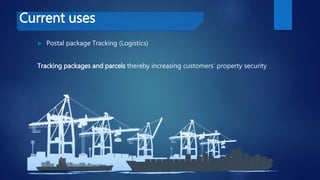
 Postal package Tracking (Logistics)
Tracking packages and parcels thereby increasing customers’ property security
Current uses
 Baggage & passenger tracing
(Integration)
Passenger & baggage
Future uses
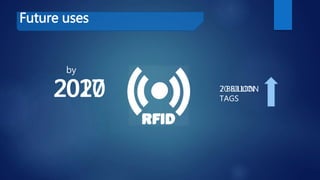
2017
by
7 BILLION
TAGS
2020 20 BILLION
TAGS
Future uses
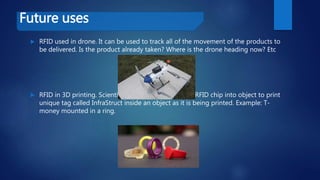
 RFID used in drone. It can be used to track all of the movement of the products to
be delivered. Is the product already taken? Where is the drone heading now? Etc
 RFID in 3D printing. Scientists are now incorporating RFID chip into object to print
unique tag called InfraStruct inside an object as it is being printed. Example: T-
money mounted in a ring.
Future uses
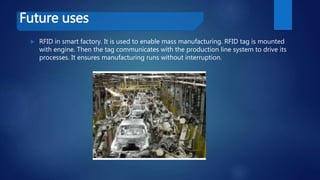
 RFID in smart factory. It is used to enable mass manufacturing. RFID tag is mounted
with engine. Then the tag communicates with the production line system to drive its
processes. It ensures manufacturing runs without interruption.
Other future uses
 Smart shelf https://www.youtube.com/watch?v=R6FfgNV2EGs
 Retail stores, meeting absence, etc
https://www.youtube.com/watch?v=OJh8X_37XP4
 Display room
 etc
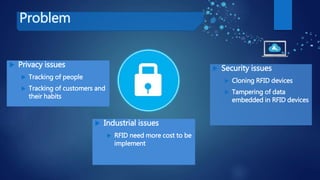
Problem
 Privacy issues
 Tracking of people
 Tracking of customers and
their habits
 Security issues
 Cloning RFID devices
 Tampering of data
embedded in RFID devices
 Industrial issues
 RFID need more cost to be
implement
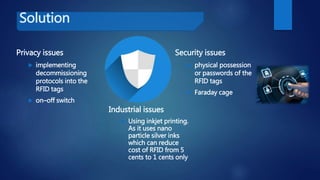
Solution
Privacy issues
 implementing
decommissioning
protocols into the
RFID tags
 on–off switch
Security issues
 physical possession
or passwords of the
RFID tags
 Faraday cage
Industrial issues
 Using inkjet printing.
As it uses nano
particle silver inks
which can reduce
cost of RFID from 5
cents to 1 cents only
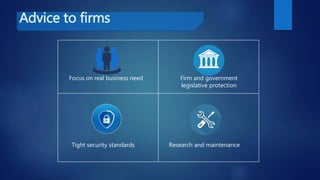
Advice to firms
Focus on real business need
Tight security standards Research and maintenance
Firm and government
legislative protection
Findings & Conclusion
 RFID has taken a huge role in our daily life activities.
 RFID has helped many businesses’ unconventional way of identifying and tracking
goods into much more efficient way of business process by providing better
visibility, faster process and accuracy.
 Although RFID has some issues regarding privacy, security and industrial, scientists
continuosly conduct research to fix issues.
 In the future, almost all technology advancement will include RFID in the activities
because it needs trigger and effect to function properly and RFID is right way.
 Firms itself has to protect their own consumers privacy and focus on their real
business needs.
 Government also take a large role to develop standards and policies regarding the
advancement of technology
References
 Darcy, P., Pupunwiwat, P., & Stantic, B. (2011). The Challenges and Issues Facing the
Deployment of RFID Technology. Deploying RFID - Challenges, Solutions, and Open
Issues, 8 - 12.
 Guest, A. (2013, November 14). RFID ARENA. Retrieved from RFID ARENA:
http://www.rfidarena.com/2013/11/14/benefits-of-implementing-rfid-in-supply-
chain-management.aspx
 Holloway, S. (2006). RFID in brief. RFID benefits and challenges, 20-25.
 Hyster, A. (2012, May 1). RFID VS BARCODES: Advantages and disadvantages
comparison. Retrieved from aalhysterforklifts:
http://www.aalhysterforklifts.com.au/index.php/about/blog-
post/rfid_vs_barcodes_advantages_and_disadvantages_comparison
 Peslak, A. (2005). An ethical exploration of privacy and radio frequency
identification. Journal of Business Ethics, 327-345.
 Solutions, L. (2015, January 26). Lowry Solutions. Retrieved from Lowry
Solutions.com: http://www.lowrysolutions.com/blogs/future-rfid-technology/
References
 Dimension, N. (2015, September 3). NANO DIMENSION. Retrieved from nano-di:
http://www.nano-di.com/blog/how-can-rfid-tags-cost-1-cent
 Li, H., & Hung, P. C. (2008). Privacy Issues of Applying RFID in Retail Industry . Issues
in RFID, 9-11.
 Choperena, M. (2015, November 26). RFID drone really mobile and completely
automated RFID readers. Retrieved from Pulse Channels:
https://www.linkedin.com/pulse/rfid-drones-really-mobile-completely-automated-
mikel-choperena
 Holloway, J. (2013, July 24). RFID be gone: Why you might soon be 3D printing the
Internet of Things. Retrieved from gizmag: http://www.gizmag.com/infrastructs-
internet-of-things/28438/
Video
https://www.youtube.com/watch?v=iEfEQsJJ07Q
Rfid in manufacturing
https://www.youtube.com/watch?v=_MGn9e6ARQQ
Rfid in logistics
https://www.youtube.com/watch?v=o2VrItVOpZU
RFID in brief, history, etc

Rfid

  • 1.
  • 2.
    AGENDA <1> Introduction <2> Currentuses <3> Future uses <4> Issues <5> Findings & conclusion <6> Advice to firms <7> References
  • 3.
    Introduction HISTORYBACKGROUND CONCEPT How RFIDwas founded? Phenomenon of traditional activities without RFID before What is RFID? What is the components of RFID? RFID vs Barcode How RFID works? What is benefits of RFID? Benefits of RFID
  • 4.
  • 5.
  • 6.
    History of RFID 1990-recentEmergence standards. RFID widely deployed. Becomes a part of everyday life 1980-1990 Commercial application of RFID enter mainstream 1970-1980 Explosion of RFID development. Tests of RFID accelerate. Very early adopter implementation of RFID 1960-1970 Development of theory of RFID. Start of application field trials 1950-1960 Early exploration of RFID technplogy, laboratory experiment 1940-1950 Radar used in World War II
  • 7.
    Difference with barcode •Less Expensive • Need direct line of sight of barcode to be able to read • No read/write capabilites, only contain the product and manufacturer information • Labor intensive, must be scanned individually • More easily damaged • More expensive • Can read RFID tags from a greater distance • Do not need to be positioned in a line of sight with the scanner • Carry larger data capabilites • Minimal human participation • Reusable and protected by plastic cover
  • 8.
    RFID COMPONENTS TAGS orTRANSPORDER HOST COMPUTERREADER or INTERROGATOR active passive Mobile-handheld mounted
  • 9.
  • 10.
    BENEFITS in INVENTORYMANAGEMENT • Improved visibility • Tracking • Real-time information • Increases accuracy • Increases efficiency • Accelerates the speed of process • Reduces cost https://www.youtube.com/watch?v=W2ZvtBhECYw
  • 11.
  • 12.
    Current uses  Aviationindustry (sourcing) Easier process to locate and identify the needed parts  Boeing  Airbus
  • 13.
    Current uses  Healthcare (Operation) Taiwanese Chang-Gung Memorial Hospital  Monitoring  Obtaining data  Updating or modifying data
  • 14.
    Current uses  Postalpackage Tracking (Logistics) Tracking packages and parcels thereby increasing customers’ property security
  • 15.
    Current uses  Baggage& passenger tracing (Integration) Passenger & baggage
  • 16.
  • 17.
    Future uses  RFIDused in drone. It can be used to track all of the movement of the products to be delivered. Is the product already taken? Where is the drone heading now? Etc  RFID in 3D printing. Scientists are now incorporating RFID chip into object to print unique tag called InfraStruct inside an object as it is being printed. Example: T- money mounted in a ring.
  • 18.
    Future uses  RFIDin smart factory. It is used to enable mass manufacturing. RFID tag is mounted with engine. Then the tag communicates with the production line system to drive its processes. It ensures manufacturing runs without interruption.
  • 19.
    Other future uses Smart shelf https://www.youtube.com/watch?v=R6FfgNV2EGs  Retail stores, meeting absence, etc https://www.youtube.com/watch?v=OJh8X_37XP4  Display room  etc
  • 20.
    Problem  Privacy issues Tracking of people  Tracking of customers and their habits  Security issues  Cloning RFID devices  Tampering of data embedded in RFID devices  Industrial issues  RFID need more cost to be implement
  • 21.
    Solution Privacy issues  implementing decommissioning protocolsinto the RFID tags  on–off switch Security issues  physical possession or passwords of the RFID tags  Faraday cage Industrial issues  Using inkjet printing. As it uses nano particle silver inks which can reduce cost of RFID from 5 cents to 1 cents only
  • 22.
    Advice to firms Focuson real business need Tight security standards Research and maintenance Firm and government legislative protection
  • 23.
    Findings & Conclusion RFID has taken a huge role in our daily life activities.  RFID has helped many businesses’ unconventional way of identifying and tracking goods into much more efficient way of business process by providing better visibility, faster process and accuracy.  Although RFID has some issues regarding privacy, security and industrial, scientists continuosly conduct research to fix issues.  In the future, almost all technology advancement will include RFID in the activities because it needs trigger and effect to function properly and RFID is right way.  Firms itself has to protect their own consumers privacy and focus on their real business needs.  Government also take a large role to develop standards and policies regarding the advancement of technology
  • 24.
    References  Darcy, P.,Pupunwiwat, P., & Stantic, B. (2011). The Challenges and Issues Facing the Deployment of RFID Technology. Deploying RFID - Challenges, Solutions, and Open Issues, 8 - 12.  Guest, A. (2013, November 14). RFID ARENA. Retrieved from RFID ARENA: http://www.rfidarena.com/2013/11/14/benefits-of-implementing-rfid-in-supply- chain-management.aspx  Holloway, S. (2006). RFID in brief. RFID benefits and challenges, 20-25.  Hyster, A. (2012, May 1). RFID VS BARCODES: Advantages and disadvantages comparison. Retrieved from aalhysterforklifts: http://www.aalhysterforklifts.com.au/index.php/about/blog- post/rfid_vs_barcodes_advantages_and_disadvantages_comparison  Peslak, A. (2005). An ethical exploration of privacy and radio frequency identification. Journal of Business Ethics, 327-345.  Solutions, L. (2015, January 26). Lowry Solutions. Retrieved from Lowry Solutions.com: http://www.lowrysolutions.com/blogs/future-rfid-technology/
  • 25.
    References  Dimension, N.(2015, September 3). NANO DIMENSION. Retrieved from nano-di: http://www.nano-di.com/blog/how-can-rfid-tags-cost-1-cent  Li, H., & Hung, P. C. (2008). Privacy Issues of Applying RFID in Retail Industry . Issues in RFID, 9-11.  Choperena, M. (2015, November 26). RFID drone really mobile and completely automated RFID readers. Retrieved from Pulse Channels: https://www.linkedin.com/pulse/rfid-drones-really-mobile-completely-automated- mikel-choperena  Holloway, J. (2013, July 24). RFID be gone: Why you might soon be 3D printing the Internet of Things. Retrieved from gizmag: http://www.gizmag.com/infrastructs- internet-of-things/28438/
  • 26.
    Video https://www.youtube.com/watch?v=iEfEQsJJ07Q Rfid in manufacturing https://www.youtube.com/watch?v=_MGn9e6ARQQ Rfidin logistics https://www.youtube.com/watch?v=o2VrItVOpZU RFID in brief, history, etc

Editor's Notes

  • #3 What is RFID? Differences of RFID and Barcode How RFID works? Function of RFID in Inventory Management Benefits of RFID Real Case of RFID in real world Introduction (History, Background, Concept Description) Current Uses: Sourcing, Operations, Logistics, Integration (How supply chain players use, Examples) Future Uses Issues (Problems and Solution) Findings & Conclusion What advice would you give to firms? List of References Main criterion for evaluation will be an assessment of the thoughtfulness of your own comments.
  • #5 Imagine you own a retail store and you have lots of products to be stored in your inventory. How will you manage your warehouses? Will you do it in traditional way by checking all products one by one? Is it the best way to control your inventory or otherwise it might be expired before you sell it? Of course not! It is not a best way to manage your inventory! In these technological era, everything is now sophisticated. Forget the traditional way if you really want to have an effective and efficient management.
  • #6 RFID stands for Radio Frequency Identification. It is small electronic devices that consist of a small chip and an antenna. The chip typically is capable of carrying 2,000 bytes of data or less. RFID is the advanced technology which helps a lot of industries in the world, it is first used in aircraft industry to track the military aircraft to recognize which one is friend or rival. Nowadays it is used in many industries such as transportation, banking, security, medical and so on.
  • #10 Tag or Transponder—An RFID tag is a tiny radio device that is also referred to as a transponder, smart tag, smart label, or radio barcode. The tag comprises a simple silicon microchip (typically less than half a millimeter in size) attached to a small flat aerial and mounted on a substrate. The whole device can then be encapsulated in different materials (such as plastic) dependent upon its intended usage. The finished tag can be attached to an object, typically an item, box, or pallet, and read remotely to ascertain its identity, position, or state. For an active tag there will also be a battery. Reader or Interrogator—The reader—sometimes called an interrogator or scanner—sends and receives RF data to and from the tag via antennas. A reader may have multiple antennas that are responsible for sending and receiving radio waves. Host Computer—The data acquired by the readers is then passed to a host computer, which may run specialist RFID software or middleware to filter the data and route it to the correct application, to be processed into useful information.
  • #12 Current uses of RFID in supply chain: Sourcing – relate with suppliers Operation – relate with daily activities of company to fulfill the demand Logistics – relate with how the product is delivered to customer Integration – relate with all activities within the organization