RFID TECHNOLOGY
Submitted By:
11_Himanshi
(02215002817)
Seminar Topic
Introduction To RFID Radio Frequency Identification
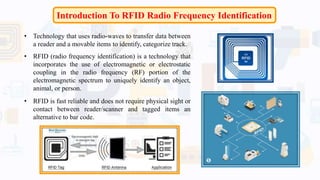
• Technology that uses radio-waves to transfer data between
a reader and a movable items to identify, categorize track.
• RFID (radio frequency identification) is a technology that
incorporates the use of electromagnetic or electrostatic
coupling in the radio frequency (RF) portion of the
electromagnetic spectrum to uniquely identify an object,
animal, or person.
• RFID is fast reliable and does not require physical sight or
contact between reader/scanner and tagged items an
alternative to bar code.
Active Tag
Passive Tag
• Tag contains an antenna, and a small chip that stores a small amount of data.
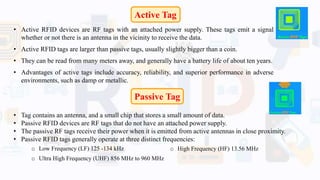
• Passive RFID devices are RF tags that do not have an attached power supply.
• The passive RF tags receive their power when it is emitted from active antennas in close proximity.
• Passive RFID tags generally operate at three distinct frequencies:
• Active RFID devices are RF tags with an attached power supply. These tags emit a signal
whether or not there is an antenna in the vicinity to receive the data.
• Active RFID tags are larger than passive tags, usually slightly bigger than a coin.
• They can be read from many meters away, and generally have a battery life of about ten years.
• Advantages of active tags include accuracy, reliability, and superior performance in adverse
environments, such as damp or metallic.
o Low Frequency (LF) 125 -134 kHz o High Frequency (HF) 13.56 MHz
o Ultra High Frequency (UHF) 856 MHz to 960 MHz
RFID Radio Frequency Spectrum
Scope of technology
RFID is leveraging on the mobile technology:
One of such technological advances is NFC technology, i.e. a type of HF RFID technology that enables online
stores to give users a more convenient online payment option with added security layer.
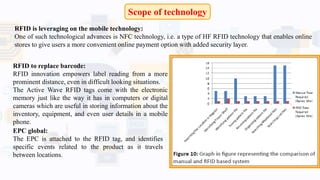
RFID to replace barcode:
RFID innovation empowers label reading from a more
prominent distance, even in difficult looking situations.
The Active Wave RFID tags come with the electronic
memory just like the way it has in computers or digital
cameras which are useful in storing information about the
inventory, equipment, and even user details in a mobile
phone.
EPC global:
The EPC is attached to the RFID tag, and identifies
specific events related to the product as it travels
between locations.
Challenges
• Return on investment.
• Privacy Concern.
• Radio standards & spectrum allocation.
• RFID vs barcode
• Tag cost
• Product information maintenance
• Data security and privacy
• Inventory Monitoring:
o Library book and bookstore tracking
o Departmental Store (Membership tracking)
• Access Control
o RFID Door-lock system for security.
• Payment Systems
o Cell phones are including RFID tags built in
o High-end VIP nightclubs
• Long range access control for vehicles
o Entry gates
o Electronic toll collection
RFID’s Current Uses
APPLICATIONS
Supply Chain Management Process
Live Stock
Retail and Inventory Tracking
Vehicle Mentoring Solutions
Health Care
Document Tracking
Product Tracking
Attendee Tracking
Materials Management
IT Asset Tracking.
Tool Tracking Library Systems
Laundry Management
Product tracking
Access Control
Logistics
Security
Animal Husbandry
Race Timing
Future scope
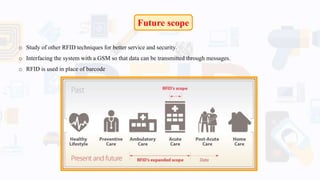
o Study of other RFID techniques for better service and security.
o Interfacing the system with a GSM so that data can be transmitted through messages.
o RFID is used in place of barcode
Thank You

RFID Technology - Electronics and Communication Seminar Topic

  • 1.
  • 2.
    Introduction To RFIDRadio Frequency Identification • Technology that uses radio-waves to transfer data between a reader and a movable items to identify, categorize track. • RFID (radio frequency identification) is a technology that incorporates the use of electromagnetic or electrostatic coupling in the radio frequency (RF) portion of the electromagnetic spectrum to uniquely identify an object, animal, or person. • RFID is fast reliable and does not require physical sight or contact between reader/scanner and tagged items an alternative to bar code.
  • 3.
    Active Tag Passive Tag •Tag contains an antenna, and a small chip that stores a small amount of data. • Passive RFID devices are RF tags that do not have an attached power supply. • The passive RF tags receive their power when it is emitted from active antennas in close proximity. • Passive RFID tags generally operate at three distinct frequencies: • Active RFID devices are RF tags with an attached power supply. These tags emit a signal whether or not there is an antenna in the vicinity to receive the data. • Active RFID tags are larger than passive tags, usually slightly bigger than a coin. • They can be read from many meters away, and generally have a battery life of about ten years. • Advantages of active tags include accuracy, reliability, and superior performance in adverse environments, such as damp or metallic. o Low Frequency (LF) 125 -134 kHz o High Frequency (HF) 13.56 MHz o Ultra High Frequency (UHF) 856 MHz to 960 MHz
  • 4.
  • 5.
    Scope of technology RFIDis leveraging on the mobile technology: One of such technological advances is NFC technology, i.e. a type of HF RFID technology that enables online stores to give users a more convenient online payment option with added security layer. RFID to replace barcode: RFID innovation empowers label reading from a more prominent distance, even in difficult looking situations. The Active Wave RFID tags come with the electronic memory just like the way it has in computers or digital cameras which are useful in storing information about the inventory, equipment, and even user details in a mobile phone. EPC global: The EPC is attached to the RFID tag, and identifies specific events related to the product as it travels between locations.
  • 6.
    Challenges • Return oninvestment. • Privacy Concern. • Radio standards & spectrum allocation. • RFID vs barcode • Tag cost • Product information maintenance • Data security and privacy • Inventory Monitoring: o Library book and bookstore tracking o Departmental Store (Membership tracking) • Access Control o RFID Door-lock system for security. • Payment Systems o Cell phones are including RFID tags built in o High-end VIP nightclubs • Long range access control for vehicles o Entry gates o Electronic toll collection RFID’s Current Uses
  • 7.
    APPLICATIONS Supply Chain ManagementProcess Live Stock Retail and Inventory Tracking Vehicle Mentoring Solutions Health Care Document Tracking Product Tracking Attendee Tracking Materials Management IT Asset Tracking. Tool Tracking Library Systems Laundry Management Product tracking Access Control Logistics Security Animal Husbandry Race Timing
  • 8.
    Future scope o Studyof other RFID techniques for better service and security. o Interfacing the system with a GSM so that data can be transmitted through messages. o RFID is used in place of barcode
  • 9.