1
INTERNET OF THINGS AND SENSOR NETWORKING
DEPARTMENT OF COMPUTER SCIENCE
SCHOOL OF GRADUATE STUDY AND RESEARCH
UNIVERSITY OF THE GAMBIA
UTG
Assignment Presentation
by
School of Information Technology and Communication, UTG.
Ansumana Darboe
2
CONTENT
• What is RFID ?
• How does RFID work?
• What are the types of RFID systems?
• RFID applications and use cases?
• RFID vs. Barcodes ?
• RFID Challenges?
• Conclusion
School of Information Technology and Communication, UTG.
3
WHAT IS RFID ?
(RADIO FREQUENCY IDENTIFICATION)
• The technology known as Radio Frequency
Identification (RFID) automatically recognizes
and tracks objects, animals, or people using
radio waves. Retail, logistics, healthcare, and
security are just a few of the industries that
employ RFID for automated identification and
data capture (AIDC) systems.
• RFID, or radio frequency identification, is a
wireless communication technology that uses
electrostatic or electromagnetic coupling in the
radio frequency region of the electromagnetic
spectrum to identify a person, animal, or
object uniquely.
School of Information Technology and Communication, UTG.
4
HOW RFID WORKS
School of Information Technology and Communication, UTG.
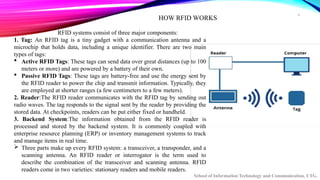
RFID systems consist of three major components:
1. Tag: An RFID tag is a tiny gadget with a communication antenna and a
microchip that holds data, including a unique identifier. There are two main
types of tags:
 Active RFID Tags: These tags can send data over great distances (up to 100
meters or more) and are powered by a battery of their own.
 Passive RFID Tags: These tags are battery-free and use the energy sent by
the RFID reader to power the chip and transmit information. Typically, they
are employed at shorter ranges (a few centimeters to a few meters).
2. Reader:The RFID reader communicates with the RFID tag by sending out
radio waves. The tag responds to the signal sent by the reader by providing the
stored data. At checkpoints, readers can be put either fixed or handheld.
3. Backend System:The information obtained from the RFID reader is
processed and stored by the backend system. It is commonly coupled with
enterprise resource planning (ERP) or inventory management systems to track
and manage items in real time.
 Three parts make up every RFID system: a transceiver, a transponder, and a
scanning antenna. An RFID reader or interrogator is the term used to
describe the combination of the transceiver and scanning antenna. RFID
readers come in two varieties: stationary readers and mobile readers.
5
WHAT ARE THE TYPES OF RFID SYSTEMS
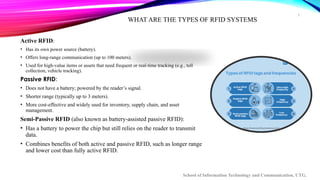
Active RFID:
• Has its own power source (battery).
• Offers long-range communication (up to 100 meters).
• Used for high-value items or assets that need frequent or real-time tracking (e.g., toll
collection, vehicle tracking).
Passive RFID:
• Does not have a battery; powered by the reader’s signal.
• Shorter range (typically up to 3 meters).
• More cost-effective and widely used for inventory, supply chain, and asset
management.
Semi-Passive RFID (also known as battery-assisted passive RFID):
• Has a battery to power the chip but still relies on the reader to transmit
data.
• Combines benefits of both active and passive RFID, such as longer range
and lower cost than fully active RFID.
School of Information Technology and Communication, UTG.
6
continued
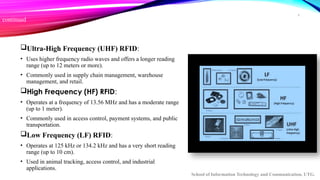
Ultra-High Frequency (UHF) RFID:
• Uses higher frequency radio waves and offers a longer reading
range (up to 12 meters or more).
• Commonly used in supply chain management, warehouse
management, and retail.
High Frequency (HF) RFID:
• Operates at a frequency of 13.56 MHz and has a moderate range
(up to 1 meter).
• Commonly used in access control, payment systems, and public
transportation.
Low Frequency (LF) RFID:
• Operates at 125 kHz or 134.2 kHz and has a very short reading
range (up to 10 cm).
• Used in animal tracking, access control, and industrial
applications.
School of Information Technology and Communication, UTG.
7
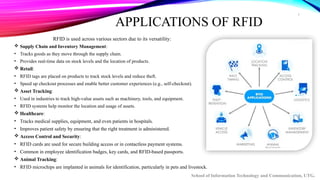
APPLICATIONS OF RFID
RFID is used across various sectors due to its versatility:
 Supply Chain and Inventory Management:
• Tracks goods as they move through the supply chain.
• Provides real-time data on stock levels and the location of products.
 Retail:
• RFID tags are placed on products to track stock levels and reduce theft.
• Speed up checkout processes and enable better customer experiences (e.g., self-checkout).
 Asset Tracking:
• Used in industries to track high-value assets such as machinery, tools, and equipment.
• RFID systems help monitor the location and usage of assets.
 Healthcare:
• Tracks medical supplies, equipment, and even patients in hospitals.
• Improves patient safety by ensuring that the right treatment is administered.
 Access Control and Security:
• RFID cards are used for secure building access or in contactless payment systems.
• Common in employee identification badges, key cards, and RFID-based passports.
 Animal Tracking:
• RFID microchips are implanted in animals for identification, particularly in pets and livestock.
School of Information Technology and Communication, UTG.
8
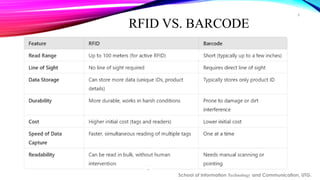
RFID VS. BARCODE
School of Information Technology and Communication, UTG.
9
CHALLENGES OF RFID
• Despite its advantages, RFID also presents challenges:
• Cost: Because RFID tags, particularly active ones, can be costly, smaller enterprises
may find it challenging to adopt the technology.
• Privacy and Security Concerns: Privacy issues may result from RFID tags being
read without authorization. In order to prevent sensitive data from being intercepted,
security protocols are necessary.
• Interference and Signal Blockage: Metals, liquids, and other things can interfere
with RFID signals. To guarantee that RFID tags work correctly in difficult situations,
further precautions must be taken.
• Integration Complexity: It can be difficult and time-consuming to integrate RFID
with current enterprise systems, such as supply chain management software or ERP.
• Standardization: Numerous RFID standards exist, such as ISO and EPCglobal, and
the absence of universal standards may make it more difficult for disparate RFID
systems to communicate with one another.
• Tag Collision: Multiple tags may "collide" or interfere with one another in situations
with a lot of tags, which could cause delays or misreads.
School of Information Technology and Communication, UTG.
10
CONCLUSION
• The capacity of RFID technology to monitor things without direct line
of sight and scan several tags simultaneously gives it a substantial edge
over earlier identification technologies like barcodes. Despite certain
obstacles, like cost and privacy issues, RFID is becoming more and
more popular across a range of businesses because of its effectiveness
and scalability.
School of Information Technology and Communication, UTG.

Internet Of Things Assignment Presentation.pptx

  • 1.
    1 INTERNET OF THINGSAND SENSOR NETWORKING DEPARTMENT OF COMPUTER SCIENCE SCHOOL OF GRADUATE STUDY AND RESEARCH UNIVERSITY OF THE GAMBIA UTG Assignment Presentation by School of Information Technology and Communication, UTG. Ansumana Darboe
  • 2.
    2 CONTENT • What isRFID ? • How does RFID work? • What are the types of RFID systems? • RFID applications and use cases? • RFID vs. Barcodes ? • RFID Challenges? • Conclusion School of Information Technology and Communication, UTG.
  • 3.
    3 WHAT IS RFID? (RADIO FREQUENCY IDENTIFICATION) • The technology known as Radio Frequency Identification (RFID) automatically recognizes and tracks objects, animals, or people using radio waves. Retail, logistics, healthcare, and security are just a few of the industries that employ RFID for automated identification and data capture (AIDC) systems. • RFID, or radio frequency identification, is a wireless communication technology that uses electrostatic or electromagnetic coupling in the radio frequency region of the electromagnetic spectrum to identify a person, animal, or object uniquely. School of Information Technology and Communication, UTG.
  • 4.
    4 HOW RFID WORKS Schoolof Information Technology and Communication, UTG. RFID systems consist of three major components: 1. Tag: An RFID tag is a tiny gadget with a communication antenna and a microchip that holds data, including a unique identifier. There are two main types of tags:  Active RFID Tags: These tags can send data over great distances (up to 100 meters or more) and are powered by a battery of their own.  Passive RFID Tags: These tags are battery-free and use the energy sent by the RFID reader to power the chip and transmit information. Typically, they are employed at shorter ranges (a few centimeters to a few meters). 2. Reader:The RFID reader communicates with the RFID tag by sending out radio waves. The tag responds to the signal sent by the reader by providing the stored data. At checkpoints, readers can be put either fixed or handheld. 3. Backend System:The information obtained from the RFID reader is processed and stored by the backend system. It is commonly coupled with enterprise resource planning (ERP) or inventory management systems to track and manage items in real time.  Three parts make up every RFID system: a transceiver, a transponder, and a scanning antenna. An RFID reader or interrogator is the term used to describe the combination of the transceiver and scanning antenna. RFID readers come in two varieties: stationary readers and mobile readers.
  • 5.
    5 WHAT ARE THETYPES OF RFID SYSTEMS Active RFID: • Has its own power source (battery). • Offers long-range communication (up to 100 meters). • Used for high-value items or assets that need frequent or real-time tracking (e.g., toll collection, vehicle tracking). Passive RFID: • Does not have a battery; powered by the reader’s signal. • Shorter range (typically up to 3 meters). • More cost-effective and widely used for inventory, supply chain, and asset management. Semi-Passive RFID (also known as battery-assisted passive RFID): • Has a battery to power the chip but still relies on the reader to transmit data. • Combines benefits of both active and passive RFID, such as longer range and lower cost than fully active RFID. School of Information Technology and Communication, UTG.
  • 6.
    6 continued Ultra-High Frequency (UHF)RFID: • Uses higher frequency radio waves and offers a longer reading range (up to 12 meters or more). • Commonly used in supply chain management, warehouse management, and retail. High Frequency (HF) RFID: • Operates at a frequency of 13.56 MHz and has a moderate range (up to 1 meter). • Commonly used in access control, payment systems, and public transportation. Low Frequency (LF) RFID: • Operates at 125 kHz or 134.2 kHz and has a very short reading range (up to 10 cm). • Used in animal tracking, access control, and industrial applications. School of Information Technology and Communication, UTG.
  • 7.
    7 APPLICATIONS OF RFID RFIDis used across various sectors due to its versatility:  Supply Chain and Inventory Management: • Tracks goods as they move through the supply chain. • Provides real-time data on stock levels and the location of products.  Retail: • RFID tags are placed on products to track stock levels and reduce theft. • Speed up checkout processes and enable better customer experiences (e.g., self-checkout).  Asset Tracking: • Used in industries to track high-value assets such as machinery, tools, and equipment. • RFID systems help monitor the location and usage of assets.  Healthcare: • Tracks medical supplies, equipment, and even patients in hospitals. • Improves patient safety by ensuring that the right treatment is administered.  Access Control and Security: • RFID cards are used for secure building access or in contactless payment systems. • Common in employee identification badges, key cards, and RFID-based passports.  Animal Tracking: • RFID microchips are implanted in animals for identification, particularly in pets and livestock. School of Information Technology and Communication, UTG.
  • 8.
    8 RFID VS. BARCODE Schoolof Information Technology and Communication, UTG.
  • 9.
    9 CHALLENGES OF RFID •Despite its advantages, RFID also presents challenges: • Cost: Because RFID tags, particularly active ones, can be costly, smaller enterprises may find it challenging to adopt the technology. • Privacy and Security Concerns: Privacy issues may result from RFID tags being read without authorization. In order to prevent sensitive data from being intercepted, security protocols are necessary. • Interference and Signal Blockage: Metals, liquids, and other things can interfere with RFID signals. To guarantee that RFID tags work correctly in difficult situations, further precautions must be taken. • Integration Complexity: It can be difficult and time-consuming to integrate RFID with current enterprise systems, such as supply chain management software or ERP. • Standardization: Numerous RFID standards exist, such as ISO and EPCglobal, and the absence of universal standards may make it more difficult for disparate RFID systems to communicate with one another. • Tag Collision: Multiple tags may "collide" or interfere with one another in situations with a lot of tags, which could cause delays or misreads. School of Information Technology and Communication, UTG.
  • 10.
    10 CONCLUSION • The capacityof RFID technology to monitor things without direct line of sight and scan several tags simultaneously gives it a substantial edge over earlier identification technologies like barcodes. Despite certain obstacles, like cost and privacy issues, RFID is becoming more and more popular across a range of businesses because of its effectiveness and scalability. School of Information Technology and Communication, UTG.