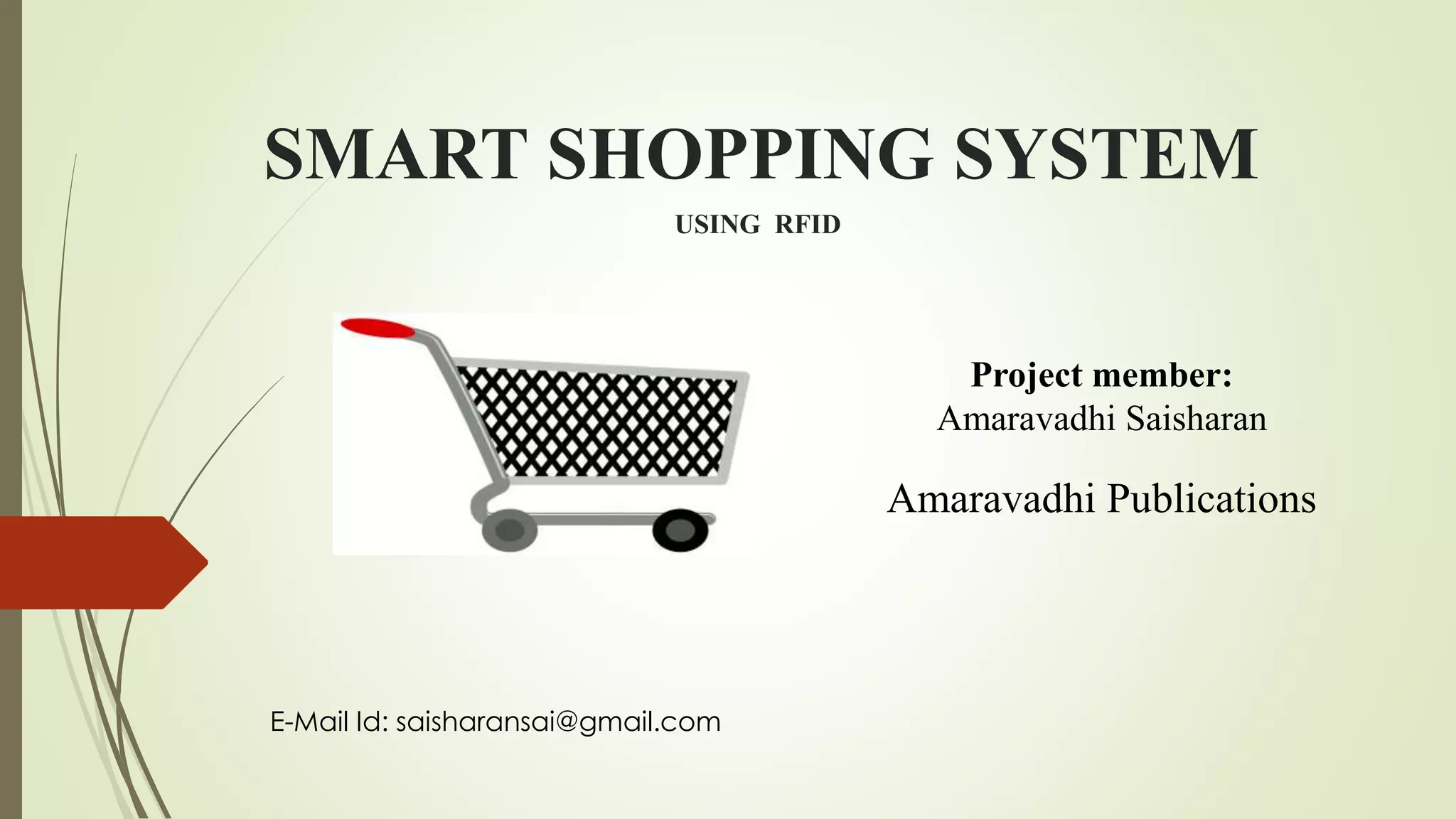
SMART SHOPPING SYSTEM
USING RFID
Project member:
Amaravadhi Saisharan
Amaravadhi Publications
E-Mail Id: saisharansai@gmail.com
Abstract:
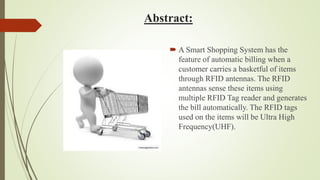
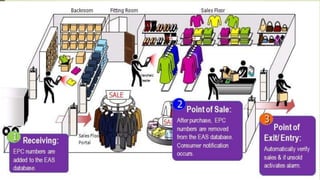
 A Smart Shopping System has the
feature of automatic billing when a
customer carries a basketful of items
through RFID antennas. The RFID
antennas sense these items using
multiple RFID Tag reader and generates
the bill automatically. The RFID tags
used on the items will be Ultra High
Frequency(UHF).
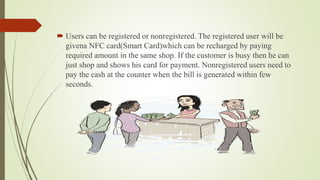
 Users can be registered or nonregistered. The registered user will be
givena NFC card(Smart Card)which can be recharged by paying
required amount in the same shop. If the customer is busy then he can
just shop and shows his card for payment. Nonregistered users need to
pay the cash at the counter when the bill is generated within few
seconds.
Functional Requirements:
 Every product
details such as
Product-Code,
P-Name, Price,
Mf-date, Exp-date,
UHFTAGID need to
be stored in a
database.
 Modifying product
details.
 Deleting product
details.
 Automatic bill
generation facility.
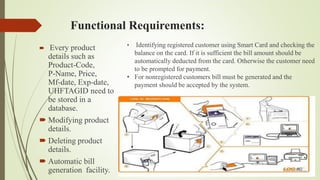
• Identifying registered customer using Smart Card and checking the
balance on the card. If it is sufficient the bill amount should be
automatically deducted from the card. Otherwise the customer need
to be prompted for payment.
• For nonregistered customers bill must be generated and the
payment should be accepted by the system.
RFID Overview:
 Radio Frequency Identification (RFID):-It is a
technology that uses radio-frequency waves to
transfer data between a reader and a movable
item to identify, categorize, track...
 RFID is fast, reliable, and does not require
physical sight or contact between
reader/scanner and the tagged item.
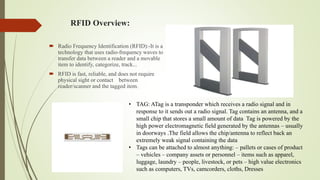
• TAG: ATag is a transponder which receives a radio signal and in
response to it sends out a radio signal. Tag contains an antenna, and a
small chip that stores a small amount of data Tag is powered by the
high power electromagnetic field generated by the antennas – usually
in doorways .The field allows the chip/antenna to reflect back an
extremely weak signal containing the data
• Tags can be attached to almost anything: – pallets or cases of product
– vehicles – company assets or personnel – items such as apparel,
luggage, laundry – people, livestock, or pets – high value electronics
such as computers, TVs, camcorders, cloths, Dresses
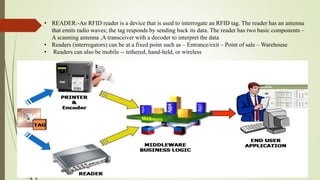
• READER:-An RFID reader is a device that is used to interrogate an RFID tag. The reader has an antenna
that emits radio waves; the tag responds by sending back its data. The reader has two basic components –
A scanning antenna ,A transceiver with a decoder to interpret the data
• Readers (interrogators) can be at a fixed point such as – Entrance/exit – Point of sale – Warehouse
• Readers can also be mobile -- tethered, hand-held, or wireless
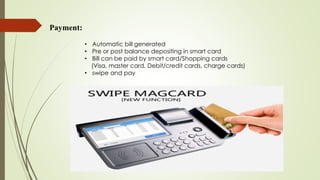
Payment:
• Automatic bill generated
• Pre or post balance depositing in smart card
• Bill can be paid by smart card/Shopping cards
(Visa, master card, Debit/credit cards, charge cards)
• swipe and pay
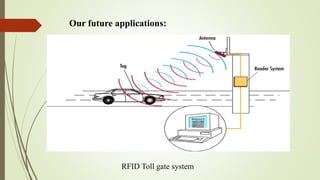
Our future applications:
RFID Toll gate system
THANK YOU

Smart shopping system using rfid

  • 1.
    SMART SHOPPING SYSTEM USINGRFID Project member: Amaravadhi Saisharan Amaravadhi Publications E-Mail Id: saisharansai@gmail.com
  • 2.
    Abstract:  A SmartShopping System has the feature of automatic billing when a customer carries a basketful of items through RFID antennas. The RFID antennas sense these items using multiple RFID Tag reader and generates the bill automatically. The RFID tags used on the items will be Ultra High Frequency(UHF).
  • 3.
     Users canbe registered or nonregistered. The registered user will be givena NFC card(Smart Card)which can be recharged by paying required amount in the same shop. If the customer is busy then he can just shop and shows his card for payment. Nonregistered users need to pay the cash at the counter when the bill is generated within few seconds.
  • 4.
    Functional Requirements:  Everyproduct details such as Product-Code, P-Name, Price, Mf-date, Exp-date, UHFTAGID need to be stored in a database.  Modifying product details.  Deleting product details.  Automatic bill generation facility. • Identifying registered customer using Smart Card and checking the balance on the card. If it is sufficient the bill amount should be automatically deducted from the card. Otherwise the customer need to be prompted for payment. • For nonregistered customers bill must be generated and the payment should be accepted by the system.
  • 5.
    RFID Overview:  RadioFrequency Identification (RFID):-It is a technology that uses radio-frequency waves to transfer data between a reader and a movable item to identify, categorize, track...  RFID is fast, reliable, and does not require physical sight or contact between reader/scanner and the tagged item. • TAG: ATag is a transponder which receives a radio signal and in response to it sends out a radio signal. Tag contains an antenna, and a small chip that stores a small amount of data Tag is powered by the high power electromagnetic field generated by the antennas – usually in doorways .The field allows the chip/antenna to reflect back an extremely weak signal containing the data • Tags can be attached to almost anything: – pallets or cases of product – vehicles – company assets or personnel – items such as apparel, luggage, laundry – people, livestock, or pets – high value electronics such as computers, TVs, camcorders, cloths, Dresses
  • 6.
    • READER:-An RFIDreader is a device that is used to interrogate an RFID tag. The reader has an antenna that emits radio waves; the tag responds by sending back its data. The reader has two basic components – A scanning antenna ,A transceiver with a decoder to interpret the data • Readers (interrogators) can be at a fixed point such as – Entrance/exit – Point of sale – Warehouse • Readers can also be mobile -- tethered, hand-held, or wireless
  • 7.
    Payment: • Automatic billgenerated • Pre or post balance depositing in smart card • Bill can be paid by smart card/Shopping cards (Visa, master card, Debit/credit cards, charge cards) • swipe and pay
  • 9.
  • 10.