RFID & ITS APPLICATIONS
Monday,
October 12,
2015
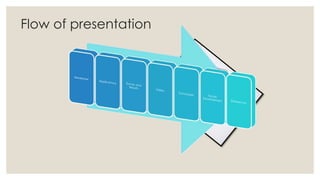
Flow of presentation
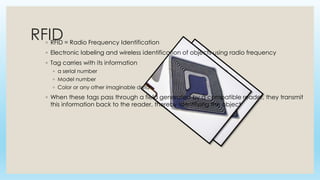
RFID◦ RFID = Radio Frequency Identification
◦ Electronic labeling and wireless identification of objects using radio frequency
◦ Tag carries with its information
◦ a serial number
◦ Model number
◦ Color or any other imaginable data
◦ When these tags pass through a field generated by a compatible reader, they transmit
this information back to the reader, thereby identifying the object
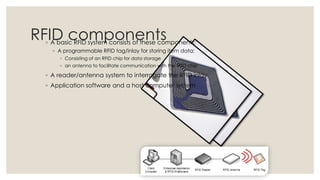
RFID components◦ A basic RFID system consists of these components:
◦ A programmable RFID tag/inlay for storing item data;
◦ Consisting of an RFID chip for data storage
◦ an antenna to facilitate communication with the RFID chip
◦ A reader/antenna system to interrogate the RFID inlay
◦ Application software and a host computer system
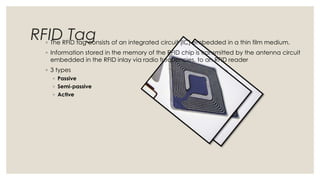
RFID Tag◦ The RFID tag consists of an integrated circuit (IC) embedded in a thin film medium.
◦ Information stored in the memory of the RFID chip is transmitted by the antenna circuit
embedded in the RFID inlay via radio frequencies, to an RFID reader
◦ 3 types
◦ Passive
◦ Semi-passive
◦ Active
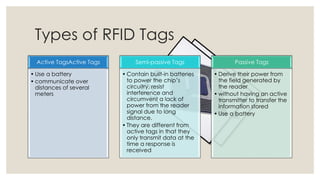
Types of RFID Tags
Active TagsActive Tags
• Use a battery
• communicate over
distances of several
meters
Semi-passive Tags
• Contain built-in batteries
to power the chip’s
circuitry, resist
interference and
circumvent a lack of
power from the reader
signal due to long
distance.
• They are different from
active tags in that they
only transmit data at the
time a response is
received
Passive Tags
• Derive their power from
the field generated by
the reader
• without having an active
transmitter to transfer the
information stored
• Use a battery
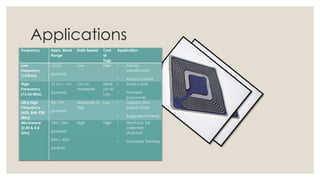
Applications
Frequency Appx. Read
Range
Data Speed Cost
of
Tags
Application
Low
Frequency
(125kHz)
<5cm
(passive)
Low High • Animal
Identification
• Access Control
High
Frequency
(13.56 Mhz)
10 cm – 1m
(passive)
Low to
Moderate
Medi
um to
Low
• Smart Cards
• Payment
(paywave)
Ultra High
Frequency
(433, 868-928
Mhz)
3m -7m
(passive)
Moderate to
High
Low • Logistics and
Supply Chain
• Baggage Tracking
Microwave
(2.45 & 5.8
Ghz)
10m -15m
(passive)
20m – 40m
(active)
High High • Electronic toll
collection
(Autotoll)
• Container Tracking
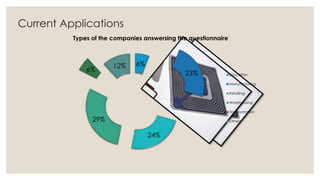
Current Applications
6%
23%
24%
29%
6%
12%
Types of the companies answersing the questionnaire
Education
Manufacturing
Retailing
Warehousing
Transportation
Others
Applications
Credit Cards with RFID
(Paywave function)
Octopus (Smart Card)
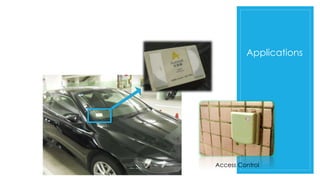
Applications
Autotoll (Electronic toll collection)
Access Control
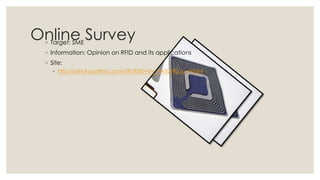
Online Survey◦ Target: SME
◦ Information: Opinion on RFID and its applications
◦ Site:
◦ http://qtrial.qualtrics.com/SE/?SID=SV_9N5UPRZuyuWtsk4
Survey Result
Further Development◦ In medical uses and library management
Video
Conclusion
◦ Positive
◦ RFID is a contactless reading technology and can read through other
materials
◦ Hold more data than barcode does
◦ RFID tags data can be changed or added
◦ More effective, bring lots of convenience to us
◦ Negative
◦ Cost is relatively remain high (compare to barcode)
◦ RFID signals may have problems with some materials
◦ RFID standards are still being developed

15205487pss7 ans

  • 1.
    RFID & ITSAPPLICATIONS Monday, October 12, 2015
  • 2.
  • 3.
    RFID◦ RFID =Radio Frequency Identification ◦ Electronic labeling and wireless identification of objects using radio frequency ◦ Tag carries with its information ◦ a serial number ◦ Model number ◦ Color or any other imaginable data ◦ When these tags pass through a field generated by a compatible reader, they transmit this information back to the reader, thereby identifying the object
  • 4.
    RFID components◦ Abasic RFID system consists of these components: ◦ A programmable RFID tag/inlay for storing item data; ◦ Consisting of an RFID chip for data storage ◦ an antenna to facilitate communication with the RFID chip ◦ A reader/antenna system to interrogate the RFID inlay ◦ Application software and a host computer system
  • 5.
    RFID Tag◦ TheRFID tag consists of an integrated circuit (IC) embedded in a thin film medium. ◦ Information stored in the memory of the RFID chip is transmitted by the antenna circuit embedded in the RFID inlay via radio frequencies, to an RFID reader ◦ 3 types ◦ Passive ◦ Semi-passive ◦ Active
  • 6.
    Types of RFIDTags Active TagsActive Tags • Use a battery • communicate over distances of several meters Semi-passive Tags • Contain built-in batteries to power the chip’s circuitry, resist interference and circumvent a lack of power from the reader signal due to long distance. • They are different from active tags in that they only transmit data at the time a response is received Passive Tags • Derive their power from the field generated by the reader • without having an active transmitter to transfer the information stored • Use a battery
  • 7.
    Applications Frequency Appx. Read Range DataSpeed Cost of Tags Application Low Frequency (125kHz) <5cm (passive) Low High • Animal Identification • Access Control High Frequency (13.56 Mhz) 10 cm – 1m (passive) Low to Moderate Medi um to Low • Smart Cards • Payment (paywave) Ultra High Frequency (433, 868-928 Mhz) 3m -7m (passive) Moderate to High Low • Logistics and Supply Chain • Baggage Tracking Microwave (2.45 & 5.8 Ghz) 10m -15m (passive) 20m – 40m (active) High High • Electronic toll collection (Autotoll) • Container Tracking
  • 8.
    Current Applications 6% 23% 24% 29% 6% 12% Types ofthe companies answersing the questionnaire Education Manufacturing Retailing Warehousing Transportation Others
  • 9.
    Applications Credit Cards withRFID (Paywave function) Octopus (Smart Card)
  • 10.
    Applications Autotoll (Electronic tollcollection) Access Control
  • 11.
    Online Survey◦ Target:SME ◦ Information: Opinion on RFID and its applications ◦ Site: ◦ http://qtrial.qualtrics.com/SE/?SID=SV_9N5UPRZuyuWtsk4
  • 12.
  • 13.
    Further Development◦ Inmedical uses and library management
  • 14.
  • 15.
    Conclusion ◦ Positive ◦ RFIDis a contactless reading technology and can read through other materials ◦ Hold more data than barcode does ◦ RFID tags data can be changed or added ◦ More effective, bring lots of convenience to us ◦ Negative ◦ Cost is relatively remain high (compare to barcode) ◦ RFID signals may have problems with some materials ◦ RFID standards are still being developed