N I V E L I N T E R M E D I O
REVISION THIRD TERM
SUMMARY
 VERB TENSES:
Revision of all tenses
 THE PASSIVE VOICE
 MODAL VERBS OF
DEDUCTION :
may/might, can’t, must
 CONDIONAL SENTENCES
 RELATIVE CLAUSES
(revision)
 REPORTED SPEECH
 INFINITIVES AND GERUNDS
(revision)
 QUANTIFIERS
(revision)
 VOCABULARY:
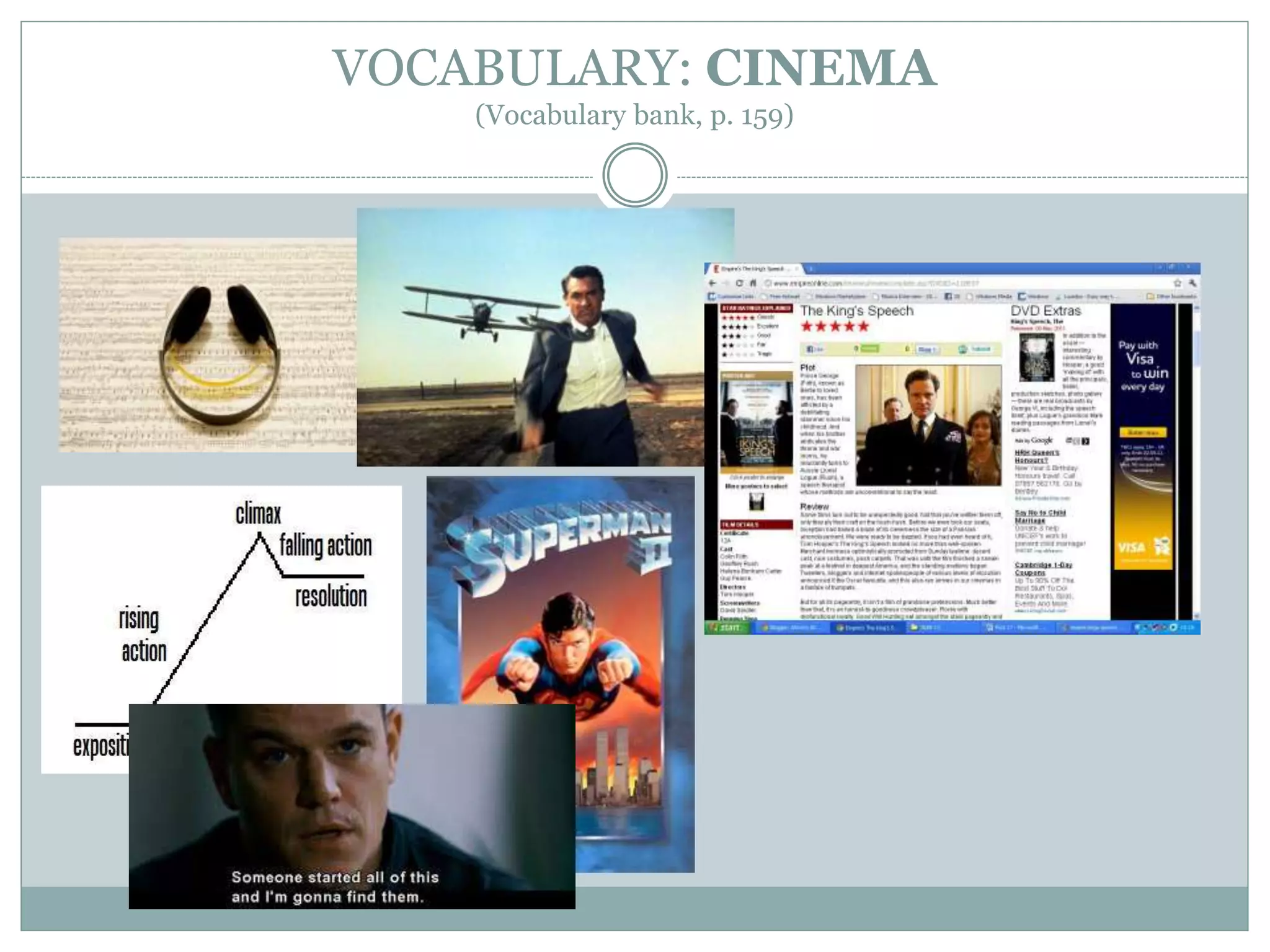
- Cinema
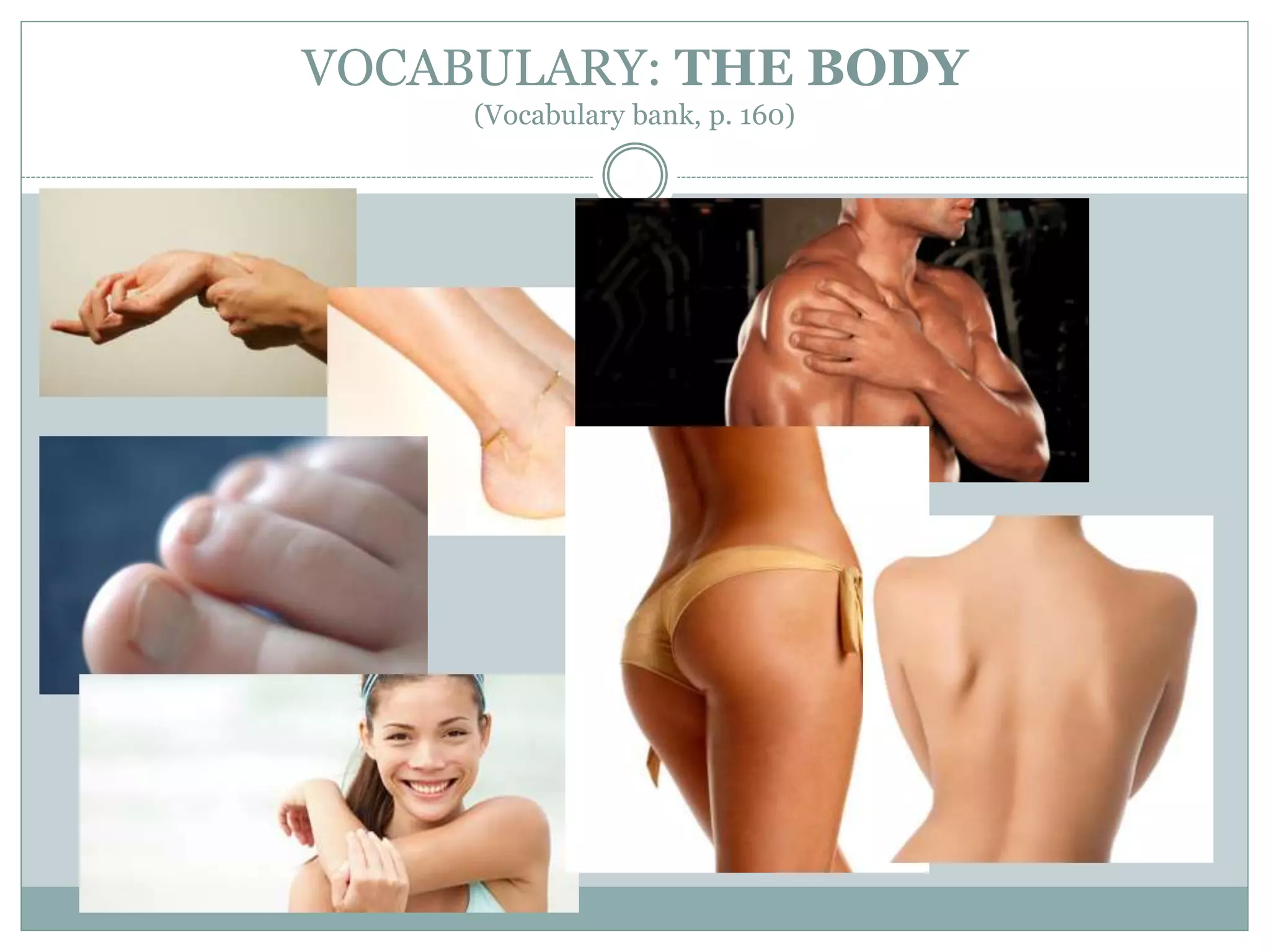
- The body
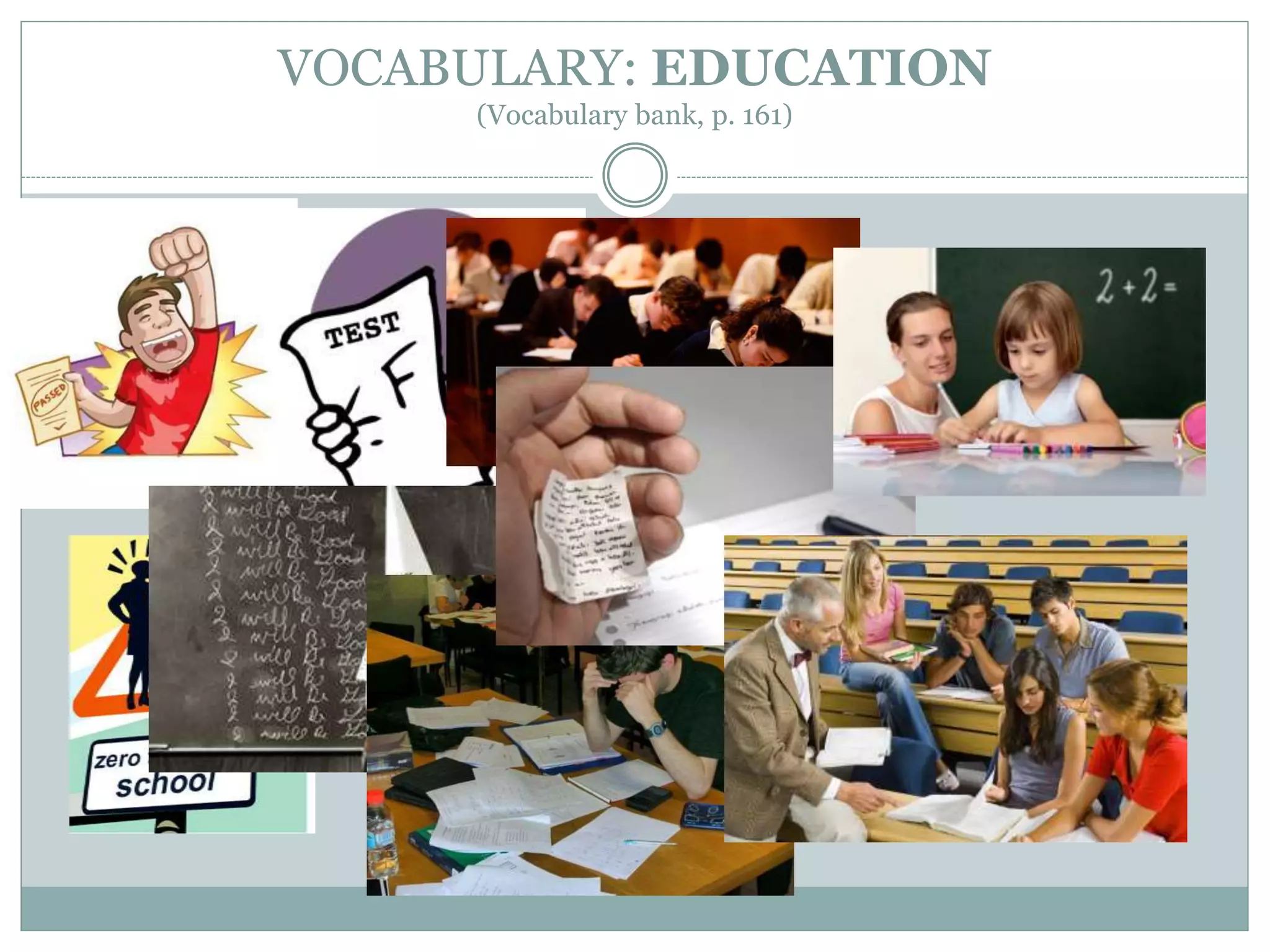
- Education
- Houses
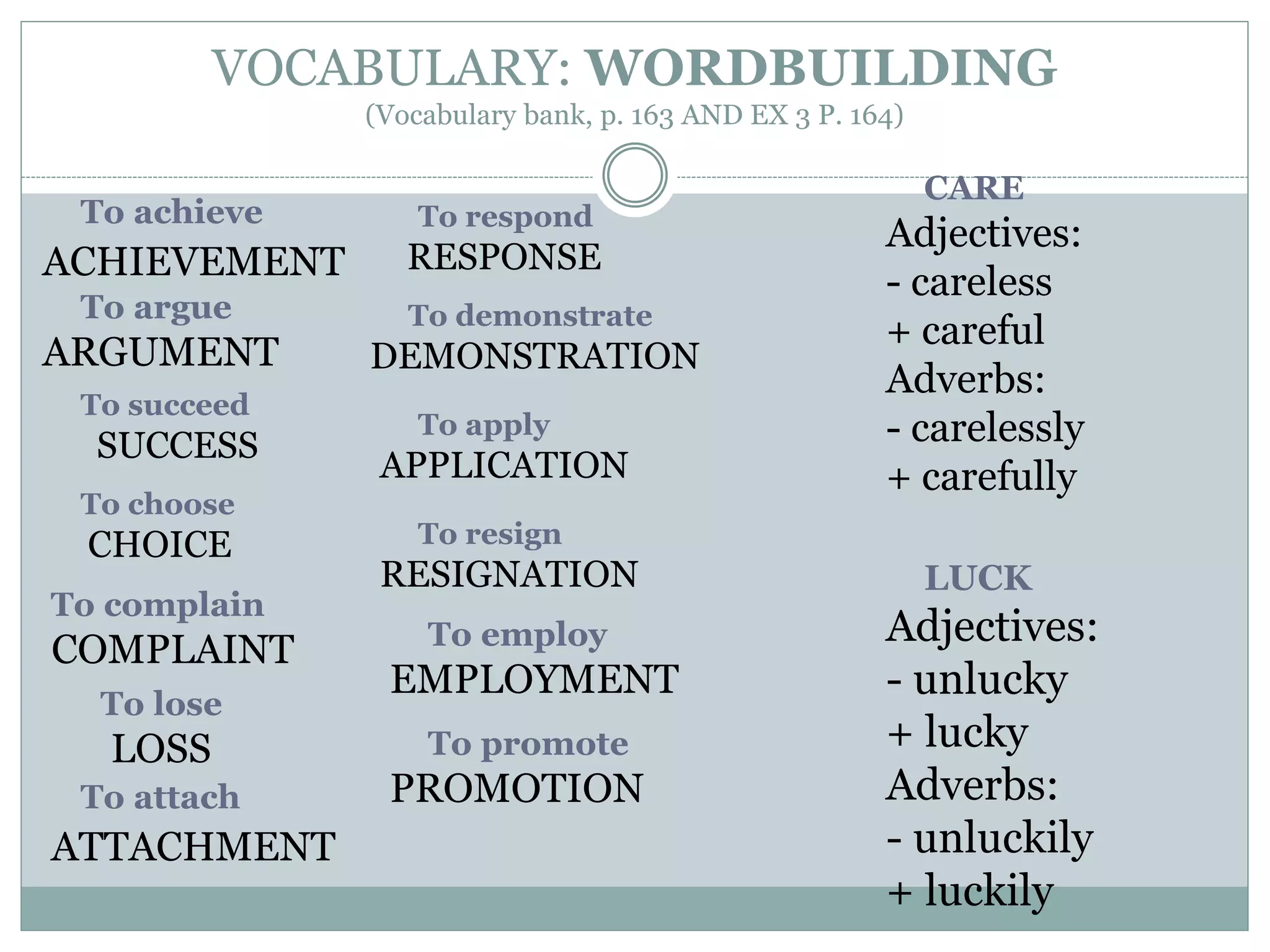
- Wordbuilding
- Work
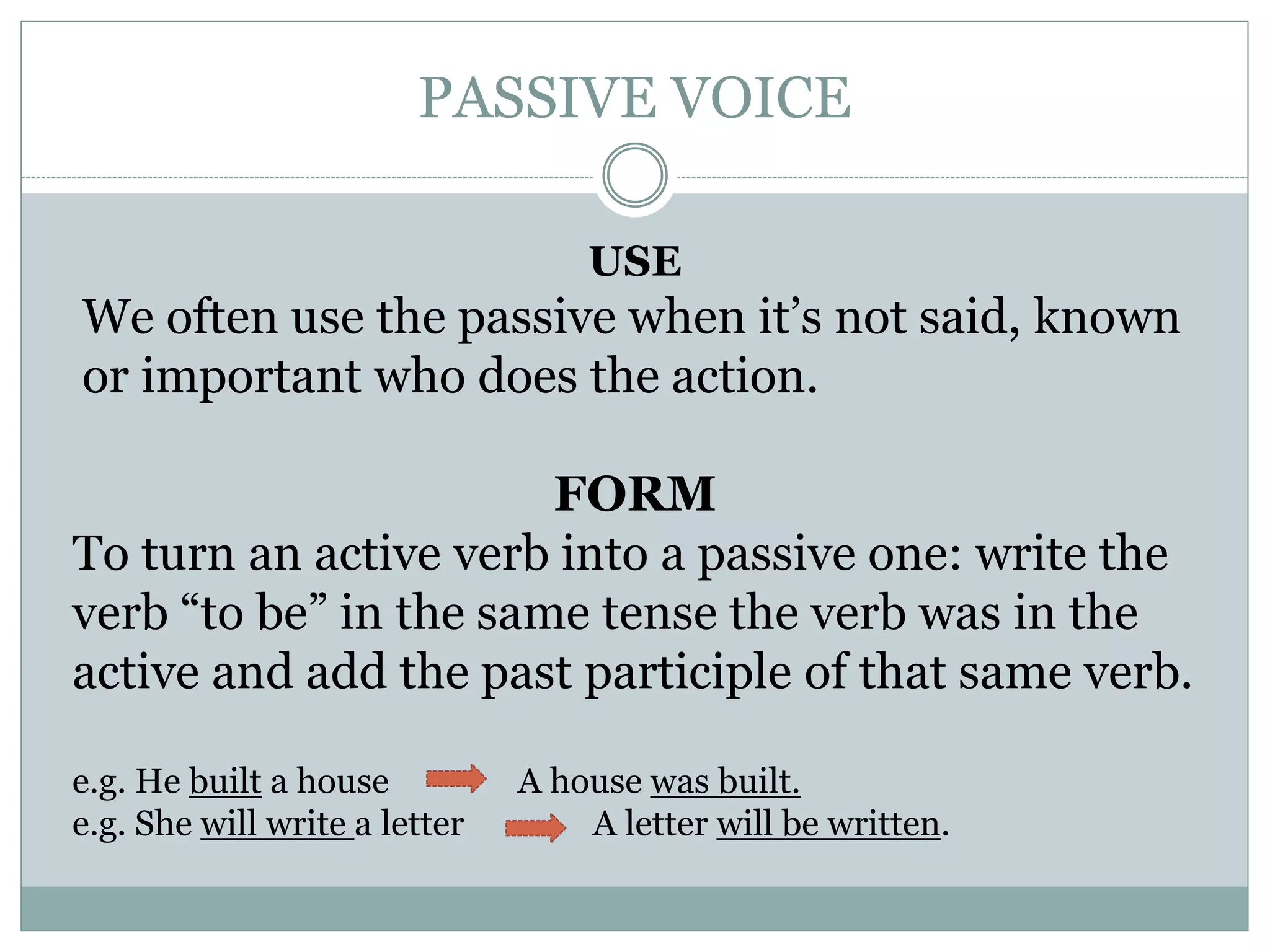
PASSIVE VOICE
USE
We often use the passive when it’s not said, known
or important who does the action.
FORM
To turn an active verb into a passive one: write the
verb “to be” in the same tense the verb was in the
active and add the past participle of that same verb.
e.g. He built a house A house was built.
e.g. She will write a letter A letter will be written.
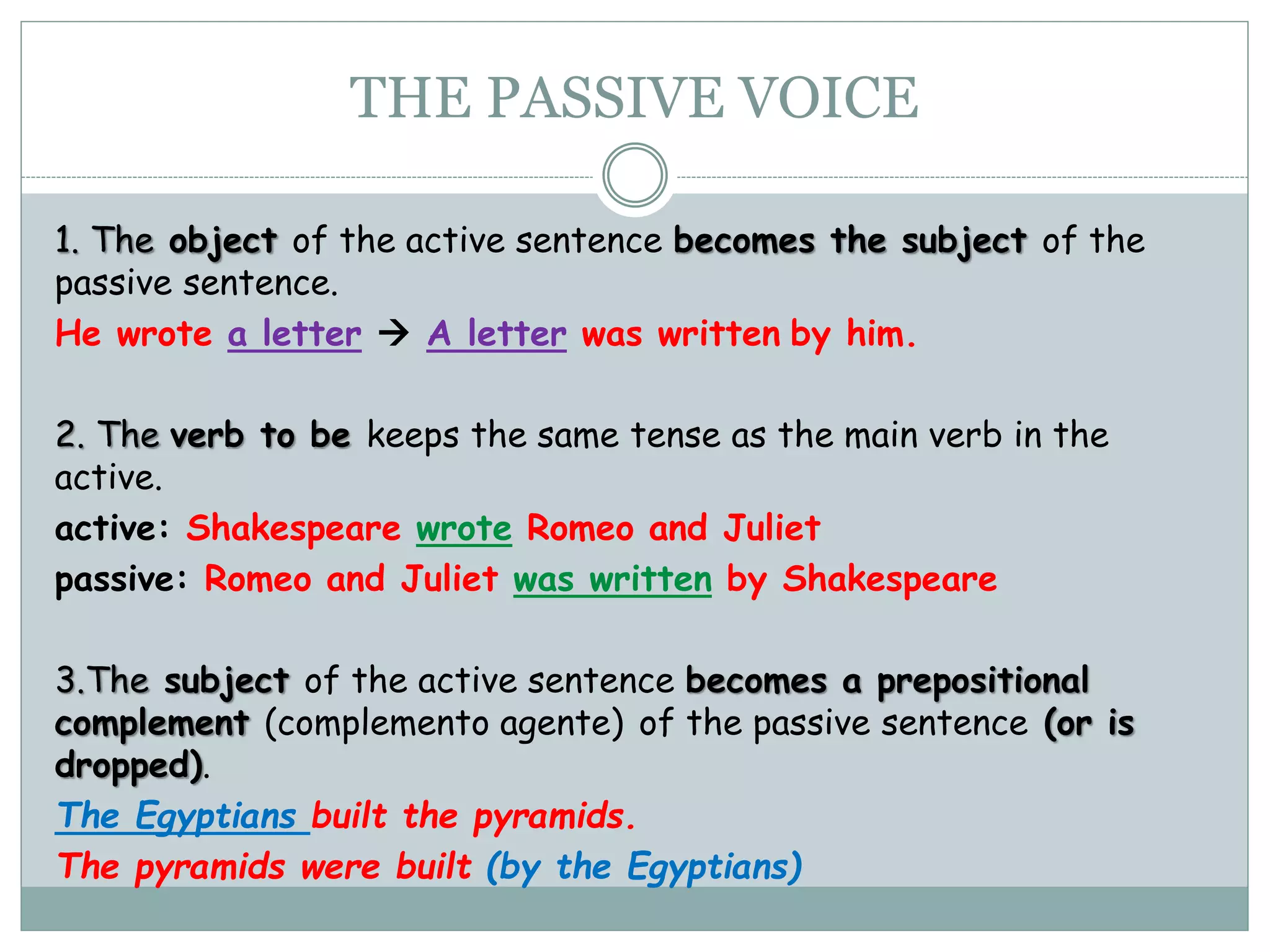
THE PASSIVE VOICE
1. The object of the active sentence becomes the subject of the
passive sentence.
He wrote a letter  A letter was written by him.
2. The verb to be keeps the same tense as the main verb in the
active.
active: Shakespeare wrote Romeo and Juliet
passive: Romeo and Juliet was written by Shakespeare
3.The subject of the active sentence becomes a prepositional
complement (complemento agente) of the passive sentence (or is
dropped).
The Egyptians built the pyramids.
The pyramids were built (by the Egyptians)
THE PASSIVE VOICE
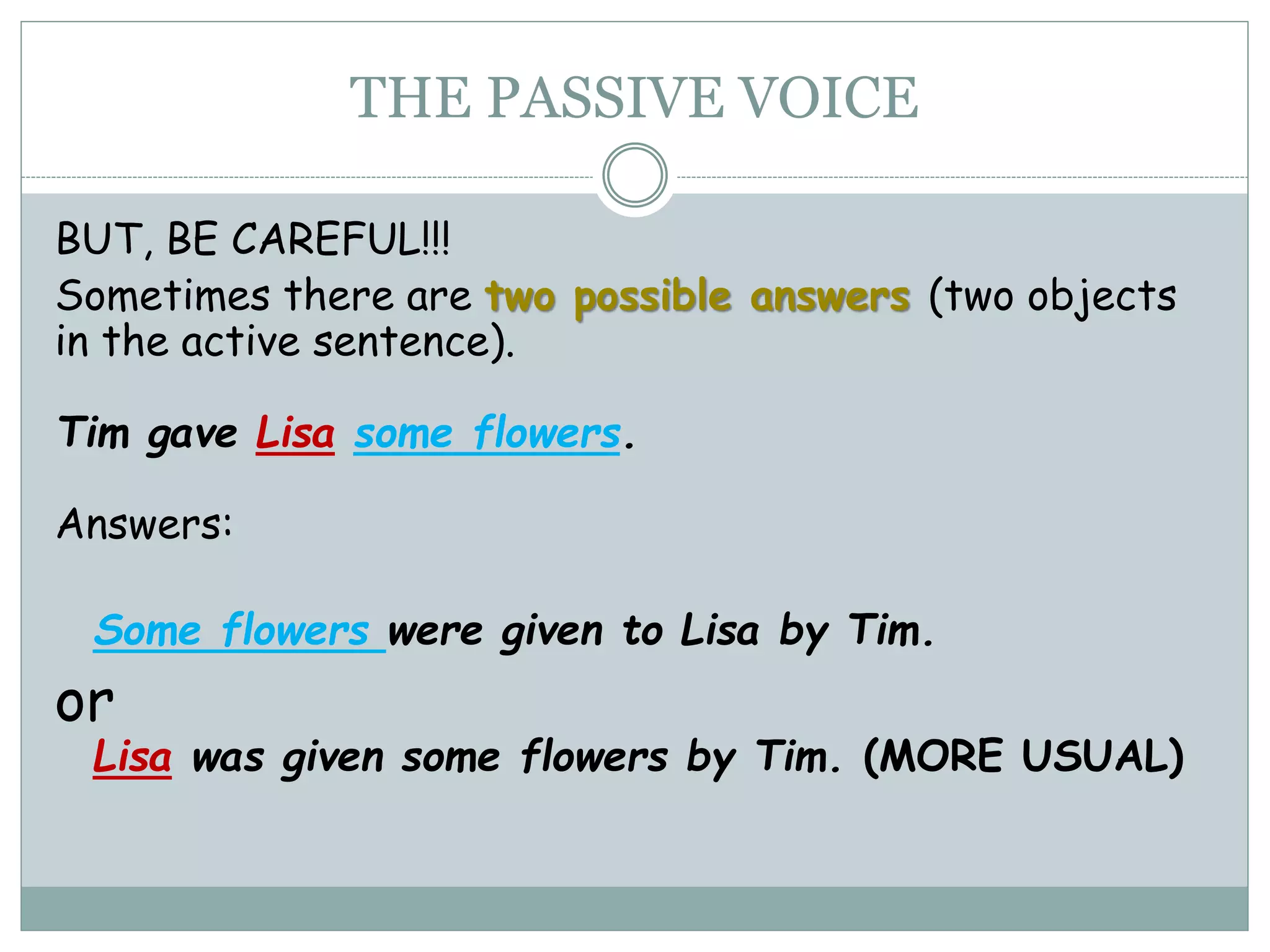
BUT, BE CAREFUL!!!
Sometimes there are two possible answers (two objects
in the active sentence).
Tim gave Lisa some flowers.
Answers:
Some flowers were given to Lisa by Tim.
or
Lisa was given some flowers by Tim. (MORE USUAL)
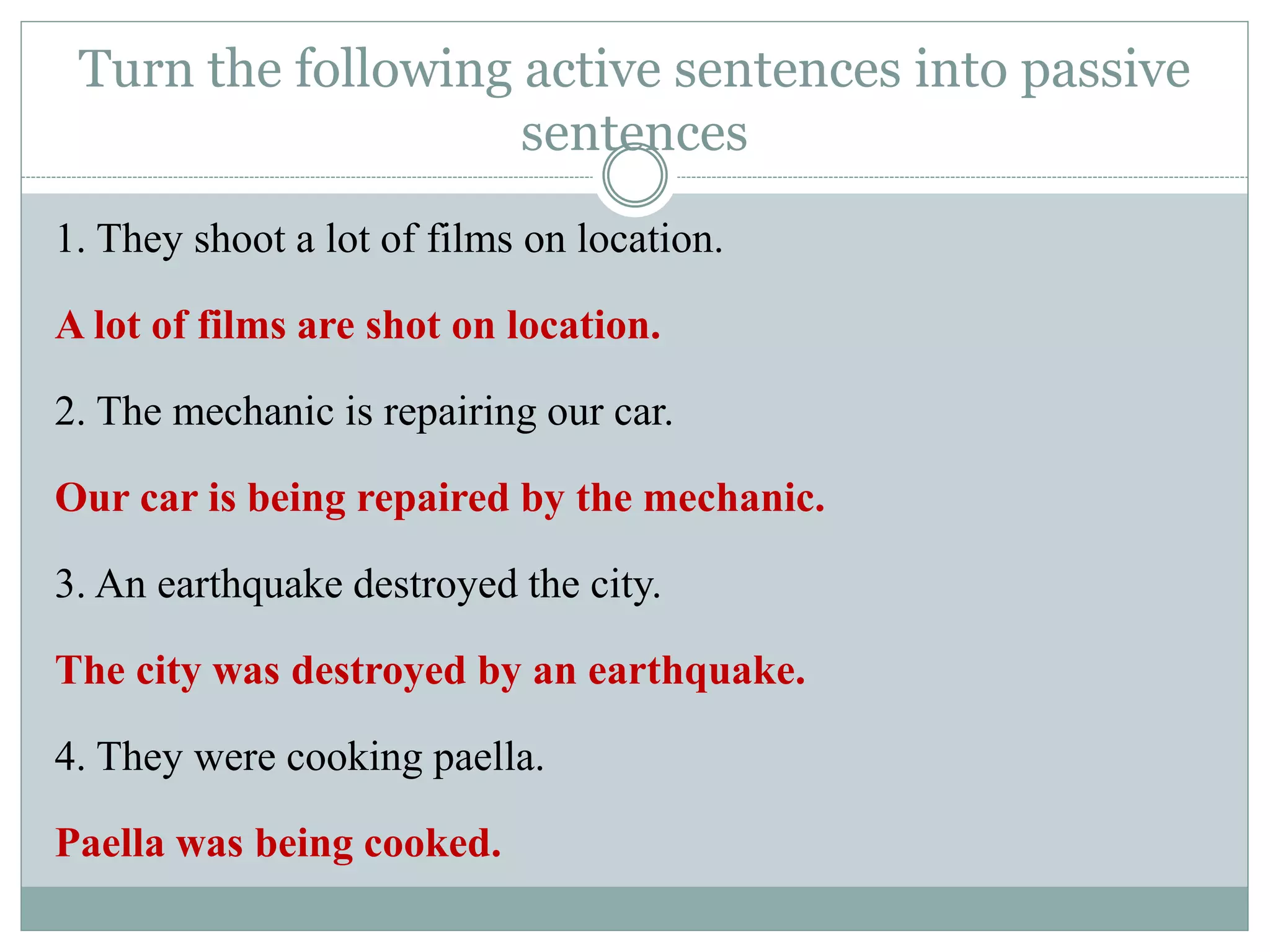
Turn the following active sentences into passive
sentences
1. They shoot a lot of films on location.
A lot of films are shot on location.
2. The mechanic is repairing our car.
Our car is being repaired by the mechanic.
3. An earthquake destroyed the city.
The city was destroyed by an earthquake.
4. They were cooking paella.
Paella was being cooked.
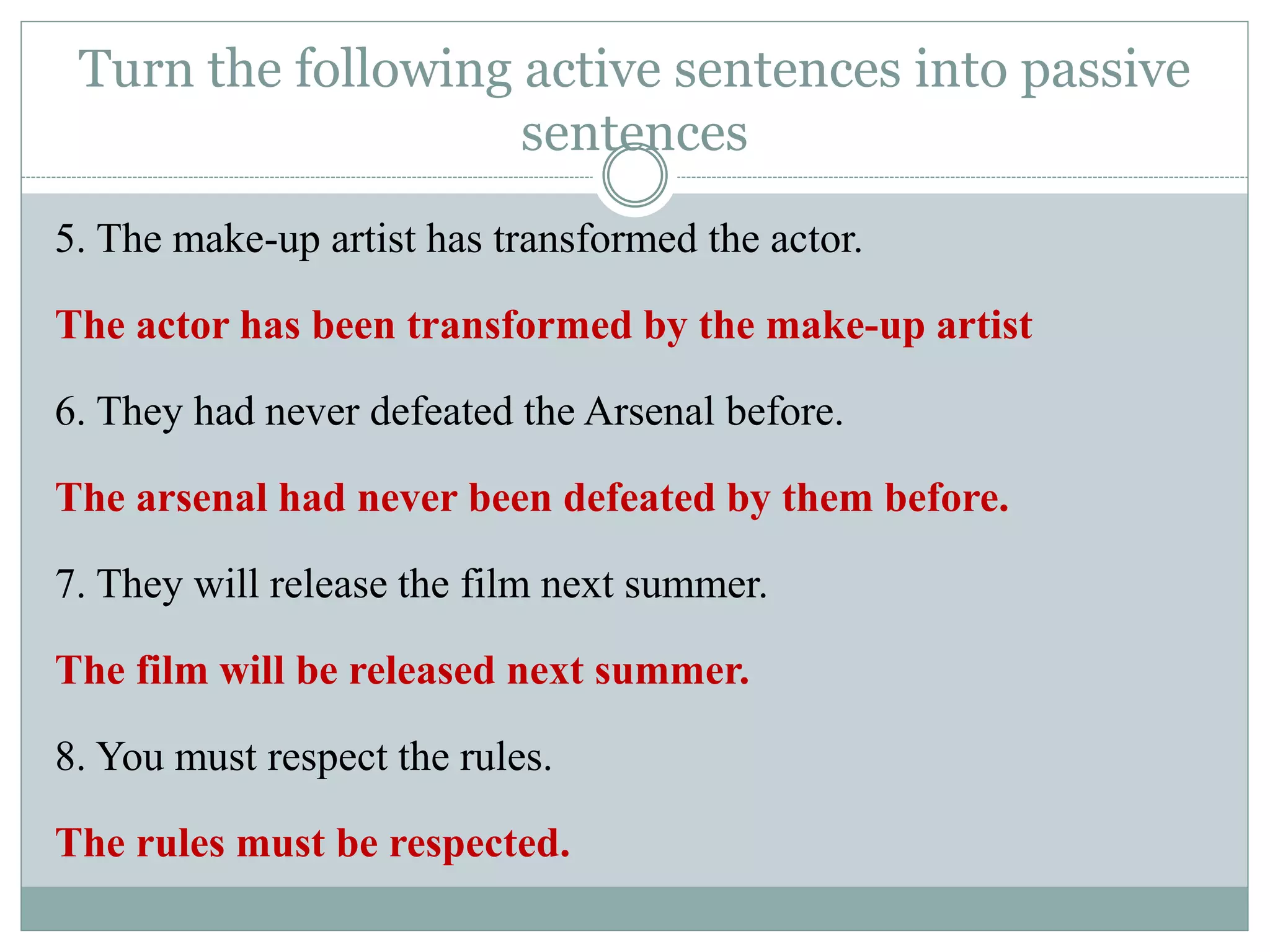
5. The make-up artist has transformed the actor.
The actor has been transformed by the make-up artist
6. They had never defeated the Arsenal before.
The arsenal had never been defeated by them before.
7. They will release the film next summer.
The film will be released next summer.
8. You must respect the rules.
The rules must be respected.
Turn the following active sentences into passive
sentences
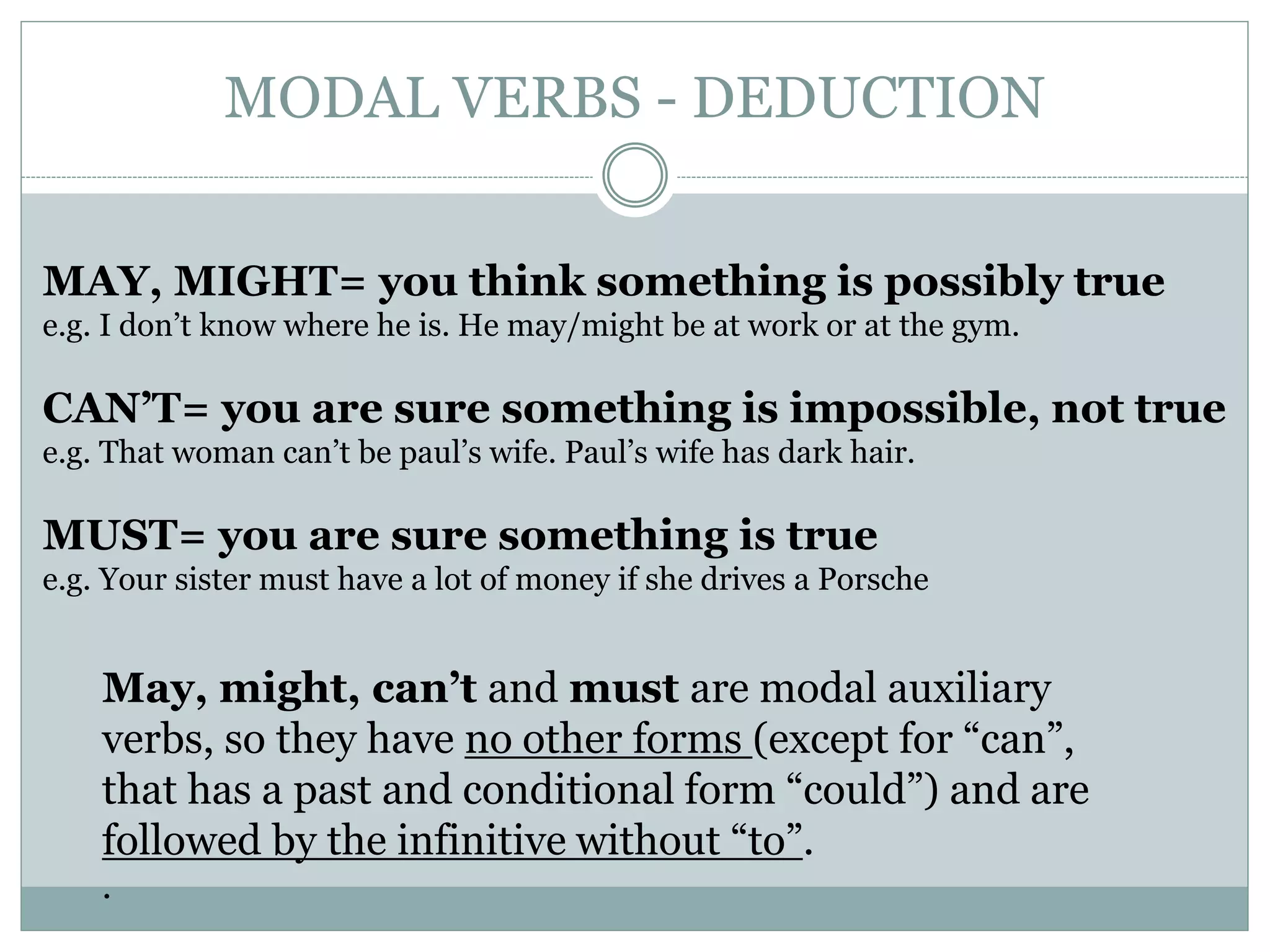
MODAL VERBS - DEDUCTION
MAY, MIGHT= you think something is possibly true
e.g. I don’t know where he is. He may/might be at work or at the gym.
CAN’T= you are sure something is impossible, not true
e.g. That woman can’t be paul’s wife. Paul’s wife has dark hair.
MUST= you are sure something is true
e.g. Your sister must have a lot of money if she drives a Porsche
May, might, can’t and must are modal auxiliary
verbs, so they have no other forms (except for “can”,
that has a past and conditional form “could”) and are
followed by the infinitive without “to”.
.
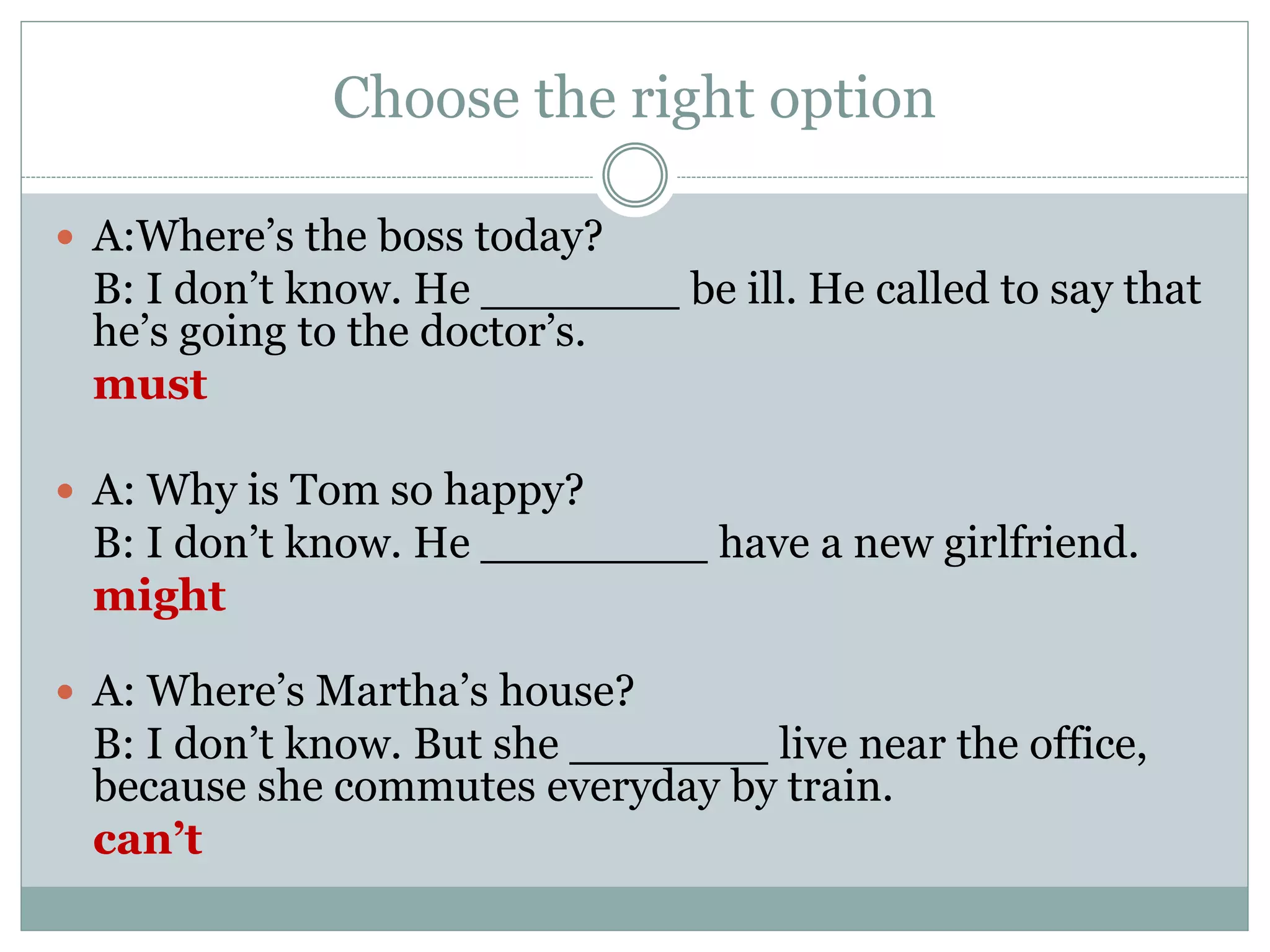
Choose the right option
 A:Where’s the boss today?
B: I don’t know. He _______ be ill. He called to say that
he’s going to the doctor’s.
must
 A: Why is Tom so happy?
B: I don’t know. He ________ have a new girlfriend.
might
 A: Where’s Martha’s house?
B: I don’t know. But she _______ live near the office,
because she commutes everyday by train.
can’t
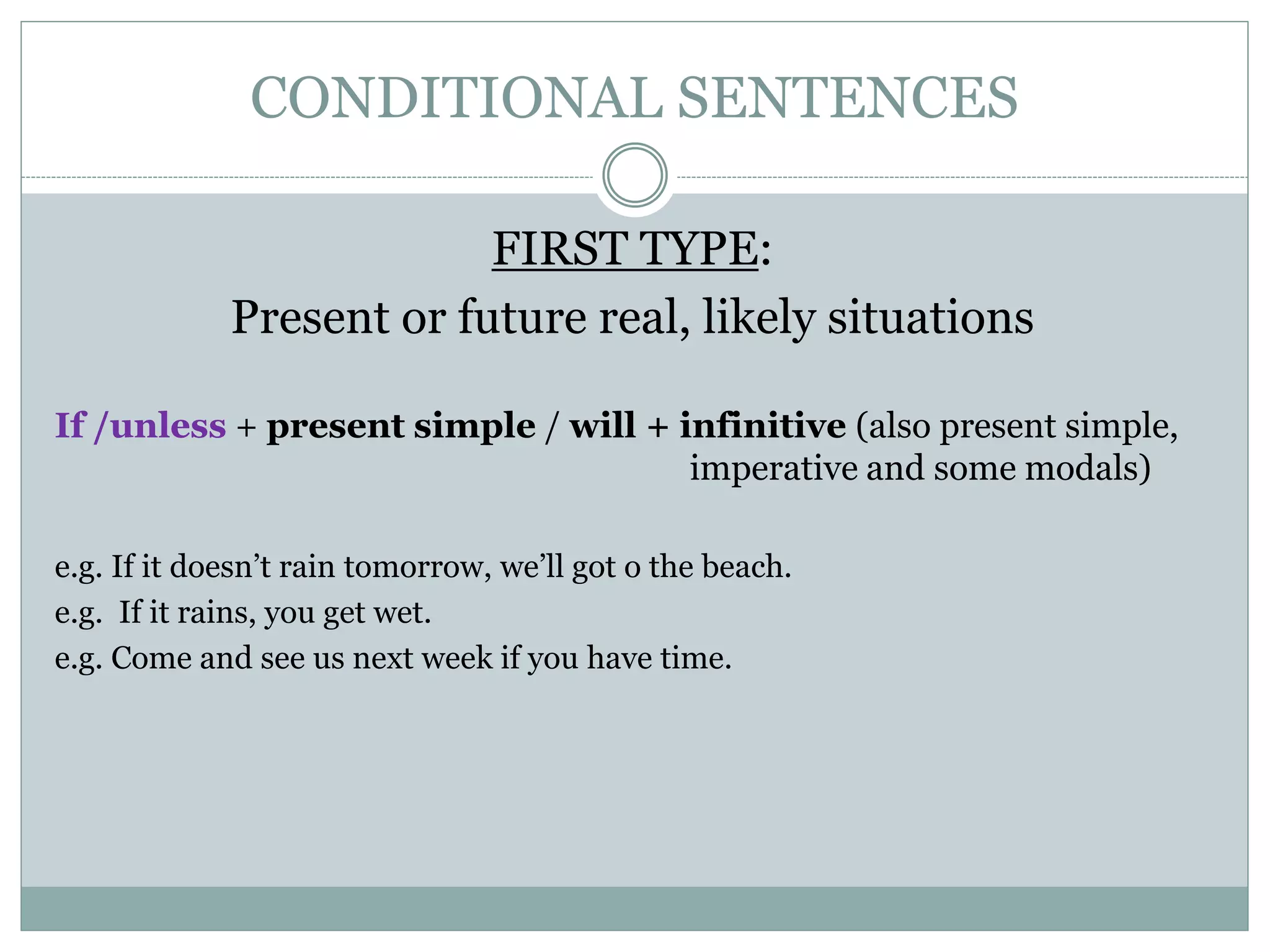
CONDITIONAL SENTENCES
FIRST TYPE:
Present or future real, likely situations
If /unless + present simple / will + infinitive (also present simple,
imperative and some modals)
e.g. If it doesn’t rain tomorrow, we’ll got o the beach.
e.g. If it rains, you get wet.
e.g. Come and see us next week if you have time.
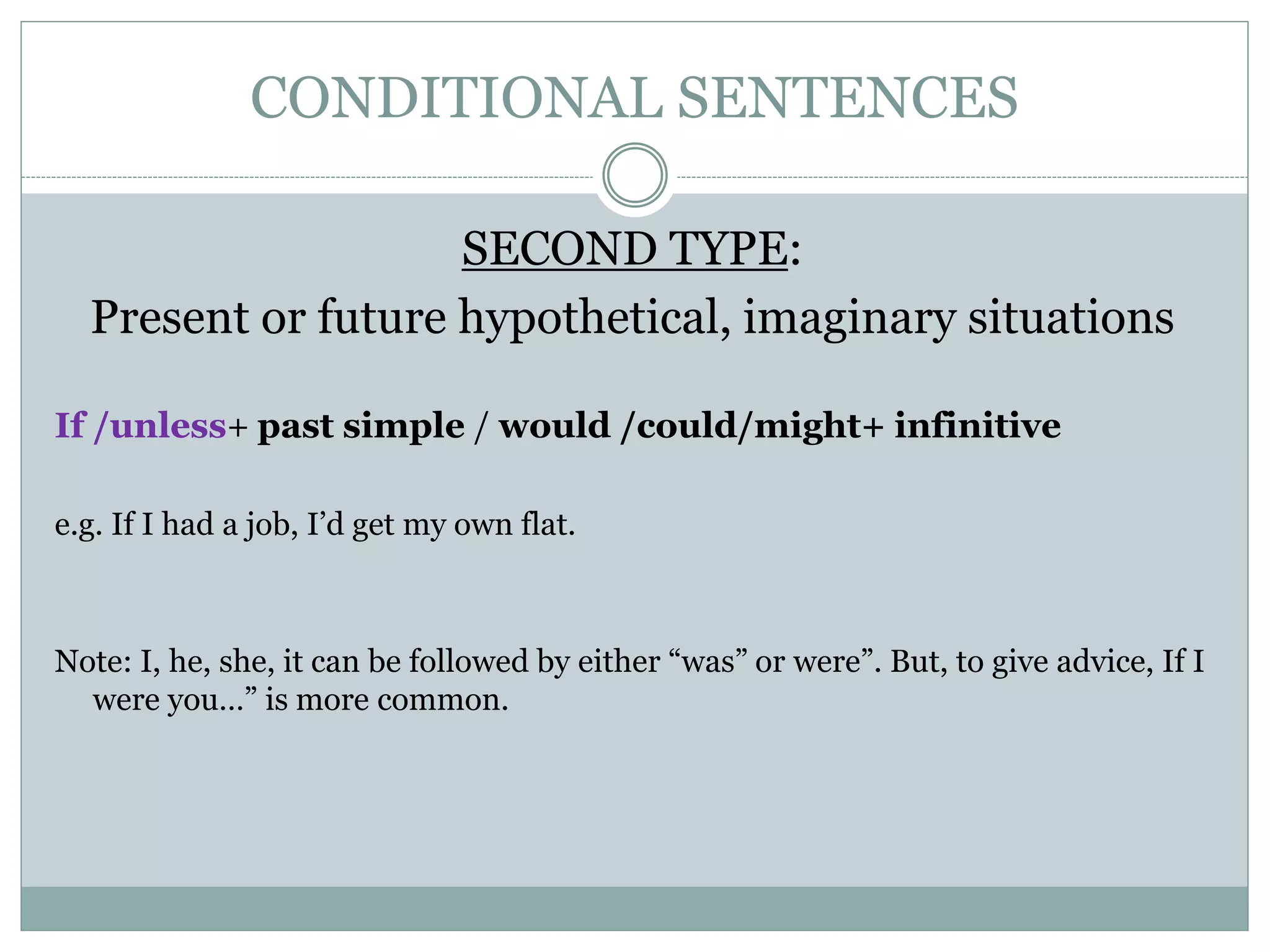
CONDITIONAL SENTENCES
SECOND TYPE:
Present or future hypothetical, imaginary situations
If /unless+ past simple / would /could/might+ infinitive
e.g. If I had a job, I’d get my own flat.
Note: I, he, she, it can be followed by either “was” or were”. But, to give advice, If I
were you…” is more common.
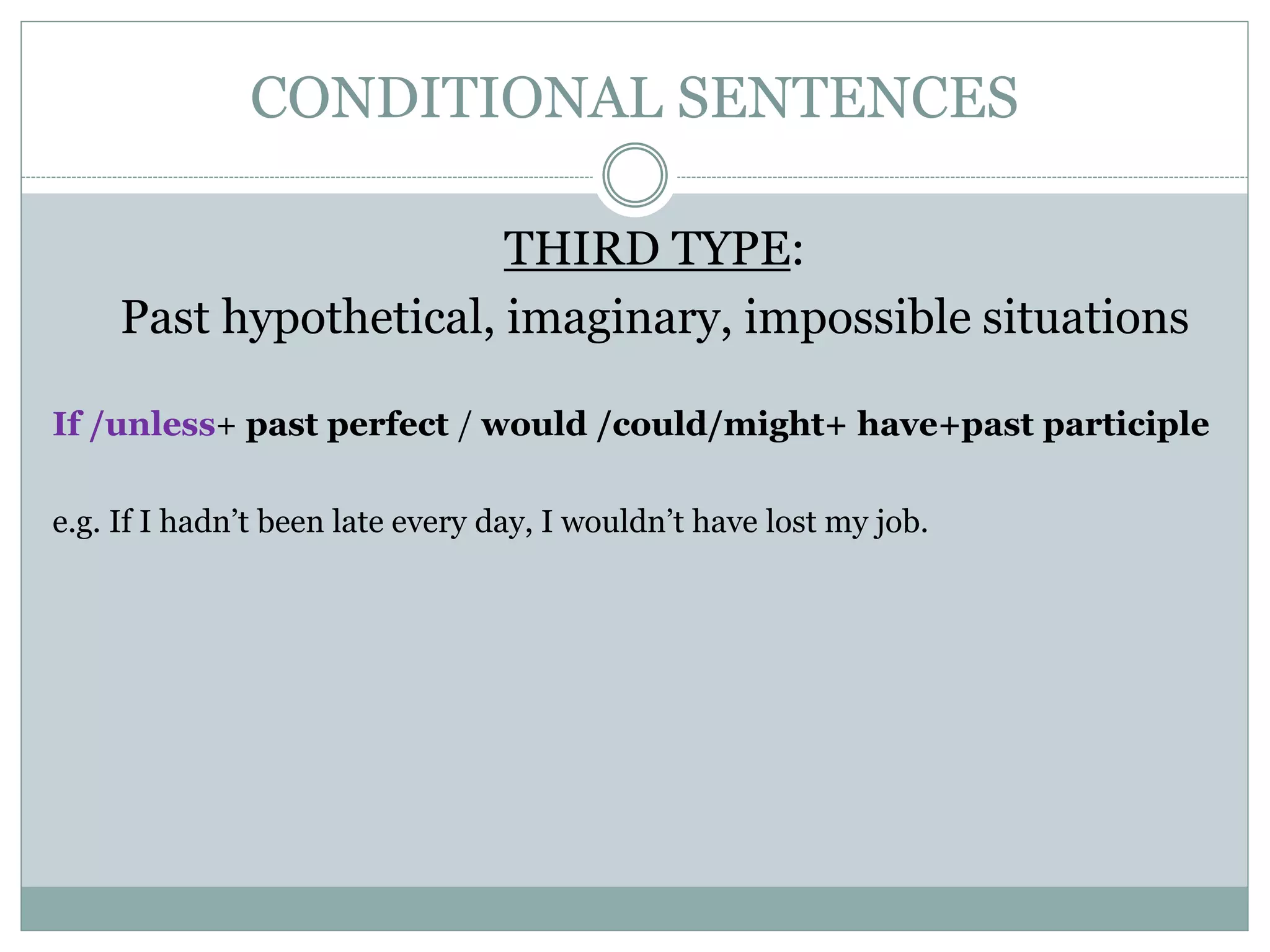
CONDITIONAL SENTENCES
THIRD TYPE:
Past hypothetical, imaginary, impossible situations
If /unless+ past perfect / would /could/might+ have+past participle
e.g. If I hadn’t been late every day, I wouldn’t have lost my job.
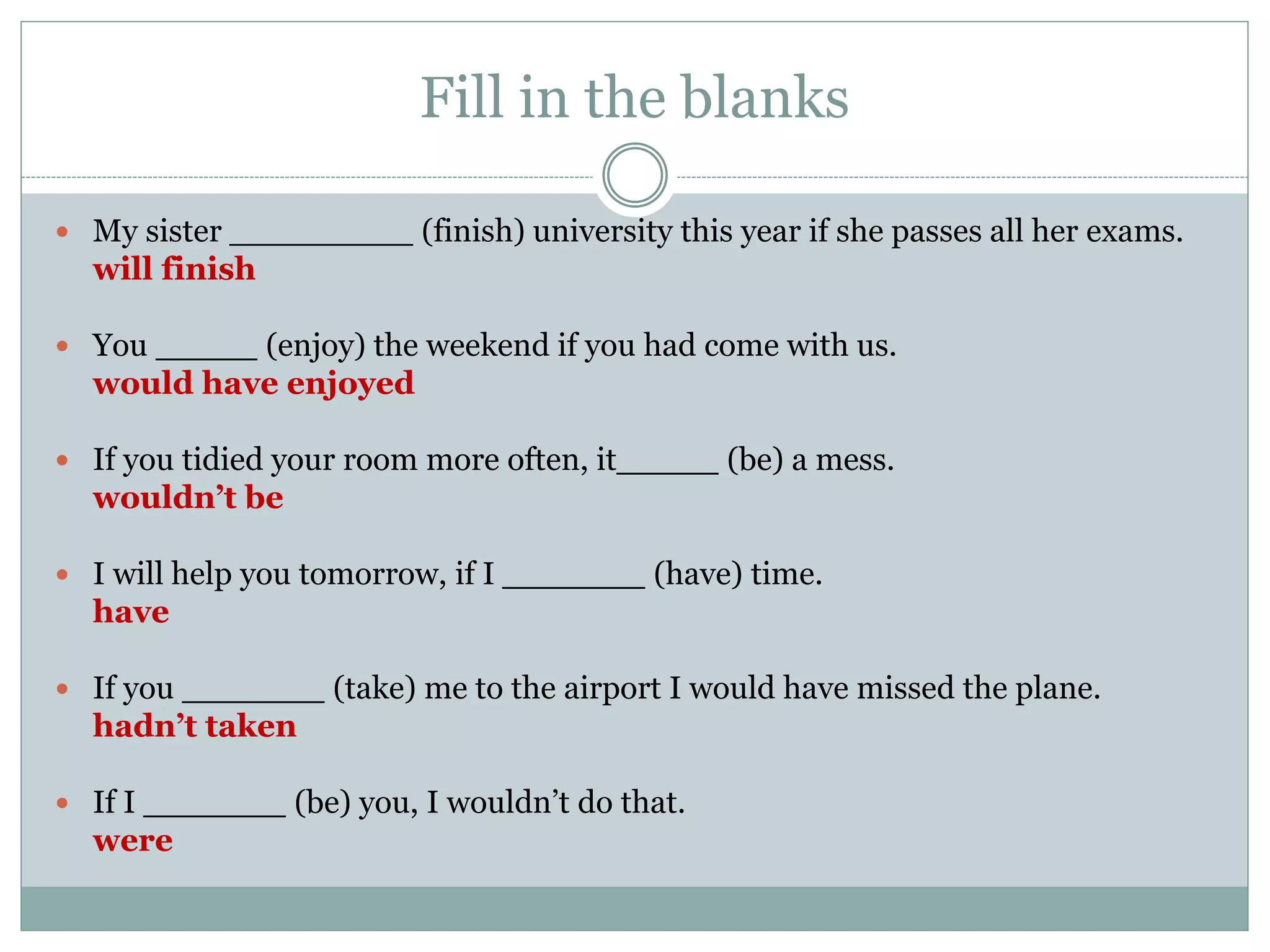
Fill in the blanks
 My sister _________ (finish) university this year if she passes all her exams.
will finish
 You _____ (enjoy) the weekend if you had come with us.
would have enjoyed
 If you tidied your room more often, it_____ (be) a mess.
wouldn’t be
 I will help you tomorrow, if I _______ (have) time.
have
 If you _______ (take) me to the airport I would have missed the plane.
hadn’t taken
 If I _______ (be) you, I wouldn’t do that.
were
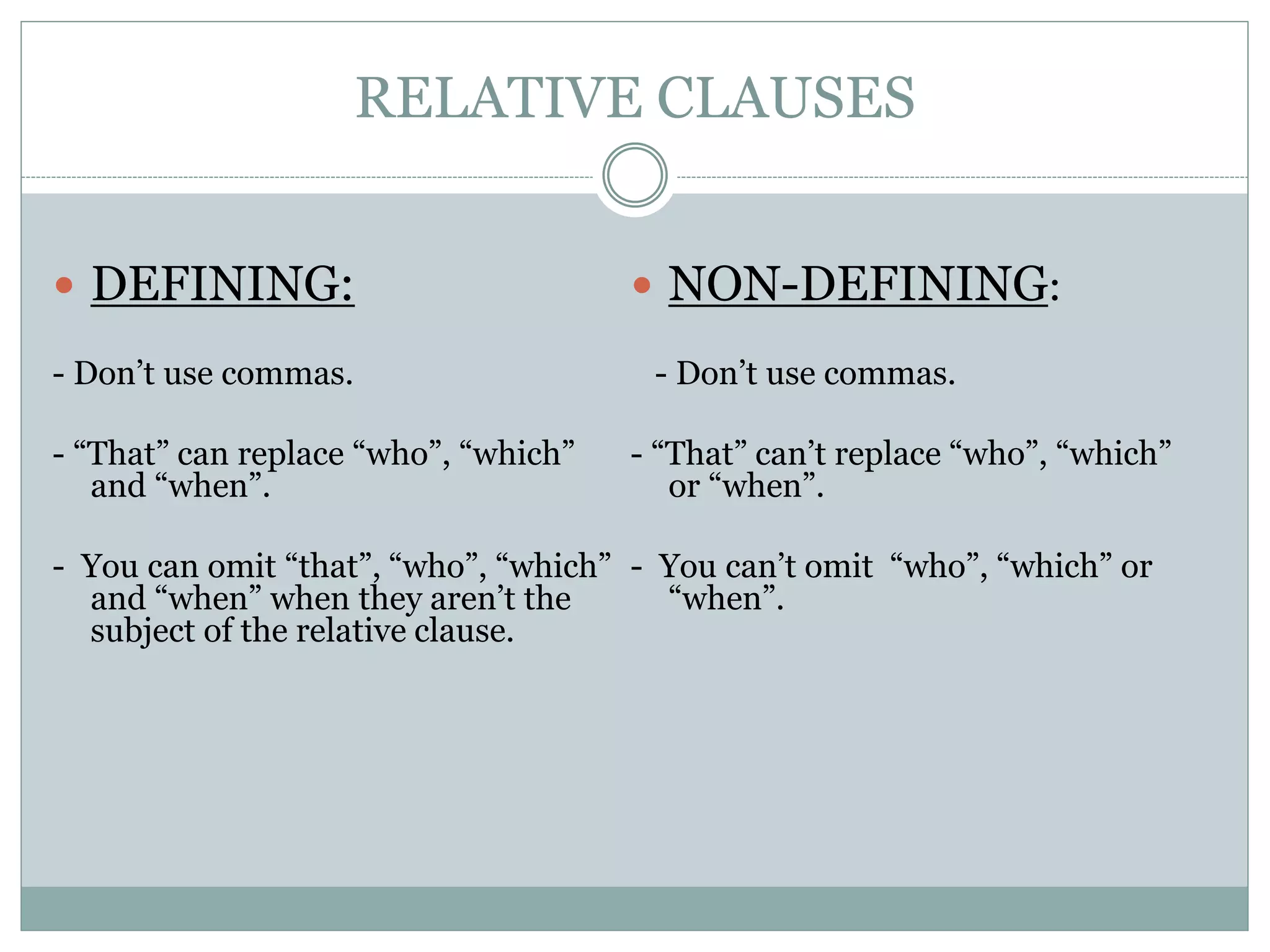
RELATIVE CLAUSES
 DEFINING:
- Don’t use commas.
- “That” can replace “who”, “which”
and “when”.
- You can omit “that”, “who”, “which”
and “when” when they aren’t the
subject of the relative clause.
 NON-DEFINING:
- Don’t use commas.
- “That” can’t replace “who”, “which”
or “when”.
- You can’t omit “who”, “which” or
“when”.
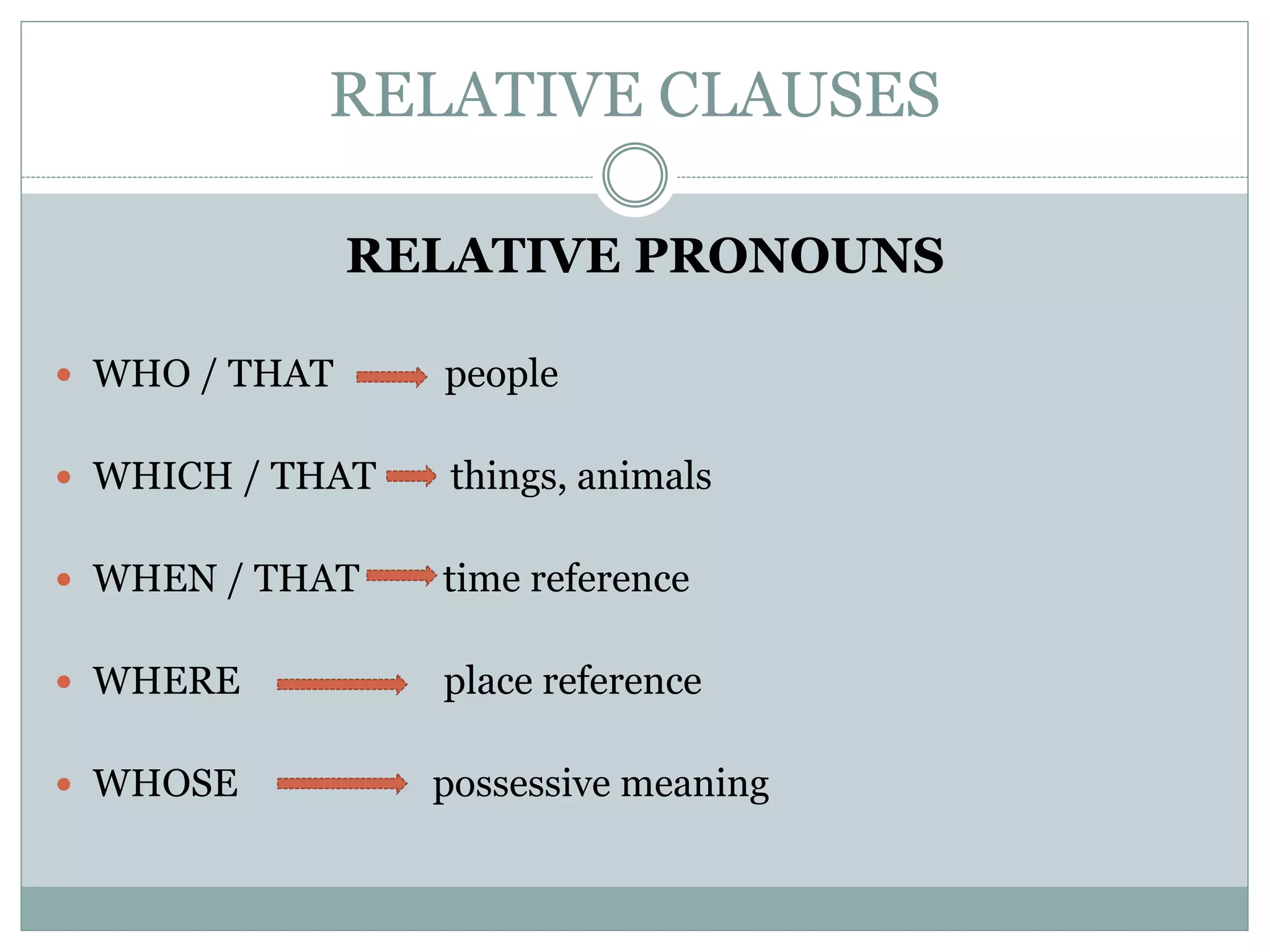
RELATIVE CLAUSES
 WHO / THAT people
 WHICH / THAT things, animals
 WHEN / THAT time reference
 WHERE place reference
 WHOSE possessive meaning
RELATIVE PRONOUNS
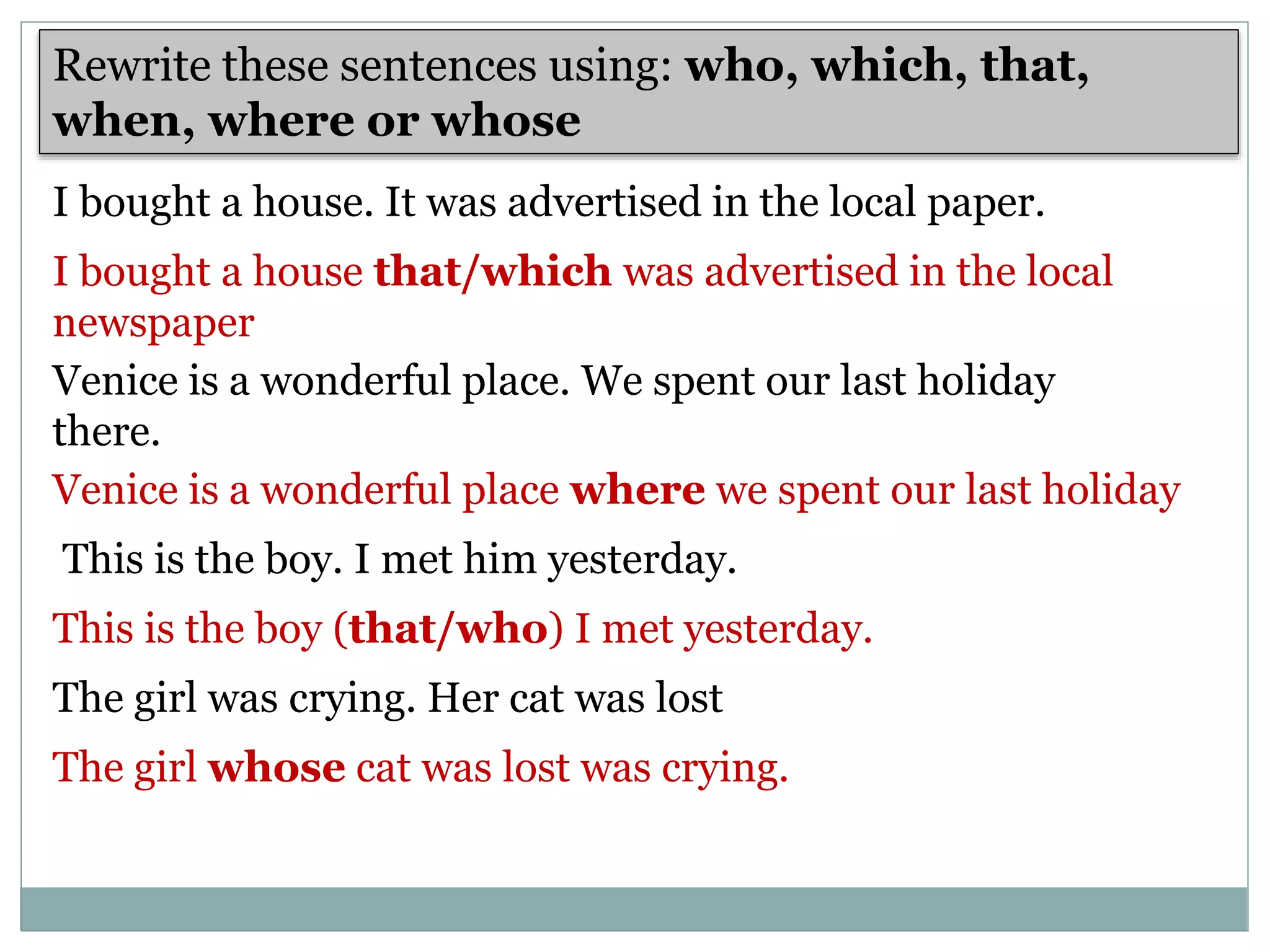
I bought a house. It was advertised in the local paper.
Rewrite these sentences using: who, which, that,
when, where or whose
I bought a house that/which was advertised in the local
newspaper
Venice is a wonderful place. We spent our last holiday
there.
Venice is a wonderful place where we spent our last holiday
This is the boy. I met him yesterday.
This is the boy (that/who) I met yesterday.
The girl was crying. Her cat was lost
The girl whose cat was lost was crying.
REPORTED SPEECH
USE
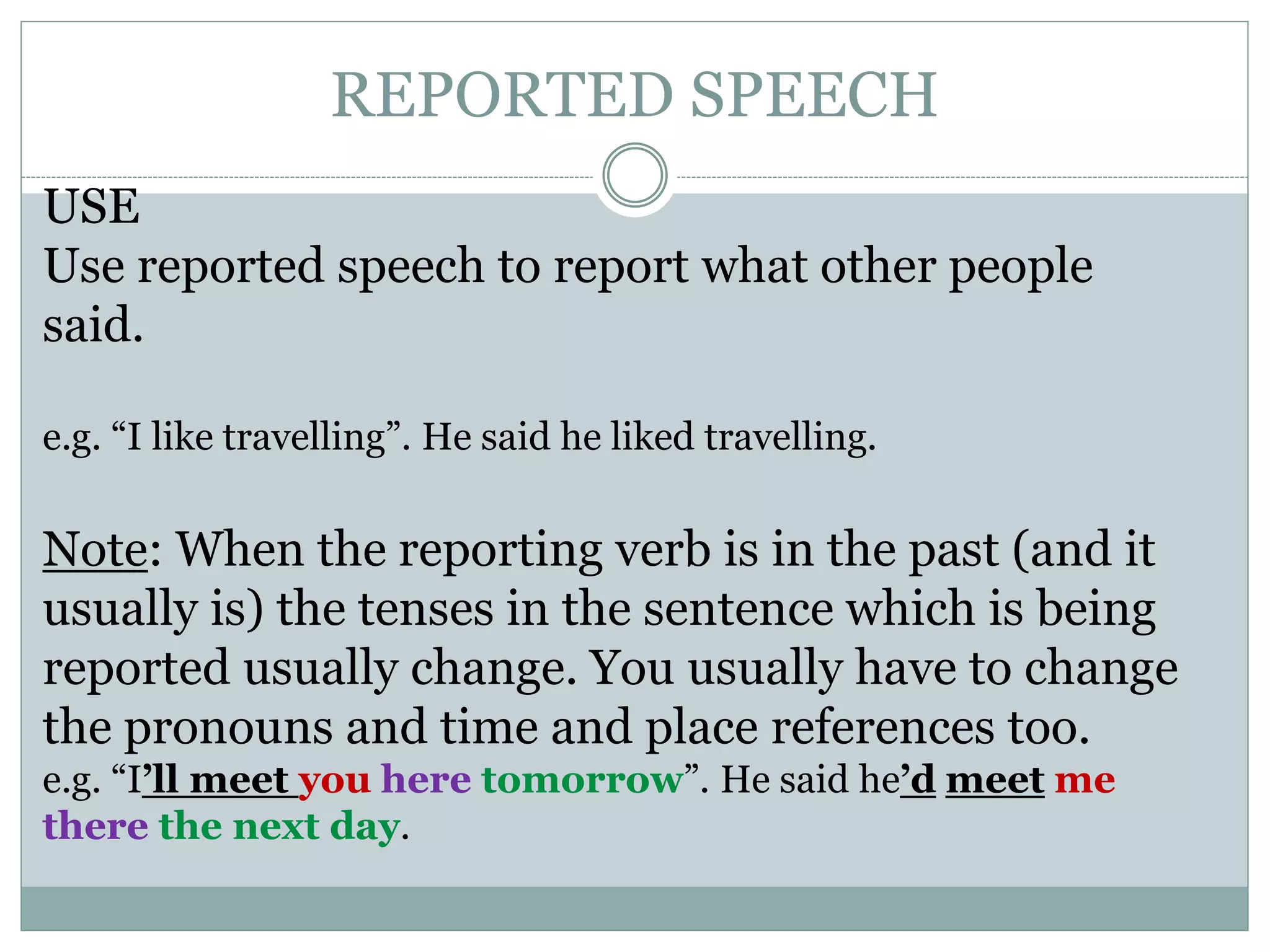
Use reported speech to report what other people
said.
e.g. “I like travelling”. He said he liked travelling.
Note: When the reporting verb is in the past (and it
usually is) the tenses in the sentence which is being
reported usually change. You usually have to change
the pronouns and time and place references too.
e.g. “I’ll meet you here tomorrow”. He said he’d meet me
there the next day.
REPORTED SPEECH
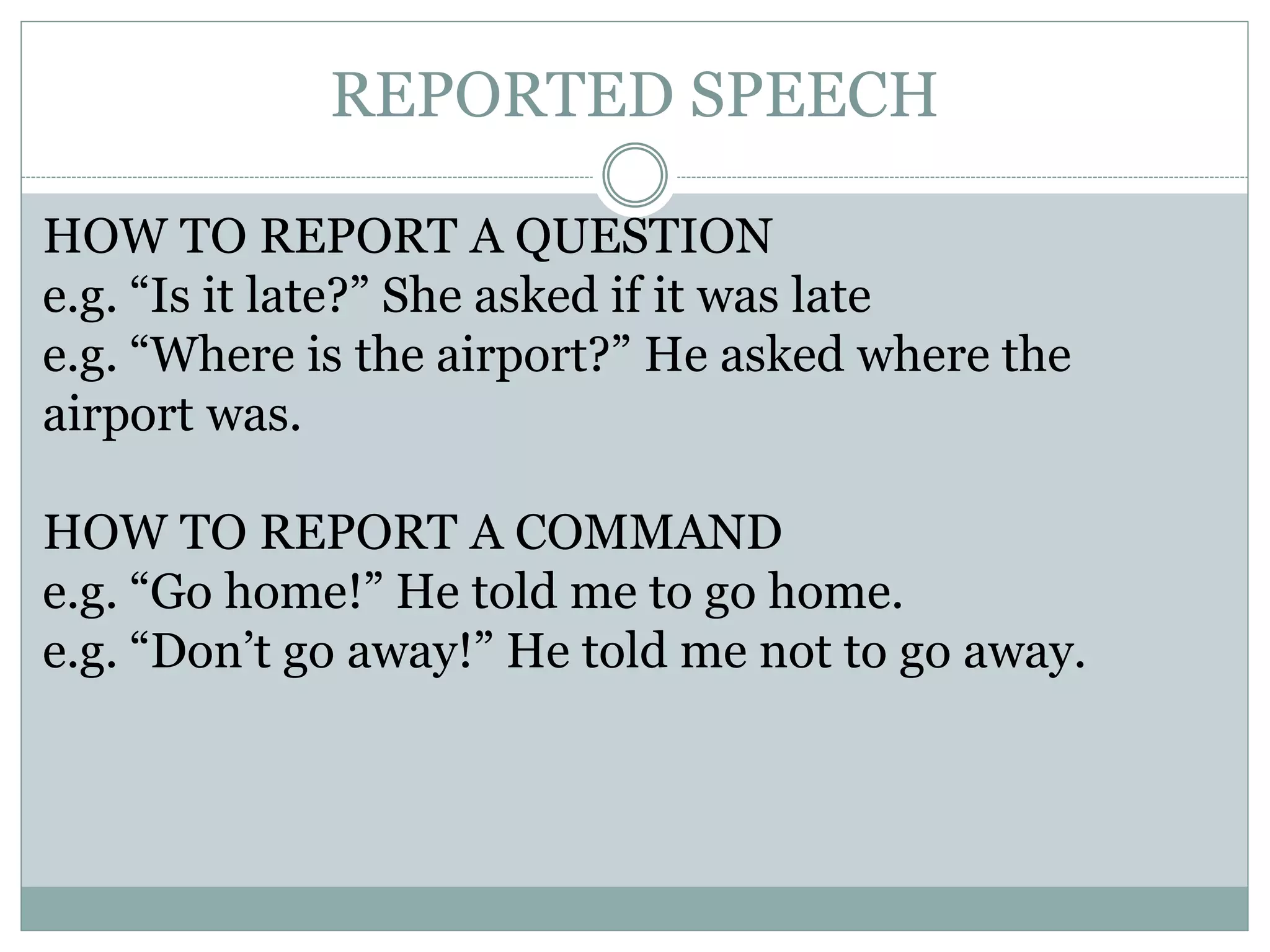
HOW TO REPORT A QUESTION
e.g. “Is it late?” She asked if it was late
e.g. “Where is the airport?” He asked where the
airport was.
HOW TO REPORT A COMMAND
e.g. “Go home!” He told me to go home.
e.g. “Don’t go away!” He told me not to go away.
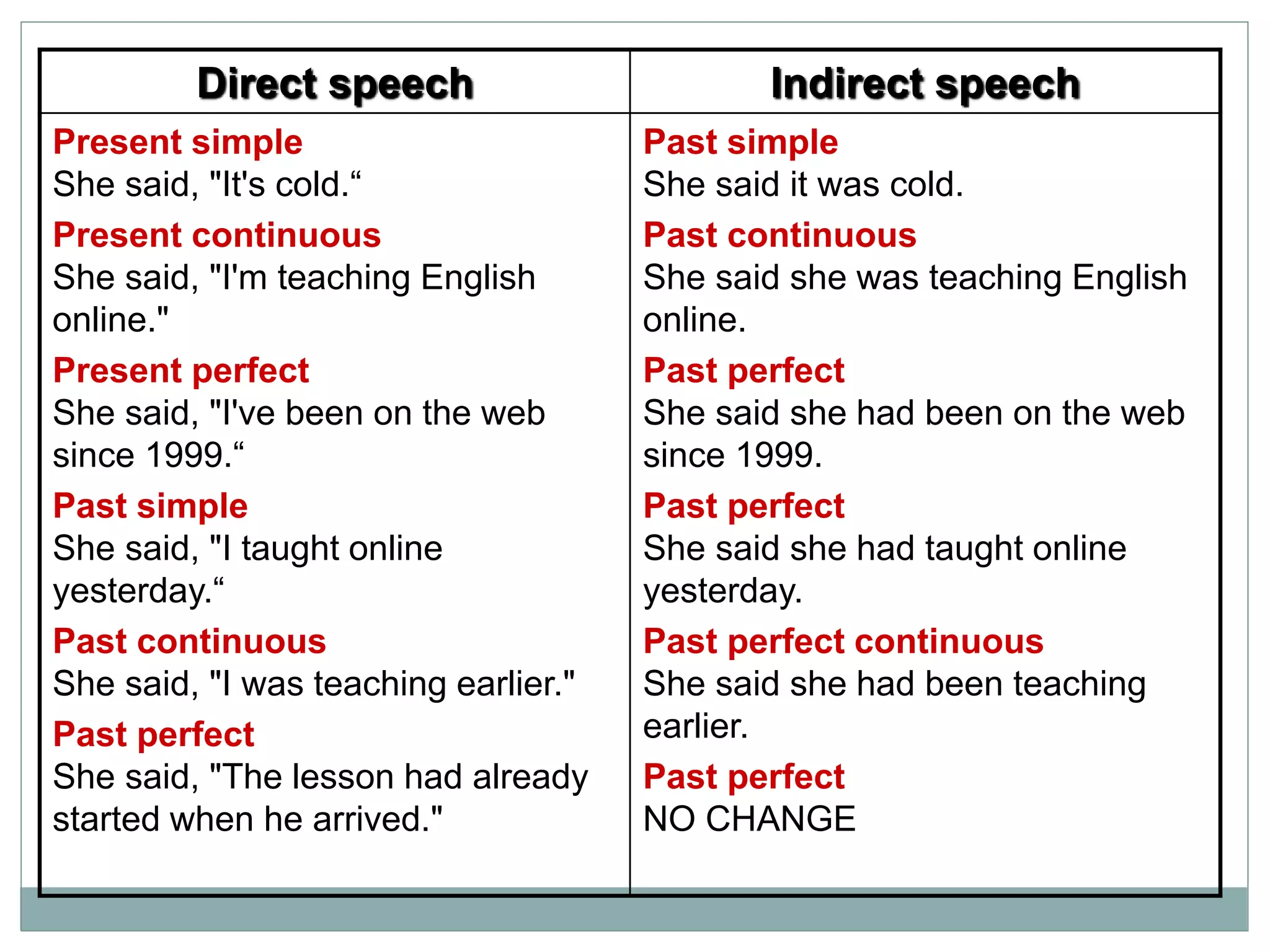
Direct speech Indirect speech
Present simple
She said, "It's cold.“
Present continuous
She said, "I'm teaching English
online."
Present perfect
She said, "I've been on the web
since 1999.“
Past simple
She said, "I taught online
yesterday.“
Past continuous
She said, "I was teaching earlier."
Past perfect
She said, "The lesson had already
started when he arrived."
Past simple
She said it was cold.
Past continuous
She said she was teaching English
online.
Past perfect
She said she had been on the web
since 1999.
Past perfect
She said she had taught online
yesterday.
Past perfect continuous
She said she had been teaching
earlier.
Past perfect
NO CHANGE
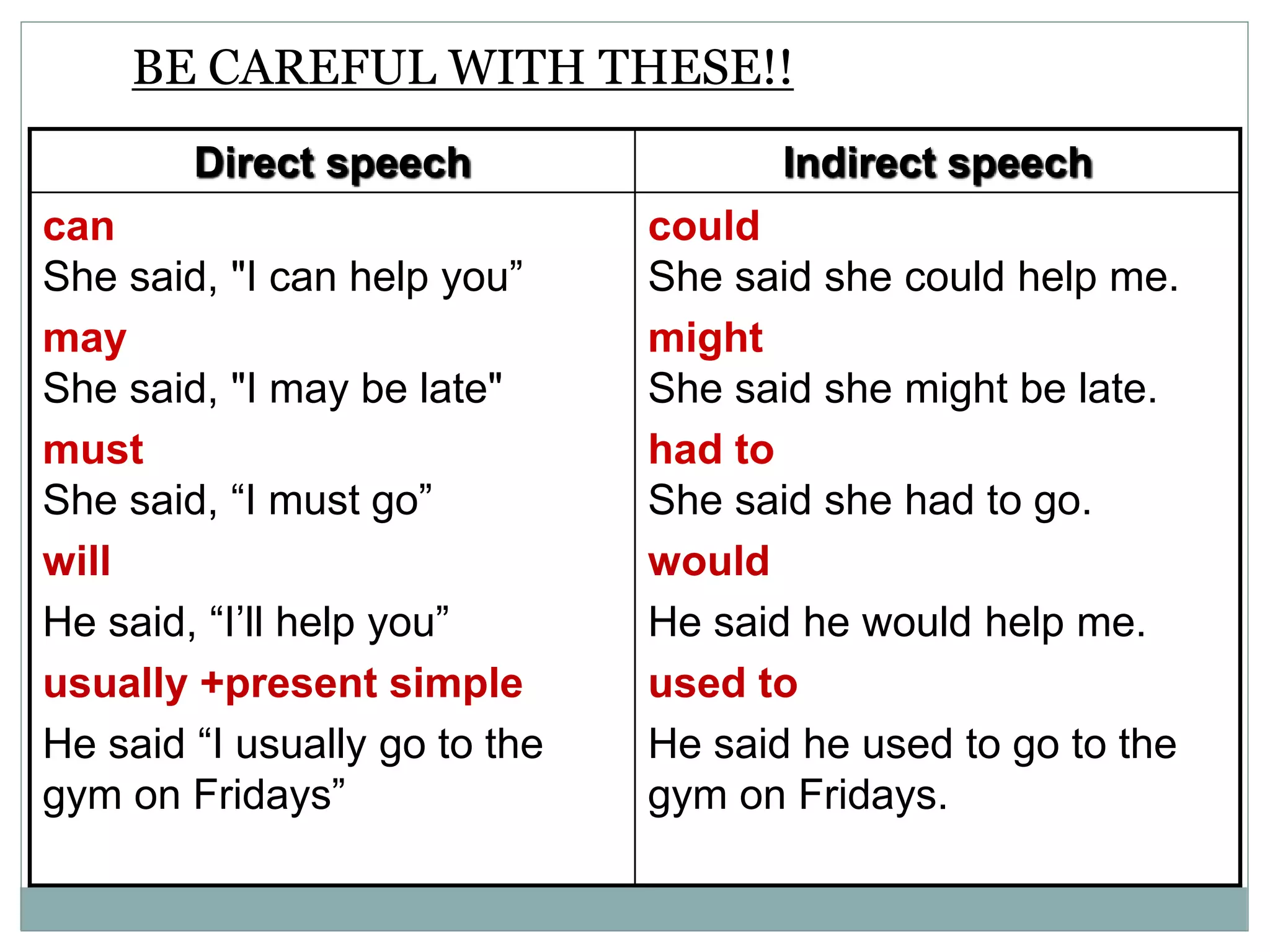
Direct speech Indirect speech
can
She said, "I can help you”
may
She said, "I may be late"
must
She said, “I must go”
will
He said, “I’ll help you”
usually +present simple
He said “I usually go to the
gym on Fridays”
could
She said she could help me.
might
She said she might be late.
had to
She said she had to go.
would
He said he would help me.
used to
He said he used to go to the
gym on Fridays.
BE CAREFUL WITH THESE!!
He said, "I have eaten my lunch.“
He said that he had eaten his lunch.
Rewrite the following in the reported speech
He said, "I am doing a degree at the university“
He said he was doing a degree at the university.
Rewrite the following in the reported speech
The teacher said to the class, "Pay attention.“
The teacher told the class to pay attention.
Rewrite the following in the reported speech
My friend said to me. "Don't be late tomorrow.“
My friend told me not to be late the next day.
Rewrite the following in the reported speech
She said to me, "Where is the hospital?.“
She asked me where the hospital was.
Rewrite the following in the reported speech
GERUNDS OR INFINITIVES
We use the gerund:
1. After prepositions and phrasal verbs.
e.g. I’m not very good at remembering names.
e.g. Mike has given up smoking.
2. As the subject of a sentence.
e.g. Driving at night is quite tiring.
e.g. Shopping is my favourite thing to do at weekends.
3. After some verbs.
e.g. I don’t mind getting up early.
e.g. I hate doing the washing up.
Note: negative gerund = not + verb + -ing
GERUNDS OR INFINITIVES
We use the infinitive with to:
1. After adjectives.
e.g. My flat is easy to find
2. To express a reason or purpose.
e.g. Monica is saving money to buy a new car.
3. To report commands and imperative sentences.
e.g. I want you to do this now.
4. After some verbs.
e.g. We decided to leave earlier.
e.g. I tried not to make noise
Note: negative infinitive = not to + verb
GERUNDS OR INFINITIVES
We use the infinitive without to:
1. After most modal and auxiliary verbs.
e.g. We must hurry.
e.g. I can’t drive.
2. After “make” and “let”.
e.g. She always makes me laugh.
e.g. My parents didn’t let me go out last night.
VOCABULARY: CINEMA
(Vocabulary bank, p. 159)
VOCABULARY: THE BODY
(Vocabulary bank, p. 160)
VOCABULARY: EDUCATION
(Vocabulary bank, p. 161)
VOCABULARY: HOUSES
(Vocabulary bank, p. 162)
VOCABULARY: WORDBUILDING
(Vocabulary bank, p. 163 AND EX 3 P. 164)
To achieve
ACHIEVEMENT
To argue
ARGUMENT
To succeed
SUCCESS
To choose
CHOICE
To complain
COMPLAINT
To lose
LOSS
To attach
ATTACHMENT
To respond
RESPONSE
To demonstrate
DEMONSTRATION
CARE
Adjectives:
- careless
+ careful
Adverbs:
- carelessly
+ carefully
LUCK
Adjectives:
- unlucky
+ lucky
Adverbs:
- unluckily
+ luckily
To apply
APPLICATION
To resign
RESIGNATION
To employ
EMPLOYMENT
To promote
PROMOTION
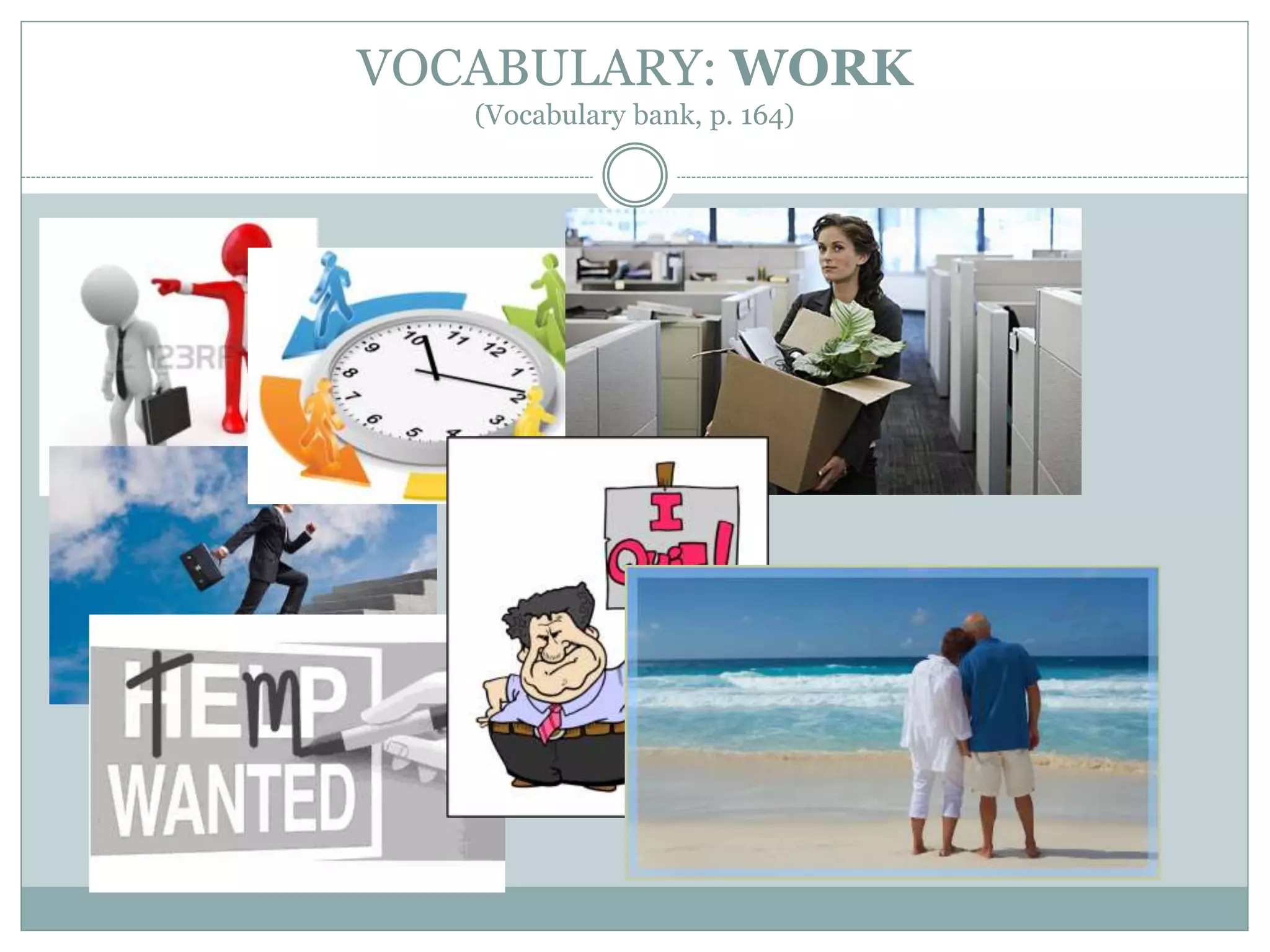
VOCABULARY: WORK
(Vocabulary bank, p. 164)

Revision third term

  • 1.
    N I VE L I N T E R M E D I O REVISION THIRD TERM
  • 2.
    SUMMARY  VERB TENSES: Revisionof all tenses  THE PASSIVE VOICE  MODAL VERBS OF DEDUCTION : may/might, can’t, must  CONDIONAL SENTENCES  RELATIVE CLAUSES (revision)  REPORTED SPEECH  INFINITIVES AND GERUNDS (revision)  QUANTIFIERS (revision)  VOCABULARY: - Cinema - The body - Education - Houses - Wordbuilding - Work
  • 3.
    PASSIVE VOICE USE We oftenuse the passive when it’s not said, known or important who does the action. FORM To turn an active verb into a passive one: write the verb “to be” in the same tense the verb was in the active and add the past participle of that same verb. e.g. He built a house A house was built. e.g. She will write a letter A letter will be written.
  • 4.
    THE PASSIVE VOICE 1.The object of the active sentence becomes the subject of the passive sentence. He wrote a letter  A letter was written by him. 2. The verb to be keeps the same tense as the main verb in the active. active: Shakespeare wrote Romeo and Juliet passive: Romeo and Juliet was written by Shakespeare 3.The subject of the active sentence becomes a prepositional complement (complemento agente) of the passive sentence (or is dropped). The Egyptians built the pyramids. The pyramids were built (by the Egyptians)
  • 5.
    THE PASSIVE VOICE BUT,BE CAREFUL!!! Sometimes there are two possible answers (two objects in the active sentence). Tim gave Lisa some flowers. Answers: Some flowers were given to Lisa by Tim. or Lisa was given some flowers by Tim. (MORE USUAL)
  • 6.
    Turn the followingactive sentences into passive sentences 1. They shoot a lot of films on location. A lot of films are shot on location. 2. The mechanic is repairing our car. Our car is being repaired by the mechanic. 3. An earthquake destroyed the city. The city was destroyed by an earthquake. 4. They were cooking paella. Paella was being cooked.
  • 7.
    5. The make-upartist has transformed the actor. The actor has been transformed by the make-up artist 6. They had never defeated the Arsenal before. The arsenal had never been defeated by them before. 7. They will release the film next summer. The film will be released next summer. 8. You must respect the rules. The rules must be respected. Turn the following active sentences into passive sentences
  • 8.
    MODAL VERBS -DEDUCTION MAY, MIGHT= you think something is possibly true e.g. I don’t know where he is. He may/might be at work or at the gym. CAN’T= you are sure something is impossible, not true e.g. That woman can’t be paul’s wife. Paul’s wife has dark hair. MUST= you are sure something is true e.g. Your sister must have a lot of money if she drives a Porsche May, might, can’t and must are modal auxiliary verbs, so they have no other forms (except for “can”, that has a past and conditional form “could”) and are followed by the infinitive without “to”. .
  • 9.
    Choose the rightoption  A:Where’s the boss today? B: I don’t know. He _______ be ill. He called to say that he’s going to the doctor’s. must  A: Why is Tom so happy? B: I don’t know. He ________ have a new girlfriend. might  A: Where’s Martha’s house? B: I don’t know. But she _______ live near the office, because she commutes everyday by train. can’t
  • 10.
    CONDITIONAL SENTENCES FIRST TYPE: Presentor future real, likely situations If /unless + present simple / will + infinitive (also present simple, imperative and some modals) e.g. If it doesn’t rain tomorrow, we’ll got o the beach. e.g. If it rains, you get wet. e.g. Come and see us next week if you have time.
  • 11.
    CONDITIONAL SENTENCES SECOND TYPE: Presentor future hypothetical, imaginary situations If /unless+ past simple / would /could/might+ infinitive e.g. If I had a job, I’d get my own flat. Note: I, he, she, it can be followed by either “was” or were”. But, to give advice, If I were you…” is more common.
  • 12.
    CONDITIONAL SENTENCES THIRD TYPE: Pasthypothetical, imaginary, impossible situations If /unless+ past perfect / would /could/might+ have+past participle e.g. If I hadn’t been late every day, I wouldn’t have lost my job.
  • 13.
    Fill in theblanks  My sister _________ (finish) university this year if she passes all her exams. will finish  You _____ (enjoy) the weekend if you had come with us. would have enjoyed  If you tidied your room more often, it_____ (be) a mess. wouldn’t be  I will help you tomorrow, if I _______ (have) time. have  If you _______ (take) me to the airport I would have missed the plane. hadn’t taken  If I _______ (be) you, I wouldn’t do that. were
  • 14.
    RELATIVE CLAUSES  DEFINING: -Don’t use commas. - “That” can replace “who”, “which” and “when”. - You can omit “that”, “who”, “which” and “when” when they aren’t the subject of the relative clause.  NON-DEFINING: - Don’t use commas. - “That” can’t replace “who”, “which” or “when”. - You can’t omit “who”, “which” or “when”.
  • 15.
    RELATIVE CLAUSES  WHO/ THAT people  WHICH / THAT things, animals  WHEN / THAT time reference  WHERE place reference  WHOSE possessive meaning RELATIVE PRONOUNS
  • 16.
    I bought ahouse. It was advertised in the local paper. Rewrite these sentences using: who, which, that, when, where or whose I bought a house that/which was advertised in the local newspaper Venice is a wonderful place. We spent our last holiday there. Venice is a wonderful place where we spent our last holiday This is the boy. I met him yesterday. This is the boy (that/who) I met yesterday. The girl was crying. Her cat was lost The girl whose cat was lost was crying.
  • 17.
    REPORTED SPEECH USE Use reportedspeech to report what other people said. e.g. “I like travelling”. He said he liked travelling. Note: When the reporting verb is in the past (and it usually is) the tenses in the sentence which is being reported usually change. You usually have to change the pronouns and time and place references too. e.g. “I’ll meet you here tomorrow”. He said he’d meet me there the next day.
  • 18.
    REPORTED SPEECH HOW TOREPORT A QUESTION e.g. “Is it late?” She asked if it was late e.g. “Where is the airport?” He asked where the airport was. HOW TO REPORT A COMMAND e.g. “Go home!” He told me to go home. e.g. “Don’t go away!” He told me not to go away.
  • 19.
    Direct speech Indirectspeech Present simple She said, "It's cold.“ Present continuous She said, "I'm teaching English online." Present perfect She said, "I've been on the web since 1999.“ Past simple She said, "I taught online yesterday.“ Past continuous She said, "I was teaching earlier." Past perfect She said, "The lesson had already started when he arrived." Past simple She said it was cold. Past continuous She said she was teaching English online. Past perfect She said she had been on the web since 1999. Past perfect She said she had taught online yesterday. Past perfect continuous She said she had been teaching earlier. Past perfect NO CHANGE
  • 20.
    Direct speech Indirectspeech can She said, "I can help you” may She said, "I may be late" must She said, “I must go” will He said, “I’ll help you” usually +present simple He said “I usually go to the gym on Fridays” could She said she could help me. might She said she might be late. had to She said she had to go. would He said he would help me. used to He said he used to go to the gym on Fridays. BE CAREFUL WITH THESE!!
  • 21.
    He said, "Ihave eaten my lunch.“ He said that he had eaten his lunch. Rewrite the following in the reported speech
  • 22.
    He said, "Iam doing a degree at the university“ He said he was doing a degree at the university. Rewrite the following in the reported speech
  • 23.
    The teacher saidto the class, "Pay attention.“ The teacher told the class to pay attention. Rewrite the following in the reported speech
  • 24.
    My friend saidto me. "Don't be late tomorrow.“ My friend told me not to be late the next day. Rewrite the following in the reported speech
  • 25.
    She said tome, "Where is the hospital?.“ She asked me where the hospital was. Rewrite the following in the reported speech
  • 26.
    GERUNDS OR INFINITIVES Weuse the gerund: 1. After prepositions and phrasal verbs. e.g. I’m not very good at remembering names. e.g. Mike has given up smoking. 2. As the subject of a sentence. e.g. Driving at night is quite tiring. e.g. Shopping is my favourite thing to do at weekends. 3. After some verbs. e.g. I don’t mind getting up early. e.g. I hate doing the washing up. Note: negative gerund = not + verb + -ing
  • 27.
    GERUNDS OR INFINITIVES Weuse the infinitive with to: 1. After adjectives. e.g. My flat is easy to find 2. To express a reason or purpose. e.g. Monica is saving money to buy a new car. 3. To report commands and imperative sentences. e.g. I want you to do this now. 4. After some verbs. e.g. We decided to leave earlier. e.g. I tried not to make noise Note: negative infinitive = not to + verb
  • 28.
    GERUNDS OR INFINITIVES Weuse the infinitive without to: 1. After most modal and auxiliary verbs. e.g. We must hurry. e.g. I can’t drive. 2. After “make” and “let”. e.g. She always makes me laugh. e.g. My parents didn’t let me go out last night.
  • 29.
  • 30.
  • 31.
  • 32.
  • 33.
    VOCABULARY: WORDBUILDING (Vocabulary bank,p. 163 AND EX 3 P. 164) To achieve ACHIEVEMENT To argue ARGUMENT To succeed SUCCESS To choose CHOICE To complain COMPLAINT To lose LOSS To attach ATTACHMENT To respond RESPONSE To demonstrate DEMONSTRATION CARE Adjectives: - careless + careful Adverbs: - carelessly + carefully LUCK Adjectives: - unlucky + lucky Adverbs: - unluckily + luckily To apply APPLICATION To resign RESIGNATION To employ EMPLOYMENT To promote PROMOTION
  • 34.