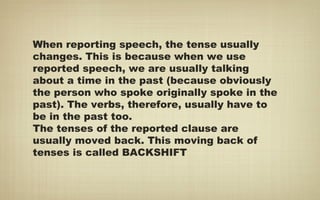
When reporting speech, the tense usually
changes. This is because when we use
reported speech, we are usually talking
about a time in the past (because obviously
the person who spoke originally spoke in the
past). The verbs, therefore, usually have to
be in the past too.
The tenses of the reported clause are
usually moved back. This moving back of
tenses is called BACKSHIFT
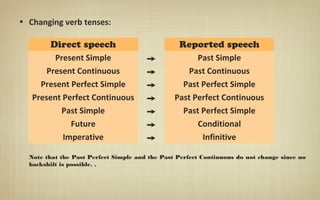
• Changing verb tenses:
Note that the Past Perfect Simple and the Past Perfect Continuous do not change since no
backshift is possible. .
Direct speech Reported speech
Present Simple ➙ Past Simple
Present Continuous ➙ Past Continuous
Present Perfect Simple ➙ Past Perfect Simple
Present Perfect Continuous ➙ Past Perfect Continuous
Past Simple ➙ Past Perfect Simple
Future ➙ Conditional
Imperative ➙ Infinitive
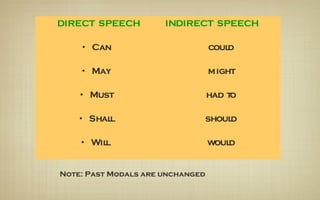
DIRECT SPEECH INDIRECT SPEECH
• Can could
• May might
• Must had to
• Shall should
• Will would
Note: Past Modals are unchanged
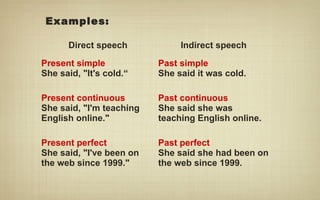
Direct speech Indirect speech
Present simple
She said, "It's cold.“
Present continuous
She said, "I'm teaching
English online."
Present perfect
She said, "I've been on
the web since 1999."
Past simple
She said it was cold.
Past continuous
She said she was
teaching English online.
Past perfect
She said she had been on
the web since 1999.
Examples:
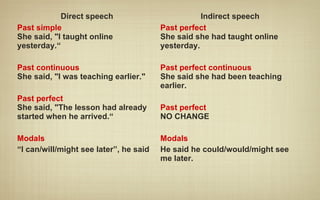
Direct speech Indirect speech
Past simple
She said, "I taught online
yesterday.“
Past continuous
She said, "I was teaching earlier."
Past perfect
She said, "The lesson had already
started when he arrived.“
Modals
“I can/will/might see later”, he said
Past perfect
She said she had taught online
yesterday.
Past perfect continuous
She said she had been teaching
earlier.
Past perfect
NO CHANGE
Modals
He said he could/would/might see
me later.
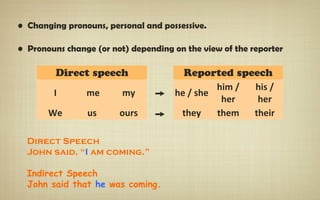
• Changing pronouns, personal and possessive.
• Pronouns change (or not) depending on the view of the reporter
Direct speech Reported speech
I me my ➙ he / she
him /
her
his /
her
We us ours ➙ they them their
Direct Speech
John said, “I am coming.”
Indirect Speech
John said that he was coming.
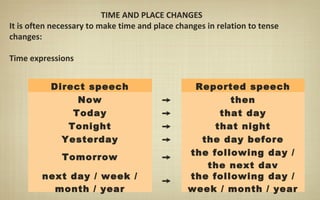
TIME AND PLACE CHANGES
It is often necessary to make time and place changes in relation to tense
changes:
Time expressions
Direct speech Reported speech
Now ➙ then
Today ➙ that day
Tonight ➙ that night
Yesterday ➙ the day before
Tomorrow ➙ the following day /
the next day
next day / week /
month / year
➙ the following day /
week / month / year
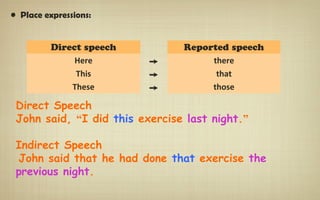
• Place expressions:
Direct speech Reported speech
Here ➙ there
This ➙ that
These ➙ those
Direct Speech
John said, “I did this exercise last night.”
Indirect Speech
 John said that he had done that exercise the
previous night.
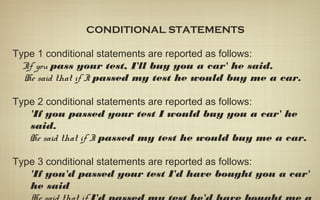
CONDITIONAL STATEMENTS
Type 1 conditional statements are reported as follows:
'If you pass your test, I'll buy you a car' he said.
He said that if I passed my test he would buy me a car.
Type 2 conditional statements are reported as follows:
'If you passed your test I would buy you a car' he
said.
He said that if I passed my test he would buy me a car.
Type 3 conditional statements are reported as follows:
'If you'd passed your test I'd have bought you a car'
he said
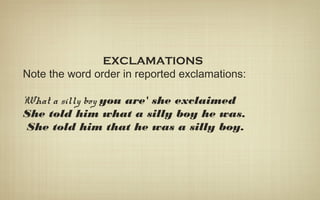
EXCLAMATIONS
Note the word order in reported exclamations:
'What a silly boy you are' she exclaimed
She told him what a silly boy he was.
She told him that he was a silly boy.
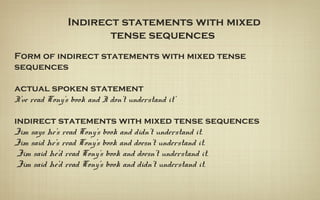
Indirect statements with mixed
tense sequences
Form of indirect statements with mixed tense
sequences
actual spoken statement
I've read Tony's book and I don't understand it'
indirect statements with mixed tense sequences
Jim says he's read Tony's book and didn't understand it.
Jim said he's read Tony's book and doesn’t understand it.
Jim said he'd read Tony's book and doesn't understand it.
Jim said he’d read Tony's book and didn't understand it.
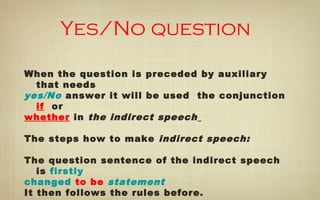
Yes/No question
When the question is preceded by auxiliary
that needs
yes/No answer it will be used the conjunction
if or
whether in the indirect speech
The steps how to make indirect speech:
The question sentence of the indirect speech
is firstly
changed to be statement
It then follows the rules before.
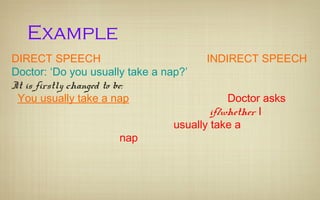
Example
DIRECT SPEECH INDIRECT SPEECH
Doctor: ‘Do you usually take a nap?’
It is firstly changed to be:
You usually take a nap Doctor asks
if/whether I
usually take a
nap
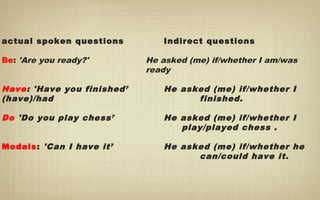
actual spoken questions Indirect questions
Be: 'Are you ready?' He asked (me) if/whether I am/was
ready
Have: 'Have you finished? He asked (me) if/whether I
(have)/had finished.
Do 'Do you play chess? He asked (me) if/whether I
play/played chess .
Modals: 'Can I have it? He asked (me) if/whether he
can/could have it.
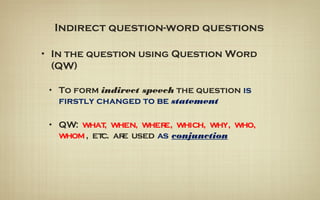
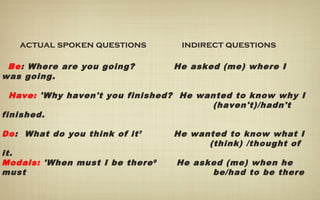
Indirect question-word questions
• In the question using Question Word
(QW)
• To form indirect speech the question is
firstly changed to be statement
• QW: what, when, where, which, why, who,
whom, etc. are used as conjunction
actual spoken questions indirect questions
Be: Where are you going? He asked (me) where I
was going.
Have: 'Why haven't you finished? He wanted to know why I
(haven't)/hadn't
finished.
Do: What do you think of it? He wanted to know what I
(think) /thought of
it.
Modals: 'When must I be there9 He asked (me) when he
must be/had to be there
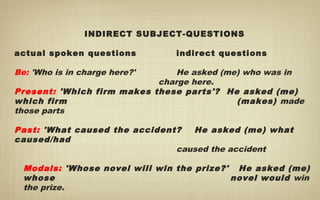
INDIRECT SUBJECT-QUESTIONS
actual spoken questions indirect questions
Be: 'Who is in charge here?' He asked (me) who was in
charge here.
Present: 'Which firm makes these parts'? He asked (me)
which firm (makes) made
those parts
Past: 'What caused the accident? He asked (me) what
caused/had
caused the accident
Modals: 'Whose novel will win the prize?' He asked (me)
whose novel would win
the prize.
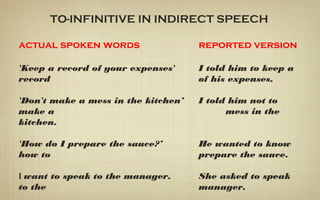
TO-INFINITIVE IN INDIRECT SPEECH
actual spoken words reported version
'Keep a record of your expenses' I told him to keep a
record of his expenses.
'Don't make a mess in the kitchen’ I told him not to
make a mess in the
kitchen.
'How do I prepare the sauce?’ He wanted to know
how to prepare the sauce.
I want to speak to the manager. She asked to speak
to the manager.
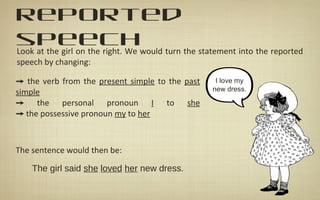
reported
speechLook at the girl on the right. We would turn the statement into the reported
speech by changing:
I love my
new dress.
➙ the verb from the present simple to the past
simple
➙ the personal pronoun I to she
➙ the possessive pronoun my to her
The sentence would then be:
The girl said she loved her new dress.
reported
speechThere are several reporting verbs we can use:
➙ The most commonly used one is to say.
She said she was studying.
➙ When the person who we are talking to is referred, we can use to tell.
You told me you liked your new dress.
➙ We may report something that was said without keeping to the original
words, the reporting verb itself may contain that idea or intention. The verbs
here can be: to admit, to advise, to agree, to remind, to suggest, to
encourage, to insist, to persuade, to warn, to refuse, to urge, among others.
- I admit it, I did it!
She admitted she did it.
reported
speech
Time to practise!
Look at the images that will appear and change what the characters say into
the reported speech. Take in consideration all the changes that must occur: in
the verbs, the pronouns and the expressions of time and place.
reported
speech
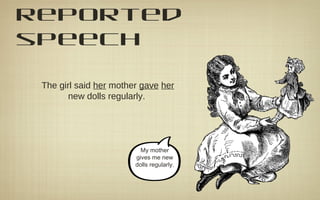
The girl said her mother gave her
new dolls regularly.
My mother
gives me new
dolls regularly.
reported
speech
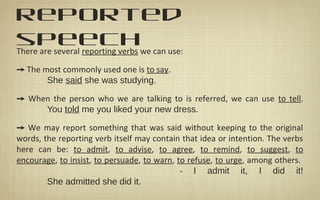
The woman said her book was being very
interesting.
My book
is being very
interesting!
reported
speech
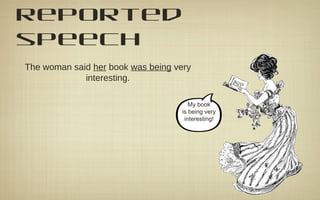
The man said he had been so tired he passed
out on the middle of the street.
I was
so tired I passed
out on the middle
of the street.
reported
speech
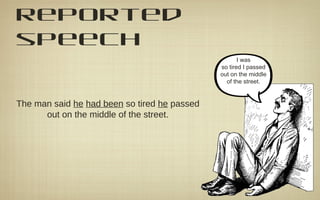
The woman said it had been years since she
had had that much fun.
It has been
years since I’ve
had this much
fun!
reported
speech
The girl said she would catch a fish that day.
I will catch
a fish
today!
reported
speech
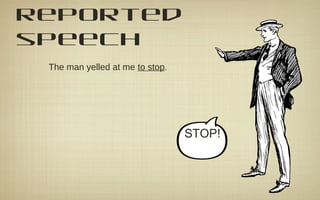
The man yelled at me to stop.
STOP!
REPORTED SPEECH
REPORTED SPEECH

REPORTED SPEECH

  • 2.
    When reporting speech,the tense usually changes. This is because when we use reported speech, we are usually talking about a time in the past (because obviously the person who spoke originally spoke in the past). The verbs, therefore, usually have to be in the past too. The tenses of the reported clause are usually moved back. This moving back of tenses is called BACKSHIFT
  • 3.
    • Changing verbtenses: Note that the Past Perfect Simple and the Past Perfect Continuous do not change since no backshift is possible. . Direct speech Reported speech Present Simple ➙ Past Simple Present Continuous ➙ Past Continuous Present Perfect Simple ➙ Past Perfect Simple Present Perfect Continuous ➙ Past Perfect Continuous Past Simple ➙ Past Perfect Simple Future ➙ Conditional Imperative ➙ Infinitive
  • 4.
    DIRECT SPEECH INDIRECTSPEECH • Can could • May might • Must had to • Shall should • Will would Note: Past Modals are unchanged
  • 5.
    Direct speech Indirectspeech Present simple She said, "It's cold.“ Present continuous She said, "I'm teaching English online." Present perfect She said, "I've been on the web since 1999." Past simple She said it was cold. Past continuous She said she was teaching English online. Past perfect She said she had been on the web since 1999. Examples:
  • 6.
    Direct speech Indirectspeech Past simple She said, "I taught online yesterday.“ Past continuous She said, "I was teaching earlier." Past perfect She said, "The lesson had already started when he arrived.“ Modals “I can/will/might see later”, he said Past perfect She said she had taught online yesterday. Past perfect continuous She said she had been teaching earlier. Past perfect NO CHANGE Modals He said he could/would/might see me later.
  • 7.
    • Changing pronouns,personal and possessive. • Pronouns change (or not) depending on the view of the reporter Direct speech Reported speech I me my ➙ he / she him / her his / her We us ours ➙ they them their Direct Speech John said, “I am coming.” Indirect Speech John said that he was coming.
  • 8.
    TIME AND PLACECHANGES It is often necessary to make time and place changes in relation to tense changes: Time expressions Direct speech Reported speech Now ➙ then Today ➙ that day Tonight ➙ that night Yesterday ➙ the day before Tomorrow ➙ the following day / the next day next day / week / month / year ➙ the following day / week / month / year
  • 9.
    • Place expressions: Directspeech Reported speech Here ➙ there This ➙ that These ➙ those Direct Speech John said, “I did this exercise last night.” Indirect Speech  John said that he had done that exercise the previous night.
  • 10.
    CONDITIONAL STATEMENTS Type 1conditional statements are reported as follows: 'If you pass your test, I'll buy you a car' he said. He said that if I passed my test he would buy me a car. Type 2 conditional statements are reported as follows: 'If you passed your test I would buy you a car' he said. He said that if I passed my test he would buy me a car. Type 3 conditional statements are reported as follows: 'If you'd passed your test I'd have bought you a car' he said
  • 11.
    EXCLAMATIONS Note the wordorder in reported exclamations: 'What a silly boy you are' she exclaimed She told him what a silly boy he was. She told him that he was a silly boy.
  • 12.
    Indirect statements withmixed tense sequences Form of indirect statements with mixed tense sequences actual spoken statement I've read Tony's book and I don't understand it' indirect statements with mixed tense sequences Jim says he's read Tony's book and didn't understand it. Jim said he's read Tony's book and doesn’t understand it. Jim said he'd read Tony's book and doesn't understand it. Jim said he’d read Tony's book and didn't understand it.
  • 13.
    Yes/No question When thequestion is preceded by auxiliary that needs yes/No answer it will be used the conjunction if or whether in the indirect speech The steps how to make indirect speech: The question sentence of the indirect speech is firstly changed to be statement It then follows the rules before.
  • 14.
    Example DIRECT SPEECH INDIRECTSPEECH Doctor: ‘Do you usually take a nap?’ It is firstly changed to be: You usually take a nap Doctor asks if/whether I usually take a nap
  • 15.
    actual spoken questionsIndirect questions Be: 'Are you ready?' He asked (me) if/whether I am/was ready Have: 'Have you finished? He asked (me) if/whether I (have)/had finished. Do 'Do you play chess? He asked (me) if/whether I play/played chess . Modals: 'Can I have it? He asked (me) if/whether he can/could have it.
  • 16.
    Indirect question-word questions •In the question using Question Word (QW) • To form indirect speech the question is firstly changed to be statement • QW: what, when, where, which, why, who, whom, etc. are used as conjunction
  • 17.
    actual spoken questionsindirect questions Be: Where are you going? He asked (me) where I was going. Have: 'Why haven't you finished? He wanted to know why I (haven't)/hadn't finished. Do: What do you think of it? He wanted to know what I (think) /thought of it. Modals: 'When must I be there9 He asked (me) when he must be/had to be there
  • 18.
    INDIRECT SUBJECT-QUESTIONS actual spokenquestions indirect questions Be: 'Who is in charge here?' He asked (me) who was in charge here. Present: 'Which firm makes these parts'? He asked (me) which firm (makes) made those parts Past: 'What caused the accident? He asked (me) what caused/had caused the accident Modals: 'Whose novel will win the prize?' He asked (me) whose novel would win the prize.
  • 19.
    TO-INFINITIVE IN INDIRECTSPEECH actual spoken words reported version 'Keep a record of your expenses' I told him to keep a record of his expenses. 'Don't make a mess in the kitchen’ I told him not to make a mess in the kitchen. 'How do I prepare the sauce?’ He wanted to know how to prepare the sauce. I want to speak to the manager. She asked to speak to the manager.
  • 20.
    reported speechLook at thegirl on the right. We would turn the statement into the reported speech by changing: I love my new dress. ➙ the verb from the present simple to the past simple ➙ the personal pronoun I to she ➙ the possessive pronoun my to her The sentence would then be: The girl said she loved her new dress.
  • 21.
    reported speechThere are severalreporting verbs we can use: ➙ The most commonly used one is to say. She said she was studying. ➙ When the person who we are talking to is referred, we can use to tell. You told me you liked your new dress. ➙ We may report something that was said without keeping to the original words, the reporting verb itself may contain that idea or intention. The verbs here can be: to admit, to advise, to agree, to remind, to suggest, to encourage, to insist, to persuade, to warn, to refuse, to urge, among others. - I admit it, I did it! She admitted she did it.
  • 22.
    reported speech Time to practise! Lookat the images that will appear and change what the characters say into the reported speech. Take in consideration all the changes that must occur: in the verbs, the pronouns and the expressions of time and place.
  • 23.
    reported speech The girl saidher mother gave her new dolls regularly. My mother gives me new dolls regularly.
  • 24.
    reported speech The woman saidher book was being very interesting. My book is being very interesting!
  • 25.
    reported speech The man saidhe had been so tired he passed out on the middle of the street. I was so tired I passed out on the middle of the street.
  • 26.
    reported speech The woman saidit had been years since she had had that much fun. It has been years since I’ve had this much fun!
  • 27.
    reported speech The girl saidshe would catch a fish that day. I will catch a fish today!
  • 28.
    reported speech The man yelledat me to stop. STOP!