INTRODUCTION
 LET’S WATCH THIS VIDEO!
 Introduction to Reported Speech
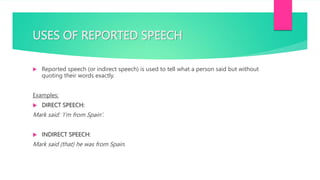
USES OF REPORTED SPEECH
 Reported speech (or indirect speech) is used to tell what a person said but without
quoting their words exactly.
Examples:
 DIRECT SPEECH:
Mark said: ‘I’m from Spain’.
 INDIRECT SPEECH:
Mark said (that) he was from Spain.
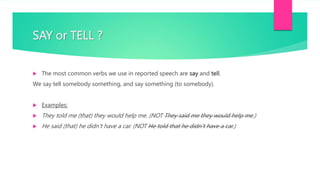
SAY or TELL ?
 The most common verbs we use in reported speech are say and tell.
We say tell somebody something, and say something (to somebody).
 Examples:
 They told me (that) they would help me. (NOT They said me they would help me.)
 He said (that) he didn’t have a car. (NOT He told that he didn’t have a car.)
FORM
 The indirect speech, unlike the direct speech, does not use quotation
marks (‘’) and does not need to be word for word. In general, when the
indirect speech is used, the verb tense changes.
 Sometimes "that" is used in affirmative and negative sentences to
introduce what the other person has said. On the other hand, in
interrogative sentences you can use "if" or "whether".
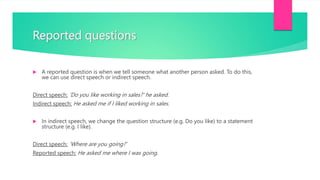
Reported questions
 A reported question is when we tell someone what another person asked. To do this,
we can use direct speech or indirect speech.
Direct speech: 'Do you like working in sales?' he asked.
Indirect speech: He asked me if I liked working in sales.
 In indirect speech, we change the question structure (e.g. Do you like) to a statement
structure (e.g. I like).
Direct speech: ‘Where are you going?’
Reported speech: He asked me where I was going.
Yes/no questions
 This type of question is reported by using ‘ask’ + ‘if / whether + clause If is more
common.
 Examples:
‘Do you speak English?’ —-> He asked me if I spoke English.
‘Are you British or American?’ —-> He asked me whether I was British or American.
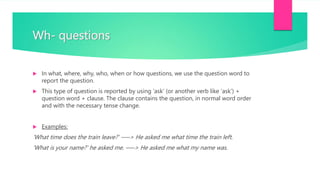
Wh- questions
 In what, where, why, who, when or how questions, we use the question word to
report the question.
 This type of question is reported by using ‘ask’ (or another verb like ‘ask’) +
question word + clause. The clause contains the question, in normal word order
and with the necessary tense change.
 Examples:
'What time does the train leave?' —–> He asked me what time the train left.
'What is your name?' he asked me. —–> He asked me what my name was.
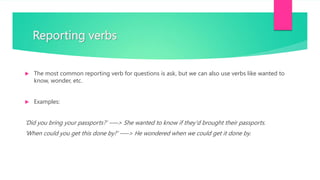
Reporting verbs
 The most common reporting verb for questions is ask, but we can also use verbs like wanted to
know, wonder, etc.
 Examples:
'Did you bring your passports?‘ —–> She wanted to know if they'd brought their passports.
'When could you get this done by?‘ —–> He wondered when we could get it done by.
Offers, requests and suggestions
 If the question is making an offer, request or suggestion, we can use a specific
verb pattern instead, for example offer + infinitive, ask + infinitive or suggest +
ing.
 Examples:
'Would you like me to help you?‘—–> He offered to help me.
'Can you hold this for me, please?‘ —–> She asked me to hold it.
'Why don't we check with Joel?‘ —–> She suggested checking with Joel.
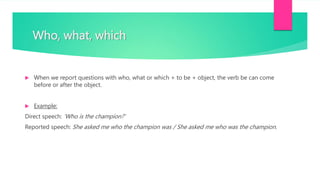
Who, what, which
 When we report questions with who, what or which + to be + object, the verb be can come
before or after the object.
 Example:
Direct speech: ‘Who is the champion?’
Reported speech: She asked me who the champion was / She asked me who was the champion.
CHANGES: Pronouns/Possessive adjectives
 I ……. He/she
 My ……. His/her
 Me ……. Him/her
 Mine ……. His/her
 We ……. They
 Our ……. Their
 Us ……. Them
 Ours ……. Their
CHANGES: Verb tense - Present
Phrase in Direct Speech Equivalent in Reported Speech
Simple present Simple past
"I always drink coffee", she said She said that she always drank coffee.
Present continuous Past continuous
"I am reading a book", he explained. He explained that he was reading a book
Present perfect Past perfect
"I have been to Spain", he told me. He told me that he had been to Spain.
Present perfect continuous Past perfect continuous
They complained, "We have been
waiting for hours".
They complained that they had been
waiting for hours.
CHANGES: Verb tense - Past
Phrase in Direct Speech Equivalent in Reported Speech
Simple past Past perfect
"Bill arrived on Saturday", he said. He said that Bill had arrived on Saturday.
Past continuous Past perfect continuous
"We were living in Paris", they told me. They told me that they had been living in
Paris.
Past perfect Past perfect
"I had just turned out the light," he
explained.
He explained that he had just turned
out the light.
Past perfect continuous Past perfect continuous
“I had been dancing for years before the
accident.” she said
She said she had been dancing for
years before the accident.
CHANGES: Verb tense – Modal verbs
Phrase in Direct Speech Equivalent in Reported Speech
Will Would
“I will go to the cinema tomorrow” he said. He said he would go to the cinema the next
day
Can Could
“Can you open the window, please?” she asked. She asked me if I could open the window.
Must Must / Had to
“You must wear your seat belt,” mom said. My mom said I had to wear my seat belt.
Shall Should
“Shall we go to the beach today?” Tom asked. Tom asked if we should go to the beach that
day.
May Might / Could
“May I use the bathroom, please?”, the boy
asked.
The boy asked if he could use the bathroom.
CHANGES: Time/Place expressions 1
Phrase in Direct Speech Equivalent in Reported Speech
now then
“Tom is sleeping now”, he said. He said that Tom was sleeping then.
today that day
"I saw him today", she said. She said that she had seen him that day.
yesterday the day before/the previous day
"I saw him yesterday", she said. She said that she had seen him the day
before.
tomorrow the next/following day
"I'll see you tomorrow", he said He said that he would see me the next day.
next week/month/year the following week/month/year
"I have an appointment next week", she said. She said that she had an appointment the
following week.
CHANGES: Time/Place expressions 2
Phrase in Direct Speech Equivalent in Reported Speech
last week/month/year the previous/week/month/year
"I was on holiday last week", he told us. He told us that he had been on holiday the
previous week.
ago before
"I saw her a week ago," he said. He said he had seen her a week before.
this (for time) that
"I'm getting a new car this week", she said. She said she was getting a new car that week.
here there
He said, "I live here". He told me he lived there.
this/these (adjectives) that/those
“I’ll be very busy this week" he said. He said he would be very busy that week.
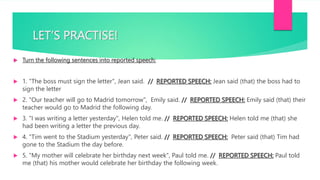
LET’S PRACTISE!
 Turn the following sentences into reported speech:
 1. "The boss must sign the letter", Jean said. // REPORTED SPEECH: Jean said (that) the boss had to
sign the letter
 2. "Our teacher will go to Madrid tomorrow", Emily said. // REPORTED SPEECH: Emily said (that) their
teacher would go to Madrid the following day.
 3. "I was writing a letter yesterday", Helen told me. // REPORTED SPEECH: Helen told me (that) she
had been writing a letter the previous day.
 4. "Tim went to the Stadium yesterday", Peter said. // REPORTED SPEECH: Peter said (that) Tim had
gone to the Stadium the day before.
 5. "My mother will celebrate her birthday next week", Paul told me. // REPORTED SPEECH: Paul told
me (that) his mother would celebrate her birthday the following week.
 6. "John had already gone at six", David said. // REPORTED SPEECH: David said (that) John had already
gone at six.
 7. "Are the boys reading a book?" Mandy asked me. // REPORTED SPEECH: Mandy asked me if/whether
the boys were reading a book.
 8. "Where are you playing football today?", Jennifer asked. // REPORTED SPEECH: Jennifer asked where I
was playing football that day.
 9. "Did Max fly to London two weeks ago?", Paul asked. // REPORTED SPEECH: Paul asked if Max had
flown to London two weeks before.
 10. Where are my glasses? My grandmother asked me. // REPORTED SPEECH: My grandmother asked
me where her glasses were.
LET’S PRACTISE!
 Indirect(REPORTED) or direct speech?
 Peter said: ‘Titanic is the best movie I’ve ever seen.’ - DIRECT SPEECH
 My aunt told me she was going to go to London the following day. - INDIRECT/REPORTED SPEECH
 Sarah asked me if I had been to Paris before. - INDIRECT/REPORTED SPEECH
 Linda said: ‘I bought a new computer last year’. – DIRECT SPEECH
 She said: ‘I need to text my Mum in one hour’. – DIRECT SPEECH
 Mark said that he hadn’t gone to the cinema the day before. - INDIRECT/REPORTED SPEECH
 The boy said he is 21 years old. - INDIRECT/REPORTED SPEECH
 Erik said: ‘She is living in Barcelona’. – DIRECT SPEECH
LET’S PRACTISE!
LET’S PRACTISE!
LET’S PRACTISE AT HOME!
Reported speech
 Reported Speech: Oral Exercise
 Reported Speech – Exercises
 Reported Speech - Quiz
Time for questions

Presentación PowerPoint sobre REPORTED SPEECH

  • 2.
    INTRODUCTION  LET’S WATCHTHIS VIDEO!  Introduction to Reported Speech
  • 3.
    USES OF REPORTEDSPEECH  Reported speech (or indirect speech) is used to tell what a person said but without quoting their words exactly. Examples:  DIRECT SPEECH: Mark said: ‘I’m from Spain’.  INDIRECT SPEECH: Mark said (that) he was from Spain.
  • 4.
    SAY or TELL?  The most common verbs we use in reported speech are say and tell. We say tell somebody something, and say something (to somebody).  Examples:  They told me (that) they would help me. (NOT They said me they would help me.)  He said (that) he didn’t have a car. (NOT He told that he didn’t have a car.)
  • 5.
    FORM  The indirectspeech, unlike the direct speech, does not use quotation marks (‘’) and does not need to be word for word. In general, when the indirect speech is used, the verb tense changes.  Sometimes "that" is used in affirmative and negative sentences to introduce what the other person has said. On the other hand, in interrogative sentences you can use "if" or "whether".
  • 6.
    Reported questions  Areported question is when we tell someone what another person asked. To do this, we can use direct speech or indirect speech. Direct speech: 'Do you like working in sales?' he asked. Indirect speech: He asked me if I liked working in sales.  In indirect speech, we change the question structure (e.g. Do you like) to a statement structure (e.g. I like). Direct speech: ‘Where are you going?’ Reported speech: He asked me where I was going.
  • 7.
    Yes/no questions  Thistype of question is reported by using ‘ask’ + ‘if / whether + clause If is more common.  Examples: ‘Do you speak English?’ —-> He asked me if I spoke English. ‘Are you British or American?’ —-> He asked me whether I was British or American.
  • 8.
    Wh- questions  Inwhat, where, why, who, when or how questions, we use the question word to report the question.  This type of question is reported by using ‘ask’ (or another verb like ‘ask’) + question word + clause. The clause contains the question, in normal word order and with the necessary tense change.  Examples: 'What time does the train leave?' —–> He asked me what time the train left. 'What is your name?' he asked me. —–> He asked me what my name was.
  • 9.
    Reporting verbs  Themost common reporting verb for questions is ask, but we can also use verbs like wanted to know, wonder, etc.  Examples: 'Did you bring your passports?‘ —–> She wanted to know if they'd brought their passports. 'When could you get this done by?‘ —–> He wondered when we could get it done by.
  • 10.
    Offers, requests andsuggestions  If the question is making an offer, request or suggestion, we can use a specific verb pattern instead, for example offer + infinitive, ask + infinitive or suggest + ing.  Examples: 'Would you like me to help you?‘—–> He offered to help me. 'Can you hold this for me, please?‘ —–> She asked me to hold it. 'Why don't we check with Joel?‘ —–> She suggested checking with Joel.
  • 11.
    Who, what, which When we report questions with who, what or which + to be + object, the verb be can come before or after the object.  Example: Direct speech: ‘Who is the champion?’ Reported speech: She asked me who the champion was / She asked me who was the champion.
  • 12.
    CHANGES: Pronouns/Possessive adjectives I ……. He/she  My ……. His/her  Me ……. Him/her  Mine ……. His/her  We ……. They  Our ……. Their  Us ……. Them  Ours ……. Their
  • 13.
    CHANGES: Verb tense- Present Phrase in Direct Speech Equivalent in Reported Speech Simple present Simple past "I always drink coffee", she said She said that she always drank coffee. Present continuous Past continuous "I am reading a book", he explained. He explained that he was reading a book Present perfect Past perfect "I have been to Spain", he told me. He told me that he had been to Spain. Present perfect continuous Past perfect continuous They complained, "We have been waiting for hours". They complained that they had been waiting for hours.
  • 14.
    CHANGES: Verb tense- Past Phrase in Direct Speech Equivalent in Reported Speech Simple past Past perfect "Bill arrived on Saturday", he said. He said that Bill had arrived on Saturday. Past continuous Past perfect continuous "We were living in Paris", they told me. They told me that they had been living in Paris. Past perfect Past perfect "I had just turned out the light," he explained. He explained that he had just turned out the light. Past perfect continuous Past perfect continuous “I had been dancing for years before the accident.” she said She said she had been dancing for years before the accident.
  • 15.
    CHANGES: Verb tense– Modal verbs Phrase in Direct Speech Equivalent in Reported Speech Will Would “I will go to the cinema tomorrow” he said. He said he would go to the cinema the next day Can Could “Can you open the window, please?” she asked. She asked me if I could open the window. Must Must / Had to “You must wear your seat belt,” mom said. My mom said I had to wear my seat belt. Shall Should “Shall we go to the beach today?” Tom asked. Tom asked if we should go to the beach that day. May Might / Could “May I use the bathroom, please?”, the boy asked. The boy asked if he could use the bathroom.
  • 16.
    CHANGES: Time/Place expressions1 Phrase in Direct Speech Equivalent in Reported Speech now then “Tom is sleeping now”, he said. He said that Tom was sleeping then. today that day "I saw him today", she said. She said that she had seen him that day. yesterday the day before/the previous day "I saw him yesterday", she said. She said that she had seen him the day before. tomorrow the next/following day "I'll see you tomorrow", he said He said that he would see me the next day. next week/month/year the following week/month/year "I have an appointment next week", she said. She said that she had an appointment the following week.
  • 17.
    CHANGES: Time/Place expressions2 Phrase in Direct Speech Equivalent in Reported Speech last week/month/year the previous/week/month/year "I was on holiday last week", he told us. He told us that he had been on holiday the previous week. ago before "I saw her a week ago," he said. He said he had seen her a week before. this (for time) that "I'm getting a new car this week", she said. She said she was getting a new car that week. here there He said, "I live here". He told me he lived there. this/these (adjectives) that/those “I’ll be very busy this week" he said. He said he would be very busy that week.
  • 18.
    LET’S PRACTISE!  Turnthe following sentences into reported speech:  1. "The boss must sign the letter", Jean said. // REPORTED SPEECH: Jean said (that) the boss had to sign the letter  2. "Our teacher will go to Madrid tomorrow", Emily said. // REPORTED SPEECH: Emily said (that) their teacher would go to Madrid the following day.  3. "I was writing a letter yesterday", Helen told me. // REPORTED SPEECH: Helen told me (that) she had been writing a letter the previous day.  4. "Tim went to the Stadium yesterday", Peter said. // REPORTED SPEECH: Peter said (that) Tim had gone to the Stadium the day before.  5. "My mother will celebrate her birthday next week", Paul told me. // REPORTED SPEECH: Paul told me (that) his mother would celebrate her birthday the following week.
  • 19.
     6. "Johnhad already gone at six", David said. // REPORTED SPEECH: David said (that) John had already gone at six.  7. "Are the boys reading a book?" Mandy asked me. // REPORTED SPEECH: Mandy asked me if/whether the boys were reading a book.  8. "Where are you playing football today?", Jennifer asked. // REPORTED SPEECH: Jennifer asked where I was playing football that day.  9. "Did Max fly to London two weeks ago?", Paul asked. // REPORTED SPEECH: Paul asked if Max had flown to London two weeks before.  10. Where are my glasses? My grandmother asked me. // REPORTED SPEECH: My grandmother asked me where her glasses were. LET’S PRACTISE!
  • 20.
     Indirect(REPORTED) ordirect speech?  Peter said: ‘Titanic is the best movie I’ve ever seen.’ - DIRECT SPEECH  My aunt told me she was going to go to London the following day. - INDIRECT/REPORTED SPEECH  Sarah asked me if I had been to Paris before. - INDIRECT/REPORTED SPEECH  Linda said: ‘I bought a new computer last year’. – DIRECT SPEECH  She said: ‘I need to text my Mum in one hour’. – DIRECT SPEECH  Mark said that he hadn’t gone to the cinema the day before. - INDIRECT/REPORTED SPEECH  The boy said he is 21 years old. - INDIRECT/REPORTED SPEECH  Erik said: ‘She is living in Barcelona’. – DIRECT SPEECH LET’S PRACTISE!
  • 21.
    LET’S PRACTISE! LET’S PRACTISEAT HOME! Reported speech  Reported Speech: Oral Exercise  Reported Speech – Exercises  Reported Speech - Quiz
  • 22.