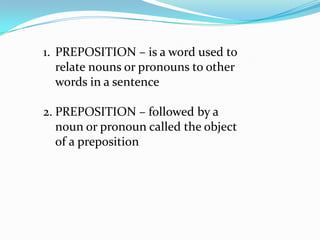
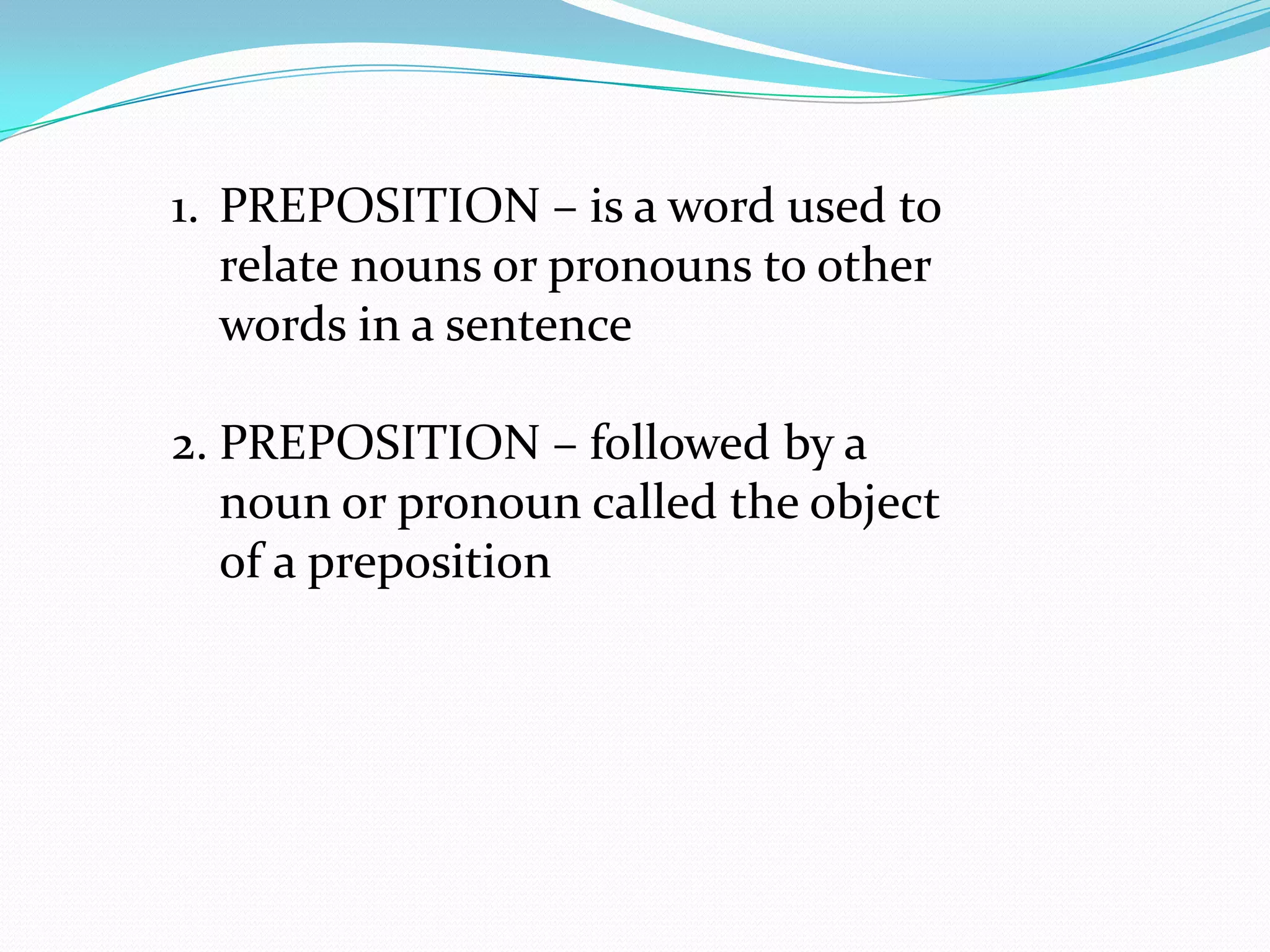
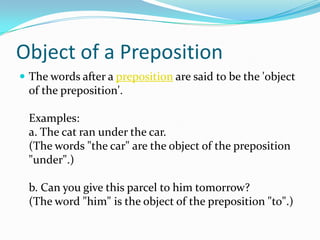
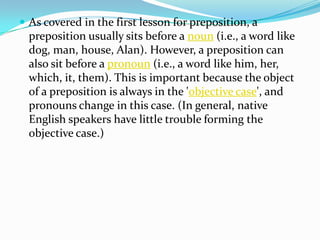
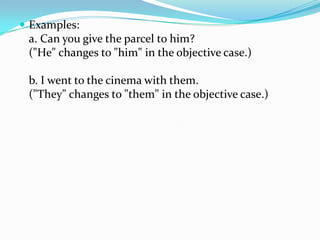
PREPOSITION – is a word used to relate nouns or pronouns to other words in a sentencePREPOSITION – followed by a noun or pronoun called the object of a preposition
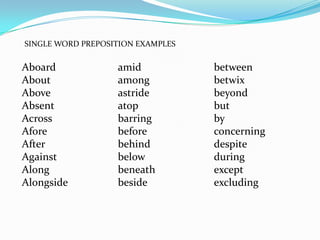
SINGLE WORD PREPOSITION EXAMPLESAboard		amid			betweenAbout			among			betwixAbove			astride			beyondAbsent		atop			butAcross			barring		byAfore			before			concerningAfter			behind		despiteAgainst		below			duringAlong			beneath		exceptAlongside		beside			excluding
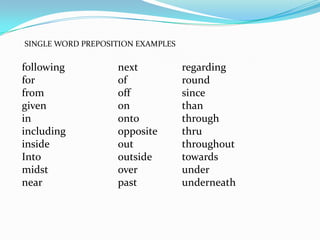
SINGLE WORD PREPOSITION EXAMPLESfollowing		next		regardingfor			of		roundfrom			off		sincegiven			on		thanin			onto		throughincluding		opposite	thru		inside			out		throughoutInto			outside	towardsmidst			over		undernear			past		underneath
SINGLE WORD PREPOSITION EXAMPLESunlike		until			up		upon		versus			vice			inside			Into		midst			near
COMPOUND  WORD PREPOSITION EXAMPLES instead of  left of  near to  next to  on to (contracted as onto)  out from  out of  outside of  owing to  prior to  pursuant to  regardless of  right of  subsequent to  thanks to  that of  where as Two  words according to  ahead of  apart from  as for  as of  as per  as regards  aside from  because of  close to  due to  except for  far from  in to (contracted as into)  inside of (note that inside out
COMPOUND  WORD PREPOSITION EXAMPLESThree words  preposition as far as  as well as  by means of  in accordance with  in addition to  in case of  in front of  in lieu of  in place of  in point of  in spite of  on account of  on behalf of  on top of  with regard to  with respect to
Role of a PrepositionPrepositions are important when constructing sentences. A preposition sits before a noun  and pronoun to show the nounand pronoun’srelationship to another word in the sentence.	Examples:It is a container for butter.(The preposition "for" shows the relationship between "butter" and "container".)The eagle soared above the clouds.(The preposition "above" shows the relationship between "clouds" and "soared".)
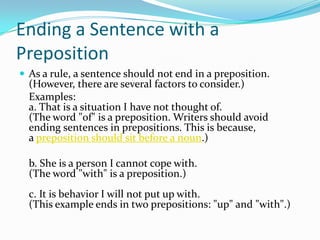
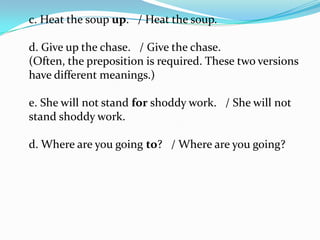
Ending a Sentence with a PrepositionAs a rule, a sentence should not end in a preposition. (However, there are several factors to consider.)	Examples:a. That is a situation I have not thought of.  (The word "of" is a preposition. Writers should avoid ending sentences in prepositions. This is because, a preposition should sit before a noun.)	b. She is a person I cannot cope with.  (The word "with" is a preposition.)c. It is behavior I will not put up with.  (This example ends in two prepositions: "up" and "with".)
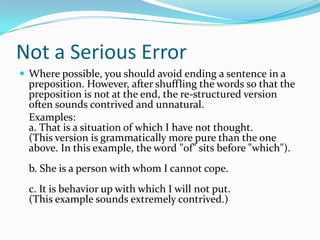
Not a Serious ErrorWhere possible, you should avoid ending a sentence in a preposition. However, after shuffling the words so that the preposition is not at the end, the re-structured version often sounds contrived and unnatural.	Examples:a. That is a situation of which I have not thought.  (This version is grammatically more pure than the one above. In this example, the word "of" sits before "which").b. She is a person with whom I cannot cope.  c. It is behavior up with which I will not put.  (This example sounds extremely contrived.)
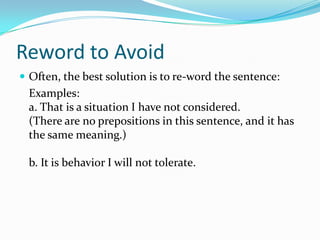
Reword to AvoidOften, the best solution is to re-word the sentence:	Examples:a. That is a situation I have not considered.  (There are no prepositions in this sentence, and it has the same meaning.)b. It is behavior I will not tolerate. 
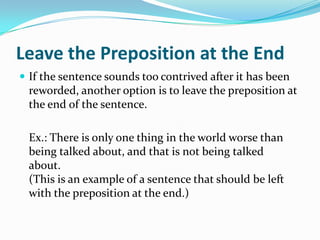
Leave the Preposition at the EndIf the sentence sounds too contrived after it has been reworded, another option is to leave the preposition at the end of the sentence. 	Ex.: There is only one thing in the world worse than being talked about, and that is not being talked about.  (This is an example of a sentence that should be left with the preposition at the end.)
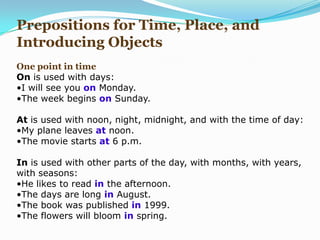
Prepositions for Time, Place, and Introducing ObjectsOne point in timeOn is used with days:I will see you on Monday.
The week begins on Sunday.At is used with noon, night, midnight, and with the time of day:My plane leaves at noon.
The movie starts at 6 p.m.In is used with other parts of the day, with months, with years, with seasons:He likes to read in the afternoon.
The days are long in August.
The book was published in 1999.
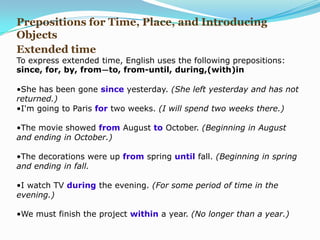
The flowers will bloom in spring.Prepositions for Time, Place, and Introducing ObjectsExtended timeTo express extended time, English uses the following prepositions: since, for, by, from—to, from-until, during,(with)inShe has been gone since yesterday. (She left yesterday and has not returned.)
I'm going to Paris for two weeks. (I will spend two weeks there.)
The movie showed from August to October. (Beginning in August and ending in October.)
The decorations were up from spring until fall. (Beginning in spring and ending in fall.
I watch TV during the evening. (For some period of time in the evening.)
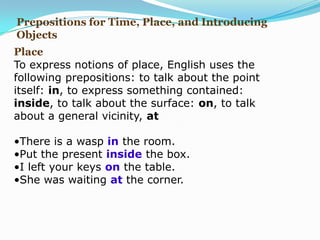
We must finish the project within a year. (No longer than a year.)Prepositions for Time, Place, and Introducing ObjectsPlaceTo express notions of place, English uses the following prepositions: to talk about the point itself: in, to express something contained: inside, to talk about the surface: on, to talk about a general vicinity, atThere is a wasp in the room.
Put the present inside the box.
I left your keys on the table.

Module 6 PREPOSITION

  • 1.
    PREPOSITION – isa word used to relate nouns or pronouns to other words in a sentencePREPOSITION – followed by a noun or pronoun called the object of a preposition
  • 2.
    SINGLE WORD PREPOSITIONEXAMPLESAboard amid betweenAbout among betwixAbove astride beyondAbsent atop butAcross barring byAfore before concerningAfter behind despiteAgainst below duringAlong beneath exceptAlongside beside excluding
  • 3.
    SINGLE WORD PREPOSITIONEXAMPLESfollowing next regardingfor of roundfrom off sincegiven on thanin onto throughincluding opposite thru inside out throughoutInto outside towardsmidst over undernear past underneath
  • 4.
    SINGLE WORD PREPOSITIONEXAMPLESunlike until up upon versus vice inside Into midst near
  • 5.
    COMPOUND WORDPREPOSITION EXAMPLES instead of  left of  near to  next to  on to (contracted as onto)  out from  out of  outside of  owing to  prior to  pursuant to  regardless of  right of  subsequent to  thanks to  that of  where as Two words according to  ahead of  apart from  as for  as of  as per  as regards  aside from  because of  close to  due to  except for  far from  in to (contracted as into)  inside of (note that inside out
  • 6.
    COMPOUND WORDPREPOSITION EXAMPLESThree words preposition as far as  as well as  by means of  in accordance with  in addition to  in case of  in front of  in lieu of  in place of  in point of  in spite of  on account of  on behalf of  on top of  with regard to  with respect to
  • 7.
    Role of aPrepositionPrepositions are important when constructing sentences. A preposition sits before a noun and pronoun to show the nounand pronoun’srelationship to another word in the sentence. Examples:It is a container for butter.(The preposition "for" shows the relationship between "butter" and "container".)The eagle soared above the clouds.(The preposition "above" shows the relationship between "clouds" and "soared".)
  • 8.
    Ending a Sentencewith a PrepositionAs a rule, a sentence should not end in a preposition. (However, there are several factors to consider.) Examples:a. That is a situation I have not thought of.  (The word "of" is a preposition. Writers should avoid ending sentences in prepositions. This is because, a preposition should sit before a noun.) b. She is a person I cannot cope with.  (The word "with" is a preposition.)c. It is behavior I will not put up with.  (This example ends in two prepositions: "up" and "with".)
  • 9.
    Not a SeriousErrorWhere possible, you should avoid ending a sentence in a preposition. However, after shuffling the words so that the preposition is not at the end, the re-structured version often sounds contrived and unnatural. Examples:a. That is a situation of which I have not thought.  (This version is grammatically more pure than the one above. In this example, the word "of" sits before "which").b. She is a person with whom I cannot cope.  c. It is behavior up with which I will not put.  (This example sounds extremely contrived.)
  • 10.
    Reword to AvoidOften,the best solution is to re-word the sentence: Examples:a. That is a situation I have not considered.  (There are no prepositions in this sentence, and it has the same meaning.)b. It is behavior I will not tolerate. 
  • 11.
    Leave the Prepositionat the EndIf the sentence sounds too contrived after it has been reworded, another option is to leave the preposition at the end of the sentence.  Ex.: There is only one thing in the world worse than being talked about, and that is not being talked about.  (This is an example of a sentence that should be left with the preposition at the end.)
  • 12.
    Prepositions for Time,Place, and Introducing ObjectsOne point in timeOn is used with days:I will see you on Monday.
  • 13.
    The week beginson Sunday.At is used with noon, night, midnight, and with the time of day:My plane leaves at noon.
  • 14.
    The movie startsat 6 p.m.In is used with other parts of the day, with months, with years, with seasons:He likes to read in the afternoon.
  • 15.
    The days arelong in August.
  • 16.
    The book waspublished in 1999.
  • 17.
    The flowers willbloom in spring.Prepositions for Time, Place, and Introducing ObjectsExtended timeTo express extended time, English uses the following prepositions: since, for, by, from—to, from-until, during,(with)inShe has been gone since yesterday. (She left yesterday and has not returned.)
  • 18.
    I'm going toParis for two weeks. (I will spend two weeks there.)
  • 19.
    The movie showedfrom August to October. (Beginning in August and ending in October.)
  • 20.
    The decorations wereup from spring until fall. (Beginning in spring and ending in fall.
  • 21.
    I watch TVduring the evening. (For some period of time in the evening.)
  • 22.
    We must finishthe project within a year. (No longer than a year.)Prepositions for Time, Place, and Introducing ObjectsPlaceTo express notions of place, English uses the following prepositions: to talk about the point itself: in, to express something contained: inside, to talk about the surface: on, to talk about a general vicinity, atThere is a wasp in the room.
  • 23.
    Put the presentinside the box.
  • 24.
    I left yourkeys on the table.