1
Lesson 1-1
Properties & Operations
of Real Numbers
2
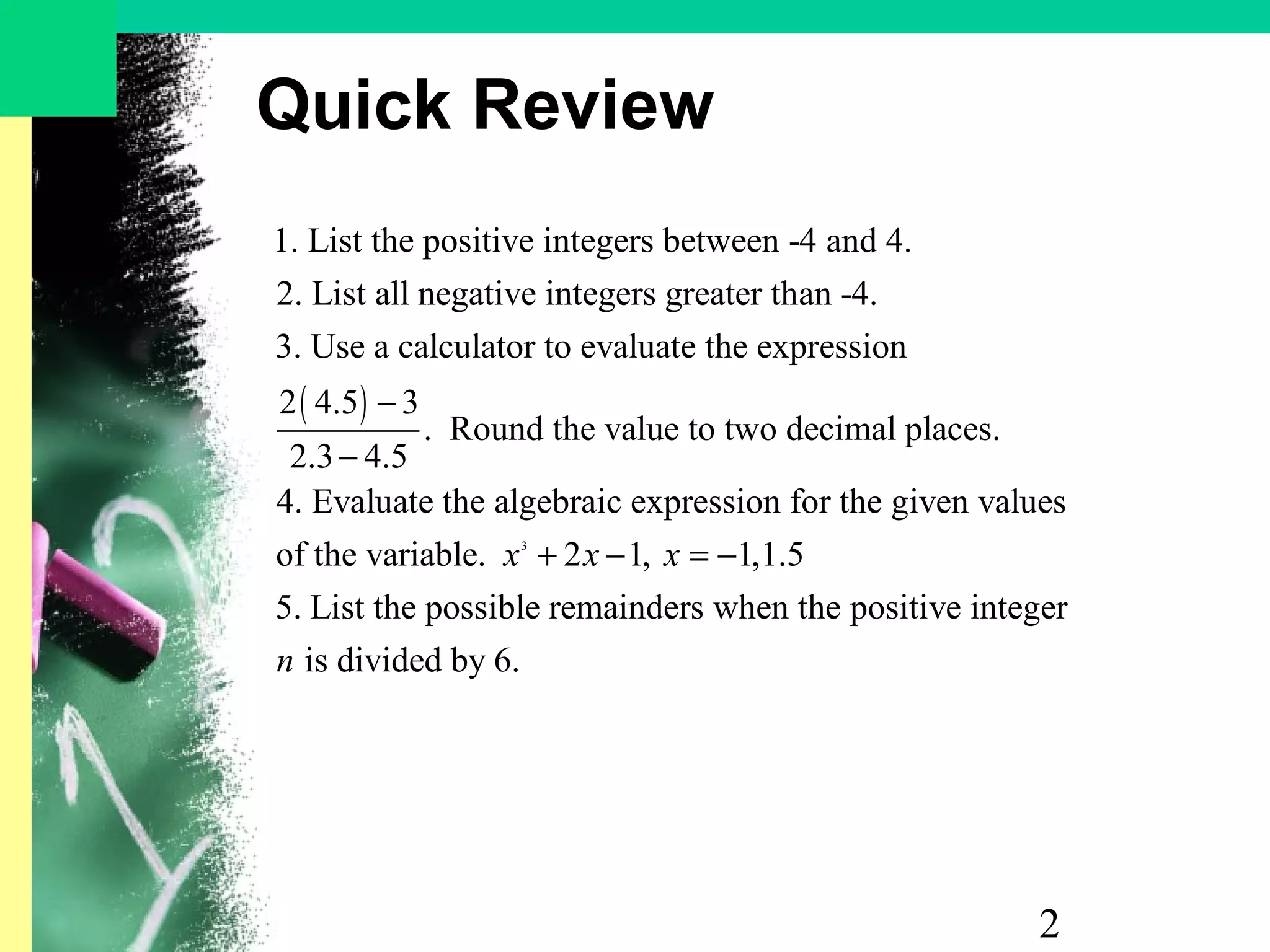
Quick Review
( )
1. List the positive integers between -4 and 4.
2. List all negative integers greater than -4.
3. Use a calculator to evaluate the expression
2 4.5 3
. Round the value to two decimal places.
2.3 4.5
4. Eva
−
−
3
luate the algebraic expression for the given values
of the variable. 2 1, 1,1.5
5. List the possible remainders when the positive integer
is divided by 6.
x x x
n
+ − = −
3
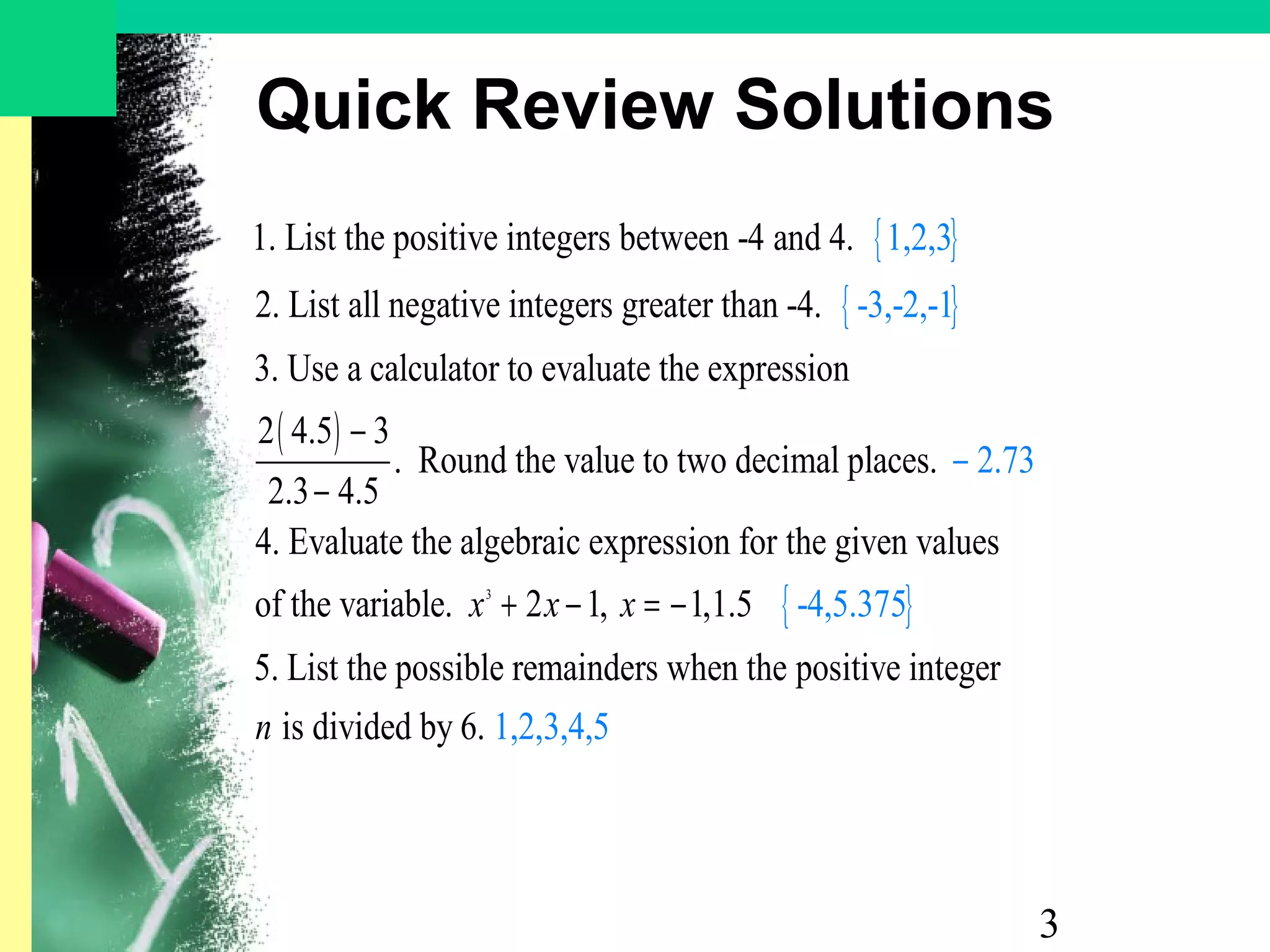
Quick Review Solutions
{ }
{ }
( )
1. List the positive integers between -4 and 4.
2. List all negative integers greater than -4.
3. Use a calculator to evaluate the expression
2 4.5 3
. Round the value to two deci
2.3 4.
1
5
,2,3
-3,-2,-1
−
−
{ }3
mal places.
4. Evaluate the algebraic expression for the given values
of the variable. 2 1, 1,1.5
5. List the possible remainders when the positive integer
i
2.73
-4,
s divid
5.375
1,2,ed by 6.
x x x
n
+
−
− = −
3,4,5
4
Lesson 1-1
Properties & Operations
of Real Numbers
5
At the end of the day
You will be able to
• Identify & represent real number types
• Order numbers (tables, number line, etc.),
• Identify properties of real numbers,
• Use operations with real numbers.
6
{1,2,3…}
{0,1,2,3…}
{...,-3,-2,-1,0,1,2,3…}
any number that can be expressed as
the ratio of two integers a/b where b≠0
e,57,2π,:exampleforrational,
notarethatnumbersreal
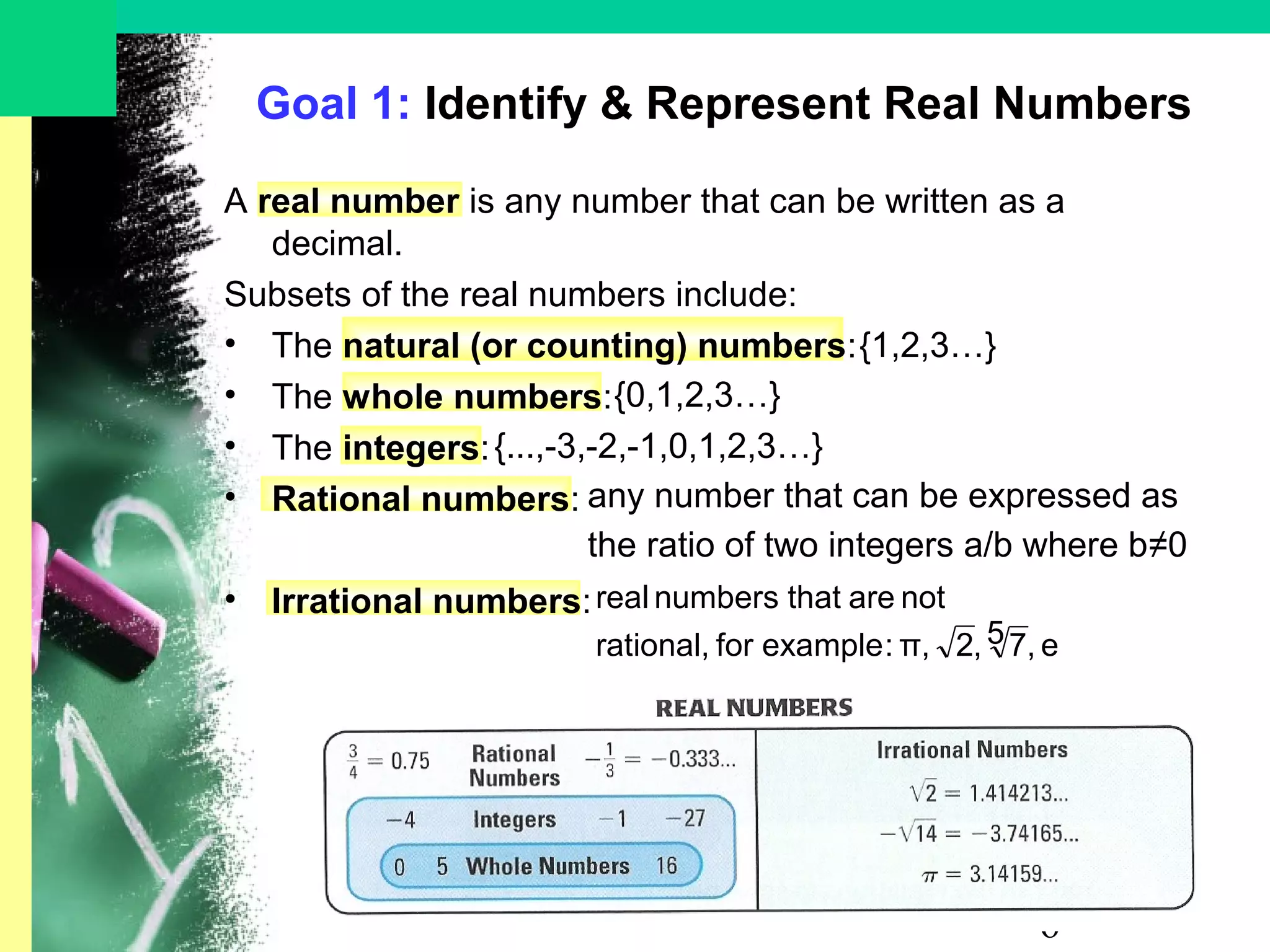
A real number is any number that can be written as a
decimal.
Subsets of the real numbers include:
• The natural (or counting) numbers:
• The whole numbers:
• The integers:
• Rational numbers:
• Irrational numbers:
Goal 1: Identify & Represent Real Numbers
7
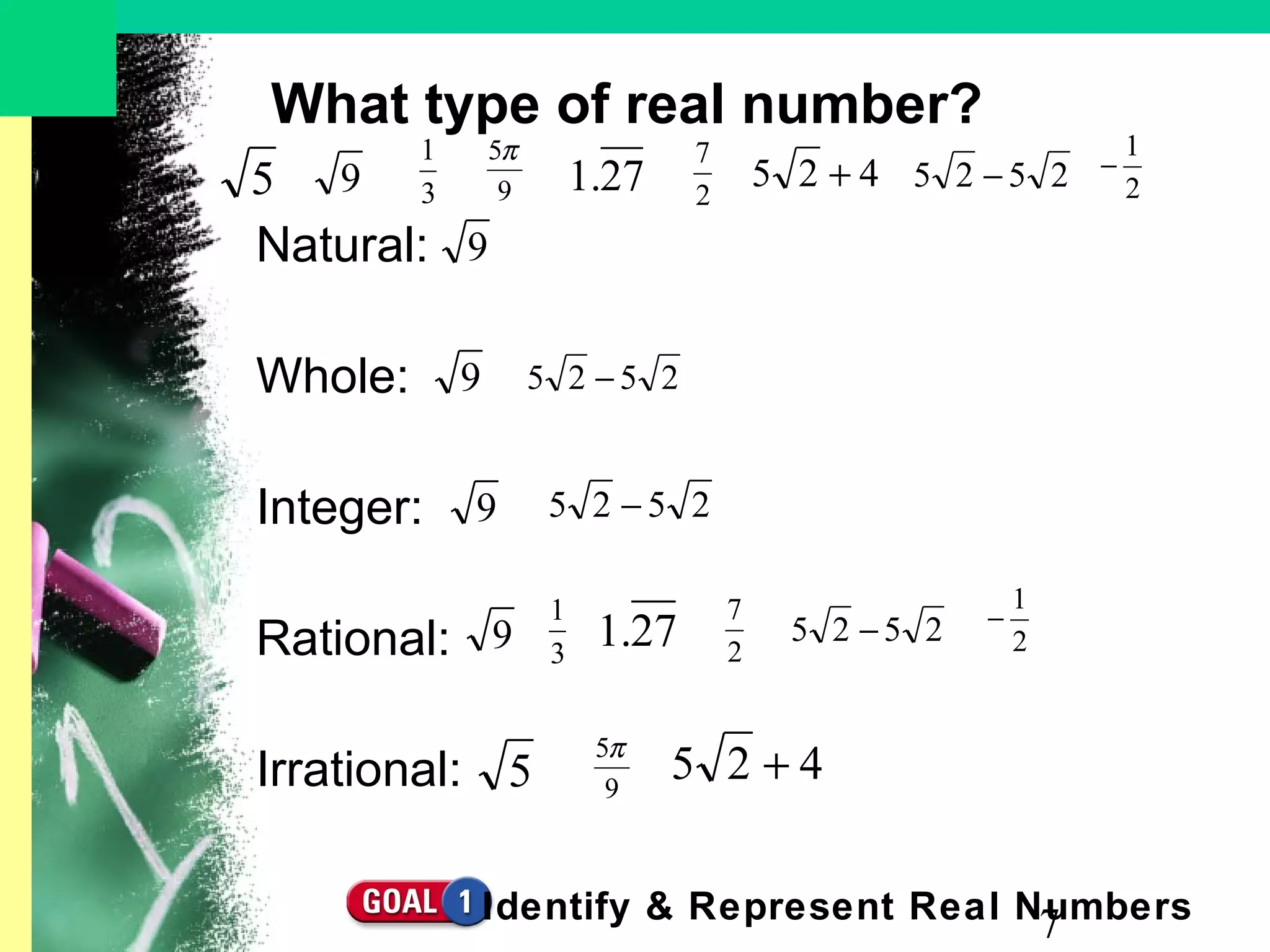
What type of real number?
Natural:
Whole:
Integer:
Rational:
Irrational:
5 9 2
1
−
3
1
2
7
9
5π
27.1 425 + 2525 −
5
9
9
9
9 3
1
9
5π
27.1 2
7
425 +
2525 −
2525 −
2525 − 2
1
−
Identify & Represent Real Numbers
8
It means that every decimal number that
repeats or terminates can be represented as a
fraction – that’s the “ratio” in “rational number.”
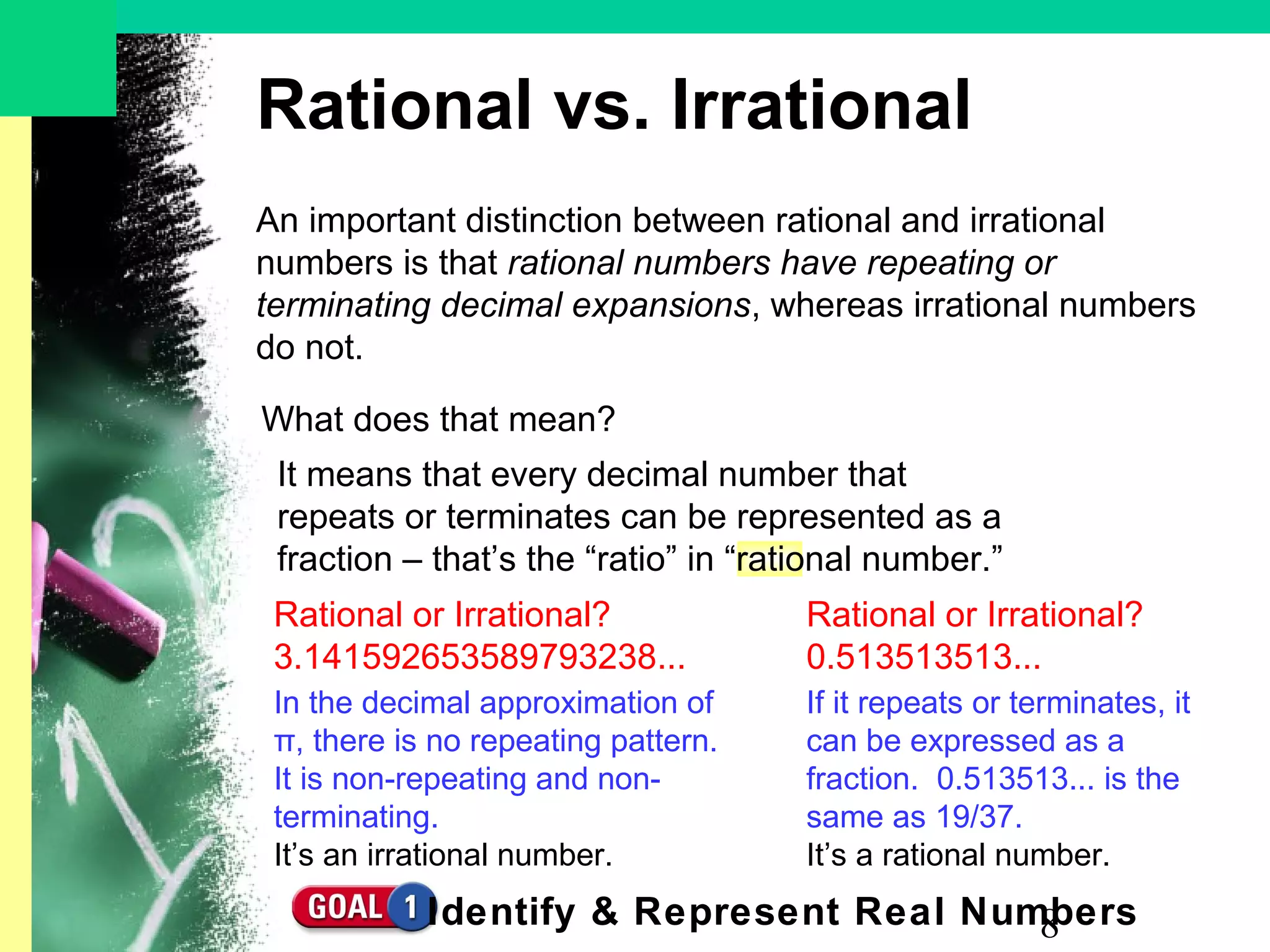
Rational vs. Irrational
An important distinction between rational and irrational
numbers is that rational numbers have repeating or
terminating decimal expansions, whereas irrational numbers
do not.
What does that mean?
Rational or Irrational?
3.141592653589793238...
In the decimal approximation of
π, there is no repeating pattern.
It is non-repeating and non-
terminating.
It’s an irrational number.
Rational or Irrational?
0.513513513...
If it repeats or terminates, it
can be expressed as a
fraction. 0.513513... is the
same as 19/37.
It’s a rational number.
Identify & Represent Real Numbers
9
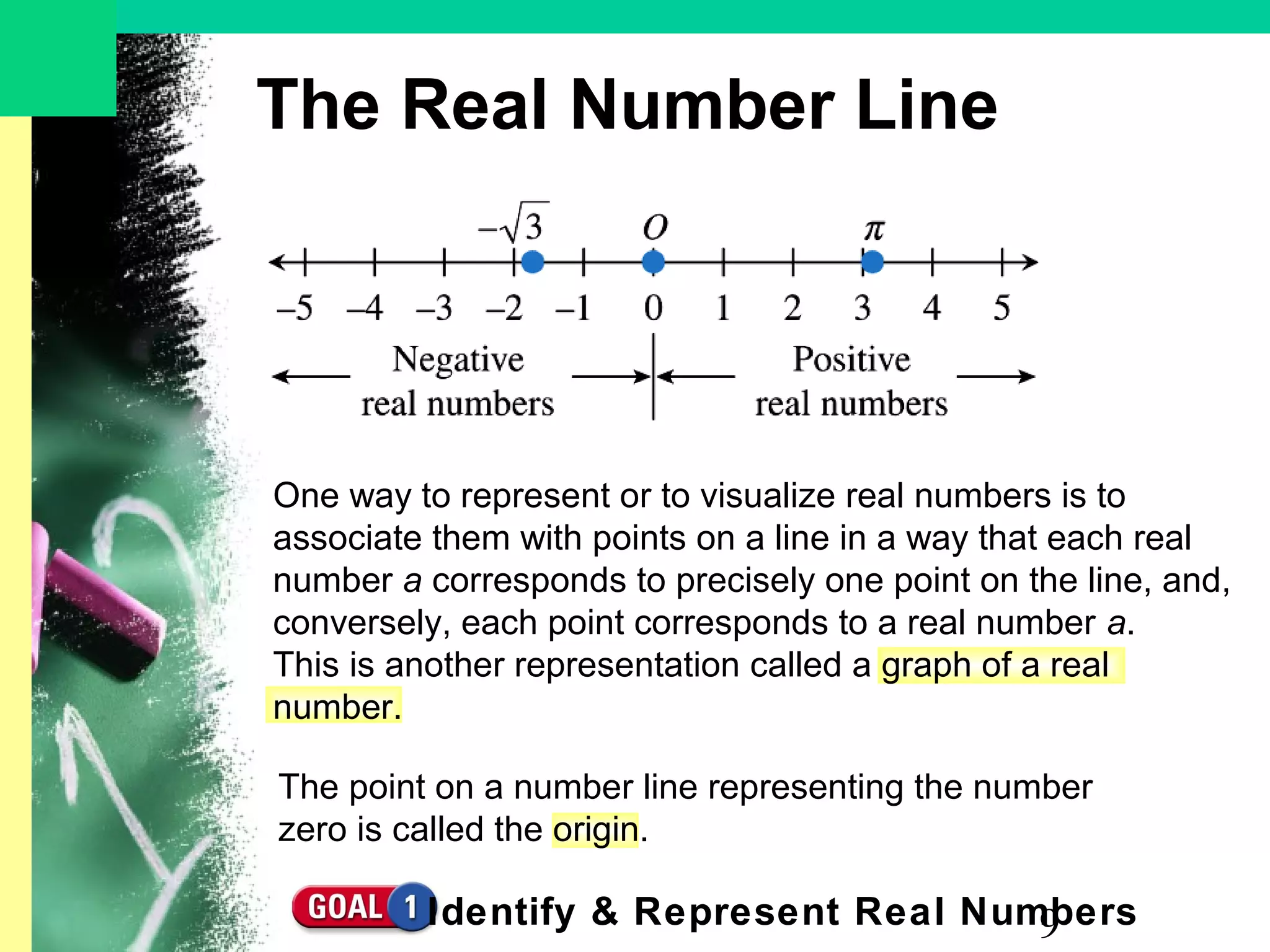
The Real Number Line
One way to represent or to visualize real numbers is to
associate them with points on a line in a way that each real
number a corresponds to precisely one point on the line, and,
conversely, each point corresponds to a real number a.
This is another representation called a graph of a real
number.
Identify & Represent Real Numbers
The point on a number line representing the number
zero is called the origin.
10
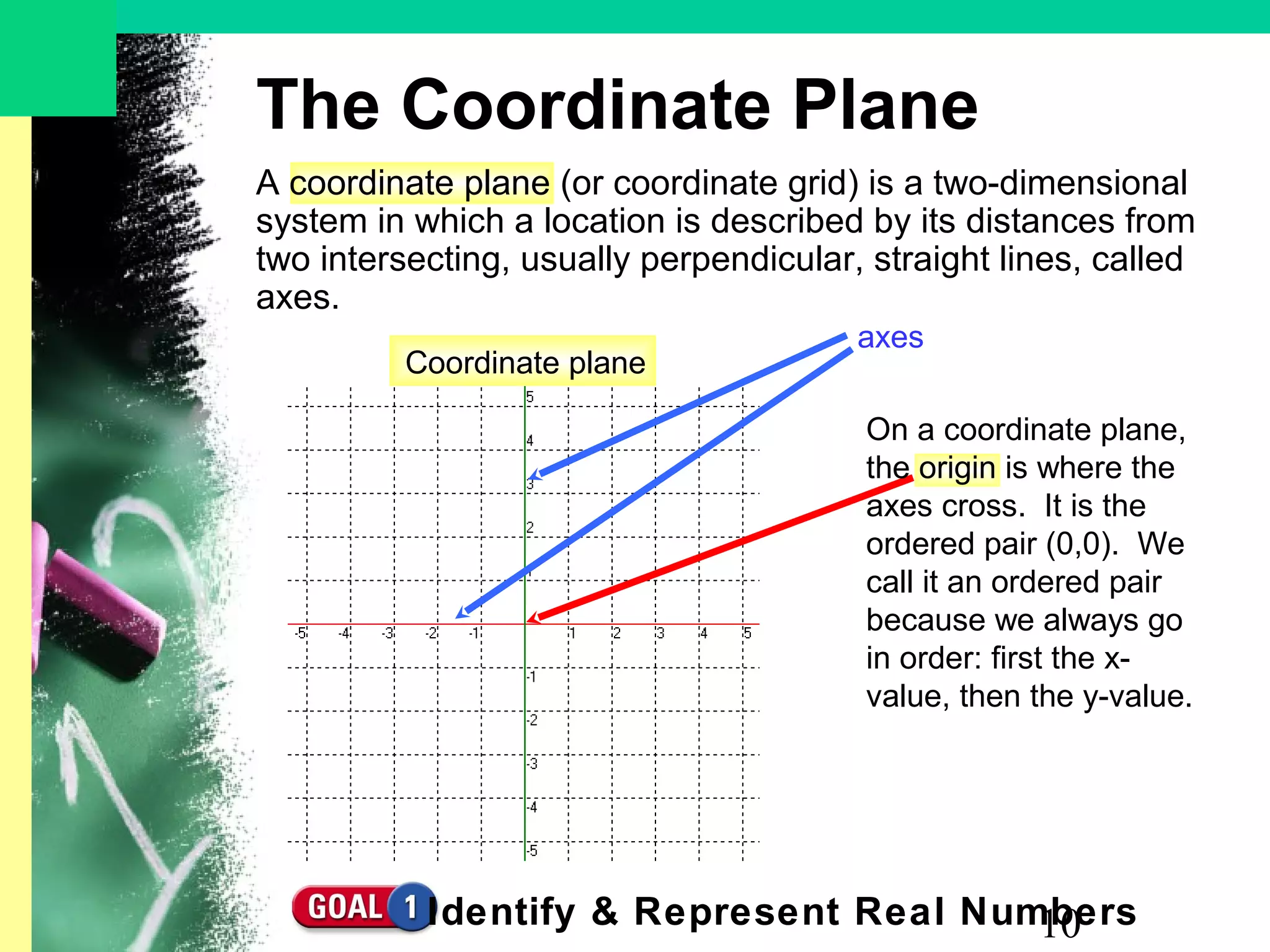
A coordinate plane (or coordinate grid) is a two-dimensional
system in which a location is described by its distances from
two intersecting, usually perpendicular, straight lines, called
axes.
The Coordinate Plane
Coordinate plane
axes
On a coordinate plane,
the origin is where the
axes cross. It is the
ordered pair (0,0). We
call it an ordered pair
because we always go
in order: first the x-
value, then the y-value.
Identify & Represent Real Numbers
11
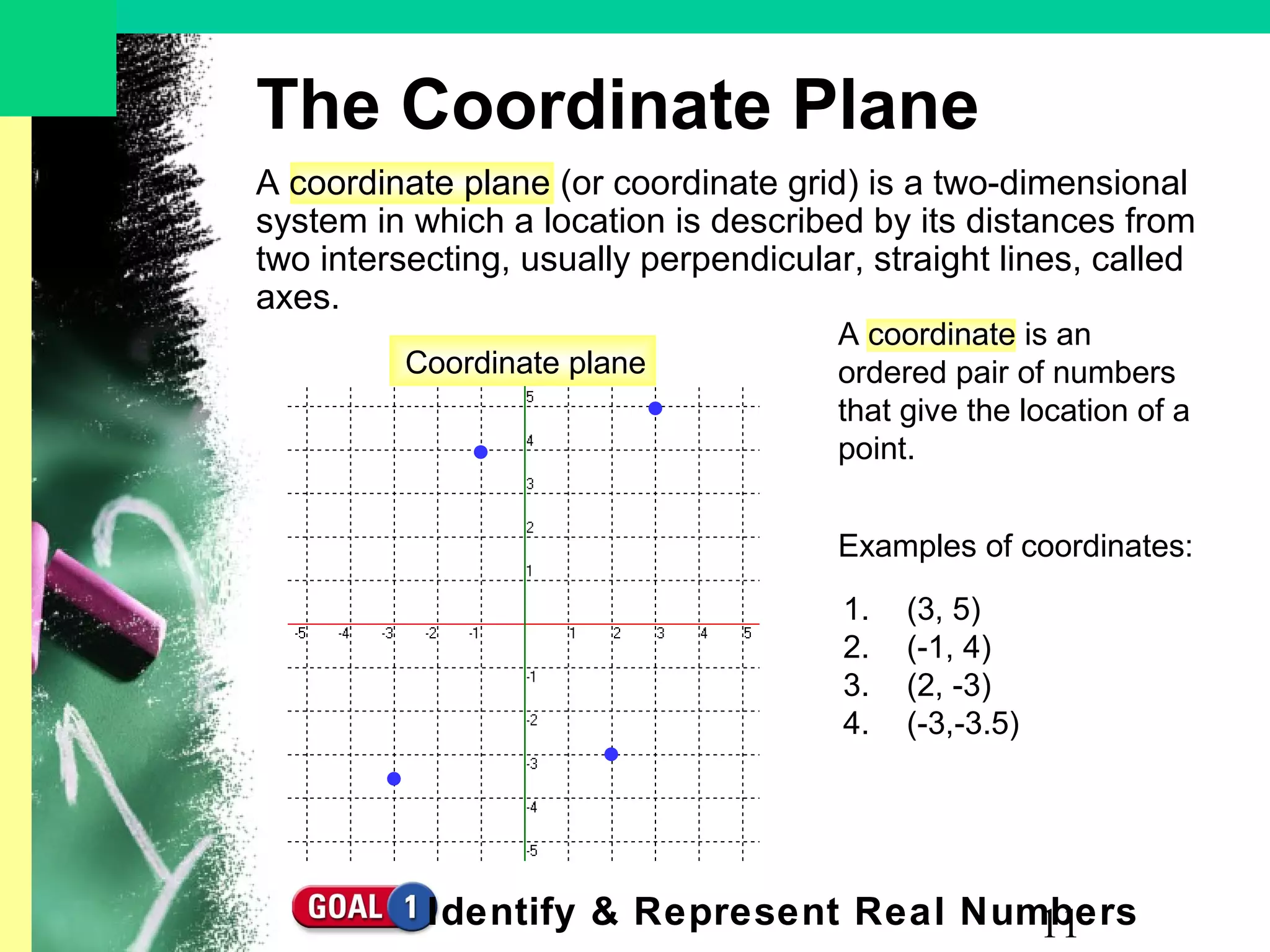
A coordinate plane (or coordinate grid) is a two-dimensional
system in which a location is described by its distances from
two intersecting, usually perpendicular, straight lines, called
axes.
The Coordinate Plane
Coordinate plane
A coordinate is an
ordered pair of numbers
that give the location of a
point.
Examples of coordinates:
1. (3, 5)
2. (-1, 4)
3. (2, -3)
4. (-3,-3.5)
●
●
●
●
Identify & Represent Real Numbers
12
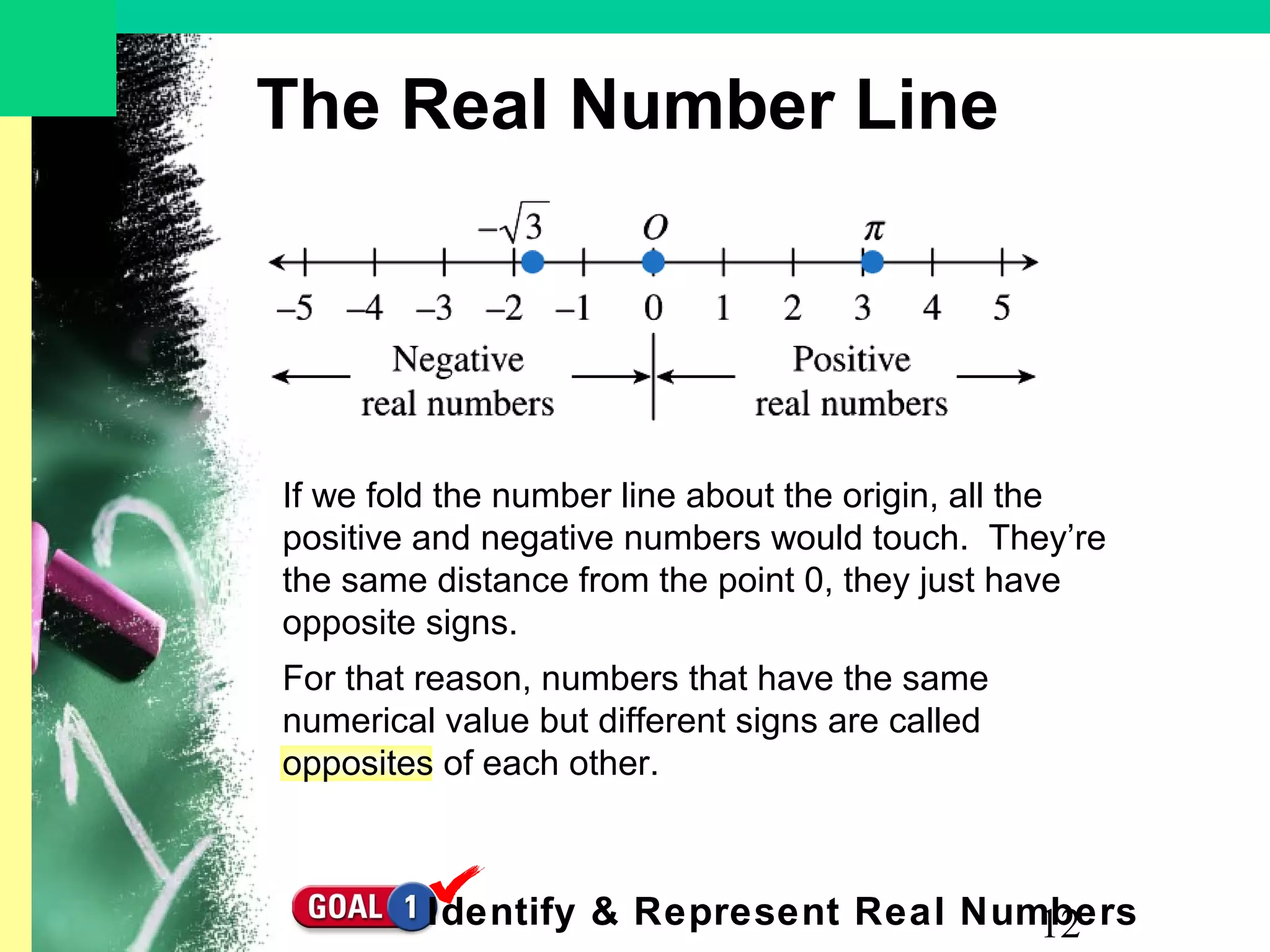
The Real Number Line
If we fold the number line about the origin, all the
positive and negative numbers would touch. They’re
the same distance from the point 0, they just have
opposite signs.
For that reason, numbers that have the same
numerical value but different signs are called
opposites of each other.
Identify & Represent Real Numbers
13
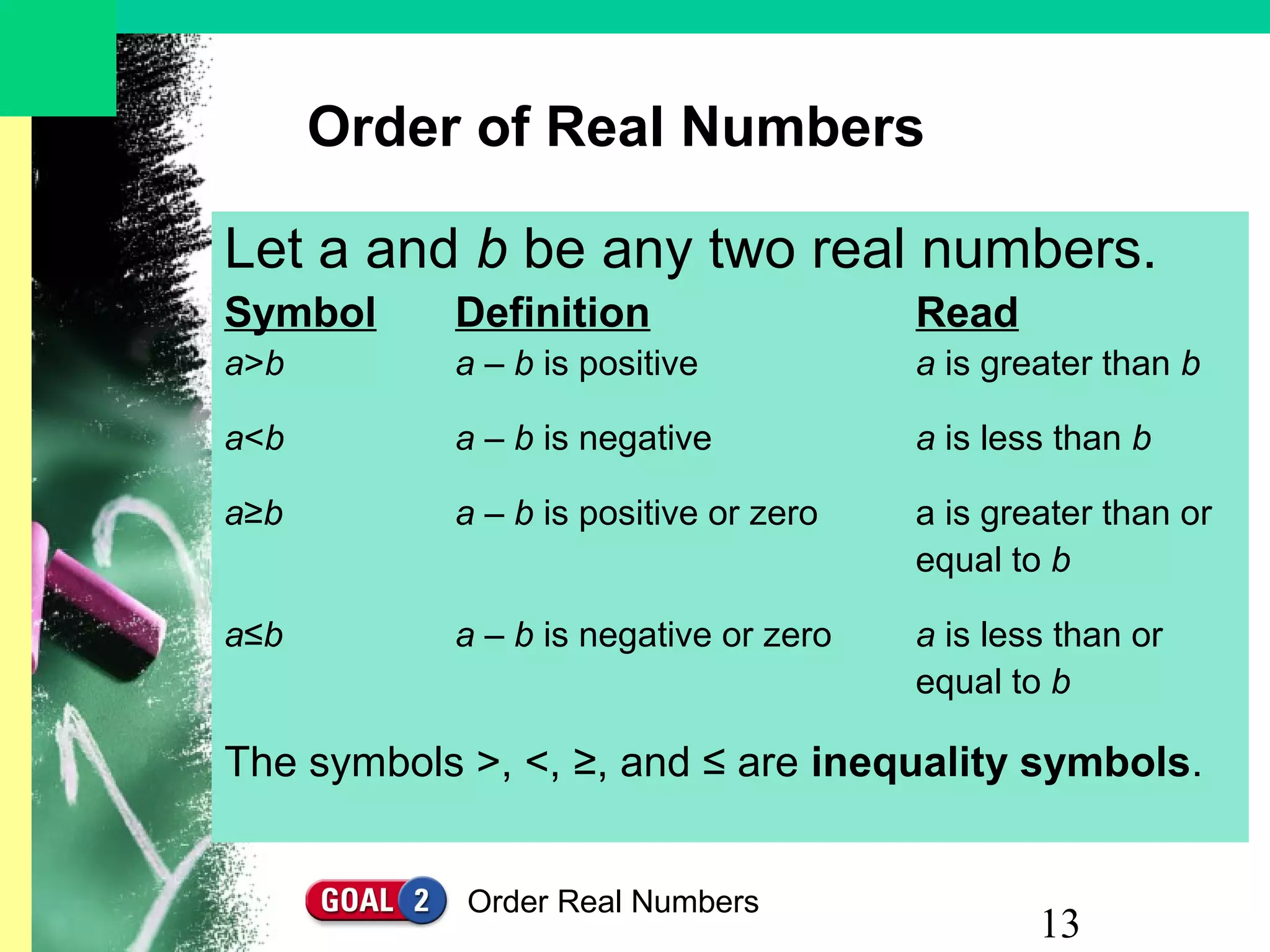
Order of Real Numbers
Let a and b be any two real numbers.
Symbol Definition Read
a>b a – b is positive a is greater than b
a<b a – b is negative a is less than b
a≥b a – b is positive or zero a is greater than or
equal to b
a≤b a – b is negative or zero a is less than or
equal to b
The symbols >, <, ≥, and ≤ are inequality symbols.
Order Real Numbers
14
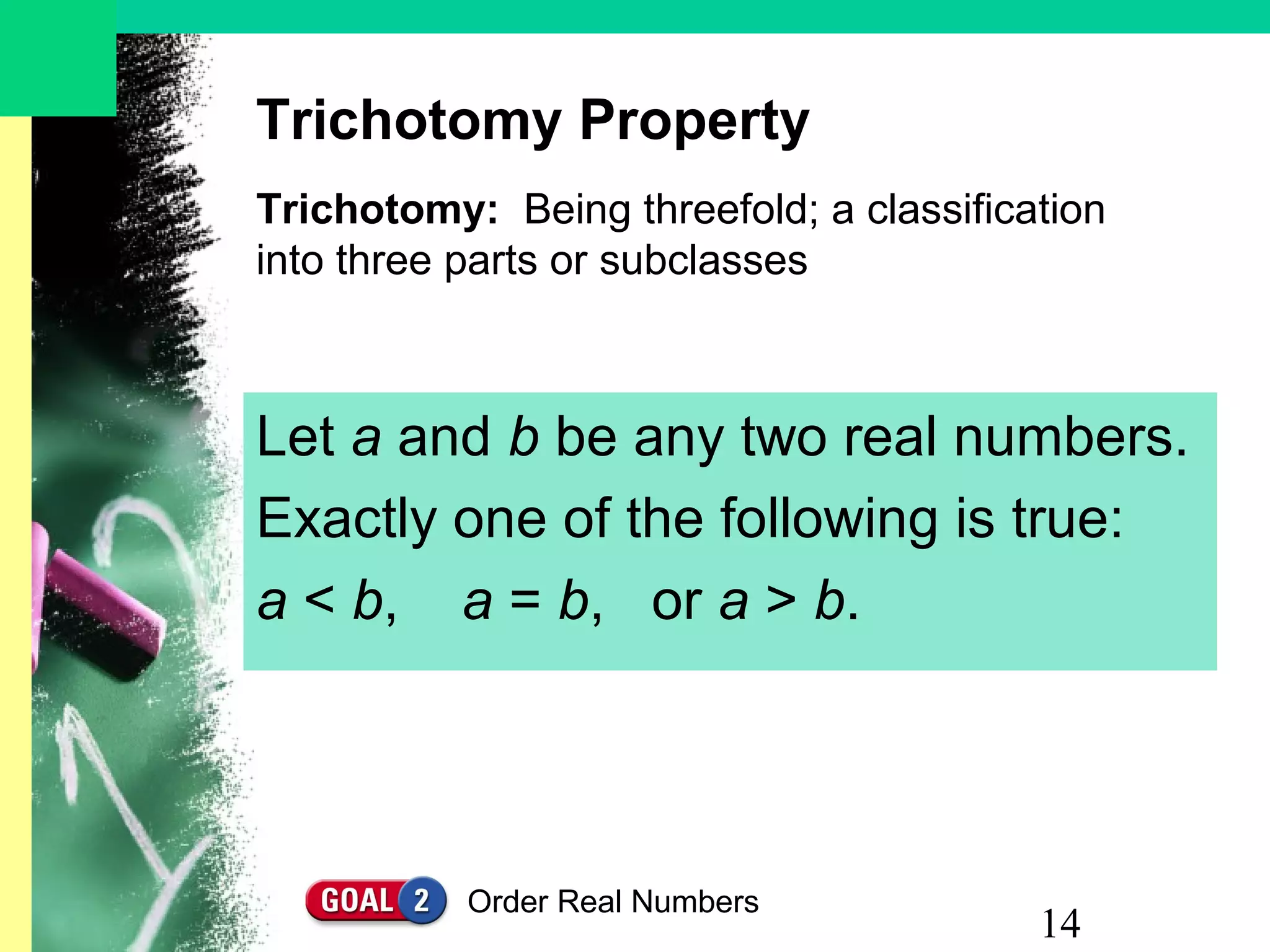
Trichotomy Property
Let a and b be any two real numbers.
Exactly one of the following is true:
a < b, a = b, or a > b.
Trichotomy: Being threefold; a classification
into three parts or subclasses
Order Real Numbers
15
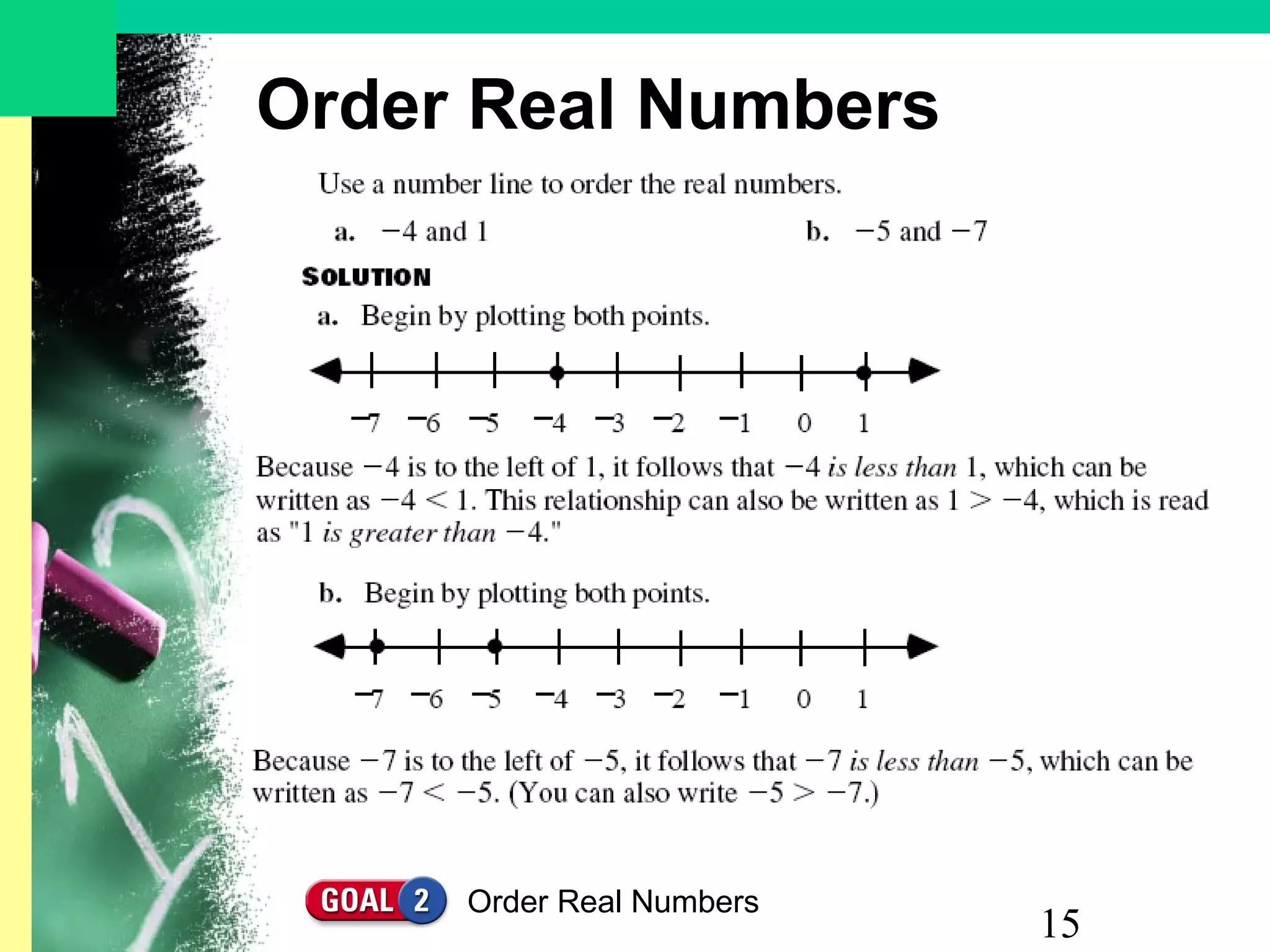
Order Real Numbers
Order Real Numbers
16
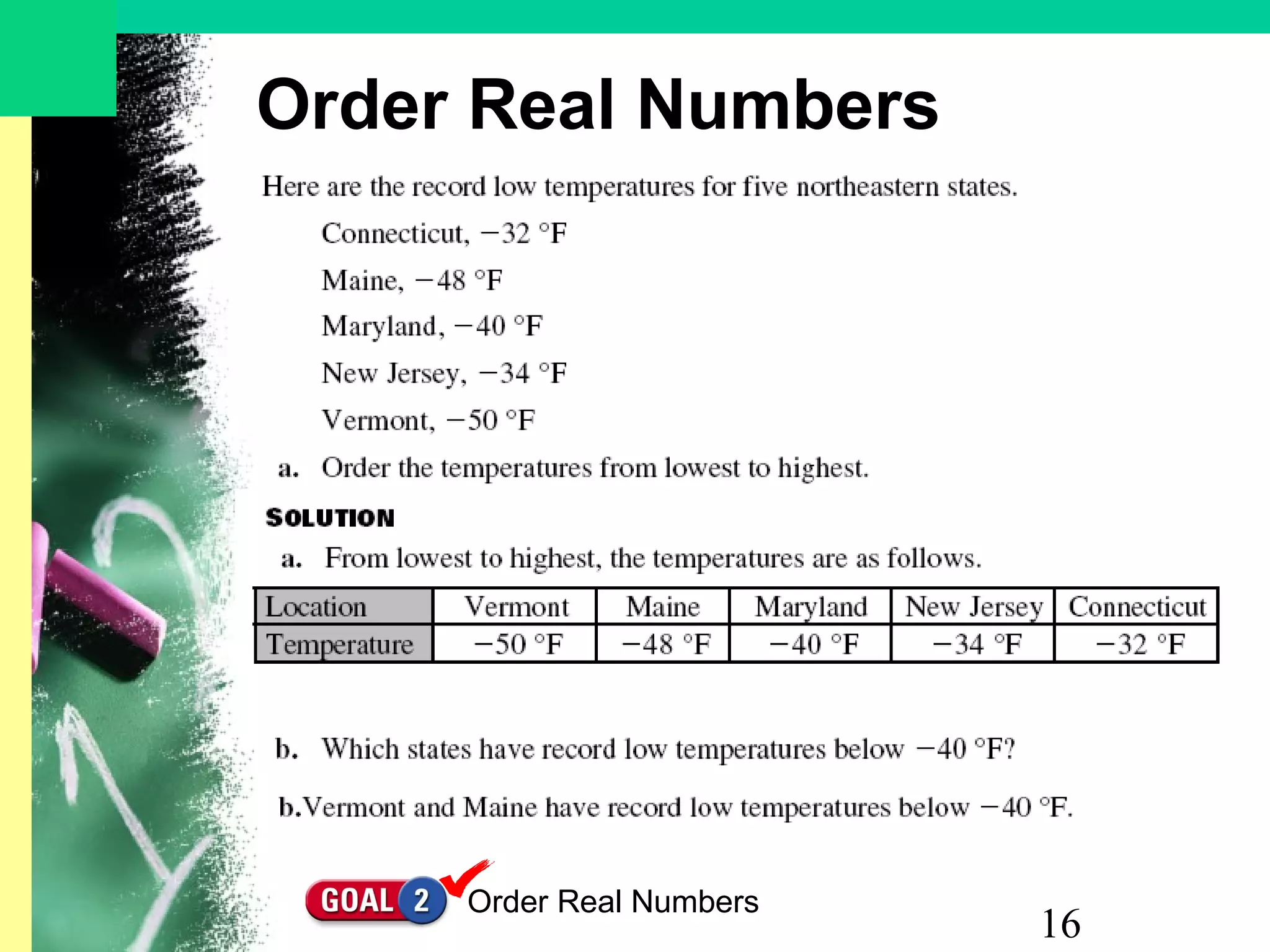
Order Real Numbers
Order Real Numbers
17
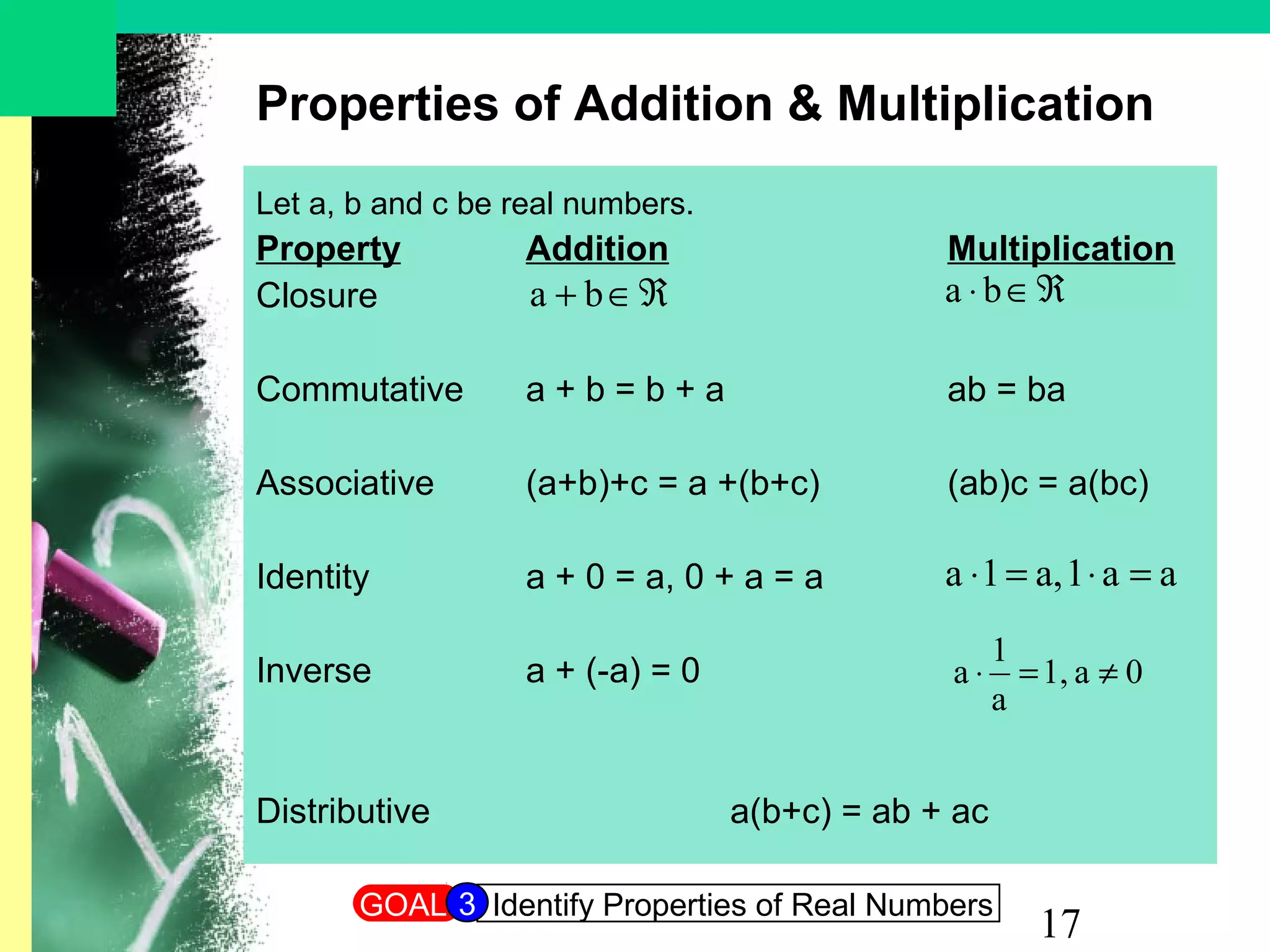
Properties of Addition & Multiplication
Let a, b and c be real numbers.
Property Addition Multiplication
Closure
Commutative a + b = b + a ab = ba
Associative (a+b)+c = a +(b+c) (ab)c = a(bc)
Identity a + 0 = a, 0 + a = a
Inverse a + (-a) = 0
Distributive a(b+c) = ab + ac
ℜ∈+ ba ℜ∈⋅ba
aa1a,1a =⋅=⋅
0a1,
a
1
a ≠=⋅
GOAL Identify Properties of Real Numbers3
18
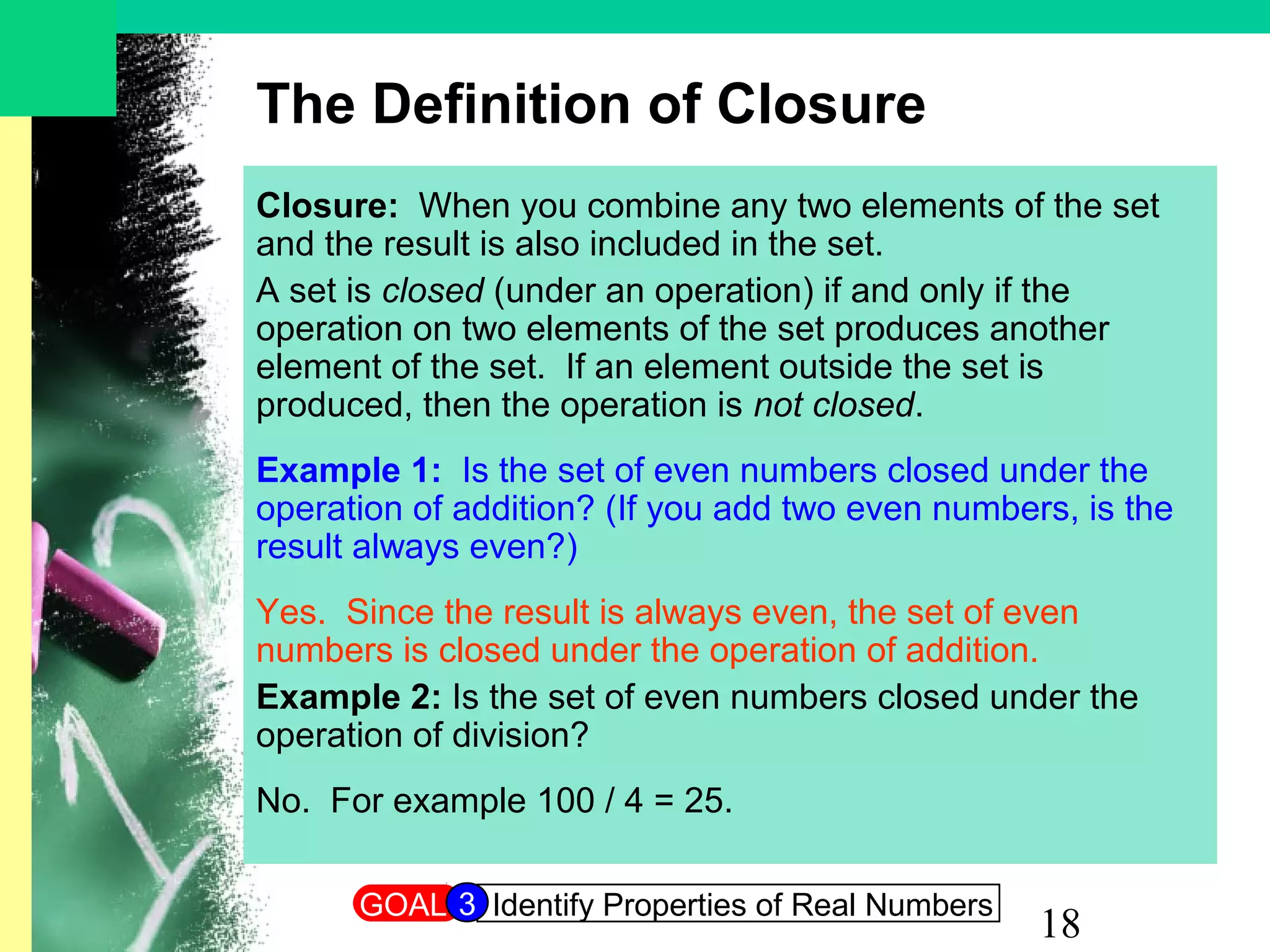
The Definition of Closure
Closure: When you combine any two elements of the set
and the result is also included in the set.
A set is closed (under an operation) if and only if the
operation on two elements of the set produces another
element of the set. If an element outside the set is
produced, then the operation is not closed.
Example 1: Is the set of even numbers closed under the
operation of addition? (If you add two even numbers, is the
result always even?)
Yes. Since the result is always even, the set of even
numbers is closed under the operation of addition.
Example 2: Is the set of even numbers closed under the
operation of division?
No. For example 100 / 4 = 25.
GOAL Identify Properties of Real Numbers3
19
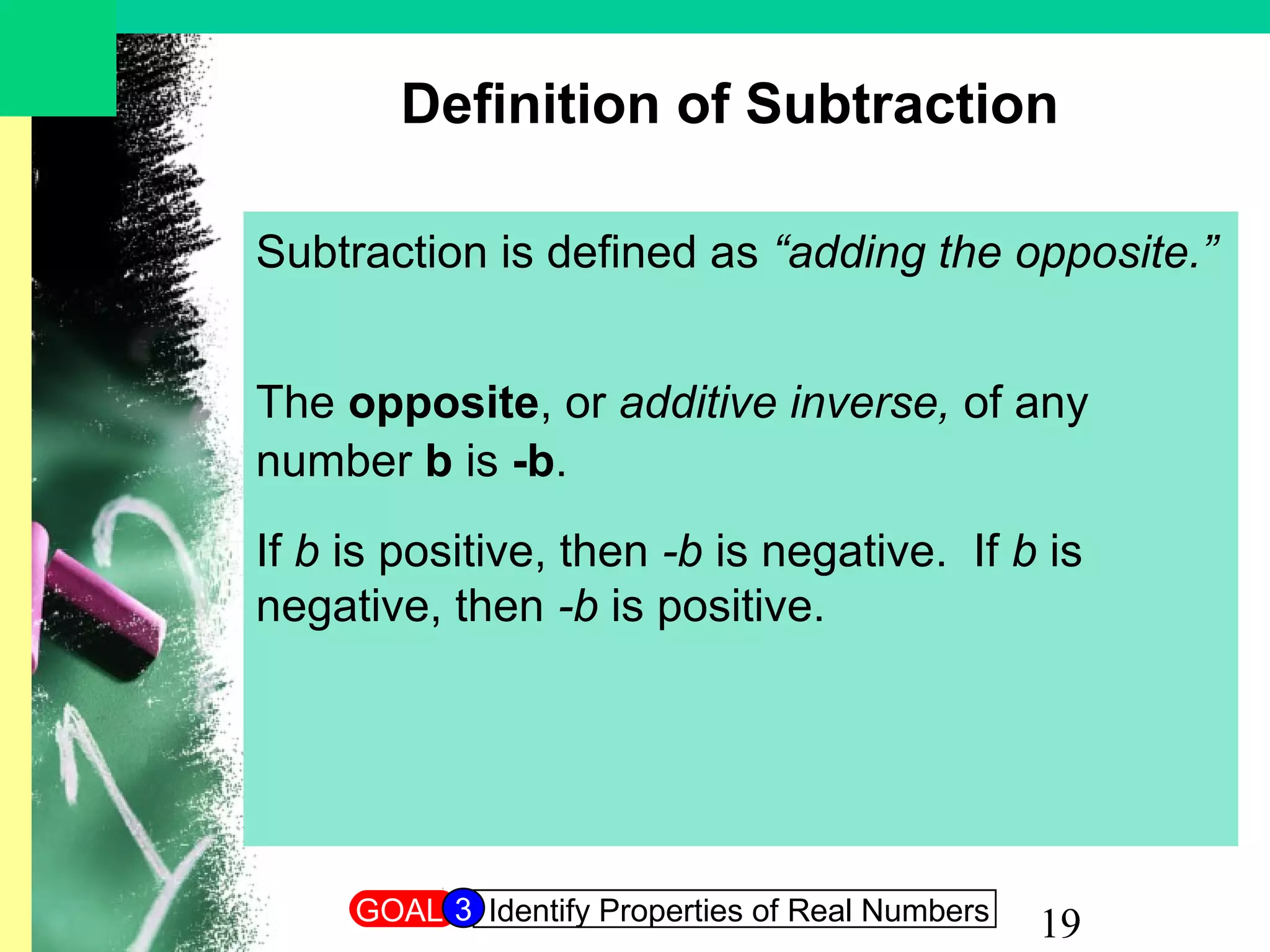
Definition of Subtraction
Subtraction is defined as “adding the opposite.”
The opposite, or additive inverse, of any
number b is -b.
If b is positive, then -b is negative. If b is
negative, then -b is positive.
GOAL Identify Properties of Real Numbers3
20
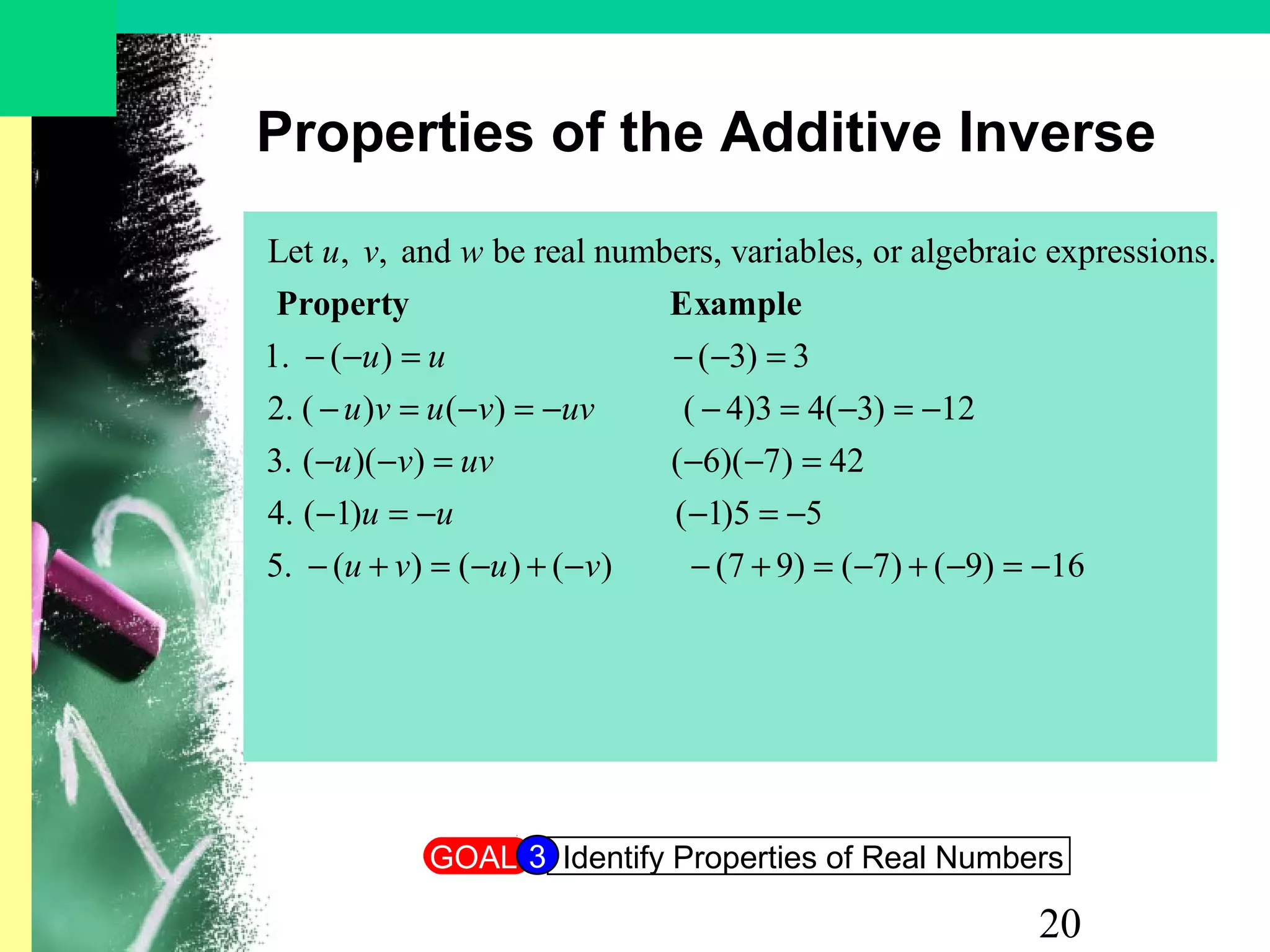
Properties of the Additive Inverse
Let , , and be real numbers, variables, or algebraic expressions.
1. ( ) ( 3) 3
2. ( ) ( ) ( 4)3 4( 3) 12
u v w
u u
u v u v uv
− − = − − =
− = − = − − = − = −
Property Example
3. ( )( ) ( 6)( 7) 42
4. ( 1) ( 1)5 5
5. ( ) ( ) ( ) (7 9) ( 7) ( 9) 16
u v uv
u u
u v u v
− − = − − =
− = − − = −
− + = − + − − + = − + − = −
GOAL Identify Properties of Real Numbers3
21
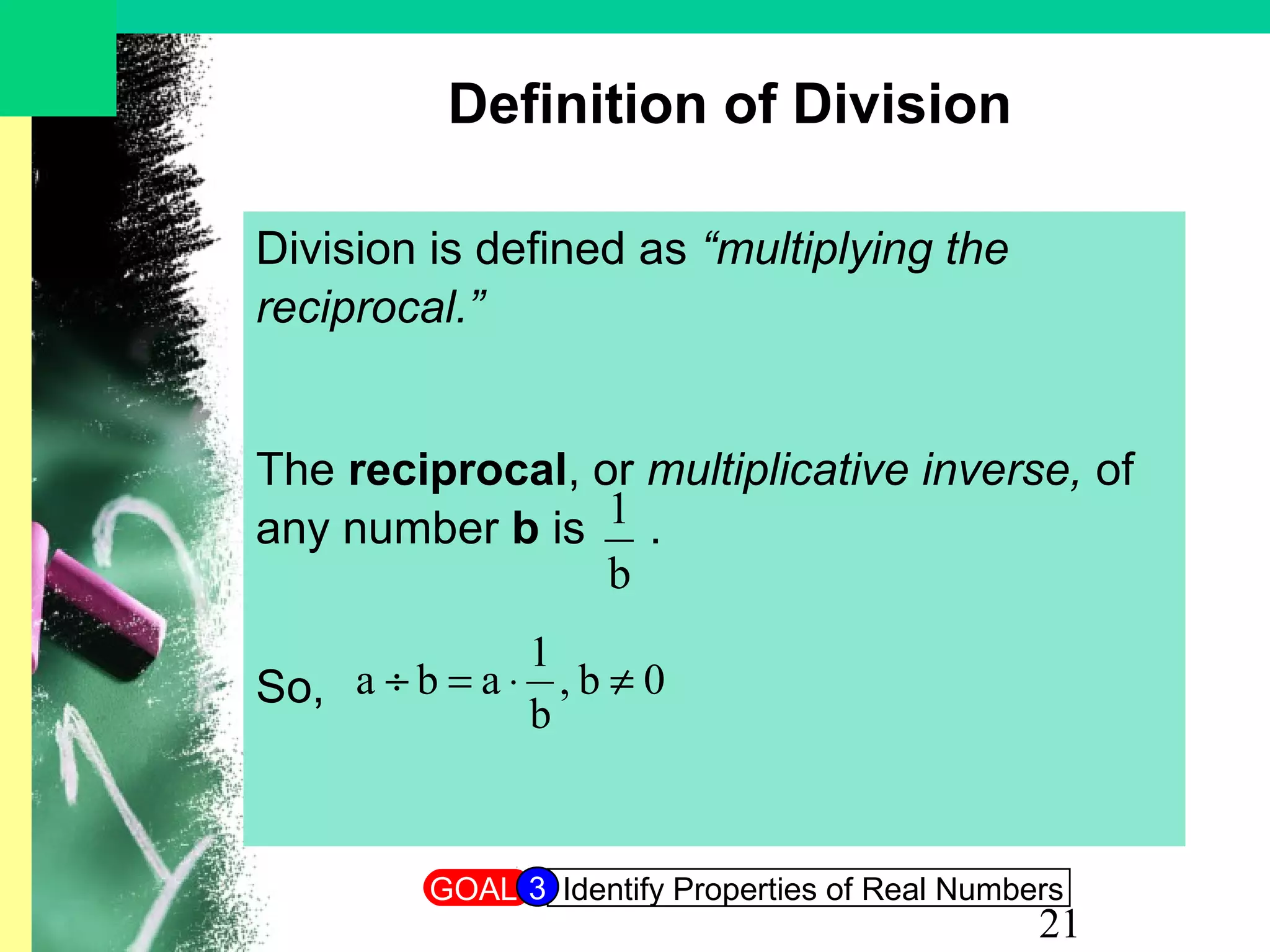
Definition of Division
Division is defined as “multiplying the
reciprocal.”
The reciprocal, or multiplicative inverse, of
any number b is .
So,
b
1
0b,
b
1
aba ≠⋅=÷
GOAL Identify Properties of Real Numbers3
22
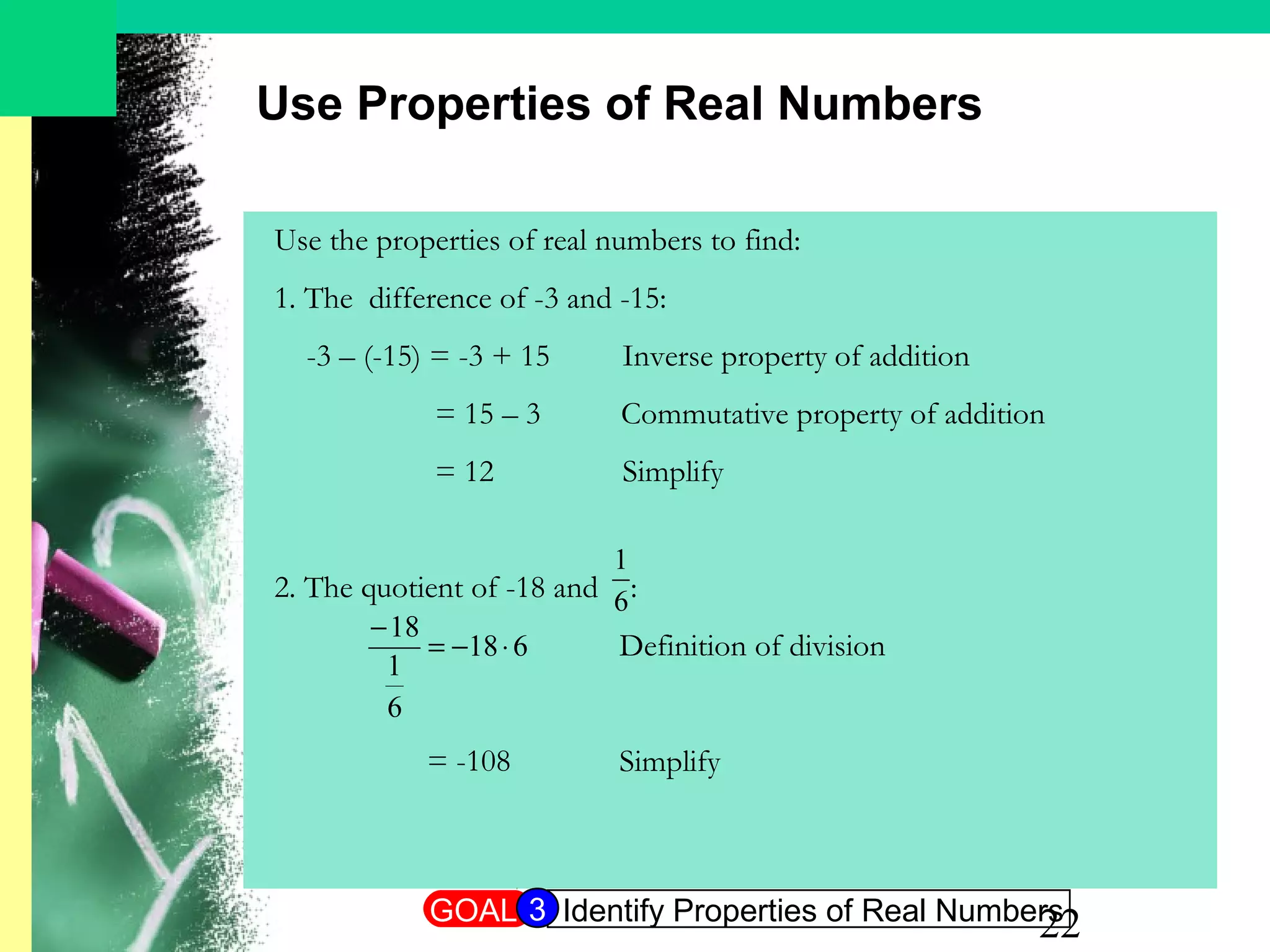
Use the properties of real numbers to find:
1. The difference of -3 and -15:
-3 – (-15) = -3 + 15 Inverse property of addition
= 15 – 3 Commutative property of addition
= 12 Simplify
2. The quotient of -18 and :
= -108
Use Properties of Real Numbers
618
6
1
18
⋅−=
−
6
1
Definition of division
Simplify
GOAL Identify Properties of Real Numbers3
23
Use Properties of Real Numbers
Use properties and definitions of operations to show
that a+(2 – a) = 2
a + (2 – a) = a + [2 + (-a)]
= a + [(-a) + 2]
= [a + (-a)] + 2
= 0 + 2
= 2
Definition of subtraction
Commutative property of addition
Associative property of addition
Inverse property of addition
Identity property of addition
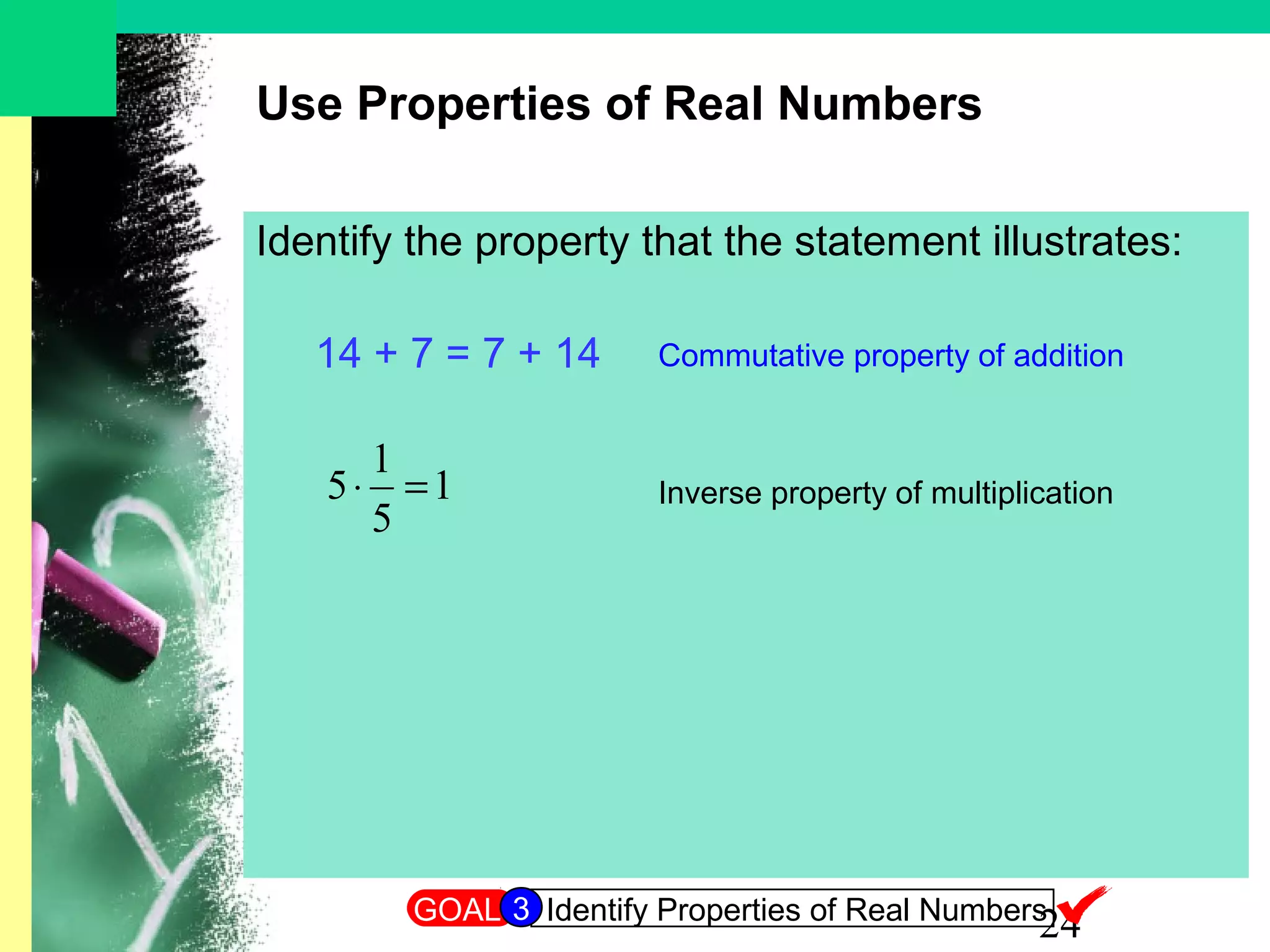
Identify the property that the statement illustrates:
(2 x 3) x 9 = 2 x (3 x 9)
4(5 + 25) = 4(5) + 4(25)
1 x 500 = 500
15 + 0 = 15
Associative property of multiplication
Distributive property of multiplication
Identity property of multiplication
Identity property of addition
GOAL Identify Properties of Real Numbers3
24
Use Properties of Real Numbers
Identify the property that the statement illustrates:
14 + 7 = 7 + 14
1
5
1
5 =⋅
Commutative property of addition
Inverse property of multiplication
GOAL Identify Properties of Real Numbers3
25
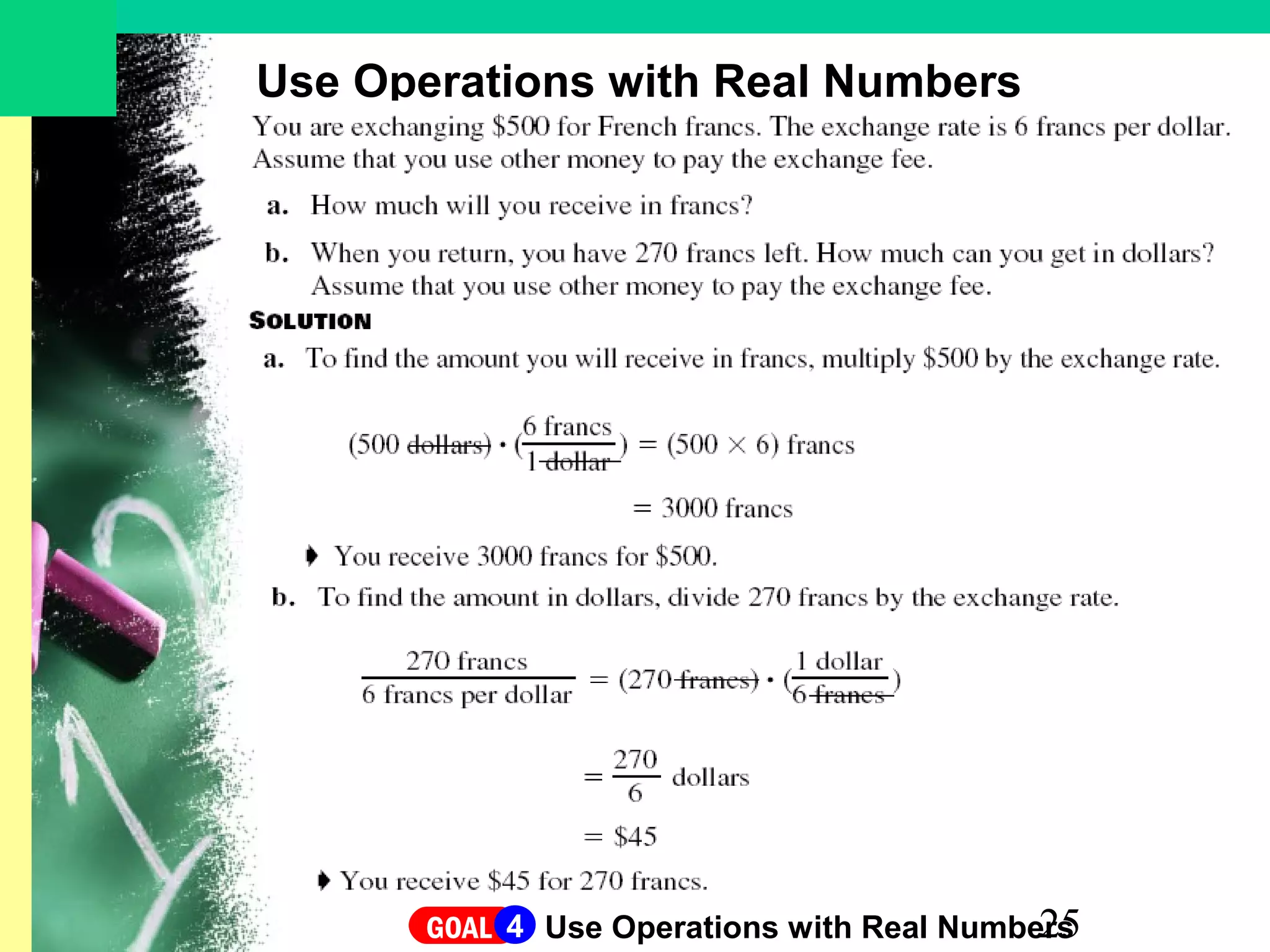
Use Operations with Real Numbers
GOAL Use Operations with Real Numbers4
26
Use Operations with Real Numbers
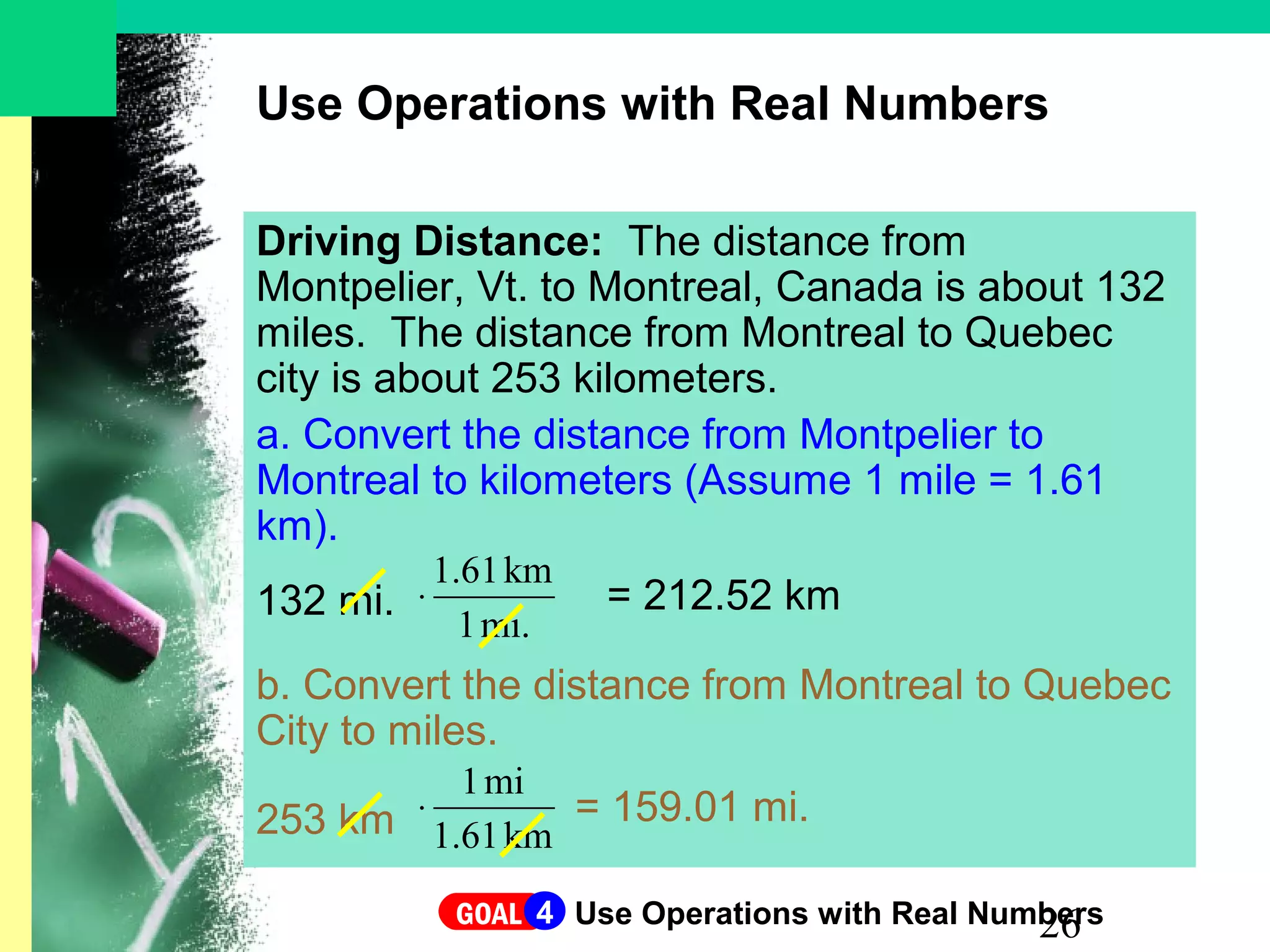
Driving Distance: The distance from
Montpelier, Vt. to Montreal, Canada is about 132
miles. The distance from Montreal to Quebec
city is about 253 kilometers.
a. Convert the distance from Montpelier to
Montreal to kilometers (Assume 1 mile = 1.61
km).
132 mi.
b. Convert the distance from Montreal to Quebec
City to miles.
253 km
mi.1
km1.61
⋅ = 212.52 km
km1.61
mi1
⋅ = 159.01 mi.
GOAL Use Operations with Real Numbers4
27
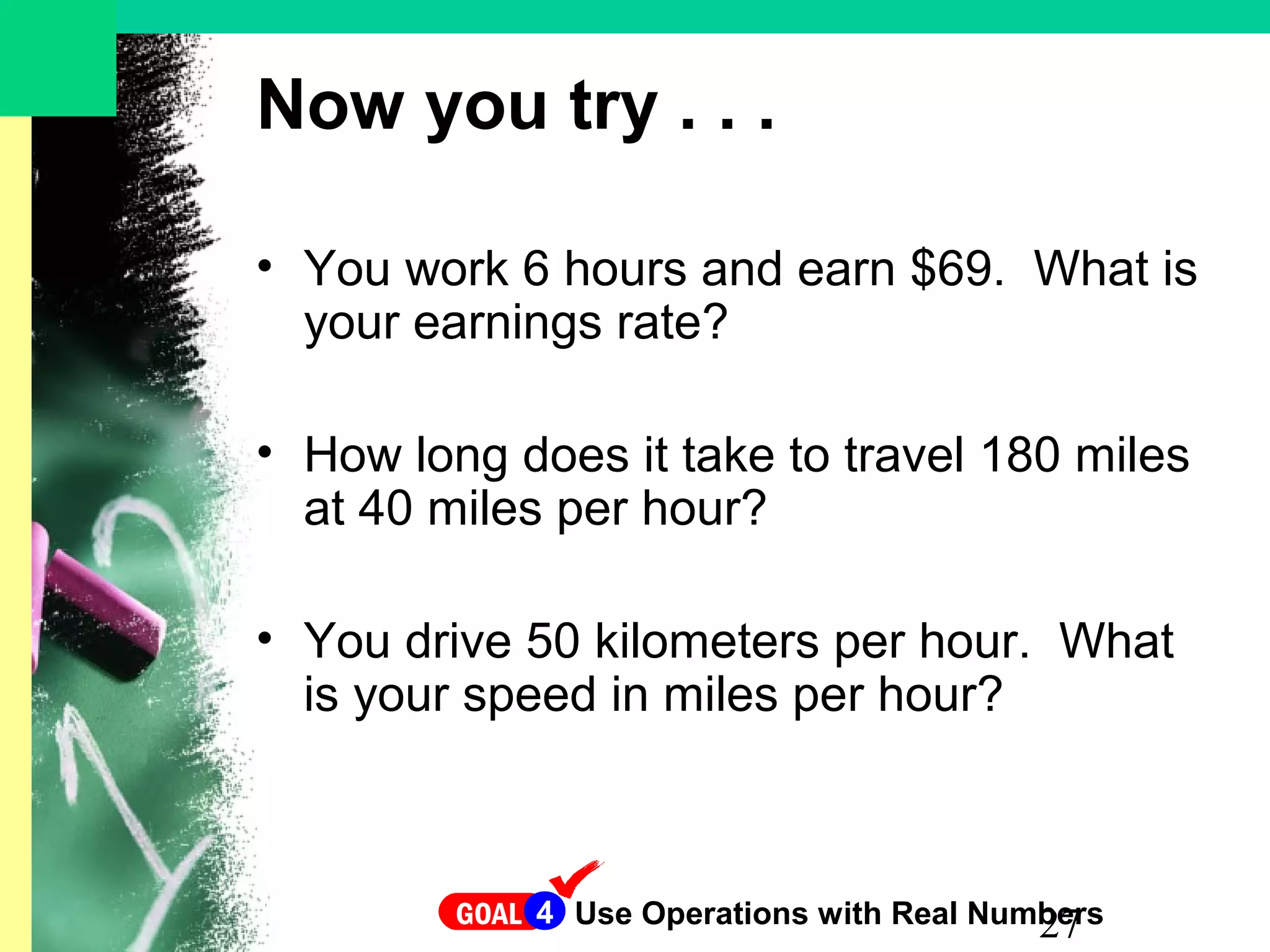
Now you try . . .
• You work 6 hours and earn $69. What is
your earnings rate?
• How long does it take to travel 180 miles
at 40 miles per hour?
• You drive 50 kilometers per hour. What
is your speed in miles per hour?
GOAL Use Operations with Real Numbers4
28
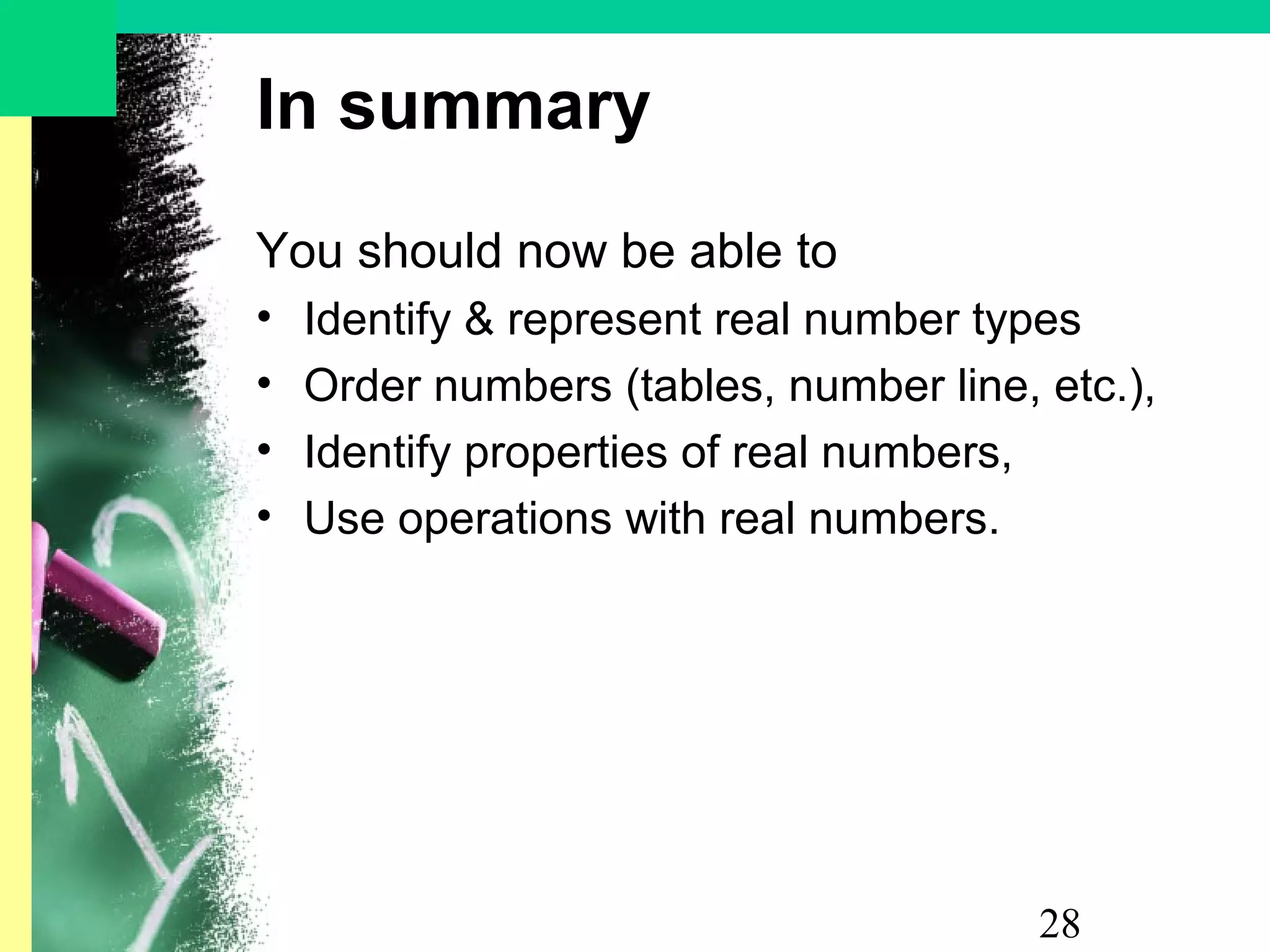
In summary
You should now be able to
• Identify & represent real number types
• Order numbers (tables, number line, etc.),
• Identify properties of real numbers,
• Use operations with real numbers.

Lesson 1 1 properties of real numbers

  • 1.
    1 Lesson 1-1 Properties &Operations of Real Numbers
  • 2.
    2 Quick Review ( ) 1.List the positive integers between -4 and 4. 2. List all negative integers greater than -4. 3. Use a calculator to evaluate the expression 2 4.5 3 . Round the value to two decimal places. 2.3 4.5 4. Eva − − 3 luate the algebraic expression for the given values of the variable. 2 1, 1,1.5 5. List the possible remainders when the positive integer is divided by 6. x x x n + − = −
  • 3.
    3 Quick Review Solutions {} { } ( ) 1. List the positive integers between -4 and 4. 2. List all negative integers greater than -4. 3. Use a calculator to evaluate the expression 2 4.5 3 . Round the value to two deci 2.3 4. 1 5 ,2,3 -3,-2,-1 − − { }3 mal places. 4. Evaluate the algebraic expression for the given values of the variable. 2 1, 1,1.5 5. List the possible remainders when the positive integer i 2.73 -4, s divid 5.375 1,2,ed by 6. x x x n + − − = − 3,4,5
  • 4.
    4 Lesson 1-1 Properties &Operations of Real Numbers
  • 5.
    5 At the endof the day You will be able to • Identify & represent real number types • Order numbers (tables, number line, etc.), • Identify properties of real numbers, • Use operations with real numbers.
  • 6.
    6 {1,2,3…} {0,1,2,3…} {...,-3,-2,-1,0,1,2,3…} any number thatcan be expressed as the ratio of two integers a/b where b≠0 e,57,2π,:exampleforrational, notarethatnumbersreal A real number is any number that can be written as a decimal. Subsets of the real numbers include: • The natural (or counting) numbers: • The whole numbers: • The integers: • Rational numbers: • Irrational numbers: Goal 1: Identify & Represent Real Numbers
  • 7.
    7 What type ofreal number? Natural: Whole: Integer: Rational: Irrational: 5 9 2 1 − 3 1 2 7 9 5π 27.1 425 + 2525 − 5 9 9 9 9 3 1 9 5π 27.1 2 7 425 + 2525 − 2525 − 2525 − 2 1 − Identify & Represent Real Numbers
  • 8.
    8 It means thatevery decimal number that repeats or terminates can be represented as a fraction – that’s the “ratio” in “rational number.” Rational vs. Irrational An important distinction between rational and irrational numbers is that rational numbers have repeating or terminating decimal expansions, whereas irrational numbers do not. What does that mean? Rational or Irrational? 3.141592653589793238... In the decimal approximation of π, there is no repeating pattern. It is non-repeating and non- terminating. It’s an irrational number. Rational or Irrational? 0.513513513... If it repeats or terminates, it can be expressed as a fraction. 0.513513... is the same as 19/37. It’s a rational number. Identify & Represent Real Numbers
  • 9.
    9 The Real NumberLine One way to represent or to visualize real numbers is to associate them with points on a line in a way that each real number a corresponds to precisely one point on the line, and, conversely, each point corresponds to a real number a. This is another representation called a graph of a real number. Identify & Represent Real Numbers The point on a number line representing the number zero is called the origin.
  • 10.
    10 A coordinate plane(or coordinate grid) is a two-dimensional system in which a location is described by its distances from two intersecting, usually perpendicular, straight lines, called axes. The Coordinate Plane Coordinate plane axes On a coordinate plane, the origin is where the axes cross. It is the ordered pair (0,0). We call it an ordered pair because we always go in order: first the x- value, then the y-value. Identify & Represent Real Numbers
  • 11.
    11 A coordinate plane(or coordinate grid) is a two-dimensional system in which a location is described by its distances from two intersecting, usually perpendicular, straight lines, called axes. The Coordinate Plane Coordinate plane A coordinate is an ordered pair of numbers that give the location of a point. Examples of coordinates: 1. (3, 5) 2. (-1, 4) 3. (2, -3) 4. (-3,-3.5) ● ● ● ● Identify & Represent Real Numbers
  • 12.
    12 The Real NumberLine If we fold the number line about the origin, all the positive and negative numbers would touch. They’re the same distance from the point 0, they just have opposite signs. For that reason, numbers that have the same numerical value but different signs are called opposites of each other. Identify & Represent Real Numbers
  • 13.
    13 Order of RealNumbers Let a and b be any two real numbers. Symbol Definition Read a>b a – b is positive a is greater than b a<b a – b is negative a is less than b a≥b a – b is positive or zero a is greater than or equal to b a≤b a – b is negative or zero a is less than or equal to b The symbols >, <, ≥, and ≤ are inequality symbols. Order Real Numbers
  • 14.
    14 Trichotomy Property Let aand b be any two real numbers. Exactly one of the following is true: a < b, a = b, or a > b. Trichotomy: Being threefold; a classification into three parts or subclasses Order Real Numbers
  • 15.
  • 16.
  • 17.
    17 Properties of Addition& Multiplication Let a, b and c be real numbers. Property Addition Multiplication Closure Commutative a + b = b + a ab = ba Associative (a+b)+c = a +(b+c) (ab)c = a(bc) Identity a + 0 = a, 0 + a = a Inverse a + (-a) = 0 Distributive a(b+c) = ab + ac ℜ∈+ ba ℜ∈⋅ba aa1a,1a =⋅=⋅ 0a1, a 1 a ≠=⋅ GOAL Identify Properties of Real Numbers3
  • 18.
    18 The Definition ofClosure Closure: When you combine any two elements of the set and the result is also included in the set. A set is closed (under an operation) if and only if the operation on two elements of the set produces another element of the set. If an element outside the set is produced, then the operation is not closed. Example 1: Is the set of even numbers closed under the operation of addition? (If you add two even numbers, is the result always even?) Yes. Since the result is always even, the set of even numbers is closed under the operation of addition. Example 2: Is the set of even numbers closed under the operation of division? No. For example 100 / 4 = 25. GOAL Identify Properties of Real Numbers3
  • 19.
    19 Definition of Subtraction Subtractionis defined as “adding the opposite.” The opposite, or additive inverse, of any number b is -b. If b is positive, then -b is negative. If b is negative, then -b is positive. GOAL Identify Properties of Real Numbers3
  • 20.
    20 Properties of theAdditive Inverse Let , , and be real numbers, variables, or algebraic expressions. 1. ( ) ( 3) 3 2. ( ) ( ) ( 4)3 4( 3) 12 u v w u u u v u v uv − − = − − = − = − = − − = − = − Property Example 3. ( )( ) ( 6)( 7) 42 4. ( 1) ( 1)5 5 5. ( ) ( ) ( ) (7 9) ( 7) ( 9) 16 u v uv u u u v u v − − = − − = − = − − = − − + = − + − − + = − + − = − GOAL Identify Properties of Real Numbers3
  • 21.
    21 Definition of Division Divisionis defined as “multiplying the reciprocal.” The reciprocal, or multiplicative inverse, of any number b is . So, b 1 0b, b 1 aba ≠⋅=÷ GOAL Identify Properties of Real Numbers3
  • 22.
    22 Use the propertiesof real numbers to find: 1. The difference of -3 and -15: -3 – (-15) = -3 + 15 Inverse property of addition = 15 – 3 Commutative property of addition = 12 Simplify 2. The quotient of -18 and : = -108 Use Properties of Real Numbers 618 6 1 18 ⋅−= − 6 1 Definition of division Simplify GOAL Identify Properties of Real Numbers3
  • 23.
    23 Use Properties ofReal Numbers Use properties and definitions of operations to show that a+(2 – a) = 2 a + (2 – a) = a + [2 + (-a)] = a + [(-a) + 2] = [a + (-a)] + 2 = 0 + 2 = 2 Definition of subtraction Commutative property of addition Associative property of addition Inverse property of addition Identity property of addition Identify the property that the statement illustrates: (2 x 3) x 9 = 2 x (3 x 9) 4(5 + 25) = 4(5) + 4(25) 1 x 500 = 500 15 + 0 = 15 Associative property of multiplication Distributive property of multiplication Identity property of multiplication Identity property of addition GOAL Identify Properties of Real Numbers3
  • 24.
    24 Use Properties ofReal Numbers Identify the property that the statement illustrates: 14 + 7 = 7 + 14 1 5 1 5 =⋅ Commutative property of addition Inverse property of multiplication GOAL Identify Properties of Real Numbers3
  • 25.
    25 Use Operations withReal Numbers GOAL Use Operations with Real Numbers4
  • 26.
    26 Use Operations withReal Numbers Driving Distance: The distance from Montpelier, Vt. to Montreal, Canada is about 132 miles. The distance from Montreal to Quebec city is about 253 kilometers. a. Convert the distance from Montpelier to Montreal to kilometers (Assume 1 mile = 1.61 km). 132 mi. b. Convert the distance from Montreal to Quebec City to miles. 253 km mi.1 km1.61 ⋅ = 212.52 km km1.61 mi1 ⋅ = 159.01 mi. GOAL Use Operations with Real Numbers4
  • 27.
    27 Now you try. . . • You work 6 hours and earn $69. What is your earnings rate? • How long does it take to travel 180 miles at 40 miles per hour? • You drive 50 kilometers per hour. What is your speed in miles per hour? GOAL Use Operations with Real Numbers4
  • 28.
    28 In summary You shouldnow be able to • Identify & represent real number types • Order numbers (tables, number line, etc.), • Identify properties of real numbers, • Use operations with real numbers.