International Research Journal of Engineering and Technology (IRJET) e-ISSN: 2395 -0056
Volume: 04 Issue: 02 | Feb -2017 www.irjet.net p-ISSN: 2395-0072
© 2017, IRJET | Impact Factor value: 5.181 | ISO 9001:2008 Certified Journal | Page 1323
Review on Automation Tool for ERD Normalization
A.S.Gaikwad, F.A.Kadri, S.S.Khandagle,N.I.Tava
Student, Department of Computer Engineering, MET'S BKC IOE Nashik, Maharashtra, India
Guided by Prof.Madhuri Shinde.
Department of Computer Engineering, MET BKC
---------------------------------------------------------------------***---------------------------------------------------------------------
Abstract - Entity Relationship Diagram (ERD) is the first
step in database design; it is an important step for the
database designers, users, analyst, and managers and in
software engineering. In this paper, a methodology for
detection of ambiguity in the ERD diagram is given. If
ambiguity is found then apply various normalization
techniques to remove it. The Normalization algorithms that
are included are – 1NF, 2NF. This methodology is based on a
predefined set of a heuristic rules that aims to extract the
ambiguity of the ERD, then these rules are mapped into a
database. A diagram generator automatically converts ERD
into database schema's or table according to the rules of
generations. The proposed methodology is explained by the
examples to show how it can provide a mechanism for quick
and easy way in extracting the Database Schemas.
Key Words: Entity RelationshipDiagram, entity, relationship,
attribute
1. INTRODUCTION
The Entity Relationship Diagram (ERD) shows that the real
world consists of a collection of entities, the relationships
between them, and the attributes that describe them. An
entity is the object where we want to store data. A
relationship defines the allowed connections between
instances of entities [1]. Attributeisa characteristic common
to all or most instances of a particular entity. Since the ER
approach is easy to understand, a designer can focus on
conceptual modeling of an organization, making decisions
of what to use from entity sets, relationship sets and
constraints. The ER-Diagram tool provides a mechanism for
quickly and easily modeling data structures required by a
software system. The ERD tool provides all the usual
features of a data modeling tool and additionally provides
reverse engineering. Thus, the user can create a database
system quickly on a number of different target platforms
without the need to write any Data Definition Language
(DDL) type code. There are many essential concepts
between ERD structure and English grammar structure
[3] after analyzing the English sentences, so it is easy to
make mapping between them.
This paper describes a methodology, which is able to extract
the ERD from a description of the application domain given
in English sentences. Using ER-extractor it extracts entities
relationships and attributes according to the heuristic rules
it will be defined, as well as by matching between the
structures of both English and ERD structures. After that,
ER-generator depends on the predicate to convert the
structure, which next pass the ER-descriptor to start to
draw the ERD automatically depending on the rules. This
paper proposed to define a methodology that provide a
help to the database designer to automatically extract the
ERD from a given English sentences. ERD is the first step
in database design, it is also a simple technique described in
a graphical way to decide which database fields,
relationships and tables will be the base of any database.
ERD is a good communication tool between users and who
use the system during the identification of the user
information requirements process.
2. EXISTING SYSTEM
There is face-to-face interaction in traditional environment.
The data normalization is introduced in this environment.
DBMS is directly saved in the database whereas files locally
act. Transactions are not possible in file systems; whereas
various types of transactions are possible in DBMS like
insert, view, delete, update etc. In DBMS, for accessing data
tables i.e. schema is used whereas in file systems data is
access is done through various files. In file systems to store
different relationships in directories “File Manager” is used;
whereas to store the relationships in the form of structural
tables, a database manager i.e. administrator is used.
Therefore, the data in database is moresecureascompare to
data in file systems.
Various tools are available that allows database designers to
draw and model the ER diagram. The given section provides
an overview of the tool sets that are considered to define ER
Diagrams for extending the ER Model. Summary and
comparisons of all the modeling tools and ER drawings used
in Chen like model is provided for ER definitions in Table 1.
Comparison of tools is based on the criteria such that if the
tool is open source or need to buy, draw or model or both,
International Research Journal of Engineering and Technology (IRJET) e-ISSN: 2395 -0056
Volume: 04 Issue: 02 | Feb -2017 www.irjet.net p-ISSN: 2395-0072
© 2017, IRJET | Impact Factor value: 5.181 | ISO 9001:2008 Certified Journal | Page 1324
only if it provides the facility to generate SQL script. Source
code is available for extension purposes and the allows
export formats.
Table -1: Summary of ER Modeling Tools
Draw
PRO
8.0.7.4
Drawing No .pdf,.html Buy No
Smart
Draw
2010
Drawing No .doc,.emf,jp
eg,.tiff,.wmf
,.ppt
Buy No
Edraz
Max5.1
System
Archite
cture
Drawing No .html,.pdf,.
doc,.ppt,.sv
g,.tiff,anygr
aphicsform
at
(.jpeg,.gif,
etc.)
Buy No
Eclipse
ERD
Both Yes .java, .xml Open
Sourc
e
Yes
DDS
Pro
Both Yes NA Buy No
ER
Draw
Both Yes .erml Free Yes
Eclipse ERD , satisfies all criteria such as if the tool is open
source, drawing or modeling or both can be done, if it
provides the facility to generate SQL script, if source code is
available for extension purposes and the allows to export
formats of the comparisons and thus is chosen for the
implementing the ER diagram.
The study of already existing automatic normalization tools
such as JMathNorm, Formalizer etc, shows that, there is no
tool existing that allows automation for normalization at
conceptual level. These tools perform normalization at
relational level.
For example, in, a system such as “Micro” is proposed that
uses two-linked list - one for storing attributes and other for
storing FDs. User has to enter keys, attributes and FD
information using a GUI interface and then can normalize a
relation up to BCNF normal form. This approach however
provides automation of normalization only at the relational
level. Also, the tools takes every relation as individual input
hence is incapable of taking the whole relational schema asa
single input to normalize it.
Some toolsets such as NORMIT , Web based Normalization
Tool , etc., are specifically designed for
learning/teaching/understanding the process of
normalization, since the process is difficult to understand
and theoretical and thus it is difficult to motivate students.
But these tools do not provide visual aid for normalization.
Our approach provides visual aid to normalization process
which is always easytounderstandandinterpretratherthan
theoretical approach.
3. PROPOSED SYSTEM
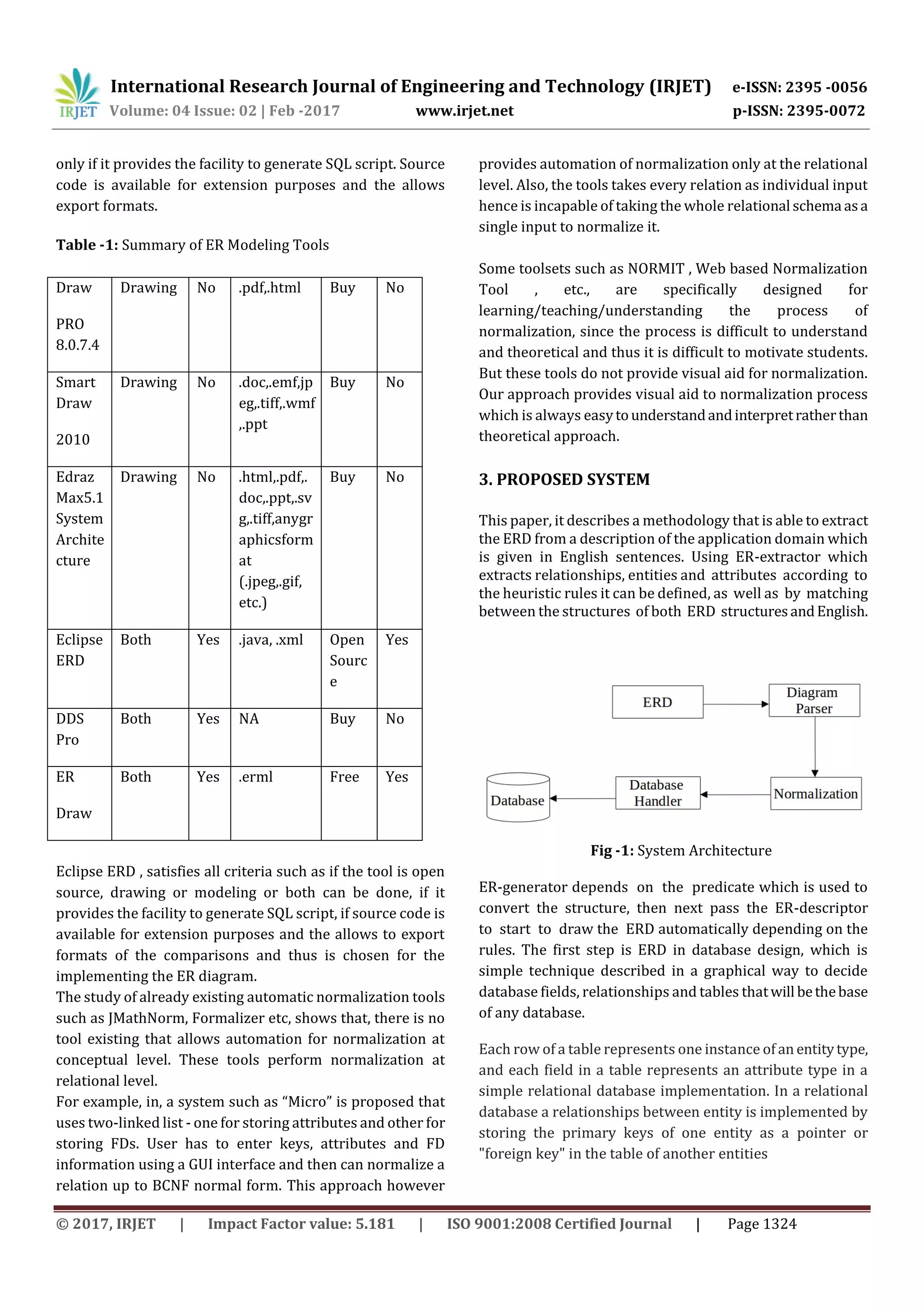
This paper, it describes a methodology that is able to extract
the ERD from a description of the application domain which
is given in English sentences. Using ER-extractor which
extracts relationships, entities and attributes according to
the heuristic rules it can be defined, as well as by matching
between the structures of both ERD structuresandEnglish.
Fig -1: System Architecture
ER-generator depends on the predicate which is used to
convert the structure, then next pass the ER-descriptor
to start to draw the ERD automatically depending on the
rules. The first step is ERD in database design, which is
simple technique described in a graphical way to decide
database fields, relationships and tables thatwill bethebase
of any database.
Each row of a table represents one instance of an entitytype,
and each field in a table represents an attribute type in a
simple relational database implementation. In a relational
database a relationships between entity is implemented by
storing the primary keys of one entity as a pointer or
"foreign key" in the table of another entities
International Research Journal of Engineering and Technology (IRJET) e-ISSN: 2395 -0056
Volume: 04 Issue: 02 | Feb -2017 www.irjet.net p-ISSN: 2395-0072
© 2017, IRJET | Impact Factor value: 5.181 | ISO 9001:2008 Certified Journal | Page 1325
There is a tradition for ER/data models to be built at two to
three levels of abstraction.
Some advantages of proposed system is as follows.
1. Reduction in data redundancy.
2. Increased consistency andreducedupdatingerrors.
3. Independence from applications programs and
greater data integrity.
4. Improvised data access to users through useofhost
and query languages.
5. Improved security of data.
6. Reduced storage, data entry, and retrieval costs.
7. Facilitated development in new applications
programs.
4. CONCLUSIONS
Since the real world consists of a collection of entities
and relationship between them with attributes that
describes them, extracting database from ERD is an
important step to understand the entire system. ERD
supplement data modeling, and also considered to be the
base approach for database designers and software
developers. In future, we can extend ER diagram
normalization using the parallel processing framework so
that it can handle very big diagram in efficient manner.
REFERENCES
[1]. Adelman, S., Moss, Larissa and Abai, Majid (2005) Data
Strategy, Addison-Wesley, Readings, MA.
[2]. Bala, Mohan and Martin, Kipp (1997) “A Mathematical
Programming Approach to Data Base Normalization,”
Informs Journal of Computing, Vol. 9, No.1, pp. 1-14.
[3].Balaban, M. and Shoval, P. (1999). Enhancing the ER
model with integrity methods. Journal of Database
Management, 10(4),14-23.
BIOGRAPHIES
Nazneen I .Tava currently perusing BE
in Computer Engineering from MET’S
Bhujbal Knowledge city, Institute of
Engineering , Adgaon , Nasik
,Maharashtra, India from 2014.My area
of interest is Database Normalization
and Networking.

Review on Automation Tool for ERD Normalization

  • 1.
    International Research Journalof Engineering and Technology (IRJET) e-ISSN: 2395 -0056 Volume: 04 Issue: 02 | Feb -2017 www.irjet.net p-ISSN: 2395-0072 © 2017, IRJET | Impact Factor value: 5.181 | ISO 9001:2008 Certified Journal | Page 1323 Review on Automation Tool for ERD Normalization A.S.Gaikwad, F.A.Kadri, S.S.Khandagle,N.I.Tava Student, Department of Computer Engineering, MET'S BKC IOE Nashik, Maharashtra, India Guided by Prof.Madhuri Shinde. Department of Computer Engineering, MET BKC ---------------------------------------------------------------------***--------------------------------------------------------------------- Abstract - Entity Relationship Diagram (ERD) is the first step in database design; it is an important step for the database designers, users, analyst, and managers and in software engineering. In this paper, a methodology for detection of ambiguity in the ERD diagram is given. If ambiguity is found then apply various normalization techniques to remove it. The Normalization algorithms that are included are – 1NF, 2NF. This methodology is based on a predefined set of a heuristic rules that aims to extract the ambiguity of the ERD, then these rules are mapped into a database. A diagram generator automatically converts ERD into database schema's or table according to the rules of generations. The proposed methodology is explained by the examples to show how it can provide a mechanism for quick and easy way in extracting the Database Schemas. Key Words: Entity RelationshipDiagram, entity, relationship, attribute 1. INTRODUCTION The Entity Relationship Diagram (ERD) shows that the real world consists of a collection of entities, the relationships between them, and the attributes that describe them. An entity is the object where we want to store data. A relationship defines the allowed connections between instances of entities [1]. Attributeisa characteristic common to all or most instances of a particular entity. Since the ER approach is easy to understand, a designer can focus on conceptual modeling of an organization, making decisions of what to use from entity sets, relationship sets and constraints. The ER-Diagram tool provides a mechanism for quickly and easily modeling data structures required by a software system. The ERD tool provides all the usual features of a data modeling tool and additionally provides reverse engineering. Thus, the user can create a database system quickly on a number of different target platforms without the need to write any Data Definition Language (DDL) type code. There are many essential concepts between ERD structure and English grammar structure [3] after analyzing the English sentences, so it is easy to make mapping between them. This paper describes a methodology, which is able to extract the ERD from a description of the application domain given in English sentences. Using ER-extractor it extracts entities relationships and attributes according to the heuristic rules it will be defined, as well as by matching between the structures of both English and ERD structures. After that, ER-generator depends on the predicate to convert the structure, which next pass the ER-descriptor to start to draw the ERD automatically depending on the rules. This paper proposed to define a methodology that provide a help to the database designer to automatically extract the ERD from a given English sentences. ERD is the first step in database design, it is also a simple technique described in a graphical way to decide which database fields, relationships and tables will be the base of any database. ERD is a good communication tool between users and who use the system during the identification of the user information requirements process. 2. EXISTING SYSTEM There is face-to-face interaction in traditional environment. The data normalization is introduced in this environment. DBMS is directly saved in the database whereas files locally act. Transactions are not possible in file systems; whereas various types of transactions are possible in DBMS like insert, view, delete, update etc. In DBMS, for accessing data tables i.e. schema is used whereas in file systems data is access is done through various files. In file systems to store different relationships in directories “File Manager” is used; whereas to store the relationships in the form of structural tables, a database manager i.e. administrator is used. Therefore, the data in database is moresecureascompare to data in file systems. Various tools are available that allows database designers to draw and model the ER diagram. The given section provides an overview of the tool sets that are considered to define ER Diagrams for extending the ER Model. Summary and comparisons of all the modeling tools and ER drawings used in Chen like model is provided for ER definitions in Table 1. Comparison of tools is based on the criteria such that if the tool is open source or need to buy, draw or model or both,
  • 2.
    International Research Journalof Engineering and Technology (IRJET) e-ISSN: 2395 -0056 Volume: 04 Issue: 02 | Feb -2017 www.irjet.net p-ISSN: 2395-0072 © 2017, IRJET | Impact Factor value: 5.181 | ISO 9001:2008 Certified Journal | Page 1324 only if it provides the facility to generate SQL script. Source code is available for extension purposes and the allows export formats. Table -1: Summary of ER Modeling Tools Draw PRO 8.0.7.4 Drawing No .pdf,.html Buy No Smart Draw 2010 Drawing No .doc,.emf,jp eg,.tiff,.wmf ,.ppt Buy No Edraz Max5.1 System Archite cture Drawing No .html,.pdf,. doc,.ppt,.sv g,.tiff,anygr aphicsform at (.jpeg,.gif, etc.) Buy No Eclipse ERD Both Yes .java, .xml Open Sourc e Yes DDS Pro Both Yes NA Buy No ER Draw Both Yes .erml Free Yes Eclipse ERD , satisfies all criteria such as if the tool is open source, drawing or modeling or both can be done, if it provides the facility to generate SQL script, if source code is available for extension purposes and the allows to export formats of the comparisons and thus is chosen for the implementing the ER diagram. The study of already existing automatic normalization tools such as JMathNorm, Formalizer etc, shows that, there is no tool existing that allows automation for normalization at conceptual level. These tools perform normalization at relational level. For example, in, a system such as “Micro” is proposed that uses two-linked list - one for storing attributes and other for storing FDs. User has to enter keys, attributes and FD information using a GUI interface and then can normalize a relation up to BCNF normal form. This approach however provides automation of normalization only at the relational level. Also, the tools takes every relation as individual input hence is incapable of taking the whole relational schema asa single input to normalize it. Some toolsets such as NORMIT , Web based Normalization Tool , etc., are specifically designed for learning/teaching/understanding the process of normalization, since the process is difficult to understand and theoretical and thus it is difficult to motivate students. But these tools do not provide visual aid for normalization. Our approach provides visual aid to normalization process which is always easytounderstandandinterpretratherthan theoretical approach. 3. PROPOSED SYSTEM This paper, it describes a methodology that is able to extract the ERD from a description of the application domain which is given in English sentences. Using ER-extractor which extracts relationships, entities and attributes according to the heuristic rules it can be defined, as well as by matching between the structures of both ERD structuresandEnglish. Fig -1: System Architecture ER-generator depends on the predicate which is used to convert the structure, then next pass the ER-descriptor to start to draw the ERD automatically depending on the rules. The first step is ERD in database design, which is simple technique described in a graphical way to decide database fields, relationships and tables thatwill bethebase of any database. Each row of a table represents one instance of an entitytype, and each field in a table represents an attribute type in a simple relational database implementation. In a relational database a relationships between entity is implemented by storing the primary keys of one entity as a pointer or "foreign key" in the table of another entities
  • 3.
    International Research Journalof Engineering and Technology (IRJET) e-ISSN: 2395 -0056 Volume: 04 Issue: 02 | Feb -2017 www.irjet.net p-ISSN: 2395-0072 © 2017, IRJET | Impact Factor value: 5.181 | ISO 9001:2008 Certified Journal | Page 1325 There is a tradition for ER/data models to be built at two to three levels of abstraction. Some advantages of proposed system is as follows. 1. Reduction in data redundancy. 2. Increased consistency andreducedupdatingerrors. 3. Independence from applications programs and greater data integrity. 4. Improvised data access to users through useofhost and query languages. 5. Improved security of data. 6. Reduced storage, data entry, and retrieval costs. 7. Facilitated development in new applications programs. 4. CONCLUSIONS Since the real world consists of a collection of entities and relationship between them with attributes that describes them, extracting database from ERD is an important step to understand the entire system. ERD supplement data modeling, and also considered to be the base approach for database designers and software developers. In future, we can extend ER diagram normalization using the parallel processing framework so that it can handle very big diagram in efficient manner. REFERENCES [1]. Adelman, S., Moss, Larissa and Abai, Majid (2005) Data Strategy, Addison-Wesley, Readings, MA. [2]. Bala, Mohan and Martin, Kipp (1997) “A Mathematical Programming Approach to Data Base Normalization,” Informs Journal of Computing, Vol. 9, No.1, pp. 1-14. [3].Balaban, M. and Shoval, P. (1999). Enhancing the ER model with integrity methods. Journal of Database Management, 10(4),14-23. BIOGRAPHIES Nazneen I .Tava currently perusing BE in Computer Engineering from MET’S Bhujbal Knowledge city, Institute of Engineering , Adgaon , Nasik ,Maharashtra, India from 2014.My area of interest is Database Normalization and Networking.