Hoàng Thị Mỹ Hạnh
Recombinant DNA Technology
 Recombinant DNA technology procedures by which
DNA from different species can be isolated, cut and
spliced together -- new "recombinant " molecules are
then multiplied in quantity in populations of rapidly
dividing cells (e.g. bacteria, yeast).
Application of Recombinant DNA
 Human gene therapy: recombinant human insulin,
recombinant human growth factor, recombinant
hepatitis B vaccine…
 Engineered crop plants: golden rice (β-carotene),
herbicide resistant crops, insect resistant crops…
Recombinant DNA Tool
Vector
Enzyme used in molecular biology
Host cells
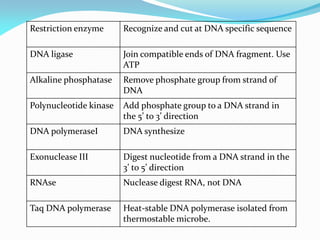
Restriction enzyme Recognize and cut at DNA specific sequence
DNA ligase Join compatible ends of DNA fragment. Use
ATP
Alkaline phosphatase Remove phosphate group from strand of
DNA
Polynucleotide kinase Add phosphate group to a DNA strand in
the 5’ to 3’ direction
DNA polymeraseI DNA synthesize
Exonuclease III Digest nucleotide from a DNA strand in the
3’ to 5’ direction
RNAse Nuclease digest RNA, not DNA
Taq DNA polymerase Heat-stable DNA polymerase isolated from
thermostable microbe.
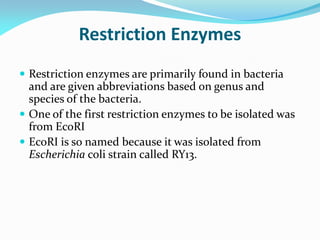
 Restriction enzymes are primarily found in bacteria
and are given abbreviations based on genus and
species of the bacteria.
 One of the first restriction enzymes to be isolated was
from EcoRI
 EcoRI is so named because it was isolated from
Escherichia coli strain called RY13.
Restriction Enzymes
Classify restriction enzymes
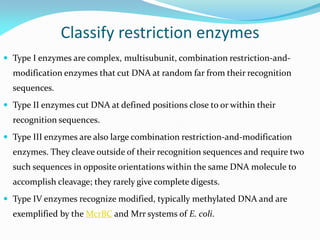
 Type I enzymes are complex, multisubunit, combination restriction-and-
modification enzymes that cut DNA at random far from their recognition
sequences.
 Type II enzymes cut DNA at defined positions close to or within their
recognition sequences.
 Type III enzymes are also large combination restriction-and-modification
enzymes. They cleave outside of their recognition sequences and require two
such sequences in opposite orientations within the same DNA molecule to
accomplish cleavage; they rarely give complete digests.
 Type IV enzymes recognize modified, typically methylated DNA and are
exemplified by the McrBC and Mrr systems of E. coli.
Restriction Enzymes
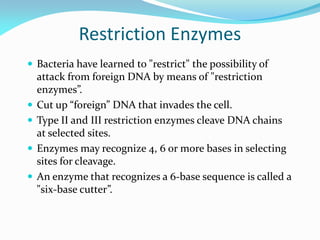
 Bacteria have learned to "restrict" the possibility of
attack from foreign DNA by means of "restriction
enzymes”.
 Cut up “foreign” DNA that invades the cell.
 Type II and III restriction enzymes cleave DNA chains
at selected sites.
 Enzymes may recognize 4, 6 or more bases in selecting
sites for cleavage.
 An enzyme that recognizes a 6-base sequence is called a
"six-base cutter”.
Type II restriction enzyme
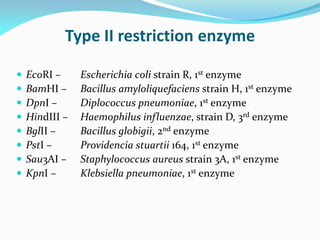
 EcoRI – Escherichia coli strain R, 1st enzyme
 BamHI – Bacillus amyloliquefaciens strain H, 1st enzyme
 DpnI – Diplococcus pneumoniae, 1st enzyme
 HindIII – Haemophilus influenzae, strain D, 3rd enzyme
 BglII – Bacillus globigii, 2nd enzyme
 PstI – Providencia stuartii 164, 1st enzyme
 Sau3AI – Staphylococcus aureus strain 3A, 1st enzyme
 KpnI – Klebsiella pneumoniae, 1st enzyme
Basics of type II Restriction Enzymes
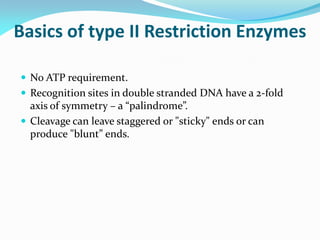
 No ATP requirement.
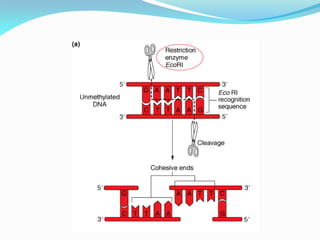
 Recognition sites in double stranded DNA have a 2-fold
axis of symmetry – a “palindrome”.
 Cleavage can leave staggered or "sticky" ends or can
produce "blunt” ends.
Results of Type II Digestion
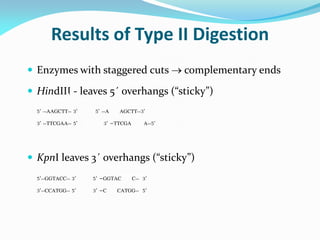
 Enzymes with staggered cuts  complementary ends
 HindIII - leaves 5´ overhangs (“sticky”)
5’ --AAGCTT-- 3’ 5’ --A AGCTT--3’
3’ --TTCGAA-- 5’ 3’ –TTCGA A--5’
 KpnI leaves 3´ overhangs (“sticky”)
5’--GGTACC-- 3’ 5’ –GGTAC C-- 3’
3’--CCATGG-- 5’ 3’ –C CATGG-- 5’
Results of Type II Digestion
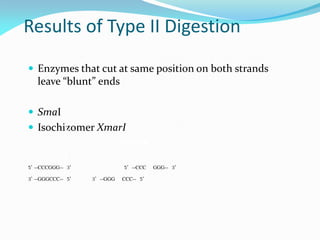
 Enzymes that cut at same position on both strands
leave “blunt” ends
 SmaI
 Isochizomer XmarI
5’ --CCCGGG-- 3’ 5’ --CCC GGG-- 3’
3’ --GGGCCC-- 5’ 3’ --GGG CCC-- 5’
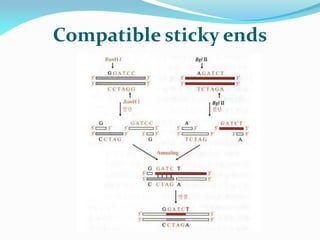
Compatible sticky ends
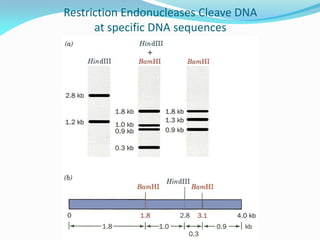
Restriction Endonucleases Cleave DNA
at specific DNA sequences
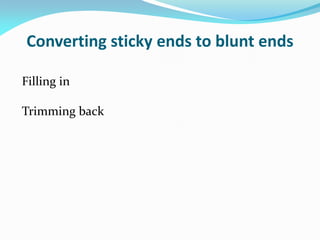
Converting sticky ends to blunt ends
Filling in
Trimming back
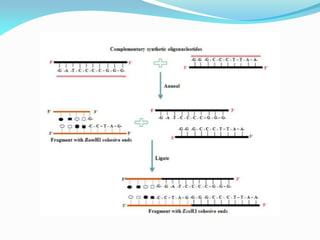
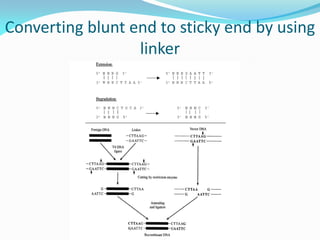
Converting blunt end to sticky end by using
linker
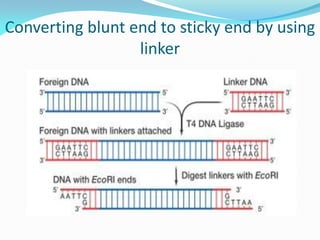
Converting blunt end to sticky end by using
linker
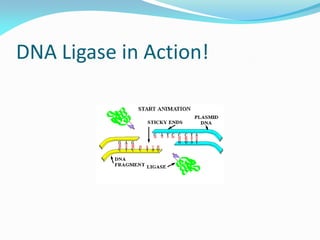
DNA Ligase in Action!
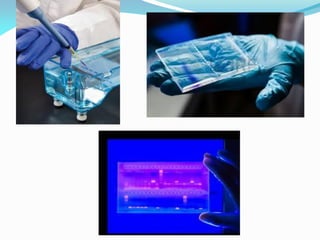
Electrophoresis
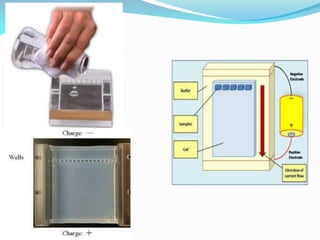
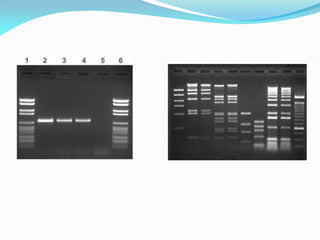
 Gel electrophoresis is a method for separation and
analysis of macromolecules (DNA, RNA and proteins)
and their fragments, based on their size and charge.
 Gel: Agarose or Acrylamide
 Dye
 Nucleic acid stain: EtBr
 Marker
 Running time
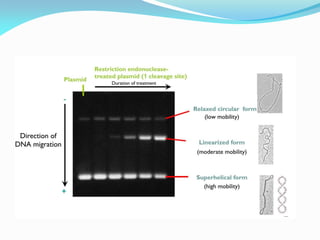
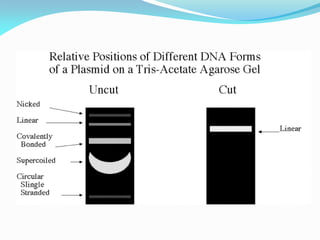
Electrophoretic mobility of form of
plasmid DNA
 Circular DNA
 Linear DNA
 Supercoil DNA
 Hypersupercoil DNA
Uncut plasmid DNA can be in five forms
 Nicked
 Circular
 Linear covalently close
 Supercoil
 Hyper supercoil
Recombinant dna-1

Recombinant dna-1

  • 1.
  • 2.
    Recombinant DNA Technology Recombinant DNA technology procedures by which DNA from different species can be isolated, cut and spliced together -- new "recombinant " molecules are then multiplied in quantity in populations of rapidly dividing cells (e.g. bacteria, yeast).
  • 3.
    Application of RecombinantDNA  Human gene therapy: recombinant human insulin, recombinant human growth factor, recombinant hepatitis B vaccine…  Engineered crop plants: golden rice (β-carotene), herbicide resistant crops, insect resistant crops…
  • 5.
    Recombinant DNA Tool Vector Enzymeused in molecular biology Host cells
  • 6.
    Restriction enzyme Recognizeand cut at DNA specific sequence DNA ligase Join compatible ends of DNA fragment. Use ATP Alkaline phosphatase Remove phosphate group from strand of DNA Polynucleotide kinase Add phosphate group to a DNA strand in the 5’ to 3’ direction DNA polymeraseI DNA synthesize Exonuclease III Digest nucleotide from a DNA strand in the 3’ to 5’ direction RNAse Nuclease digest RNA, not DNA Taq DNA polymerase Heat-stable DNA polymerase isolated from thermostable microbe.
  • 7.
     Restriction enzymesare primarily found in bacteria and are given abbreviations based on genus and species of the bacteria.  One of the first restriction enzymes to be isolated was from EcoRI  EcoRI is so named because it was isolated from Escherichia coli strain called RY13. Restriction Enzymes
  • 8.
    Classify restriction enzymes Type I enzymes are complex, multisubunit, combination restriction-and- modification enzymes that cut DNA at random far from their recognition sequences.  Type II enzymes cut DNA at defined positions close to or within their recognition sequences.  Type III enzymes are also large combination restriction-and-modification enzymes. They cleave outside of their recognition sequences and require two such sequences in opposite orientations within the same DNA molecule to accomplish cleavage; they rarely give complete digests.  Type IV enzymes recognize modified, typically methylated DNA and are exemplified by the McrBC and Mrr systems of E. coli.
  • 9.
    Restriction Enzymes  Bacteriahave learned to "restrict" the possibility of attack from foreign DNA by means of "restriction enzymes”.  Cut up “foreign” DNA that invades the cell.  Type II and III restriction enzymes cleave DNA chains at selected sites.  Enzymes may recognize 4, 6 or more bases in selecting sites for cleavage.  An enzyme that recognizes a 6-base sequence is called a "six-base cutter”.
  • 10.
    Type II restrictionenzyme  EcoRI – Escherichia coli strain R, 1st enzyme  BamHI – Bacillus amyloliquefaciens strain H, 1st enzyme  DpnI – Diplococcus pneumoniae, 1st enzyme  HindIII – Haemophilus influenzae, strain D, 3rd enzyme  BglII – Bacillus globigii, 2nd enzyme  PstI – Providencia stuartii 164, 1st enzyme  Sau3AI – Staphylococcus aureus strain 3A, 1st enzyme  KpnI – Klebsiella pneumoniae, 1st enzyme
  • 11.
    Basics of typeII Restriction Enzymes  No ATP requirement.  Recognition sites in double stranded DNA have a 2-fold axis of symmetry – a “palindrome”.  Cleavage can leave staggered or "sticky" ends or can produce "blunt” ends.
  • 13.
    Results of TypeII Digestion  Enzymes with staggered cuts  complementary ends  HindIII - leaves 5´ overhangs (“sticky”) 5’ --AAGCTT-- 3’ 5’ --A AGCTT--3’ 3’ --TTCGAA-- 5’ 3’ –TTCGA A--5’  KpnI leaves 3´ overhangs (“sticky”) 5’--GGTACC-- 3’ 5’ –GGTAC C-- 3’ 3’--CCATGG-- 5’ 3’ –C CATGG-- 5’
  • 14.
    Results of TypeII Digestion  Enzymes that cut at same position on both strands leave “blunt” ends  SmaI  Isochizomer XmarI 5’ --CCCGGG-- 3’ 5’ --CCC GGG-- 3’ 3’ --GGGCCC-- 5’ 3’ --GGG CCC-- 5’
  • 16.
  • 18.
    Restriction Endonucleases CleaveDNA at specific DNA sequences
  • 19.
    Converting sticky endsto blunt ends Filling in Trimming back
  • 20.
    Converting blunt endto sticky end by using linker
  • 21.
    Converting blunt endto sticky end by using linker
  • 22.
  • 23.
    Electrophoresis  Gel electrophoresisis a method for separation and analysis of macromolecules (DNA, RNA and proteins) and their fragments, based on their size and charge.
  • 24.
     Gel: Agaroseor Acrylamide  Dye  Nucleic acid stain: EtBr  Marker  Running time
  • 28.
    Electrophoretic mobility ofform of plasmid DNA  Circular DNA  Linear DNA  Supercoil DNA  Hypersupercoil DNA
  • 30.
    Uncut plasmid DNAcan be in five forms  Nicked  Circular  Linear covalently close  Supercoil  Hyper supercoil