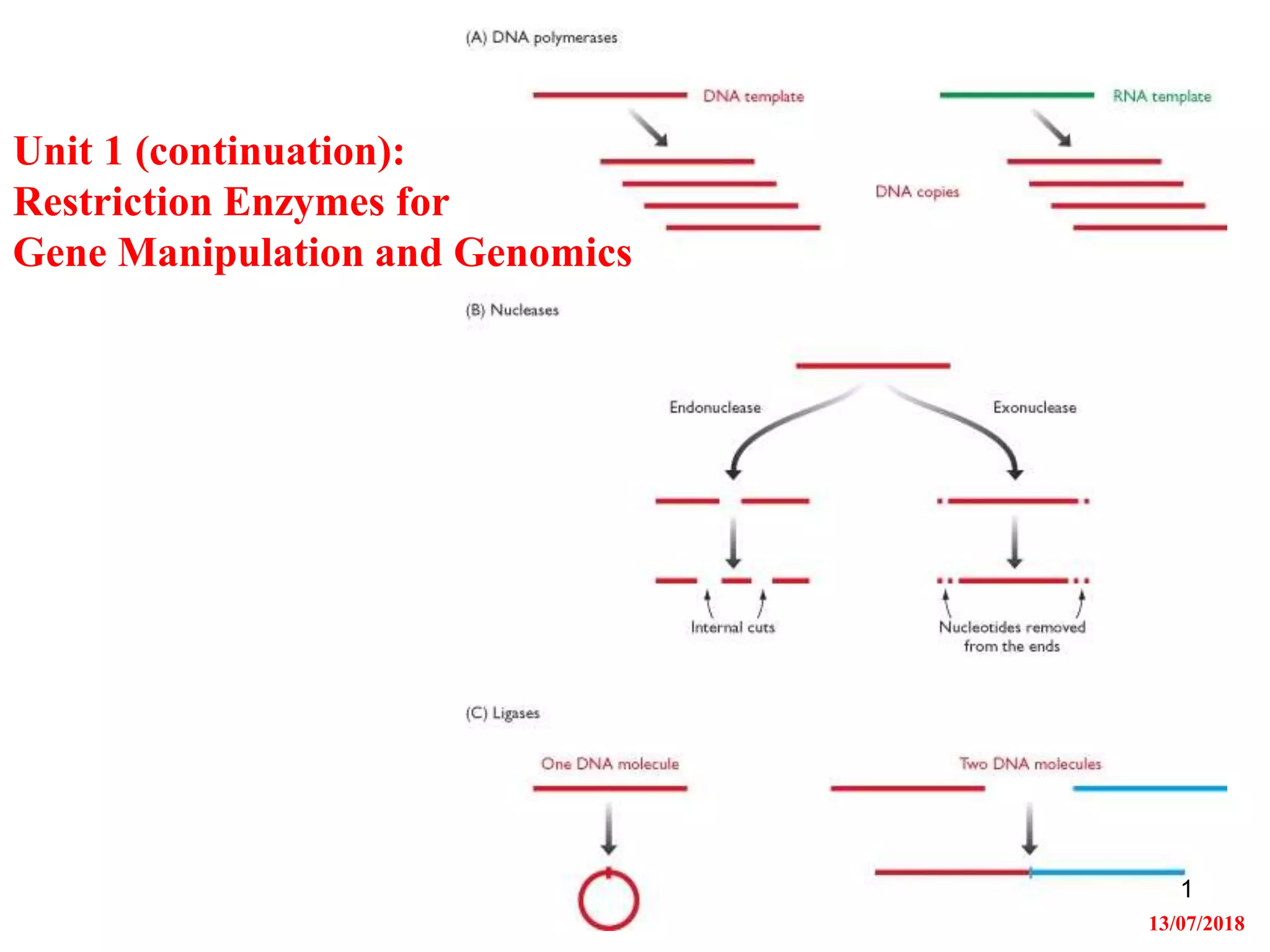
Unit 1 (continuation):
Restriction Enzymes for
Gene Manipulation and Genomics
1
13/07/2018
RESTRICTION ENDONUCLEASES
AND DNA MODIFYING ENZYMES
 Restriction endonucleases are enzymes that cleave
the sugar-phosphate backbone of DNA.
 In most practical settings, a given enzyme cuts both
strands of duplex DNA within a stretch of just few
bases.
 Several thousand different restriction endonucleases
have been isolated, which collectively exhibit a few
hundred different sequence (substrate) specificities.
 Type II Endonucleases find application in molecular
biology. 2
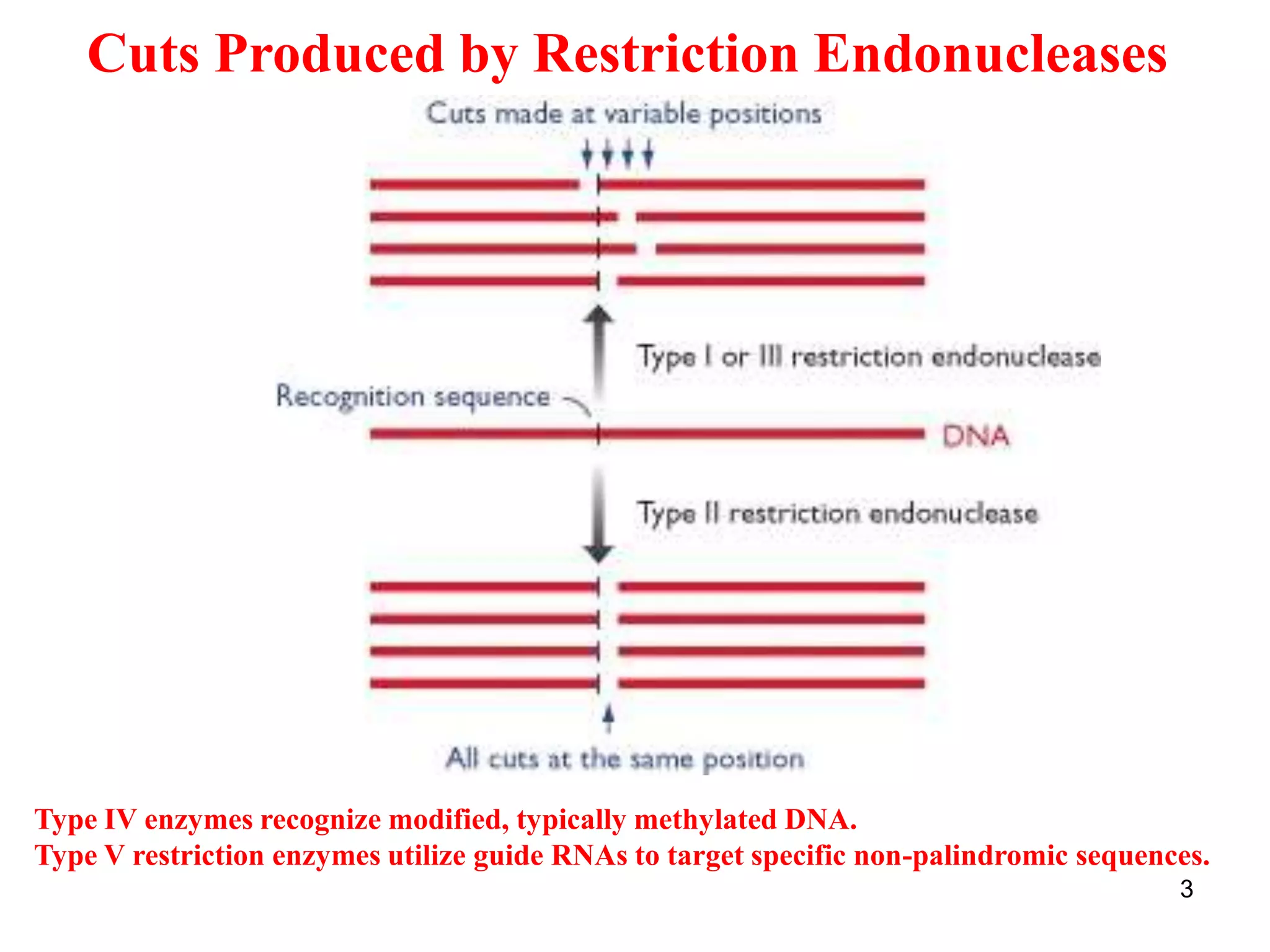
Cuts Produced by Restriction Endonucleases
3
Type IV enzymes recognize modified, typically methylated DNA.
Type V restriction enzymes utilize guide RNAs to target specific non-palindromic sequences.
 A large majority of restriction enzymes have been
isolated from bacteria, where they appear to serve a
host-defense role.
 The idea is that foreign DNA, for example from an
infecting virus, will be chopped up and inactivated
("restricted") within the bacterium by the restriction
enzyme.
 In almost all cases, a bacterium that makes a
particular restriction endonuclease also synthesizes a
companion DNA methyltransferase, which methylates
the DNA target sequence for that restriction enzyme,
thereby protecting it from cleavage.
Restriction-Modification Systems
4
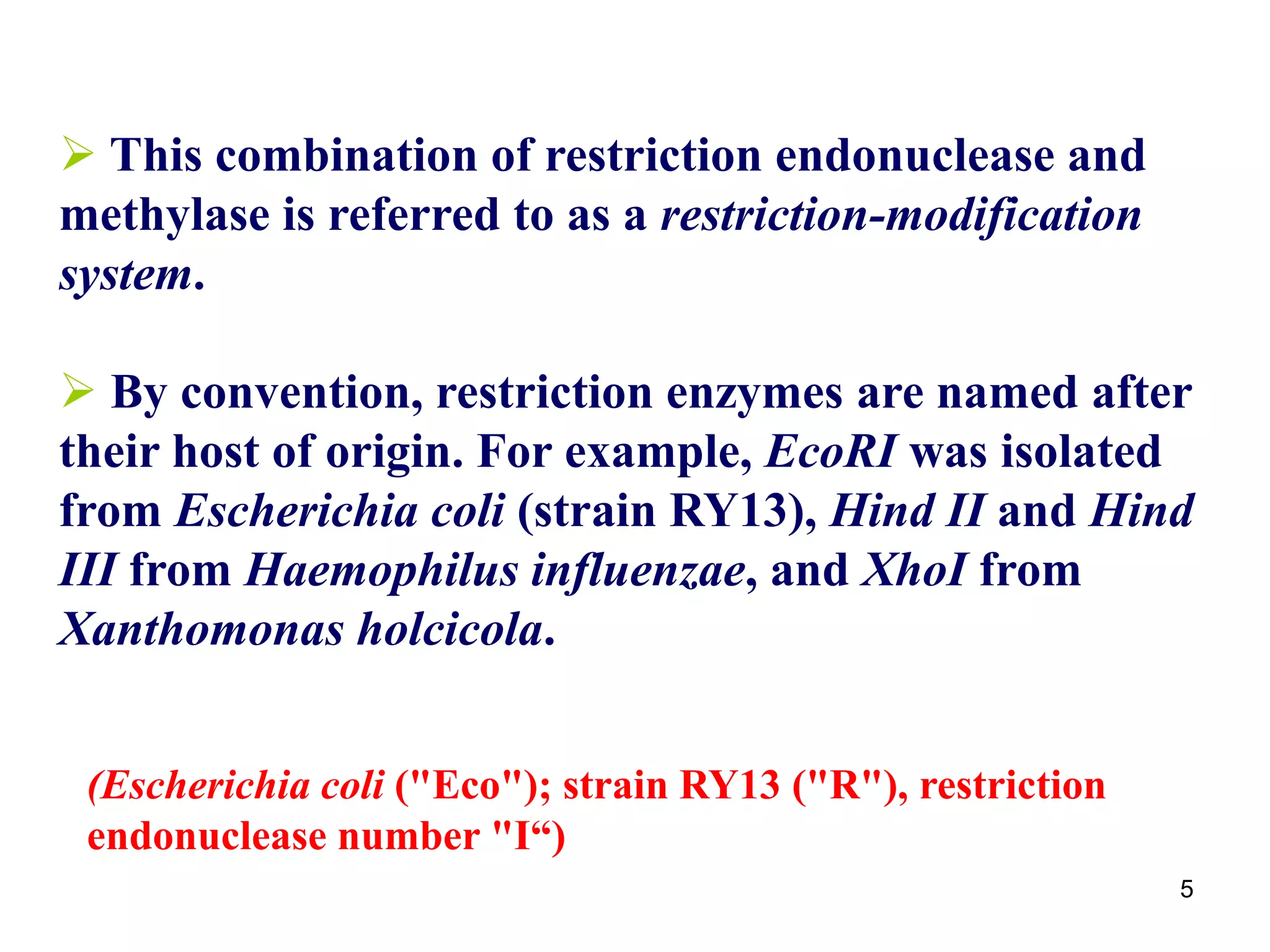
 This combination of restriction endonuclease and
methylase is referred to as a restriction-modification
system.
 By convention, restriction enzymes are named after
their host of origin. For example, EcoRI was isolated
from Escherichia coli (strain RY13), Hind II and Hind
III from Haemophilus influenzae, and XhoI from
Xanthomonas holcicola.
5
(Escherichia coli ("Eco"); strain RY13 ("R"), restriction
endonuclease number "I“)
Properties of Restriction Enzymes:
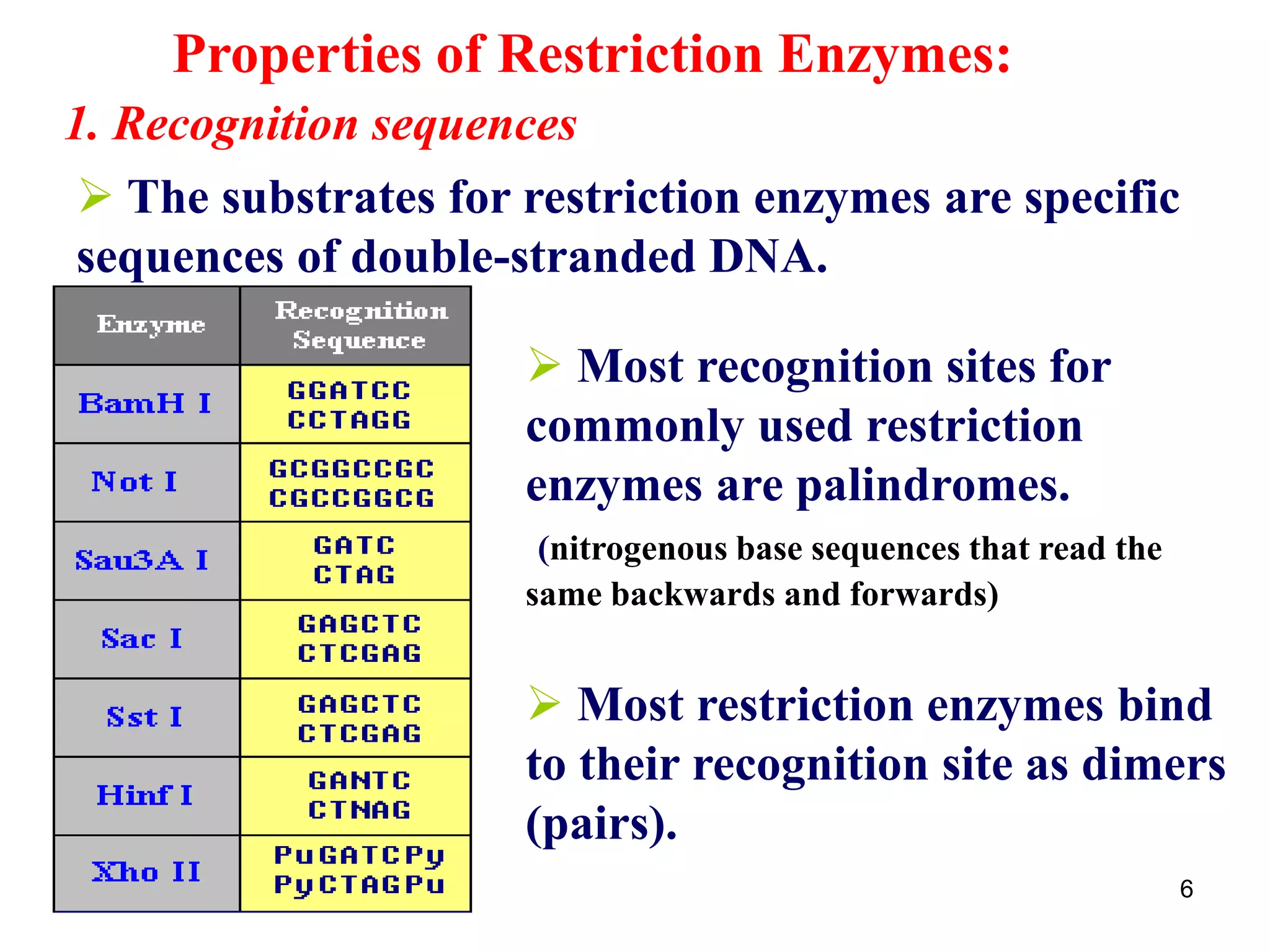
 The substrates for restriction enzymes are specific
sequences of double-stranded DNA.
 Most recognition sites for
commonly used restriction
enzymes are palindromes.
(nitrogenous base sequences that read the
same backwards and forwards)
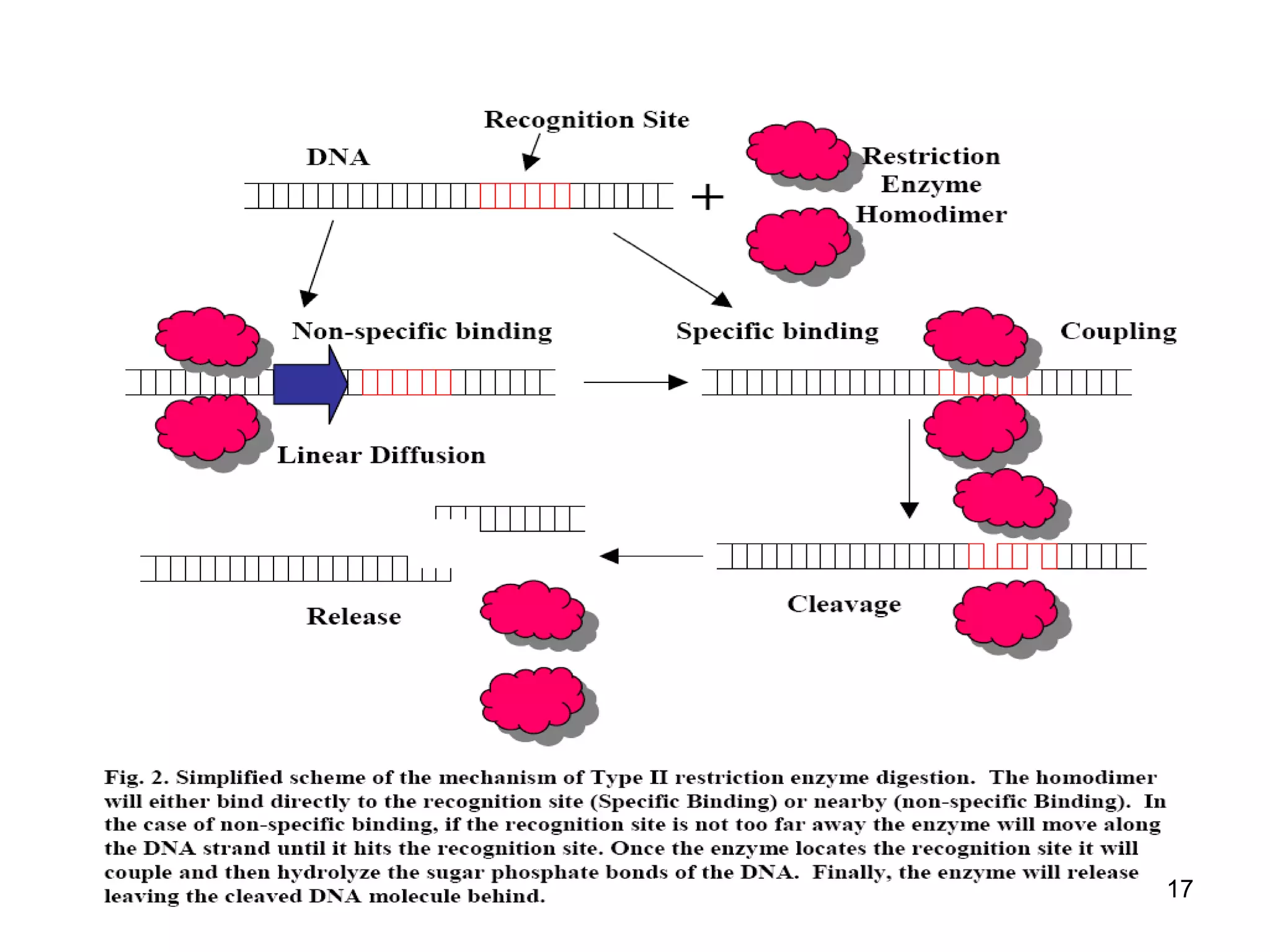
 Most restriction enzymes bind
to their recognition site as dimers
(pairs).
6
1. Recognition sequences
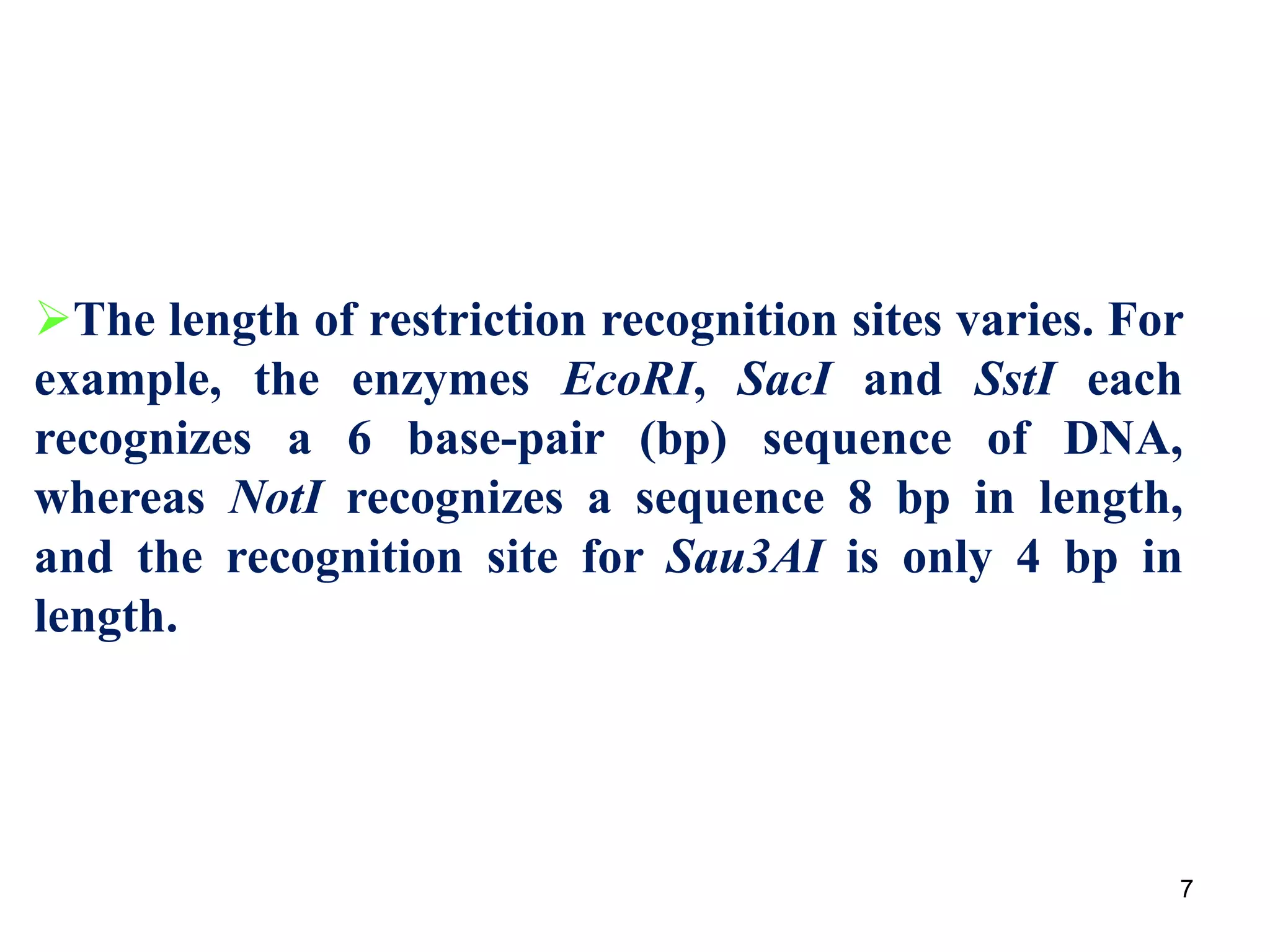
The length of restriction recognition sites varies. For
example, the enzymes EcoRI, SacI and SstI each
recognizes a 6 base-pair (bp) sequence of DNA,
whereas NotI recognizes a sequence 8 bp in length,
and the recognition site for Sau3AI is only 4 bp in
length.
7
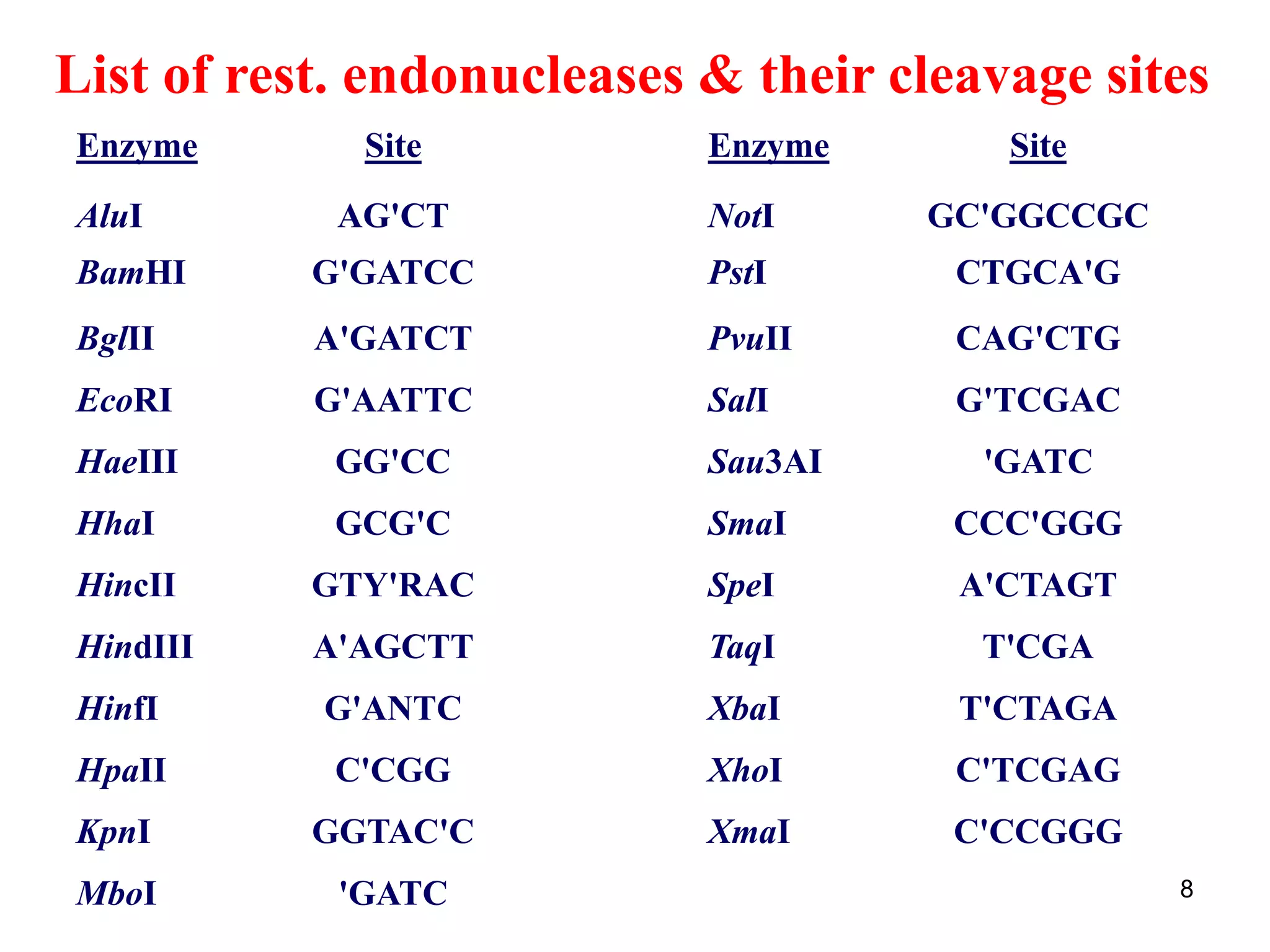
List of rest. endonucleases & their cleavage sites
Enzyme Site Enzyme Site
AluI AG'CT NotI GC'GGCCGC
BamHI G'GATCC PstI CTGCA'G
BglII A'GATCT PvuII CAG'CTG
EcoRI G'AATTC SalI G'TCGAC
HaeIII GG'CC Sau3AI 'GATC
HhaI GCG'C SmaI CCC'GGG
HincII GTY'RAC SpeI A'CTAGT
HindIII A'AGCTT TaqI T'CGA
HinfI G'ANTC XbaI T'CTAGA
HpaII C'CGG XhoI C'TCGAG
KpnI GGTAC'C XmaI C'CCGGG
MboI 'GATC 8
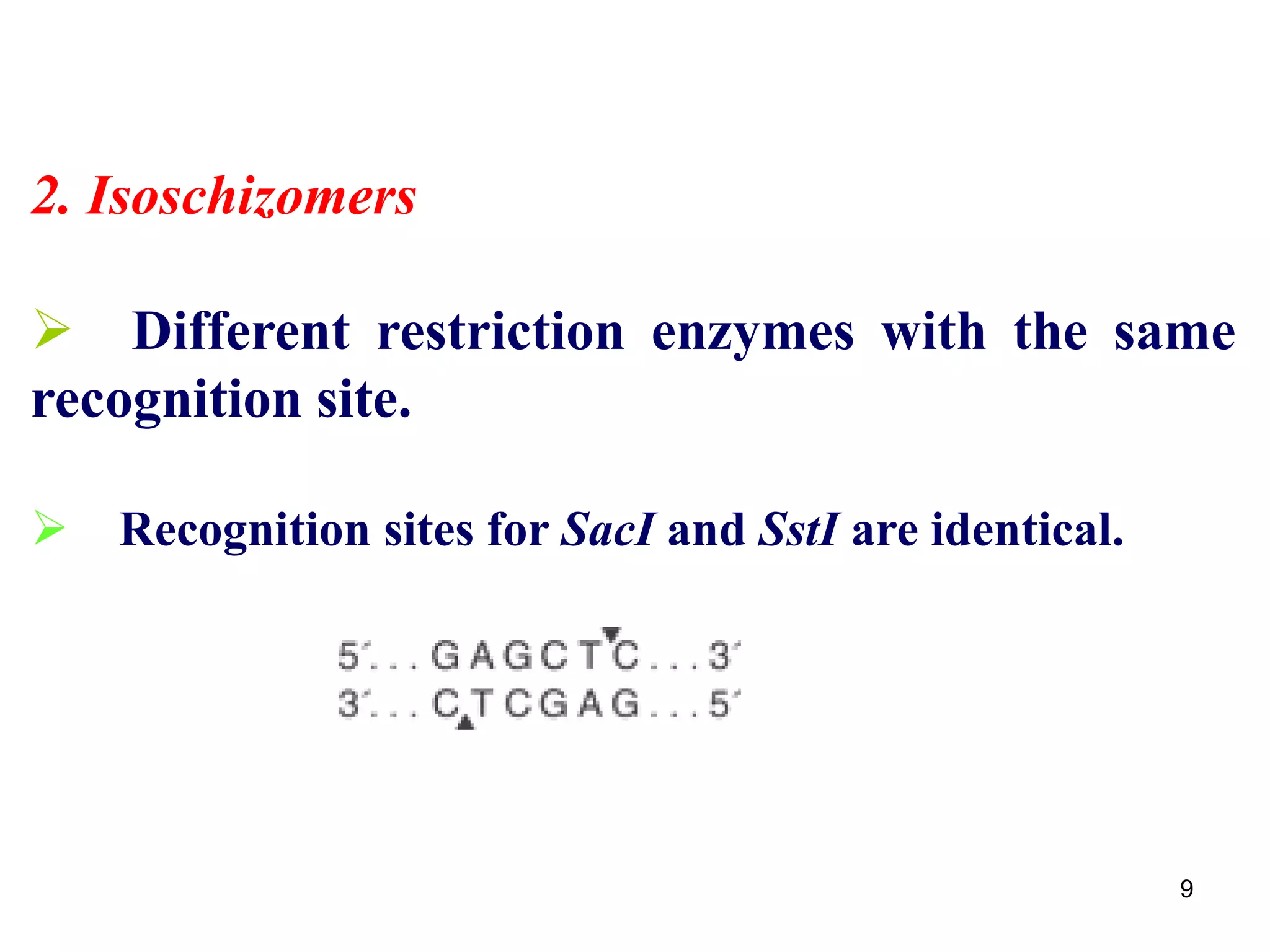
2. Isoschizomers
 Different restriction enzymes with the same
recognition site.
 Recognition sites for SacI and SstI are identical.
9
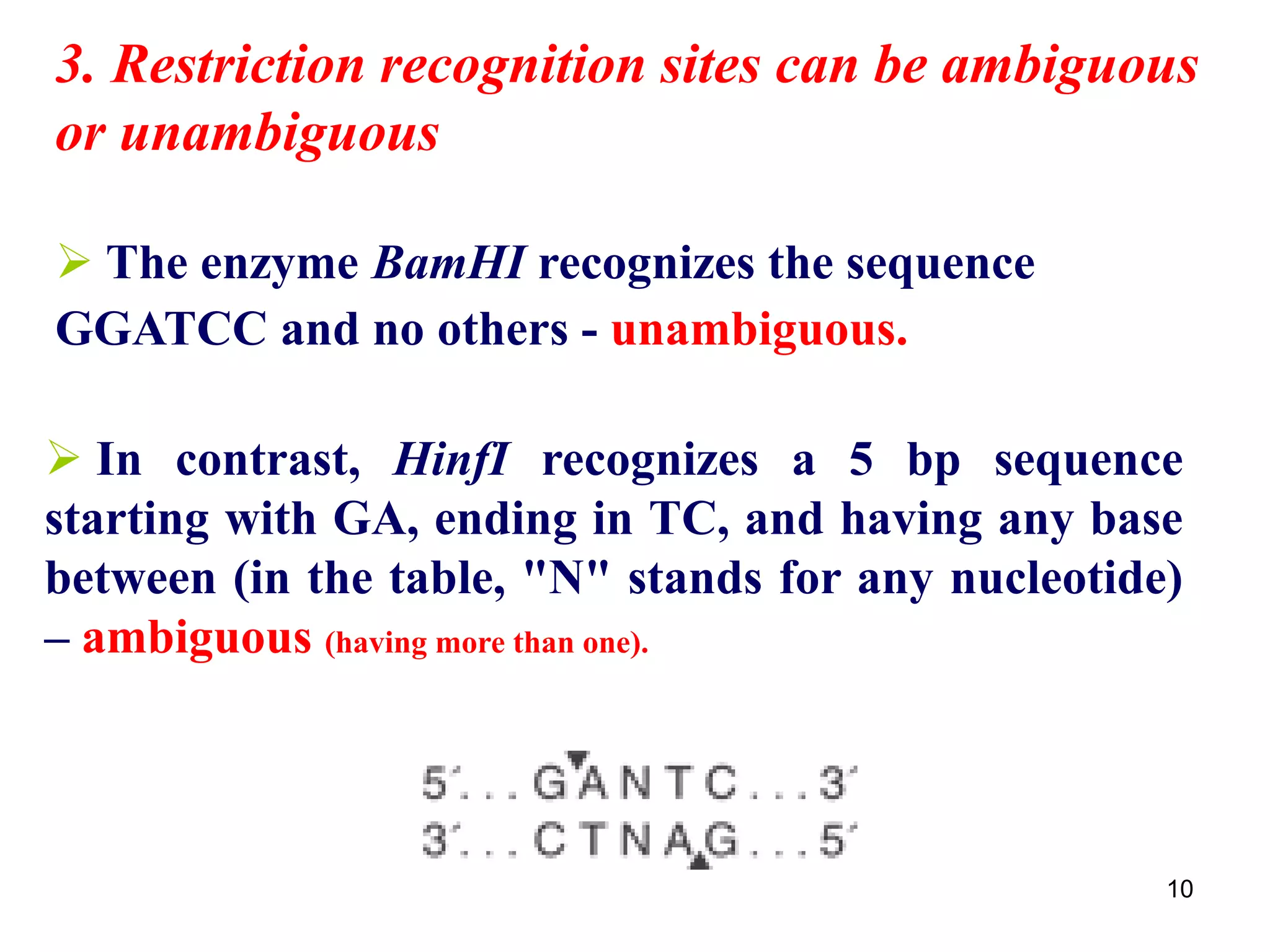
 In contrast, HinfI recognizes a 5 bp sequence
starting with GA, ending in TC, and having any base
between (in the table, "N" stands for any nucleotide)
– ambiguous (having more than one).
3. Restriction recognition sites can be ambiguous
or unambiguous
 The enzyme BamHI recognizes the sequence
GGATCC and no others - unambiguous.
10
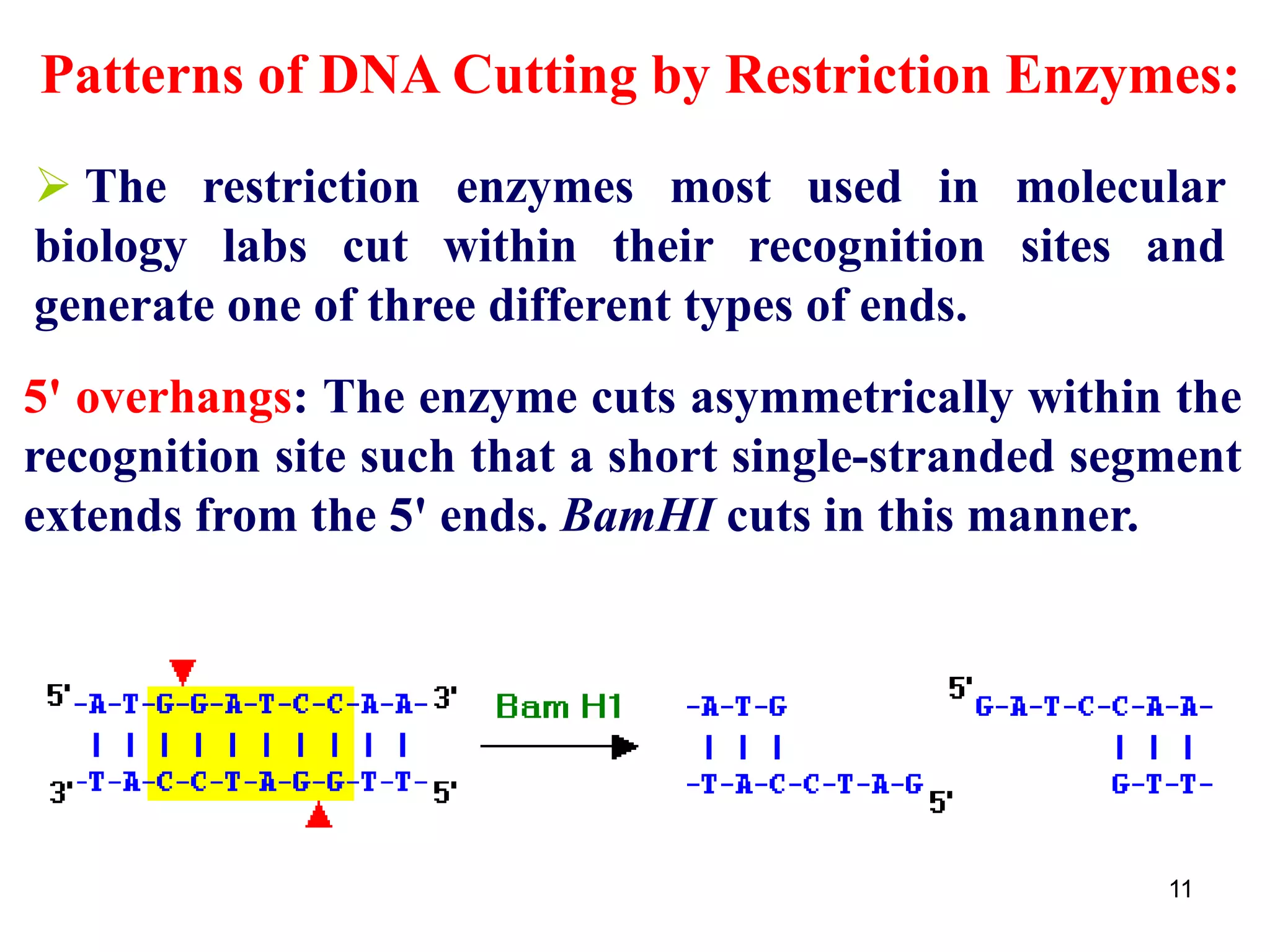
Patterns of DNA Cutting by Restriction Enzymes:
 The restriction enzymes most used in molecular
biology labs cut within their recognition sites and
generate one of three different types of ends.
5' overhangs: The enzyme cuts asymmetrically within the
recognition site such that a short single-stranded segment
extends from the 5' ends. BamHI cuts in this manner.
11
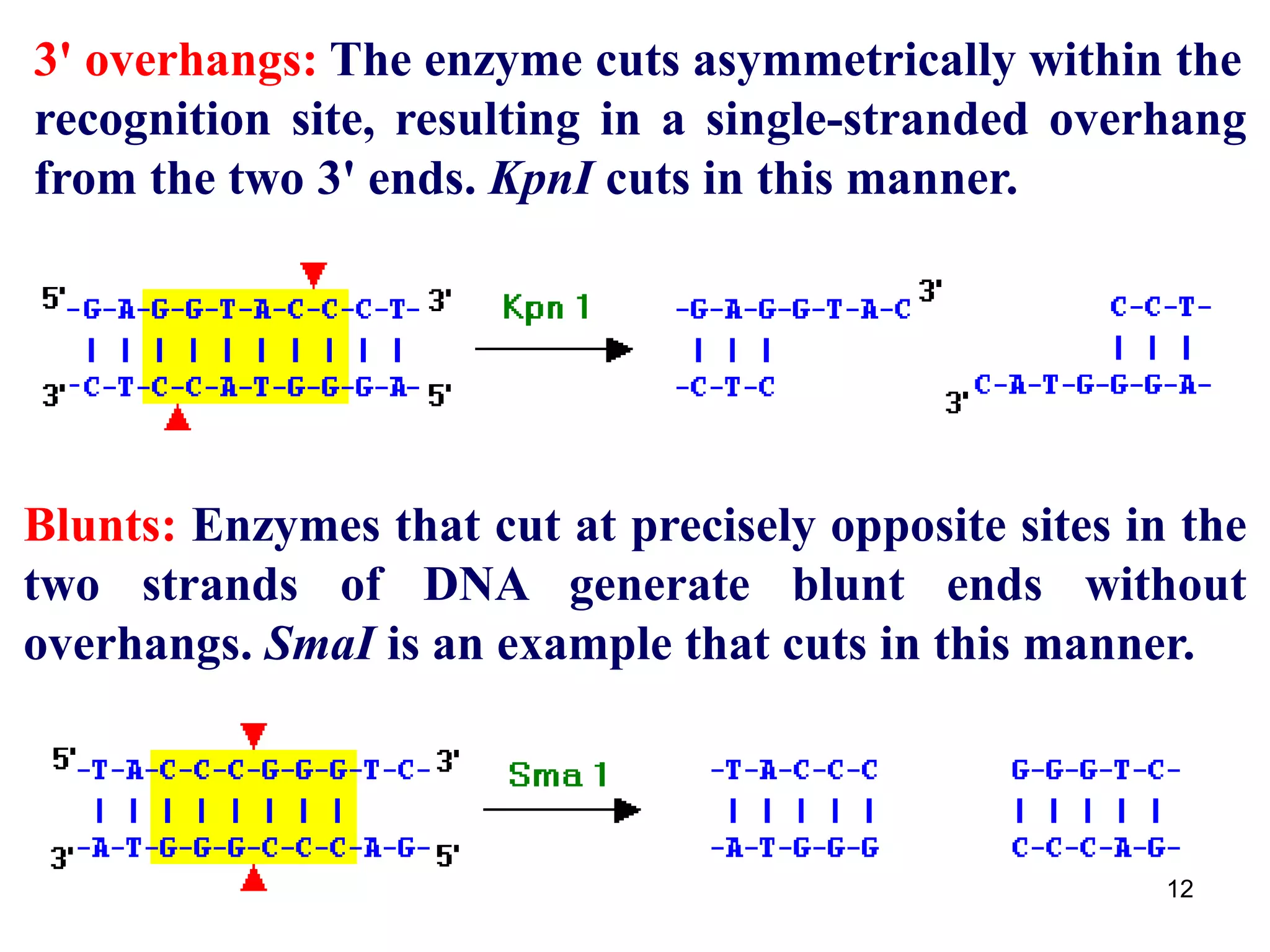
3' overhangs: The enzyme cuts asymmetrically within the
recognition site, resulting in a single-stranded overhang
from the two 3' ends. KpnI cuts in this manner.
Blunts: Enzymes that cut at precisely opposite sites in the
two strands of DNA generate blunt ends without
overhangs. SmaI is an example that cuts in this manner.
12
 Linkers are short duplex oligonucleotides that
contain a restriction endonuclease cleavage site. They
can be ligated onto any blunt-ended molecule, thereby
generating a new restriction cleavage site on the ends of
the molecule.
 Ligation of a linker on a restriction fragment
followed by cleavage with the restriction endonuclease
is one of the several ways to generate an end that is easy
to ligate to another DNA fragment.
Addition of Restriction enzyme site in the DNA
13
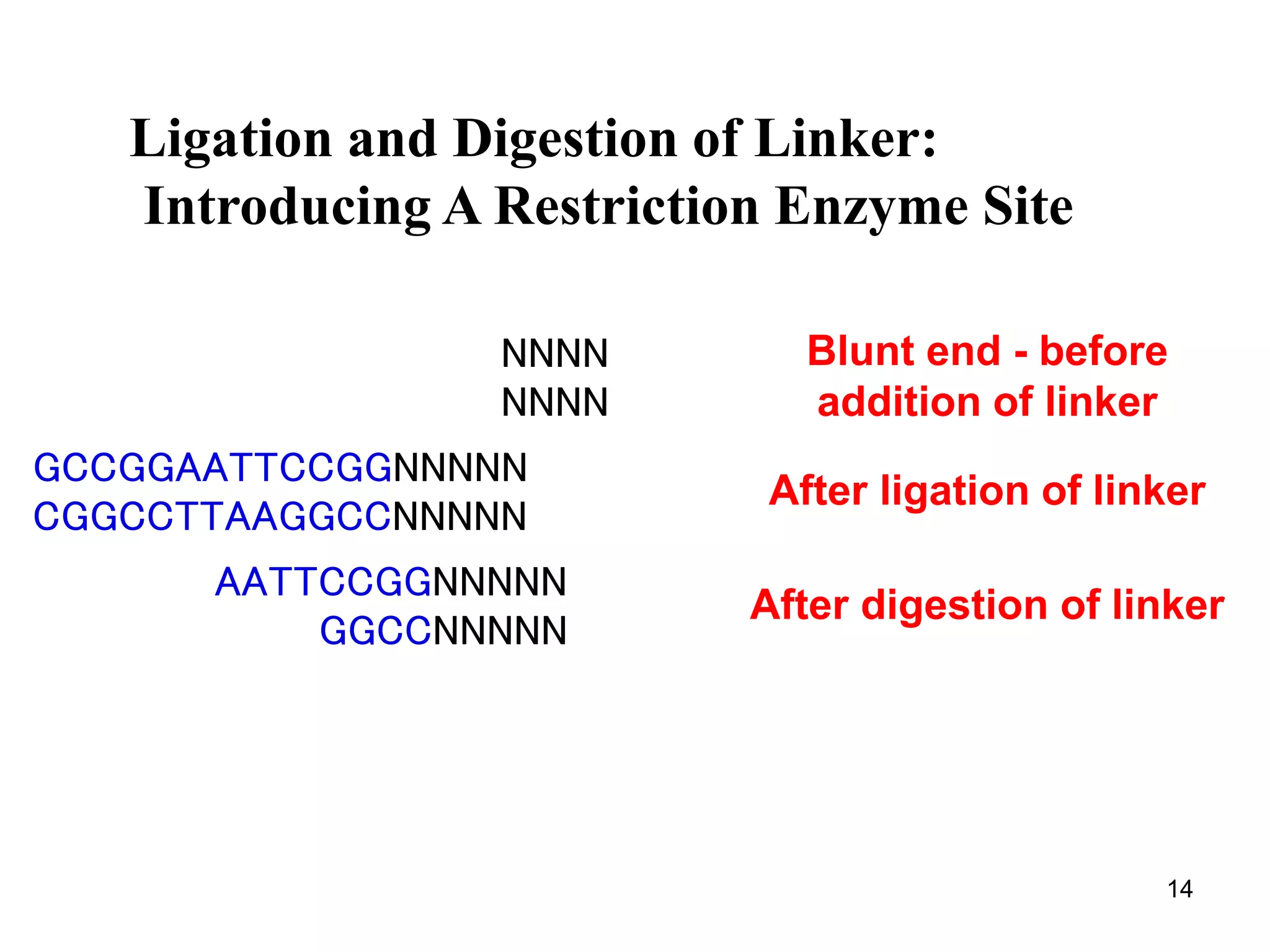
NNNN
NNNN
Blunt end - before
addition of linker
GCCGGAATTCCGGNNNNN
CGGCCTTAAGGCCNNNNN
After ligation of linker
AATTCCGGNNNNN
GGCCNNNNN
After digestion of linker
Ligation and Digestion of Linker:
Introducing A Restriction Enzyme Site
14
 Annealing of homopolymer tails is another way to join two
different DNA molecules.
The enzyme terminal deoxynucleotidyl transferase will
catalyze the addition of a string of nucleotides to the 3' end of a
DNA fragment.
 Terminal transferase (TdT) is a template independent
polymerase that catalyzes the addition of deoxynucleotides to
the 3' hydroxyl terminus of DNA molecules.
Protruding, recessed or blunt-ended double or single-stranded
DNA molecules serve as a substrate for TdT. The 58.3 kDa
enzyme does not have 5' or 3' exonuclease activity.
15
Homopolymer tailing
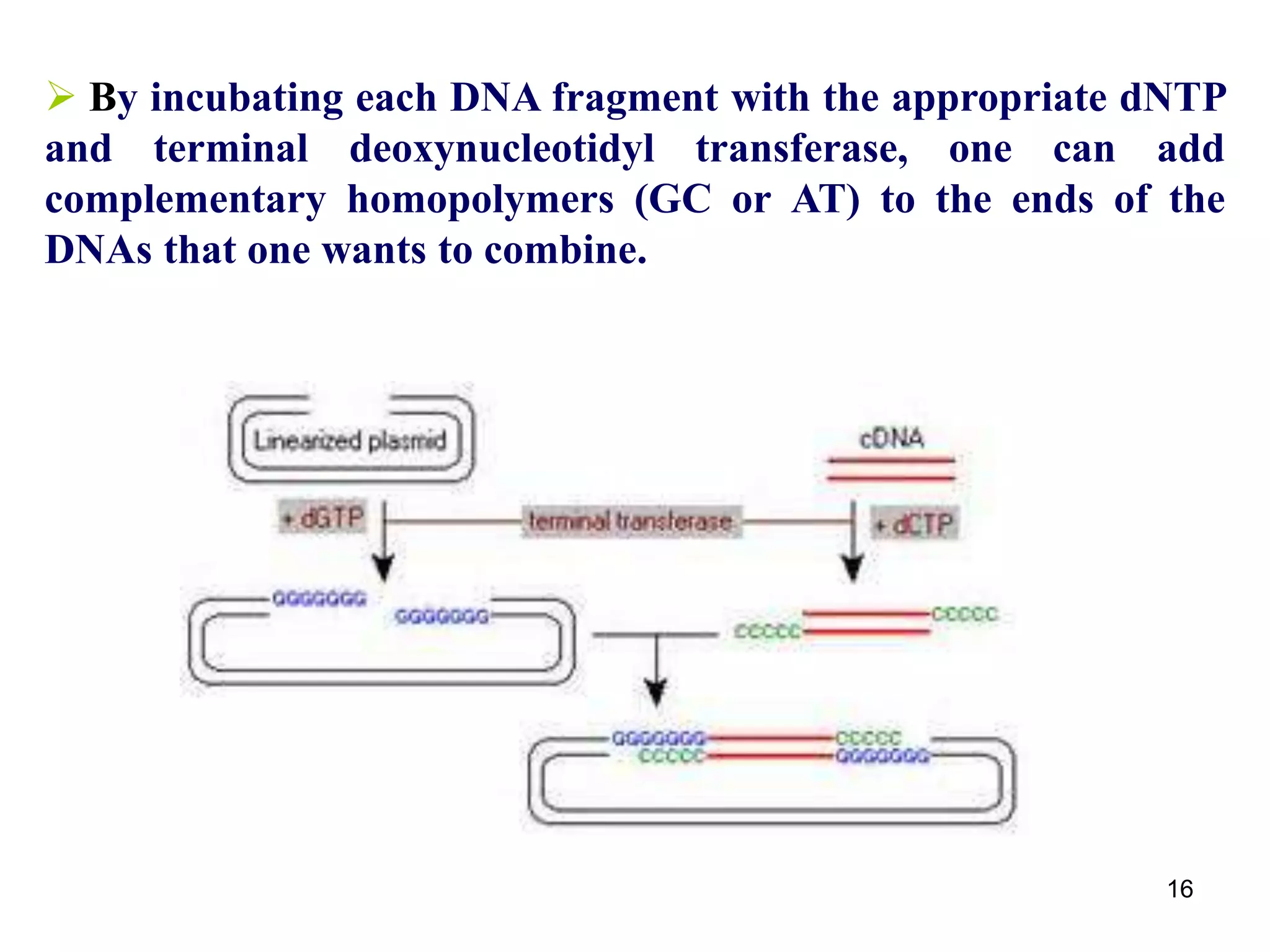
 By incubating each DNA fragment with the appropriate dNTP
and terminal deoxynucleotidyl transferase, one can add
complementary homopolymers (GC or AT) to the ends of the
DNAs that one wants to combine.
16
17

Restriction_Endonucleases for Gene Manipulation -Unit 1.pptx

  • 1.
    Unit 1 (continuation): RestrictionEnzymes for Gene Manipulation and Genomics 1 13/07/2018
  • 2.
    RESTRICTION ENDONUCLEASES AND DNAMODIFYING ENZYMES  Restriction endonucleases are enzymes that cleave the sugar-phosphate backbone of DNA.  In most practical settings, a given enzyme cuts both strands of duplex DNA within a stretch of just few bases.  Several thousand different restriction endonucleases have been isolated, which collectively exhibit a few hundred different sequence (substrate) specificities.  Type II Endonucleases find application in molecular biology. 2
  • 3.
    Cuts Produced byRestriction Endonucleases 3 Type IV enzymes recognize modified, typically methylated DNA. Type V restriction enzymes utilize guide RNAs to target specific non-palindromic sequences.
  • 4.
     A largemajority of restriction enzymes have been isolated from bacteria, where they appear to serve a host-defense role.  The idea is that foreign DNA, for example from an infecting virus, will be chopped up and inactivated ("restricted") within the bacterium by the restriction enzyme.  In almost all cases, a bacterium that makes a particular restriction endonuclease also synthesizes a companion DNA methyltransferase, which methylates the DNA target sequence for that restriction enzyme, thereby protecting it from cleavage. Restriction-Modification Systems 4
  • 5.
     This combinationof restriction endonuclease and methylase is referred to as a restriction-modification system.  By convention, restriction enzymes are named after their host of origin. For example, EcoRI was isolated from Escherichia coli (strain RY13), Hind II and Hind III from Haemophilus influenzae, and XhoI from Xanthomonas holcicola. 5 (Escherichia coli ("Eco"); strain RY13 ("R"), restriction endonuclease number "I“)
  • 6.
    Properties of RestrictionEnzymes:  The substrates for restriction enzymes are specific sequences of double-stranded DNA.  Most recognition sites for commonly used restriction enzymes are palindromes. (nitrogenous base sequences that read the same backwards and forwards)  Most restriction enzymes bind to their recognition site as dimers (pairs). 6 1. Recognition sequences
  • 7.
    The length ofrestriction recognition sites varies. For example, the enzymes EcoRI, SacI and SstI each recognizes a 6 base-pair (bp) sequence of DNA, whereas NotI recognizes a sequence 8 bp in length, and the recognition site for Sau3AI is only 4 bp in length. 7
  • 8.
    List of rest.endonucleases & their cleavage sites Enzyme Site Enzyme Site AluI AG'CT NotI GC'GGCCGC BamHI G'GATCC PstI CTGCA'G BglII A'GATCT PvuII CAG'CTG EcoRI G'AATTC SalI G'TCGAC HaeIII GG'CC Sau3AI 'GATC HhaI GCG'C SmaI CCC'GGG HincII GTY'RAC SpeI A'CTAGT HindIII A'AGCTT TaqI T'CGA HinfI G'ANTC XbaI T'CTAGA HpaII C'CGG XhoI C'TCGAG KpnI GGTAC'C XmaI C'CCGGG MboI 'GATC 8
  • 9.
    2. Isoschizomers  Differentrestriction enzymes with the same recognition site.  Recognition sites for SacI and SstI are identical. 9
  • 10.
     In contrast,HinfI recognizes a 5 bp sequence starting with GA, ending in TC, and having any base between (in the table, "N" stands for any nucleotide) – ambiguous (having more than one). 3. Restriction recognition sites can be ambiguous or unambiguous  The enzyme BamHI recognizes the sequence GGATCC and no others - unambiguous. 10
  • 11.
    Patterns of DNACutting by Restriction Enzymes:  The restriction enzymes most used in molecular biology labs cut within their recognition sites and generate one of three different types of ends. 5' overhangs: The enzyme cuts asymmetrically within the recognition site such that a short single-stranded segment extends from the 5' ends. BamHI cuts in this manner. 11
  • 12.
    3' overhangs: Theenzyme cuts asymmetrically within the recognition site, resulting in a single-stranded overhang from the two 3' ends. KpnI cuts in this manner. Blunts: Enzymes that cut at precisely opposite sites in the two strands of DNA generate blunt ends without overhangs. SmaI is an example that cuts in this manner. 12
  • 13.
     Linkers areshort duplex oligonucleotides that contain a restriction endonuclease cleavage site. They can be ligated onto any blunt-ended molecule, thereby generating a new restriction cleavage site on the ends of the molecule.  Ligation of a linker on a restriction fragment followed by cleavage with the restriction endonuclease is one of the several ways to generate an end that is easy to ligate to another DNA fragment. Addition of Restriction enzyme site in the DNA 13
  • 14.
    NNNN NNNN Blunt end -before addition of linker GCCGGAATTCCGGNNNNN CGGCCTTAAGGCCNNNNN After ligation of linker AATTCCGGNNNNN GGCCNNNNN After digestion of linker Ligation and Digestion of Linker: Introducing A Restriction Enzyme Site 14
  • 15.
     Annealing ofhomopolymer tails is another way to join two different DNA molecules. The enzyme terminal deoxynucleotidyl transferase will catalyze the addition of a string of nucleotides to the 3' end of a DNA fragment.  Terminal transferase (TdT) is a template independent polymerase that catalyzes the addition of deoxynucleotides to the 3' hydroxyl terminus of DNA molecules. Protruding, recessed or blunt-ended double or single-stranded DNA molecules serve as a substrate for TdT. The 58.3 kDa enzyme does not have 5' or 3' exonuclease activity. 15 Homopolymer tailing
  • 16.
     By incubatingeach DNA fragment with the appropriate dNTP and terminal deoxynucleotidyl transferase, one can add complementary homopolymers (GC or AT) to the ends of the DNAs that one wants to combine. 16
  • 17.