Tertiary Structure
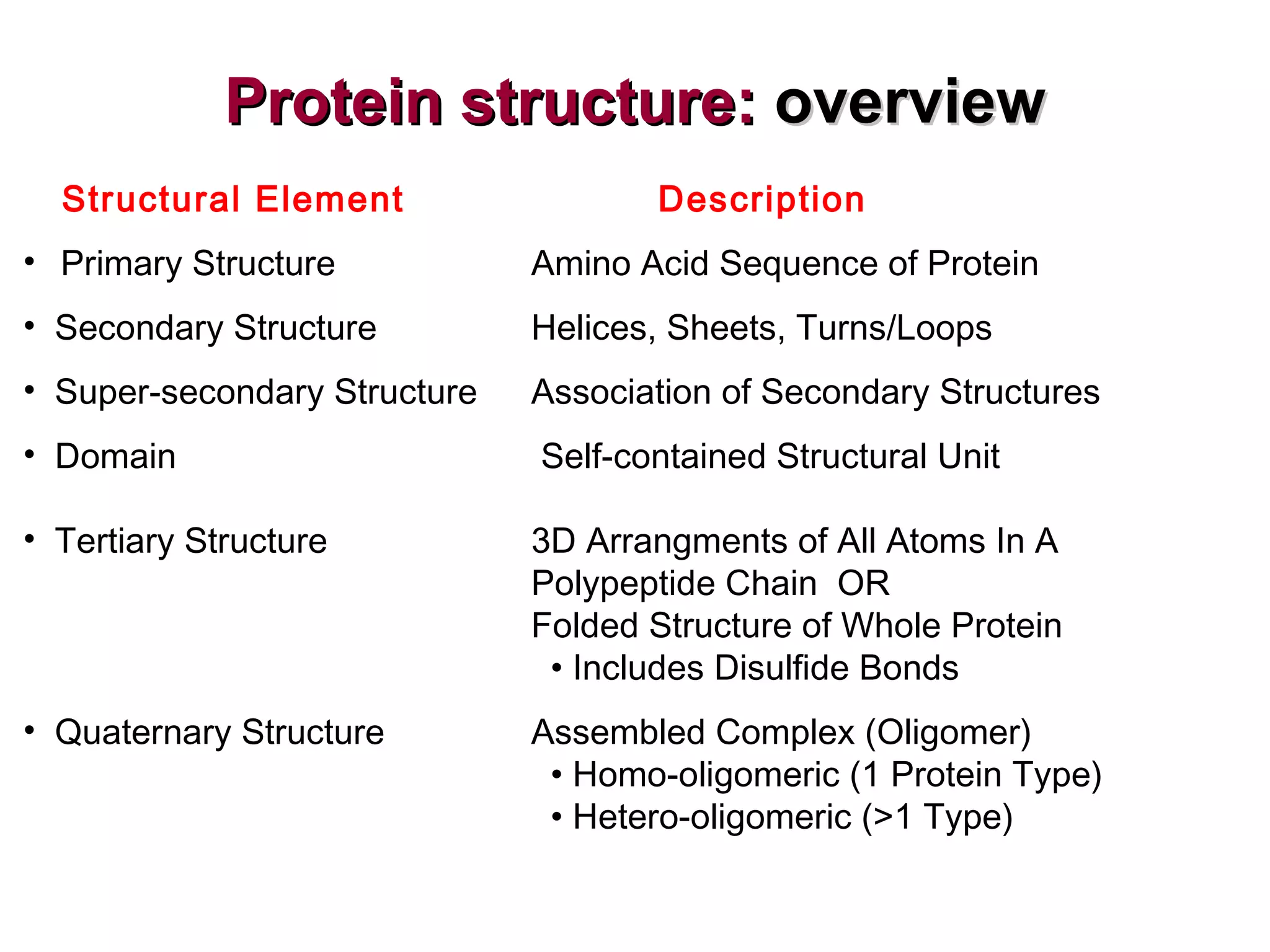
Protein structure:Protein structure: overviewoverview
Structural Element Description
• Primary Structure Amino Acid Sequence of Protein
• Secondary Structure Helices, Sheets, Turns/Loops
• Super-secondary Structure Association of Secondary Structures
• Domain Self-contained Structural Unit
• Tertiary Structure 3D Arrangments of All Atoms In A
Polypeptide Chain OR
Folded Structure of Whole Protein
• Includes Disulfide Bonds
• Quaternary Structure Assembled Complex (Oligomer)
• Homo-oligomeric (1 Protein Type)
• Hetero-oligomeric (>1 Type)
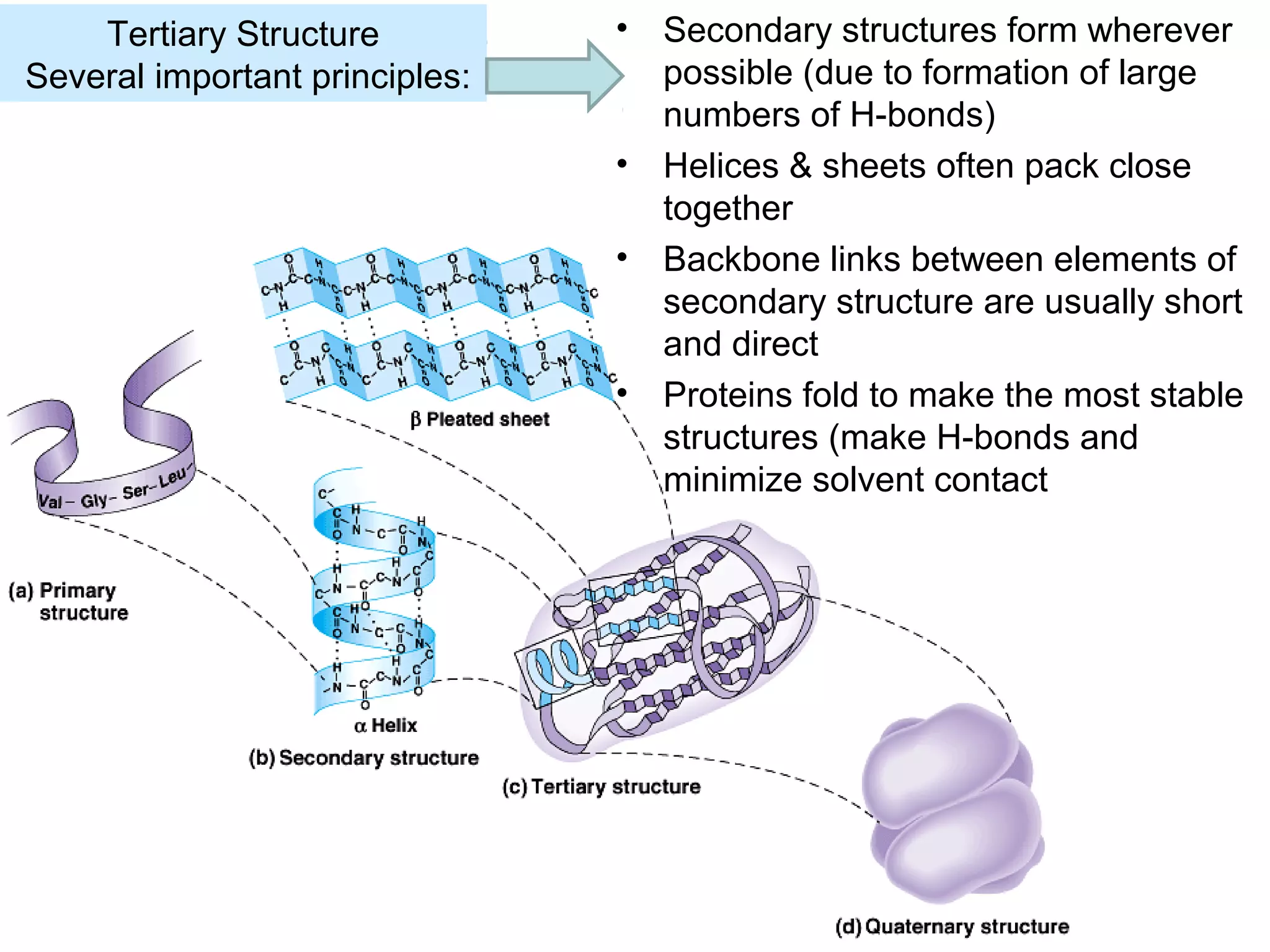
Tertiary Structure
Several important principles:
• Secondary structures form wherever
possible (due to formation of large
numbers of H-bonds)
• Helices & sheets often pack close
together
• Backbone links between elements of
secondary structure are usually short
and direct
• Proteins fold to make the most stable
structures (make H-bonds and
minimize solvent contact
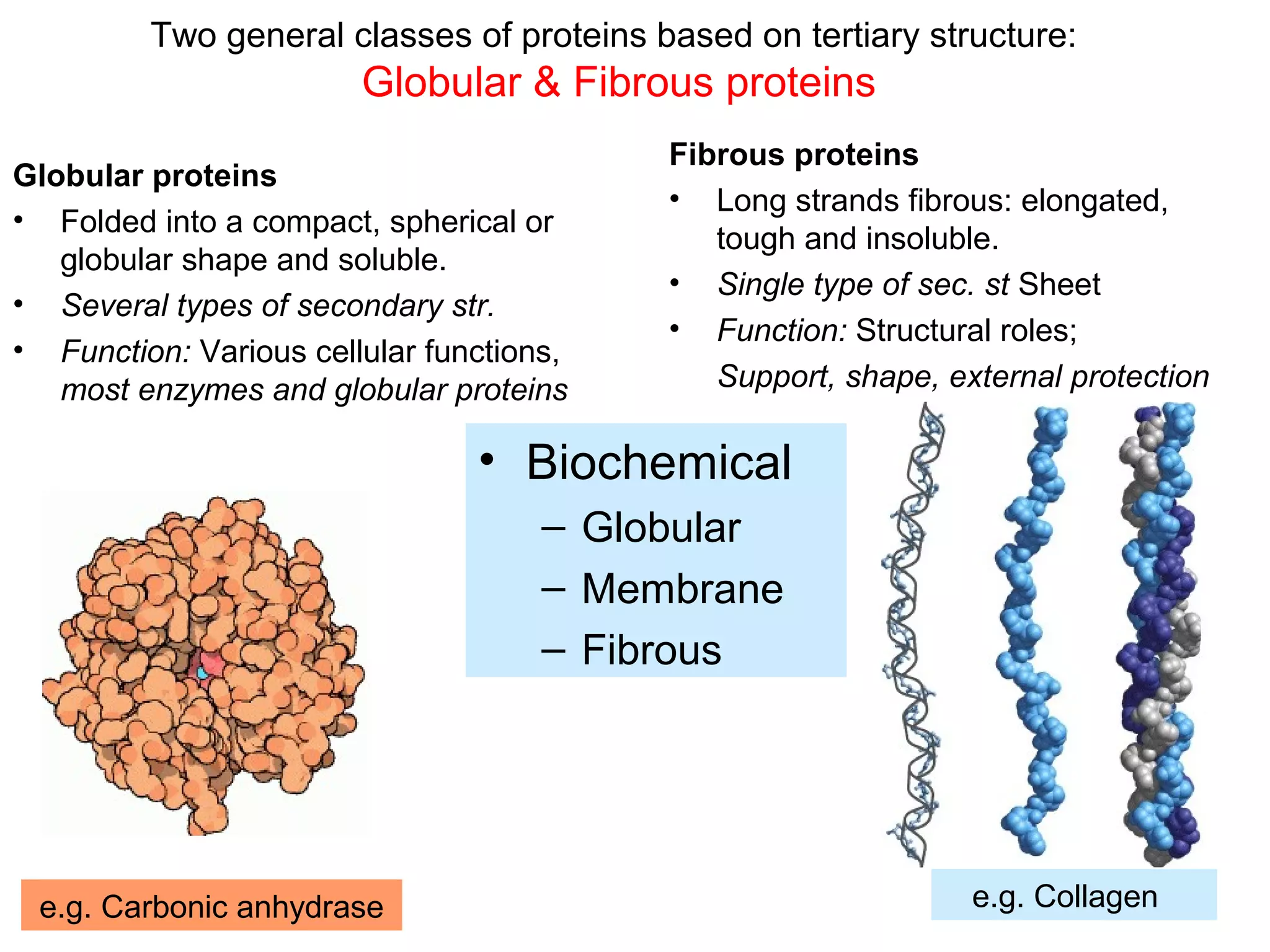
Two general classes of proteins based on tertiary structure:
Globular & Fibrous proteins
e.g. Carbonic anhydrase e.g. Collagen
• Biochemical
– Globular
– Membrane
– Fibrous
Globular proteins
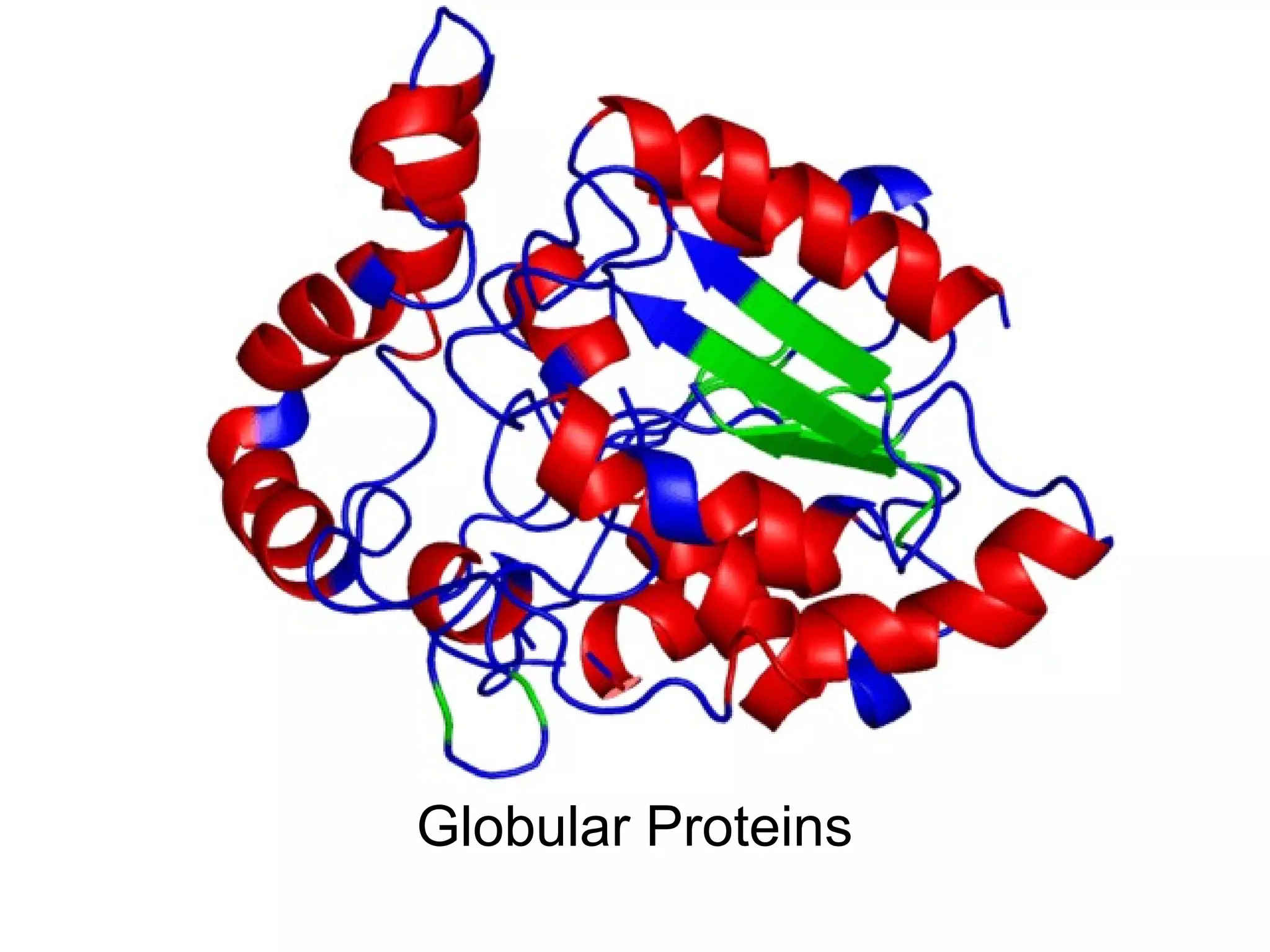
• Folded into a compact, spherical or
globular shape and soluble.
• Several types of secondary str.
• Function: Various cellular functions,
most enzymes and globular proteins
Fibrous proteins
• Long strands fibrous: elongated,
tough and insoluble.
• Single type of sec. st Sheet
• Function: Structural roles;
Support, shape, external protection
Globular Proteins
Globular Proteins
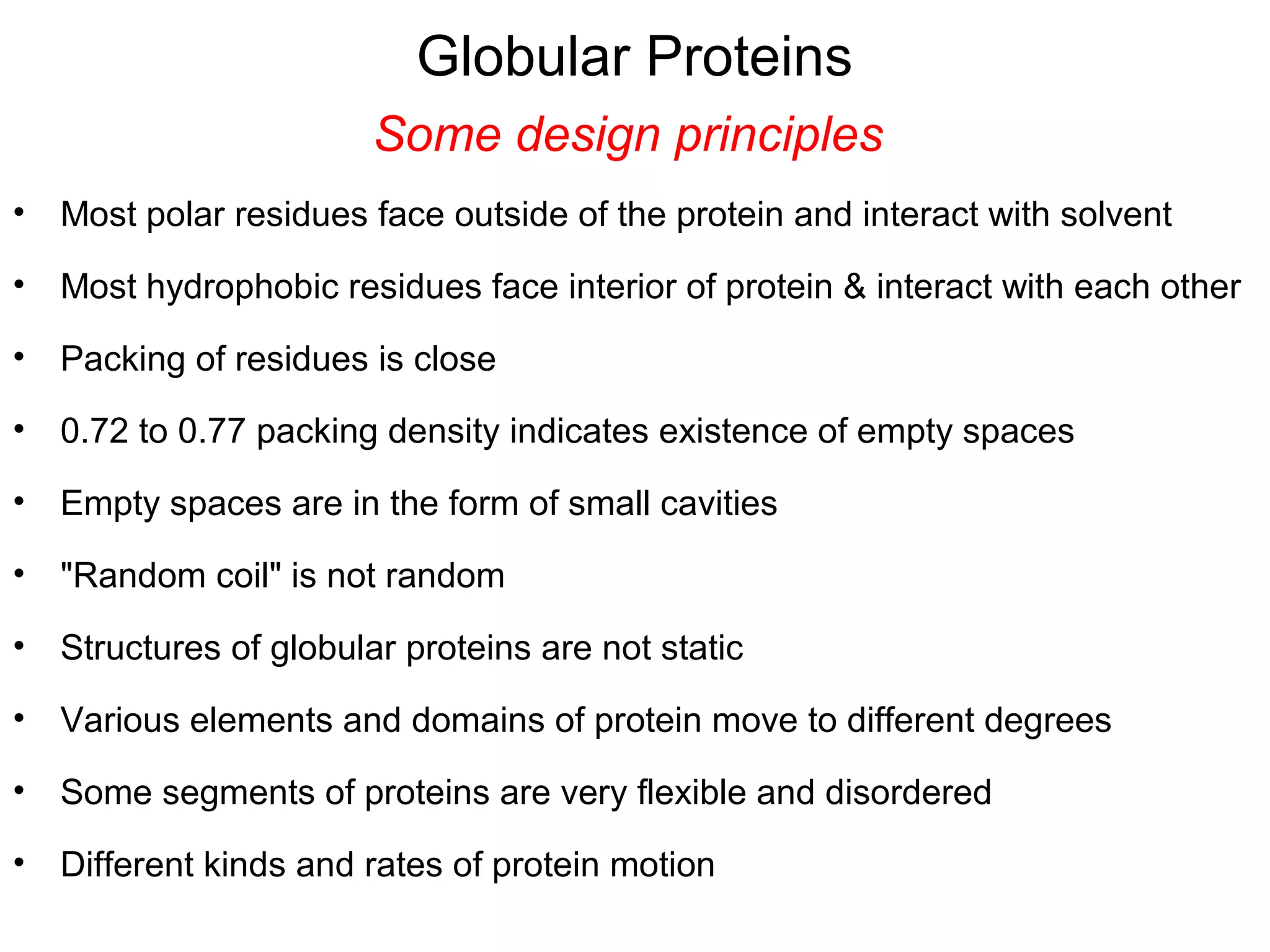
Some design principles
• Most polar residues face outside of the protein and interact with solvent
• Most hydrophobic residues face interior of protein & interact with each other
• Packing of residues is close
• 0.72 to 0.77 packing density indicates existence of empty spaces
• Empty spaces are in the form of small cavities
• "Random coil" is not random
• Structures of globular proteins are not static
• Various elements and domains of protein move to different degrees
• Some segments of proteins are very flexible and disordered
• Different kinds and rates of protein motion
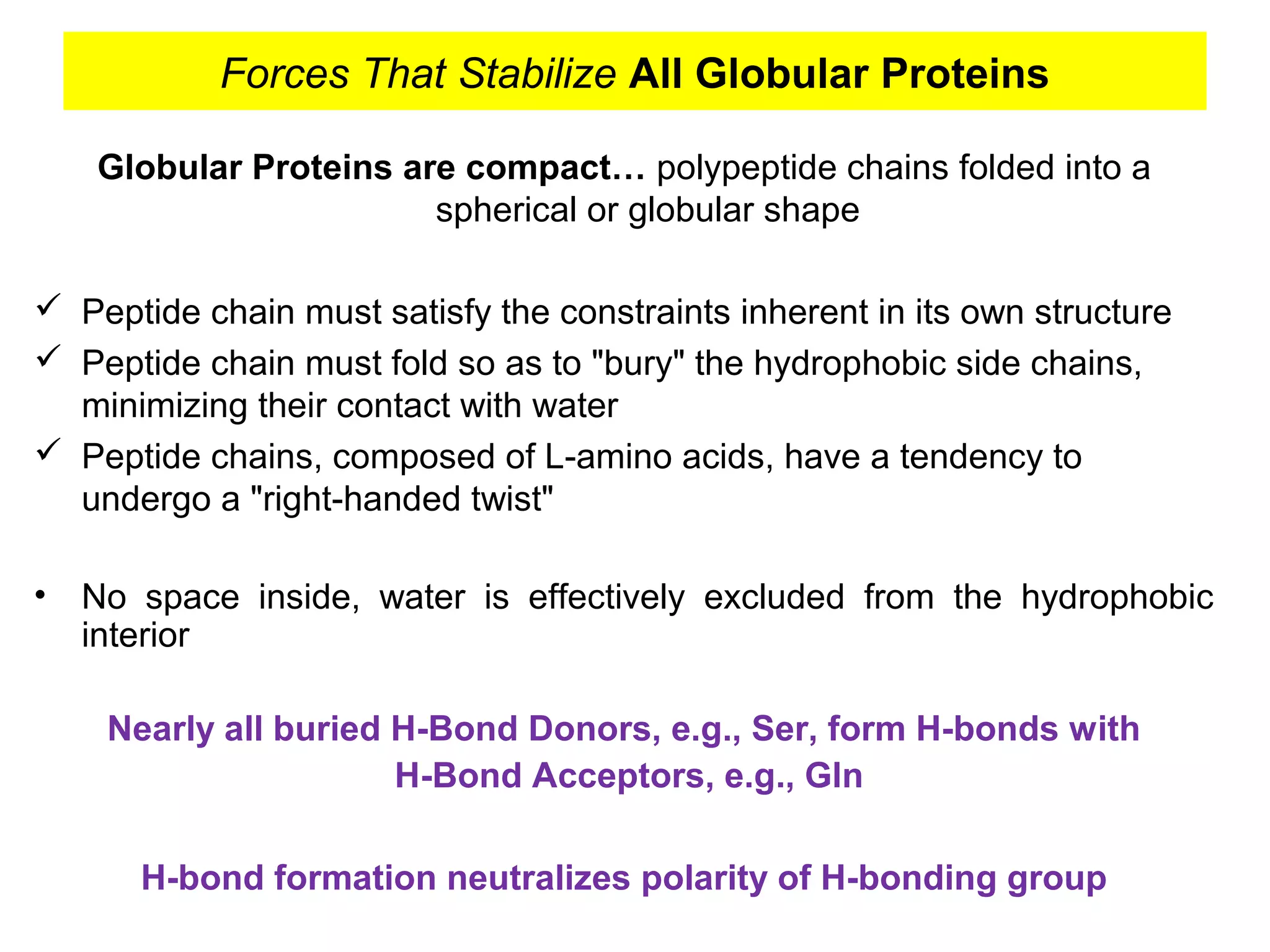
Forces That Stabilize All Globular Proteins
Globular Proteins are compact… polypeptide chains folded into a
spherical or globular shape
 Peptide chain must satisfy the constraints inherent in its own structure
 Peptide chain must fold so as to "bury" the hydrophobic side chains,
minimizing their contact with water
 Peptide chains, composed of L-amino acids, have a tendency to
undergo a "right-handed twist"
• No space inside, water is effectively excluded from the hydrophobic
interior
Nearly all buried H-Bond Donors, e.g., Ser, form H-bonds with
H-Bond Acceptors, e.g., Gln
H-bond formation neutralizes polarity of H-bonding group
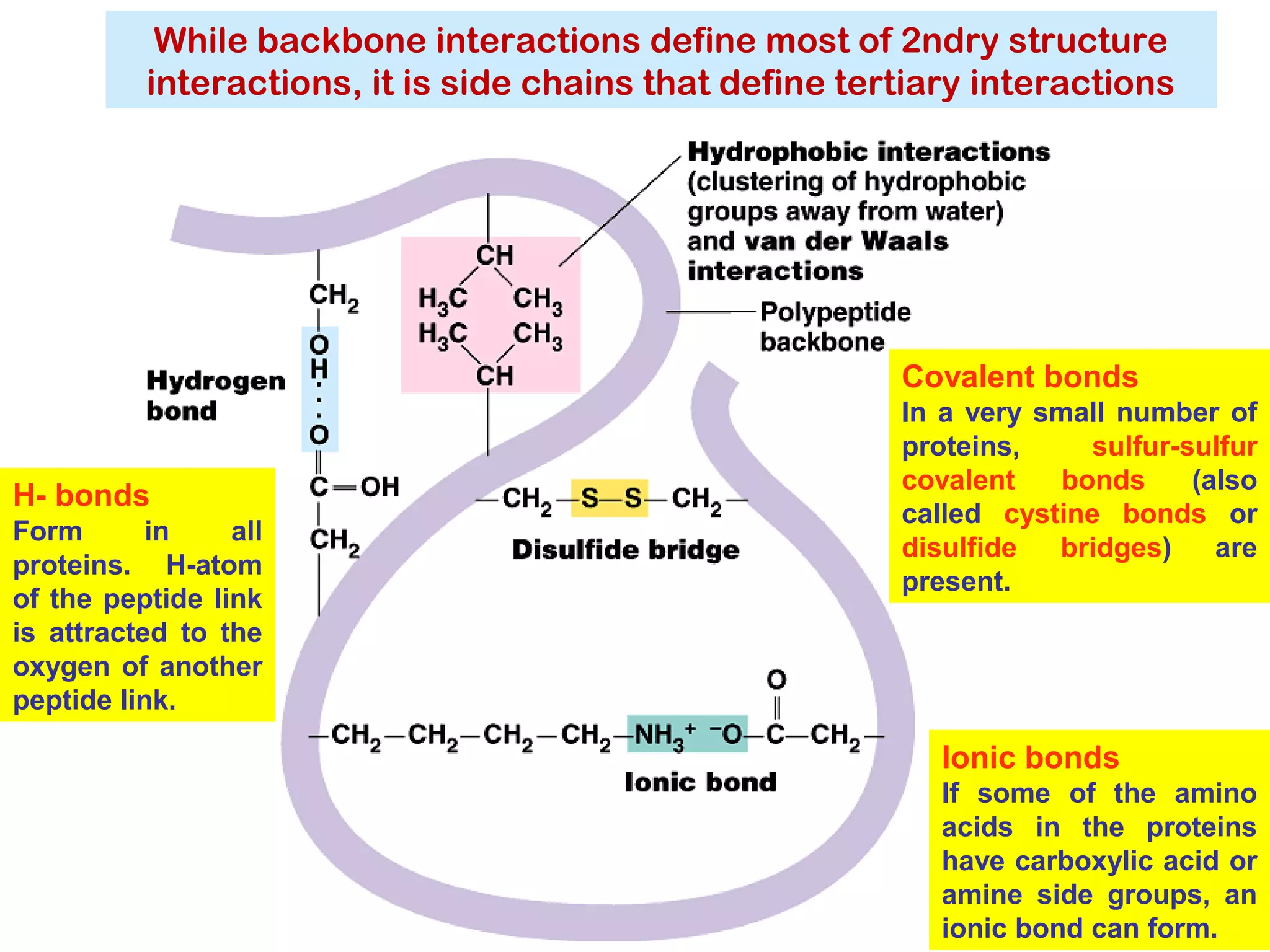
H- bonds
Form in all
proteins. H-atom
of the peptide link
is attracted to the
oxygen of another
peptide link.
Ionic bonds
If some of the amino
acids in the proteins
have carboxylic acid or
amine side groups, an
ionic bond can form.
Covalent bonds
In a very small number of
proteins, sulfur-sulfur
covalent bonds (also
called cystine bonds or
disulfide bridges) are
present.
While backbone interactions define most of 2ndry structure
interactions, it is side chains that define tertiary interactions
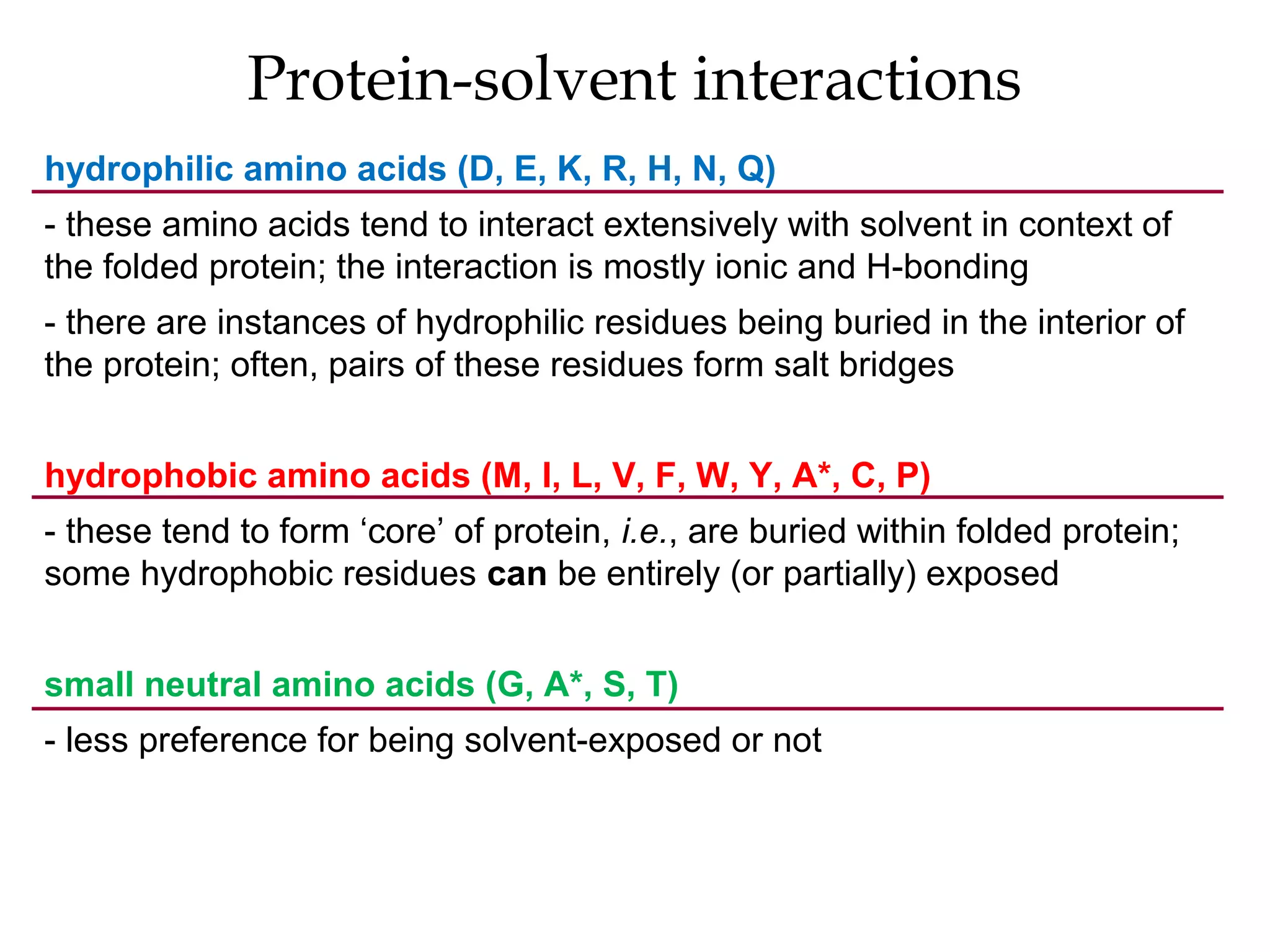
Protein-solvent interactions
hydrophilic amino acids (D, E, K, R, H, N, Q)
- these amino acids tend to interact extensively with solvent in context of
the folded protein; the interaction is mostly ionic and H-bonding
- there are instances of hydrophilic residues being buried in the interior of
the protein; often, pairs of these residues form salt bridges
hydrophobic amino acids (M, I, L, V, F, W, Y, A*, C, P)
- these tend to form ‘core’ of protein, i.e., are buried within folded protein;
some hydrophobic residues can be entirely (or partially) exposed
small neutral amino acids (G, A*, S, T)
- less preference for being solvent-exposed or not
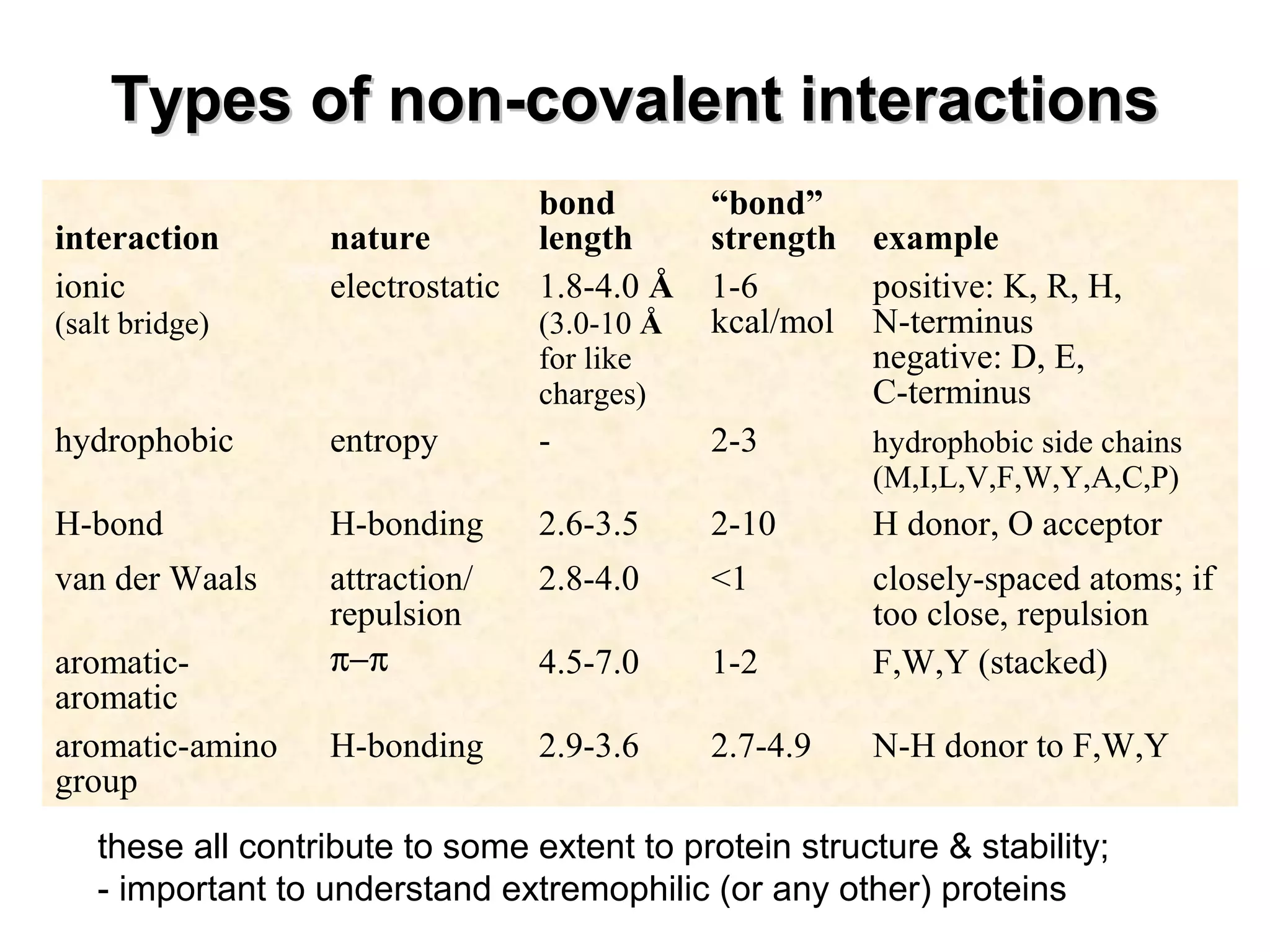
Types of non-covalent interactionsTypes of non-covalent interactions
interaction nature
bond
length
“bond”
strength example
ionic
(salt bridge)
electrostatic 1.8-4.0 Å
(3.0-10 Å
for like
charges)
1-6
kcal/mol
positive: K, R, H,
N-terminus
negative: D, E,
C-terminus
hydrophobic entropy - 2-3 hydrophobic side chains
(M,I,L,V,F,W,Y,A,C,P)
H-bond H-bonding 2.6-3.5 2-10 H donor, O acceptor
van der Waals attraction/
repulsion
2.8-4.0 <1 closely-spaced atoms; if
too close, repulsion
aromatic-
aromatic
π−π 4.5-7.0 1-2 F,W,Y (stacked)
aromatic-amino
group
H-bonding 2.9-3.6 2.7-4.9 N-H donor to F,W,Y
these all contribute to some extent to protein structure & stability;
- important to understand extremophilic (or any other) proteins
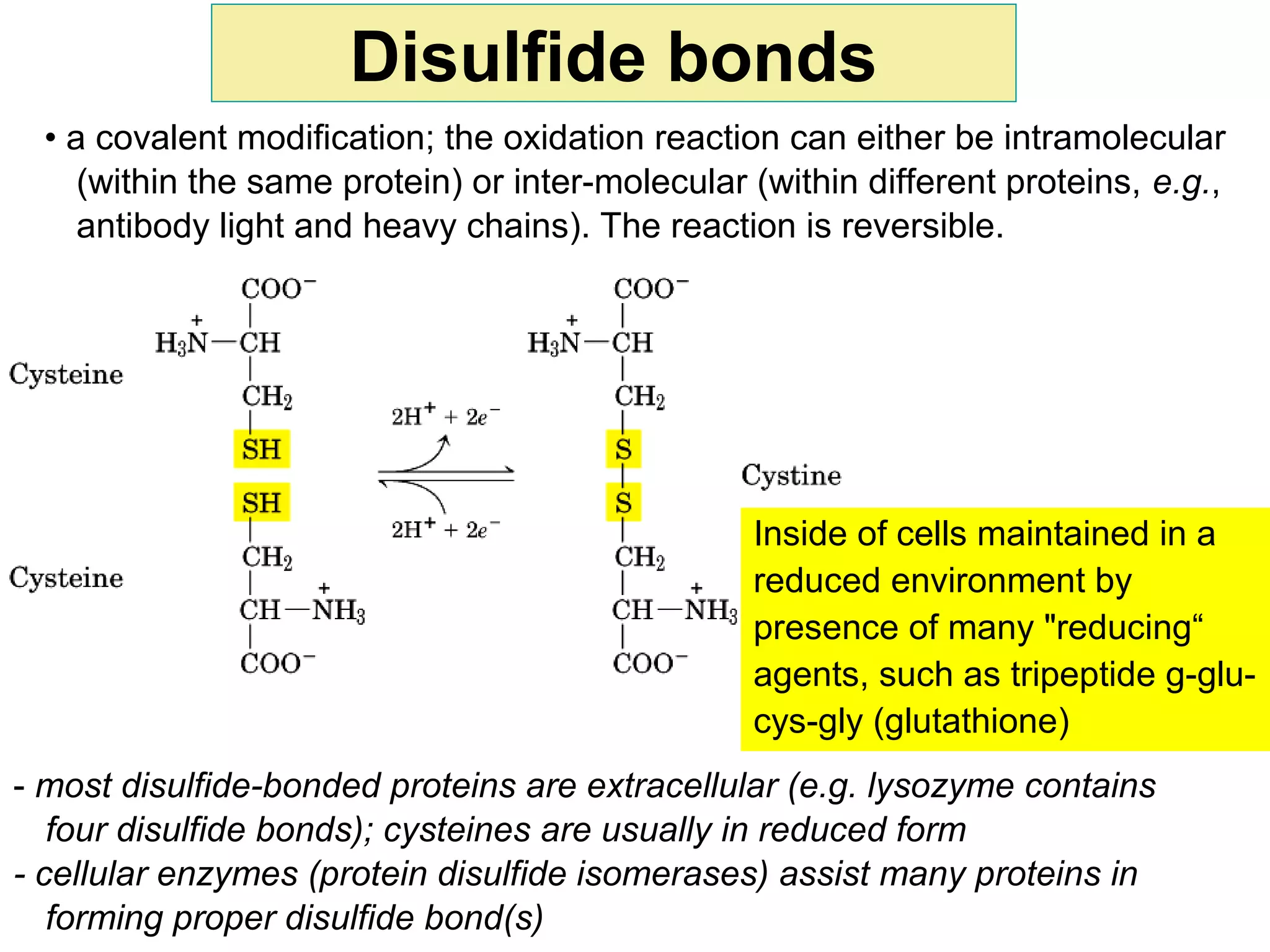
Disulfide bonds
• a covalent modification; the oxidation reaction can either be intramolecular
(within the same protein) or inter-molecular (within different proteins, e.g.,
antibody light and heavy chains). The reaction is reversible.
- most disulfide-bonded proteins are extracellular (e.g. lysozyme contains
four disulfide bonds); cysteines are usually in reduced form
- cellular enzymes (protein disulfide isomerases) assist many proteins in
forming proper disulfide bond(s)
Inside of cells maintained in a
reduced environment by
presence of many "reducing“
agents, such as tripeptide g-glu-
cys-gly (glutathione)
Proteins have the capacity to fold and become active based on the
information contained in their amino acid sequence.
Thermodynamically spontaneous
Proteins fold in buffered water
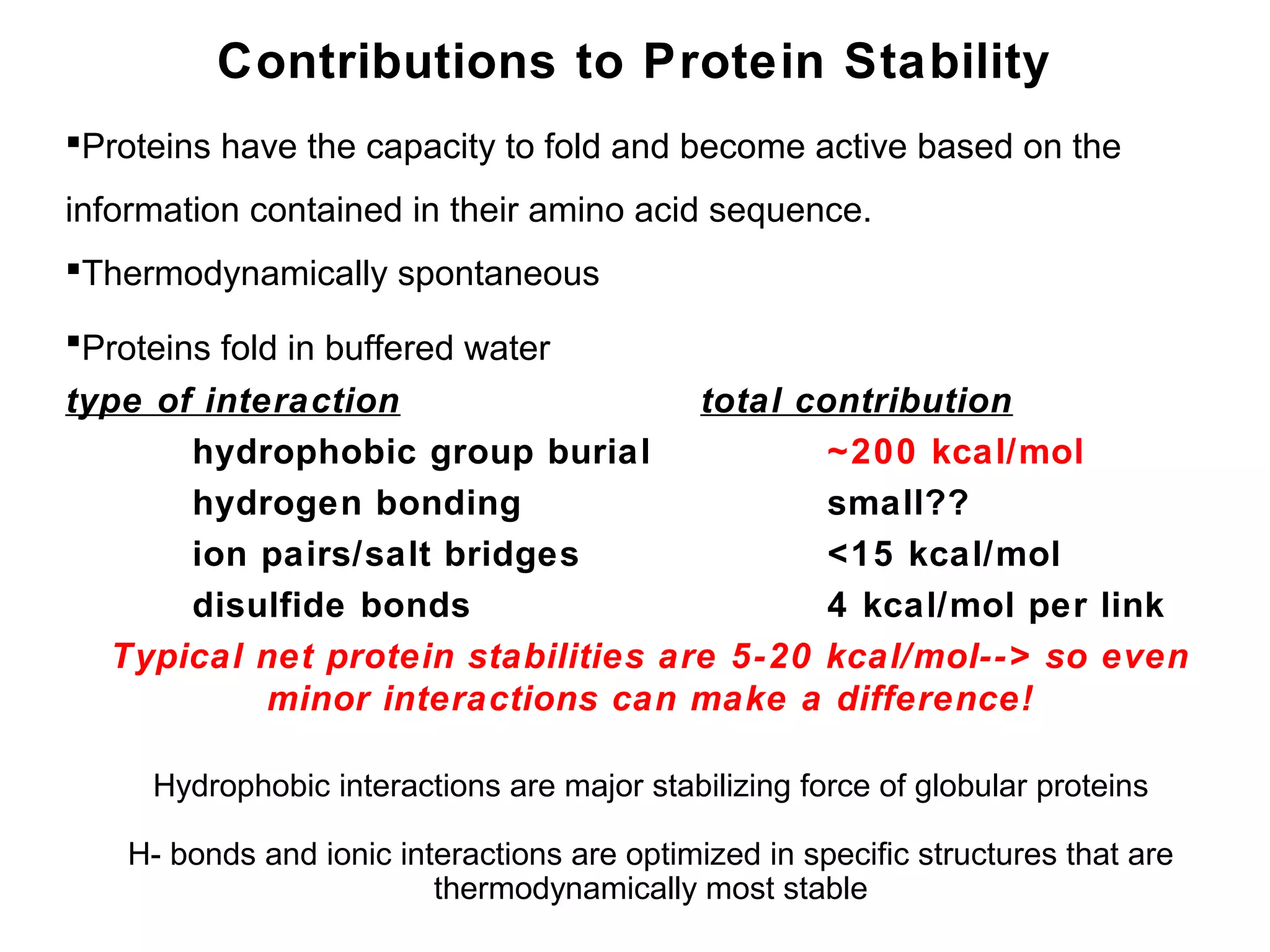
type of interaction total contribution
hydrophobic group burial ~200 kcal/mol
hydrogen bonding small??
ion pairs/salt bridges <15 kcal/mol
disulfide bonds 4 kcal/mol per link
Typical net protein stabilities are 5-20 kcal/mol--> so even
minor interactions can make a difference!
Hydrophobic interactions are major stabilizing force of globular proteins
H- bonds and ionic interactions are optimized in specific structures that are
thermodynamically most stable
Contributions to Protein Stability
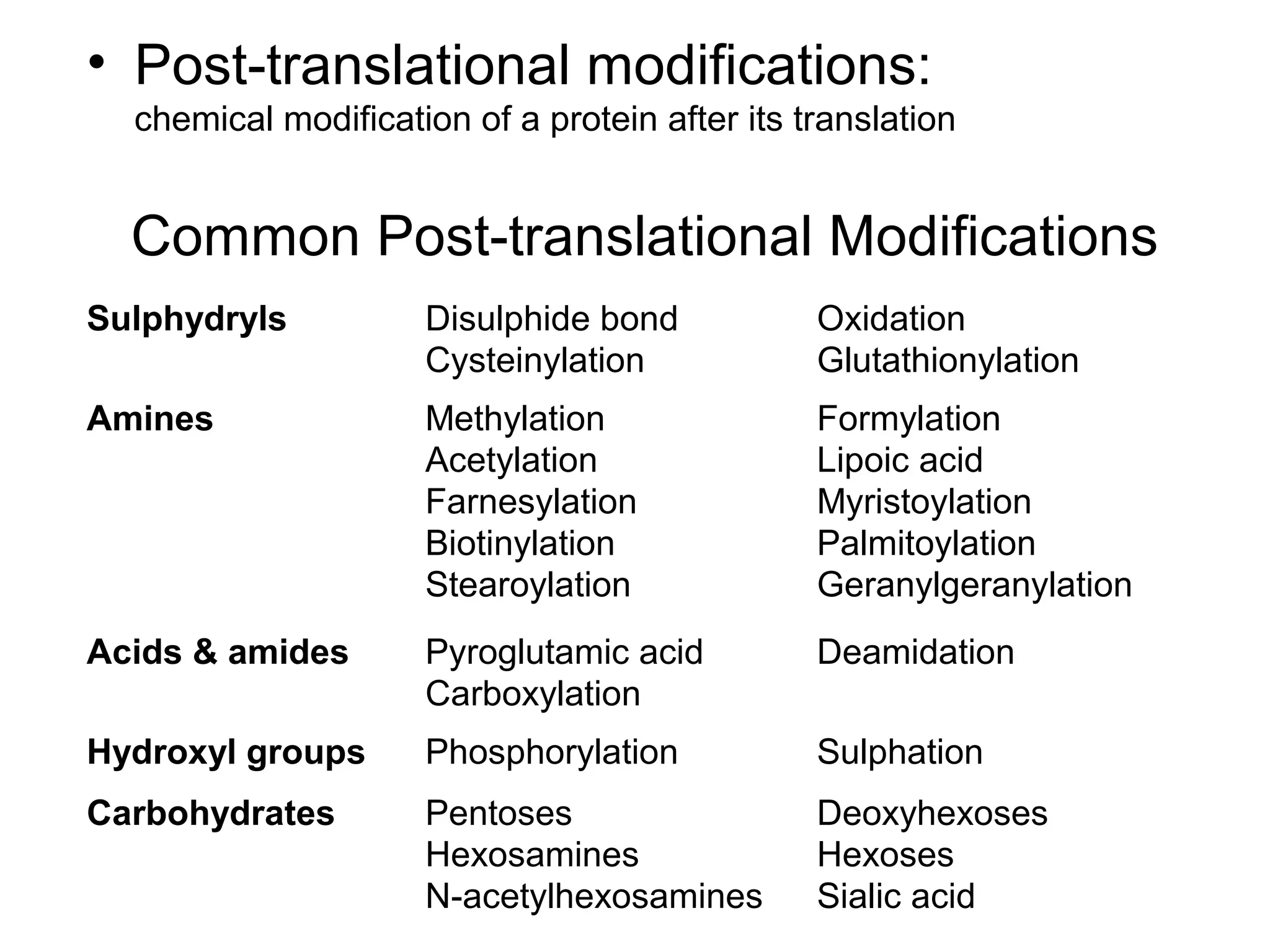
Common Post-translational Modifications
Sulphydryls Disulphide bond
Cysteinylation
Oxidation
Glutathionylation
Amines Methylation
Acetylation
Farnesylation
Biotinylation
Stearoylation
Formylation
Lipoic acid
Myristoylation
Palmitoylation
Geranylgeranylation
Acids & amides Pyroglutamic acid
Carboxylation
Deamidation
Hydroxyl groups Phosphorylation Sulphation
Carbohydrates Pentoses
Hexosamines
N-acetylhexosamines
Deoxyhexoses
Hexoses
Sialic acid
• Post-translational modifications:
chemical modification of a protein after its translation
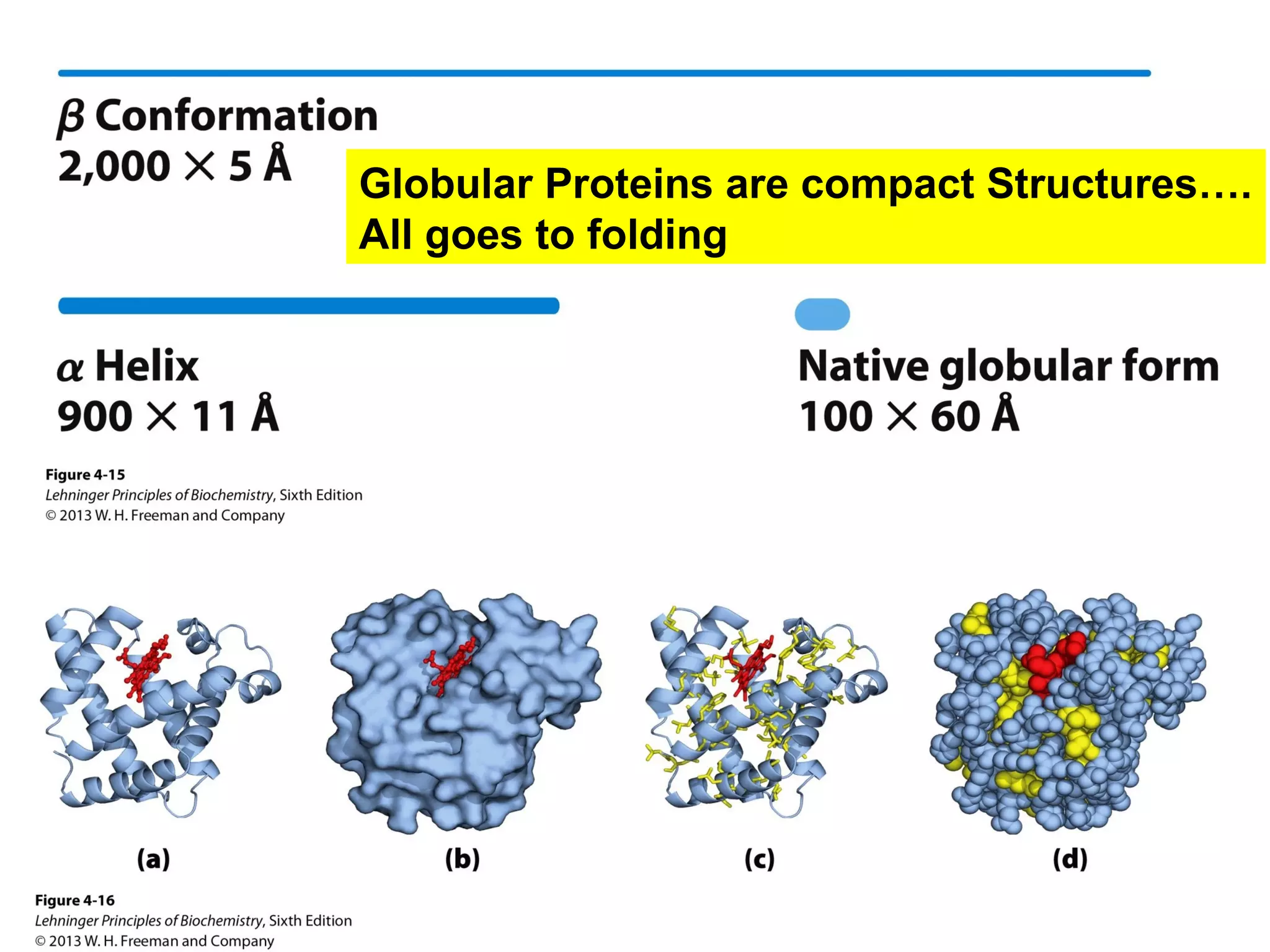
Globular Proteins are compact Structures….
All goes to folding
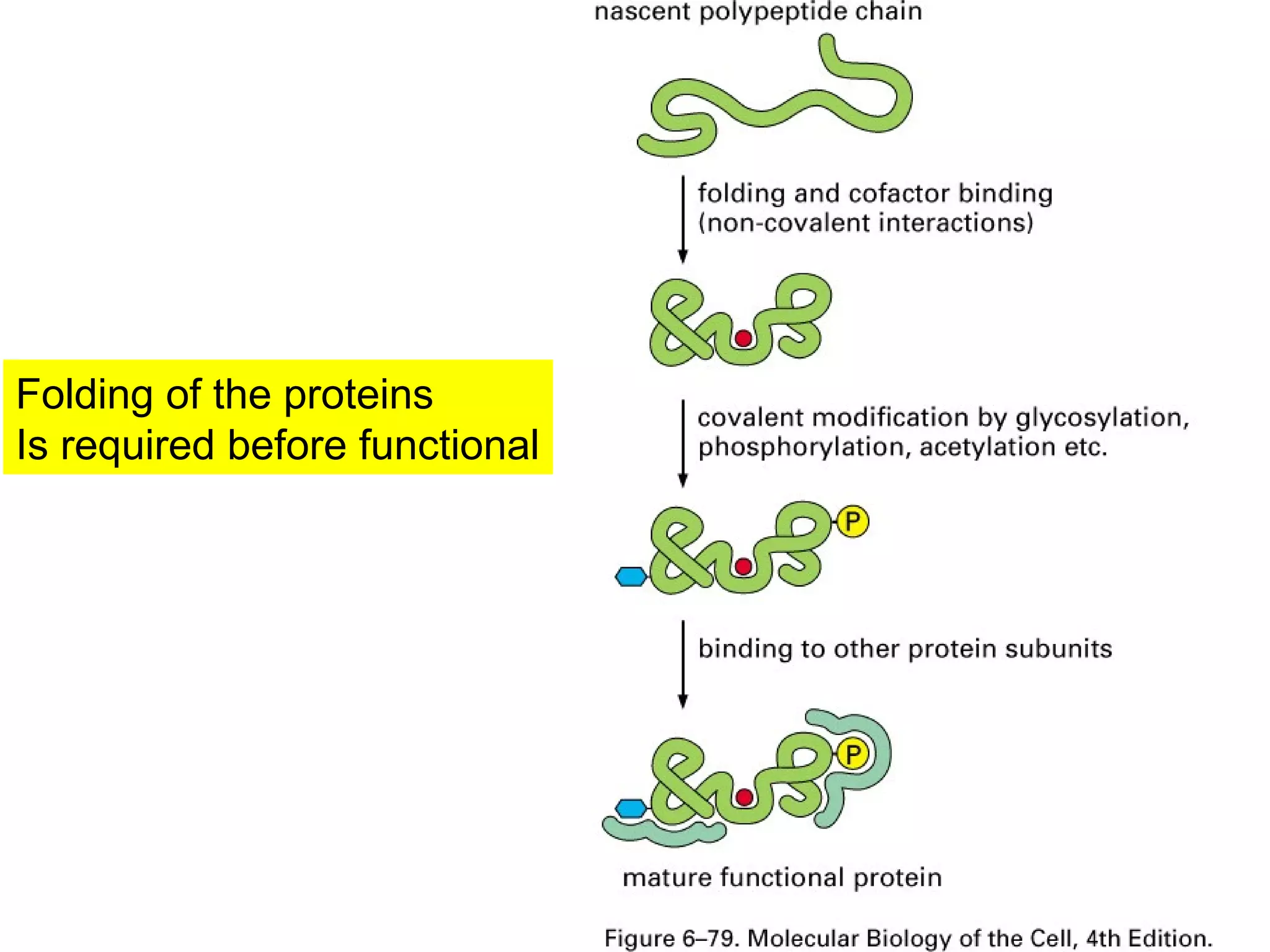
Folding of the proteins
Is required before functional
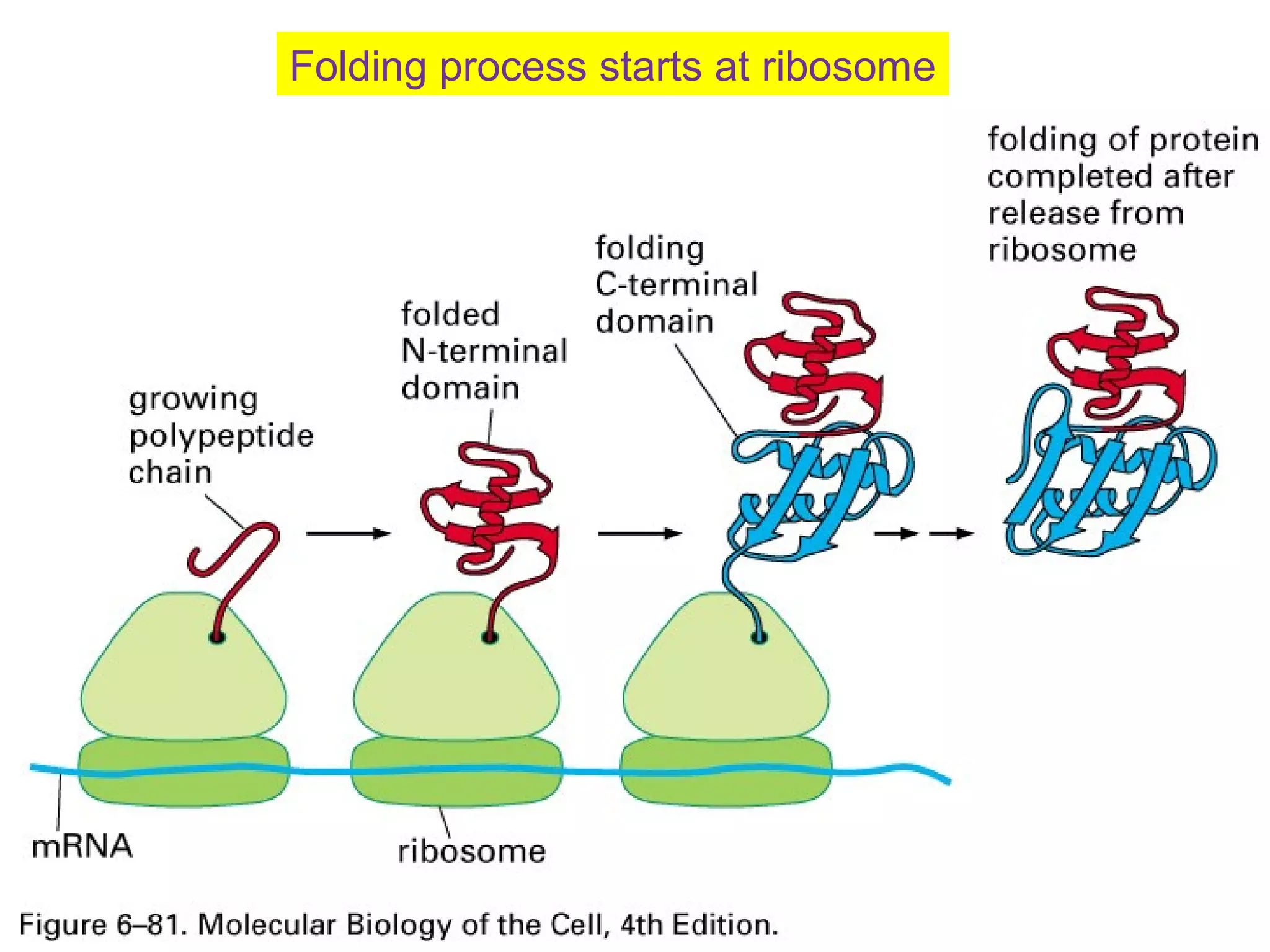
Folding process starts at ribosome
Protein Folding Pathway
Molecular Chaperone
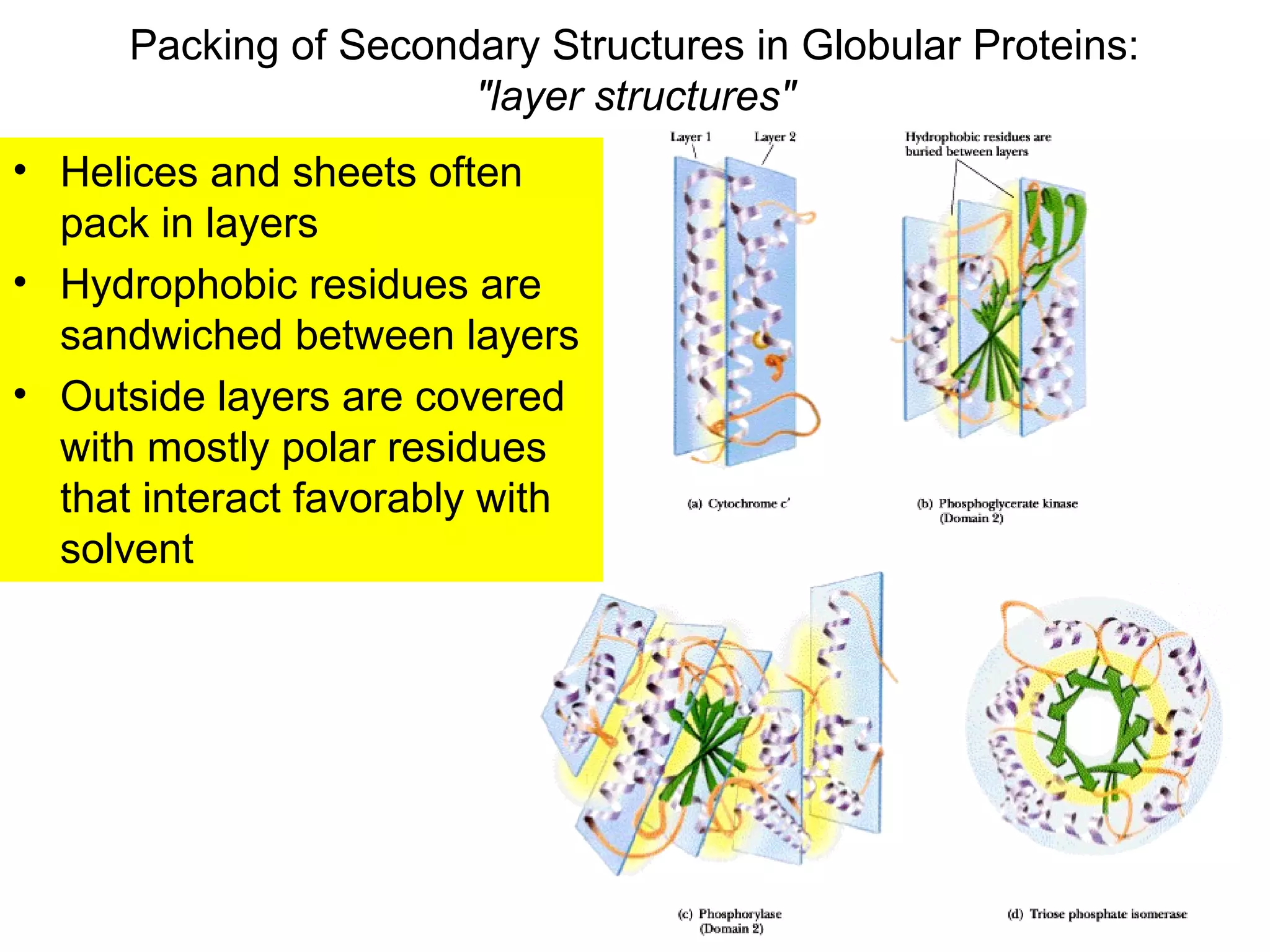
Packing of Secondary Structures in Globular Proteins:
"layer structures"
• Helices and sheets often
pack in layers
• Hydrophobic residues are
sandwiched between layers
• Outside layers are covered
with mostly polar residues
that interact favorably with
solvent
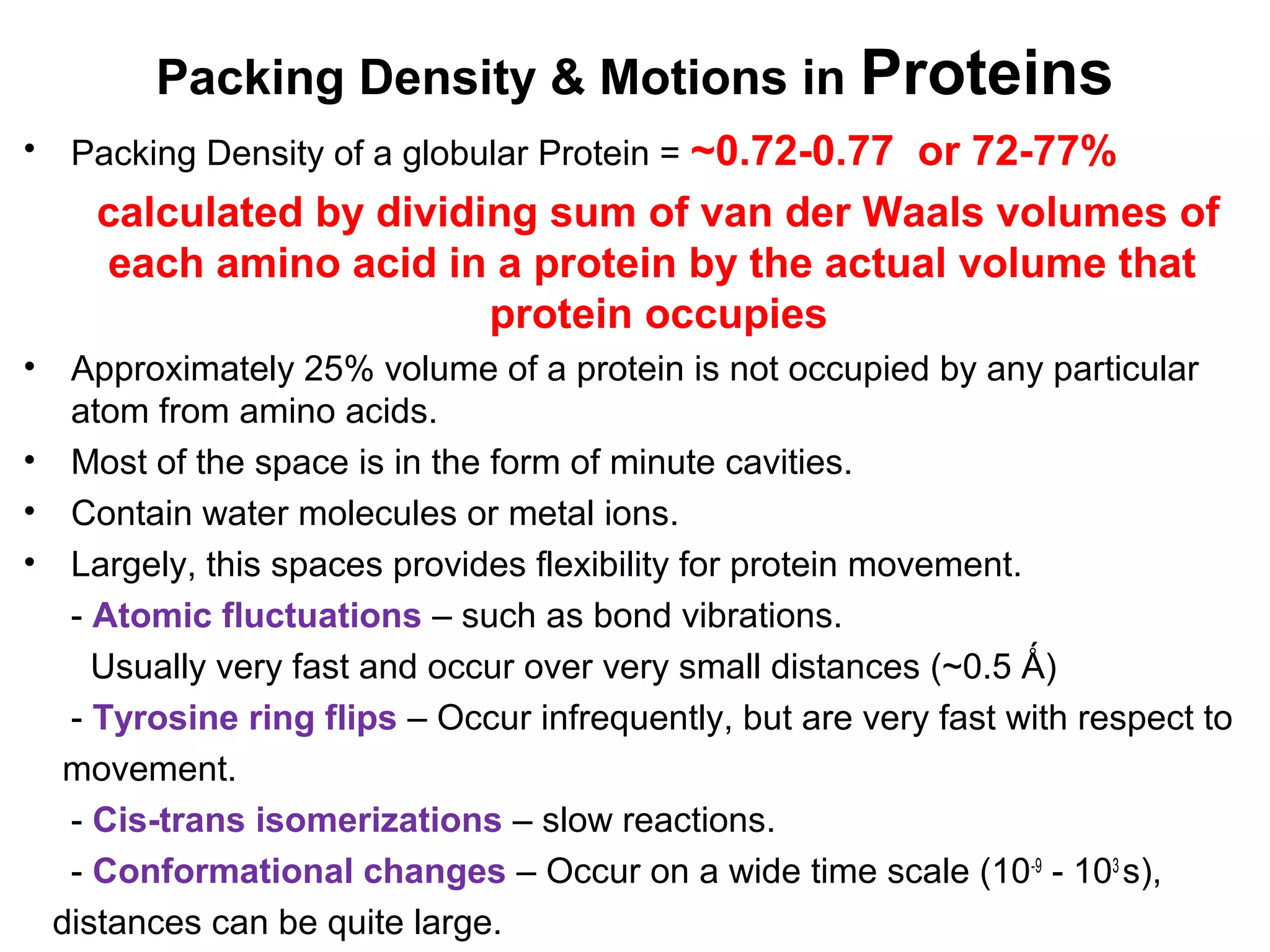
Packing Density & Motions in Proteins
• Packing Density of a globular Protein = ~0.72-0.77 or 72-77%
calculated by dividing sum of van der Waals volumes of
each amino acid in a protein by the actual volume that
protein occupies
• Approximately 25% volume of a protein is not occupied by any particular
atom from amino acids.
• Most of the space is in the form of minute cavities.
• Contain water molecules or metal ions.
• Largely, this spaces provides flexibility for protein movement.
- Atomic fluctuations – such as bond vibrations.
Usually very fast and occur over very small distances (~0.5 Ǻ)
- Tyrosine ring flips – Occur infrequently, but are very fast with respect to
movement.
- Cis-trans isomerizations – slow reactions.
- Conformational changes – Occur on a wide time scale (10-9
- 103
s),
distances can be quite large.
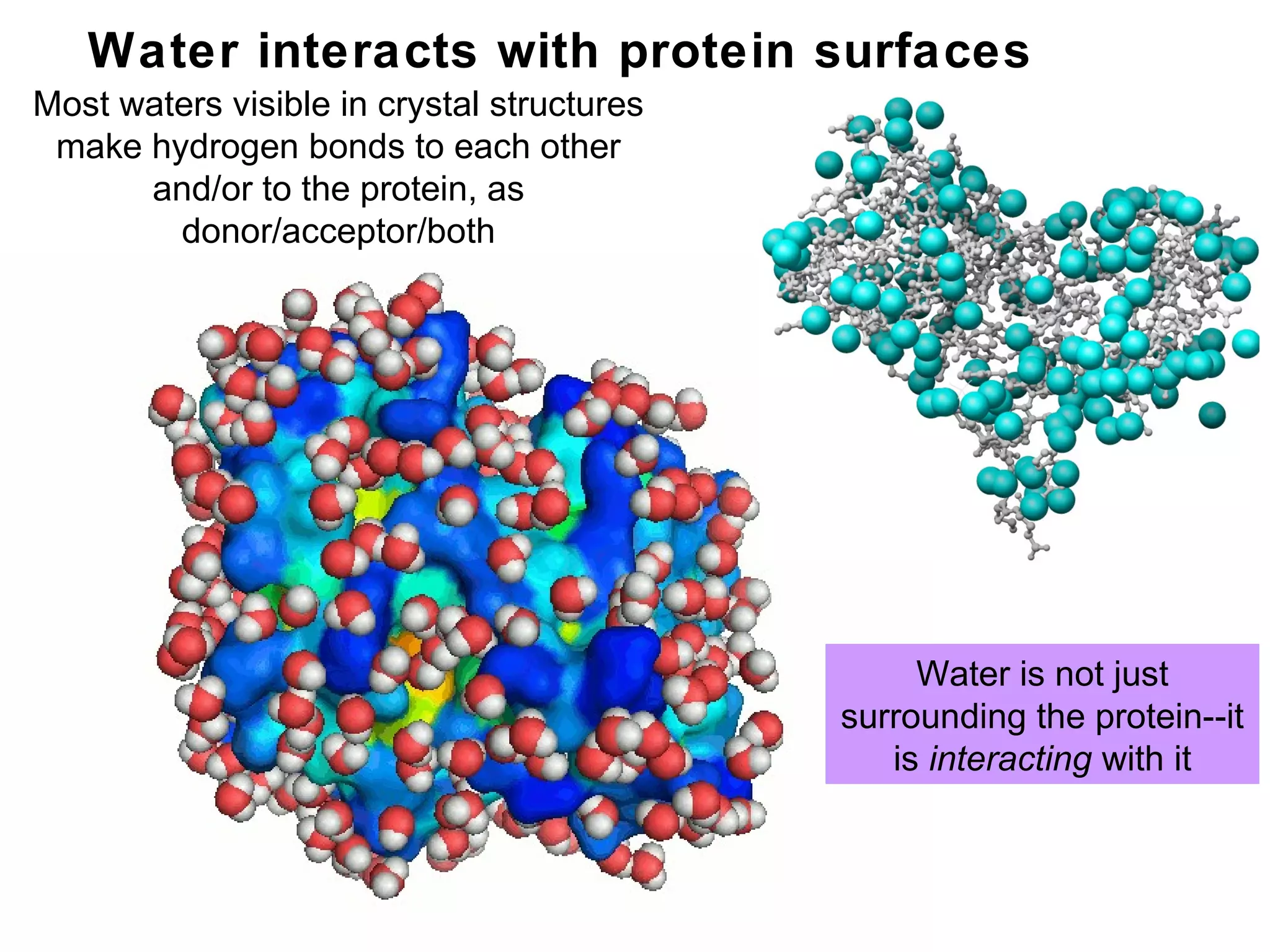
Water interacts with protein surfaces
Most waters visible in crystal structures
make hydrogen bonds to each other
and/or to the protein, as
donor/acceptor/both
Water is not just
surrounding the protein--it
is interacting with it
The outer
surface
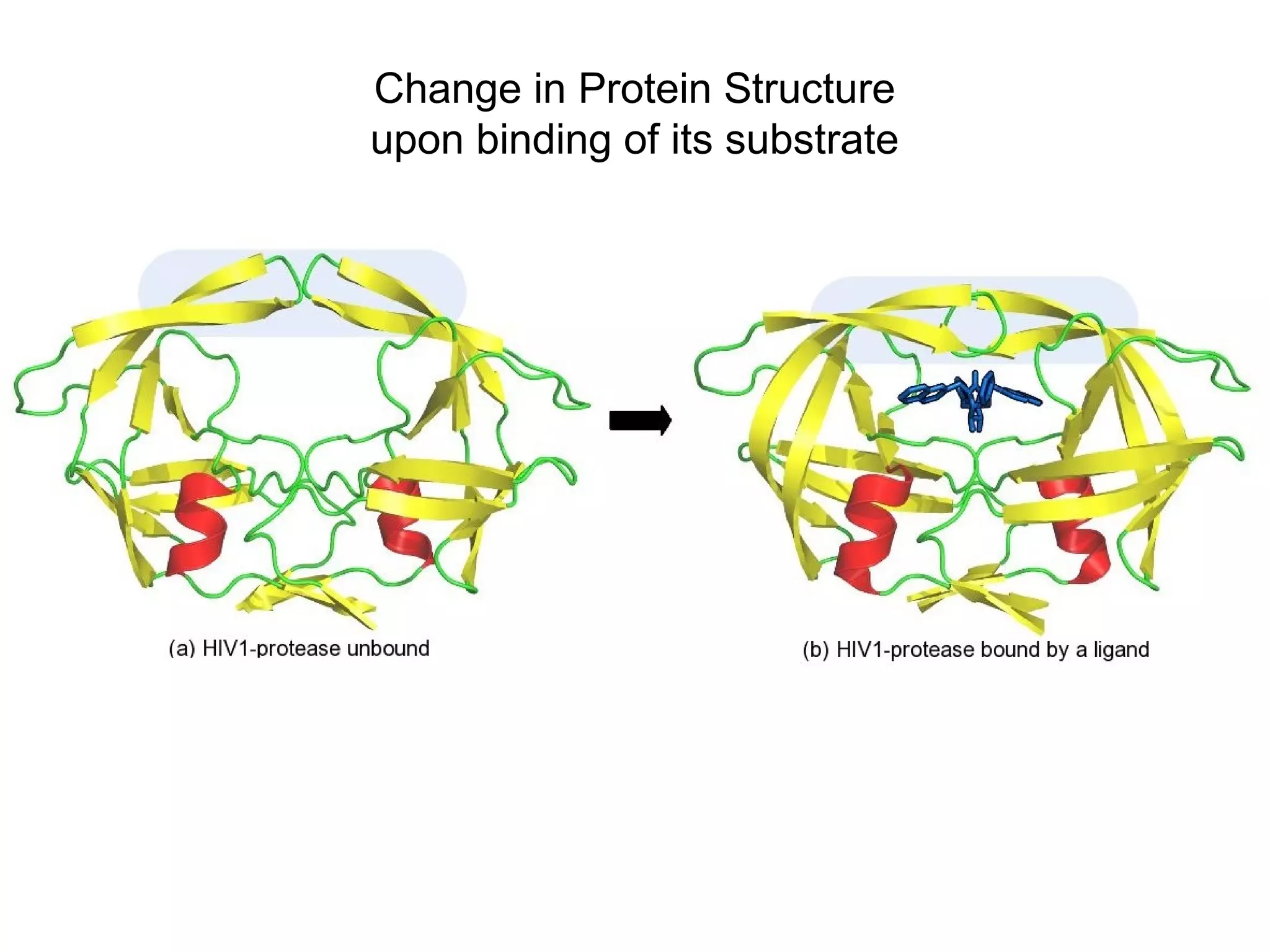
Change in Protein Structure
upon binding of its substrate
General notion in enzymology
has been that substrate [on
which the enzyme acts] induces
shape change. We found that
this is not true. The enzyme, in
fact, changes conformations
without the substrate.
Image: Courtesy of Dorothee Kern/HHMI at
Brandeis University
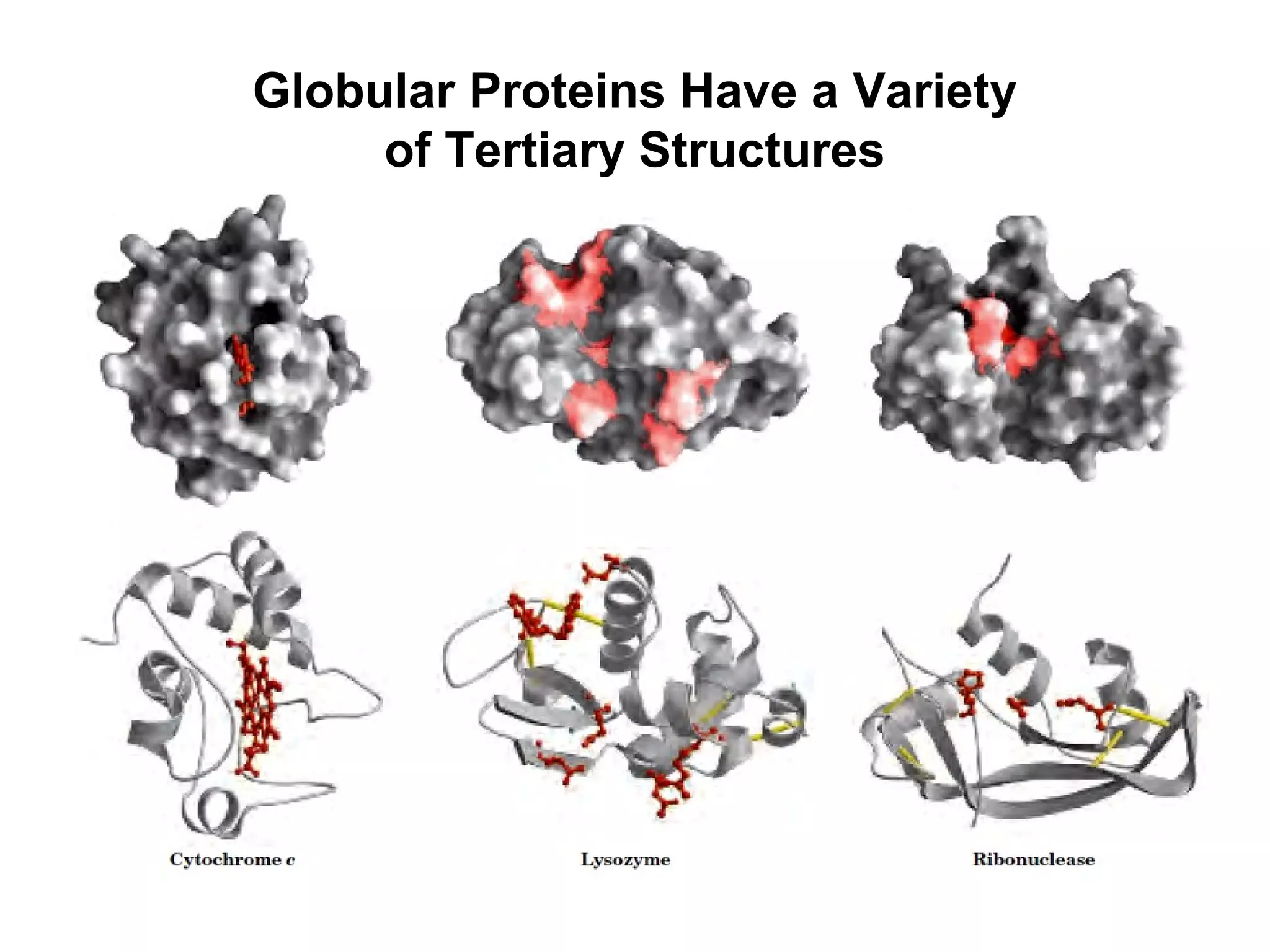
Globular Proteins Have a Variety
of Tertiary Structures
Globular Proteins could be Denatured:
Chaotropic agents:
• disrupt the structure of water by participating in hydrogen bonding.
• As a result, hydrophobic driving force that makes a folded structure
energetically favorable is disrupted
– Guanidine salts, urea, detergents
Extremes of pH: disrupts net charge on the protein; and H-bonds
• Proteins also denature at pH values deviating significantly from neutral.
Organic Solvents: Water miscible organic solvents, alcohol or acetone disrupt
hydrophobic interactions.
• are able to participate in hydrogen bonding.
• Also alters thermodynamic driving force behind protein folding.
• As organic solvent in a solution increases, the tendency of proteins to unfold
increases.
High Temperature: affects weak interactions in a protein (primarily H –bonds).
• Heat increases molecular motion.
• As proteins heat they fold and unfold rapidly.
• Intermolecular interactions of hydrophobic domains may cause proteins to
precipitate (cooking an egg).
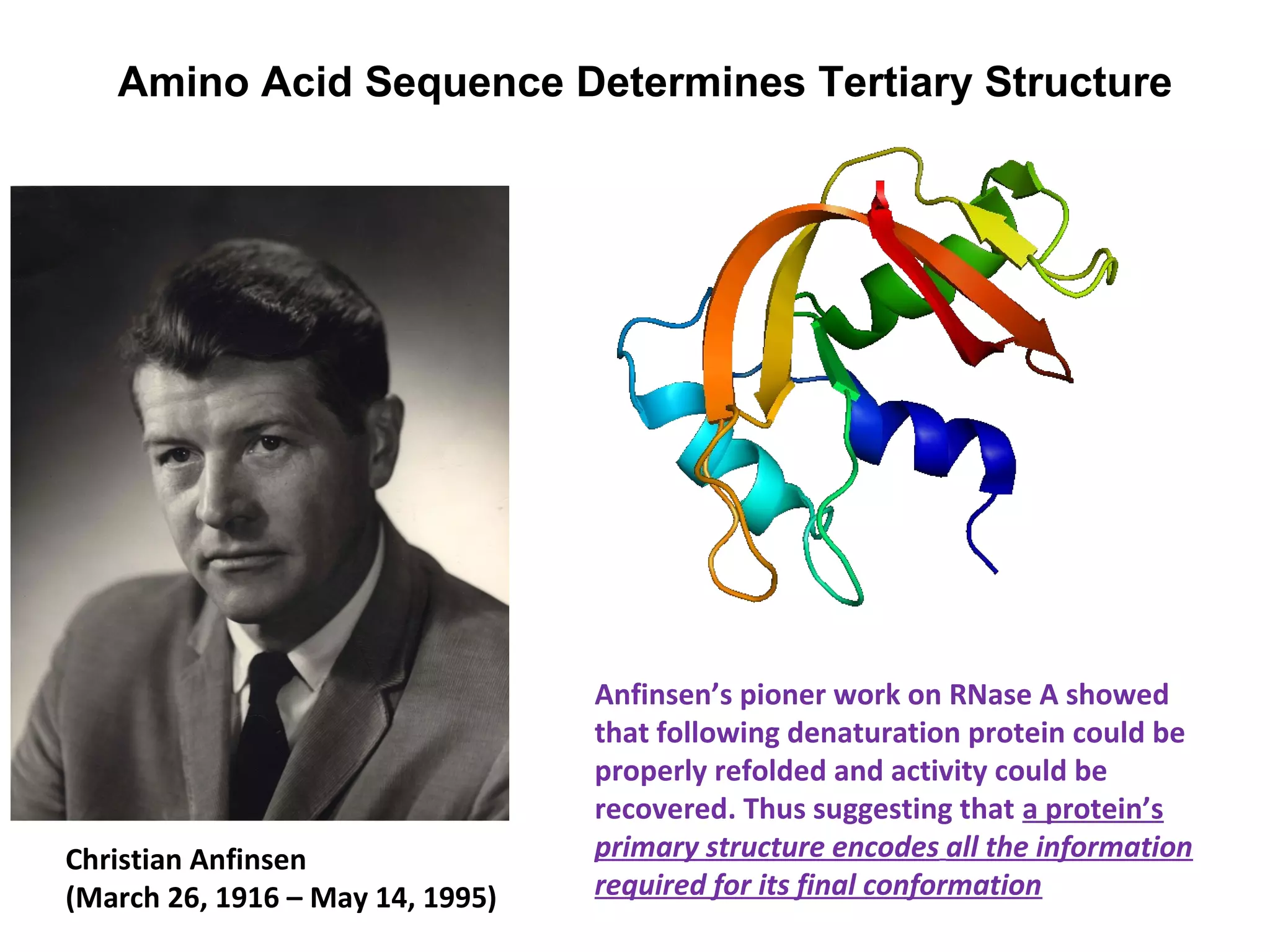
Amino Acid Sequence Determines Tertiary Structure
Christian Anfinsen
(March 26, 1916 – May 14, 1995)
Anfinsen’s pioner work on RNase A showed
that following denaturation protein could be
properly refolded and activity could be
recovered. Thus suggesting that a protein’s
primary structure encodes all the information
required for its final conformation
 Tertiary Structure more conservative than Primary Structure
 Natural variation from species-to-species tends to favor changes in surface
(and therefore polar) groups.
 Structure is determined globally and redundantly.
 Upto 30% of the amino acids in some proteins have been changed to
alanine with little change in the folded structure.
 So protein structure comparison important
• Protein family: proteins with significant primary sequence similarity, and/or
with demonstrably similar structure and function
• Super families: two or more families with little primary sequence similarities
make use of the same major structural motif and have
functional similarities

Proetin Tertiary Structure

  • 1.
  • 2.
    Protein structure:Protein structure:overviewoverview Structural Element Description • Primary Structure Amino Acid Sequence of Protein • Secondary Structure Helices, Sheets, Turns/Loops • Super-secondary Structure Association of Secondary Structures • Domain Self-contained Structural Unit • Tertiary Structure 3D Arrangments of All Atoms In A Polypeptide Chain OR Folded Structure of Whole Protein • Includes Disulfide Bonds • Quaternary Structure Assembled Complex (Oligomer) • Homo-oligomeric (1 Protein Type) • Hetero-oligomeric (>1 Type)
  • 3.
    Tertiary Structure Several importantprinciples: • Secondary structures form wherever possible (due to formation of large numbers of H-bonds) • Helices & sheets often pack close together • Backbone links between elements of secondary structure are usually short and direct • Proteins fold to make the most stable structures (make H-bonds and minimize solvent contact
  • 4.
    Two general classesof proteins based on tertiary structure: Globular & Fibrous proteins e.g. Carbonic anhydrase e.g. Collagen • Biochemical – Globular – Membrane – Fibrous Globular proteins • Folded into a compact, spherical or globular shape and soluble. • Several types of secondary str. • Function: Various cellular functions, most enzymes and globular proteins Fibrous proteins • Long strands fibrous: elongated, tough and insoluble. • Single type of sec. st Sheet • Function: Structural roles; Support, shape, external protection
  • 5.
  • 6.
    Globular Proteins Some designprinciples • Most polar residues face outside of the protein and interact with solvent • Most hydrophobic residues face interior of protein & interact with each other • Packing of residues is close • 0.72 to 0.77 packing density indicates existence of empty spaces • Empty spaces are in the form of small cavities • "Random coil" is not random • Structures of globular proteins are not static • Various elements and domains of protein move to different degrees • Some segments of proteins are very flexible and disordered • Different kinds and rates of protein motion
  • 7.
    Forces That StabilizeAll Globular Proteins Globular Proteins are compact… polypeptide chains folded into a spherical or globular shape  Peptide chain must satisfy the constraints inherent in its own structure  Peptide chain must fold so as to "bury" the hydrophobic side chains, minimizing their contact with water  Peptide chains, composed of L-amino acids, have a tendency to undergo a "right-handed twist" • No space inside, water is effectively excluded from the hydrophobic interior Nearly all buried H-Bond Donors, e.g., Ser, form H-bonds with H-Bond Acceptors, e.g., Gln H-bond formation neutralizes polarity of H-bonding group
  • 8.
    H- bonds Form inall proteins. H-atom of the peptide link is attracted to the oxygen of another peptide link. Ionic bonds If some of the amino acids in the proteins have carboxylic acid or amine side groups, an ionic bond can form. Covalent bonds In a very small number of proteins, sulfur-sulfur covalent bonds (also called cystine bonds or disulfide bridges) are present. While backbone interactions define most of 2ndry structure interactions, it is side chains that define tertiary interactions
  • 9.
    Protein-solvent interactions hydrophilic aminoacids (D, E, K, R, H, N, Q) - these amino acids tend to interact extensively with solvent in context of the folded protein; the interaction is mostly ionic and H-bonding - there are instances of hydrophilic residues being buried in the interior of the protein; often, pairs of these residues form salt bridges hydrophobic amino acids (M, I, L, V, F, W, Y, A*, C, P) - these tend to form ‘core’ of protein, i.e., are buried within folded protein; some hydrophobic residues can be entirely (or partially) exposed small neutral amino acids (G, A*, S, T) - less preference for being solvent-exposed or not
  • 10.
    Types of non-covalentinteractionsTypes of non-covalent interactions interaction nature bond length “bond” strength example ionic (salt bridge) electrostatic 1.8-4.0 Å (3.0-10 Å for like charges) 1-6 kcal/mol positive: K, R, H, N-terminus negative: D, E, C-terminus hydrophobic entropy - 2-3 hydrophobic side chains (M,I,L,V,F,W,Y,A,C,P) H-bond H-bonding 2.6-3.5 2-10 H donor, O acceptor van der Waals attraction/ repulsion 2.8-4.0 <1 closely-spaced atoms; if too close, repulsion aromatic- aromatic π−π 4.5-7.0 1-2 F,W,Y (stacked) aromatic-amino group H-bonding 2.9-3.6 2.7-4.9 N-H donor to F,W,Y these all contribute to some extent to protein structure & stability; - important to understand extremophilic (or any other) proteins
  • 11.
    Disulfide bonds • acovalent modification; the oxidation reaction can either be intramolecular (within the same protein) or inter-molecular (within different proteins, e.g., antibody light and heavy chains). The reaction is reversible. - most disulfide-bonded proteins are extracellular (e.g. lysozyme contains four disulfide bonds); cysteines are usually in reduced form - cellular enzymes (protein disulfide isomerases) assist many proteins in forming proper disulfide bond(s) Inside of cells maintained in a reduced environment by presence of many "reducing“ agents, such as tripeptide g-glu- cys-gly (glutathione)
  • 12.
    Proteins have thecapacity to fold and become active based on the information contained in their amino acid sequence. Thermodynamically spontaneous Proteins fold in buffered water type of interaction total contribution hydrophobic group burial ~200 kcal/mol hydrogen bonding small?? ion pairs/salt bridges <15 kcal/mol disulfide bonds 4 kcal/mol per link Typical net protein stabilities are 5-20 kcal/mol--> so even minor interactions can make a difference! Hydrophobic interactions are major stabilizing force of globular proteins H- bonds and ionic interactions are optimized in specific structures that are thermodynamically most stable Contributions to Protein Stability
  • 13.
    Common Post-translational Modifications SulphydrylsDisulphide bond Cysteinylation Oxidation Glutathionylation Amines Methylation Acetylation Farnesylation Biotinylation Stearoylation Formylation Lipoic acid Myristoylation Palmitoylation Geranylgeranylation Acids & amides Pyroglutamic acid Carboxylation Deamidation Hydroxyl groups Phosphorylation Sulphation Carbohydrates Pentoses Hexosamines N-acetylhexosamines Deoxyhexoses Hexoses Sialic acid • Post-translational modifications: chemical modification of a protein after its translation
  • 14.
    Globular Proteins arecompact Structures…. All goes to folding
  • 15.
    Folding of theproteins Is required before functional
  • 16.
  • 17.
  • 18.
    Packing of SecondaryStructures in Globular Proteins: "layer structures" • Helices and sheets often pack in layers • Hydrophobic residues are sandwiched between layers • Outside layers are covered with mostly polar residues that interact favorably with solvent
  • 19.
    Packing Density &Motions in Proteins • Packing Density of a globular Protein = ~0.72-0.77 or 72-77% calculated by dividing sum of van der Waals volumes of each amino acid in a protein by the actual volume that protein occupies • Approximately 25% volume of a protein is not occupied by any particular atom from amino acids. • Most of the space is in the form of minute cavities. • Contain water molecules or metal ions. • Largely, this spaces provides flexibility for protein movement. - Atomic fluctuations – such as bond vibrations. Usually very fast and occur over very small distances (~0.5 Ǻ) - Tyrosine ring flips – Occur infrequently, but are very fast with respect to movement. - Cis-trans isomerizations – slow reactions. - Conformational changes – Occur on a wide time scale (10-9 - 103 s), distances can be quite large.
  • 20.
    Water interacts withprotein surfaces Most waters visible in crystal structures make hydrogen bonds to each other and/or to the protein, as donor/acceptor/both Water is not just surrounding the protein--it is interacting with it The outer surface
  • 22.
    Change in ProteinStructure upon binding of its substrate
  • 23.
    General notion inenzymology has been that substrate [on which the enzyme acts] induces shape change. We found that this is not true. The enzyme, in fact, changes conformations without the substrate. Image: Courtesy of Dorothee Kern/HHMI at Brandeis University
  • 24.
    Globular Proteins Havea Variety of Tertiary Structures
  • 27.
    Globular Proteins couldbe Denatured: Chaotropic agents: • disrupt the structure of water by participating in hydrogen bonding. • As a result, hydrophobic driving force that makes a folded structure energetically favorable is disrupted – Guanidine salts, urea, detergents Extremes of pH: disrupts net charge on the protein; and H-bonds • Proteins also denature at pH values deviating significantly from neutral. Organic Solvents: Water miscible organic solvents, alcohol or acetone disrupt hydrophobic interactions. • are able to participate in hydrogen bonding. • Also alters thermodynamic driving force behind protein folding. • As organic solvent in a solution increases, the tendency of proteins to unfold increases. High Temperature: affects weak interactions in a protein (primarily H –bonds). • Heat increases molecular motion. • As proteins heat they fold and unfold rapidly. • Intermolecular interactions of hydrophobic domains may cause proteins to precipitate (cooking an egg).
  • 28.
    Amino Acid SequenceDetermines Tertiary Structure Christian Anfinsen (March 26, 1916 – May 14, 1995) Anfinsen’s pioner work on RNase A showed that following denaturation protein could be properly refolded and activity could be recovered. Thus suggesting that a protein’s primary structure encodes all the information required for its final conformation
  • 29.
     Tertiary Structuremore conservative than Primary Structure  Natural variation from species-to-species tends to favor changes in surface (and therefore polar) groups.  Structure is determined globally and redundantly.  Upto 30% of the amino acids in some proteins have been changed to alanine with little change in the folded structure.  So protein structure comparison important • Protein family: proteins with significant primary sequence similarity, and/or with demonstrably similar structure and function • Super families: two or more families with little primary sequence similarities make use of the same major structural motif and have functional similarities

Editor's Notes

  • #14 Highlighted ones discussed
  • #22 Refer back also to the section on water in the Richardson review.