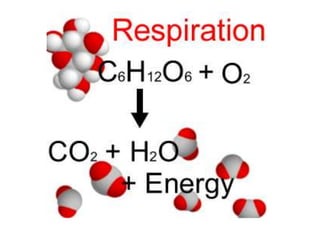
Respiration
LO:
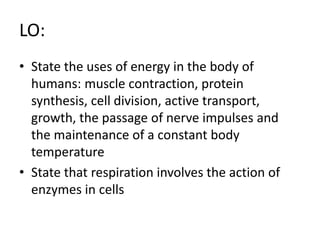
• State the uses of energy in the body of
humans: muscle contraction, protein
synthesis, cell division, active transport,
growth, the passage of nerve impulses and
the maintenance of a constant body
temperature
• State that respiration involves the action of
enzymes in cells
LO:
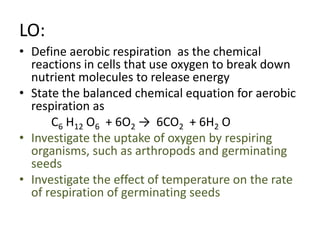
• Define aerobic respiration as the chemical
reactions in cells that use oxygen to break down
nutrient molecules to release energy
• State the balanced chemical equation for aerobic
respiration as
C6 H12 O6 + 6O2 → 6CO2 + 6H2 O
• Investigate the uptake of oxygen by respiring
organisms, such as arthropods and germinating
seeds
• Investigate the effect of temperature on the rate
of respiration of germinating seeds
LO:
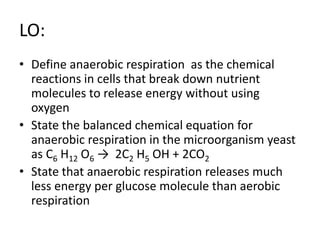
• Define anaerobic respiration as the chemical
reactions in cells that break down nutrient
molecules to release energy without using
oxygen
• State the balanced chemical equation for
anaerobic respiration in the microorganism yeast
as C6 H12 O6 → 2C2 H5 OH + 2CO2
• State that anaerobic respiration releases much
less energy per glucose molecule than aerobic
respiration
LO:
• State that lactic acid builds up in muscles and
blood during vigorous exercise causing an
oxygen debt
• Outline how the oxygen debt is removed
during recovery
LO: define the term respiration
• the set of chemical reactions that break down
nutrient molecules in living cells to release
energy
• Definition: respiration is the release of energy
from food substances, and goes on in all living
cells
• respiration involves the action of enzymes in
cells
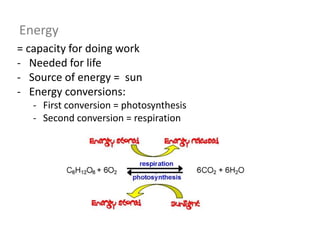
Energy
= capacity for doing work
- Needed for life
- Source of energy = sun
- Energy conversions:
- First conversion = photosynthesis
- Second conversion = respiration
• Growth (proteosynthesis) – protein synthesis
• Maintenance of a constant body temperature
• Active transport
• Cell division
• Movement – muscle contraction
• The passage of nerve impulses
LO: Know the form of energy found in human body
Adenosine triphosphate
• Small packet of energy which can drive the
reactions in a cell
• Short-term store of energy
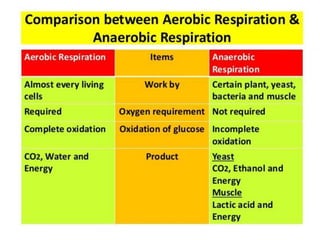
LO: Define aerobic respiration ;State the balanced chemical equation
for aerobic respiration
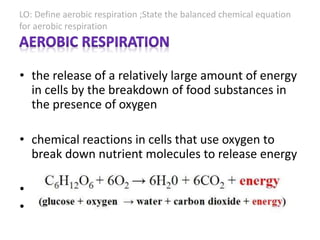
• the release of a relatively large amount of energy
in cells by the breakdown of food substances in
the presence of oxygen
• chemical reactions in cells that use oxygen to
break down nutrient molecules to release energy
• Takes place in mitochondria
• Some energy is lost as heat
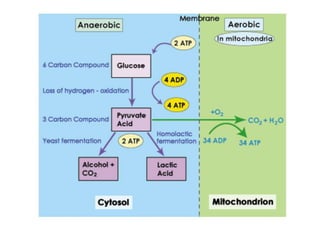
LO: Define anaerobic respiration; state the word equation
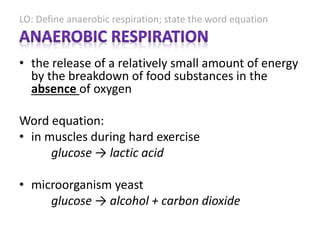
• the release of a relatively small amount of energy
by the breakdown of food substances in the
absence of oxygen
Word equation:
• in muscles during hard exercise
glucose → lactic acid
• microorganism yeast
glucose → alcohol + carbon dioxide
LO: State the balanced chemical equation for anaerobic
respiration in the microorganism yeast as
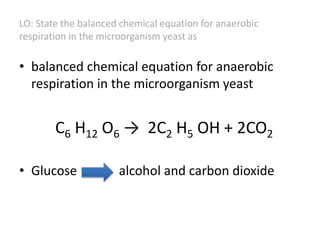
• balanced chemical equation for anaerobic
respiration in the microorganism yeast
C6 H12 O6 → 2C2 H5 OH + 2CO2
• Glucose alcohol and carbon dioxide
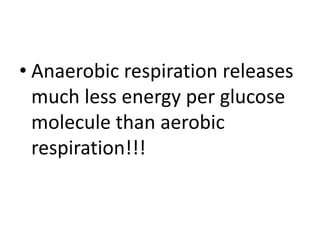
• Anaerobic respiration releases
much less energy per glucose
molecule than aerobic
respiration!!!
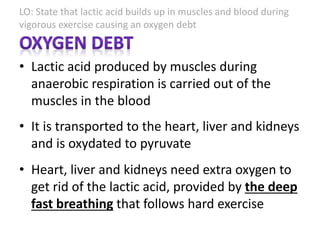
LO: State that lactic acid builds up in muscles and blood during
vigorous exercise causing an oxygen debt
• Lactic acid produced by muscles during
anaerobic respiration is carried out of the
muscles in the blood
• It is transported to the heart, liver and kidneys
and is oxydated to pyruvate
• Heart, liver and kidneys need extra oxygen to
get rid of the lactic acid, provided by the deep
fast breathing that follows hard exercise
• HOMEWORK:
• Pages 52-53 Describe the role of anaerobic
respiration in yeast during brewing and bread-
making.

Respiration

  • 1.
  • 2.
    LO: • State theuses of energy in the body of humans: muscle contraction, protein synthesis, cell division, active transport, growth, the passage of nerve impulses and the maintenance of a constant body temperature • State that respiration involves the action of enzymes in cells
  • 3.
    LO: • Define aerobicrespiration as the chemical reactions in cells that use oxygen to break down nutrient molecules to release energy • State the balanced chemical equation for aerobic respiration as C6 H12 O6 + 6O2 → 6CO2 + 6H2 O • Investigate the uptake of oxygen by respiring organisms, such as arthropods and germinating seeds • Investigate the effect of temperature on the rate of respiration of germinating seeds
  • 4.
    LO: • Define anaerobicrespiration as the chemical reactions in cells that break down nutrient molecules to release energy without using oxygen • State the balanced chemical equation for anaerobic respiration in the microorganism yeast as C6 H12 O6 → 2C2 H5 OH + 2CO2 • State that anaerobic respiration releases much less energy per glucose molecule than aerobic respiration
  • 5.
    LO: • State thatlactic acid builds up in muscles and blood during vigorous exercise causing an oxygen debt • Outline how the oxygen debt is removed during recovery
  • 6.
    LO: define theterm respiration • the set of chemical reactions that break down nutrient molecules in living cells to release energy • Definition: respiration is the release of energy from food substances, and goes on in all living cells • respiration involves the action of enzymes in cells
  • 7.
    Energy = capacity fordoing work - Needed for life - Source of energy = sun - Energy conversions: - First conversion = photosynthesis - Second conversion = respiration
  • 8.
    • Growth (proteosynthesis)– protein synthesis • Maintenance of a constant body temperature • Active transport • Cell division • Movement – muscle contraction • The passage of nerve impulses
  • 9.
    LO: Know theform of energy found in human body Adenosine triphosphate • Small packet of energy which can drive the reactions in a cell • Short-term store of energy
  • 10.
    LO: Define aerobicrespiration ;State the balanced chemical equation for aerobic respiration • the release of a relatively large amount of energy in cells by the breakdown of food substances in the presence of oxygen • chemical reactions in cells that use oxygen to break down nutrient molecules to release energy • Takes place in mitochondria • Some energy is lost as heat
  • 11.
    LO: Define anaerobicrespiration; state the word equation • the release of a relatively small amount of energy by the breakdown of food substances in the absence of oxygen Word equation: • in muscles during hard exercise glucose → lactic acid • microorganism yeast glucose → alcohol + carbon dioxide
  • 12.
    LO: State thebalanced chemical equation for anaerobic respiration in the microorganism yeast as • balanced chemical equation for anaerobic respiration in the microorganism yeast C6 H12 O6 → 2C2 H5 OH + 2CO2 • Glucose alcohol and carbon dioxide
  • 15.
    • Anaerobic respirationreleases much less energy per glucose molecule than aerobic respiration!!!
  • 16.
    LO: State thatlactic acid builds up in muscles and blood during vigorous exercise causing an oxygen debt • Lactic acid produced by muscles during anaerobic respiration is carried out of the muscles in the blood • It is transported to the heart, liver and kidneys and is oxydated to pyruvate • Heart, liver and kidneys need extra oxygen to get rid of the lactic acid, provided by the deep fast breathing that follows hard exercise
  • 17.
    • HOMEWORK: • Pages52-53 Describe the role of anaerobic respiration in yeast during brewing and bread- making.