Date: 30th September – 4th
October, 2024
Subject: Biology
Topic: CELLULAR RESPIRATION
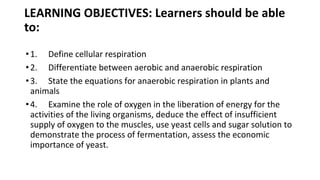
LEARNING OBJECTIVES: Learners should be able
to:
•1. Define cellular respiration
•2. Differentiate between aerobic and anaerobic respiration
•3. State the equations for anaerobic respiration in plants and
animals
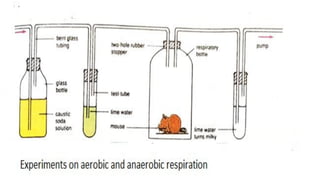
•4. Examine the role of oxygen in the liberation of energy for the
activities of the living organisms, deduce the effect of insufficient
supply of oxygen to the muscles, use yeast cells and sugar solution to
demonstrate the process of fermentation, assess the economic
importance of yeast.
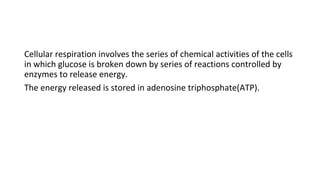
Cellular respiration involves the series of chemical activities of the cells
in which glucose is broken down by series of reactions controlled by
enzymes to release energy.
The energy released is stored in adenosine triphosphate(ATP).
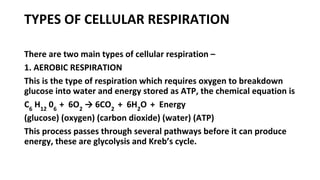
TYPES OF CELLULAR RESPIRATION
There are two main types of cellular respiration –
1. AEROBIC RESPIRATION
This is the type of respiration which requires oxygen to breakdown
glucose into water and energy stored as ATP, the chemical equation is
C6
H12
06
+ 6O2
→ 6CO2
+ 6H2
O + Energy
(glucose) (oxygen) (carbon dioxide) (water) (ATP)
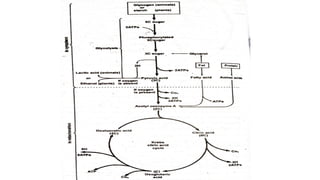
This process passes through several pathways before it can produce
energy, these are glycolysis and Kreb’s cycle.
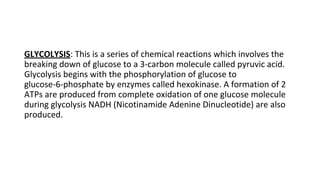
GLYCOLYSIS: This is a series of chemical reactions which involves the
breaking down of glucose to a 3-carbon molecule called pyruvic acid.
Glycolysis begins with the phosphorylation of glucose to
glucose-6-phosphate by enzymes called hexokinase. A formation of 2
ATPs are produced from complete oxidation of one glucose molecule
during glycolysis NADH (Nicotinamide Adenine Dinucleotide) are also
produced.
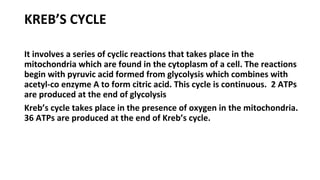
KREB’S CYCLE
It involves a series of cyclic reactions that takes place in the
mitochondria which are found in the cytoplasm of a cell. The reactions
begin with pyruvic acid formed from glycolysis which combines with
acetyl-co enzyme A to form citric acid. This cycle is continuous. 2 ATPs
are produced at the end of glycolysis
Kreb’s cycle takes place in the presence of oxygen in the mitochondria.
36 ATPs are produced at the end of Kreb’s cycle.
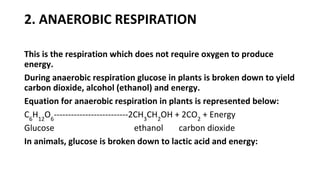
2. ANAEROBIC RESPIRATION
This is the respiration which does not require oxygen to produce
energy.
During anaerobic respiration glucose in plants is broken down to yield
carbon dioxide, alcohol (ethanol) and energy.
Equation for anaerobic respiration in plants is represented below:
C6
H12
O6
--------------------------2CH3
CH2
OH + 2CO2
+ Energy
Glucose ethanol carbon dioxide
In animals, glucose is broken down to lactic acid and energy:
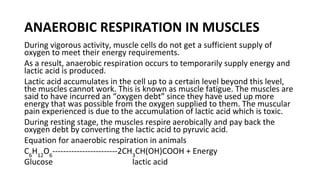
ANAEROBIC RESPIRATION IN MUSCLES
During vigorous activity, muscle cells do not get a sufficient supply of
oxygen to meet their energy requirements.
As a result, anaerobic respiration occurs to temporarily supply energy and
lactic acid is produced.
Lactic acid accumulates in the cell up to a certain level beyond this level,
the muscles cannot work. This is known as muscle fatigue. The muscles are
said to have incurred an “oxygen debt” since they have used up more
energy that was possible from the oxygen supplied to them. The muscular
pain experienced is due to the accumulation of lactic acid which is toxic.
During resting stage, the muscles respire aerobically and pay back the
oxygen debt by converting the lactic acid to pyruvic acid.
Equation for anaerobic respiration in animals
C6
H12
O6
------------------------2CH3
CH(OH)COOH + Energy
Glucose lactic acid
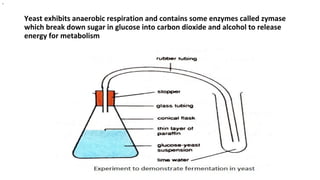
Yeast exhibits anaerobic respiration and contains some enzymes called zymase
which break down sugar in glucose into carbon dioxide and alcohol to release
energy for metabolism
.
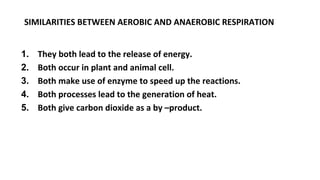
SIMILARITIES BETWEEN AEROBIC AND ANAEROBIC RESPIRATION
1. They both lead to the release of energy.
2. Both occur in plant and animal cell.
3. Both make use of enzyme to speed up the reactions.
4. Both processes lead to the generation of heat.
5. Both give carbon dioxide as a by –product.
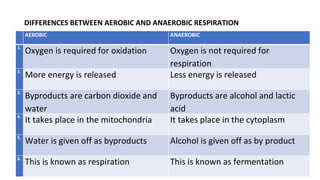
DIFFERENCES BETWEEN AEROBIC AND ANAEROBIC RESPIRATION
AEROBIC ANAEROBIC
1.
Oxygen is required for oxidation Oxygen is not required for
respiration
2.
More energy is released Less energy is released
3.
Byproducts are carbon dioxide and
water
Byproducts are alcohol and lactic
acid
4.
It takes place in the mitochondria It takes place in the cytoplasm
5.
Water is given off as byproducts Alcohol is given off as by product
6.
This is known as respiration This is known as fermentation
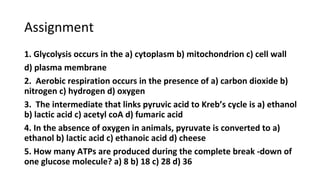
Assignment
1. Glycolysis occurs in the a) cytoplasm b) mitochondrion c) cell wall
d) plasma membrane
2. Aerobic respiration occurs in the presence of a) carbon dioxide b)
nitrogen c) hydrogen d) oxygen
3. The intermediate that links pyruvic acid to Kreb’s cycle is a) ethanol
b) lactic acid c) acetyl coA d) fumaric acid
4. In the absence of oxygen in animals, pyruvate is converted to a)
ethanol b) lactic acid c) ethanoic acid d) cheese
5. How many ATPs are produced during the complete break -down of
one glucose molecule? a) 8 b) 18 c) 28 d) 36

grade 11 first term Cellular respiration.pdf

  • 1.
    Date: 30th September– 4th October, 2024 Subject: Biology Topic: CELLULAR RESPIRATION
  • 2.
    LEARNING OBJECTIVES: Learnersshould be able to: •1. Define cellular respiration •2. Differentiate between aerobic and anaerobic respiration •3. State the equations for anaerobic respiration in plants and animals •4. Examine the role of oxygen in the liberation of energy for the activities of the living organisms, deduce the effect of insufficient supply of oxygen to the muscles, use yeast cells and sugar solution to demonstrate the process of fermentation, assess the economic importance of yeast.
  • 3.
    Cellular respiration involvesthe series of chemical activities of the cells in which glucose is broken down by series of reactions controlled by enzymes to release energy. The energy released is stored in adenosine triphosphate(ATP).
  • 4.
    TYPES OF CELLULARRESPIRATION There are two main types of cellular respiration – 1. AEROBIC RESPIRATION This is the type of respiration which requires oxygen to breakdown glucose into water and energy stored as ATP, the chemical equation is C6 H12 06 + 6O2 → 6CO2 + 6H2 O + Energy (glucose) (oxygen) (carbon dioxide) (water) (ATP) This process passes through several pathways before it can produce energy, these are glycolysis and Kreb’s cycle.
  • 5.
    GLYCOLYSIS: This isa series of chemical reactions which involves the breaking down of glucose to a 3-carbon molecule called pyruvic acid. Glycolysis begins with the phosphorylation of glucose to glucose-6-phosphate by enzymes called hexokinase. A formation of 2 ATPs are produced from complete oxidation of one glucose molecule during glycolysis NADH (Nicotinamide Adenine Dinucleotide) are also produced.
  • 6.
    KREB’S CYCLE It involvesa series of cyclic reactions that takes place in the mitochondria which are found in the cytoplasm of a cell. The reactions begin with pyruvic acid formed from glycolysis which combines with acetyl-co enzyme A to form citric acid. This cycle is continuous. 2 ATPs are produced at the end of glycolysis Kreb’s cycle takes place in the presence of oxygen in the mitochondria. 36 ATPs are produced at the end of Kreb’s cycle.
  • 8.
    2. ANAEROBIC RESPIRATION Thisis the respiration which does not require oxygen to produce energy. During anaerobic respiration glucose in plants is broken down to yield carbon dioxide, alcohol (ethanol) and energy. Equation for anaerobic respiration in plants is represented below: C6 H12 O6 --------------------------2CH3 CH2 OH + 2CO2 + Energy Glucose ethanol carbon dioxide In animals, glucose is broken down to lactic acid and energy:
  • 9.
    ANAEROBIC RESPIRATION INMUSCLES During vigorous activity, muscle cells do not get a sufficient supply of oxygen to meet their energy requirements. As a result, anaerobic respiration occurs to temporarily supply energy and lactic acid is produced. Lactic acid accumulates in the cell up to a certain level beyond this level, the muscles cannot work. This is known as muscle fatigue. The muscles are said to have incurred an “oxygen debt” since they have used up more energy that was possible from the oxygen supplied to them. The muscular pain experienced is due to the accumulation of lactic acid which is toxic. During resting stage, the muscles respire aerobically and pay back the oxygen debt by converting the lactic acid to pyruvic acid. Equation for anaerobic respiration in animals C6 H12 O6 ------------------------2CH3 CH(OH)COOH + Energy Glucose lactic acid
  • 11.
    Yeast exhibits anaerobicrespiration and contains some enzymes called zymase which break down sugar in glucose into carbon dioxide and alcohol to release energy for metabolism .
  • 12.
    SIMILARITIES BETWEEN AEROBICAND ANAEROBIC RESPIRATION 1. They both lead to the release of energy. 2. Both occur in plant and animal cell. 3. Both make use of enzyme to speed up the reactions. 4. Both processes lead to the generation of heat. 5. Both give carbon dioxide as a by –product.
  • 13.
    DIFFERENCES BETWEEN AEROBICAND ANAEROBIC RESPIRATION AEROBIC ANAEROBIC 1. Oxygen is required for oxidation Oxygen is not required for respiration 2. More energy is released Less energy is released 3. Byproducts are carbon dioxide and water Byproducts are alcohol and lactic acid 4. It takes place in the mitochondria It takes place in the cytoplasm 5. Water is given off as byproducts Alcohol is given off as by product 6. This is known as respiration This is known as fermentation
  • 14.
    Assignment 1. Glycolysis occursin the a) cytoplasm b) mitochondrion c) cell wall d) plasma membrane 2. Aerobic respiration occurs in the presence of a) carbon dioxide b) nitrogen c) hydrogen d) oxygen 3. The intermediate that links pyruvic acid to Kreb’s cycle is a) ethanol b) lactic acid c) acetyl coA d) fumaric acid 4. In the absence of oxygen in animals, pyruvate is converted to a) ethanol b) lactic acid c) ethanoic acid d) cheese 5. How many ATPs are produced during the complete break -down of one glucose molecule? a) 8 b) 18 c) 28 d) 36