3 ENZYMES
LO
• explain that enzymes are globular proteins
that catalyse metabolic reactions;
• explain the mode of action of enzymes in
terms of an active site, enzyme-substrate
complex, lowering of activation energy and
enzyme specificity
ENZYMES
• Protein molecules; globular proteins
• Biological catalysts – speed up chemical
reactions but remains unchanged at the end
of the reaction
• Name ends with –ase
• Coiled into precise three dimensional shape
with hydrophilic groups on the outside of the
molecule = soluble
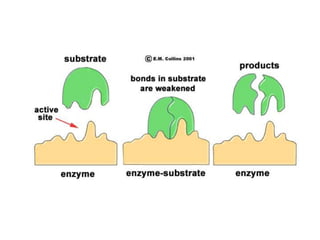
Active site
• Region to which another molecules
(substrate) can bind
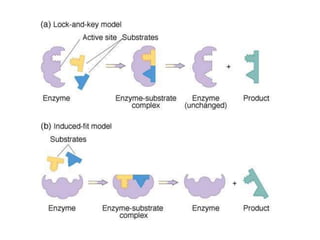
• Lock and key hypothesis
– Substrate is the key whose shape fits the lock of
the enzyme
– The substrate is held in place by temporary bonds
which form between the substrate and some of
the R groups of the enzyme’s amino acids =
enzyme-substrate complex
• Induced fit hypothesis
– Same as lock and key but adds the idea that:
– Substrate and enzyme can change shape slightly
as the substrate molecule enters the enzyme in
order to ensure a perfect fit = more efficient
catalysis
3
• Each type of enzyme will act on only one type
of substrate molecule = enzymes are specific
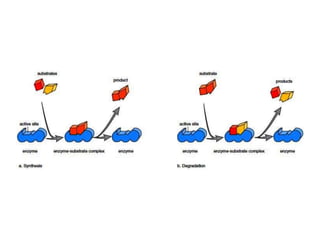
• Enzymes can catalyse the joining of two
substrates (synthesis) or braking down the
substrate (lysis) = products
• Enzyme remains unchanged
• Rate can be very high
• Lyzozyme
– Enzyme in saliva, tears and other secretions
– Natural defence against bacteria
– Breaks the polysaccharide chains that form the
cell walls of bacteria
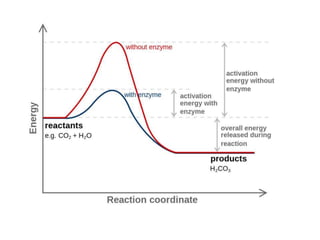
Activation energy
• Extra energy given to the substrate so that the
reaction can happen
• Energy of the reactant can be increased by
heating (benedict’s test)
• Enzymes decrease the activation energy to
the reaction
Factors effecting the enzyme activity
• The effect of enzyme concentration
– The more enzyme present, the more active sites
will be available for the substrate to slot into
– As long as there is plenty of substrate available,
the initial rate of a reaction increases linearly with
enzyme concentration
– P. 59. fig. 3.6
• The effect of substrate concentration
– As substrate concentration increases, the initial
rate of reaction also increases
– The more molecules are around the more often an
enzyme’s active site can bind with one
– If the enzyme reaches its maximum possible rate =
Vmax (maximum velocity)
• The effect of temperature
– Low temperatures – reaction takes place very
slowly as the molecules move relatively slowly
– As temperature increases – molecules move faster
and therefore collide with the active site of an
enzyme more frequently; more energy is involved
= easier for bonds to be formed or broken
– At some point – bonds within the enzyme break
and enzyme looses its shape and activity = it is
DENATURATED
– Optimum temperature = temperature at which an
enzyme catalyses a reaction at the maximum rate
(mostly 40 degrees)
• The effect of pH
– Most enzymes work fastest at a pH of around 7;
some work better in acidic conditions (pepsin)
– Too different pH can cause denaturation
– The lower the pH the higher the hydrogen ion
concentration – hydrogen ions can interact with
the R-groups of amino acids – this affects the ionic
bonding between the groups which affects the 3D
arrangement of the enzyme
Enzyme inhibitors
• If a different molecule (very similar in shape to
the enzyme’s substrate) binds with the active
site of an enzyme – this inhibits the enzyme’s
function = this molecule is called INHIBITOR
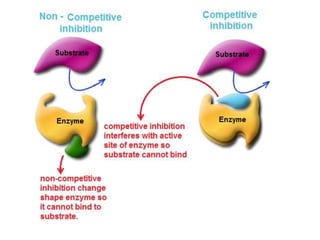
• Competitive inhibition
– If an inhibitor molecule binds only briefly to the
site = competition between it an the substrate for
the site
– If there is much more substrate than the inhibitor
– substrate molecules can easily bind to the active
site in the usual way = no effect on the enzyme’s
function
– If the concentration of inhibitor is rises = less likely
that the substrate will collide with an empty site
– This process is reversible
– Example:
– ethylene glycol – used as antifreeze; if drunk by
somebody, it is rapidly converted to oxalic acid
which causes irreversible kidney damage
– The active site of the enzyme will accept ethanol
– If the person is given ethanol – it acts as a
competitive inhibitor = results in slowing down
the reaction for long enough to allow the ethylene
glycol to be excreted
• Non-competitive inhibition
– Inhibitor can remain permanently bonded with
the active site and therefore cause an irreversible
block to the substrate
– No competition occurs
– Example:
– Penicillin – permanently occupies the active site of
an enzyme that is essential for the synthesis of
bacterial cell wall
• Second type of non-competitive inhibition
– Molecule binds to another part of the enzyme
(not the active site) – this disrupts the normal
arrangement of hydrogen bonds and hydrophobic
interactions holding the enzyme molecule in its 3D
shape = results in unsuitability of the enzyme for
the substrate; the enzyme is blocked
– This inhibition can be reversible
– Example:
– Digitalis – binds with ATPase = increase in the
contraction of heart muscle
Inhibition of enzyme function can be lethal, but in
many situations inhibition is essential!
• End product inhibition
– Using end product of a chain of reactions as an
enzyme inhibitor
– As the enzyme converts substrate to product, it is
slowed down because the end-product binds to
another part of the enzyme and prevents more
substrate binding
– As product levels fall, the enzyme is able to top
them up again
– non-competitive reversible inhibition

3 Enzymes

  • 1.
  • 2.
    LO • explain thatenzymes are globular proteins that catalyse metabolic reactions; • explain the mode of action of enzymes in terms of an active site, enzyme-substrate complex, lowering of activation energy and enzyme specificity
  • 3.
    ENZYMES • Protein molecules;globular proteins • Biological catalysts – speed up chemical reactions but remains unchanged at the end of the reaction • Name ends with –ase • Coiled into precise three dimensional shape with hydrophilic groups on the outside of the molecule = soluble
  • 4.
    Active site • Regionto which another molecules (substrate) can bind • Lock and key hypothesis – Substrate is the key whose shape fits the lock of the enzyme – The substrate is held in place by temporary bonds which form between the substrate and some of the R groups of the enzyme’s amino acids = enzyme-substrate complex
  • 6.
    • Induced fithypothesis – Same as lock and key but adds the idea that: – Substrate and enzyme can change shape slightly as the substrate molecule enters the enzyme in order to ensure a perfect fit = more efficient catalysis
  • 7.
  • 8.
    • Each typeof enzyme will act on only one type of substrate molecule = enzymes are specific • Enzymes can catalyse the joining of two substrates (synthesis) or braking down the substrate (lysis) = products • Enzyme remains unchanged • Rate can be very high
  • 10.
    • Lyzozyme – Enzymein saliva, tears and other secretions – Natural defence against bacteria – Breaks the polysaccharide chains that form the cell walls of bacteria
  • 11.
    Activation energy • Extraenergy given to the substrate so that the reaction can happen • Energy of the reactant can be increased by heating (benedict’s test) • Enzymes decrease the activation energy to the reaction
  • 13.
    Factors effecting theenzyme activity • The effect of enzyme concentration – The more enzyme present, the more active sites will be available for the substrate to slot into – As long as there is plenty of substrate available, the initial rate of a reaction increases linearly with enzyme concentration – P. 59. fig. 3.6
  • 14.
    • The effectof substrate concentration – As substrate concentration increases, the initial rate of reaction also increases – The more molecules are around the more often an enzyme’s active site can bind with one – If the enzyme reaches its maximum possible rate = Vmax (maximum velocity)
  • 15.
    • The effectof temperature – Low temperatures – reaction takes place very slowly as the molecules move relatively slowly – As temperature increases – molecules move faster and therefore collide with the active site of an enzyme more frequently; more energy is involved = easier for bonds to be formed or broken – At some point – bonds within the enzyme break and enzyme looses its shape and activity = it is DENATURATED
  • 16.
    – Optimum temperature= temperature at which an enzyme catalyses a reaction at the maximum rate (mostly 40 degrees)
  • 17.
    • The effectof pH – Most enzymes work fastest at a pH of around 7; some work better in acidic conditions (pepsin) – Too different pH can cause denaturation – The lower the pH the higher the hydrogen ion concentration – hydrogen ions can interact with the R-groups of amino acids – this affects the ionic bonding between the groups which affects the 3D arrangement of the enzyme
  • 18.
    Enzyme inhibitors • Ifa different molecule (very similar in shape to the enzyme’s substrate) binds with the active site of an enzyme – this inhibits the enzyme’s function = this molecule is called INHIBITOR
  • 19.
    • Competitive inhibition –If an inhibitor molecule binds only briefly to the site = competition between it an the substrate for the site – If there is much more substrate than the inhibitor – substrate molecules can easily bind to the active site in the usual way = no effect on the enzyme’s function – If the concentration of inhibitor is rises = less likely that the substrate will collide with an empty site – This process is reversible
  • 20.
    – Example: – ethyleneglycol – used as antifreeze; if drunk by somebody, it is rapidly converted to oxalic acid which causes irreversible kidney damage – The active site of the enzyme will accept ethanol – If the person is given ethanol – it acts as a competitive inhibitor = results in slowing down the reaction for long enough to allow the ethylene glycol to be excreted
  • 21.
    • Non-competitive inhibition –Inhibitor can remain permanently bonded with the active site and therefore cause an irreversible block to the substrate – No competition occurs – Example: – Penicillin – permanently occupies the active site of an enzyme that is essential for the synthesis of bacterial cell wall
  • 22.
    • Second typeof non-competitive inhibition – Molecule binds to another part of the enzyme (not the active site) – this disrupts the normal arrangement of hydrogen bonds and hydrophobic interactions holding the enzyme molecule in its 3D shape = results in unsuitability of the enzyme for the substrate; the enzyme is blocked – This inhibition can be reversible
  • 23.
    – Example: – Digitalis– binds with ATPase = increase in the contraction of heart muscle Inhibition of enzyme function can be lethal, but in many situations inhibition is essential!
  • 25.
    • End productinhibition – Using end product of a chain of reactions as an enzyme inhibitor – As the enzyme converts substrate to product, it is slowed down because the end-product binds to another part of the enzyme and prevents more substrate binding – As product levels fall, the enzyme is able to top them up again – non-competitive reversible inhibition