WELCOME
 INTRODUCEED BY :-
 Name of student:-
wagh vaibhav
 Registration No:- AKN- 2011/110
Name of the module Incharge:-
Prof. Sonawane s. v.
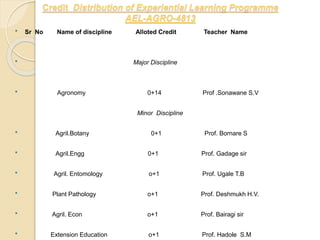
Credit Distribution of Experiential Learning Programme
AEL-AGRO-4813
 Sr No Name of discipline Alloted Credit Teacher Name
 Major Discipline
 Agronomy 0+14 Prof .Sonawane S.V
Minor Discipline
 Agril.Botany 0+1 Prof. Bornare S
 Agril.Engg 0+1 Prof. Gadage sir
 Agril. Entomology o+1 Prof. Ugale T.B
 Plant Pathology o+1 Prof. Deshmukh H.V.
 Agril. Econ o+1 Prof. Bairagi sir
 Extension Education o+1 Prof. Hadole S.M
SEED TESTING FOR
GERMINATION
 Germination:
 is the process by which plants growth from a
seedling to new fruit or a flower.the most common
example of germination is the sprouting of a
seedling from a seed of an angiosperm or
gymnosperm.
Why do a Germination Test?
 The germination rate of a particular seed lot is a
key indicator as to how that seed will perform in the
field.
 Germination rate is expressed as a percentage: a
90% germination rate means 90 out of 100 seeds
are likely to germinate under good growing
conditions.
 This information is important for calculating optimal
seedling rates, as well as helping to determine
whether a particular seed lot has the potential to
produce a good crop.
How is a Germination Test Done?
 All accredited seed testing laboratories in Canada use
germination test methods prescribed in the Methods and
Procedures manual published by CFIA.
 The testing methods used in a laboratory are controlled
so that the tests can be repeated, either within the
laboratory or between laboratories.
 Conditions such as oxygen, light, moisture and
temperature have been standardized for every crop type
to ensure that germination will take place within a
specific period of time.
 The seeds for planting (testing) are taken at random
then evenly spaced on a blotter so that they are not in
contact with adjacent seeds.
 At the end of the test period, seedlings are evaluated
and categorized as follows*:
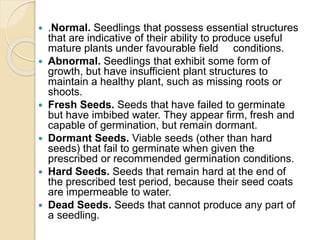
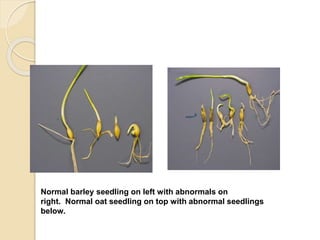
 .Normal. Seedlings that possess essential structures
that are indicative of their ability to produce useful
mature plants under favourable field conditions.
 Abnormal. Seedlings that exhibit some form of
growth, but have insufficient plant structures to
maintain a healthy plant, such as missing roots or
shoots.
 Fresh Seeds. Seeds that have failed to germinate
but have imbibed water. They appear firm, fresh and
capable of germination, but remain dormant.
 Dormant Seeds. Viable seeds (other than hard
seeds) that fail to germinate when given the
prescribed or recommended germination conditions.
 Hard Seeds. Seeds that remain hard at the end of
the prescribed test period, because their seed coats
are impermeable to water.
 Dead Seeds. Seeds that cannot produce any part of
a seedling.
Normal barley seedling on left with abnormals on
right. Normal oat seedling on top with abnormal seedlings
below.
How Do I Use Germination Test
Results?
 Less than stellar germination test results do not
necessarily mean a seed lot needs to be discarded.
 An experienced and knowledgeable seed analyst is vital
in being able to recognize deficiencies with germination
and reporting the results.
 Significant improvements to the final germination can be
achieved especially when dormancy or pathogens are
present.
Seed Testing
 Seed testing is determining the standards of a
seed lot viz., physical purity, moisture, germination
and ODV and thereby enabling the farming
community to get quality seeds.
 The Seed Testing Laboratory is the hub of seed
quality control. Seed testing services are required
from time to time to gain information regarding
planting value of seed lots. Seed testing is possible
for all those who produce, sell and use seeds.
Objective of Seed Testing
 To identify the quality problem and their probable
cause
 To determine their quality, that is, their suitability for
planting
 To determine the need for drying and processing
and specific procedures that should be used
 To determine if seed meets established quality
standards or labelling specifications.
 To establish quality and provide a basis for price
and consumer discrimination among lots in the
Importance
 The importance of seed testing was realized more
than 100 years ago for assured planting values.
 Seed testing has been developed to aid
agriculture to avoid some of the hazards of crop
production by furnishing the needed information
about different quality attributesviz., purity,
moisture, germination, vigour and health.
 Quality control of seed depends on the different
seed testing protocols which determine the
genuineness of the cultivar.
 Testing of seed to evaluate the planting value and
the authenticity of the certified lot.
 Seed testing is required to assess the seed quality
attributes of the seed lots which have to be offered
for sale.
*Principles
 Germination tests shall be conducted with a pure seed
fraction. A minimum of 400 seeds are required in four
replicates of 100 seeds each or 8 replicates of 50 seeds
each or 16 replicates of 25 seeds each depending on
the size of seed and size of containers of substrate.
 The test is conducted under favourable conditions of
moisture, temperature, suitable substratum and light if
necessary. No pretreatment to the seed is given except
for those recommended by ISTA.
*Materials required
Substratum
The substratum serves as moisture reservoir and provides a
surface or medium for which the seeds can germinate and the
seedlings grow.
The commonly used substrate are sand, germination paper
and soil.
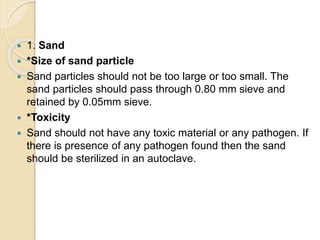
 1. Sand
 *Size of sand particle
 Sand particles should not be too large or too small. The
sand particles should pass through 0.80 mm sieve and
retained by 0.05mm sieve.
 *Toxicity
 Sand should not have any toxic material or any pathogen. If
there is presence of any pathogen found then the sand
should be sterilized in an autoclave.
Germination tray
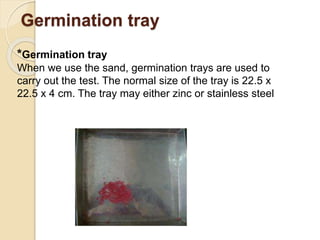
*Germination tray
When we use the sand, germination trays are used to
carry out the test. The normal size of the tray is 22.5 x
22.5 x 4 cm. The tray may either zinc or stainless steel
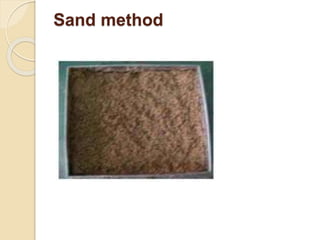
 *Seed in sand(S)
 Seeds are planted in a uniform layer of moist sand and then
covered to a depth of 1 to 2 cm with sand.
 Sand method
 Top of sand (TS)
 Seeds are pressed in to the surface of the sand.
 Spacing
 We must give equal spacing on all sides to facilitate normal
growth of seedling and to avoid entangling of seed and
spread of disease. Spacing should be 1-5 times the width or
diameter of the seed.
Sand method
 Water
 The amount of water to be added to the sand will depend on
size of the seed. For cereals, except maize, the sand can be
moistened to 50% of its water holding capacity. For large
seeded legumes and maize sand is moistened to 60%
water holding capacity.
 2. Paper
 Most widely used paper substrates are filter paper, blotter or
towel (kraft paper).
 It should have capillary movement of water, at vertical
direction (30 mm rise / min.).
 It should be free from toxic substances and free from fungi
or bacteria. It should hold sufficient moisture during the
period of test.
 The texture should be such that the roots of germinating
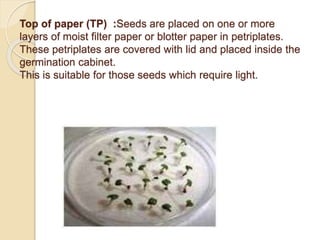
Top of paper (TP) :Seeds are placed on one or more
layers of moist filter paper or blotter paper in petriplates.
These petriplates are covered with lid and placed inside the
germination cabinet.
This is suitable for those seeds which require light.
 Between paper (BP)
 The seeds are germinated between two layers of
paper.
 The seeds are placed between two layers of paper
and rolled in towel.
 The rolled towel are placed in the germinator in an
upright position.
THANK YOU….

Seed Testing for Germination

  • 1.
  • 2.
     INTRODUCEED BY:-  Name of student:- wagh vaibhav  Registration No:- AKN- 2011/110 Name of the module Incharge:- Prof. Sonawane s. v.
  • 3.
    Credit Distribution ofExperiential Learning Programme AEL-AGRO-4813  Sr No Name of discipline Alloted Credit Teacher Name  Major Discipline  Agronomy 0+14 Prof .Sonawane S.V Minor Discipline  Agril.Botany 0+1 Prof. Bornare S  Agril.Engg 0+1 Prof. Gadage sir  Agril. Entomology o+1 Prof. Ugale T.B  Plant Pathology o+1 Prof. Deshmukh H.V.  Agril. Econ o+1 Prof. Bairagi sir  Extension Education o+1 Prof. Hadole S.M
  • 4.
    SEED TESTING FOR GERMINATION Germination:  is the process by which plants growth from a seedling to new fruit or a flower.the most common example of germination is the sprouting of a seedling from a seed of an angiosperm or gymnosperm.
  • 5.
    Why do aGermination Test?  The germination rate of a particular seed lot is a key indicator as to how that seed will perform in the field.  Germination rate is expressed as a percentage: a 90% germination rate means 90 out of 100 seeds are likely to germinate under good growing conditions.  This information is important for calculating optimal seedling rates, as well as helping to determine whether a particular seed lot has the potential to produce a good crop.
  • 6.
    How is aGermination Test Done?  All accredited seed testing laboratories in Canada use germination test methods prescribed in the Methods and Procedures manual published by CFIA.  The testing methods used in a laboratory are controlled so that the tests can be repeated, either within the laboratory or between laboratories.  Conditions such as oxygen, light, moisture and temperature have been standardized for every crop type to ensure that germination will take place within a specific period of time.  The seeds for planting (testing) are taken at random then evenly spaced on a blotter so that they are not in contact with adjacent seeds.  At the end of the test period, seedlings are evaluated and categorized as follows*:
  • 7.
     .Normal. Seedlingsthat possess essential structures that are indicative of their ability to produce useful mature plants under favourable field conditions.  Abnormal. Seedlings that exhibit some form of growth, but have insufficient plant structures to maintain a healthy plant, such as missing roots or shoots.  Fresh Seeds. Seeds that have failed to germinate but have imbibed water. They appear firm, fresh and capable of germination, but remain dormant.  Dormant Seeds. Viable seeds (other than hard seeds) that fail to germinate when given the prescribed or recommended germination conditions.  Hard Seeds. Seeds that remain hard at the end of the prescribed test period, because their seed coats are impermeable to water.  Dead Seeds. Seeds that cannot produce any part of a seedling.
  • 8.
    Normal barley seedlingon left with abnormals on right. Normal oat seedling on top with abnormal seedlings below.
  • 9.
    How Do IUse Germination Test Results?  Less than stellar germination test results do not necessarily mean a seed lot needs to be discarded.  An experienced and knowledgeable seed analyst is vital in being able to recognize deficiencies with germination and reporting the results.  Significant improvements to the final germination can be achieved especially when dormancy or pathogens are present.
  • 10.
    Seed Testing  Seedtesting is determining the standards of a seed lot viz., physical purity, moisture, germination and ODV and thereby enabling the farming community to get quality seeds.  The Seed Testing Laboratory is the hub of seed quality control. Seed testing services are required from time to time to gain information regarding planting value of seed lots. Seed testing is possible for all those who produce, sell and use seeds.
  • 11.
    Objective of SeedTesting  To identify the quality problem and their probable cause  To determine their quality, that is, their suitability for planting  To determine the need for drying and processing and specific procedures that should be used  To determine if seed meets established quality standards or labelling specifications.  To establish quality and provide a basis for price and consumer discrimination among lots in the
  • 12.
    Importance  The importanceof seed testing was realized more than 100 years ago for assured planting values.  Seed testing has been developed to aid agriculture to avoid some of the hazards of crop production by furnishing the needed information about different quality attributesviz., purity, moisture, germination, vigour and health.  Quality control of seed depends on the different seed testing protocols which determine the genuineness of the cultivar.  Testing of seed to evaluate the planting value and the authenticity of the certified lot.  Seed testing is required to assess the seed quality attributes of the seed lots which have to be offered for sale.
  • 13.
    *Principles  Germination testsshall be conducted with a pure seed fraction. A minimum of 400 seeds are required in four replicates of 100 seeds each or 8 replicates of 50 seeds each or 16 replicates of 25 seeds each depending on the size of seed and size of containers of substrate.  The test is conducted under favourable conditions of moisture, temperature, suitable substratum and light if necessary. No pretreatment to the seed is given except for those recommended by ISTA.
  • 14.
    *Materials required Substratum The substratumserves as moisture reservoir and provides a surface or medium for which the seeds can germinate and the seedlings grow. The commonly used substrate are sand, germination paper and soil.
  • 15.
     1. Sand *Size of sand particle  Sand particles should not be too large or too small. The sand particles should pass through 0.80 mm sieve and retained by 0.05mm sieve.  *Toxicity  Sand should not have any toxic material or any pathogen. If there is presence of any pathogen found then the sand should be sterilized in an autoclave.
  • 16.
    Germination tray *Germination tray Whenwe use the sand, germination trays are used to carry out the test. The normal size of the tray is 22.5 x 22.5 x 4 cm. The tray may either zinc or stainless steel
  • 17.
     *Seed insand(S)  Seeds are planted in a uniform layer of moist sand and then covered to a depth of 1 to 2 cm with sand.  Sand method  Top of sand (TS)  Seeds are pressed in to the surface of the sand.  Spacing  We must give equal spacing on all sides to facilitate normal growth of seedling and to avoid entangling of seed and spread of disease. Spacing should be 1-5 times the width or diameter of the seed.
  • 18.
  • 19.
     Water  Theamount of water to be added to the sand will depend on size of the seed. For cereals, except maize, the sand can be moistened to 50% of its water holding capacity. For large seeded legumes and maize sand is moistened to 60% water holding capacity.  2. Paper  Most widely used paper substrates are filter paper, blotter or towel (kraft paper).  It should have capillary movement of water, at vertical direction (30 mm rise / min.).  It should be free from toxic substances and free from fungi or bacteria. It should hold sufficient moisture during the period of test.  The texture should be such that the roots of germinating
  • 20.
    Top of paper(TP) :Seeds are placed on one or more layers of moist filter paper or blotter paper in petriplates. These petriplates are covered with lid and placed inside the germination cabinet. This is suitable for those seeds which require light.
  • 21.
     Between paper(BP)  The seeds are germinated between two layers of paper.  The seeds are placed between two layers of paper and rolled in towel.  The rolled towel are placed in the germinator in an upright position.
  • 22.