Chapter 11
                     Safety, Security, and Risk
                           Management
                         World of Resorts: From Development to Management
                                            Third Edition
                                        (424TXT or 424CIN)


© 2010, Educational Institute
Competencies for
        Safety, Security, and Risk Management
     1. Discuss the essential role of security at resorts.
     2. Describe the elements of a comprehensive security
        program.
     3. Summarize safety issues and activities at resorts.
     4. Explain how resorts can effectively manage a crisis.
     5. Describe how resorts can manage the various risks
        they face and control their insurance costs.


© 2010, Educational Institute                                  2
Safety and Security Issues
     •     Guestroom security
     •     Room door visual identifiers (peepholes)
     •     Proper identification of persons requesting keys
     •     Lock and key control
     •     Safe-deposit boxes
     •     Lockouts and luggage liens
     •     Surveillance of common areas
     •     Malfunctions in elevators
     •     Perimeter and access control of grounds and buildings
     •     Swimming pools and other recreation amenities
© 2010, Educational Institute         (continued)                  3
Safety and Security Issues
                                            (continued)

                                • Alarm systems
                                • Communications systems
                                • Computer security
                                • Inventory security
                                • Adequate security staffing
                                • Pre-employment screening and
                                  employee bonding and training
                                • Drugs and addiction
                                • Handling intoxicated patrons
                                • Handling disturbances
                                             (continued)
© 2010, Educational Institute                                     4
Safety and Security Issues
                                      (continued)

          •     Removal of trespassers and unauthorized solicitors
          •     Investigation of incidents
          •     Reporting accidents
          •     Handling deaths/suicide attempts
          •     Fire safety alert and evacuation
          •     Blackouts
          •     Terrorist threats, bomb scares
          •     Natural disasters
          •     Emergency procedures
          •     Risk/crisis management
          •
© 2010, Educational Institute                                        5
Training Topics for Security Personnel
     • Safety guidelines
     • Crowd and traffic control; guarding; maintaining order
     • Accident prevention and first aid
     • Fire prevention; fire evacuation
     • Handling bomb and terrorist threats
     • Procedures for dealing with accidents and emergencies
     • Preventing persons from disrupting lawful meetings held
       in the resort
     • Dealing with intoxicated guests and seeing to their safety
© 2010, Educational Institute   (continued)                    6
Training Topics for Security Personnel
                                (continued)

          • Escorting resort cashiers who carry money and
            other valuables
          • Investigating thefts in guestrooms and other areas
            of the resort
          • Interrogation techniques and legal means of
            obtaining information
          • Guarding property in public areas
          • Policing loading areas
          • Inspecting parcels carried in and out by employees

© 2010, Educational Institute   (continued)                      7
Training Topics for Security Personnel
                                (continued)

          • Fostering good public relations with guests
          • Communicating with local authorities on security
            checks
          • Inspecting physical barriers and mechanical and
            electrical equipment
          • Monitoring electronic security systems
          • Ensuring that alarms are in working order


© 2010, Educational Institute                                  8
Possible Components of a Security
            Department Reporting System

                                1.   Daily activity report
                                2.   General incident report
                                3.   Loss report
                                4.   Other reports
                                5.   Monthly statistical report


© 2010, Educational Institute                                     9
Ways Employees Can Assist
                           in Security Matters
          • Being alert to and reporting suspicious activities,
            situations, or persons anywhere on the property.
          • Reporting on any drug paraphernalia or other
            suspicious items that may be in plain view when
            cleaning or making repairs in a guestroom.
          • Reporting any unsafe conditions that merit
            immediate attention and correction.
          • Alerting security when checking in guests with
            large but empty suitcases.
© 2010, Educational Institute     (continued)                     10
Ways Employees Can Assist
                           in Security Matters
                                  (continued)

      • Alerting security of unidentified packages left in
        public areas.
      • Checking on the proper posting of innkeepers’
        notices, if required by local regulations.
      • Ensuring that any information pamphlet, tent card, or
        letter advising guests about the need for
        safety/security caution is placed where it will be seen.


© 2010, Educational Institute                                      11
Resort Areas Covered by Security
                      Technology
                                •   Outside grounds
                                •   Hotel and perimeters
                                •   Timeshare condo
                                •   Vacation club villa
                                •   Resort-operated shops
                                •   Recreational facilities
                                •   Conference hall
                                •   Spa and health center

© 2010, Educational Institute             (continued)         12
Resort Areas Covered by Security
                      Technology
                                (continued)


          • Inventory storage—liquor and food stores, etc.
          • Money-handling areas—cashiers’ stations, house
            bank, etc.
          • Specific objects—safes, safe-deposit boxes, art
            and artifacts, etc.


© 2010, Educational Institute                                 13
Major Areas of Security Concern
                         •      Physical security and perimeter control
                         •      Surveillance
                         •      Guestroom security
                         •      Alarm systems
                         •      Communication systems
                         •      Electronic room-locking systems
                         •      Electronic in-room safes


© 2010, Educational Institute                                             14
Electronic Guestroom Locking Systems
   • Per-room cost, as well as central control cost, of the
     original installation.
   • Cost of card keys and reprogrammable card keys.
   • Quality of the locking mechanism.
   • Levels of keying (guests, room attendants, bellpersons,
     maintenance employees, security personnel, etc.).
   • Battery (type, life, out-of-order or run-down warning,
     and ease of change).
   • Reliability of access card under special conditions
     (humidity, scuffing, etc.).
   • Ability to provide a record of entries in case of an
© 2010, Educational Institute   (continued)                    15
Electronic Guestroom Locking Systems
                                (continued)

     • Whether attempted forced entries are also recorded,
       identified, and timed.
     • Ease of producing and controlling duplicate keys.
     • Handling of a wide variety of special operational
       situations (for example, guest pays bill but remains
       temporarily in room; accidental assignment of new
       guest to occupied room; pre-arrival registrations, etc.).
     • Adequacy of audit trail.
     • Ability to issue temporary keys for single access and/or
       for a predetermined time period.
© 2010, Educational Institute   (continued)                    16
Electronic Guestroom Locking Systems
                                (continued)

 • Interface capability with property management system.
   (When this is present, the system can, for instance, provide
   a listing of the last ten to fifteen guests occupying a
   particular room, lock out all personnel from a given room,
   and provide management with the ability to override the
   locking system for fire, safety, or other reasons.)
 • Bi-directional communication between door and central
   computer.
 • Possible system extensions to other technology categories
   (for example, life safety or energy conservation systems).
© 2010, Educational Institute                               17
Computer Systems and Interfaces
                            •   Property management system (PMS)
                            •   Point-of-sale (POS) system
                            •   Marketing and sales system
                            •   Electronic locking systems
                            •   Telecommunications systems
                            •   Human resource systems
                            •   Data archival system
                            •   In-room entertainment
                            •   High-speed Internet
© 2010, Educational Institute                                      18
Specific PMS Security Features
          • Being SOX-compliant
          • Being PCI-compliant
          • Having tools such as “change logs” to track all
            employee modifications to the database
          • Having multiple levels of backup, including
            redundant multiple disks, high-speed tapes, and
            real-time upload to off-site company data storage
            centers of guest and hotel databases for quick data
            disaster recovery
          • Regular testing of PMS integrity
© 2010, Educational Institute                                     19
Resort/Hotel Safety Facts
   1. Accidents do not normally originate from fires, floods,
      or earthquakes but from everyday occurrences such as
      lifting a carton incorrectly or straining to stop a fall.
   2. Five working areas present the greatest hazards: food
      preparation, food service, stewarding (handling dishes
      and glassware and cleaning), receiving, and guestroom
      housekeeping.
   3. The vast majority of all accidents (85 percent) are
      caused by unsafe behavior rather than unsafe working
      conditions.

© 2010, Educational Institute             (continued)         20
Resort/Hotel Safety Facts
                                          (continued)

   1. Good safety habits are learned behavior; they are not
      simply common sense. The majority of accidents occur
      in an employee’s first six months of employment.
   2. Large hotels usually incur more losses than small
      hotels, partly because of the higher rate of employee
      turnover in large hotels.
   3. For most employees, their immediate supervisor is the
      originator of good and bad safety habits.

© 2010, Educational Institute                               21
Sample Resort/Hotel Safety Program
        1. Development of a fire brigade
        2. Formation of a safety and security committee
        3. Development of emergency procedures
        4. Regular hotel inspections
        5. Investigation of accidents
        6. Establishment of a medical/first aid program
        7. Implementation of safety training programs
        8. Establishment of written objectives for loss control
        9. Implementation of claims-evaluation meetings
        10. The filing of essential reports
© 2010, Educational Institute                                     22
Crisis Planning
          Items of concern:
          • Resources to be directed to a crisis management
             program (personnel, equipment)
          • Involvement of local community or governmental
             agencies
          • Establishment of a control center
          • Predetermination of person(s) in charge
          • The chain of command to follow when senior
             management is unavailable
          • Establishment of a crisis communication plan
© 2010, Educational Institute        (continued)              23
Crisis Planning
                                     (continued)
 Items to check:
 • Readiness for the most likely type of crisis
 • Liaison possibilities with other lodging establishments in
    the community
 • Personnel needs, availability, and skills
 • Emergency equipment, supplies, and communication needs
 • Training opportunities to prepare the staff for emergencies
 • Available technical assistance from hospitality trade
    associations
 • Opportunities for emergency preparedness and simulated
    emergency drills at the community/state/provincial level
© 2010, Educational Institute                              24
Possible Actions in Structuring
                   Emergency Response Teams
      • Establishment of responsibilities by department for
        appropriate response by staff within department.
      • Establishment of a command center with a
        prearranged chain of command and an alternative
        command center if the primary one is put out of
        commission.
      • Possible establishment of a team of employees with
        technical, mechanical, and firefighting capabilities
        for use in the event of a community-wide emergency.

© 2010, Educational Institute   (continued)                    25
Possible Actions in Structuring
                   Emergency Response Teams
                                 (continued)

          • Designation of a single spokesperson for the
            resort, with an understanding among all
            employees that they are not to talk to reporters or
            camera operators.
          • Possible assignment to specific personnel of such
            responsibilities as feeding, housing, laundry, first
            aid, and construction repair as required by the
            particular emergency.

© 2010, Educational Institute                                      26
Emergency Supplies
          • Emergency power and lighting (flashlights,
            candles with protective containers); auxiliary
            power-generating capability with reserve or
            alternative fuel supplies.
          • Sump pumps for relieving flooding problems.
          • Emergency communication equipment.
          • Food and water reserves.


© 2010, Educational Institute         (continued)            27
Emergency Supplies
                                      (continued)

 • Gas-, battery-, or manually operated tools for use in the
   event of a power failure; tools for cutting, lifting, and
   moving debris in the event of a building collapse due to
   flooding, wind, or earthquakes.
 • Shutters for covering glass windows and doors.
 • Miscellaneous supplies—strapping tape and rope needed
   for fastening things, first-aid kits, etc.
 • Bedding, cots, and bed linens if the property is designated
   as a housing center in a community-wide incident.
© 2010, Educational Institute                               28
AH&LA Basic Guidelines for
     Handling Communications in a Crisis
  • Every lodging establishment should be ready with a
    prepared crisis communication plan. A plan can provide
    a coherent way for management to tell its side of a crisis
    story, and present the hotel’s image as professional and
    concerned.
  • An audience with the press in the heat of a crisis may be
    the only opportunity to explain the steps taken to guard
    against such a crisis, and to show the operator’s efforts
    to protect guests, employees, and the community.
    Cooperating with the press gives management some
    control over the way the crisis is reported.
© 2010, Educational Institute   (continued)                      29
AH&LA Basic Guidelines for
     Handling Communications in a Crisis
                                (continued)

  • Truthfulness is mandatory. One lie, misrepresentation,
    or intentional failure to disclose relevant information
    will damage the hotel operator’s credibility before the
    press, the public, the guests, and the employees.
  • Guests and employees must be informed. Making them
    aware of efforts to resolve the crisis—and providing
    them with instructions on a regular basis—assuages
    feelings of helplessness, frustration, panic, or despair,
    and could ensure their cooperation when it is most
    needed.
© 2010, Educational Institute   (continued)                     30
AH&LA Basic Guidelines for
     Handling Communications in a Crisis
                                (continued)


        • Whatever the nature or cause of the crisis,
          management must publicly express concern for the
          victims for any inconvenience, loss, or harm caused
          by the crisis. Failure to do so can result in news
          coverage that focuses on the hotel’s culpability and
          lack of compassion.


© 2010, Educational Institute   (continued)                      31
AH&LA Basic Guidelines for
     Handling Communications in a Crisis
                                (continued)

   • Designating a single spokesperson to communicate with
     the press in time of crisis—and instructing all
     employees to refer all questions to this spokesperson—
     is essential. It is the only way to ensure that facts are
     reported accurately and consistently, with no
     speculation by employees about what occurred.
   • Legal help in preparing and vetting media statements is
     advised to avoid jeopardy from possible material
     misrepresentations.
© 2010, Educational Institute                                  32
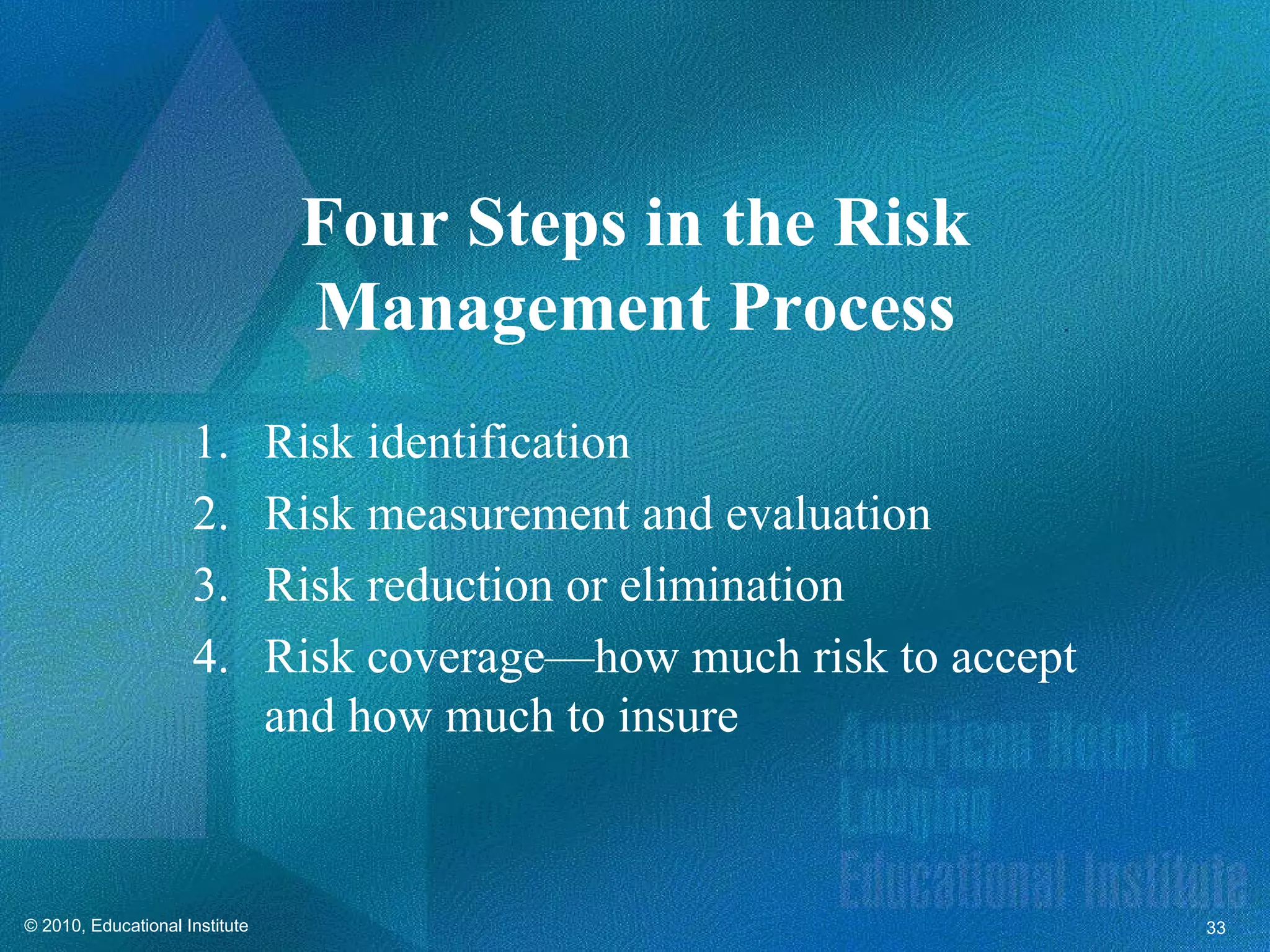
Four Steps in the Risk
                                 Management Process
                     1.         Risk identification
                     2.         Risk measurement and evaluation
                     3.         Risk reduction or elimination
                     4.         Risk coverage—how much risk to accept
                                and how much to insure


© 2010, Educational Institute                                           33
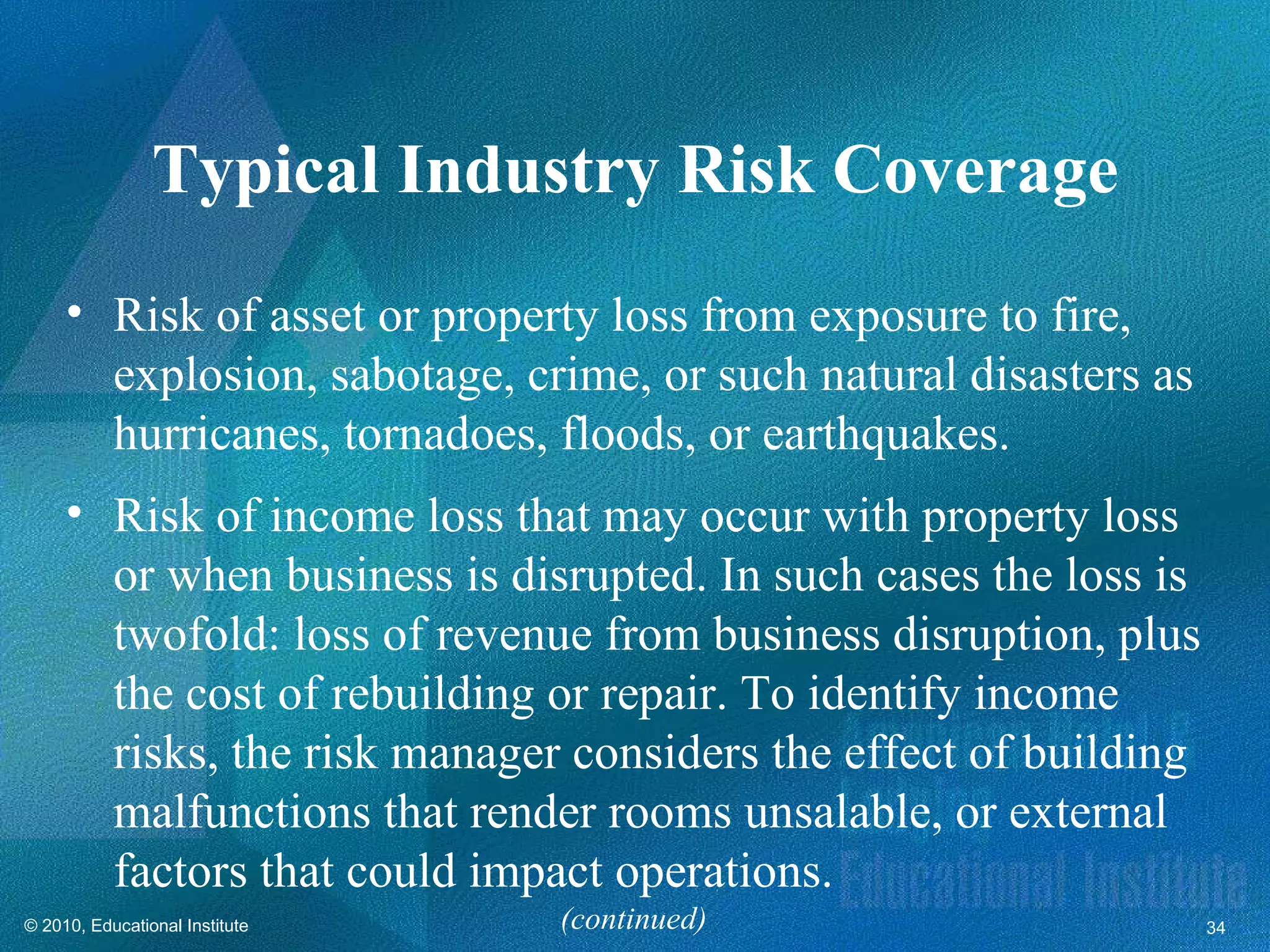
Typical Industry Risk Coverage
     • Risk of asset or property loss from exposure to fire,
       explosion, sabotage, crime, or such natural disasters as
       hurricanes, tornadoes, floods, or earthquakes.
     • Risk of income loss that may occur with property loss
       or when business is disrupted. In such cases the loss is
       twofold: loss of revenue from business disruption, plus
       the cost of rebuilding or repair. To identify income
       risks, the risk manager considers the effect of building
       malfunctions that render rooms unsalable, or external
       factors that could impact operations.
© 2010, Educational Institute   (continued)                       34
Typical Industry Risk Coverage
                                (continued)

     • Liability risks, which are harder to identify but can be
       more devastating. Huge awards are often won in
       individual lawsuits and sometimes in class action suits.
       Lodging operators need liability coverage for the
       products and services they sell, acts of employees, or
       business vehicles that are employed in the business.
     • Loss of a “key person,” one whose skills, knowledge,
       or special qualities are not easily replaced, and whose
       presence is essential to the reputation or visibility of
       the business. Generally, in the lodging business, the
       key person refers to a principal or a CEO, not managers
       at the property level.
© 2010, Educational Institute                                     35
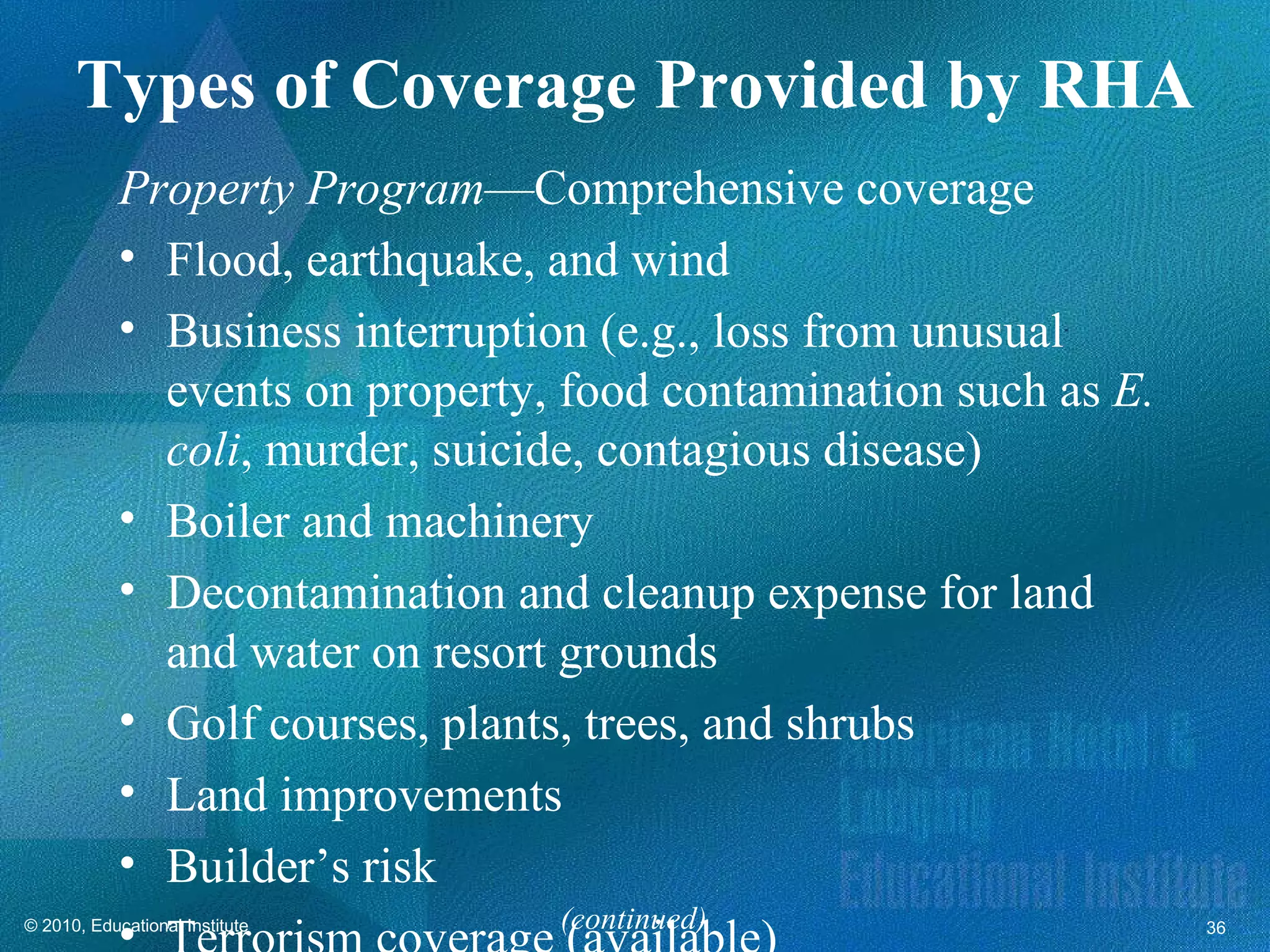
Types of Coverage Provided by RHA
            Property Program—Comprehensive coverage
            • Flood, earthquake, and wind
            • Business interruption (e.g., loss from unusual
              events on property, food contamination such as E.
              coli, murder, suicide, contagious disease)
            • Boiler and machinery
            • Decontamination and cleanup expense for land
              and water on resort grounds
            • Golf courses, plants, trees, and shrubs
            • Land improvements
            • Builder’s risk
                                  (continued)
            •
© 2010, Educational Institute                                     36
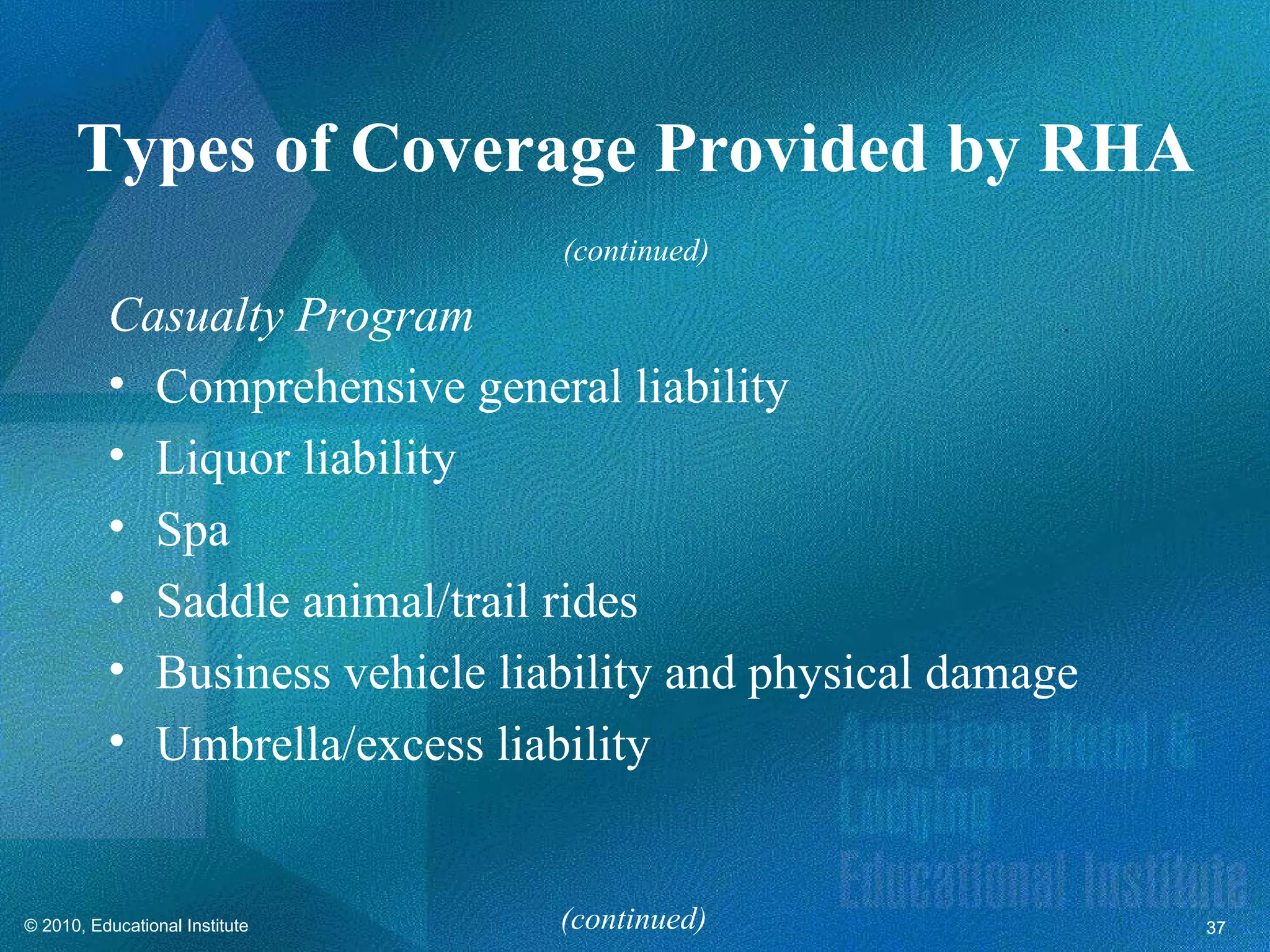
Types of Coverage Provided by RHA
                                (continued)

          Casualty Program
          • Comprehensive general liability
          • Liquor liability
          • Spa
          • Saddle animal/trail rides
          • Business vehicle liability and physical damage
          • Umbrella/excess liability


© 2010, Educational Institute   (continued)                  37
Types of Coverage Provided by RHA
                                (continued)

          Pollution Legal Liability
          • On-site cleanup of pollution conditions
          • Legal liability for pollution conditions
          • Business interruption coverage resulting from
            pollution condition causation
          • Underground storage tank coverage (available)
          • Microbial matter coverage (available)


© 2010, Educational Institute   (continued)                 38
Types of Coverage Provided by RHA
                                (continued)

          Employment Practices Liability
          • Prior acts coverage
          • Punitive damage coverage
          • Third-party coverage (e.g., guest claims of
            discrimination)
          • Accidental death and dismemberment coverage
          • Aggressive rates and deductibles
          • Limits to fit individual member requirements

© 2010, Educational Institute                              39

Chapter 11

  • 1.
    Chapter 11 Safety, Security, and Risk Management World of Resorts: From Development to Management Third Edition (424TXT or 424CIN) © 2010, Educational Institute
  • 2.
    Competencies for Safety, Security, and Risk Management 1. Discuss the essential role of security at resorts. 2. Describe the elements of a comprehensive security program. 3. Summarize safety issues and activities at resorts. 4. Explain how resorts can effectively manage a crisis. 5. Describe how resorts can manage the various risks they face and control their insurance costs. © 2010, Educational Institute 2
  • 3.
    Safety and SecurityIssues • Guestroom security • Room door visual identifiers (peepholes) • Proper identification of persons requesting keys • Lock and key control • Safe-deposit boxes • Lockouts and luggage liens • Surveillance of common areas • Malfunctions in elevators • Perimeter and access control of grounds and buildings • Swimming pools and other recreation amenities © 2010, Educational Institute (continued) 3
  • 4.
    Safety and SecurityIssues (continued) • Alarm systems • Communications systems • Computer security • Inventory security • Adequate security staffing • Pre-employment screening and employee bonding and training • Drugs and addiction • Handling intoxicated patrons • Handling disturbances (continued) © 2010, Educational Institute 4
  • 5.
    Safety and SecurityIssues (continued) • Removal of trespassers and unauthorized solicitors • Investigation of incidents • Reporting accidents • Handling deaths/suicide attempts • Fire safety alert and evacuation • Blackouts • Terrorist threats, bomb scares • Natural disasters • Emergency procedures • Risk/crisis management • © 2010, Educational Institute 5
  • 6.
    Training Topics forSecurity Personnel • Safety guidelines • Crowd and traffic control; guarding; maintaining order • Accident prevention and first aid • Fire prevention; fire evacuation • Handling bomb and terrorist threats • Procedures for dealing with accidents and emergencies • Preventing persons from disrupting lawful meetings held in the resort • Dealing with intoxicated guests and seeing to their safety © 2010, Educational Institute (continued) 6
  • 7.
    Training Topics forSecurity Personnel (continued) • Escorting resort cashiers who carry money and other valuables • Investigating thefts in guestrooms and other areas of the resort • Interrogation techniques and legal means of obtaining information • Guarding property in public areas • Policing loading areas • Inspecting parcels carried in and out by employees © 2010, Educational Institute (continued) 7
  • 8.
    Training Topics forSecurity Personnel (continued) • Fostering good public relations with guests • Communicating with local authorities on security checks • Inspecting physical barriers and mechanical and electrical equipment • Monitoring electronic security systems • Ensuring that alarms are in working order © 2010, Educational Institute 8
  • 9.
    Possible Components ofa Security Department Reporting System 1. Daily activity report 2. General incident report 3. Loss report 4. Other reports 5. Monthly statistical report © 2010, Educational Institute 9
  • 10.
    Ways Employees CanAssist in Security Matters • Being alert to and reporting suspicious activities, situations, or persons anywhere on the property. • Reporting on any drug paraphernalia or other suspicious items that may be in plain view when cleaning or making repairs in a guestroom. • Reporting any unsafe conditions that merit immediate attention and correction. • Alerting security when checking in guests with large but empty suitcases. © 2010, Educational Institute (continued) 10
  • 11.
    Ways Employees CanAssist in Security Matters (continued) • Alerting security of unidentified packages left in public areas. • Checking on the proper posting of innkeepers’ notices, if required by local regulations. • Ensuring that any information pamphlet, tent card, or letter advising guests about the need for safety/security caution is placed where it will be seen. © 2010, Educational Institute 11
  • 12.
    Resort Areas Coveredby Security Technology • Outside grounds • Hotel and perimeters • Timeshare condo • Vacation club villa • Resort-operated shops • Recreational facilities • Conference hall • Spa and health center © 2010, Educational Institute (continued) 12
  • 13.
    Resort Areas Coveredby Security Technology (continued) • Inventory storage—liquor and food stores, etc. • Money-handling areas—cashiers’ stations, house bank, etc. • Specific objects—safes, safe-deposit boxes, art and artifacts, etc. © 2010, Educational Institute 13
  • 14.
    Major Areas ofSecurity Concern • Physical security and perimeter control • Surveillance • Guestroom security • Alarm systems • Communication systems • Electronic room-locking systems • Electronic in-room safes © 2010, Educational Institute 14
  • 15.
    Electronic Guestroom LockingSystems • Per-room cost, as well as central control cost, of the original installation. • Cost of card keys and reprogrammable card keys. • Quality of the locking mechanism. • Levels of keying (guests, room attendants, bellpersons, maintenance employees, security personnel, etc.). • Battery (type, life, out-of-order or run-down warning, and ease of change). • Reliability of access card under special conditions (humidity, scuffing, etc.). • Ability to provide a record of entries in case of an © 2010, Educational Institute (continued) 15
  • 16.
    Electronic Guestroom LockingSystems (continued) • Whether attempted forced entries are also recorded, identified, and timed. • Ease of producing and controlling duplicate keys. • Handling of a wide variety of special operational situations (for example, guest pays bill but remains temporarily in room; accidental assignment of new guest to occupied room; pre-arrival registrations, etc.). • Adequacy of audit trail. • Ability to issue temporary keys for single access and/or for a predetermined time period. © 2010, Educational Institute (continued) 16
  • 17.
    Electronic Guestroom LockingSystems (continued) • Interface capability with property management system. (When this is present, the system can, for instance, provide a listing of the last ten to fifteen guests occupying a particular room, lock out all personnel from a given room, and provide management with the ability to override the locking system for fire, safety, or other reasons.) • Bi-directional communication between door and central computer. • Possible system extensions to other technology categories (for example, life safety or energy conservation systems). © 2010, Educational Institute 17
  • 18.
    Computer Systems andInterfaces • Property management system (PMS) • Point-of-sale (POS) system • Marketing and sales system • Electronic locking systems • Telecommunications systems • Human resource systems • Data archival system • In-room entertainment • High-speed Internet © 2010, Educational Institute 18
  • 19.
    Specific PMS SecurityFeatures • Being SOX-compliant • Being PCI-compliant • Having tools such as “change logs” to track all employee modifications to the database • Having multiple levels of backup, including redundant multiple disks, high-speed tapes, and real-time upload to off-site company data storage centers of guest and hotel databases for quick data disaster recovery • Regular testing of PMS integrity © 2010, Educational Institute 19
  • 20.
    Resort/Hotel Safety Facts 1. Accidents do not normally originate from fires, floods, or earthquakes but from everyday occurrences such as lifting a carton incorrectly or straining to stop a fall. 2. Five working areas present the greatest hazards: food preparation, food service, stewarding (handling dishes and glassware and cleaning), receiving, and guestroom housekeeping. 3. The vast majority of all accidents (85 percent) are caused by unsafe behavior rather than unsafe working conditions. © 2010, Educational Institute (continued) 20
  • 21.
    Resort/Hotel Safety Facts (continued) 1. Good safety habits are learned behavior; they are not simply common sense. The majority of accidents occur in an employee’s first six months of employment. 2. Large hotels usually incur more losses than small hotels, partly because of the higher rate of employee turnover in large hotels. 3. For most employees, their immediate supervisor is the originator of good and bad safety habits. © 2010, Educational Institute 21
  • 22.
    Sample Resort/Hotel SafetyProgram 1. Development of a fire brigade 2. Formation of a safety and security committee 3. Development of emergency procedures 4. Regular hotel inspections 5. Investigation of accidents 6. Establishment of a medical/first aid program 7. Implementation of safety training programs 8. Establishment of written objectives for loss control 9. Implementation of claims-evaluation meetings 10. The filing of essential reports © 2010, Educational Institute 22
  • 23.
    Crisis Planning Items of concern: • Resources to be directed to a crisis management program (personnel, equipment) • Involvement of local community or governmental agencies • Establishment of a control center • Predetermination of person(s) in charge • The chain of command to follow when senior management is unavailable • Establishment of a crisis communication plan © 2010, Educational Institute (continued) 23
  • 24.
    Crisis Planning (continued) Items to check: • Readiness for the most likely type of crisis • Liaison possibilities with other lodging establishments in the community • Personnel needs, availability, and skills • Emergency equipment, supplies, and communication needs • Training opportunities to prepare the staff for emergencies • Available technical assistance from hospitality trade associations • Opportunities for emergency preparedness and simulated emergency drills at the community/state/provincial level © 2010, Educational Institute 24
  • 25.
    Possible Actions inStructuring Emergency Response Teams • Establishment of responsibilities by department for appropriate response by staff within department. • Establishment of a command center with a prearranged chain of command and an alternative command center if the primary one is put out of commission. • Possible establishment of a team of employees with technical, mechanical, and firefighting capabilities for use in the event of a community-wide emergency. © 2010, Educational Institute (continued) 25
  • 26.
    Possible Actions inStructuring Emergency Response Teams (continued) • Designation of a single spokesperson for the resort, with an understanding among all employees that they are not to talk to reporters or camera operators. • Possible assignment to specific personnel of such responsibilities as feeding, housing, laundry, first aid, and construction repair as required by the particular emergency. © 2010, Educational Institute 26
  • 27.
    Emergency Supplies • Emergency power and lighting (flashlights, candles with protective containers); auxiliary power-generating capability with reserve or alternative fuel supplies. • Sump pumps for relieving flooding problems. • Emergency communication equipment. • Food and water reserves. © 2010, Educational Institute (continued) 27
  • 28.
    Emergency Supplies (continued) • Gas-, battery-, or manually operated tools for use in the event of a power failure; tools for cutting, lifting, and moving debris in the event of a building collapse due to flooding, wind, or earthquakes. • Shutters for covering glass windows and doors. • Miscellaneous supplies—strapping tape and rope needed for fastening things, first-aid kits, etc. • Bedding, cots, and bed linens if the property is designated as a housing center in a community-wide incident. © 2010, Educational Institute 28
  • 29.
    AH&LA Basic Guidelinesfor Handling Communications in a Crisis • Every lodging establishment should be ready with a prepared crisis communication plan. A plan can provide a coherent way for management to tell its side of a crisis story, and present the hotel’s image as professional and concerned. • An audience with the press in the heat of a crisis may be the only opportunity to explain the steps taken to guard against such a crisis, and to show the operator’s efforts to protect guests, employees, and the community. Cooperating with the press gives management some control over the way the crisis is reported. © 2010, Educational Institute (continued) 29
  • 30.
    AH&LA Basic Guidelinesfor Handling Communications in a Crisis (continued) • Truthfulness is mandatory. One lie, misrepresentation, or intentional failure to disclose relevant information will damage the hotel operator’s credibility before the press, the public, the guests, and the employees. • Guests and employees must be informed. Making them aware of efforts to resolve the crisis—and providing them with instructions on a regular basis—assuages feelings of helplessness, frustration, panic, or despair, and could ensure their cooperation when it is most needed. © 2010, Educational Institute (continued) 30
  • 31.
    AH&LA Basic Guidelinesfor Handling Communications in a Crisis (continued) • Whatever the nature or cause of the crisis, management must publicly express concern for the victims for any inconvenience, loss, or harm caused by the crisis. Failure to do so can result in news coverage that focuses on the hotel’s culpability and lack of compassion. © 2010, Educational Institute (continued) 31
  • 32.
    AH&LA Basic Guidelinesfor Handling Communications in a Crisis (continued) • Designating a single spokesperson to communicate with the press in time of crisis—and instructing all employees to refer all questions to this spokesperson— is essential. It is the only way to ensure that facts are reported accurately and consistently, with no speculation by employees about what occurred. • Legal help in preparing and vetting media statements is advised to avoid jeopardy from possible material misrepresentations. © 2010, Educational Institute 32
  • 33.
    Four Steps inthe Risk Management Process 1. Risk identification 2. Risk measurement and evaluation 3. Risk reduction or elimination 4. Risk coverage—how much risk to accept and how much to insure © 2010, Educational Institute 33
  • 34.
    Typical Industry RiskCoverage • Risk of asset or property loss from exposure to fire, explosion, sabotage, crime, or such natural disasters as hurricanes, tornadoes, floods, or earthquakes. • Risk of income loss that may occur with property loss or when business is disrupted. In such cases the loss is twofold: loss of revenue from business disruption, plus the cost of rebuilding or repair. To identify income risks, the risk manager considers the effect of building malfunctions that render rooms unsalable, or external factors that could impact operations. © 2010, Educational Institute (continued) 34
  • 35.
    Typical Industry RiskCoverage (continued) • Liability risks, which are harder to identify but can be more devastating. Huge awards are often won in individual lawsuits and sometimes in class action suits. Lodging operators need liability coverage for the products and services they sell, acts of employees, or business vehicles that are employed in the business. • Loss of a “key person,” one whose skills, knowledge, or special qualities are not easily replaced, and whose presence is essential to the reputation or visibility of the business. Generally, in the lodging business, the key person refers to a principal or a CEO, not managers at the property level. © 2010, Educational Institute 35
  • 36.
    Types of CoverageProvided by RHA Property Program—Comprehensive coverage • Flood, earthquake, and wind • Business interruption (e.g., loss from unusual events on property, food contamination such as E. coli, murder, suicide, contagious disease) • Boiler and machinery • Decontamination and cleanup expense for land and water on resort grounds • Golf courses, plants, trees, and shrubs • Land improvements • Builder’s risk (continued) • © 2010, Educational Institute 36
  • 37.
    Types of CoverageProvided by RHA (continued) Casualty Program • Comprehensive general liability • Liquor liability • Spa • Saddle animal/trail rides • Business vehicle liability and physical damage • Umbrella/excess liability © 2010, Educational Institute (continued) 37
  • 38.
    Types of CoverageProvided by RHA (continued) Pollution Legal Liability • On-site cleanup of pollution conditions • Legal liability for pollution conditions • Business interruption coverage resulting from pollution condition causation • Underground storage tank coverage (available) • Microbial matter coverage (available) © 2010, Educational Institute (continued) 38
  • 39.
    Types of CoverageProvided by RHA (continued) Employment Practices Liability • Prior acts coverage • Punitive damage coverage • Third-party coverage (e.g., guest claims of discrimination) • Accidental death and dismemberment coverage • Aggressive rates and deductibles • Limits to fit individual member requirements © 2010, Educational Institute 39