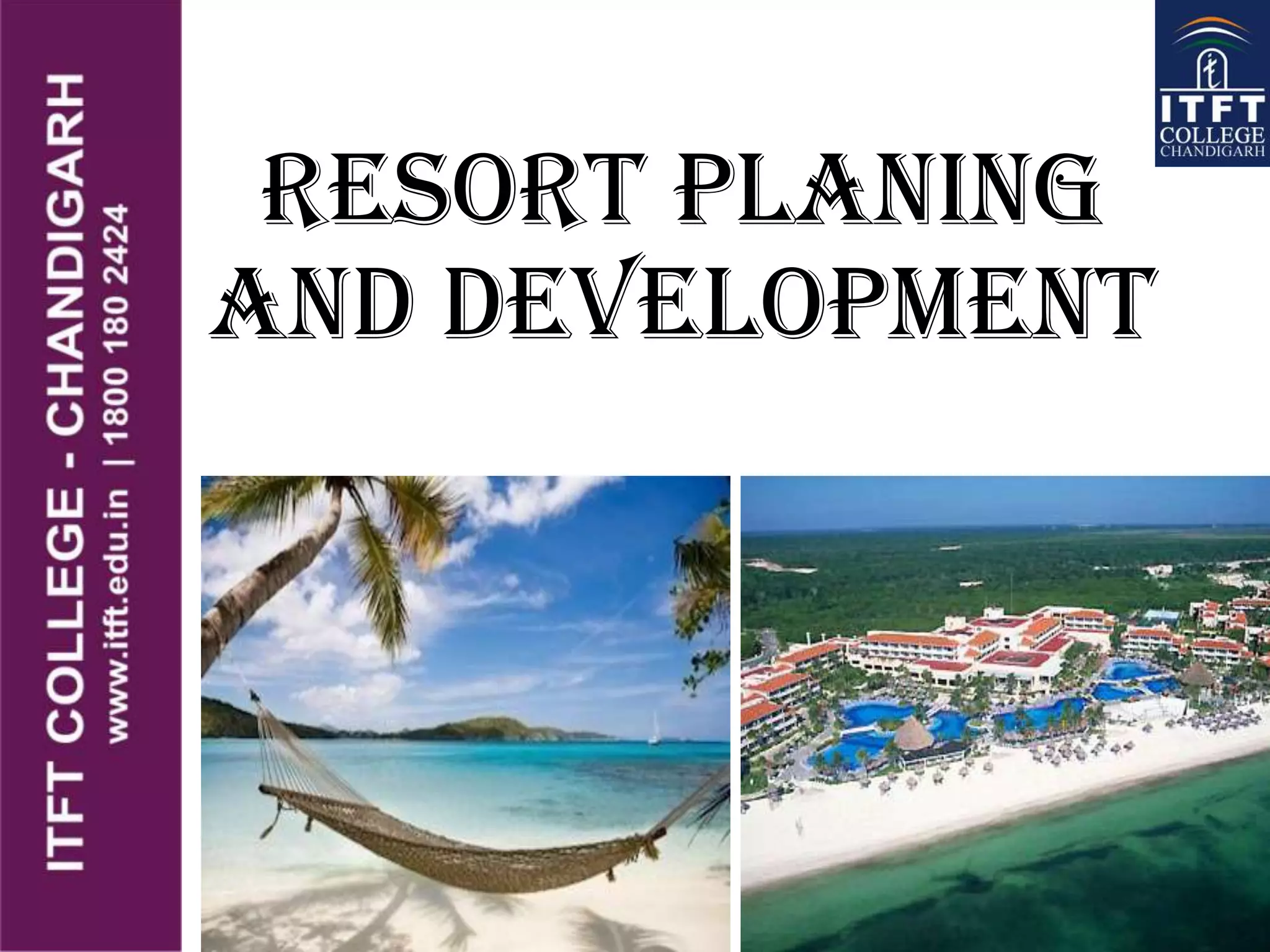
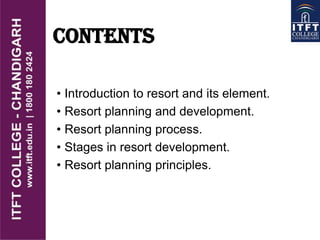
RESORT PLANING
AND DEVELOPMENT
CONTENTS
• Introduction to resort and its element.
• Resort planning and development.
• Resort planning process.
• Stages in resort development.
• Resort planning principles.
RESORT MANAGEMENT
• Definition of RESORT:
Any place or places with pleasant
environment and atmosphere conducive to
comfort, healthful relaxation and rest, offering
food, sleeping accomodation and recreational
facilities to the public for a fee (definition per
DOT Rules on Accreditation)
RESORT MANAGEMENT
• ELEMENT OF A RESORT:
1. Recreational facilities that draw guests to
the facility
2. Housing and Food & Beverage services
that cater to people away from home
3. Activities to occupy guests during their
stay
RESORT MANAGEMENT
• RESORT PLANING:
The modern concept of a resort is that
planned as an integrated development
with consideration given to its
compatibility with the natural
environment and possible benefits to
local communities.
RESORT MANAGEMENT
• RESORT PLANING:
Economic feasibility analysis:
Analysis of the economic costs and benefits of
a project to the entire area, region or country.
A project may generate overall positive
economic benefits by attracting tourists to the
area, but not make a profit in itself.
RESORT MANAGEMENT
• RESORT PLANING:
Financial feasibility analysis:
The financial rate of return and profitability of
a project based only on its own costs and
revenues.
RESORT MANAGEMENT
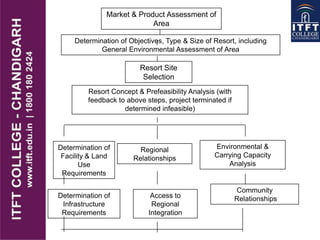
• RESORT PLANNING PROCESS:
1. First, market and product assessment
(referring especially to tourist attractions) is
conducted, the resort development objectives,
type and size determined in preliminary form,
the site selected, and conceptual planning and
prefeasibility analysis carried out.
RESORT MANAGEMENT
• RESORT PLANNING PROCESS:
This analysis feeds into more specific
determination of facility and land use
requirements and infrastructure needs, the
regional relationships including access to
the site and regional integration, and the
environmental and carrying capacity
analysis and considerations of community
relationships.
RESORT MANAGEMENT
• RESORT PLANNING PROCESS:
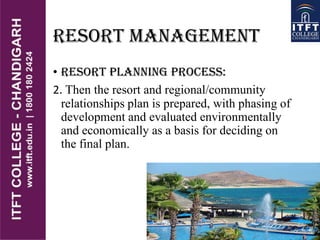
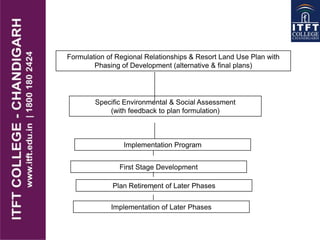
2. Then the resort and regional/community
relationships plan is prepared, with phasing of
development and evaluated environmentally
and economically as a basis for deciding on
the final plan.
RESORT MANAGEMENT
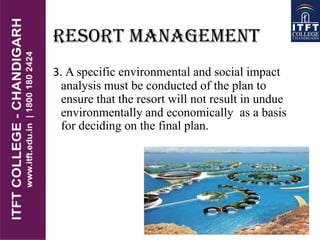
3. A specific environmental and social impact
analysis must be conducted of the plan to
ensure that the resort will not result in undue
environmentally and economically as a basis
for deciding on the final plan.
RESORT MANAGEMENT
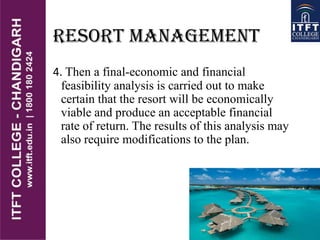
4. Then a final-economic and financial
feasibility analysis is carried out to make
certain that the resort will be economically
viable and produce an acceptable financial
rate of return. The results of this analysis may
also require modifications to the plan.
RESORT MANAGEMENT
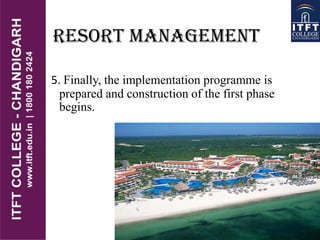
5. Finally, the implementation programme is
prepared and construction of the first phase
begins.
RESORT MANAGEMENT
• OTHER IMPORTANT CONSIDERATIONS
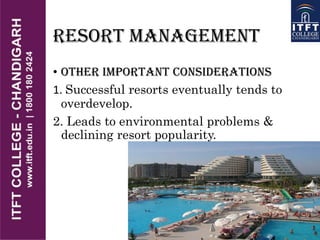
1. Successful resorts eventually tends to
overdevelop.
2. Leads to environmental problems &
declining resort popularity.
RESORT MANAGEMENT
• OTHER IMPORTANT CONSIDERATIONS
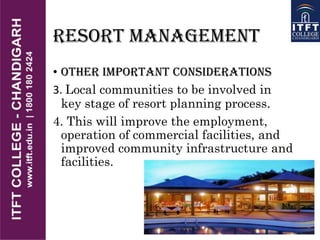
3. Local communities to be involved in
key stage of resort planning process.
4. This will improve the employment,
operation of commercial facilities, and
improved community infrastructure and
facilities.
RESORT MANAGEMENT
• OTHER IMPORTANT CONSIDERATIONS
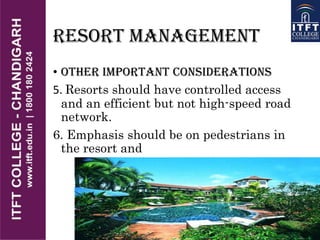
5. Resorts should have controlled access
and an efficient but not high-speed road
network.
6. Emphasis should be on pedestrians in
the resort and
RESORT MANAGEMENT
• OTHER IMPORTANT CONSIDERATIONS
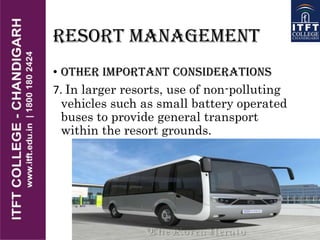
7. In larger resorts, use of non-polluting
vehicles such as small battery operated
buses to provide general transport
within the resort grounds.
RESORT MANAGEMENT
• OTHER IMPORTANT CONSIDERATIONS
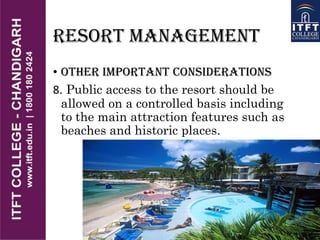
8. Public access to the resort should be
allowed on a controlled basis including
to the main attraction features such as
beaches and historic places.
RESORT MANAGEMENT
• OTHER IMPORTANT CONSIDERATIONS
9. Conservation-oriented infrastructure
techniques should be applied, such as
treatment and recycling of sewage effluent for
use in landscape irrigation and use of solar
energy for water heating and natural
ventilation substituting air conditioning air
conditioning
RESORT MANAGEMENT
• OTHER IMPORTANT CONSIDERATIONS
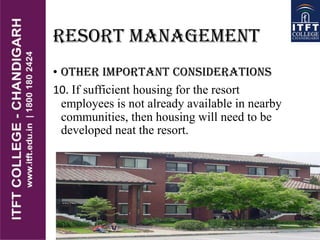
10. If sufficient housing for the resort
employees is not already available in nearby
communities, then housing will need to be
developed neat the resort.
Market & Product Assessment of
Area
Determination of Objectives, Type & Size of Resort, including
General Environmental Assessment of Area
Resort Site
Selection
Resort Concept & Prefeasibility Analysis (with
feedback to above steps, project terminated if
determined infeasible)
Determination of
Facility & Land
Use
Requirements
Regional
Relationships
Environmental &
Carrying Capacity
Analysis
Access to
Regional
Integration
Community
RelationshipsDetermination of
Infrastructure
Requirements
Formulation of Regional Relationships & Resort Land Use Plan with
Phasing of Development (alternative & final plans)
Specific Environmental & Social Assessment
(with feedback to plan formulation)
Implementation Program
First Stage Development
Plan Retirement of Later Phases
Implementation of Later Phases
Factors to Consider in
resort development
• Resort development involves a
difficult trade-off between benefits
and unfavorable impacts on the ff.
aspects:
1. Economic
2. Social
3. Environmental
A. Economic Considerations in
REsoRt DEv’t.
Variables that Determine
Profitability
1. Capacity
• The more facilities & guests, the higher
the profit
• However, capacity is limited by Physical
limitations and Ecological limitations
A. Economic Considerations
in REsoRt DEv’t.
2. Length of the Season
• Is the season long enough to earn profit?
3. Capital Investment
• Heavy costs in fixed assets for land,
building and recreational facilities
• Long payback period
B. Social Considerations in
REsoRt DEv’t.
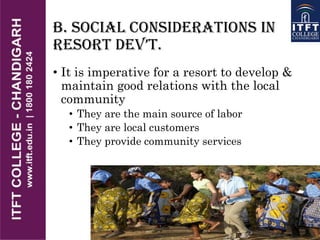
• It is imperative for a resort to develop &
maintain good relations with the local
community
• They are the main source of labor
• They are local customers
• They provide community services
B. Social Considerations in
REsoRt DEv’t.
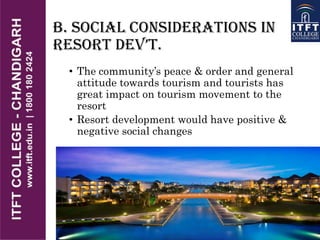
• The community’s peace & order and general
attitude towards tourism and tourists has
great impact on tourism movement to the
resort
• Resort development would have positive &
negative social changes
B. Social Considerations in
REsoRt DEv’t.
1. Employment
• Communities welcome the social benefit
of job creation in construction &
operations
• However, it has employment-related
social problems:
o Established industries may be
disrupted if they lose good
employees who transfer to the
resort
B. Social Considerations in
REsoRt DEv’t.
o Communities may resent hiring
of outsiders for better paying
positions
o For local community members
working in the resort, exposure
to the “high” lifestyle of resorts
may cause dissatisfaction w/ his
lifestyle & develop a false sense
of values anchored on material
acquisitions & creature comforts
B. Social Considerations in
REsoRt DEv’t.
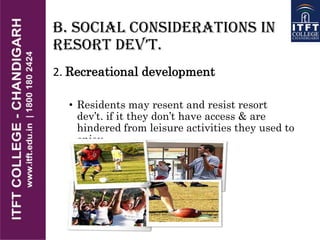
2. Recreational development
• Residents may resent and resist resort
dev’t. if it they don’t have access & are
hindered from leisure activities they used to
enjoy
B. Social Considerations in
REsoRt DEv’t.
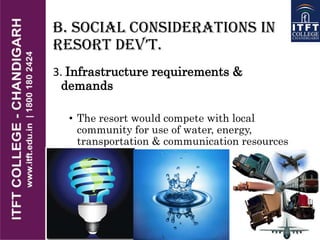
3. Infrastructure requirements &
demands
• The resort would compete with local
community for use of water, energy,
transportation & communication resources
B. Social Considerations in
REsoRt DEv’t.
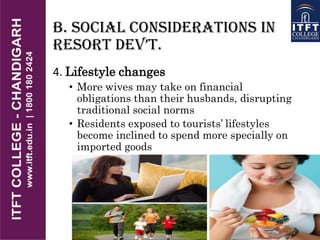
4. Lifestyle changes
• More wives may take on financial
obligations than their husbands, disrupting
traditional social norms
• Residents exposed to tourists’ lifestyles
become inclined to spend more specially on
imported goods
B. Social Considerations in
REsoRt DEv’t.
• Possible increases in prostitution, drug
addiction & other crimes as a result of
interaction with tourists
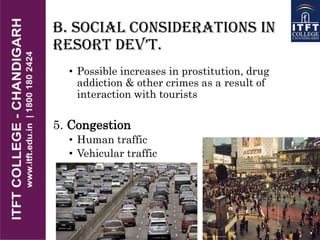
5. Congestion
• Human traffic
• Vehicular traffic
C. Environmental
ConsiDERations in REsoRt DEv’t.
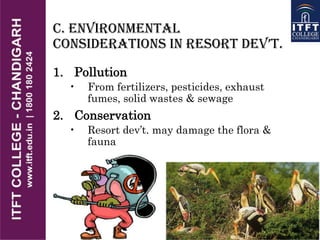
1. Pollution
• From fertilizers, pesticides, exhaust
fumes, solid wastes & sewage
2. Conservation
• Resort dev’t. may damage the flora &
fauna
C. Environmental
ConsiDERations in REsoRt DEv’t.
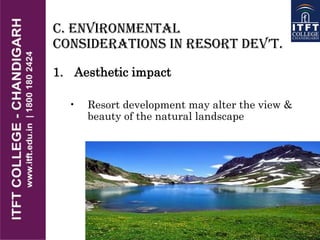
1. Aesthetic impact
• Resort development may alter the view &
beauty of the natural landscape
STAGES IN RESORT
DEVELOPMENT
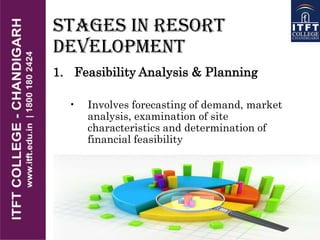
1. Feasibility Analysis & Planning
• Involves forecasting of demand, market
analysis, examination of site
characteristics and determination of
financial feasibility
STAGES IN RESORT
DEVELOPMENT
2. Construction
3. Operations/Management
RESORT PLANNING
PRINCIPLES
Fundamental Concepts
• Resort Environment
• Give the resort a distinctive image and
character that provides a contrast to the
tourist’s home environment
• Environmental Orientation
• Allow tourist appreciation of nature at
environmentally sustainable manner
RESORT PLANNING
PRINCIPLES
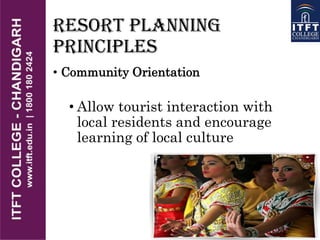
• Community Orientation
• Allow tourist interaction with
local residents and encourage
learning of local culture
RESORT PLANNING
PRINCIPLES
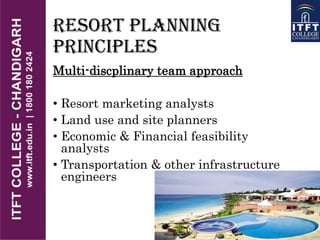
Multi-discplinary team approach
• Resort marketing analysts
• Land use and site planners
• Economic & Financial feasibility
analysts
• Transportation & other infrastructure
engineers
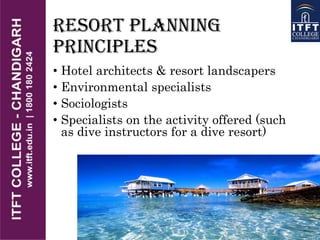
RESORT PLANNING
PRINCIPLES
• Hotel architects & resort landscapers
• Environmental specialists
• Sociologists
• Specialists on the activity offered (such
as dive instructors for a dive resort)
ITFT - resort mgt

ITFT - resort mgt

  • 1.
  • 2.
    CONTENTS • Introduction toresort and its element. • Resort planning and development. • Resort planning process. • Stages in resort development. • Resort planning principles.
  • 3.
    RESORT MANAGEMENT • Definitionof RESORT: Any place or places with pleasant environment and atmosphere conducive to comfort, healthful relaxation and rest, offering food, sleeping accomodation and recreational facilities to the public for a fee (definition per DOT Rules on Accreditation)
  • 4.
    RESORT MANAGEMENT • ELEMENTOF A RESORT: 1. Recreational facilities that draw guests to the facility 2. Housing and Food & Beverage services that cater to people away from home 3. Activities to occupy guests during their stay
  • 5.
    RESORT MANAGEMENT • RESORTPLANING: The modern concept of a resort is that planned as an integrated development with consideration given to its compatibility with the natural environment and possible benefits to local communities.
  • 6.
    RESORT MANAGEMENT • RESORTPLANING: Economic feasibility analysis: Analysis of the economic costs and benefits of a project to the entire area, region or country. A project may generate overall positive economic benefits by attracting tourists to the area, but not make a profit in itself.
  • 7.
    RESORT MANAGEMENT • RESORTPLANING: Financial feasibility analysis: The financial rate of return and profitability of a project based only on its own costs and revenues.
  • 8.
    RESORT MANAGEMENT • RESORTPLANNING PROCESS: 1. First, market and product assessment (referring especially to tourist attractions) is conducted, the resort development objectives, type and size determined in preliminary form, the site selected, and conceptual planning and prefeasibility analysis carried out.
  • 9.
    RESORT MANAGEMENT • RESORTPLANNING PROCESS: This analysis feeds into more specific determination of facility and land use requirements and infrastructure needs, the regional relationships including access to the site and regional integration, and the environmental and carrying capacity analysis and considerations of community relationships.
  • 10.
    RESORT MANAGEMENT • RESORTPLANNING PROCESS: 2. Then the resort and regional/community relationships plan is prepared, with phasing of development and evaluated environmentally and economically as a basis for deciding on the final plan.
  • 11.
    RESORT MANAGEMENT 3. Aspecific environmental and social impact analysis must be conducted of the plan to ensure that the resort will not result in undue environmentally and economically as a basis for deciding on the final plan.
  • 12.
    RESORT MANAGEMENT 4. Thena final-economic and financial feasibility analysis is carried out to make certain that the resort will be economically viable and produce an acceptable financial rate of return. The results of this analysis may also require modifications to the plan.
  • 13.
    RESORT MANAGEMENT 5. Finally,the implementation programme is prepared and construction of the first phase begins.
  • 14.
    RESORT MANAGEMENT • OTHERIMPORTANT CONSIDERATIONS 1. Successful resorts eventually tends to overdevelop. 2. Leads to environmental problems & declining resort popularity.
  • 15.
    RESORT MANAGEMENT • OTHERIMPORTANT CONSIDERATIONS 3. Local communities to be involved in key stage of resort planning process. 4. This will improve the employment, operation of commercial facilities, and improved community infrastructure and facilities.
  • 16.
    RESORT MANAGEMENT • OTHERIMPORTANT CONSIDERATIONS 5. Resorts should have controlled access and an efficient but not high-speed road network. 6. Emphasis should be on pedestrians in the resort and
  • 17.
    RESORT MANAGEMENT • OTHERIMPORTANT CONSIDERATIONS 7. In larger resorts, use of non-polluting vehicles such as small battery operated buses to provide general transport within the resort grounds.
  • 18.
    RESORT MANAGEMENT • OTHERIMPORTANT CONSIDERATIONS 8. Public access to the resort should be allowed on a controlled basis including to the main attraction features such as beaches and historic places.
  • 19.
    RESORT MANAGEMENT • OTHERIMPORTANT CONSIDERATIONS 9. Conservation-oriented infrastructure techniques should be applied, such as treatment and recycling of sewage effluent for use in landscape irrigation and use of solar energy for water heating and natural ventilation substituting air conditioning air conditioning
  • 20.
    RESORT MANAGEMENT • OTHERIMPORTANT CONSIDERATIONS 10. If sufficient housing for the resort employees is not already available in nearby communities, then housing will need to be developed neat the resort.
  • 21.
    Market & ProductAssessment of Area Determination of Objectives, Type & Size of Resort, including General Environmental Assessment of Area Resort Site Selection Resort Concept & Prefeasibility Analysis (with feedback to above steps, project terminated if determined infeasible) Determination of Facility & Land Use Requirements Regional Relationships Environmental & Carrying Capacity Analysis Access to Regional Integration Community RelationshipsDetermination of Infrastructure Requirements
  • 22.
    Formulation of RegionalRelationships & Resort Land Use Plan with Phasing of Development (alternative & final plans) Specific Environmental & Social Assessment (with feedback to plan formulation) Implementation Program First Stage Development Plan Retirement of Later Phases Implementation of Later Phases
  • 23.
    Factors to Considerin resort development • Resort development involves a difficult trade-off between benefits and unfavorable impacts on the ff. aspects: 1. Economic 2. Social 3. Environmental
  • 24.
    A. Economic Considerationsin REsoRt DEv’t. Variables that Determine Profitability 1. Capacity • The more facilities & guests, the higher the profit • However, capacity is limited by Physical limitations and Ecological limitations
  • 25.
    A. Economic Considerations inREsoRt DEv’t. 2. Length of the Season • Is the season long enough to earn profit? 3. Capital Investment • Heavy costs in fixed assets for land, building and recreational facilities • Long payback period
  • 26.
    B. Social Considerationsin REsoRt DEv’t. • It is imperative for a resort to develop & maintain good relations with the local community • They are the main source of labor • They are local customers • They provide community services
  • 27.
    B. Social Considerationsin REsoRt DEv’t. • The community’s peace & order and general attitude towards tourism and tourists has great impact on tourism movement to the resort • Resort development would have positive & negative social changes
  • 28.
    B. Social Considerationsin REsoRt DEv’t. 1. Employment • Communities welcome the social benefit of job creation in construction & operations • However, it has employment-related social problems: o Established industries may be disrupted if they lose good employees who transfer to the resort
  • 29.
    B. Social Considerationsin REsoRt DEv’t. o Communities may resent hiring of outsiders for better paying positions o For local community members working in the resort, exposure to the “high” lifestyle of resorts may cause dissatisfaction w/ his lifestyle & develop a false sense of values anchored on material acquisitions & creature comforts
  • 30.
    B. Social Considerationsin REsoRt DEv’t. 2. Recreational development • Residents may resent and resist resort dev’t. if it they don’t have access & are hindered from leisure activities they used to enjoy
  • 31.
    B. Social Considerationsin REsoRt DEv’t. 3. Infrastructure requirements & demands • The resort would compete with local community for use of water, energy, transportation & communication resources
  • 32.
    B. Social Considerationsin REsoRt DEv’t. 4. Lifestyle changes • More wives may take on financial obligations than their husbands, disrupting traditional social norms • Residents exposed to tourists’ lifestyles become inclined to spend more specially on imported goods
  • 33.
    B. Social Considerationsin REsoRt DEv’t. • Possible increases in prostitution, drug addiction & other crimes as a result of interaction with tourists 5. Congestion • Human traffic • Vehicular traffic
  • 34.
    C. Environmental ConsiDERations inREsoRt DEv’t. 1. Pollution • From fertilizers, pesticides, exhaust fumes, solid wastes & sewage 2. Conservation • Resort dev’t. may damage the flora & fauna
  • 35.
    C. Environmental ConsiDERations inREsoRt DEv’t. 1. Aesthetic impact • Resort development may alter the view & beauty of the natural landscape
  • 36.
    STAGES IN RESORT DEVELOPMENT 1.Feasibility Analysis & Planning • Involves forecasting of demand, market analysis, examination of site characteristics and determination of financial feasibility
  • 37.
    STAGES IN RESORT DEVELOPMENT 2.Construction 3. Operations/Management
  • 38.
    RESORT PLANNING PRINCIPLES Fundamental Concepts •Resort Environment • Give the resort a distinctive image and character that provides a contrast to the tourist’s home environment • Environmental Orientation • Allow tourist appreciation of nature at environmentally sustainable manner
  • 39.
    RESORT PLANNING PRINCIPLES • CommunityOrientation • Allow tourist interaction with local residents and encourage learning of local culture
  • 40.
    RESORT PLANNING PRINCIPLES Multi-discplinary teamapproach • Resort marketing analysts • Land use and site planners • Economic & Financial feasibility analysts • Transportation & other infrastructure engineers
  • 41.
    RESORT PLANNING PRINCIPLES • Hotelarchitects & resort landscapers • Environmental specialists • Sociologists • Specialists on the activity offered (such as dive instructors for a dive resort)