HOTEL
RATING
SYSTEMS
Hotel ratings are often used to classify hotels according
to their quality. From the initial purpose of informing
travelers on basic facilities that can be expected, the
objectives of hotel rating has expanded into a focus on
the hotel experience as a whole. Today the terms
'grading', 'rating', and 'classification' are used to
generally refer to the same
concept, that is to categorize hotels.
There is so far no international classification which has been adopted.
Many countries use 1 to 5 star system
In USA hotels are rated from 1 to 5 diamonds
Some hotels have claimed a six or seven-star rating for their
operation. (Example: Burj Al Arab in Dubai 7 star)
WHO DECIDES?
 Because there is no overall authority for assigning hotel ratings on
an international basis, it is the customer who ultimately decides the
quality of the hotel based upon the quality of guest experience.
 THE FOLLOWING STAR RATINGS WERE ESTABLISHED BY THE
EUROPEAN HOTELSTAR UNION.
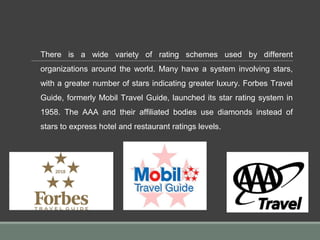
There is a wide variety of rating schemes used by different
organizations around the world. Many have a system involving stars,
with a greater number of stars indicating greater luxury. Forbes Travel
Guide, formerly Mobil Travel Guide, launched its star rating system in
1958. The AAA and their affiliated bodies use diamonds instead of
stars to express hotel and restaurant ratings levels.
Food services, entertainment, view, room variations such as size and
additional amenities, spas and fitness centers, ease of access and location
may be considered in establishing a standard. Hotels are independently
assessed in traditional systems and rest heavily on the facilities provided.
Some consider this disadvantageous to smaller hotels whose quality of
accommodation could fall into one
class but the lack of an item such as
an elevator would prevent it from
reaching a higher categorization
European Hotelstar's
Union
The HOTREC (Hotels, Restaurants & Cafés in Europe) is an umbrella
organization for 39 associations from 24 European countries. At a
conference in Bergen in 2004, the partners drafted a hotel classification
system in order to harmonize their national standards. In 2007 HOTREC
launched the European Hospitality Quality scheme (EHQ) which has since
accredited the existing national inspection bodies for hotel rating.
Under the patronage of HOTREC, the hotel associations of Austria, Czech
Republic, Germany, Hungary, Netherlands, Sweden and Switzerland
created the Hotelstars Union.
European Hotelstar's
Union
The European Hotelstars Union system is based on the earlier German
hotelstars system that had widely influenced the hotel classifications in central
Europe, with five stars and a Superior mark to flag extras. Instead of a strict
minimum in room size and required shower facilities (e.g. a bath tub in a four-
star hotel) there is a catalogue of criteria with 21 qualifications encompassing
270 elements, where some are mandatory for a star and others optional.
One Star
100% of the rooms with shower/WC or bath tub/WC
Daily room cleaning
100% of the rooms with colour-TV together with remote
control
Table and chair
Soap or body wash
Reception service
Facsimile at the reception
Publicly available telephone for guests
Extended breakfast
Beverage offer in the hotel
Deposit possibility
One Star
In addition to the single star (*) hotels
Breakfast buffet
Reading light next to the bed
Bath essence or shower gel
Bath towels and Linen shelves
Offer of sanitary products (e.g. toothbrush, toothpaste, shaving kit)
Accept Credit Cards
Two Star
Two Star
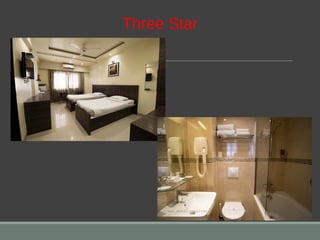
Three Star
 In addition to the standard star (**) hotels: -
 Reception opened 14 hours, accessible by phone 24
hours from inside and outside,
 bilingual staff (e.g. German/English)
 Luggage service
 Beverage offer in the room
 Telephone in the room - Internet access in the room or in
the public area
 Hair-dryer, cleansing tissue - Dressing mirror, place to
put the luggage/suitcase
 Sewing kit, shoe polish utensils, laundry and ironing
service
Three Star
Four Star
In addition to the comfort star (***) hotels:
Lobby with seats and beverage service
Breakfast buffet or breakfast menu card via room service
Minibar or 24 hours beverages via room service
Arm chair/sofa with side table
Bath robe and slippers
Cosmetic products (e.g. shower cap, nail file, cotton swabs), vanity mirror,
tray of a large scale in the bathroom)
- Internet access and internet terminal
"À la carte"-restaurant
Four Star
Five Star
Reception opened 24 hours,
In addition to the (****) hotels:
Multilingual staff –
Doorman-service or valet parking
Concierge
Spacious reception hall with several seats and beverage service
Five Star
What is missing?
How can a five-star hotel in one city be so different in its services,
quality and facilities from a hotel in another part of the world?
One of the most important elements of the guest hotel experience is
service standards, which do not generally form part of a hotel rating
system.
OTHERS
The Green Influence
 Environmentally friendly facilities will are now a core criterion of
China's hotel rating system.
 Green measures can be reflected in many dimensions, such as
hotels' design and architecture, their building materials' selection
and their customers' consumption habits, which hotels can
influence.
 China currently has more than 14,000 hotels, including 572 five-star
establishments and 2,149 four-star hotels.
Green Key
Green Key International is a voluntary eco-classification awarded to
around 2,900 hotels and other establishments in 57 countries by the
Foundation for Environmental Education.
Salam Standard
Salam Standard is a classification system for Muslim-friendly hotels.
Hotels can get certified based on certain Muslim-friendly criteria such
as offering prayer mats, removing alcohol from the room and offering
halal restaurant recommendations and is divided into 4 tiers (bronze,
silver, gold and platinum). Archipelago Hotels, Indonesia's biggest
hospitality firm, is a prominent member of the Salam Standard system
Forbes Travel Guide
The Mobil Travel Guide Star Ratings provided ratings and reviews of
hotels, restaurants and spas on a scale of one star (average to good)
to five stars (one of the best in the country) starting in 1958.
Forbes Travel Guide has continued the
Five-Star ratings with ratings
categories of Five-Star, Four-Star
and Recommended, and has a team
of inspectors who anonymously
evaluate properties against
proprietary standards.
Star Ratings Australia

Hotel rating systems

  • 1.
  • 2.
    Hotel ratings areoften used to classify hotels according to their quality. From the initial purpose of informing travelers on basic facilities that can be expected, the objectives of hotel rating has expanded into a focus on the hotel experience as a whole. Today the terms 'grading', 'rating', and 'classification' are used to generally refer to the same concept, that is to categorize hotels.
  • 3.
    There is sofar no international classification which has been adopted. Many countries use 1 to 5 star system In USA hotels are rated from 1 to 5 diamonds Some hotels have claimed a six or seven-star rating for their operation. (Example: Burj Al Arab in Dubai 7 star)
  • 4.
    WHO DECIDES?  Becausethere is no overall authority for assigning hotel ratings on an international basis, it is the customer who ultimately decides the quality of the hotel based upon the quality of guest experience.  THE FOLLOWING STAR RATINGS WERE ESTABLISHED BY THE EUROPEAN HOTELSTAR UNION.
  • 5.
    There is awide variety of rating schemes used by different organizations around the world. Many have a system involving stars, with a greater number of stars indicating greater luxury. Forbes Travel Guide, formerly Mobil Travel Guide, launched its star rating system in 1958. The AAA and their affiliated bodies use diamonds instead of stars to express hotel and restaurant ratings levels.
  • 6.
    Food services, entertainment,view, room variations such as size and additional amenities, spas and fitness centers, ease of access and location may be considered in establishing a standard. Hotels are independently assessed in traditional systems and rest heavily on the facilities provided. Some consider this disadvantageous to smaller hotels whose quality of accommodation could fall into one class but the lack of an item such as an elevator would prevent it from reaching a higher categorization
  • 7.
    European Hotelstar's Union The HOTREC(Hotels, Restaurants & Cafés in Europe) is an umbrella organization for 39 associations from 24 European countries. At a conference in Bergen in 2004, the partners drafted a hotel classification system in order to harmonize their national standards. In 2007 HOTREC launched the European Hospitality Quality scheme (EHQ) which has since accredited the existing national inspection bodies for hotel rating. Under the patronage of HOTREC, the hotel associations of Austria, Czech Republic, Germany, Hungary, Netherlands, Sweden and Switzerland created the Hotelstars Union.
  • 8.
    European Hotelstar's Union The EuropeanHotelstars Union system is based on the earlier German hotelstars system that had widely influenced the hotel classifications in central Europe, with five stars and a Superior mark to flag extras. Instead of a strict minimum in room size and required shower facilities (e.g. a bath tub in a four- star hotel) there is a catalogue of criteria with 21 qualifications encompassing 270 elements, where some are mandatory for a star and others optional.
  • 9.
    One Star 100% ofthe rooms with shower/WC or bath tub/WC Daily room cleaning 100% of the rooms with colour-TV together with remote control Table and chair Soap or body wash Reception service Facsimile at the reception Publicly available telephone for guests Extended breakfast Beverage offer in the hotel Deposit possibility
  • 10.
  • 11.
    In addition tothe single star (*) hotels Breakfast buffet Reading light next to the bed Bath essence or shower gel Bath towels and Linen shelves Offer of sanitary products (e.g. toothbrush, toothpaste, shaving kit) Accept Credit Cards Two Star
  • 12.
  • 13.
    Three Star  Inaddition to the standard star (**) hotels: -  Reception opened 14 hours, accessible by phone 24 hours from inside and outside,  bilingual staff (e.g. German/English)  Luggage service  Beverage offer in the room  Telephone in the room - Internet access in the room or in the public area  Hair-dryer, cleansing tissue - Dressing mirror, place to put the luggage/suitcase  Sewing kit, shoe polish utensils, laundry and ironing service
  • 14.
  • 15.
    Four Star In additionto the comfort star (***) hotels: Lobby with seats and beverage service Breakfast buffet or breakfast menu card via room service Minibar or 24 hours beverages via room service Arm chair/sofa with side table Bath robe and slippers Cosmetic products (e.g. shower cap, nail file, cotton swabs), vanity mirror, tray of a large scale in the bathroom) - Internet access and internet terminal "À la carte"-restaurant
  • 16.
  • 17.
    Five Star Reception opened24 hours, In addition to the (****) hotels: Multilingual staff – Doorman-service or valet parking Concierge Spacious reception hall with several seats and beverage service
  • 18.
  • 19.
    What is missing? Howcan a five-star hotel in one city be so different in its services, quality and facilities from a hotel in another part of the world? One of the most important elements of the guest hotel experience is service standards, which do not generally form part of a hotel rating system.
  • 20.
  • 21.
    The Green Influence Environmentally friendly facilities will are now a core criterion of China's hotel rating system.  Green measures can be reflected in many dimensions, such as hotels' design and architecture, their building materials' selection and their customers' consumption habits, which hotels can influence.  China currently has more than 14,000 hotels, including 572 five-star establishments and 2,149 four-star hotels.
  • 22.
    Green Key Green KeyInternational is a voluntary eco-classification awarded to around 2,900 hotels and other establishments in 57 countries by the Foundation for Environmental Education.
  • 23.
    Salam Standard Salam Standardis a classification system for Muslim-friendly hotels. Hotels can get certified based on certain Muslim-friendly criteria such as offering prayer mats, removing alcohol from the room and offering halal restaurant recommendations and is divided into 4 tiers (bronze, silver, gold and platinum). Archipelago Hotels, Indonesia's biggest hospitality firm, is a prominent member of the Salam Standard system
  • 24.
    Forbes Travel Guide TheMobil Travel Guide Star Ratings provided ratings and reviews of hotels, restaurants and spas on a scale of one star (average to good) to five stars (one of the best in the country) starting in 1958. Forbes Travel Guide has continued the Five-Star ratings with ratings categories of Five-Star, Four-Star and Recommended, and has a team of inspectors who anonymously evaluate properties against proprietary standards.
  • 26.