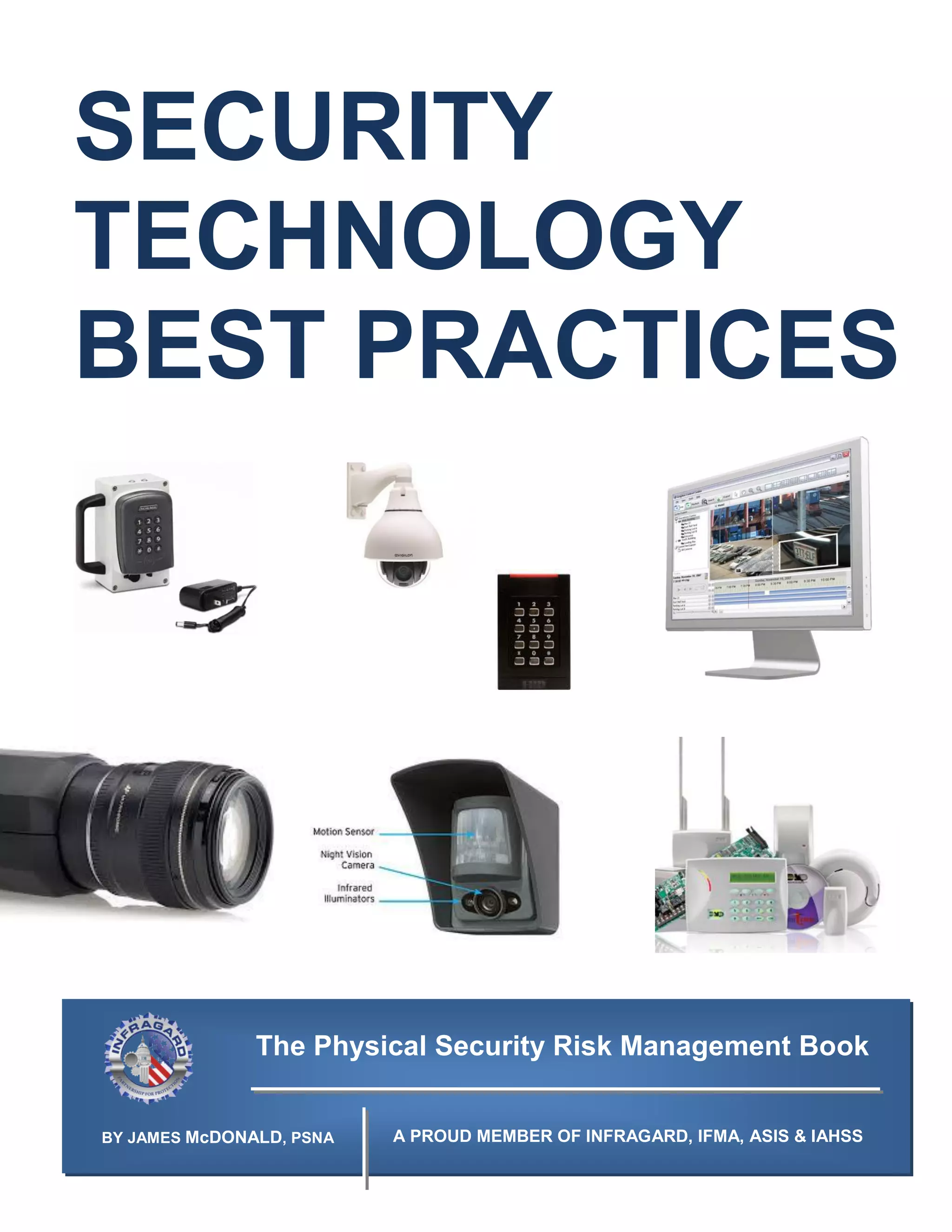
SECURITY
TECHNOLOGY
BEST PRACTICES


               The Physical Security Risk Management Book


BY JAMES McDONALD, PSNA   A PROUD MEMBER OF INFRAGARD, IFMA, ASIS & IAHSS
Introduction
             Table of Contents                             Today, integrated electronic and IP security
                                                           systems can do many things. They can provide
Table of Contents                                      2   better security detection and confirmation, with
Introduction                                           2   less labor than ever before; they can work
                                                           seamlessly with other systems running within
Risk Management & Physical Security                    4
                                                           the organization to alert and investigate
Critical Infrastructure Monitoring                     8   activities, detect threats and automatically
Implementation                                         9   initiate a threat response. Over the last decade
                                                           the integration and use of physical security
Policy Basics                                         11   solutions as a Risk Management and Asset
Non-Compliance                                        11   Management tool has reduced theft, fraud and
Identification Procedures                             12
                                                           violence by huge numbers. In most cases the
                                                           return on investment (ROI) of these systems,
Summary                                               12   used correctly, has been in months and weeks
Appendix A: Understanding Physical                         not in years. My goal here is to discuss how my
                                                           associates and I have been successful in
Access Control Solutions                              14
                                                           multiple industries providing these solutions and
Site Survey for Access Systems                        18   at the same time improving the overall security,
Physical Security Data or Key Facility                     productivity and profits of our clients.
Assessment Checklist                                  20
                                                           For thousands of years man has developed
Contact Information                                   46   systems and countermeasures to protect
                                                                           assets, whether buildings,
                                                                           people, food supplies, etc. What
                                                                           we do in the security industry is
                                                                           to constantly improve and
Disclaimer                                                                 update those countermeasures
                                                                           to keep pace with those who
Reference to any specific commercial product,                              would do you harm physically,
process or service by trade name, trademark                                financially or emotionally for their
manufacturer, or otherwise, does not constitute
or imply its endorsement, recommendation, or
                                                                           own personal or organizational
favoring     by    American     Alarm      and                             gain. Where 2,000 years a
Communications, Inc. or INFRAGARD. The                     Roman Centurion may have protected the
views and opinions of author expressed within              assets of the time, today
this document shall not be used for advertising
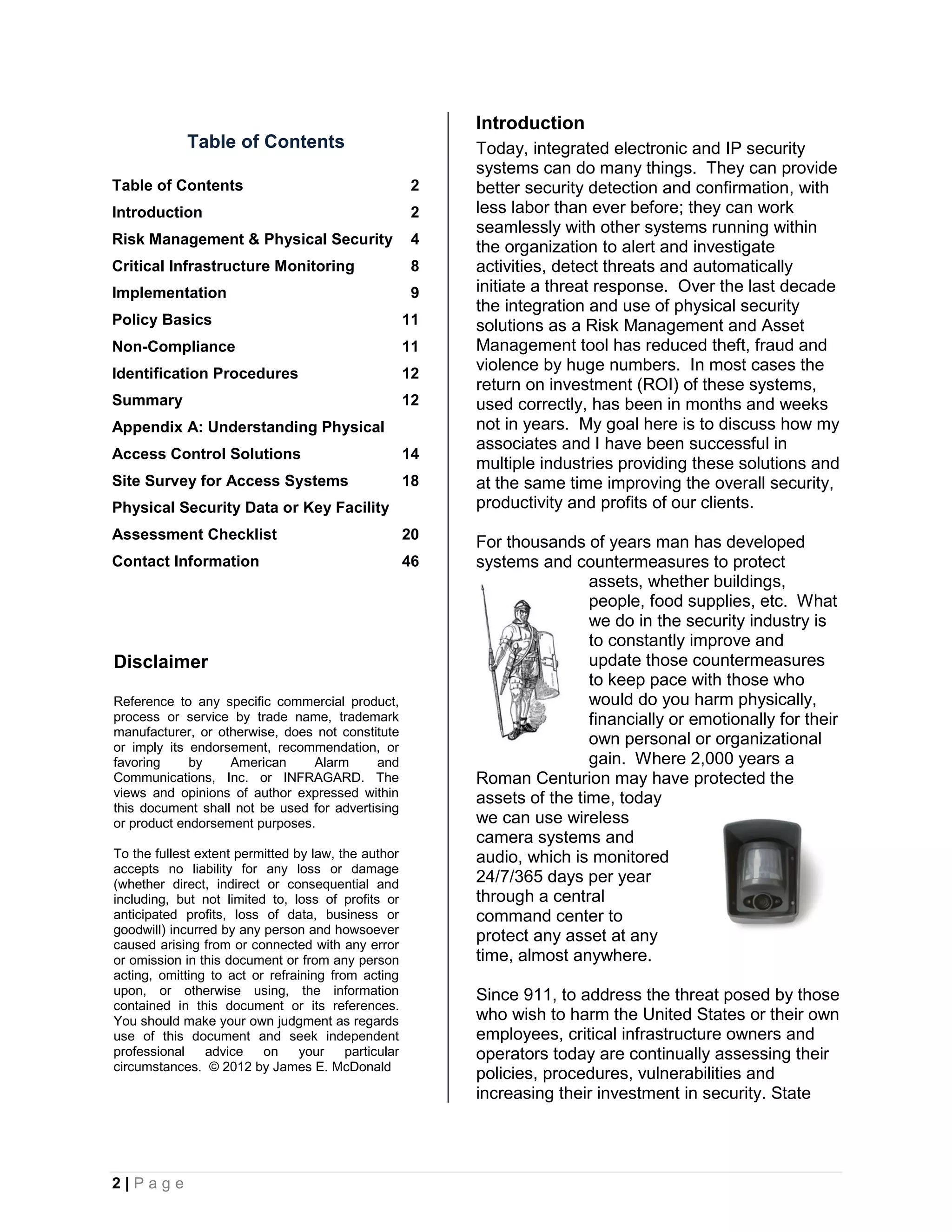
or product endorsement purposes.                           we can use wireless
                                                           camera systems and
To the fullest extent permitted by law, the author         audio, which is monitored
accepts no liability for any loss or damage
(whether direct, indirect or consequential and             24/7/365 days per year
including, but not limited to, loss of profits or          through a central
anticipated profits, loss of data, business or             command center to
goodwill) incurred by any person and howsoever
caused arising from or connected with any error
                                                           protect any asset at any
or omission in this document or from any person            time, almost anywhere.
acting, omitting to act or refraining from acting
upon, or otherwise using, the information                  Since 911, to address the threat posed by those
contained in this document or its references.
You should make your own judgment as regards               who wish to harm the United States or their own
use of this document and seek independent                  employees, critical infrastructure owners and
professional     advice   on     your    particular        operators today are continually assessing their
circumstances. © 2012 by James E. McDonald
                                                           policies, procedures, vulnerabilities and
                                                           increasing their investment in security. State


2|Page
and municipal governments across the        Homeland Security Presidential Directives 7
country continue to take important steps    and 8 are putting pressure on public and
to identify and assure the protection of    private locations, and managed services
key assets and services within their        entities to comply with a myriad amount of
jurisdictions.                              security and privacy issues. Within the broad
                                            concept of the United States' national and
Federal departments and agencies are        homeland security policies are several specific
working closely with industry to take       policies which focus on a specific aspect of
stock of key assets and facilitate          national or homeland security. These policies
protective actions, while improving the     include: the National Security Strategy, the
timely exchange of important security       National Infrastructure Protection Plan, the
related information. The Office of          National Health Security Strategy, the
Homeland Security is working closely        National Strategy for Physical Protection of
with key public- and private-sector         Critical Infrastructure and Key Assets, the
entities to implement the Homeland          National Strategy for Homeland Security, the
Security Advisory System across all         National Counterintelligence Strategy of the
levels of government and the critical       United States, the National Strategy to
sectors.                                    Secure Cyberspace, and the National Military
                                            Strategy of the United States of America.
As a proud member if INFRAGARD, and         Each of these strategies form a part of the
their goal to promote ongoing dialogue      overall national and homeland security policies
and timely communication between            of the United States, and in combination defines
members and the FBI. My team and I          how the United States acts to protect itself from
work hard every day to help those in key    enemies, both foreign and domestic.
sectors protect their facilities,
employees and visitors from internal and    Homeland Security Presidential Directive 7
external threats. In today's ever-          (HSPD-7) & Physical Protection of Critical
growing regulatory compliance               Infrastructure and Key Assets identified 18
landscape, organization can greatly         critical infrastructure and key resources (CIKR)
benefit from implementing viable and        sectors. Each sector is responsible for
proven physical security best practices     developing and implementing a Sector-Specific
for their organization.                     Plan (SSP) and providing sector-level
                                            performance feedback to the Department of
There are plenty of complicated             Homeland Security (DHS) to enable gap
documents that can guide companies          assessments of national cross-sector CIKR
through the process of designing a          protection programs. SSAs are responsible for
secure facility from the gold-standard      collaborating with public and private sector
specs used by the federal government        security partners and encouraging the
to build sensitive facilities like          development of appropriate information-sharing
embassies, to infrastructure standards      and analysis mechanisms within the sector.
published by industry groups like the
Telecommunications Industry                 These Industry Sectors are broken down as
Association, to safety requirements from    follows:
the likes of the National Fire Protection         Agriculture and Food
Association.                                      Banking and Finance
                                                  Chemical
Recent federal legislation, ranging from          Commercial Facilities
the Gramm-Leach Bliley Act (GLBA),                Communications
the Health Insurance Portability and              Critical Manufacturing
Accountability Act (HIPAA) and The                Dams
Sarbanes Oxley Act of 2002 (SOX)


                                                                                  3|Page
   Defense Industrial Base
       Emergency Services
       Energy
       Government Facilities
       Healthcare and Public Health
       Information Technology
       National Monuments
       Nuclear Reactors, Materials,
        and Waste
       Postal and Shipping
       Transportation
       Water

As a Physical Security Professional the
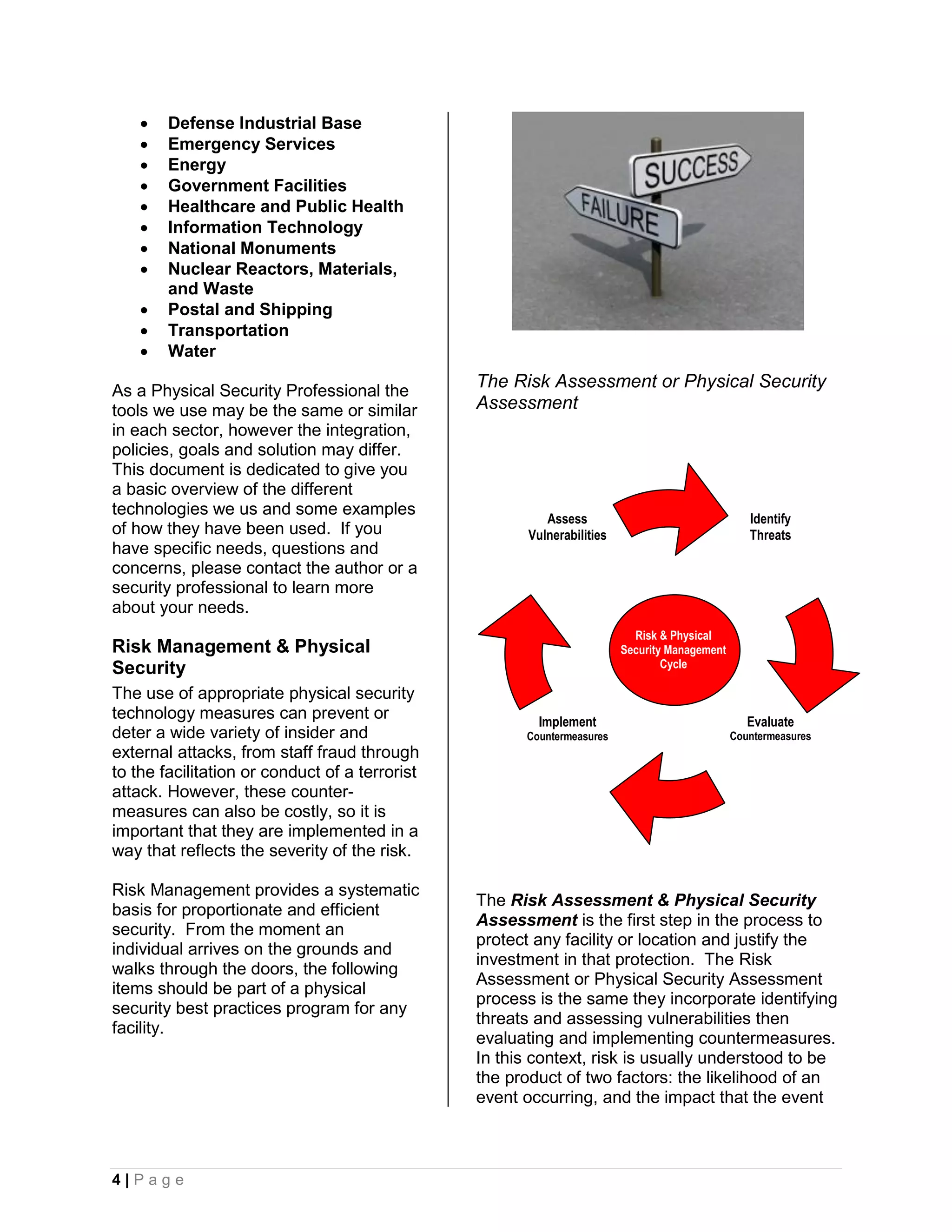
                                                The Risk Assessment or Physical Security
tools we use may be the same or similar         Assessment
in each sector, however the integration,
policies, goals and solution may differ.
This document is dedicated to give you
a basic overview of the different
technologies we us and some examples
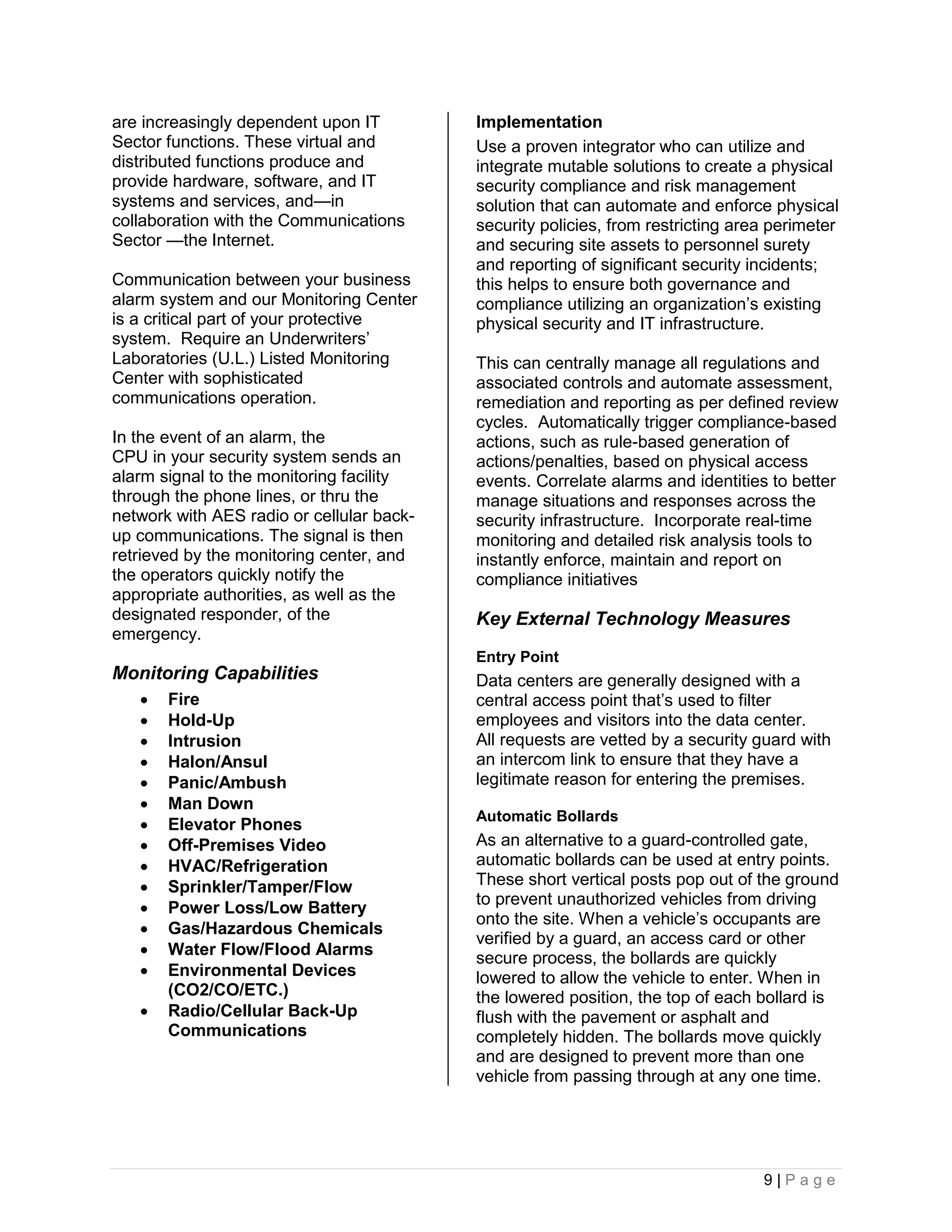
                                                          Assess                                  Identify
of how they have been used. If you                     Vulnerabilities                            Threats
have specific needs, questions and
concerns, please contact the author or a
security professional to learn more
about your needs.
                                                                           Risk & Physical
Risk Management & Physical                                               Security Management
Security                                                                         Cycle

The use of appropriate physical security
technology measures can prevent or                      Implement                                 Evaluate
deter a wide variety of insider and                   Countermeasures                          Countermeasures
external attacks, from staff fraud through
to the facilitation or conduct of a terrorist
attack. However, these counter-
measures can also be costly, so it is
important that they are implemented in a
way that reflects the severity of the risk.

Risk Management provides a systematic
                                                The Risk Assessment & Physical Security
basis for proportionate and efficient
                                                Assessment is the first step in the process to
security. From the moment an
                                                protect any facility or location and justify the
individual arrives on the grounds and
                                                investment in that protection. The Risk
walks through the doors, the following
                                                Assessment or Physical Security Assessment
items should be part of a physical
                                                process is the same they incorporate identifying
security best practices program for any
                                                threats and assessing vulnerabilities then
facility.
                                                evaluating and implementing countermeasures.
                                                In this context, risk is usually understood to be
                                                the product of two factors: the likelihood of an
                                                event occurring, and the impact that the event


4|Page
would have. When each of these has              Opportunity is a combination of the access that
been evaluated, they are combined to            an insider has to an organization’s assets (by
provide an overall measure of risk.             virtue of their role or position), together with the
Then we use our security technology             vulnerability of the environment (for example,
countermeasures to further reduce the           an environment that is constantly supervised or
opportunity and risk.                           monitored by CCTV cameras is less vulnerable
                                                to some insider threats than an environment
Likelihood can be further broken down           which is not subject to these controls). Impact
into three factors: intent, capability and      should be considered in terms of the value of
opportunity. Intent is a measure of the         the assets affected and any wider
insider’s determination to carry out the        consequences. For example, insider fraud can
attack, while capability is the degree to       have both financial and reputational impacts.
which the insider possesses the skills,
knowledge and resources to be                   Levels of risk assessment
successful in the attempt. I my study of
fraud as a member of the Association of         There are three levels at which personnel
Certified Fraud Examiners (ACFE) I              security risk assessments can be conducted:
learned that according to Donald R.
Cressey (April 27, 1919 – July 21, 1987)            1. Organization
who was an American penologist,                     2. Group
sociologist, and criminologist who made             3. Individual
innovative contributions to the study of
organized crime, prisons, criminology,          The first examines and prioritizes the types of
the sociology of criminal law, white-           insider threats that are of concern to the
collar crime. He is also known as the           organization as a whole, the second focuses on
farther of the Fraud Triangle which             groups of employees with differing levels of
states that there are three factors that        opportunity to commit the threats, while the
need to exist for someone to commit             third deals with each employee on an individual
fraud. They are Motive or Financial             basis.
Pressure, Rationalization and
Opportunity. Some things we can                 Most risk practitioners will find it helpful to start
control and others we cannot, I have            with the simplest and highest level approach,
always focused on eliminating the               the organization level risk assessment, which
Opportunity. My goal is to create the           provides a useful overview of the threats facing
Perception of Detection with the                the organization and an opportunity to review
security technology to stop fraud and           countermeasures in general. The group level
other crimes. Besides a terrorist who is        assessment will require a greater commitment
willing to die for their cause, most            of time and effort, but can yield significant
people, in my experience will think twice       insight into the groups of employees that give
or find another target if they feel they will   most cause for concern and the proportionate
be unsuccessful or caught.                      application of countermeasures within the
                                                organization. The individual level assessment is
                                                the most labor intensive of all, looking at every
                                                employee in turn to determine their combined
                                                opportunity and insider potential (i.e. threat and
                                                susceptibility).

                                                The levels of risk assessment that you use will
                                                depend on the threats faced by your
                                                organization and the nature of the workforce. It


                                                                                          5|Page
is important that you understand the         Design Solution Check List
way in which the three approaches            The following are some key examples of points
support different types of decision. For     to consider when building a new data center. I
example, if the organizational risk          use this as an example because Physical and
assessment reveals that there is a           Cyber Strategies share common underlying
negligible threat to the organization from   policy objectives and principles. The first
an insider bringing a bomb into the          objective of this Strategy is to identify and
building, this may rule out the need for     assure the protection of those assets, systems,
baggage checks on entry to the site.         and functions that are deemed most “critical” to
Alternatively, the group level               the organization. Almost every facility today
assessment could reveal that certain         has data access or data storage and in many
employees, due to their role in the          cases the “Data Room or Closet” is one of the
organization, have regular access to         least secured locations in the facility and is the
highly confidential or sensitive             most vulnerable. The liability of data loss for
information, and they may therefore          almost every organization is astronomical. The
require higher levels of supervision in      customer or personal data, organizational
the office. If, at the individual level, a   confidential information or trade secrets could
particular employee is considered to         destroy an organization without firing a shot.
have high insider potential and a high       Most MDF rooms or main equipment room is
level of opportunity, then an individually   where inside and outside cables and conduit
tailored risk management plan might be       terminate. It is usually referred to as the MDF
required.                                    (Main Distribution Frame) are accessible by
                                             everyone in the organization from the
The remaining two stages are                 receptionist to the janitor.
implementation, which involves putting
the new countermeasures identified by        So, as you read through this next section, apply
the risk or security assessment into         the principles to your facility and think of how
operation, and evaluation, during which      you could enhance you security to reduce your
the effectiveness of the counter-            risk of loss.
measures is reviewed. The lists of
assumptions made during the risk             Build on the Right Spot
assessment will prove particularly useful    Be sure the building is some distance from
during this evaluation.                      headquarters (20 miles is typical) and at least
                                             100 feet from the main road. Bad neighbors:
Depending on how much time has               airports, chemical facilities, power plants. Bad
passed since the risk assessment, the        news: earthquake fault lines and (as we've seen
evaluation stage should also show that       all too clearly this year) areas prone to
the threats identified either have or have   hurricanes and floods. And scrap the "data
not been reduced by the counter-             center" sign.
measures you have introduced. It is
worth bearing in mind, however, those        Restrict Area Perimeter
factors outside your control, such as the
                                             Secure and monitor the perimeter of the facility.
current threat level, or economic,
political and social issues, may also        Have Redundant Utilities
have an influence. These same factors
are likely to introduce new threats to be    Data centers need two sources for utilities, such
addressed in future assessments.             as electricity, water, voice and data. Trace
                                             electricity sources back to two separate
                                             substations and water back to two different
                                             main lines. Lines should be underground and
                                             should come into different areas of the building,


6|Page
with water separate from other utilities.   default, and lowered only when someone has
Use the data center's anticipated power     permission to pass through.
usage as leverage for getting the
electric company to accommodate the         Plan for Bomb Detection
building's special needs.                   For data facilities that are especially sensitive or
                                            likely targets, have guards use mirrors to check
Deter, Detect, and Delay                    underneath vehicles for explosives, or provide
Deter, detect, and delay an attack,         portable bomb-sniffing devices. You can
creating sufficient time between            respond to a raised threat by increasing the
detection of an attack and the point at     number of vehicles you check, perhaps by
which the attack becomes successful.        checking employee vehicles as well as visitors
                                            and delivery trucks.
Pay Attention to Walls
Foot-thick concrete is a cheap and          Limit Entry Points
effective barrier against the elements      Control access to the building by establishing
and explosive devices. For extra            one main entrance, plus a back one for the
security, use walls lined with Kevlar.      loading dock. This keeps costs down too.

Avoid Windows                               Make Fire Doors Exit Only
Think warehouse and not an office           For exits required by fire codes, install doors
building. If you must have windows,         that don't have handles on the outside. When
limit them to the break room or             any of these doors is opened, a loud alarm
administrative area, and use bomb-          should sound and trigger a response from the
resistant laminated glass.                  security command center.

Use Landscaping for Protection              Use Plenty of Cameras
Trees, boulders and gulleys can hide        Surveillance cameras should be installed
the building from passing cars, obscure     around the perimeter of the building, at all
security devices (like fences), and also    entrances and exits, and at every access point
help keep vehicles from getting too         throughout the building. A combination of
close. Oh, and they look nice too.          motion-detection devices, low-light cameras,
                                            pan-tilt-zoom cameras and standard fixed
Keep a 100-foot Buffer Zone around the      cameras is ideal. Footage should be digitally
Site                                        recorded and stored offsite.
Where landscaping does not protect the
building from vehicles, use crash-proof     Protect the Building's Machinery
barriers instead. Bollard planters are      Keep the mechanical area of the building, which
less conspicuous and more attractive        houses environmental systems and
than other devices.                         uninterruptible power supplies, strictly off limits.
                                            If generators are outside, use concrete walls to
Use Retractable Crash Barriers at Vehicle   secure the area. For both areas, make sure all
Entry Points                                contractors and repair crews are accompanied
Control access to the parking lot and       by an employee at all times.
loading dock with a staffed guard station
that operates the retractable bollards.     Personnel Surety
Use a raised gate and a green light as      Perform appropriate background checks on and
visual cues that the bollards are down      ensure appropriate credentials for facility
and the driver can go forward. In           personnel, and, as appropriate, for unescorted
situations when extra security is           visitors with access to restricted areas or critical
needed, have the barriers left up by        assets.


                                                                                     7|Page
Plan for Secure Air Handling                 If someone tries to sneak in behind an
Make sure the heating, ventilating and       authenticated user, the door gently revolves in
air-conditioning systems can be set to       the reverse direction. (In case of a fire, the walls
recirculate air rather than drawing in air   of the turnstile flatten to allow quick egress.)
from the outside. This could help protect
people and equipment if there were           A "mantrap"
some kind of biological or chemical          Provides alternate access for equipment and for
attack or heavy smoke spreading from a       persons with disabilities. This consists of two
nearby fire. For added security, put         separate doors with an airlock in between. Only
devices in place to monitor the air for      one door can be opened at a time, and
chemical, biological or radiological         authentication is needed for both doors.
contaminant.
                                             At the Door to an Individual Computer
Ensure nothing can hide in the walls and     Processing Room
ceilings                                     This is for the room where actual servers,
In secure areas of the data center, make     mainframes or other critical IT equipment is
sure internal walls run from the slab        located. Provide access only on an as-needed
ceiling all the way to subflooring where     basis, and segment these rooms as much as
wiring is typically housed. Also make        possible in order to control and track access.
sure drop-down ceilings don't provide
hidden access points.                        Watch the Exits Too
                                             Monitor entrance and exit—not only for the
Use two-factor Authentication                main facility but for more sensitive areas of the
Biometric identification is becoming         facility as well. It'll help you keep track of who
standard for access control to sensitive     was where, when. It also helps with building
areas of data centers, with hand             evacuation if there's a fire..
geometry or fingerprint scanners usually
considered less invasive than retinal        Prohibit Food in the Computer Rooms
scanning. In other areas, you may be         Provide a common area where people can eat
able to get away with less-expensive         without getting food on computer equipment.
access cards.
                                             Install Visitor Rest Rooms
Harden the Core with Security Layers         Make sure to include rest rooms for use by
Anyone entering the most secure part of      visitors and delivery people who don't have
the data center will have been               access to the secure parts of the building.
authenticated at least three times,
including at the outer door. Don't forget    Critical Infrastructure Monitoring
you'll need a way for visitors to buzz the   "Critical infrastructure" is defined by federal law
front desk (IP Intercom works well for       as "systems and assets, whether physical or
this). At the entrance to the "data" part    virtual, so vital to the United States that the
of the data center. At the inner door        incapacity or destruction of such systems and
separates visitor area from general          assets would have a debilitating impact on
employee area. Typically, this is the        security, national economic security, national
layer that has the strictest "positive       public health or safety, or any combination of
control," meaning no piggybacking            those matters.
allowed. For implementation, you have
two options:                                 The Information Technology (IT) Sector is
                                             central to the nation's security, economy, and
-A floor-to-ceiling turnstile                public health and safety. Businesses,
                                             governments, academia, and private citizens


8|Page
are increasingly dependent upon IT         Implementation
Sector functions. These virtual and        Use a proven integrator who can utilize and
distributed functions produce and          integrate mutable solutions to create a physical
provide hardware, software, and IT         security compliance and risk management
systems and services, and—in               solution that can automate and enforce physical
collaboration with the Communications      security policies, from restricting area perimeter
Sector —the Internet.                      and securing site assets to personnel surety
                                           and reporting of significant security incidents;
Communication between your business        this helps to ensure both governance and
alarm system and our Monitoring Center     compliance utilizing an organization’s existing
is a critical part of your protective      physical security and IT infrastructure.
system. Require an Underwriters’
Laboratories (U.L.) Listed Monitoring      This can centrally manage all regulations and
Center with sophisticated                  associated controls and automate assessment,
communications operation.                  remediation and reporting as per defined review
                                           cycles. Automatically trigger compliance-based
In the event of an alarm, the              actions, such as rule-based generation of
CPU in your security system sends an       actions/penalties, based on physical access
alarm signal to the monitoring facility    events. Correlate alarms and identities to better
through the phone lines, or thru the       manage situations and responses across the
network with AES radio or cellular back-   security infrastructure. Incorporate real-time
up communications. The signal is then      monitoring and detailed risk analysis tools to
retrieved by the monitoring center, and    instantly enforce, maintain and report on
the operators quickly notify the           compliance initiatives
appropriate authorities, as well as the
designated responder, of the               Key External Technology Measures
emergency.
                                           Entry Point
Monitoring Capabilities                    Data centers are generally designed with a
      Fire                                central access point that’s used to filter
      Hold-Up                             employees and visitors into the data center.
      Intrusion                           All requests are vetted by a security guard with
      Halon/Ansul                         an intercom link to ensure that they have a
      Panic/Ambush                        legitimate reason for entering the premises.
      Man Down
                                           Automatic Bollards
      Elevator Phones
      Off-Premises Video                  As an alternative to a guard-controlled gate,
      HVAC/Refrigeration                  automatic bollards can be used at entry points.
      Sprinkler/Tamper/Flow               These short vertical posts pop out of the ground
                                           to prevent unauthorized vehicles from driving
      Power Loss/Low Battery
                                           onto the site. When a vehicle’s occupants are
      Gas/Hazardous Chemicals
                                           verified by a guard, an access card or other
      Water Flow/Flood Alarms             secure process, the bollards are quickly
      Environmental Devices               lowered to allow the vehicle to enter. When in
       (CO2/CO/ETC.)                       the lowered position, the top of each bollard is
      Radio/Cellular Back-Up              flush with the pavement or asphalt and
       Communications                      completely hidden. The bollards move quickly
                                           and are designed to prevent more than one
                                           vehicle from passing through at any one time.


                                                                                  9|Page
Closed-Circuit TV or IP Video                 the second one opens. In a typical mantrap, the
External video cameras, positioned in         visitor needs to first “badge-in” and then once
strategic locations, including along          inside must pass a biometric screening in the
perimeter fencing, provide efficient and      form of an iris scan.
continuous visual surveillance. The
cameras can detect and follow the             Access Control List
activities of people in both authorized       Defined by the data center customer, an access
and “off limits” locations. In the event      control list includes the names of individuals
someone performs an unauthorized              who are authorized to enter the data center
action or commits a crime, the digitally      environment. Anyone not on the list will not be
stored video can supply valuable              granted access to operational areas.
evidence to supervisors, law
enforcement officials and judicial            Badges and Cards
authorities. For added protection, the        Visually distinctive badges and identification
video should be stored off-site on a          cards, combined with automated entry points,
digital video recorder (DVR).                 ensure that only authorized people can access
                                              specific data center areas. The most common
Key Internal Technology Measures              identification technologies are magnetic stripe,
                                              proximity, barcode, smart cards and various
Lobby Area                                    biometric devices.
With proper software and surveillance
and communications tools, a staffed           Guard Staff
reception desk, with one or more              A well-trained staff that monitors site facilities
security guards checking visitors’            and security technologies is an essential
credentials, creates an invaluable first      element in any access control plan.
line of access control.
                                              Loading and Receiving
Surveillance
                                              For full premises security, mantraps, card
Like their external counterparts, internal    readers and other access controls located in
cameras provide constant surveillance         public-facing facilities also need to be
and offer documented proof of any             duplicated at the data center’s loading docks
observed wrongdoing.                          and storage areas.
Biometric Screening                           Operational Areas
Once the stuff of science fiction and spy     The final line of physical protection falls in front
movies, biometric identification now          of the data center’s IT resources. Private cages
plays a key role in premises security.        and suites need to be equipped with dedicated
Biometric systems authorize users on          access control systems while cabinets should
the basis of a physical characteristic that   have locking front and rear doors for additional
doesn’t change during a lifetime, such        protection.
as a fingerprint, hand or face geometry,
retina or iris features.                      Humans are the weakest link in any security
                                              scheme. Security professionals can do their
Mantrap                                       best to protect systems with layers of anti-
Typically located at the gateway              malware, personal and network firewalls,
between the lobby and the rest of the         biometric login authentication, and even data
data center, mantrap technology               encryption, but give a good hacker (or computer
consists of two interlocking doors            forensics expert) enough time with physical
positioned on either side of an enclosed      access to the hardware, and there’s a good
space. The first door must close before       chance they’ll break in. Thus, robust physical


10 | P a g e
access controls and policies are critical      Authenticate individuals with regular access
elements of any comprehensive IT                requirements through the use of their
security strategy.                              assigned permanent authenticator.
                                               Authenticate individuals with occasional
According to a report by the SANS               access requirements through the use of a
Institute, “IT security and physical            personal identification mechanism that
security are no longer security silos in        includes name, signature and photograph.
the IT environment; they are and must
be considered one and the same or, as       Step 2
it should be called, overall security.”     Verify that work to be performed has been pre-
                                            approved or meets emergency response
It is the innermost layer—physical entry    procedures:
to computer rooms—over which IT                 Verify against standard Change Control
managers typically have responsibility,             procedures.
and the means to have effective control         Verify against standard Maintenance
over human access focuses on a set of               procedures.
policies, procedures, and enforcement
mechanisms.                                 Step 3
Policy Basics                               Make use of logs to document the coming and
                                            goings of people and equipment:
Given their importance and ramifications
on employees, access policies must           Assign the responsibility for the
come from the top leadership. After             maintenance of an access log that records
setting expectations and behavioral             personnel access. Record the following:
ground rules, actual data center access          Date and time of entry.
policies have several common                     Name of accessing individual and
elements. The most essential are                   authentication mechanism.
definitions of various access levels and         Name and title of authorizing individual.
procedures for authenticating individuals        Reason for access.
in each group and their associated               Date and time of departure.
privileges and responsibilities when in
the data center.                               Assign the responsibility for the
                                                maintenance of a delivery and removal log
Step 1                                          that records equipment that is delivered to
Authorize, identify and authenticate            or removed from facilities; Record the
individuals that require physical access:       following:
 Identify the roles that require both           Date and time of delivery/removal.
    regular as well as occasional                Name and type of equipment to be
    physical access and identify the                 delivered or removed.
    individuals that fill these roles.           Name and employer of the individual
 Provide standing authorization and a               performing the delivery/removal and the
    permanent authenticator to                       authentication mechanism used.
    individuals that require regular             Name and title of authorizing individual.
    access.                                      Reason for delivery/removal.
 Require individuals that require
    occasional access to submit a           Non-Compliance
    request that must be approved prior     Violation of any of the constraints of these
    to access being attempted or            policies or procedures should be considered a
    allowed.                                security breach and depending on the nature of
                                            the violation, various sanctions will be taken:


                                                                                 11 | P a g e
   A minor breach should result in      cards. I also recommend using time-stamped
        written reprimand.                   video surveillance in conjunction with electronic
       Multiple minor breaches or a         access logs and a sign-in sheet to provide a
        major breach should result in        paper trail.
        suspension.
       Multiple major breaches should       Access levels and controls, with identification,
        result in termination.               monitoring, and logging, form the foundation of
                                             an access policy, but two other major policy
Although older data centers typically just   elements are standards of conduct and
consisted of a large, un-partitioned         behaviors inside the data center such as:
raised-floor area, newer enterprise          prohibitions on food and beverages or
facilities have taken a page from ISP        tampering with unauthorized equipment,
designs by dividing the space into           limitations and controls on the admission of
various zones—for example, a cage for        personal electronics such as USB thumb drives,
high-availability servers, another area      laptops, Smartphones, or cameras are critical.
for Tier 2 or 3 systems, a dedicated
network control room, and even               Policies should also incorporate processes for
separate areas for facilities                granting access or elevating restriction levels,
infrastructure such as PDUs and              an exception process for unusual situations,
chillers. Such partitioned data centers      sanctions for policy violations, and standards
provide control points for denying           for reviewing and auditing policy compliance.
access to personnel with no                  Stahl cautions that penalties for noncompliance
responsibility for equipment that’s in       will vary from company to company because
them.                                        they must reflect each enterprise’s specific risk
                                             tolerance, corporate culture, local employment
Identification Procedures                    laws, and union contracts.
The next step in a physical security
policy is to set up controls and             Summary
identification procedures for                It’s time to get physical—as in physically
authenticating data center users and         protecting a data center and all of its assets.
granting them physical access. Although      The need for ironclad virtual security measures,
biometric scanners look flashy in the        such as managed firewalls, is well known. Yet
movies and certainly provide an added        physical security is often placed on the back
measure of security, a magnetic stripe       burner, largely forgotten about until an
badge reader is still the most common        unauthorized party manages to break into or
entry technology, as it’s simple, cheap,     sneak onto a site and steals or vandalizes
and effective and allows automated           systems.
logging, which is a necessary audit trail.
One problem with magnetic readers,           Today’s security systems include:
according is their susceptibility to          Intrusion and Monitoring Systems
tailgating, or allowing unauthorized          Access Control Systems
personnel to trail a colleague through an     Visitor Management Systems
entryway. That’s why we advise                Surveillance Systems
supplementing doors and locks with            Emergency Communications Systems
recorded video surveillance.                  PISM Software Platforms
I also like to add a form of two-factor
authentication to entry points by            The newest of these is the PISM or Physical
coupling a card reader (“something you       Security Information Management system.
have”) with a PIN pad (“something you
know”), which reduces the risks of lost


12 | P a g e
Physical Security Information                  Geo-Location Engine
Management (PISM)                              The Geo Location Engine provides spatial
                                               recognition for geo-location of devices and supports
                                               situation mapping functionality. The physical
The PSIM Platform enables the                  position of devices is stored in an internal knowledge
integration and organization of any            base as GIS/GPS positions or building coordinates.
number and type of security devices or         The engine uses the information to determine
systems and provides a common set of           relevance, selects, and relate devices involved in a
services for analyzing and managing the        given situation. The system uses the information to
incoming information. It also serves as        overlay graphical representations of security assets
the common services platform for video         and activities onto Google-type maps or building
and situation management applications.         layouts.

                                               Routing Engine
Effectively maintaining security of critical
infrastructure does not happen by              The Routing Engine is an intelligent switch that
accident, it means giving your security        connects any security device to PISM command
                                               interfaces or output device(s) and accommodates
professionals the best security/software
                                               any required transformation of formats and protocols
tools available today. By unifying your        between connected devices. In most cases, devices
existing surveillance system and               connect directly to each other and exchange data
providing spatial context to your camera       streams directly, avoiding possible bottlenecks that
feeds, PISM brings out the best of your        would arise from routing all traffic through a single
equipment.                                     centralized server. An internal knowledge base of
                                               all connected devices and their characteristics is
To investigate day-to-day incidents, as        maintained by the Routing Engine, which uses that
well as prepare for emergency                  information to ensure a viable communication path,
situations, the security department            compatibility of signal format and acceptable quality
                                               of service.
makes use of a vast network of video
cameras, access control points,                Rules Engine
intercoms, fire and other safety systems.
PISM unifies all of these disparate            The PSIM Platform contains a powerful Rules
feeds, including systems from diverse          Engine that analyzes event and policy
manufacturers, into a single decision-         information from multiple sources to correlate
oriented Common Operating Picture.             events, make decisions based upon event
Within the PSIM Platform are five key          variables and initiate activities.
components:
                                               Dispatch Engine
Integration Services                           The Dispatch Engine integrates with
                                               communications infrastructure to initiate
Multiple strategies are used for
                                               external applications or the transmission of
connection, communication with, and
                                               messages, data and commands. Dispatch
management of installed devices and
                                               actions are automatically triggered by the rules
systems from multiple vendors. The
                                               engine as it executes recommendations for
PSIM Platform offers complete support
                                               situation resolution. Operators can manually
for the industry’s most commonly-used
                                               initiate actions as well.
device types – out of the box. In
addition, it employs customizable
                                               The key benefits of today’s technology is
“pipeline” architecture to receive device
                                               allowing system users to do more with less by
events. Network connectivity is achieved
                                               getting maximum benefits through integrated
using combinations of multiple
                                               technologies with each system (Both new and
communications protocols.
                                               old) and with the goals of company policies and
                                               procedures like never before.


                                                                                        13 | P a g e
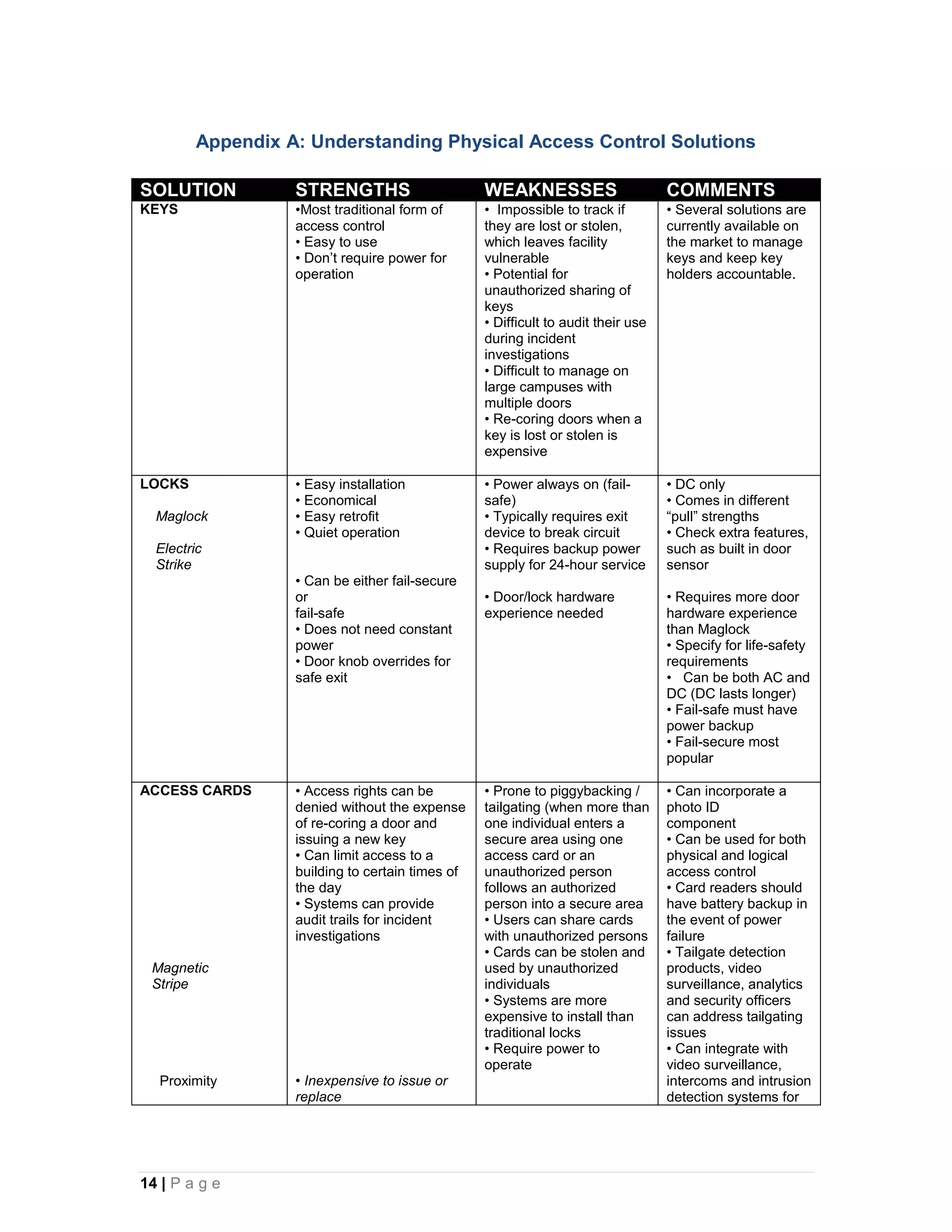
Appendix A: Understanding Physical Access Control Solutions

SOLUTION           STRENGTHS                      WEAKNESSES                       COMMENTS
KEYS               •Most traditional form of      • Impossible to track if         • Several solutions are
                   access control                 they are lost or stolen,         currently available on
                   • Easy to use                  which leaves facility            the market to manage
                   • Don’t require power for      vulnerable                       keys and keep key
                   operation                      • Potential for                  holders accountable.
                                                  unauthorized sharing of
                                                  keys
                                                  • Difficult to audit their use
                                                  during incident
                                                  investigations
                                                  • Difficult to manage on
                                                  large campuses with
                                                  multiple doors
                                                  • Re-coring doors when a
                                                  key is lost or stolen is
                                                  expensive

LOCKS              • Easy installation            • Power always on (fail-         • DC only
                   • Economical                   safe)                            • Comes in different
  Maglock          • Easy retrofit                • Typically requires exit        “pull” strengths
                   • Quiet operation              device to break circuit          • Check extra features,
  Electric                                        • Requires backup power          such as built in door
  Strike                                          supply for 24-hour service       sensor
                   • Can be either fail-secure
                   or                             • Door/lock hardware             • Requires more door
                   fail-safe                      experience needed                hardware experience
                   • Does not need constant                                        than Maglock
                   power                                                           • Specify for life-safety
                   • Door knob overrides for                                       requirements
                   safe exit                                                       • Can be both AC and
                                                                                   DC (DC lasts longer)
                                                                                   • Fail-safe must have
                                                                                   power backup
                                                                                   • Fail-secure most
                                                                                   popular

ACCESS CARDS       • Access rights can be         • Prone to piggybacking /        • Can incorporate a
                   denied without the expense     tailgating (when more than       photo ID
                   of re-coring a door and        one individual enters a          component
                   issuing a new key              secure area using one            • Can be used for both
                   • Can limit access to a        access card or an                physical and logical
                   building to certain times of   unauthorized person              access control
                   the day                        follows an authorized            • Card readers should
                   • Systems can provide          person into a secure area        have battery backup in
                   audit trails for incident      • Users can share cards          the event of power
                   investigations                 with unauthorized persons        failure
                                                  • Cards can be stolen and        • Tailgate detection
 Magnetic                                         used by unauthorized             products, video
 Stripe                                           individuals                      surveillance, analytics
                                                  • Systems are more               and security officers
                                                  expensive to install than        can address tailgating
                                                  traditional locks                issues
                                                  • Require power to               • Can integrate with
                                                  operate                          video surveillance,
  Proximity        • Inexpensive to issue or                                       intercoms and intrusion
                   replace                                                         detection systems for


14 | P a g e
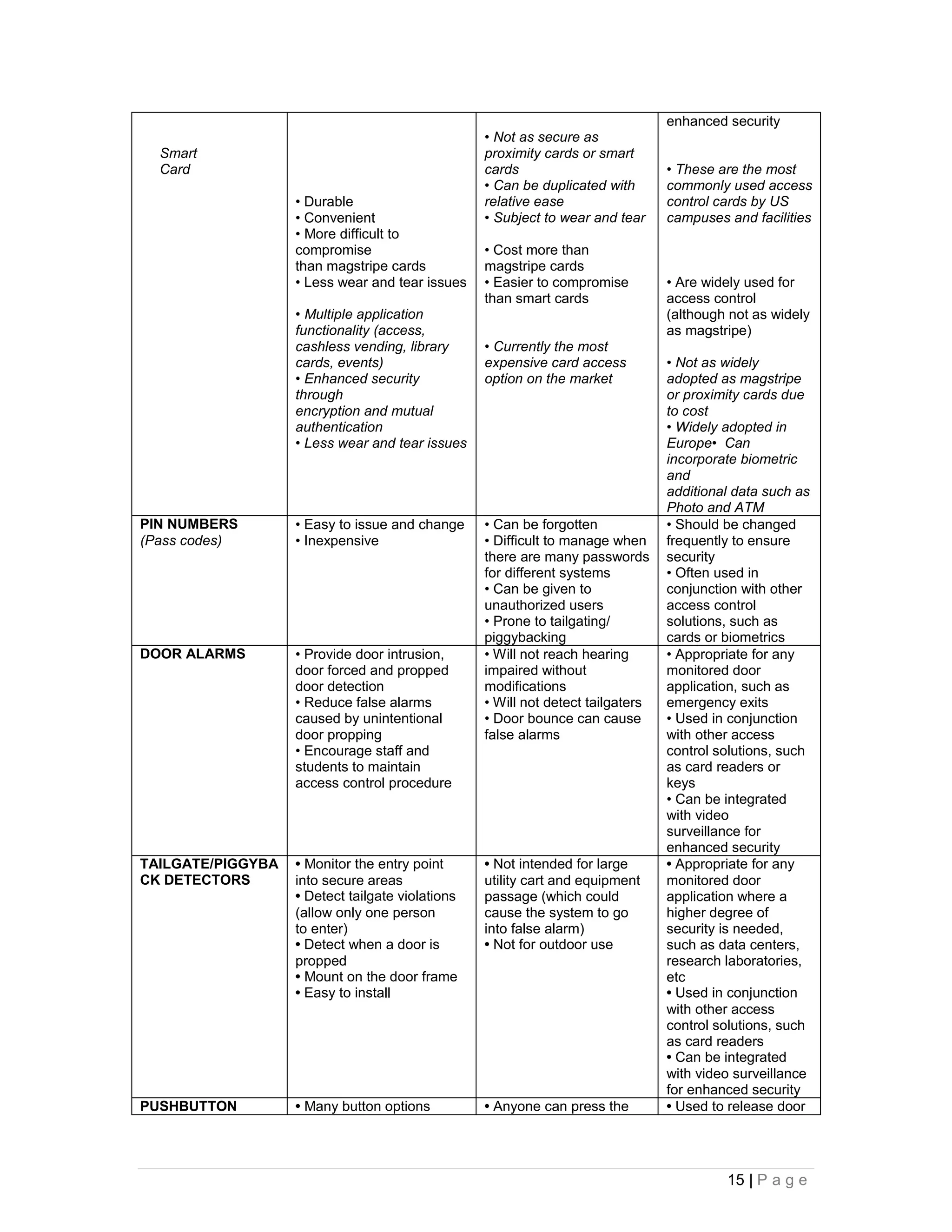
enhanced security
                                                  • Not as secure as
  Smart                                           proximity cards or smart
  Card                                            cards                          • These are the most
                                                  • Can be duplicated with       commonly used access
                   • Durable                      relative ease                  control cards by US
                   • Convenient                   • Subject to wear and tear     campuses and facilities
                   • More difficult to
                   compromise                     • Cost more than
                   than magstripe cards           magstripe cards
                   • Less wear and tear issues    • Easier to compromise         • Are widely used for
                                                  than smart cards               access control
                   • Multiple application                                        (although not as widely
                   functionality (access,                                        as magstripe)
                   cashless vending, library      • Currently the most
                   cards, events)                 expensive card access          • Not as widely
                   • Enhanced security            option on the market           adopted as magstripe
                   through                                                       or proximity cards due
                   encryption and mutual                                         to cost
                   authentication                                                • Widely adopted in
                   • Less wear and tear issues                                   Europe• Can
                                                                                 incorporate biometric
                                                                                 and
                                                                                 additional data such as
                                                                                 Photo and ATM
PIN NUMBERS        • Easy to issue and change     • Can be forgotten             • Should be changed
(Pass codes)       • Inexpensive                  • Difficult to manage when     frequently to ensure
                                                  there are many passwords       security
                                                  for different systems          • Often used in
                                                  • Can be given to              conjunction with other
                                                  unauthorized users             access control
                                                  • Prone to tailgating/         solutions, such as
                                                  piggybacking                   cards or biometrics
DOOR ALARMS        • Provide door intrusion,      • Will not reach hearing       • Appropriate for any
                   door forced and propped        impaired without               monitored door
                   door detection                 modifications                  application, such as
                   • Reduce false alarms          • Will not detect tailgaters   emergency exits
                   caused by unintentional        • Door bounce can cause        • Used in conjunction
                   door propping                  false alarms                   with other access
                   • Encourage staff and                                         control solutions, such
                   students to maintain                                          as card readers or
                   access control procedure                                      keys
                                                                                 • Can be integrated
                                                                                 with video
                                                                                 surveillance for
                                                                                 enhanced security
TAILGATE/PIGGYBA   • Monitor the entry point      • Not intended for large       • Appropriate for any
CK DETECTORS       into secure areas              utility cart and equipment     monitored door
                   • Detect tailgate violations   passage (which could           application where a
                   (allow only one person         cause the system to go         higher degree of
                   to enter)                      into false alarm)              security is needed,
                   • Detect when a door is        • Not for outdoor use          such as data centers,
                   propped                                                       research laboratories,
                   • Mount on the door frame                                     etc
                   • Easy to install                                             • Used in conjunction
                                                                                 with other access
                                                                                 control solutions, such
                                                                                 as card readers
                                                                                 • Can be integrated
                                                                                 with video surveillance
                                                                                 for enhanced security
PUSHBUTTON         • Many button options          • Anyone can press the         • Used to release door


                                                                                          15 | P a g e
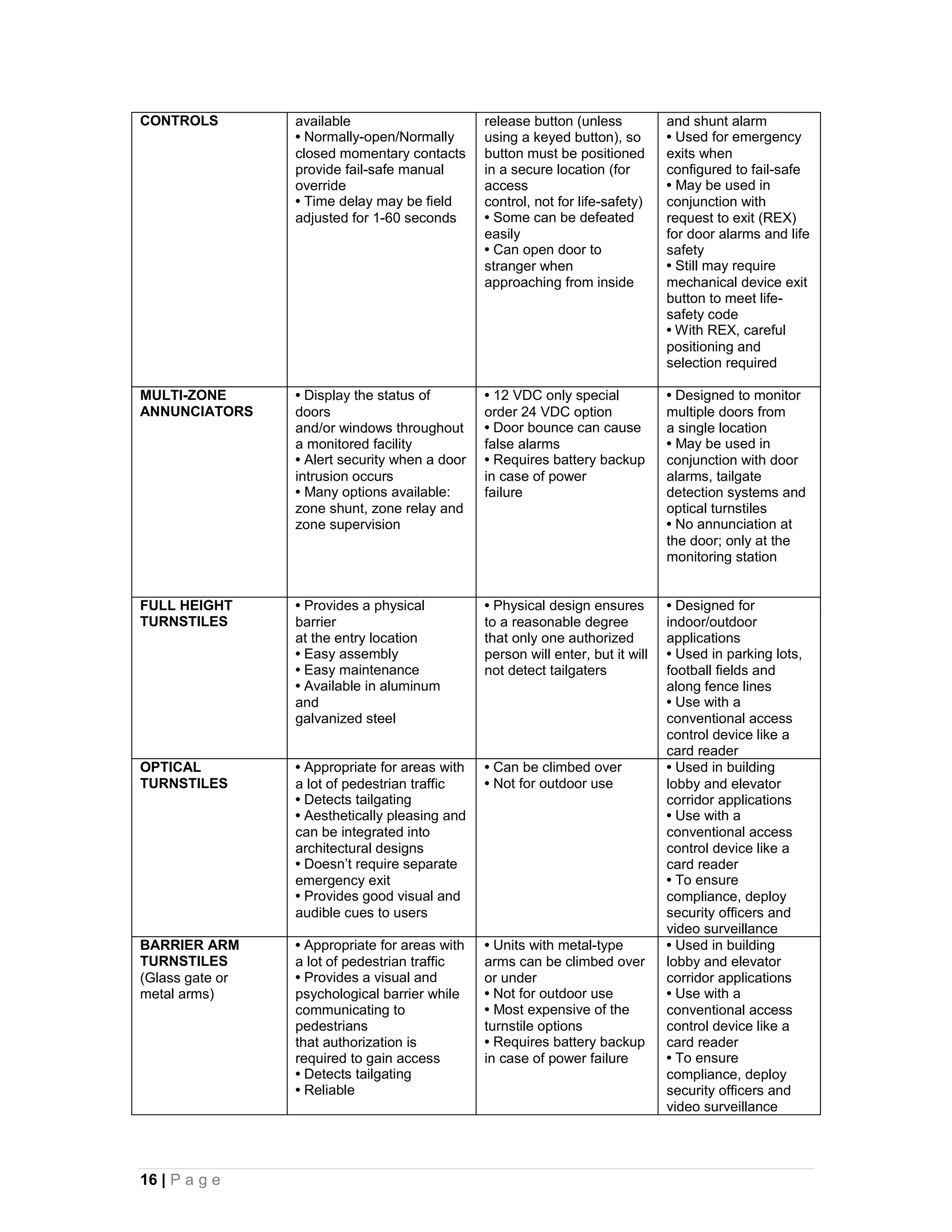
CONTROLS         available                      release button (unless           and shunt alarm
                 • Normally-open/Normally       using a keyed button), so        • Used for emergency
                 closed momentary contacts      button must be positioned        exits when
                 provide fail-safe manual       in a secure location (for        configured to fail-safe
                 override                       access                           • May be used in
                 • Time delay may be field      control, not for life-safety)    conjunction with
                 adjusted for 1-60 seconds      • Some can be defeated           request to exit (REX)
                                                easily                           for door alarms and life
                                                • Can open door to               safety
                                                stranger when                    • Still may require
                                                approaching from inside          mechanical device exit
                                                                                 button to meet life-
                                                                                 safety code
                                                                                 • With REX, careful
                                                                                 positioning and
                                                                                 selection required

MULTI-ZONE       • Display the status of        • 12 VDC only special            • Designed to monitor
ANNUNCIATORS     doors                          order 24 VDC option              multiple doors from
                 and/or windows throughout      • Door bounce can cause          a single location
                 a monitored facility           false alarms                     • May be used in
                 • Alert security when a door   • Requires battery backup        conjunction with door
                 intrusion occurs               in case of power                 alarms, tailgate
                 • Many options available:      failure                          detection systems and
                 zone shunt, zone relay and                                      optical turnstiles
                 zone supervision                                                • No annunciation at
                                                                                 the door; only at the
                                                                                 monitoring station


FULL HEIGHT      • Provides a physical          • Physical design ensures        • Designed for
TURNSTILES       barrier                        to a reasonable degree           indoor/outdoor
                 at the entry location          that only one authorized         applications
                 • Easy assembly                person will enter, but it will   • Used in parking lots,
                 • Easy maintenance             not detect tailgaters            football fields and
                 • Available in aluminum                                         along fence lines
                 and                                                             • Use with a
                 galvanized steel                                                conventional access
                                                                                 control device like a
                                                                                 card reader
OPTICAL          • Appropriate for areas with   • Can be climbed over            • Used in building
TURNSTILES       a lot of pedestrian traffic    • Not for outdoor use            lobby and elevator
                 • Detects tailgating                                            corridor applications
                 • Aesthetically pleasing and                                    • Use with a
                 can be integrated into                                          conventional access
                 architectural designs                                           control device like a
                 • Doesn’t require separate                                      card reader
                 emergency exit                                                  • To ensure
                 • Provides good visual and                                      compliance, deploy
                 audible cues to users                                           security officers and
                                                                                 video surveillance
BARRIER ARM      • Appropriate for areas with   • Units with metal-type          • Used in building
TURNSTILES       a lot of pedestrian traffic    arms can be climbed over         lobby and elevator
(Glass gate or   • Provides a visual and        or under                         corridor applications
metal arms)      psychological barrier while    • Not for outdoor use            • Use with a
                 communicating to               • Most expensive of the          conventional access
                 pedestrians                    turnstile options                control device like a
                 that authorization is          • Requires battery backup        card reader
                 required to gain access        in case of power failure         • To ensure
                 • Detects tailgating                                            compliance, deploy
                 • Reliable                                                      security officers and
                                                                                 video surveillance


16 | P a g e
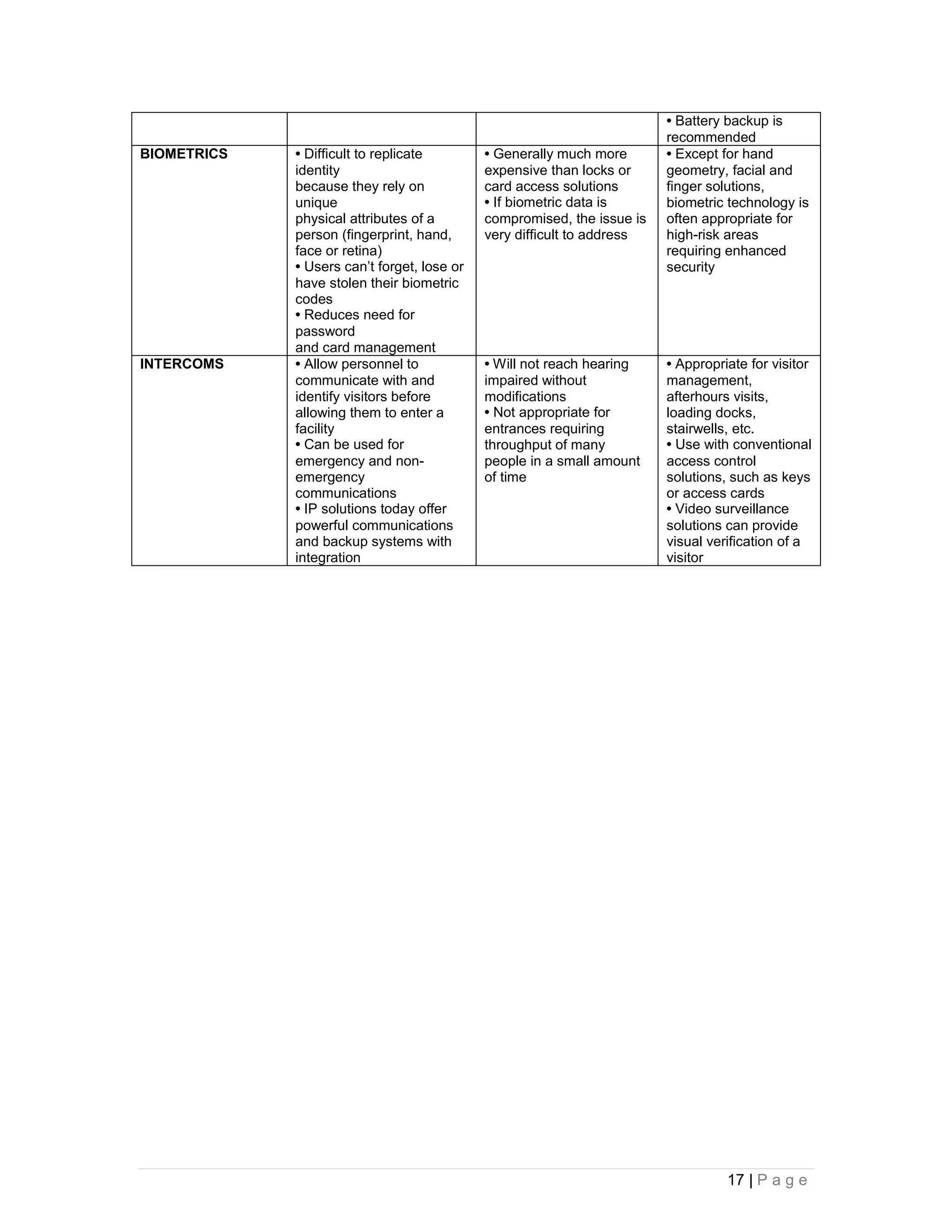
• Battery backup is
                                                                         recommended
BIOMETRICS   • Difficult to replicate        • Generally much more       • Except for hand
             identity                        expensive than locks or     geometry, facial and
             because they rely on            card access solutions       finger solutions,
             unique                          • If biometric data is      biometric technology is
             physical attributes of a        compromised, the issue is   often appropriate for
             person (fingerprint, hand,      very difficult to address   high-risk areas
             face or retina)                                             requiring enhanced
             • Users can’t forget, lose or                               security
             have stolen their biometric
             codes
             • Reduces need for
             password
             and card management
INTERCOMS    • Allow personnel to            • Will not reach hearing    • Appropriate for visitor
             communicate with and            impaired without            management,
             identify visitors before        modifications               afterhours visits,
             allowing them to enter a        • Not appropriate for       loading docks,
             facility                        entrances requiring         stairwells, etc.
             • Can be used for               throughput of many          • Use with conventional
             emergency and non-              people in a small amount    access control
             emergency                       of time                     solutions, such as keys
             communications                                              or access cards
             • IP solutions today offer                                  • Video surveillance
             powerful communications                                     solutions can provide
             and backup systems with                                     visual verification of a
             integration                                                 visitor


                                                                                   17 | P a g e
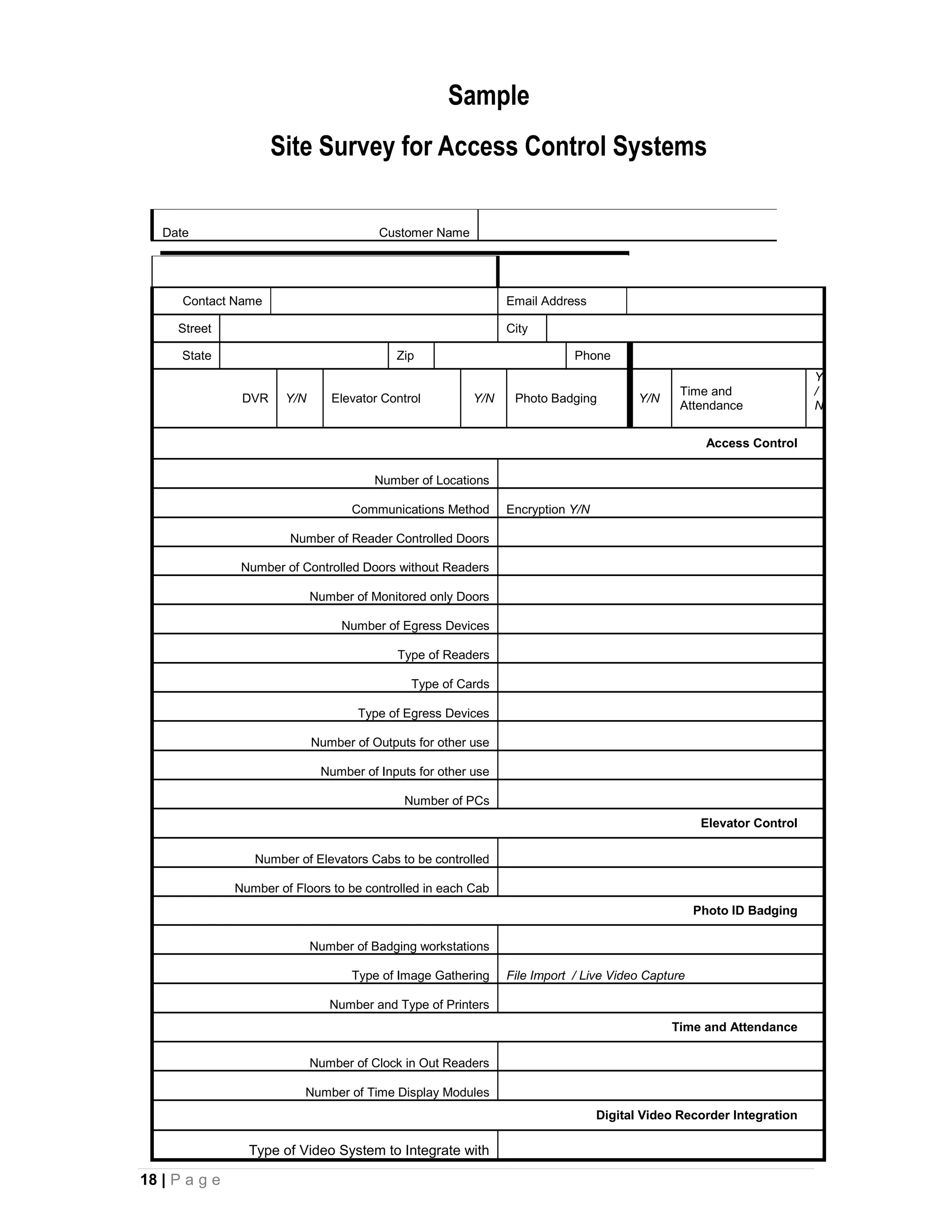
Sample
                      Site Survey for Access Control Systems

   Date                                 Customer Name


      Contact Name                                             Email Address

     Street                                                    City

      State                                Zip                             Phone
                                                                                                                      Y
                                                                                              Time and                /
                DVR    Y/N      Elevator Control         Y/N    Photo Badging          Y/N
                                                                                              Attendance              N


                                                                                                    Access Control

                                        Number of Locations

                                    Communications Method      Encryption Y/N

                        Number of Reader Controlled Doors

                Number of Controlled Doors without Readers

                             Number of Monitored only Doors

                                  Number of Egress Devices

                                            Type of Readers

                                              Type of Cards

                                     Type of Egress Devices

                             Number of Outputs for other use

                              Number of Inputs for other use

                                             Number of PCs
                                                                                                   Elevator Control

                  Number of Elevators Cabs to be controlled

               Number of Floors to be controlled in each Cab
                                                                                                  Photo ID Badging

                             Number of Badging workstations

                                    Type of Image Gathering    File Import / Live Video Capture

                                Number and Type of Printers
                                                                                             Time and Attendance

                             Number of Clock in Out Readers

                           Number of Time Display Modules
                                                                                Digital Video Recorder Integration

                 Type of Video System to Integrate with

18 | P a g e
19 | P a g e
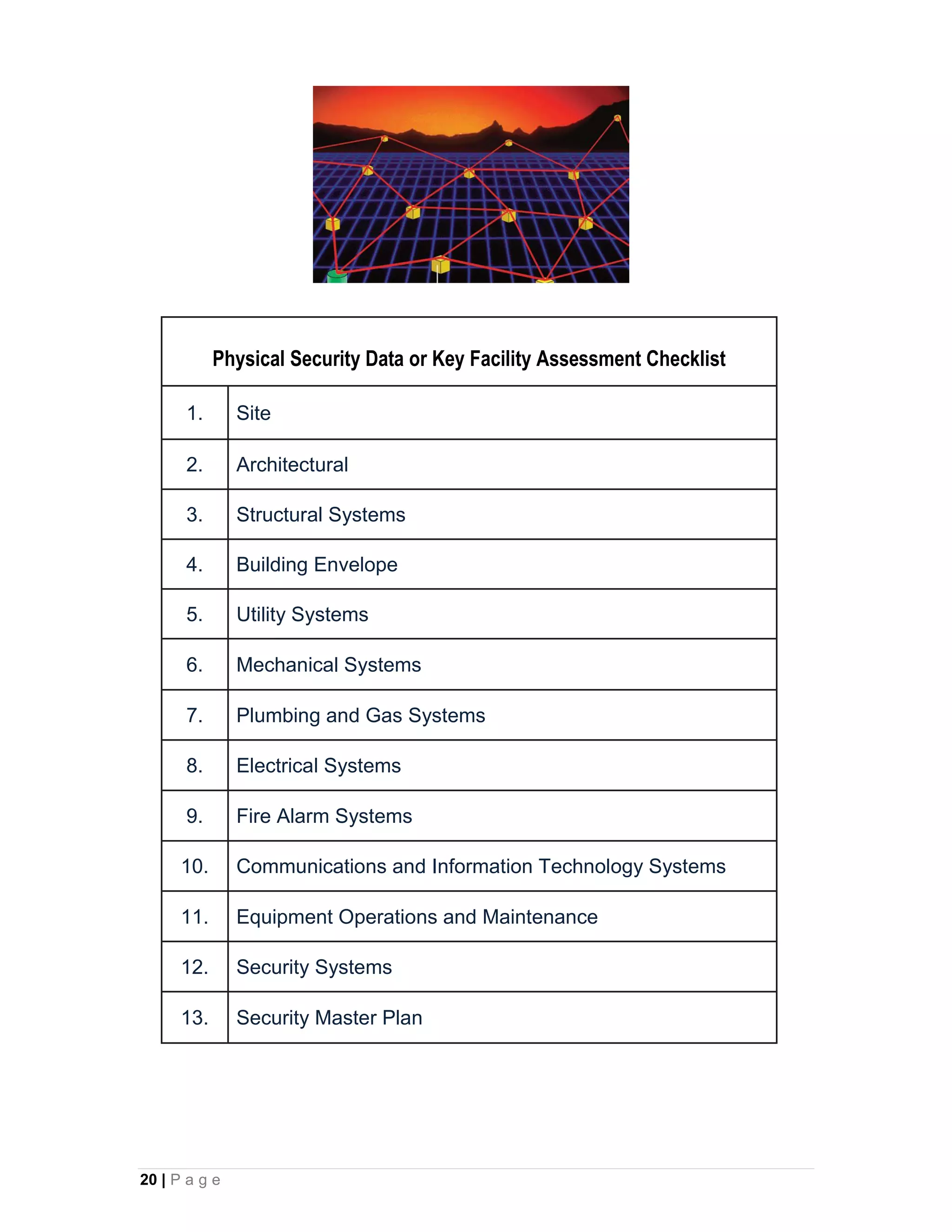
Physical Security Data or Key Facility Assessment Checklist

      1.       Site

      2.       Architectural

      3.       Structural Systems

      4.       Building Envelope

      5.       Utility Systems

      6.       Mechanical Systems

      7.       Plumbing and Gas Systems

      8.       Electrical Systems

      9.       Fire Alarm Systems

      10.      Communications and Information Technology Systems

      11.      Equipment Operations and Maintenance

      12.      Security Systems

      13.      Security Master Plan


20 | P a g e
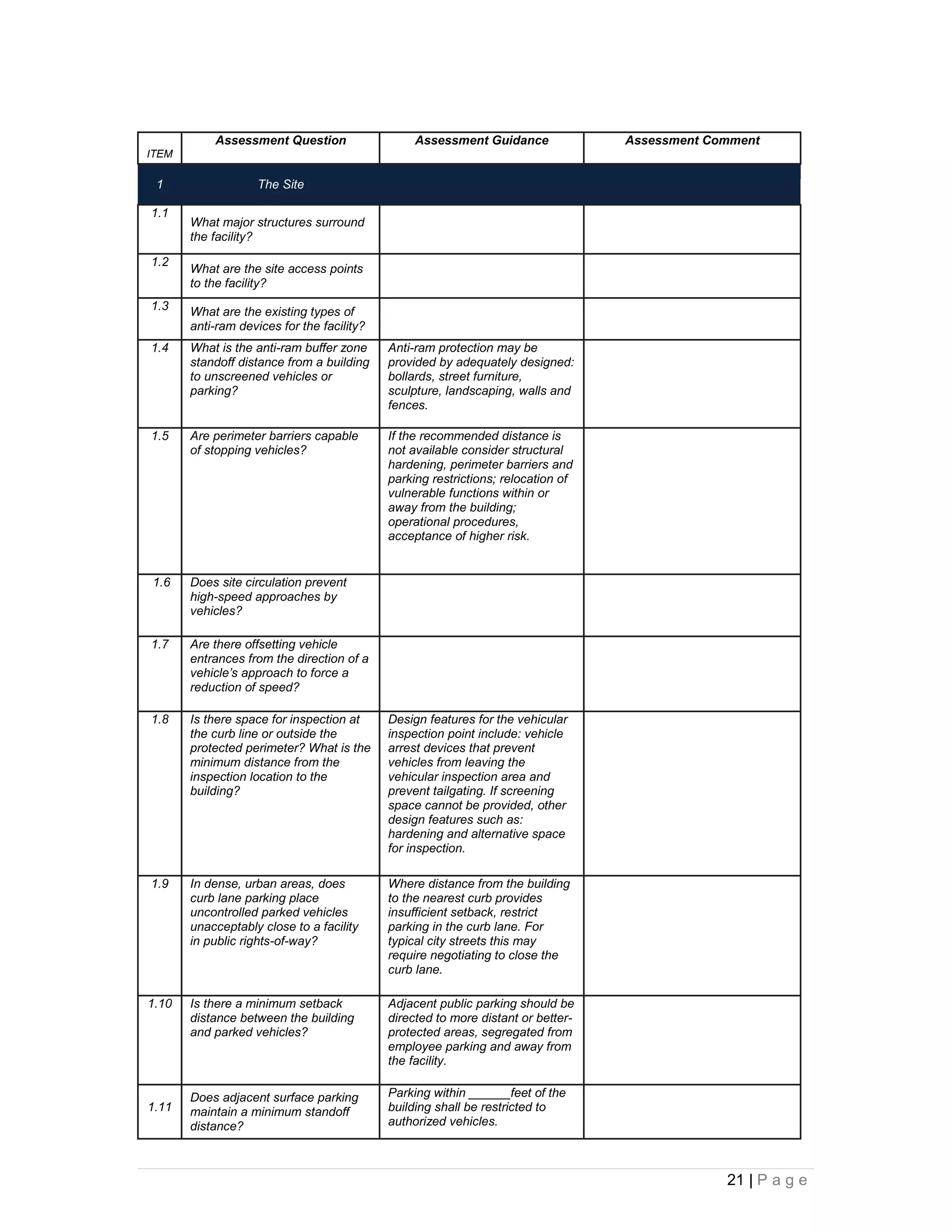
Assessment Question                   Assessment Guidance              Assessment Comment
ITEM

 1                  The Site

1.1
       What major structures surround
       the facility?

1.2
       What are the site access points
       to the facility?
1.3    What are the existing types of
       anti-ram devices for the facility?
1.4    What is the anti-ram buffer zone     Anti-ram protection may be
       standoff distance from a building    provided by adequately designed:
       to unscreened vehicles or            bollards, street furniture,
       parking?                             sculpture, landscaping, walls and
                                            fences.

1.5    Are perimeter barriers capable       If the recommended distance is
       of stopping vehicles?                not available consider structural
                                            hardening, perimeter barriers and
                                            parking restrictions; relocation of
                                            vulnerable functions within or
                                            away from the building;
                                            operational procedures,
                                            acceptance of higher risk.


1.6    Does site circulation prevent
       high-speed approaches by
       vehicles?

1.7    Are there offsetting vehicle
       entrances from the direction of a
       vehicle’s approach to force a
       reduction of speed?

1.8    Is there space for inspection at     Design features for the vehicular
       the curb line or outside the         inspection point include: vehicle
       protected perimeter? What is the     arrest devices that prevent
       minimum distance from the            vehicles from leaving the
       inspection location to the           vehicular inspection area and
       building?                            prevent tailgating. If screening
                                            space cannot be provided, other
                                            design features such as:
                                            hardening and alternative space
                                            for inspection.

1.9    In dense, urban areas, does          Where distance from the building
       curb lane parking place              to the nearest curb provides
       uncontrolled parked vehicles         insufficient setback, restrict
       unacceptably close to a facility     parking in the curb lane. For
       in public rights-of-way?             typical city streets this may
                                            require negotiating to close the
                                            curb lane.

1.10   Is there a minimum setback           Adjacent public parking should be
       distance between the building        directed to more distant or better-
       and parked vehicles?                 protected areas, segregated from
                                            employee parking and away from
                                            the facility.

       Does adjacent surface parking        Parking within ______feet of the
1.11   maintain a minimum standoff          building shall be restricted to
       distance?                            authorized vehicles.


                                                                                               21 | P a g e
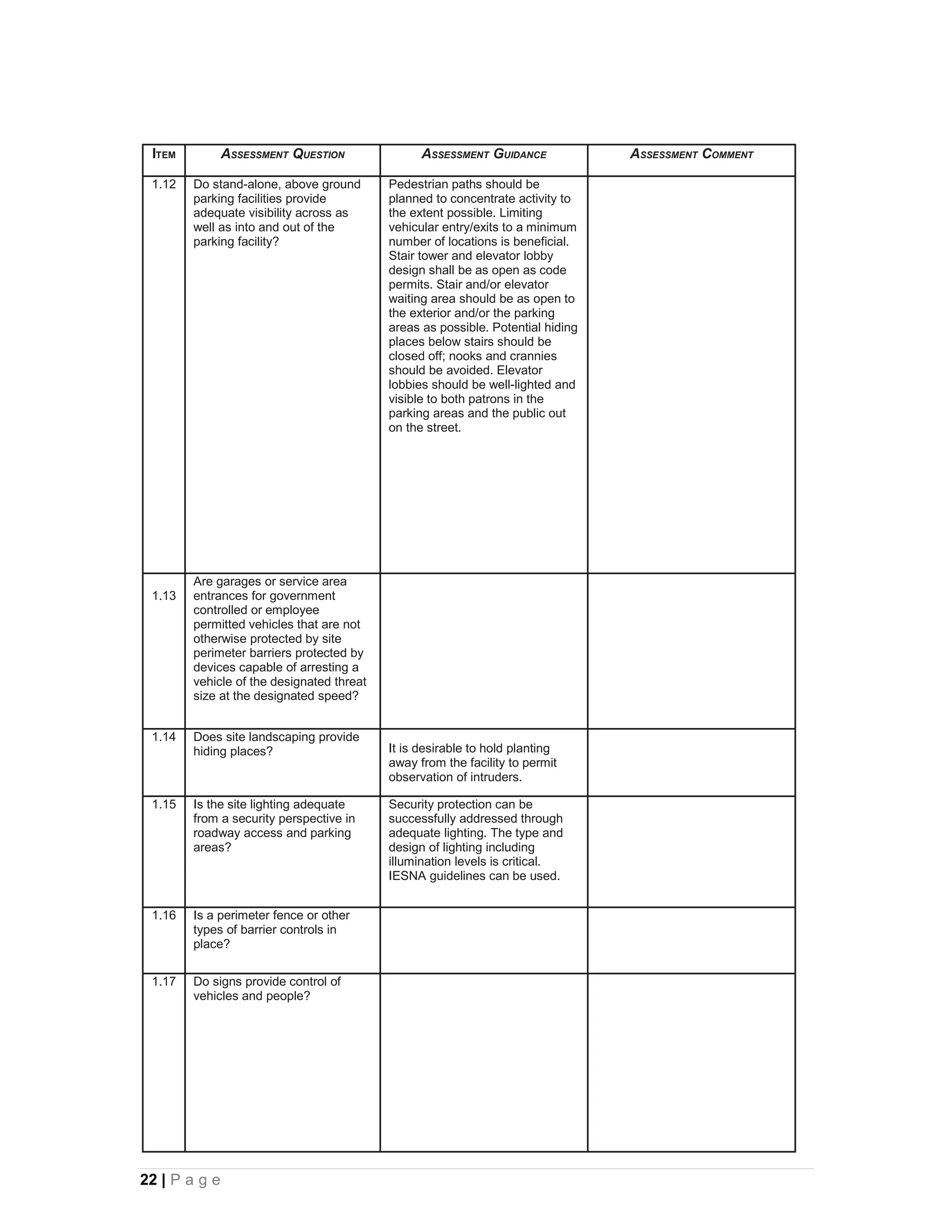
ITEM          ASSESSMENT QUESTION               ASSESSMENT GUIDANCE             ASSESSMENT COMMENT

 1.12   Do stand-alone, above ground       Pedestrian paths should be
        parking facilities provide         planned to concentrate activity to
        adequate visibility across as      the extent possible. Limiting
        well as into and out of the        vehicular entry/exits to a minimum
        parking facility?                  number of locations is beneficial.
                                           Stair tower and elevator lobby
                                           design shall be as open as code
                                           permits. Stair and/or elevator
                                           waiting area should be as open to
                                           the exterior and/or the parking
                                           areas as possible. Potential hiding
                                           places below stairs should be
                                           closed off; nooks and crannies
                                           should be avoided. Elevator
                                           lobbies should be well-lighted and
                                           visible to both patrons in the
                                           parking areas and the public out
                                           on the street.


        Are garages or service area
 1.13   entrances for government
        controlled or employee
        permitted vehicles that are not
        otherwise protected by site
        perimeter barriers protected by
        devices capable of arresting a
        vehicle of the designated threat
        size at the designated speed?


 1.14   Does site landscaping provide
        hiding places?                     It is desirable to hold planting
                                           away from the facility to permit
                                           observation of intruders.

 1.15   Is the site lighting adequate      Security protection can be
        from a security perspective in     successfully addressed through
        roadway access and parking         adequate lighting. The type and
        areas?                             design of lighting including
                                           illumination levels is critical.
                                           IESNA guidelines can be used.


 1.16   Is a perimeter fence or other
        types of barrier controls in
        place?

 1.17   Do signs provide control of
        vehicles and people?


22 | P a g e
ITEM         ASSESSMENT QUESTION                 ASSESSMENT GUIDANCE              ASSESSMENT COMMENT

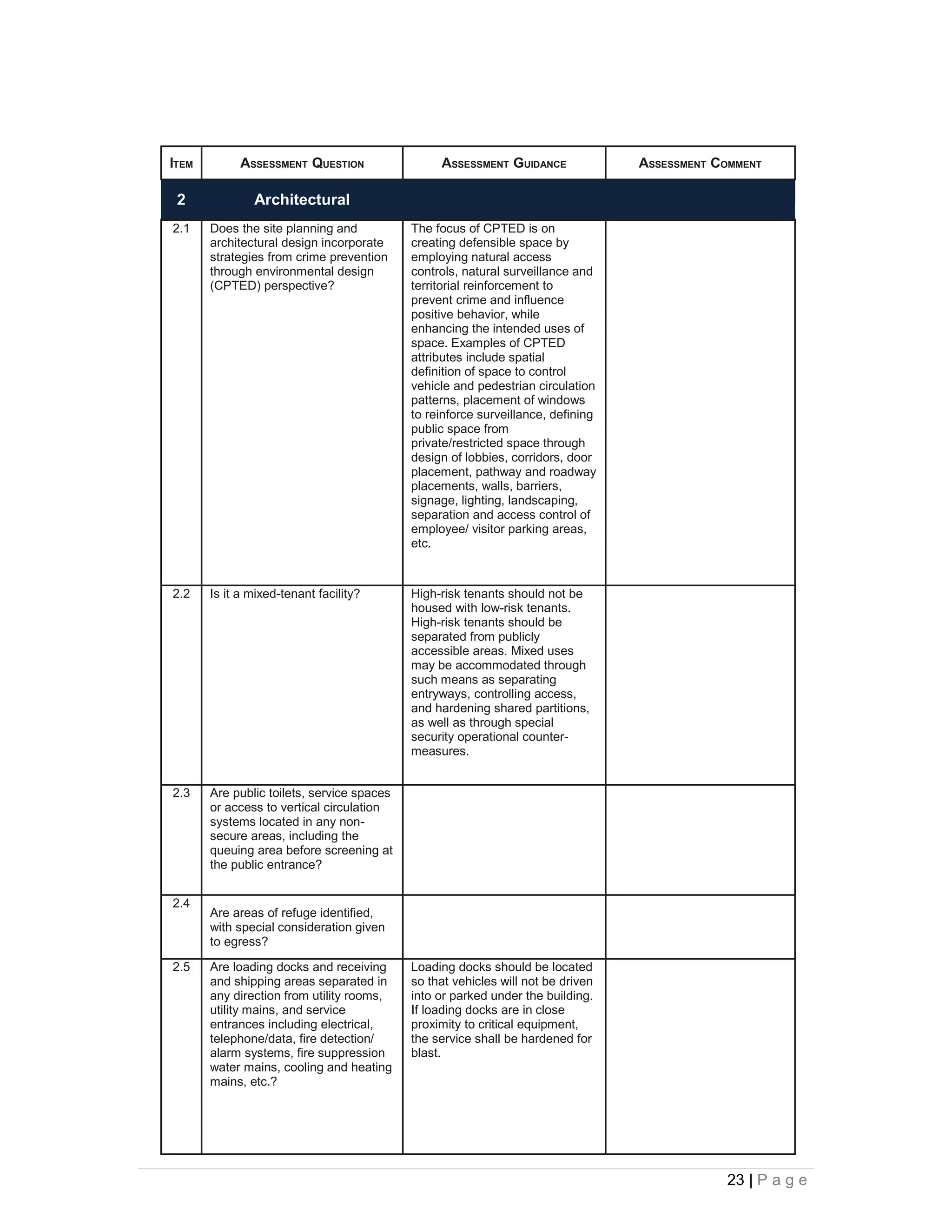
 2             Architectural
2.1    Does the site planning and           The focus of CPTED is on
       architectural design incorporate     creating defensible space by
       strategies from crime prevention     employing natural access
       through environmental design         controls, natural surveillance and
       (CPTED) perspective?                 territorial reinforcement to
                                            prevent crime and influence
                                            positive behavior, while
                                            enhancing the intended uses of
                                            space. Examples of CPTED
                                            attributes include spatial
                                            definition of space to control
                                            vehicle and pedestrian circulation
                                            patterns, placement of windows
                                            to reinforce surveillance, defining
                                            public space from
                                            private/restricted space through
                                            design of lobbies, corridors, door
                                            placement, pathway and roadway
                                            placements, walls, barriers,
                                            signage, lighting, landscaping,
                                            separation and access control of
                                            employee/ visitor parking areas,
                                            etc.


2.2    Is it a mixed-tenant facility?       High-risk tenants should not be
                                            housed with low-risk tenants.
                                            High-risk tenants should be
                                            separated from publicly
                                            accessible areas. Mixed uses
                                            may be accommodated through
                                            such means as separating
                                            entryways, controlling access,
                                            and hardening shared partitions,
                                            as well as through special
                                            security operational counter-
                                            measures.


2.3    Are public toilets, service spaces
       or access to vertical circulation
       systems located in any non-
       secure areas, including the
       queuing area before screening at
       the public entrance?


2.4
       Are areas of refuge identified,
       with special consideration given
       to egress?

2.5    Are loading docks and receiving      Loading docks should be located
       and shipping areas separated in      so that vehicles will not be driven
       any direction from utility rooms,    into or parked under the building.
       utility mains, and service           If loading docks are in close
       entrances including electrical,      proximity to critical equipment,
       telephone/data, fire detection/      the service shall be hardened for
       alarm systems, fire suppression      blast.
       water mains, cooling and heating
       mains, etc.?


                                                                                              23 | P a g e
ASSESSMENT QUESTION                 ASSESSMENT GUIDANCE                   ASSESSMENT COMMENT
     ITEM
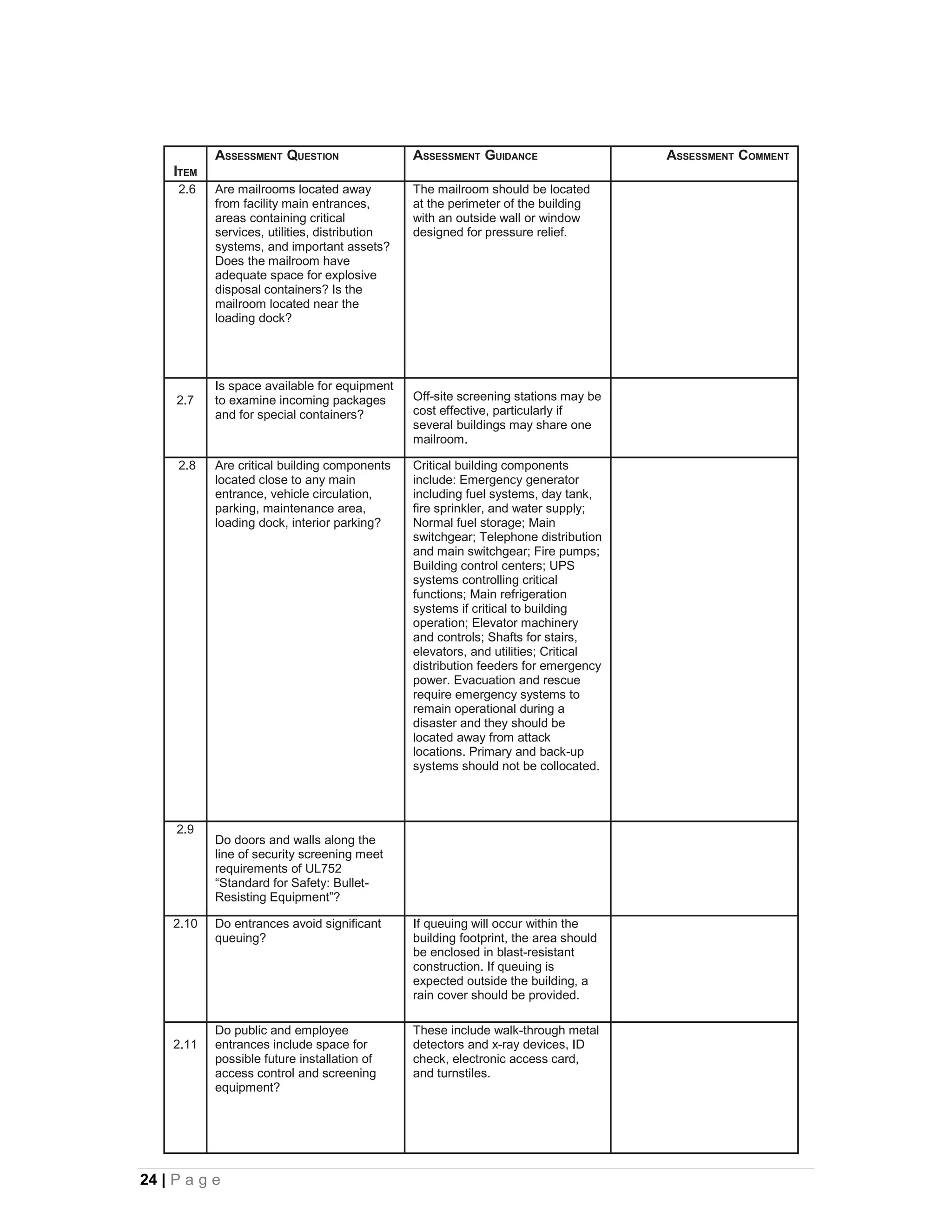
     2.6    Are mailrooms located away          The mailroom should be located
            from facility main entrances,       at the perimeter of the building
            areas containing critical           with an outside wall or window
            services, utilities, distribution   designed for pressure relief.
            systems, and important assets?
            Does the mailroom have
            adequate space for explosive
            disposal containers? Is the
            mailroom located near the
            loading dock?


            Is space available for equipment
     2.7    to examine incoming packages        Off-site screening stations may be
            and for special containers?         cost effective, particularly if
                                                several buildings may share one
                                                mailroom.

     2.8    Are critical building components    Critical building components
            located close to any main           include: Emergency generator
            entrance, vehicle circulation,      including fuel systems, day tank,
            parking, maintenance area,          fire sprinkler, and water supply;
            loading dock, interior parking?     Normal fuel storage; Main
                                                switchgear; Telephone distribution
                                                and main switchgear; Fire pumps;
                                                Building control centers; UPS
                                                systems controlling critical
                                                functions; Main refrigeration
                                                systems if critical to building
                                                operation; Elevator machinery
                                                and controls; Shafts for stairs,
                                                elevators, and utilities; Critical
                                                distribution feeders for emergency
                                                power. Evacuation and rescue
                                                require emergency systems to
                                                remain operational during a
                                                disaster and they should be
                                                located away from attack
                                                locations. Primary and back-up
                                                systems should not be collocated.


     2.9
            Do doors and walls along the
            line of security screening meet
            requirements of UL752
            “Standard for Safety: Bullet-
            Resisting Equipment”?

    2.10    Do entrances avoid significant      If queuing will occur within the
            queuing?                            building footprint, the area should
                                                be enclosed in blast-resistant
                                                construction. If queuing is
                                                expected outside the building, a
                                                rain cover should be provided.

            Do public and employee              These include walk-through metal
    2.11    entrances include space for         detectors and x-ray devices, ID
            possible future installation of     check, electronic access card,
            access control and screening        and turnstiles.
            equipment?


24 | P a g e
ASSESSMENT QUESTION                   ASSESSMENT GUIDANCE                   ASSESSMENT COMMENT
ITEM

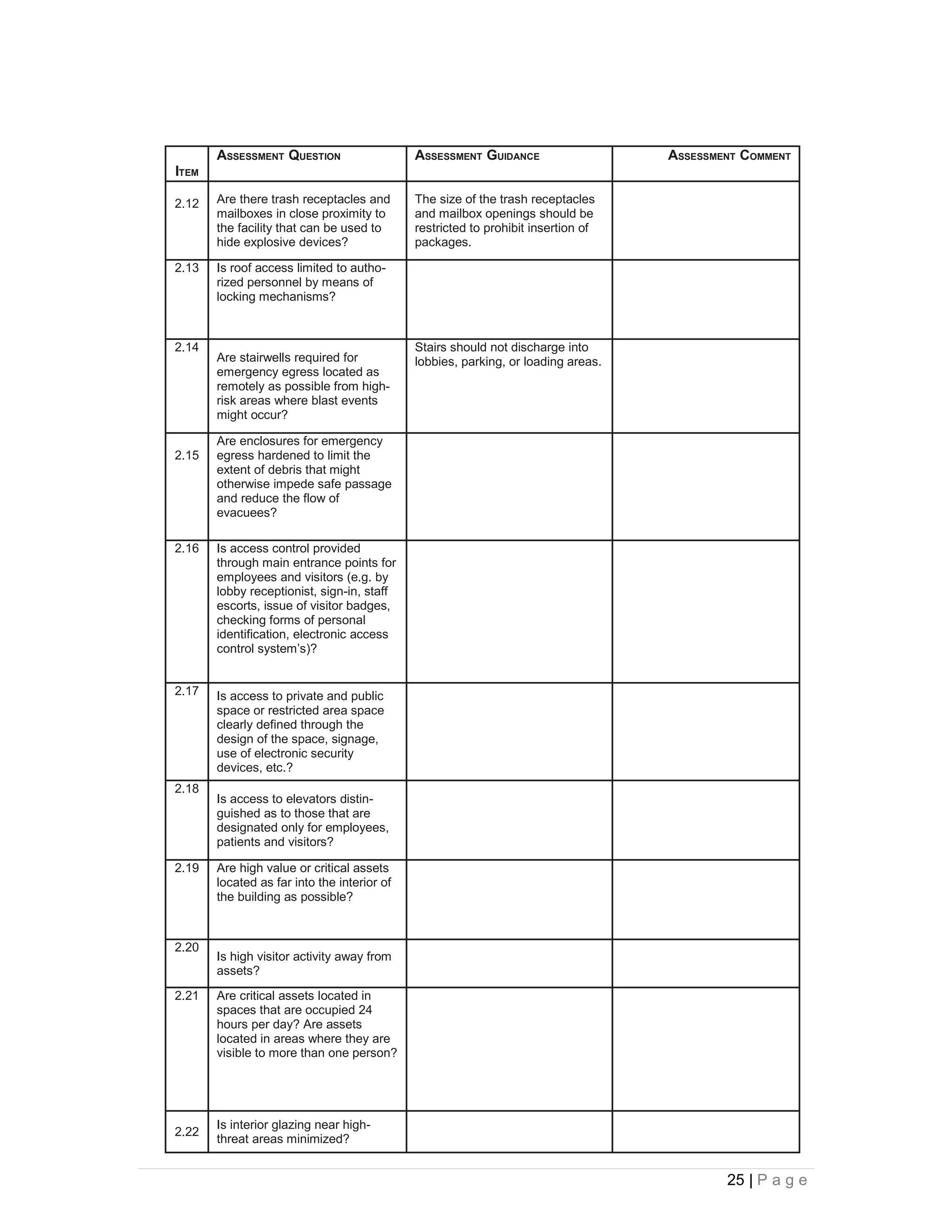
2.12   Are there trash receptacles and       The size of the trash receptacles
       mailboxes in close proximity to       and mailbox openings should be
       the facility that can be used to      restricted to prohibit insertion of
       hide explosive devices?               packages.

2.13   Is roof access limited to autho-
       rized personnel by means of
       locking mechanisms?


2.14                                         Stairs should not discharge into
       Are stairwells required for           lobbies, parking, or loading areas.
       emergency egress located as
       remotely as possible from high-
       risk areas where blast events
       might occur?

       Are enclosures for emergency
2.15   egress hardened to limit the
       extent of debris that might
       otherwise impede safe passage
       and reduce the flow of
       evacuees?

2.16   Is access control provided
       through main entrance points for
       employees and visitors (e.g. by
       lobby receptionist, sign-in, staff
       escorts, issue of visitor badges,
       checking forms of personal
       identification, electronic access
       control system’s)?


2.17   Is access to private and public
       space or restricted area space
       clearly defined through the
       design of the space, signage,
       use of electronic security
       devices, etc.?
2.18
       Is access to elevators distin-
       guished as to those that are
       designated only for employees,
       patients and visitors?

2.19   Are high value or critical assets
       located as far into the interior of
       the building as possible?


2.20
       Is high visitor activity away from
       assets?

2.21   Are critical assets located in
       spaces that are occupied 24
       hours per day? Are assets
       located in areas where they are
       visible to more than one person?


       Is interior glazing near high-
2.22
       threat areas minimized?


                                                                                           25 | P a g e
ASSESSMENT QUESTION                    ASSESSMENT GUIDANCE                    ASSESSMENT COMMENT
    ITEM
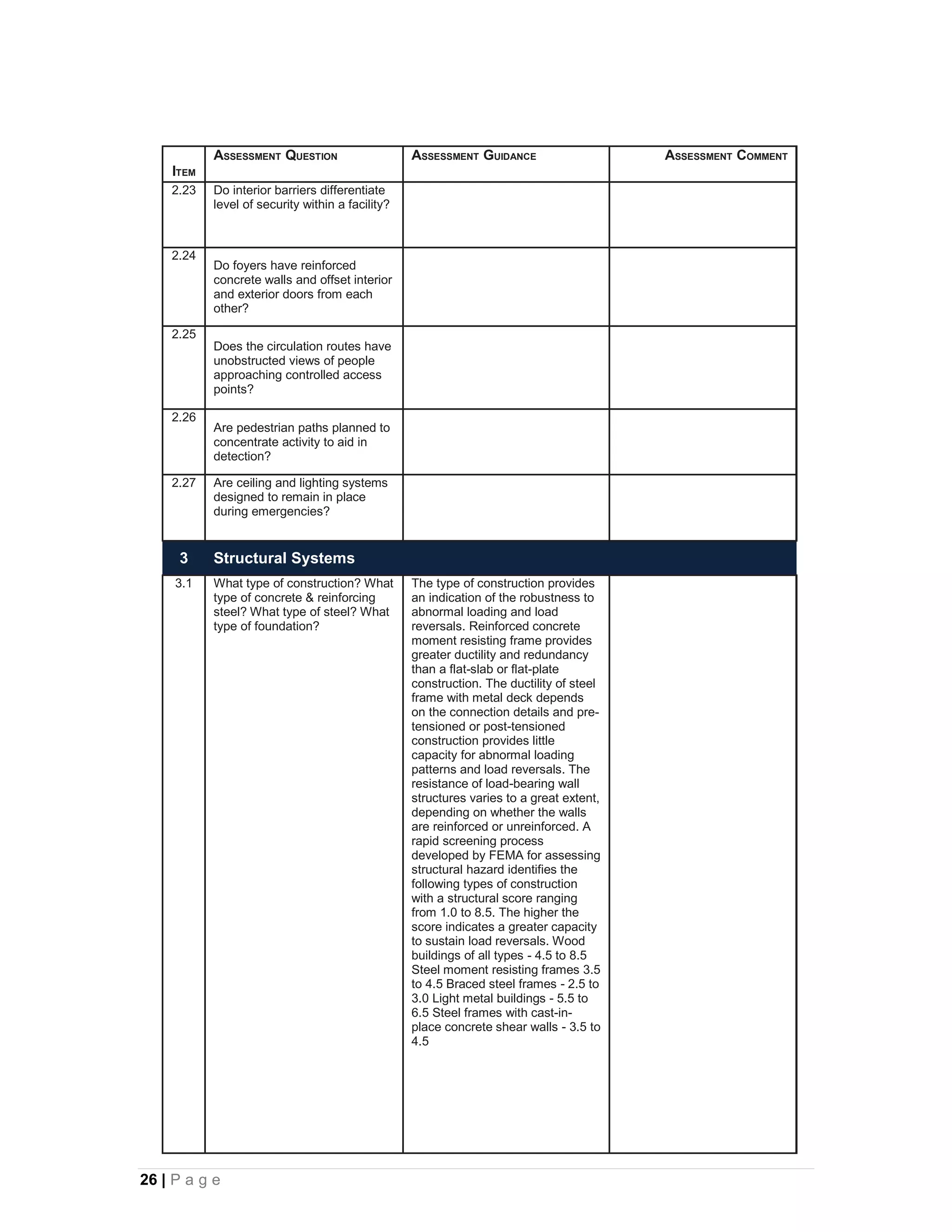
    2.23   Do interior barriers differentiate
           level of security within a facility?


    2.24
           Do foyers have reinforced
           concrete walls and offset interior
           and exterior doors from each
           other?

    2.25
           Does the circulation routes have
           unobstructed views of people
           approaching controlled access
           points?

    2.26
           Are pedestrian paths planned to
           concentrate activity to aid in
           detection?

    2.27   Are ceiling and lighting systems
           designed to remain in place
           during emergencies?


     3     Structural Systems
     3.1   What type of construction? What        The type of construction provides
           type of concrete & reinforcing         an indication of the robustness to
           steel? What type of steel? What        abnormal loading and load
           type of foundation?                    reversals. Reinforced concrete
                                                  moment resisting frame provides
                                                  greater ductility and redundancy
                                                  than a flat-slab or flat-plate
                                                  construction. The ductility of steel
                                                  frame with metal deck depends
                                                  on the connection details and pre-
                                                  tensioned or post-tensioned
                                                  construction provides little
                                                  capacity for abnormal loading
                                                  patterns and load reversals. The
                                                  resistance of load-bearing wall
                                                  structures varies to a great extent,
                                                  depending on whether the walls
                                                  are reinforced or unreinforced. A
                                                  rapid screening process
                                                  developed by FEMA for assessing
                                                  structural hazard identifies the
                                                  following types of construction
                                                  with a structural score ranging
                                                  from 1.0 to 8.5. The higher the
                                                  score indicates a greater capacity
                                                  to sustain load reversals. Wood
                                                  buildings of all types - 4.5 to 8.5
                                                  Steel moment resisting frames 3.5
                                                  to 4.5 Braced steel frames - 2.5 to
                                                  3.0 Light metal buildings - 5.5 to
                                                  6.5 Steel frames with cast-in-
                                                  place concrete shear walls - 3.5 to
                                                  4.5


26 | P a g e
ITEM   ASSESSMENT QUESTION                   ASSESSMENT GUIDANCE                  ASSESSMENT COMMENT

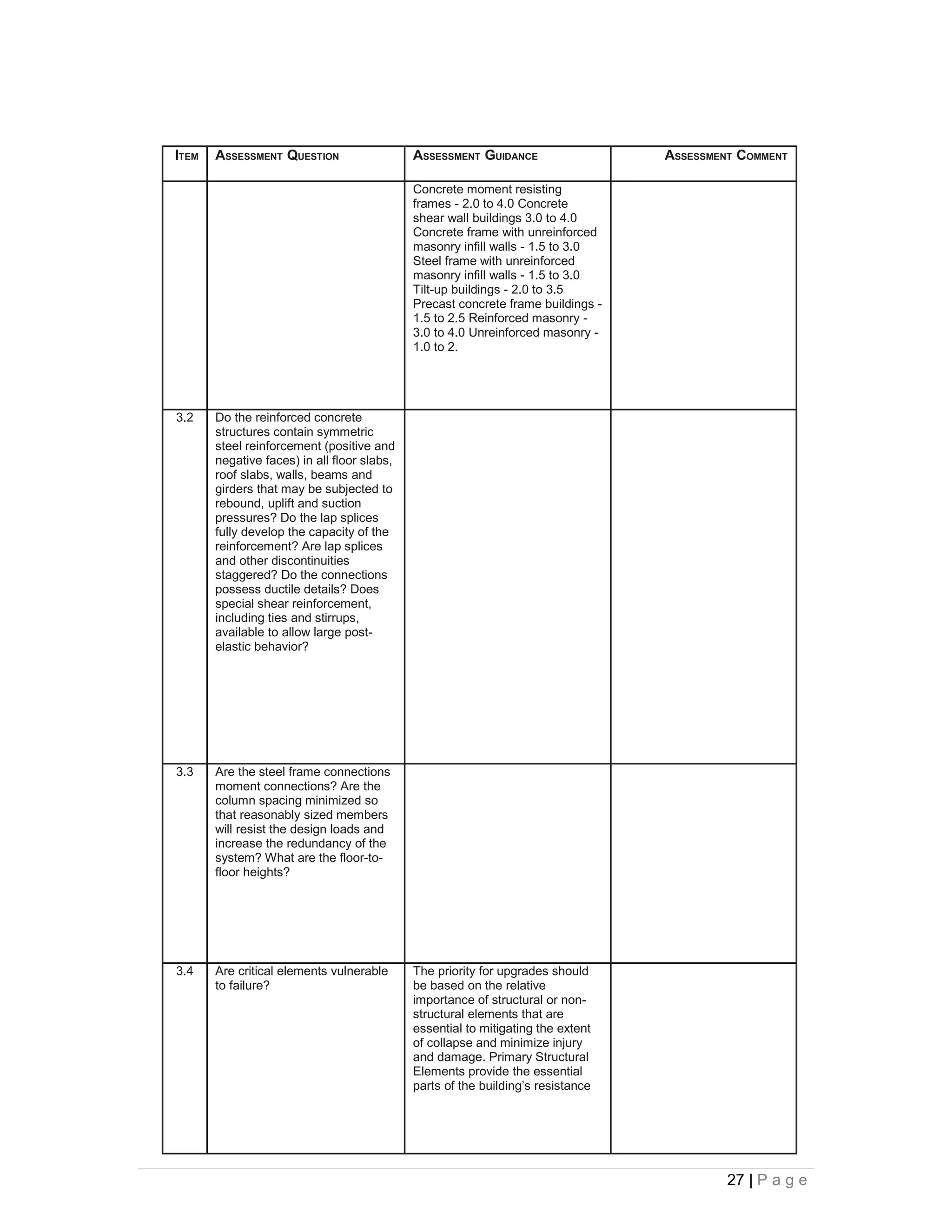
                                             Concrete moment resisting
                                             frames - 2.0 to 4.0 Concrete
                                             shear wall buildings 3.0 to 4.0
                                             Concrete frame with unreinforced
                                             masonry infill walls - 1.5 to 3.0
                                             Steel frame with unreinforced
                                             masonry infill walls - 1.5 to 3.0
                                             Tilt-up buildings - 2.0 to 3.5
                                             Precast concrete frame buildings -
                                             1.5 to 2.5 Reinforced masonry -
                                             3.0 to 4.0 Unreinforced masonry -
                                             1.0 to 2.


3.2    Do the reinforced concrete
       structures contain symmetric
       steel reinforcement (positive and
       negative faces) in all floor slabs,
       roof slabs, walls, beams and
       girders that may be subjected to
       rebound, uplift and suction
       pressures? Do the lap splices
       fully develop the capacity of the
       reinforcement? Are lap splices
       and other discontinuities
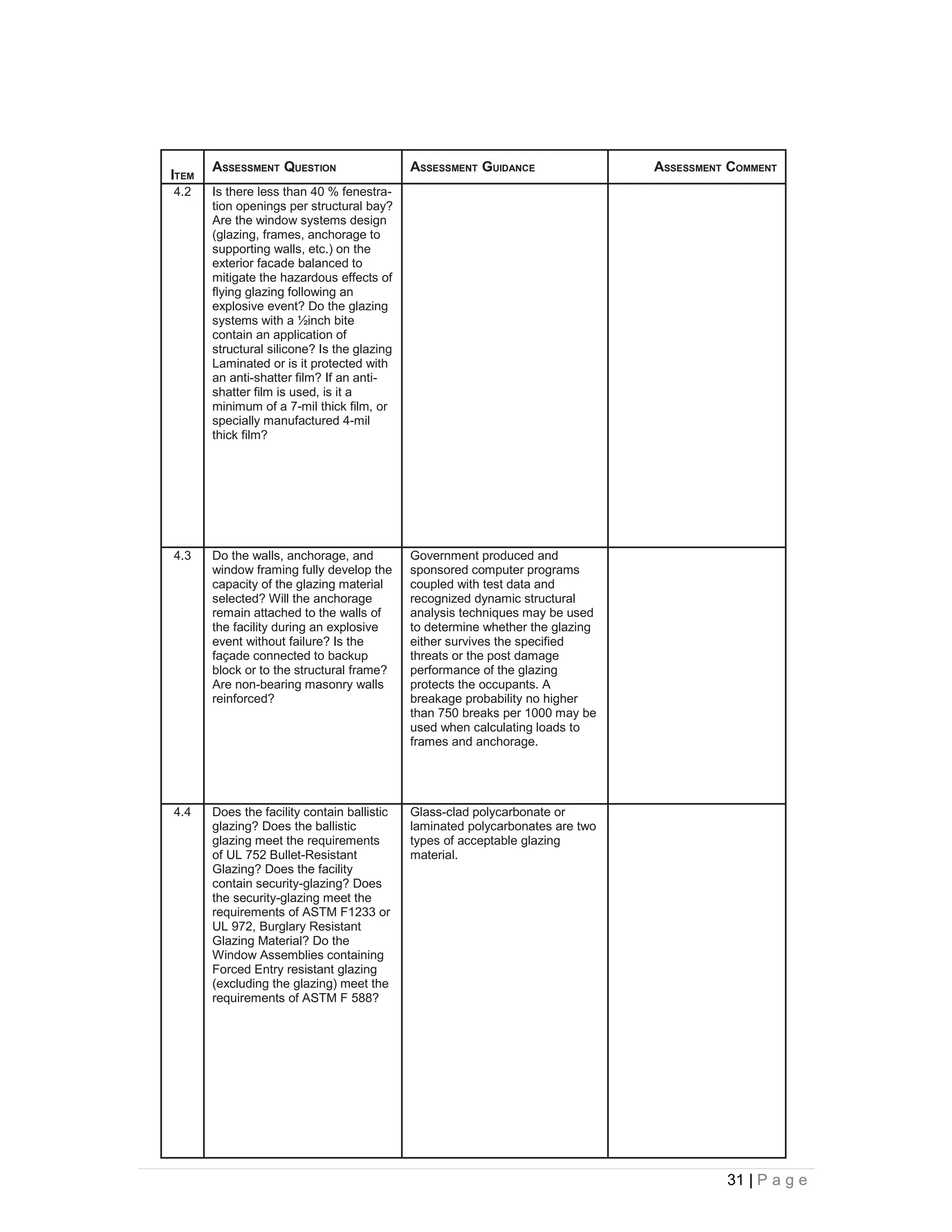
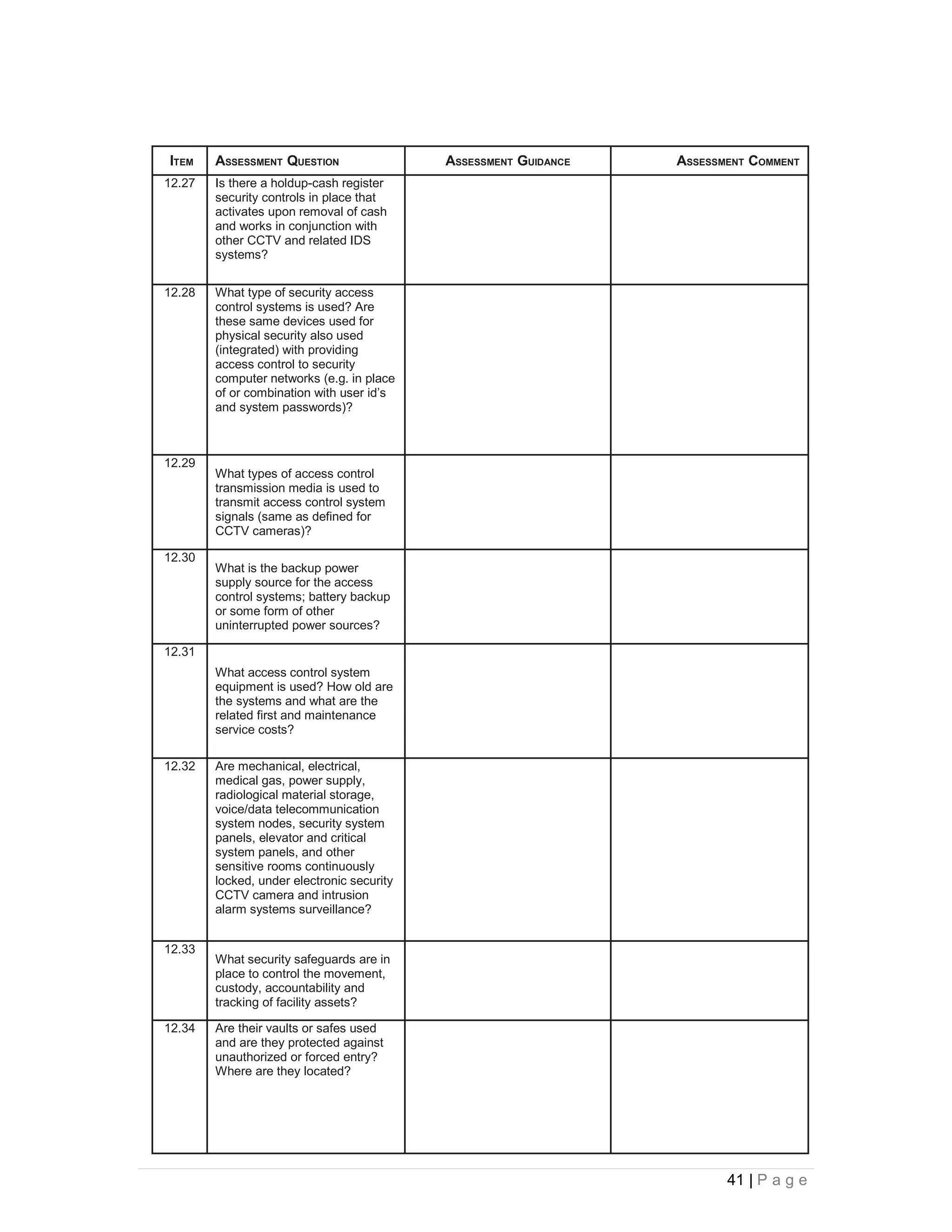
       staggered? Do the connections
       possess ductile details? Does
       special shear reinforcement,
       including ties and stirrups,
       available to allow large post-
       elastic behavior?


3.3    Are the steel frame connections
       moment connections? Are the
       column spacing minimized so
       that reasonably sized members
       will resist the design loads and
       increase the redundancy of the
       system? What are the floor-to-
       floor heights?


3.4    Are critical elements vulnerable      The priority for upgrades should
       to failure?                           be based on the relative
                                             importance of structural or non-
                                             structural elements that are
                                             essential to mitigating the extent
                                             of collapse and minimize injury
                                             and damage. Primary Structural
                                             Elements provide the essential
                                             parts of the building’s resistance


                                                                                           27 | P a g e
ITEM    ASSESSMENT QUESTION             ASSESSMENT GUIDANCE                     ASSESSMENT COMMENT

                                          Catastrophic blast loads and
                                          progressive collapse. These
                                          include columns, girders, roof
                                          beams, and the main lateral
                                          resistance system; Secondary
                                          Structural Elements consist of all
                                          other load bearing members, such
                                          as floor beams, slabs, etc.;
                                          Primary Non-Structural Elements
                                          consist of elements (including
                                          their attachments) which are
                                          essential for life safety systems or
                                          elements which can cause
                                          substantial injury if failure occurs,
                                          including ceilings or heavy
                                          suspended mechanical units; and
                                          Secondary Non-Structural
                                          Elements consist of all elements
                                          not covered in primary non-
                                          structural elements, such as
                                          partitions, furniture, and light
                                          fixtures.


   3.5    Will the structure suffer an    The extent of damage to the
          unacceptable level of damage    structure and exterior wall
          resulting from the postulated   systems from the bomb threat
          threat?                         may be related to a protection
                                          level: Low and Medium/Low Level
                                          Protection - Major damage. The
                                          facility or protected space will
                                          sustain a high level of damage
                                          without progressive collapse.
                                          Casualties will occur and assets
                                          will be damaged. Building
                                          components, including structural
                                          members, will require replace-
                                          ment, or the building may be
                                          completely un-repairable,
                                          requiring demolition and
                                          replacement. Medium Level
                                          Protection Moderate damage,
                                          repairable. The facility or
                                          protected space will sustain a
                                          significant degree of damage, but
                                          the structure should be reusable.
                                          Some casualties may occur and
                                          assets may be damaged.
                                          Building elements other than
                                          major structural members may
                                          require replacement. Higher Level
                                          Protection - Minor damage,
                                          repairable. The facility or
                                          protected space may globally
                                          sustain minor damage with some


28 | P a g e
ASSESSMENT QUESTION                  ASSESSMENT GUIDANCE                     ASSESSMENT COMMENT
ITEM

                                            local significant damage possible.
                                            Occupants may incur some injury,
                                            and assets may receive minor
                                            damage.

3.6    Is the structure vulnerable to       Design to mitigate progressive
       progressive collapse? Is the         collapse is an independent
       facility capable of sustaining the   analysis to determine a system’s
       removal of a column for one          ability to resist structural collapse
       floor above grade at the building    upon the loss of a major structural
       perimeter without progressive        element or the system’s ability to
       collapse? In the event of an         resist the loss of a major
       internal explosion in an             structural element. Design to
       uncontrolled public ground floor     mitigate progressive collapse may
       area (such as lobbies, loading       be based on the methods outlined
       docks and mailrooms) does the        in ASCE 7-98. Designers may
       design prevent progressive           apply static and/ or dynamic
       collapse due to the loss of one      methods of analysis to meet this
       primary column or does the           requirement and ultimate load
       design preclude such a loss? Do      capacities may be assumed in the
       architectural or structural          analyses. Existing buildings
       features provide a minimum 6-        should not be retrofitted to
       inch standoff to the internal        prevent progressive collapse
       columns? Are the columns in the      unless they are undergoing a
       unscreened internal spaces           structural renovation, such as a
       designed for an un-braced            seismic upgrade. Existing facilities
       length equal to two floors, or       may be retrofitted to withstand the
       three floors where there are two     design level threat or to accept
       levels of parking?                   the loss of a column for one floor
                                            above grade at the building
                                            perimeter without progressive
                                            collapse.


3.7    Are there adequate redundant         Special consideration should be
       load paths in the structure?         given to materials which have
                                            inherent ductility and which are
                                            better able to respond to load
                                            reversals such as cast in place
                                            reinforced concrete and steel
                                            construction. Careful detailing is
                                            required for material such as pre-
                                            stressed concrete, pre-cast
                                            concrete, and masonry to
                                            adequately respond to the design
                                            loads. Primary vertical load
                                            carrying members shall be
                                            protected where parking is inside
                                            a facility and the building
                                            superstructure is supported by the
                                            parking structure.


3.8    Will the loading dock design limit   The floor of the loading dock does
       damage to adjacent areas and         not need to be designed for blast
       vent explosive force to the          resistance if the area below is not
       exterior of the building?            occupied and contains no critical
                                            utilities.


                                                                                              29 | P a g e
ASSESSMENT QUESTION                   ASSESSMENT GUIDANCE                 ASSESSMENT COMMENT
      ITEM
       3.9     Are mailrooms, where packages         Where mailrooms and
               are received and opened for           unscreened retail spaces are
               inspection, and unscreened            located in occupied areas or
               retail spaces designed to             adjacent to critical utilities,
               mitigate the effects of a blast on    walls, ceilings, and floors, they
               primary vertical or lateral bracing   should be blast and fragment
               members?                              resistant. Methods to facilitate
                                                     the venting of explosive forces
                                                     and gases from the interior
                                                     spaces to the outside of the
                                                     structure may include blow-out
                                                     panels and window system
                                                     designs that provide protection
                                                     from blast pressure applied to
                                                     the outside but that readily fail
                                                     and vent if exposed to blast
                                                     pressure on the inside.


      3.10     Are there transfer girders that
               are supported by columns within
               unscreened public spaces or at
               the exterior of the building?


       4       Building Envelope
      4.1      To what level are the exterior        The performance of the façade
               Walls designed to provide less        varies to a great extent on the
               than a high hazard response?          materials. Different
               Are the walls capable of              construction includes brick or
               withstanding the dynamic              stone with block back-up, steel
               reactions from the windows?           stud walls, precast panels,
                                                     curtainwall with glass, stone or
                                                     metal panel elements. The
                                                     performance of the glass will
                                                     similarly depend on the
                                                     materials. Glazing may be
                                                     single pane or double pane,
                                                     monolithic or laminated,
                                                     annealed, heat strengthened or
                                                     fully tempered.Shear walls that
                                                     are essential to the lateral and
                                                     vertical load bearing system,
                                                     and that also function as
                                                     exterior walls, shall be
                                                     considered primary structures
                                                     and shall resist the actual blast
                                                     loads predicted from the
                                                     threats specified. Where
                                                     exterior walls are not designed
                                                     for the full design loads,
                                                     special consideration shall be
                                                     given to construction types that
                                                     reduce the potential for injury.
                                                     As a minimum goal, the
                                                     window systems should be
                                                     designed so that at least __ %
                                                     of the total glazed areas of the
                                                     facility meet the specified
                                                     performance conditions when
                                                     subjected to the defined
                                                     threats.


30 | P a g e
ASSESSMENT QUESTION                   ASSESSMENT GUIDANCE                ASSESSMENT COMMENT
ITEM
4.2    Is there less than 40 % fenestra-
       tion openings per structural bay?
       Are the window systems design
       (glazing, frames, anchorage to
       supporting walls, etc.) on the
       exterior facade balanced to
       mitigate the hazardous effects of
       flying glazing following an
       explosive event? Do the glazing
       systems with a ½inch bite
       contain an application of
       structural silicone? Is the glazing
       Laminated or is it protected with
       an anti-shatter film? If an anti-
       shatter film is used, is it a
       minimum of a 7-mil thick film, or
       specially manufactured 4-mil
       thick film?


4.3    Do the walls, anchorage, and          Government produced and
       window framing fully develop the      sponsored computer programs
       capacity of the glazing material      coupled with test data and
       selected? Will the anchorage          recognized dynamic structural
       remain attached to the walls of       analysis techniques may be used
       the facility during an explosive      to determine whether the glazing
       event without failure? Is the         either survives the specified
       façade connected to backup            threats or the post damage
       block or to the structural frame?     performance of the glazing
       Are non-bearing masonry walls         protects the occupants. A
       reinforced?                           breakage probability no higher
                                             than 750 breaks per 1000 may be
                                             used when calculating loads to
                                             frames and anchorage.


4.4    Does the facility contain ballistic   Glass-clad polycarbonate or
       glazing? Does the ballistic           laminated polycarbonates are two
       glazing meet the requirements         types of acceptable glazing
       of UL 752 Bullet-Resistant            material.
       Glazing? Does the facility
       contain security-glazing? Does
       the security-glazing meet the
       requirements of ASTM F1233 or
       UL 972, Burglary Resistant
       Glazing Material? Do the
       Window Assemblies containing
       Forced Entry resistant glazing
       (excluding the glazing) meet the
       requirements of ASTM F 588?


                                                                                          31 | P a g e
ITEM   ASSESSMENT QUESTION                  ASSESSMENT GUIDANCE                    ASSESSMENT COMMENT
    4.5    Do non-window openings, such         In-filling of blast over-pressures
           as mechanical vents and              must be considered through non-
           exposed plenums, provide the         window openings such that
           same level of protection required    structural members and all
           for the exterior wall? Are non-      mechanical system mountings
           window openings, such as             and attachments should resist
           mechanical vents and exposed         these interior fill pressures.
           plenums, designed to the level
           of protection required for the
           exterior wall?


    4.6    Is interior glazing shatter
           resistant?                           Interior glazing should be
                                                minimized where a threat exists
                                                and should be avoided in
                                                enclosures of critical functions
                                                next to high-risk areas.


     5     Utility Systems
    5.1    What is the source of domestic       Critical water supply may be
           water?                               vulnerable. Sources include
                                                municipal, wells, storage tank.

    5.2    Are there multiple entry points
           for the water supply?                If the facility has only one source
                                                of water entering at one location,
                                                the entry points should be secure.

    5.3    Is the incoming water supply in a
           secure location?                     Access to water supply should
                                                not be open to non-authorized
                                                personnel.

    5.4
           Does the facility have storage       Operational facilities will require
           capacity for domestic water?         reliance on adequate domestic
           How much?                            water supply.
    5.5    What is the source of water for
           the fire suppression system?         Describe location and number of
                                                service entry points. Is the service
                                                reliant on the local utility
                                                company?

    5.6    Are sewer systems protected?
           Are they accessible?                 Sanitary and storm water sewers
                                                should be protected from
                                                unauthorized access and possible
                                                contamination.

    5.7    What fuel supplies do the facility
           rely on for critical operation?      Typically natural gas, propane, or
                                                fuel oil are required for continued
                                                operation

    5.8    How much fuel is stored on the       Fuel storage protection is
           facility? How is it stored?          essential for continued operation.


32 | P a g e
ITEM   ASSESSMENT QUESTION                    ASSESSMENT GUIDANCE                      ASSESSMENT COMMENT

5.9                                           The supply of fuel is dependent
                                              on the reliability of the supplier.
       Where is the fuel supply
       obtained? How is it delivered?


                                              Critical functions may be served
5.10   Are there alternate sources of         by alternate methods if normal
       fuel? Can alternate fuels be           fuel supply is interrupted.
       used?

       What is the normal source of
5.11   electrical service for the facility?   Utilities are the general source
                                              unless co-generation or a private
                                              energy provider is available.

5.12   Is there a redundant electrical
       service source? Can the                The utility may have only one
       facilities be feed from more than      source of power from a single
       one utility substation?                substation. There may be only
                                              single feeders from the main
                                              substation.

       How may service entry points
5.13   does the facility have for             Electrical supply at one location
       electricity?                           creates a vulnerable situation
                                              unless alternate source are
                                              available.

       What provisions for emergency
5.14   power exist?                           Describe the emergency power
                                              system and its location. Can the
                                              utility provide backup power if the
                                              normal electrical service is
                                              interrupted?

5.15   Is the incoming electric service
       to the building secure?                Typically, the service entrance is
                                              a locked room, unaccessible to
                                              the public.

5.16   Does the fire alarm system
       require communication with             Typically, the local fire department
       external sources?                      responds to an alarm. Describe
                                              how the alarm signal is sent to the
                                              responding agency: telephone,
                                              radio, etc.

5.17                                          Typically communication ducts or
       By what means does the main            other conducts are available.
       telephone and data communica-
       tions interface the facility?

5.18
       Are there multiple or redundant        Secure locations of communica-
       location for the communication         tions wiring entry to the facility are
       service?                               required.


 6     Mechanical Systems
6.1    Where are the air intakes and
       exhaust louvers for the building?      Describe location and relation to
                                              public access. Indicate if intakes
                                              are low, high or midpoint of
                                              building structure.

6.2    Are there multiple air intake          Single air intakes may feed
       locations?                             several air handling units. Indicate
                                              if the air intakes are localized or
                                              separated.


                                                                                                    33 | P a g e
ITEM   ASSESSMENT QUESTION                   ASSESSMENT GUIDANCE                     ASSESSMENT COMMENT
    6.3    What are the types of air
           filtration?                           Describe the efficiency and
                                                 number of filter modules for each
                                                 of the main air handling systems.

           Is there space for larger filter
    6.4    assemblies on critical air            Air handling units serving critical
           handling systems?                     functions during continued
                                                 operation may be retrofitted to
                                                 provide enhanced protection
                                                 during emergencies.

    6.5    How are the air handling
           systems zoned?                        Describe the areas and functions
                                                 served by each of the primary air
                                                 handling systems.

     6.6                                         Independent units can continue to
           Are there large central air           operate if damage occurs to
           handling units or are there           limited areas of the facility.
           multiple units serving separate
           zones?

           Are there any redundancies in
    6.7    the air handling system?              Describe if critical areas can be
                                                 served from other units if a major
                                                 system is disabled.

    6.8    Is the air supply to critical areas
           compartmentalized?                    Describe if air flow can occur from
                                                 critical to non-critical areas either
                                                 through building openings,
                                                 ductwork, or air handling system.

    6.9
           Are supply and exhaust air
           systems for laboratories secure?

    6.10
                                                 Central systems can range from
           What is the method of tempera-
                                                 monitoring only to full control.
           ture and humidity control? Is it
                                                 Local control may be available to
           localized or centralized?
                                                 override central operation.

    6.11   Where are the control centers         Access to any component of the
           and cabinets located? Are they        building automation and control
           in secure areas? How is the           system could compromise the
           control wiring routed?                functioning of the system.


    6.12   Are there provisions for air          Duct mounted sensors are found
           monitors or sensors for chemical      in limited cases generally in
           or biological agents?                 laboratory areas.

     7     Plumbing and Gas                      Systems
    7.1    What is the method of water
           distribution?                         Central shaft locations for piping
                                                 are more vulnerable than multiple
                                                 riser locations.

    7.2    What is the method of medical
           gas distribution?


34 | P a g e
ITEM   ASSESSMENT QUESTION                     ASSESSMENT GUIDANCE                   ASSESSMENT COMMENT
7.3    Is there redundancy to the main
       piping distribution?                    Looping of piping and use of
                                               section valves provide redun-
                                               dancy in the event sections of the
                                               system are damaged.

7.4    What is the method of heating
       domestic water? What fuel is            Single source of hot water with
       used?                                   one fuel source is more
                                               vulnerable than multiple sources
                                               and multiple fuel types.

7.5
                                               Describe the locations relative to
       Where are the oxygen and
                                               the facility including any blast
       nitrous oxide tanks located?
                                               protection? Indicate if the
       How are they piped to the
                                               distribution piping is above or
       distribution system?
                                               belowground.

7.6    Are there reserve supplies of
       oxygen and nitrous oxide?               Localized gas cylinders could be
                                               available in the event of damage
                                               to the central tank system.

 8     Electrical Systems
8.1    How are the electrical rooms
       secured?                                Describe if all primary electrical
                                               equipment is located in a secured
                                               area.

8.2    Are critical electrical systems co-
       located with other building             Indicate those areas where major
       systems?                                electrical equipment is colocated
                                               with other systems or is located in
                                               areas outside secured electrical
                                               areas.

8.3    Are electrical distribution panels
       secured or in secure locations?         Describe the means of access
                                               and location of critical electrical
                                               distribution panels serving branch
                                               circuits.

8.4
       Does emergency backup power             Is the emergency power system
       exist for all areas within the          independent from the normal
       facility? How is the emergency          electrical service, particularly in
       power distributed?                      critical care areas?
8.5
                                               Central utility shafts may be
       How is the primary electrical
                                               subject to damage. Describe if the
       system wiring distributed? Is
                                               distribution is co-located with
       there redundancy of distribution
                                               other major utilities and if there
       to critical areas?
                                               are alternate suppliers.

8.6    What is the extent of the
       external facility lighting in utility   Indicate the amount of exterior
       and service areas?                      lighting particularly in critical
                                               areas such as utility and service
                                               areas.

8.7    Are there any transformers or           Describe how these devices are
       switchgears located outside the         secured and if they are vulnerable
       building or accessible from the         to public access.
       building exterior?


                                                                                                     35 | P a g e
ITEM   ASSESSMENT QUESTION                    ASSESSMENT GUIDANCE                    ASSESSMENT COMMENT

   9     Fire Alarm Systems
  9.1    Is the facility fire alarm system
         centralized or localized?              Describe the main components of
                                                the system including methods and
                                                extent of annunciation both locally
                                                and centrally.

  9.2    Where are the fire alarm panels
         located?                               Indicate the location and
                                                accessibility of the panels
                                                particularly with regard to access
                                                by unauthorized personnel.

  9.3                                           Describe what interface the fire
         Is the fire alarm system stand-        alarm system has with other
         alone or integrated with other         building management systems.
         functions such as security and
         environmental systems?

         Communications and IT
  10                                            tems
         Sys
 10.1    Where are communication
         systems wiring closets located?        Describe if communications
         Are they in secure areas?              closets are independent or if they
                                                are co-located with other utilities.

         How is communications system
 10.2    wiring distributed?                    Indicate if wiring systems are in
                                                chases or if distribution is in
                                                occupied areas.

         Are there redundant
 10.3    communications systems                 Critical areas should be supplied
         available?                             with multiple or redundant means
                                                of communications.
 10.4
         Do the IT systems meet require-
         ments of confidentiality, integrity,
         and availability?

 10.5
         Where is the disaster recovery/
         mirroring site?

 10.6    Where is the back-up tape/file
         storage site and what is the type
         of safe environment? (safe,
         vault, underground) Is there
         redundant refrigeration in the
         site?


 10.7    Where is the main distribution
         facility? Where are the
         secondary and/or intermediate
         distribution facilities?


 10.8    Where are the routers and
         firewalls located?


36 | P a g e
ITEM   ASSESSMENT QUESTION                  ASSESSMENT GUIDANCE                    ASSESSMENT COMMENT
10.9
       What type, power rating, and
       location of the UPS? (battery,
       online, filtered)

10.1
0      What type and where are the
       WAN connections?

10.1
1      What type and where are the
       wireless systems (RF, HF, VHG,
       MW) located?

10.1
2      What type of LAN (Cat 5, fiber,
       Ethernet, Token Ring) is used?


10.1   What type and where are data
3      centers located?

       Equipment Operations
11                                          Maintenance
       and
11.1                                        Rebalancing may only occur
       Have critical air systems been       during renovation.
       rebalanced? If so, when and
       how often?

11.2   Is air pressurization monitored
       regularly?                           Some areas required positive or
                                            negative pressure to function
                                            properly. Pressurization is critical
                                            in a hazardous environment or
                                            emergency situation.

11.3
                                            Describe if there are composite
       Are there composite drawings
                                            layout drawings of electrical,
       indicating location and
                                            mechanical and fire protection
       capacities of major systems? Do
                                            systems and the status of latest
       updated O&M manuals exist?
                                            updates.

11.4   Does the facility have a policy or
       procedure for periodic               Recommissioning involves testing
       decommissioning of major             and balancing of systems to
       M/E/P systems?                       ascertain their capability to
                                            perform as described.

11.5   Is there an adequate operations      Describe level of maintenance
       and maintenance program              and operation and the extent of
       including training of facilities     training provided at the facility.
       management staff?

11.6
       What maintenance and service
       agreements exist for MEP
       systems?


12     Security Systems

       Perimeter Security

12.1
       Are black/white or color CCTV
       cameras used? Are they analog
       or digital by design?


                                                                                         37 | P a g e
ITEM   ASSESSMENT QUESTION                ASSESSMENT GUIDANCE                    ASSESSMENT COMMENT
          What are the number of fixed,      Security technology is frequently
          wireless and pan-tilt-zoom         considered to compliment or
          cameras used? Who are the          supplement security personnel
          manufacturers of the CCTV          forces and to provide a wider area
          cameras? What is the age of the    of coverage. Typically these
          CCTV cameras in use?               physical security elements
                                             provide the first line of defense in
                                             deterring, detecting and
                                             responding to threats and
                                             vulnerabilities. They must be
                                             viewed are an integral component
                                             of the overall security program.
                                             Their design, engineering,
                                             installation, operation and
                                             management must be able to
                                             meet daily security challenges
                                             from a cost effective and
                                             efficiency perspective.


   12.2   Are the cameras programmed to      Example, if a perimeter door is
          respond automatically to           opened, the closest camera
          perimeter building alarm events?   responds and begins surveillance
          Do they have built-in video        of the area.
          motion capabilities?


   12.3   Are panic/duress alarm sensors
          used, where are they located
          and are they hardwired or
          portable?


   12.4
          Are intercom call-boxes used in
          parking areas or along the
          building perimeter?

   12.5   Are the perimeter cameras
          supported by an uninterrupted
          power supply source; battery or
          building emergency power?


   12.6   What is the quality of video
          images both during the day and
          hours of darkness? Are infrared
          camera illuminators used?


   12.7   What is the transmission media
          used to transmit camera video
          signals: fiber, wire line,
          telephone wire, coaxial,
          wireless?


   12.8   What type of camera housings
          are used and are they environ-
          mental in design to protect
          against exposure to heat and
          cold weather elements?


38 | P a g e
ITEM    ASSESSMENT QUESTION                 ASSESSMENT GUIDANCE                ASSESSMENT COMMENT
12.9    Who monitors the CCTV
        system?

12.10   What type of exterior IDS
        sensors are used:
        electromagnetic, fiber optic,
        active infrared, bistatic
        microwave, seismic,
        photoelectric, ground, fence,
        glass break (vibration/shock),
        single, double and roll-up door
        magnetic contacts or switches.

12.11   Is a global positioning satellite
        system (GPS) used to monitor
        vehicles and asset
        movements?

        Interior Security

12.12   Are black/white or color CCTV
        cameras used? Are they
        monitored and recorded 24
        hours/7 days a week? By
        whom? Are they analog or
        digital by design? What are
        the number of fixed, wireless
        and pan-tilt-zoom cameras
        used? Who are the
        manufacturers of the CCTV
        cameras? What is the age of
        the CCTV cameras in use?


12.13   Are the cameras programmed          Example, if a perimeter door is
        to respond automatically to         opened, the closest camera
        interior building alarm events?     responds and begins surveillance
        Do they have built-in video         of the area.
        motion capabilities?


12.14
        What are the first costs and
        maintenance costs associated
        with the interior cameras?

12.15
        Are their panic/duress alarm
        sensors used, where are they
        located and are they
        hardwired or portable?
12.16   Are intercom call-boxes or
        building intercom system used
        throughout the facility?


                                                                                      39 | P a g e
ITEM   ASSESSMENT QUESTION                 ASSESSMENT GUIDANCE   ASSESSMENT COMMENT
  12.17
          Are the interior cameras
          supported by an uninterrupted
          power supply source; battery
          or building emergency power?

  12.18
          Is the quality in interior camera
          video images of good visual
          and recording quality?

  12.19   Are the camera lenses used of
          the proper specifications,
          especially distance viewing
          and clarity?

  12.20   What is the transmission
          media used to transmit
          camera video signals: fiber,
          wire line, telephone wire,
          coaxial, wireless?
  12.21
          What type of camera housings
          are used and are they
          designed to protect against
          exposure or tampering?

  12.22
          Are magnetometers (metal
          detectors) and x-ray
          equipment used and at what
          locations within the facility?

  12.23   Does a security photo
          identification badge
          processing system in place?
          Does it work in conjunction
          with the access control system
          or is it a standalone system?


  12.24   What type of interior IDS
          sensors are used:
          electromagnetic, fiber optic,
          active infrared-motion
          detector, photoelectric, glass
          break (vibration/shock), single,
          double and roll-up door
          magnetic contacts or
          switches?
  12.25
          Is there a security system in
          place to protect against
          infant/patient abductions?

  12.26   Is there a security asset
          tracking system in place that
          monitors the movement,
          control and accountability of
          assets within and removal
          from a facility (e.g. electronic
          tags, bar codes, wire,
          infrared/black light markings,
          etched or chemical embedded
          id number, etc.)?


40 | P a g e
ITEM    ASSESSMENT QUESTION                 ASSESSMENT GUIDANCE   ASSESSMENT COMMENT
12.27   Is there a holdup-cash register
        security controls in place that
        activates upon removal of cash
        and works in conjunction with
        other CCTV and related IDS
        systems?


12.28   What type of security access
        control systems is used? Are
        these same devices used for
        physical security also used
        (integrated) with providing
        access control to security
        computer networks (e.g. in place
        of or combination with user id’s
        and system passwords)?


12.29
        What types of access control
        transmission media is used to
        transmit access control system
        signals (same as defined for
        CCTV cameras)?

12.30
        What is the backup power
        supply source for the access
        control systems; battery backup
        or some form of other
        uninterrupted power sources?

12.31
        What access control system
        equipment is used? How old are
        the systems and what are the
        related first and maintenance
        service costs?

12.32   Are mechanical, electrical,
        medical gas, power supply,
        radiological material storage,
        voice/data telecommunication
        system nodes, security system
        panels, elevator and critical
        system panels, and other
        sensitive rooms continuously
        locked, under electronic security
        CCTV camera and intrusion
        alarm systems surveillance?


12.33
        What security safeguards are in
        place to control the movement,
        custody, accountability and
        tracking of facility assets?

12.34   Are their vaults or safes used
        and are they protected against
        unauthorized or forced entry?
        Where are they located?


                                                                         41 | P a g e
ITEM    ASSESSMENT QUESTION                ASSESSMENT GUIDANCE   ASSESSMENT COMMENT
       12.35   What security controls are in
               place to handle the processing
               of mail and protect against
               potential biological, explosive
               or other threatening
               exposures?
       12.36   What type of security key
               management system is in
               place? How are keys made,
               issued and accounted for?
               Who is responsible for key
               management and the
               authorized release of them?


       12.37   What types of locking
               hardware are used throughout
               the facility? Are manual and
               electromagnetic cipher,
               keypad, pushbutton, panic
               bar, door strikes and related
               hardware and software used?

       12.38   Are any potentially hazardous
               chemicals, combustible or
               toxic materials stored on-site
               in non-secure and non-
               monitored areas?
       12.39
               Is there a designated security
               control room and console in
               place to monitor security, fire
               alarm and possibly other
               building systems?

       12.40   Is the security console and
               control room adequate in size,
               provide room for expansion,
               have adequate environment
               controls (e.g. a/c, lighting,
               heating, air circulation, backup
               power, etc,) and is
               ergonomically designed?
       12.41
               Is the location of the security
               room located in a secure area
               with limited, controlled and
               restricted access controls in
               place?

       12.42   What are the means by which
               facility and security personnel
               can communicate with one
               another: portable radio, pager,
               cell phone, personal data
               assistants (PDA’s), etc)? What
               problems have been
               experienced with these and
               other electronic security
               systems?


42 | P a g e
ITEM    ASSESSMENT QUESTION             ASSESSMENT GUIDANCE                  ASSESSMENT COMMENT
12.43   Is there a computerized
        security incident reporting
        system used to prepare
        reports and track security
        incident trends and patterns?
12.44   Does the present security       This system allows for the
        force have access to use a      systematic performance of guard
        computerized guard tour         patrols with validation indicators
        system?                         built in. The system notes
                                        stations/locations checked or
                                        missed, dates and times of such
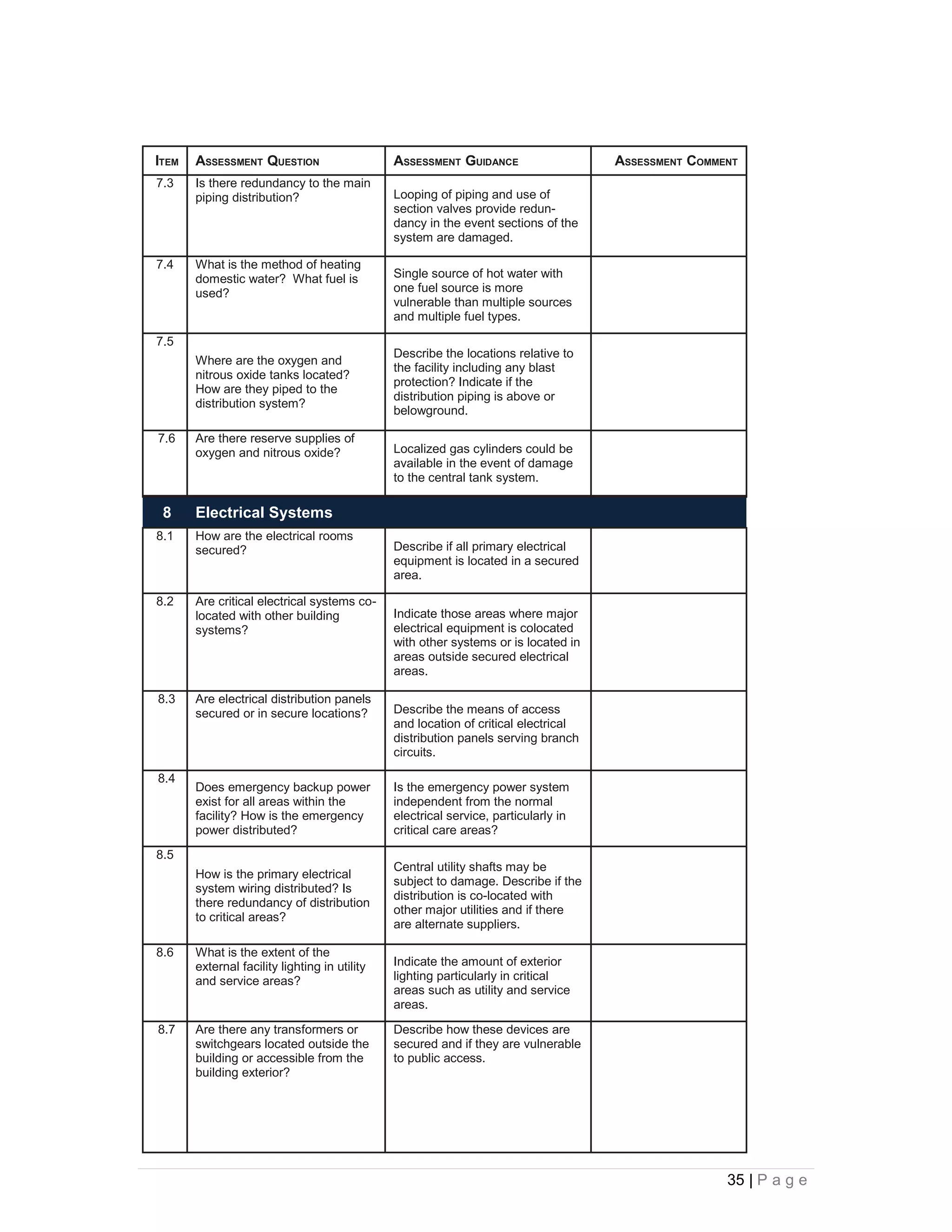
                                        patrols and who conducted them
                                        on what shifts. Management
                                        reports can be produced for
                                        record keeping and manpower
                                        analysis purposes.


        Security System Documents

12.45   Are security system as-built    Critical to the consideration and
        drawings been generated and     operation of security technologies
        ready for review?               its overall design and engineering
                                        processes. These historical
                                        reference documents outline
                                        system specifications and layout
                                        security device used, their
                                        application, location and
                                        connectivity. They are a critical
                                        resource tool for troubleshooting
                                        system problems, for replacing
                                        and adding other security system
                                        hardware and software products.
                                        Such documents are an integral
                                        component to new and retrofit
                                        construction projects.


12.46
        Have security system design
        and drawing standards been
        developed?
12.47
        Are security equipment
        selection criteria defined?

12.48
        What contingency plans have
        been developed or are in
        place to deal with security
        control center redundancy and
        backup operations?

12.49   Have security system
        construction specification
        documents been prepared and
        standardized?
12.50
        Are all security system
        documents to include as-built
        drawings current?

12.51   Have qualifications been
        determined in using security
        consultants, system designers
        and engineers, installation
        vendors and contractors?


                                                                                      43 | P a g e
ITEM      ASSESSMENT QUESTION                 ASSESSMENT GUIDANCE                    ASSESSMENT COMMENT
    12.52      Are security systems
               decentralized, centralized,
               integrated, and operate over
               existing IT network or
               standalone method of
               operation?
    12.53      What security systems
               manuals are available?

    12.54      What maintenance or service
               agreements exist for security
               systems?


    13         Security Master Plan
    13.1       Does a written security plan        The development and imple-
               exist for this facility? When       mentation of a security master
               was the initial security plan       plan provides a roadmap which
               written and last revised? Who       outlines the strategic direction and
               is responsible for preparing        vision, operational, managerial
               and reviewing the security          and technological mission, goals
               plan?                               and objectives of the
                                                   organizations security program.


    13.2       Has the security plan been
               communicated and
               disseminated to key
               management personnel and
               departments?
    13.3       Has the security plan been
               benchmarked or compared
               against related organizations
               and operational entities?

    13.4       Has the security plan ever
               been tested and evaluated
               from a cost-benefit and
               operational efficiency and
               effectiveness perspective?


    13.5       Does it define mission, vision,
               short-long term security
               program goals and objectives?

    13.6       Are threats, vulnerabilities,
               risks adequately defined and
               security countermeasures
               addressed and prioritized
               relevant to their criticality and
               probability of occurrence?


    13.7       Has a security implementation
               schedule been established to
               address recommended
               security solutions?

    13.8       Have security operating and
               capital budgets been
               addressed, approved and
               established to support the
               plan?

44 | P a g e
ITEM    ASSESSMENT QUESTION                  ASSESSMENT GUIDANCE   ASSESSMENT COMMENT
13.9
        What regulatory or industry
        guidelines/standards were
        followed in the preparation of
        the security plan?

13.10   Does the security plan
        address existing security
        conditions from an
        administrative, operational,
        managerial and technical
        security systems perspective?
13.11   Does the security plan
        address the protection of
        people, property, assets and
        information?
13.12   Does the security plan
        address the following major
        components: access control,
        surveillance, response,
        building hardening and
        protection against biological,
        chemical, radiological and
        cyber-network attacks?
13.13   Has the level of risk been
        identified and communicated
        in the security plan through
        the performance of a physical
        security assessment?

13.14
        When was the last security
        assessment performed? Who
        performed the security risk
        assessment?

13.15   Were the following areas of
        security analysis addressed in
        the security master plan:
        Asset Analysis: Does the
        security plan identify and
        prioritize the assets to be
        protected in accordance to
        their location, control, current
        and replacement value?
        Threat Analysis: Does the
        security plan address potential
        threats; causes of potential
        harm in the form of death,
        injury, destruction, disclosure,
        interruption of operations, or
        denial of services? Examples
        include possible criminal acts
        (documented and review of
        police/security incident
        reports) associated with
        forced entry, bombs, ballistic
        assault, biochemical and
        related terrorist tactics, attacks
        against utility systems
        infrastructure and buildings.


                                                                             45 | P a g e
ITEM   ASSESSMENT QUESTION                   ASSESSMENT GUIDANCE   ASSESSMENT COMMENT
            Vulnerability Analysis: Does the
            security plan address other
            areas and anything else
            associated with a facility and it’s
            operations that can be taken
            advantage of to carry out a
            threat? Examples include the
            architectural design and
            construction of new and existing
            facilities, technological support
            systems (e.g. heating, air
            conditioning, power, lighting and
            security systems, etc.) and
            operational procedures, policies
            and controls. Risk Analysis:
            Does the security plan address
            the findings from the asset,
            threat, and vulnerability
            analyses to develop,
            recommend and consider
            implementation of appropriate
            security countermeasures?


        Contact Information
        James E. McDonald
        C/O American Alarm and Communications, Inc.
        Central Massachusetts Regional Office
        489 Washington Street
        Auburn, Massachusetts 01501
        Direct Phone: (508) 453-2731
        Direct Fax: (781) 645-7537

        Email: JMcDonald@AmericanAlarm.com
        American Alarm Website: www.AmericanAlarm.com
        Blog: www.SecurityTalkingPoints.com
        Twitter: www.Twitter.com/physectech


46 | P a g e
The Physical Security Risk Management Book


  BY JAMES McDONALD, PSNA   A PROUD MEMBER OF INFRAGARD, IFMA, ASIS & IAHSS


AMERICANALARM


                                                           47 | P a g e

The Physical Security_&_Risk_Management_book

  • 1.
    SECURITY TECHNOLOGY BEST PRACTICES The Physical Security Risk Management Book BY JAMES McDONALD, PSNA A PROUD MEMBER OF INFRAGARD, IFMA, ASIS & IAHSS
  • 2.
    Introduction Table of Contents Today, integrated electronic and IP security systems can do many things. They can provide Table of Contents 2 better security detection and confirmation, with Introduction 2 less labor than ever before; they can work seamlessly with other systems running within Risk Management & Physical Security 4 the organization to alert and investigate Critical Infrastructure Monitoring 8 activities, detect threats and automatically Implementation 9 initiate a threat response. Over the last decade the integration and use of physical security Policy Basics 11 solutions as a Risk Management and Asset Non-Compliance 11 Management tool has reduced theft, fraud and Identification Procedures 12 violence by huge numbers. In most cases the return on investment (ROI) of these systems, Summary 12 used correctly, has been in months and weeks Appendix A: Understanding Physical not in years. My goal here is to discuss how my associates and I have been successful in Access Control Solutions 14 multiple industries providing these solutions and Site Survey for Access Systems 18 at the same time improving the overall security, Physical Security Data or Key Facility productivity and profits of our clients. Assessment Checklist 20 For thousands of years man has developed Contact Information 46 systems and countermeasures to protect assets, whether buildings, people, food supplies, etc. What we do in the security industry is to constantly improve and Disclaimer update those countermeasures to keep pace with those who Reference to any specific commercial product, would do you harm physically, process or service by trade name, trademark financially or emotionally for their manufacturer, or otherwise, does not constitute or imply its endorsement, recommendation, or own personal or organizational favoring by American Alarm and gain. Where 2,000 years a Communications, Inc. or INFRAGARD. The Roman Centurion may have protected the views and opinions of author expressed within assets of the time, today this document shall not be used for advertising or product endorsement purposes. we can use wireless camera systems and To the fullest extent permitted by law, the author audio, which is monitored accepts no liability for any loss or damage (whether direct, indirect or consequential and 24/7/365 days per year including, but not limited to, loss of profits or through a central anticipated profits, loss of data, business or command center to goodwill) incurred by any person and howsoever caused arising from or connected with any error protect any asset at any or omission in this document or from any person time, almost anywhere. acting, omitting to act or refraining from acting upon, or otherwise using, the information Since 911, to address the threat posed by those contained in this document or its references. You should make your own judgment as regards who wish to harm the United States or their own use of this document and seek independent employees, critical infrastructure owners and professional advice on your particular operators today are continually assessing their circumstances. © 2012 by James E. McDonald policies, procedures, vulnerabilities and increasing their investment in security. State 2|Page
  • 3.
    and municipal governmentsacross the Homeland Security Presidential Directives 7 country continue to take important steps and 8 are putting pressure on public and to identify and assure the protection of private locations, and managed services key assets and services within their entities to comply with a myriad amount of jurisdictions. security and privacy issues. Within the broad concept of the United States' national and Federal departments and agencies are homeland security policies are several specific working closely with industry to take policies which focus on a specific aspect of stock of key assets and facilitate national or homeland security. These policies protective actions, while improving the include: the National Security Strategy, the timely exchange of important security National Infrastructure Protection Plan, the related information. The Office of National Health Security Strategy, the Homeland Security is working closely National Strategy for Physical Protection of with key public- and private-sector Critical Infrastructure and Key Assets, the entities to implement the Homeland National Strategy for Homeland Security, the Security Advisory System across all National Counterintelligence Strategy of the levels of government and the critical United States, the National Strategy to sectors. Secure Cyberspace, and the National Military Strategy of the United States of America. As a proud member if INFRAGARD, and Each of these strategies form a part of the their goal to promote ongoing dialogue overall national and homeland security policies and timely communication between of the United States, and in combination defines members and the FBI. My team and I how the United States acts to protect itself from work hard every day to help those in key enemies, both foreign and domestic. sectors protect their facilities, employees and visitors from internal and Homeland Security Presidential Directive 7 external threats. In today's ever- (HSPD-7) & Physical Protection of Critical growing regulatory compliance Infrastructure and Key Assets identified 18 landscape, organization can greatly critical infrastructure and key resources (CIKR) benefit from implementing viable and sectors. Each sector is responsible for proven physical security best practices developing and implementing a Sector-Specific for their organization. Plan (SSP) and providing sector-level performance feedback to the Department of There are plenty of complicated Homeland Security (DHS) to enable gap documents that can guide companies assessments of national cross-sector CIKR through the process of designing a protection programs. SSAs are responsible for secure facility from the gold-standard collaborating with public and private sector specs used by the federal government security partners and encouraging the to build sensitive facilities like development of appropriate information-sharing embassies, to infrastructure standards and analysis mechanisms within the sector. published by industry groups like the Telecommunications Industry These Industry Sectors are broken down as Association, to safety requirements from follows: the likes of the National Fire Protection  Agriculture and Food Association.  Banking and Finance  Chemical Recent federal legislation, ranging from  Commercial Facilities the Gramm-Leach Bliley Act (GLBA),  Communications the Health Insurance Portability and  Critical Manufacturing Accountability Act (HIPAA) and The  Dams Sarbanes Oxley Act of 2002 (SOX) 3|Page
  • 4.
    Defense Industrial Base  Emergency Services  Energy  Government Facilities  Healthcare and Public Health  Information Technology  National Monuments  Nuclear Reactors, Materials, and Waste  Postal and Shipping  Transportation  Water As a Physical Security Professional the The Risk Assessment or Physical Security tools we use may be the same or similar Assessment in each sector, however the integration, policies, goals and solution may differ. This document is dedicated to give you a basic overview of the different technologies we us and some examples Assess Identify of how they have been used. If you Vulnerabilities Threats have specific needs, questions and concerns, please contact the author or a security professional to learn more about your needs. Risk & Physical Risk Management & Physical Security Management Security Cycle The use of appropriate physical security technology measures can prevent or Implement Evaluate deter a wide variety of insider and Countermeasures Countermeasures external attacks, from staff fraud through to the facilitation or conduct of a terrorist attack. However, these counter- measures can also be costly, so it is important that they are implemented in a way that reflects the severity of the risk. Risk Management provides a systematic The Risk Assessment & Physical Security basis for proportionate and efficient Assessment is the first step in the process to security. From the moment an protect any facility or location and justify the individual arrives on the grounds and investment in that protection. The Risk walks through the doors, the following Assessment or Physical Security Assessment items should be part of a physical process is the same they incorporate identifying security best practices program for any threats and assessing vulnerabilities then facility. evaluating and implementing countermeasures. In this context, risk is usually understood to be the product of two factors: the likelihood of an event occurring, and the impact that the event 4|Page
  • 5.
    would have. Wheneach of these has Opportunity is a combination of the access that been evaluated, they are combined to an insider has to an organization’s assets (by provide an overall measure of risk. virtue of their role or position), together with the Then we use our security technology vulnerability of the environment (for example, countermeasures to further reduce the an environment that is constantly supervised or opportunity and risk. monitored by CCTV cameras is less vulnerable to some insider threats than an environment Likelihood can be further broken down which is not subject to these controls). Impact into three factors: intent, capability and should be considered in terms of the value of opportunity. Intent is a measure of the the assets affected and any wider insider’s determination to carry out the consequences. For example, insider fraud can attack, while capability is the degree to have both financial and reputational impacts. which the insider possesses the skills, knowledge and resources to be Levels of risk assessment successful in the attempt. I my study of fraud as a member of the Association of There are three levels at which personnel Certified Fraud Examiners (ACFE) I security risk assessments can be conducted: learned that according to Donald R. Cressey (April 27, 1919 – July 21, 1987) 1. Organization who was an American penologist, 2. Group sociologist, and criminologist who made 3. Individual innovative contributions to the study of organized crime, prisons, criminology, The first examines and prioritizes the types of the sociology of criminal law, white- insider threats that are of concern to the collar crime. He is also known as the organization as a whole, the second focuses on farther of the Fraud Triangle which groups of employees with differing levels of states that there are three factors that opportunity to commit the threats, while the need to exist for someone to commit third deals with each employee on an individual fraud. They are Motive or Financial basis. Pressure, Rationalization and Opportunity. Some things we can Most risk practitioners will find it helpful to start control and others we cannot, I have with the simplest and highest level approach, always focused on eliminating the the organization level risk assessment, which Opportunity. My goal is to create the provides a useful overview of the threats facing Perception of Detection with the the organization and an opportunity to review security technology to stop fraud and countermeasures in general. The group level other crimes. Besides a terrorist who is assessment will require a greater commitment willing to die for their cause, most of time and effort, but can yield significant people, in my experience will think twice insight into the groups of employees that give or find another target if they feel they will most cause for concern and the proportionate be unsuccessful or caught. application of countermeasures within the organization. The individual level assessment is the most labor intensive of all, looking at every employee in turn to determine their combined opportunity and insider potential (i.e. threat and susceptibility). The levels of risk assessment that you use will depend on the threats faced by your organization and the nature of the workforce. It 5|Page
  • 6.
    is important thatyou understand the Design Solution Check List way in which the three approaches The following are some key examples of points support different types of decision. For to consider when building a new data center. I example, if the organizational risk use this as an example because Physical and assessment reveals that there is a Cyber Strategies share common underlying negligible threat to the organization from policy objectives and principles. The first an insider bringing a bomb into the objective of this Strategy is to identify and building, this may rule out the need for assure the protection of those assets, systems, baggage checks on entry to the site. and functions that are deemed most “critical” to Alternatively, the group level the organization. Almost every facility today assessment could reveal that certain has data access or data storage and in many employees, due to their role in the cases the “Data Room or Closet” is one of the organization, have regular access to least secured locations in the facility and is the highly confidential or sensitive most vulnerable. The liability of data loss for information, and they may therefore almost every organization is astronomical. The require higher levels of supervision in customer or personal data, organizational the office. If, at the individual level, a confidential information or trade secrets could particular employee is considered to destroy an organization without firing a shot. have high insider potential and a high Most MDF rooms or main equipment room is level of opportunity, then an individually where inside and outside cables and conduit tailored risk management plan might be terminate. It is usually referred to as the MDF required. (Main Distribution Frame) are accessible by everyone in the organization from the The remaining two stages are receptionist to the janitor. implementation, which involves putting the new countermeasures identified by So, as you read through this next section, apply the risk or security assessment into the principles to your facility and think of how operation, and evaluation, during which you could enhance you security to reduce your the effectiveness of the counter- risk of loss. measures is reviewed. The lists of assumptions made during the risk Build on the Right Spot assessment will prove particularly useful Be sure the building is some distance from during this evaluation. headquarters (20 miles is typical) and at least 100 feet from the main road. Bad neighbors: Depending on how much time has airports, chemical facilities, power plants. Bad passed since the risk assessment, the news: earthquake fault lines and (as we've seen evaluation stage should also show that all too clearly this year) areas prone to the threats identified either have or have hurricanes and floods. And scrap the "data not been reduced by the counter- center" sign. measures you have introduced. It is worth bearing in mind, however, those Restrict Area Perimeter factors outside your control, such as the Secure and monitor the perimeter of the facility. current threat level, or economic, political and social issues, may also Have Redundant Utilities have an influence. These same factors are likely to introduce new threats to be Data centers need two sources for utilities, such addressed in future assessments. as electricity, water, voice and data. Trace electricity sources back to two separate substations and water back to two different main lines. Lines should be underground and should come into different areas of the building, 6|Page
  • 7.
    with water separatefrom other utilities. default, and lowered only when someone has Use the data center's anticipated power permission to pass through. usage as leverage for getting the electric company to accommodate the Plan for Bomb Detection building's special needs. For data facilities that are especially sensitive or likely targets, have guards use mirrors to check Deter, Detect, and Delay underneath vehicles for explosives, or provide Deter, detect, and delay an attack, portable bomb-sniffing devices. You can creating sufficient time between respond to a raised threat by increasing the detection of an attack and the point at number of vehicles you check, perhaps by which the attack becomes successful. checking employee vehicles as well as visitors and delivery trucks. Pay Attention to Walls Foot-thick concrete is a cheap and Limit Entry Points effective barrier against the elements Control access to the building by establishing and explosive devices. For extra one main entrance, plus a back one for the security, use walls lined with Kevlar. loading dock. This keeps costs down too. Avoid Windows Make Fire Doors Exit Only Think warehouse and not an office For exits required by fire codes, install doors building. If you must have windows, that don't have handles on the outside. When limit them to the break room or any of these doors is opened, a loud alarm administrative area, and use bomb- should sound and trigger a response from the resistant laminated glass. security command center. Use Landscaping for Protection Use Plenty of Cameras Trees, boulders and gulleys can hide Surveillance cameras should be installed the building from passing cars, obscure around the perimeter of the building, at all security devices (like fences), and also entrances and exits, and at every access point help keep vehicles from getting too throughout the building. A combination of close. Oh, and they look nice too. motion-detection devices, low-light cameras, pan-tilt-zoom cameras and standard fixed Keep a 100-foot Buffer Zone around the cameras is ideal. Footage should be digitally Site recorded and stored offsite. Where landscaping does not protect the building from vehicles, use crash-proof Protect the Building's Machinery barriers instead. Bollard planters are Keep the mechanical area of the building, which less conspicuous and more attractive houses environmental systems and than other devices. uninterruptible power supplies, strictly off limits. If generators are outside, use concrete walls to Use Retractable Crash Barriers at Vehicle secure the area. For both areas, make sure all Entry Points contractors and repair crews are accompanied Control access to the parking lot and by an employee at all times. loading dock with a staffed guard station that operates the retractable bollards. Personnel Surety Use a raised gate and a green light as Perform appropriate background checks on and visual cues that the bollards are down ensure appropriate credentials for facility and the driver can go forward. In personnel, and, as appropriate, for unescorted situations when extra security is visitors with access to restricted areas or critical needed, have the barriers left up by assets. 7|Page
  • 8.
    Plan for SecureAir Handling If someone tries to sneak in behind an Make sure the heating, ventilating and authenticated user, the door gently revolves in air-conditioning systems can be set to the reverse direction. (In case of a fire, the walls recirculate air rather than drawing in air of the turnstile flatten to allow quick egress.) from the outside. This could help protect people and equipment if there were A "mantrap" some kind of biological or chemical Provides alternate access for equipment and for attack or heavy smoke spreading from a persons with disabilities. This consists of two nearby fire. For added security, put separate doors with an airlock in between. Only devices in place to monitor the air for one door can be opened at a time, and chemical, biological or radiological authentication is needed for both doors. contaminant. At the Door to an Individual Computer Ensure nothing can hide in the walls and Processing Room ceilings This is for the room where actual servers, In secure areas of the data center, make mainframes or other critical IT equipment is sure internal walls run from the slab located. Provide access only on an as-needed ceiling all the way to subflooring where basis, and segment these rooms as much as wiring is typically housed. Also make possible in order to control and track access. sure drop-down ceilings don't provide hidden access points. Watch the Exits Too Monitor entrance and exit—not only for the Use two-factor Authentication main facility but for more sensitive areas of the Biometric identification is becoming facility as well. It'll help you keep track of who standard for access control to sensitive was where, when. It also helps with building areas of data centers, with hand evacuation if there's a fire.. geometry or fingerprint scanners usually considered less invasive than retinal Prohibit Food in the Computer Rooms scanning. In other areas, you may be Provide a common area where people can eat able to get away with less-expensive without getting food on computer equipment. access cards. Install Visitor Rest Rooms Harden the Core with Security Layers Make sure to include rest rooms for use by Anyone entering the most secure part of visitors and delivery people who don't have the data center will have been access to the secure parts of the building. authenticated at least three times, including at the outer door. Don't forget Critical Infrastructure Monitoring you'll need a way for visitors to buzz the "Critical infrastructure" is defined by federal law front desk (IP Intercom works well for as "systems and assets, whether physical or this). At the entrance to the "data" part virtual, so vital to the United States that the of the data center. At the inner door incapacity or destruction of such systems and separates visitor area from general assets would have a debilitating impact on employee area. Typically, this is the security, national economic security, national layer that has the strictest "positive public health or safety, or any combination of control," meaning no piggybacking those matters. allowed. For implementation, you have two options: The Information Technology (IT) Sector is central to the nation's security, economy, and -A floor-to-ceiling turnstile public health and safety. Businesses, governments, academia, and private citizens 8|Page
  • 9.
    are increasingly dependentupon IT Implementation Sector functions. These virtual and Use a proven integrator who can utilize and distributed functions produce and integrate mutable solutions to create a physical provide hardware, software, and IT security compliance and risk management systems and services, and—in solution that can automate and enforce physical collaboration with the Communications security policies, from restricting area perimeter Sector —the Internet. and securing site assets to personnel surety and reporting of significant security incidents; Communication between your business this helps to ensure both governance and alarm system and our Monitoring Center compliance utilizing an organization’s existing is a critical part of your protective physical security and IT infrastructure. system. Require an Underwriters’ Laboratories (U.L.) Listed Monitoring This can centrally manage all regulations and Center with sophisticated associated controls and automate assessment, communications operation. remediation and reporting as per defined review cycles. Automatically trigger compliance-based In the event of an alarm, the actions, such as rule-based generation of CPU in your security system sends an actions/penalties, based on physical access alarm signal to the monitoring facility events. Correlate alarms and identities to better through the phone lines, or thru the manage situations and responses across the network with AES radio or cellular back- security infrastructure. Incorporate real-time up communications. The signal is then monitoring and detailed risk analysis tools to retrieved by the monitoring center, and instantly enforce, maintain and report on the operators quickly notify the compliance initiatives appropriate authorities, as well as the designated responder, of the Key External Technology Measures emergency. Entry Point Monitoring Capabilities Data centers are generally designed with a  Fire central access point that’s used to filter  Hold-Up employees and visitors into the data center.  Intrusion All requests are vetted by a security guard with  Halon/Ansul an intercom link to ensure that they have a  Panic/Ambush legitimate reason for entering the premises.  Man Down Automatic Bollards  Elevator Phones  Off-Premises Video As an alternative to a guard-controlled gate,  HVAC/Refrigeration automatic bollards can be used at entry points.  Sprinkler/Tamper/Flow These short vertical posts pop out of the ground to prevent unauthorized vehicles from driving  Power Loss/Low Battery onto the site. When a vehicle’s occupants are  Gas/Hazardous Chemicals verified by a guard, an access card or other  Water Flow/Flood Alarms secure process, the bollards are quickly  Environmental Devices lowered to allow the vehicle to enter. When in (CO2/CO/ETC.) the lowered position, the top of each bollard is  Radio/Cellular Back-Up flush with the pavement or asphalt and Communications completely hidden. The bollards move quickly and are designed to prevent more than one vehicle from passing through at any one time. 9|Page
  • 10.
    Closed-Circuit TV orIP Video the second one opens. In a typical mantrap, the External video cameras, positioned in visitor needs to first “badge-in” and then once strategic locations, including along inside must pass a biometric screening in the perimeter fencing, provide efficient and form of an iris scan. continuous visual surveillance. The cameras can detect and follow the Access Control List activities of people in both authorized Defined by the data center customer, an access and “off limits” locations. In the event control list includes the names of individuals someone performs an unauthorized who are authorized to enter the data center action or commits a crime, the digitally environment. Anyone not on the list will not be stored video can supply valuable granted access to operational areas. evidence to supervisors, law enforcement officials and judicial Badges and Cards authorities. For added protection, the Visually distinctive badges and identification video should be stored off-site on a cards, combined with automated entry points, digital video recorder (DVR). ensure that only authorized people can access specific data center areas. The most common Key Internal Technology Measures identification technologies are magnetic stripe, proximity, barcode, smart cards and various Lobby Area biometric devices. With proper software and surveillance and communications tools, a staffed Guard Staff reception desk, with one or more A well-trained staff that monitors site facilities security guards checking visitors’ and security technologies is an essential credentials, creates an invaluable first element in any access control plan. line of access control. Loading and Receiving Surveillance For full premises security, mantraps, card Like their external counterparts, internal readers and other access controls located in cameras provide constant surveillance public-facing facilities also need to be and offer documented proof of any duplicated at the data center’s loading docks observed wrongdoing. and storage areas. Biometric Screening Operational Areas Once the stuff of science fiction and spy The final line of physical protection falls in front movies, biometric identification now of the data center’s IT resources. Private cages plays a key role in premises security. and suites need to be equipped with dedicated Biometric systems authorize users on access control systems while cabinets should the basis of a physical characteristic that have locking front and rear doors for additional doesn’t change during a lifetime, such protection. as a fingerprint, hand or face geometry, retina or iris features. Humans are the weakest link in any security scheme. Security professionals can do their Mantrap best to protect systems with layers of anti- Typically located at the gateway malware, personal and network firewalls, between the lobby and the rest of the biometric login authentication, and even data data center, mantrap technology encryption, but give a good hacker (or computer consists of two interlocking doors forensics expert) enough time with physical positioned on either side of an enclosed access to the hardware, and there’s a good space. The first door must close before chance they’ll break in. Thus, robust physical 10 | P a g e
  • 11.
    access controls andpolicies are critical  Authenticate individuals with regular access elements of any comprehensive IT requirements through the use of their security strategy. assigned permanent authenticator.  Authenticate individuals with occasional According to a report by the SANS access requirements through the use of a Institute, “IT security and physical personal identification mechanism that security are no longer security silos in includes name, signature and photograph. the IT environment; they are and must be considered one and the same or, as Step 2 it should be called, overall security.” Verify that work to be performed has been pre- approved or meets emergency response It is the innermost layer—physical entry procedures: to computer rooms—over which IT  Verify against standard Change Control managers typically have responsibility, procedures. and the means to have effective control  Verify against standard Maintenance over human access focuses on a set of procedures. policies, procedures, and enforcement mechanisms. Step 3 Policy Basics Make use of logs to document the coming and goings of people and equipment: Given their importance and ramifications on employees, access policies must  Assign the responsibility for the come from the top leadership. After maintenance of an access log that records setting expectations and behavioral personnel access. Record the following: ground rules, actual data center access  Date and time of entry. policies have several common  Name of accessing individual and elements. The most essential are authentication mechanism. definitions of various access levels and  Name and title of authorizing individual. procedures for authenticating individuals  Reason for access. in each group and their associated  Date and time of departure. privileges and responsibilities when in the data center.  Assign the responsibility for the maintenance of a delivery and removal log Step 1 that records equipment that is delivered to Authorize, identify and authenticate or removed from facilities; Record the individuals that require physical access: following:  Identify the roles that require both  Date and time of delivery/removal. regular as well as occasional  Name and type of equipment to be physical access and identify the delivered or removed. individuals that fill these roles.  Name and employer of the individual  Provide standing authorization and a performing the delivery/removal and the permanent authenticator to authentication mechanism used. individuals that require regular  Name and title of authorizing individual. access.  Reason for delivery/removal.  Require individuals that require occasional access to submit a Non-Compliance request that must be approved prior Violation of any of the constraints of these to access being attempted or policies or procedures should be considered a allowed. security breach and depending on the nature of the violation, various sanctions will be taken: 11 | P a g e
  • 12.
    A minor breach should result in cards. I also recommend using time-stamped written reprimand. video surveillance in conjunction with electronic  Multiple minor breaches or a access logs and a sign-in sheet to provide a major breach should result in paper trail. suspension.  Multiple major breaches should Access levels and controls, with identification, result in termination. monitoring, and logging, form the foundation of an access policy, but two other major policy Although older data centers typically just elements are standards of conduct and consisted of a large, un-partitioned behaviors inside the data center such as: raised-floor area, newer enterprise prohibitions on food and beverages or facilities have taken a page from ISP tampering with unauthorized equipment, designs by dividing the space into limitations and controls on the admission of various zones—for example, a cage for personal electronics such as USB thumb drives, high-availability servers, another area laptops, Smartphones, or cameras are critical. for Tier 2 or 3 systems, a dedicated network control room, and even Policies should also incorporate processes for separate areas for facilities granting access or elevating restriction levels, infrastructure such as PDUs and an exception process for unusual situations, chillers. Such partitioned data centers sanctions for policy violations, and standards provide control points for denying for reviewing and auditing policy compliance. access to personnel with no Stahl cautions that penalties for noncompliance responsibility for equipment that’s in will vary from company to company because them. they must reflect each enterprise’s specific risk tolerance, corporate culture, local employment Identification Procedures laws, and union contracts. The next step in a physical security policy is to set up controls and Summary identification procedures for It’s time to get physical—as in physically authenticating data center users and protecting a data center and all of its assets. granting them physical access. Although The need for ironclad virtual security measures, biometric scanners look flashy in the such as managed firewalls, is well known. Yet movies and certainly provide an added physical security is often placed on the back measure of security, a magnetic stripe burner, largely forgotten about until an badge reader is still the most common unauthorized party manages to break into or entry technology, as it’s simple, cheap, sneak onto a site and steals or vandalizes and effective and allows automated systems. logging, which is a necessary audit trail. One problem with magnetic readers, Today’s security systems include: according is their susceptibility to  Intrusion and Monitoring Systems tailgating, or allowing unauthorized  Access Control Systems personnel to trail a colleague through an  Visitor Management Systems entryway. That’s why we advise  Surveillance Systems supplementing doors and locks with  Emergency Communications Systems recorded video surveillance.  PISM Software Platforms I also like to add a form of two-factor authentication to entry points by The newest of these is the PISM or Physical coupling a card reader (“something you Security Information Management system. have”) with a PIN pad (“something you know”), which reduces the risks of lost 12 | P a g e
  • 13.
    Physical Security Information Geo-Location Engine Management (PISM) The Geo Location Engine provides spatial recognition for geo-location of devices and supports situation mapping functionality. The physical The PSIM Platform enables the position of devices is stored in an internal knowledge integration and organization of any base as GIS/GPS positions or building coordinates. number and type of security devices or The engine uses the information to determine systems and provides a common set of relevance, selects, and relate devices involved in a services for analyzing and managing the given situation. The system uses the information to incoming information. It also serves as overlay graphical representations of security assets the common services platform for video and activities onto Google-type maps or building and situation management applications. layouts. Routing Engine Effectively maintaining security of critical infrastructure does not happen by The Routing Engine is an intelligent switch that accident, it means giving your security connects any security device to PISM command interfaces or output device(s) and accommodates professionals the best security/software any required transformation of formats and protocols tools available today. By unifying your between connected devices. In most cases, devices existing surveillance system and connect directly to each other and exchange data providing spatial context to your camera streams directly, avoiding possible bottlenecks that feeds, PISM brings out the best of your would arise from routing all traffic through a single equipment. centralized server. An internal knowledge base of all connected devices and their characteristics is To investigate day-to-day incidents, as maintained by the Routing Engine, which uses that well as prepare for emergency information to ensure a viable communication path, situations, the security department compatibility of signal format and acceptable quality of service. makes use of a vast network of video cameras, access control points, Rules Engine intercoms, fire and other safety systems. PISM unifies all of these disparate The PSIM Platform contains a powerful Rules feeds, including systems from diverse Engine that analyzes event and policy manufacturers, into a single decision- information from multiple sources to correlate oriented Common Operating Picture. events, make decisions based upon event Within the PSIM Platform are five key variables and initiate activities. components: Dispatch Engine Integration Services The Dispatch Engine integrates with communications infrastructure to initiate Multiple strategies are used for external applications or the transmission of connection, communication with, and messages, data and commands. Dispatch management of installed devices and actions are automatically triggered by the rules systems from multiple vendors. The engine as it executes recommendations for PSIM Platform offers complete support situation resolution. Operators can manually for the industry’s most commonly-used initiate actions as well. device types – out of the box. In addition, it employs customizable The key benefits of today’s technology is “pipeline” architecture to receive device allowing system users to do more with less by events. Network connectivity is achieved getting maximum benefits through integrated using combinations of multiple technologies with each system (Both new and communications protocols. old) and with the goals of company policies and procedures like never before. 13 | P a g e
  • 14.
    Appendix A: UnderstandingPhysical Access Control Solutions SOLUTION STRENGTHS WEAKNESSES COMMENTS KEYS •Most traditional form of • Impossible to track if • Several solutions are access control they are lost or stolen, currently available on • Easy to use which leaves facility the market to manage • Don’t require power for vulnerable keys and keep key operation • Potential for holders accountable. unauthorized sharing of keys • Difficult to audit their use during incident investigations • Difficult to manage on large campuses with multiple doors • Re-coring doors when a key is lost or stolen is expensive LOCKS • Easy installation • Power always on (fail- • DC only • Economical safe) • Comes in different Maglock • Easy retrofit • Typically requires exit “pull” strengths • Quiet operation device to break circuit • Check extra features, Electric • Requires backup power such as built in door Strike supply for 24-hour service sensor • Can be either fail-secure or • Door/lock hardware • Requires more door fail-safe experience needed hardware experience • Does not need constant than Maglock power • Specify for life-safety • Door knob overrides for requirements safe exit • Can be both AC and DC (DC lasts longer) • Fail-safe must have power backup • Fail-secure most popular ACCESS CARDS • Access rights can be • Prone to piggybacking / • Can incorporate a denied without the expense tailgating (when more than photo ID of re-coring a door and one individual enters a component issuing a new key secure area using one • Can be used for both • Can limit access to a access card or an physical and logical building to certain times of unauthorized person access control the day follows an authorized • Card readers should • Systems can provide person into a secure area have battery backup in audit trails for incident • Users can share cards the event of power investigations with unauthorized persons failure • Cards can be stolen and • Tailgate detection Magnetic used by unauthorized products, video Stripe individuals surveillance, analytics • Systems are more and security officers expensive to install than can address tailgating traditional locks issues • Require power to • Can integrate with operate video surveillance, Proximity • Inexpensive to issue or intercoms and intrusion replace detection systems for 14 | P a g e
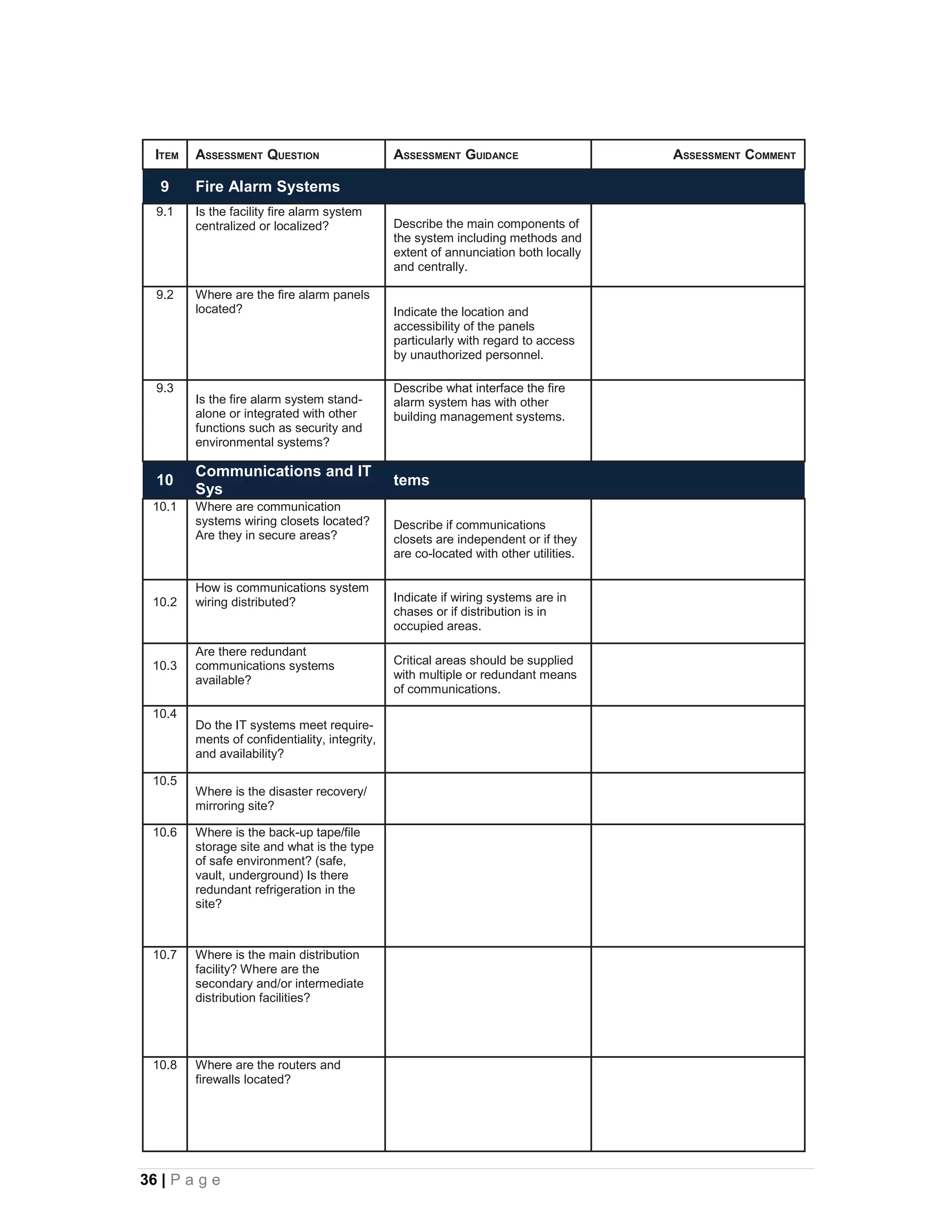
  • 15.
    enhanced security • Not as secure as Smart proximity cards or smart Card cards • These are the most • Can be duplicated with commonly used access • Durable relative ease control cards by US • Convenient • Subject to wear and tear campuses and facilities • More difficult to compromise • Cost more than than magstripe cards magstripe cards • Less wear and tear issues • Easier to compromise • Are widely used for than smart cards access control • Multiple application (although not as widely functionality (access, as magstripe) cashless vending, library • Currently the most cards, events) expensive card access • Not as widely • Enhanced security option on the market adopted as magstripe through or proximity cards due encryption and mutual to cost authentication • Widely adopted in • Less wear and tear issues Europe• Can incorporate biometric and additional data such as Photo and ATM PIN NUMBERS • Easy to issue and change • Can be forgotten • Should be changed (Pass codes) • Inexpensive • Difficult to manage when frequently to ensure there are many passwords security for different systems • Often used in • Can be given to conjunction with other unauthorized users access control • Prone to tailgating/ solutions, such as piggybacking cards or biometrics DOOR ALARMS • Provide door intrusion, • Will not reach hearing • Appropriate for any door forced and propped impaired without monitored door door detection modifications application, such as • Reduce false alarms • Will not detect tailgaters emergency exits caused by unintentional • Door bounce can cause • Used in conjunction door propping false alarms with other access • Encourage staff and control solutions, such students to maintain as card readers or access control procedure keys • Can be integrated with video surveillance for enhanced security TAILGATE/PIGGYBA • Monitor the entry point • Not intended for large • Appropriate for any CK DETECTORS into secure areas utility cart and equipment monitored door • Detect tailgate violations passage (which could application where a (allow only one person cause the system to go higher degree of to enter) into false alarm) security is needed, • Detect when a door is • Not for outdoor use such as data centers, propped research laboratories, • Mount on the door frame etc • Easy to install • Used in conjunction with other access control solutions, such as card readers • Can be integrated with video surveillance for enhanced security PUSHBUTTON • Many button options • Anyone can press the • Used to release door 15 | P a g e
  • 16.
    CONTROLS available release button (unless and shunt alarm • Normally-open/Normally using a keyed button), so • Used for emergency closed momentary contacts button must be positioned exits when provide fail-safe manual in a secure location (for configured to fail-safe override access • May be used in • Time delay may be field control, not for life-safety) conjunction with adjusted for 1-60 seconds • Some can be defeated request to exit (REX) easily for door alarms and life • Can open door to safety stranger when • Still may require approaching from inside mechanical device exit button to meet life- safety code • With REX, careful positioning and selection required MULTI-ZONE • Display the status of • 12 VDC only special • Designed to monitor ANNUNCIATORS doors order 24 VDC option multiple doors from and/or windows throughout • Door bounce can cause a single location a monitored facility false alarms • May be used in • Alert security when a door • Requires battery backup conjunction with door intrusion occurs in case of power alarms, tailgate • Many options available: failure detection systems and zone shunt, zone relay and optical turnstiles zone supervision • No annunciation at the door; only at the monitoring station FULL HEIGHT • Provides a physical • Physical design ensures • Designed for TURNSTILES barrier to a reasonable degree indoor/outdoor at the entry location that only one authorized applications • Easy assembly person will enter, but it will • Used in parking lots, • Easy maintenance not detect tailgaters football fields and • Available in aluminum along fence lines and • Use with a galvanized steel conventional access control device like a card reader OPTICAL • Appropriate for areas with • Can be climbed over • Used in building TURNSTILES a lot of pedestrian traffic • Not for outdoor use lobby and elevator • Detects tailgating corridor applications • Aesthetically pleasing and • Use with a can be integrated into conventional access architectural designs control device like a • Doesn’t require separate card reader emergency exit • To ensure • Provides good visual and compliance, deploy audible cues to users security officers and video surveillance BARRIER ARM • Appropriate for areas with • Units with metal-type • Used in building TURNSTILES a lot of pedestrian traffic arms can be climbed over lobby and elevator (Glass gate or • Provides a visual and or under corridor applications metal arms) psychological barrier while • Not for outdoor use • Use with a communicating to • Most expensive of the conventional access pedestrians turnstile options control device like a that authorization is • Requires battery backup card reader required to gain access in case of power failure • To ensure • Detects tailgating compliance, deploy • Reliable security officers and video surveillance 16 | P a g e
  • 17.
    • Battery backupis recommended BIOMETRICS • Difficult to replicate • Generally much more • Except for hand identity expensive than locks or geometry, facial and because they rely on card access solutions finger solutions, unique • If biometric data is biometric technology is physical attributes of a compromised, the issue is often appropriate for person (fingerprint, hand, very difficult to address high-risk areas face or retina) requiring enhanced • Users can’t forget, lose or security have stolen their biometric codes • Reduces need for password and card management INTERCOMS • Allow personnel to • Will not reach hearing • Appropriate for visitor communicate with and impaired without management, identify visitors before modifications afterhours visits, allowing them to enter a • Not appropriate for loading docks, facility entrances requiring stairwells, etc. • Can be used for throughput of many • Use with conventional emergency and non- people in a small amount access control emergency of time solutions, such as keys communications or access cards • IP solutions today offer • Video surveillance powerful communications solutions can provide and backup systems with visual verification of a integration visitor 17 | P a g e
  • 18.
    Sample Site Survey for Access Control Systems Date Customer Name Contact Name Email Address Street City State Zip Phone Y Time and / DVR Y/N Elevator Control Y/N Photo Badging Y/N Attendance N Access Control Number of Locations Communications Method Encryption Y/N Number of Reader Controlled Doors Number of Controlled Doors without Readers Number of Monitored only Doors Number of Egress Devices Type of Readers Type of Cards Type of Egress Devices Number of Outputs for other use Number of Inputs for other use Number of PCs Elevator Control Number of Elevators Cabs to be controlled Number of Floors to be controlled in each Cab Photo ID Badging Number of Badging workstations Type of Image Gathering File Import / Live Video Capture Number and Type of Printers Time and Attendance Number of Clock in Out Readers Number of Time Display Modules Digital Video Recorder Integration Type of Video System to Integrate with 18 | P a g e
  • 19.
    19 | Pa g e
  • 20.
    Physical Security Dataor Key Facility Assessment Checklist 1. Site 2. Architectural 3. Structural Systems 4. Building Envelope 5. Utility Systems 6. Mechanical Systems 7. Plumbing and Gas Systems 8. Electrical Systems 9. Fire Alarm Systems 10. Communications and Information Technology Systems 11. Equipment Operations and Maintenance 12. Security Systems 13. Security Master Plan 20 | P a g e
  • 21.
    Assessment Question Assessment Guidance Assessment Comment ITEM 1 The Site 1.1 What major structures surround the facility? 1.2 What are the site access points to the facility? 1.3 What are the existing types of anti-ram devices for the facility? 1.4 What is the anti-ram buffer zone Anti-ram protection may be standoff distance from a building provided by adequately designed: to unscreened vehicles or bollards, street furniture, parking? sculpture, landscaping, walls and fences. 1.5 Are perimeter barriers capable If the recommended distance is of stopping vehicles? not available consider structural hardening, perimeter barriers and parking restrictions; relocation of vulnerable functions within or away from the building; operational procedures, acceptance of higher risk. 1.6 Does site circulation prevent high-speed approaches by vehicles? 1.7 Are there offsetting vehicle entrances from the direction of a vehicle’s approach to force a reduction of speed? 1.8 Is there space for inspection at Design features for the vehicular the curb line or outside the inspection point include: vehicle protected perimeter? What is the arrest devices that prevent minimum distance from the vehicles from leaving the inspection location to the vehicular inspection area and building? prevent tailgating. If screening space cannot be provided, other design features such as: hardening and alternative space for inspection. 1.9 In dense, urban areas, does Where distance from the building curb lane parking place to the nearest curb provides uncontrolled parked vehicles insufficient setback, restrict unacceptably close to a facility parking in the curb lane. For in public rights-of-way? typical city streets this may require negotiating to close the curb lane. 1.10 Is there a minimum setback Adjacent public parking should be distance between the building directed to more distant or better- and parked vehicles? protected areas, segregated from employee parking and away from the facility. Does adjacent surface parking Parking within ______feet of the 1.11 maintain a minimum standoff building shall be restricted to distance? authorized vehicles. 21 | P a g e
  • 22.
    ITEM ASSESSMENT QUESTION ASSESSMENT GUIDANCE ASSESSMENT COMMENT 1.12 Do stand-alone, above ground Pedestrian paths should be parking facilities provide planned to concentrate activity to adequate visibility across as the extent possible. Limiting well as into and out of the vehicular entry/exits to a minimum parking facility? number of locations is beneficial. Stair tower and elevator lobby design shall be as open as code permits. Stair and/or elevator waiting area should be as open to the exterior and/or the parking areas as possible. Potential hiding places below stairs should be closed off; nooks and crannies should be avoided. Elevator lobbies should be well-lighted and visible to both patrons in the parking areas and the public out on the street. Are garages or service area 1.13 entrances for government controlled or employee permitted vehicles that are not otherwise protected by site perimeter barriers protected by devices capable of arresting a vehicle of the designated threat size at the designated speed? 1.14 Does site landscaping provide hiding places? It is desirable to hold planting away from the facility to permit observation of intruders. 1.15 Is the site lighting adequate Security protection can be from a security perspective in successfully addressed through roadway access and parking adequate lighting. The type and areas? design of lighting including illumination levels is critical. IESNA guidelines can be used. 1.16 Is a perimeter fence or other types of barrier controls in place? 1.17 Do signs provide control of vehicles and people? 22 | P a g e
  • 23.
    ITEM ASSESSMENT QUESTION ASSESSMENT GUIDANCE ASSESSMENT COMMENT 2 Architectural 2.1 Does the site planning and The focus of CPTED is on architectural design incorporate creating defensible space by strategies from crime prevention employing natural access through environmental design controls, natural surveillance and (CPTED) perspective? territorial reinforcement to prevent crime and influence positive behavior, while enhancing the intended uses of space. Examples of CPTED attributes include spatial definition of space to control vehicle and pedestrian circulation patterns, placement of windows to reinforce surveillance, defining public space from private/restricted space through design of lobbies, corridors, door placement, pathway and roadway placements, walls, barriers, signage, lighting, landscaping, separation and access control of employee/ visitor parking areas, etc. 2.2 Is it a mixed-tenant facility? High-risk tenants should not be housed with low-risk tenants. High-risk tenants should be separated from publicly accessible areas. Mixed uses may be accommodated through such means as separating entryways, controlling access, and hardening shared partitions, as well as through special security operational counter- measures. 2.3 Are public toilets, service spaces or access to vertical circulation systems located in any non- secure areas, including the queuing area before screening at the public entrance? 2.4 Are areas of refuge identified, with special consideration given to egress? 2.5 Are loading docks and receiving Loading docks should be located and shipping areas separated in so that vehicles will not be driven any direction from utility rooms, into or parked under the building. utility mains, and service If loading docks are in close entrances including electrical, proximity to critical equipment, telephone/data, fire detection/ the service shall be hardened for alarm systems, fire suppression blast. water mains, cooling and heating mains, etc.? 23 | P a g e
  • 24.
    ASSESSMENT QUESTION ASSESSMENT GUIDANCE ASSESSMENT COMMENT ITEM 2.6 Are mailrooms located away The mailroom should be located from facility main entrances, at the perimeter of the building areas containing critical with an outside wall or window services, utilities, distribution designed for pressure relief. systems, and important assets? Does the mailroom have adequate space for explosive disposal containers? Is the mailroom located near the loading dock? Is space available for equipment 2.7 to examine incoming packages Off-site screening stations may be and for special containers? cost effective, particularly if several buildings may share one mailroom. 2.8 Are critical building components Critical building components located close to any main include: Emergency generator entrance, vehicle circulation, including fuel systems, day tank, parking, maintenance area, fire sprinkler, and water supply; loading dock, interior parking? Normal fuel storage; Main switchgear; Telephone distribution and main switchgear; Fire pumps; Building control centers; UPS systems controlling critical functions; Main refrigeration systems if critical to building operation; Elevator machinery and controls; Shafts for stairs, elevators, and utilities; Critical distribution feeders for emergency power. Evacuation and rescue require emergency systems to remain operational during a disaster and they should be located away from attack locations. Primary and back-up systems should not be collocated. 2.9 Do doors and walls along the line of security screening meet requirements of UL752 “Standard for Safety: Bullet- Resisting Equipment”? 2.10 Do entrances avoid significant If queuing will occur within the queuing? building footprint, the area should be enclosed in blast-resistant construction. If queuing is expected outside the building, a rain cover should be provided. Do public and employee These include walk-through metal 2.11 entrances include space for detectors and x-ray devices, ID possible future installation of check, electronic access card, access control and screening and turnstiles. equipment? 24 | P a g e
  • 25.
    ASSESSMENT QUESTION ASSESSMENT GUIDANCE ASSESSMENT COMMENT ITEM 2.12 Are there trash receptacles and The size of the trash receptacles mailboxes in close proximity to and mailbox openings should be the facility that can be used to restricted to prohibit insertion of hide explosive devices? packages. 2.13 Is roof access limited to autho- rized personnel by means of locking mechanisms? 2.14 Stairs should not discharge into Are stairwells required for lobbies, parking, or loading areas. emergency egress located as remotely as possible from high- risk areas where blast events might occur? Are enclosures for emergency 2.15 egress hardened to limit the extent of debris that might otherwise impede safe passage and reduce the flow of evacuees? 2.16 Is access control provided through main entrance points for employees and visitors (e.g. by lobby receptionist, sign-in, staff escorts, issue of visitor badges, checking forms of personal identification, electronic access control system’s)? 2.17 Is access to private and public space or restricted area space clearly defined through the design of the space, signage, use of electronic security devices, etc.? 2.18 Is access to elevators distin- guished as to those that are designated only for employees, patients and visitors? 2.19 Are high value or critical assets located as far into the interior of the building as possible? 2.20 Is high visitor activity away from assets? 2.21 Are critical assets located in spaces that are occupied 24 hours per day? Are assets located in areas where they are visible to more than one person? Is interior glazing near high- 2.22 threat areas minimized? 25 | P a g e
  • 26.
    ASSESSMENT QUESTION ASSESSMENT GUIDANCE ASSESSMENT COMMENT ITEM 2.23 Do interior barriers differentiate level of security within a facility? 2.24 Do foyers have reinforced concrete walls and offset interior and exterior doors from each other? 2.25 Does the circulation routes have unobstructed views of people approaching controlled access points? 2.26 Are pedestrian paths planned to concentrate activity to aid in detection? 2.27 Are ceiling and lighting systems designed to remain in place during emergencies? 3 Structural Systems 3.1 What type of construction? What The type of construction provides type of concrete & reinforcing an indication of the robustness to steel? What type of steel? What abnormal loading and load type of foundation? reversals. Reinforced concrete moment resisting frame provides greater ductility and redundancy than a flat-slab or flat-plate construction. The ductility of steel frame with metal deck depends on the connection details and pre- tensioned or post-tensioned construction provides little capacity for abnormal loading patterns and load reversals. The resistance of load-bearing wall structures varies to a great extent, depending on whether the walls are reinforced or unreinforced. A rapid screening process developed by FEMA for assessing structural hazard identifies the following types of construction with a structural score ranging from 1.0 to 8.5. The higher the score indicates a greater capacity to sustain load reversals. Wood buildings of all types - 4.5 to 8.5 Steel moment resisting frames 3.5 to 4.5 Braced steel frames - 2.5 to 3.0 Light metal buildings - 5.5 to 6.5 Steel frames with cast-in- place concrete shear walls - 3.5 to 4.5 26 | P a g e
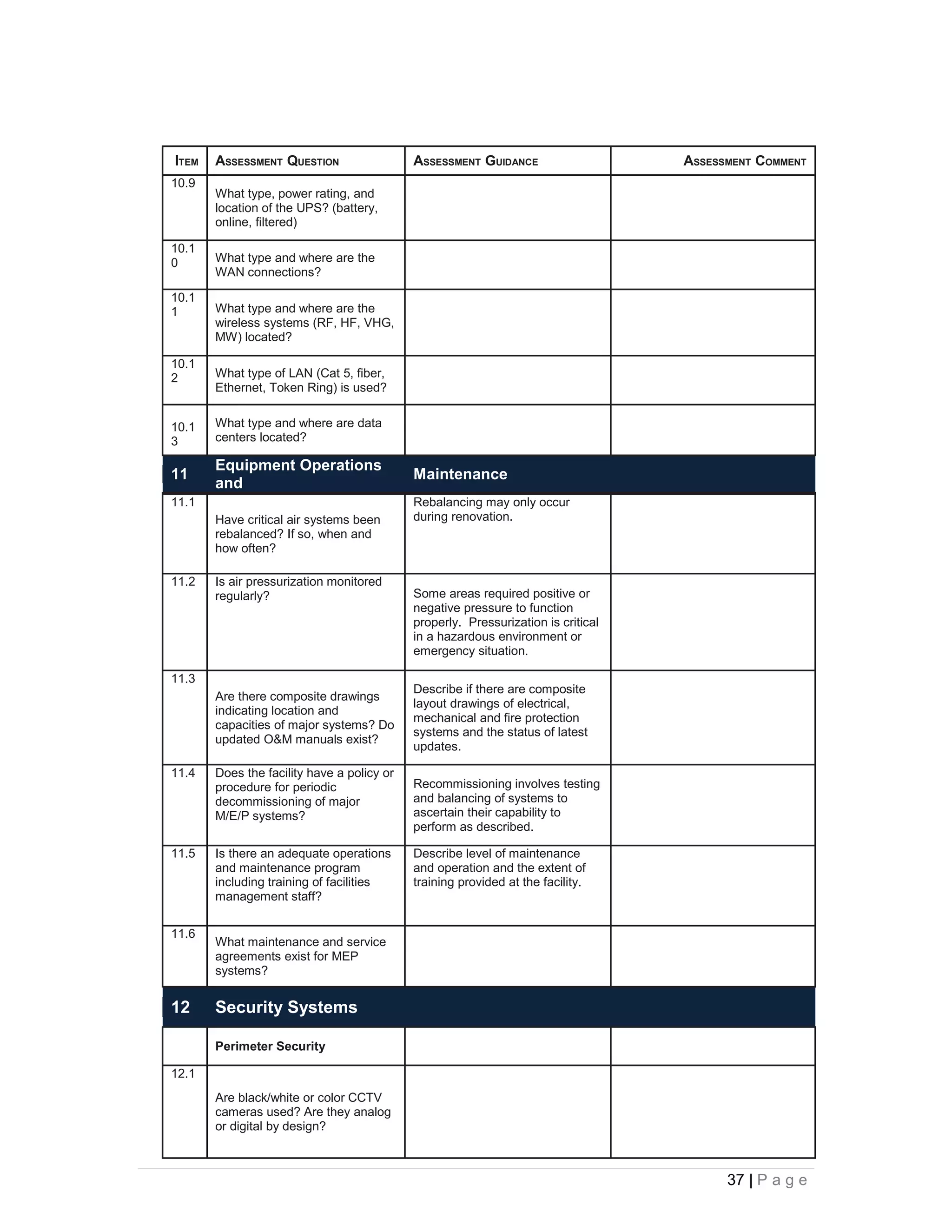
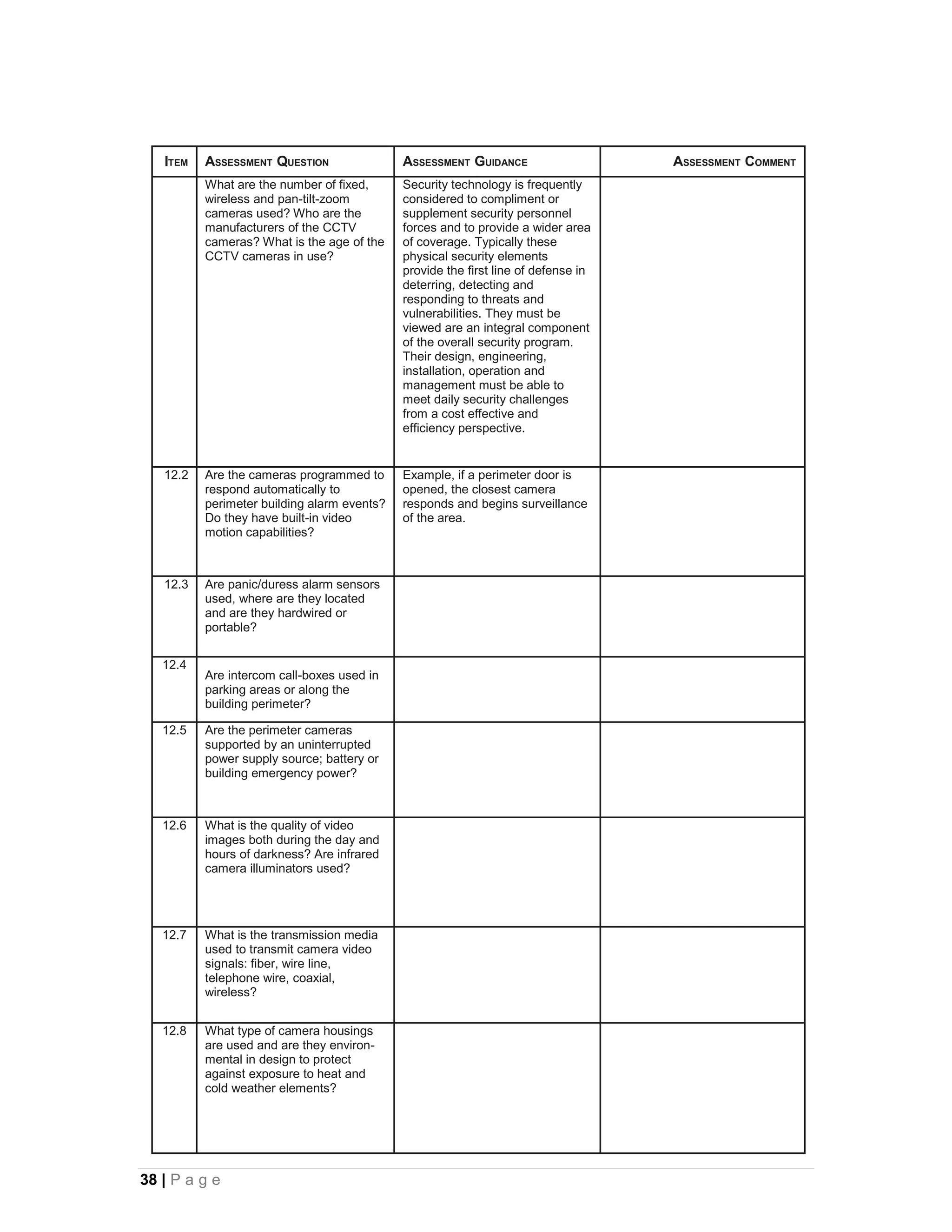
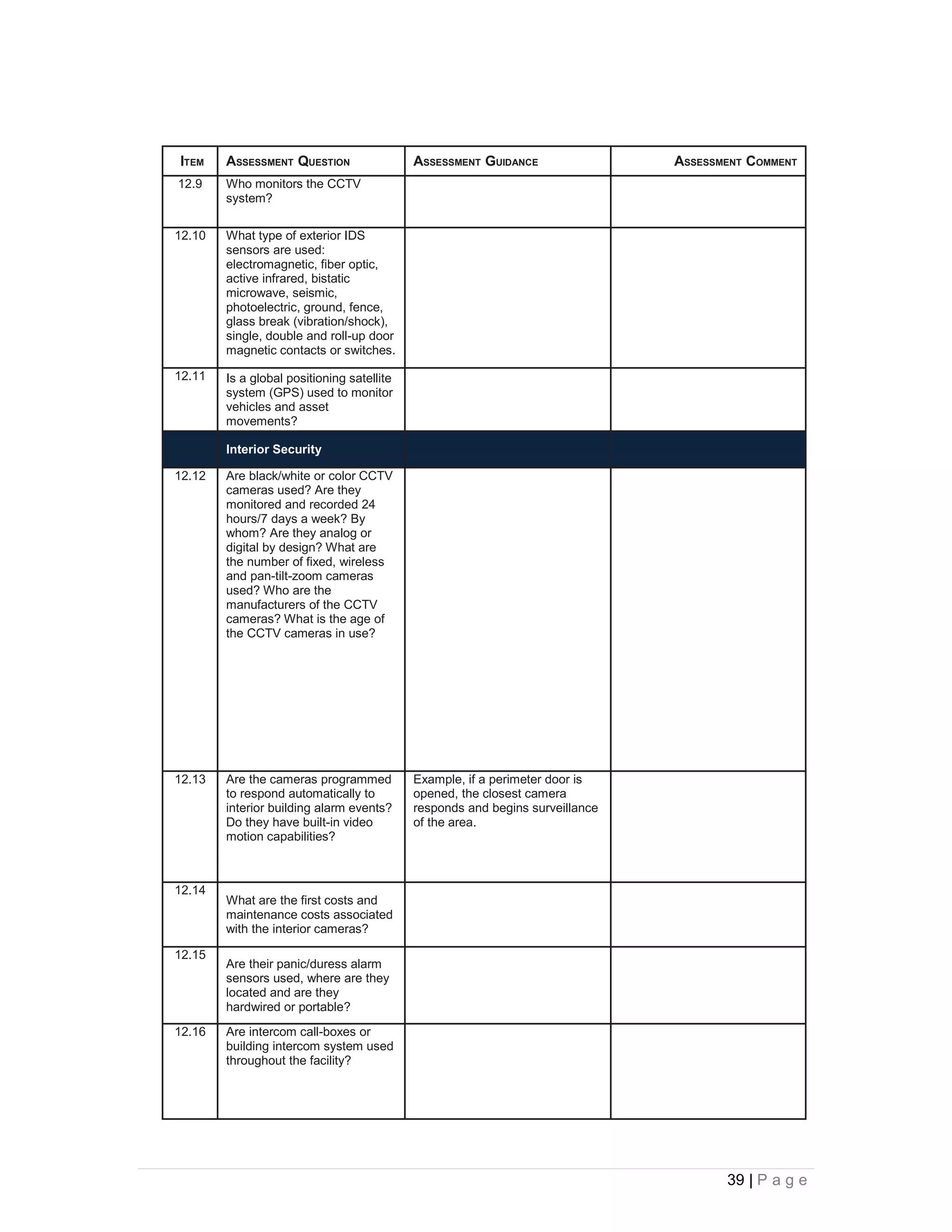
  • 27.
    ITEM ASSESSMENT QUESTION ASSESSMENT GUIDANCE ASSESSMENT COMMENT Concrete moment resisting frames - 2.0 to 4.0 Concrete shear wall buildings 3.0 to 4.0 Concrete frame with unreinforced masonry infill walls - 1.5 to 3.0 Steel frame with unreinforced masonry infill walls - 1.5 to 3.0 Tilt-up buildings - 2.0 to 3.5 Precast concrete frame buildings - 1.5 to 2.5 Reinforced masonry - 3.0 to 4.0 Unreinforced masonry - 1.0 to 2. 3.2 Do the reinforced concrete structures contain symmetric steel reinforcement (positive and negative faces) in all floor slabs, roof slabs, walls, beams and girders that may be subjected to rebound, uplift and suction pressures? Do the lap splices fully develop the capacity of the reinforcement? Are lap splices and other discontinuities staggered? Do the connections possess ductile details? Does special shear reinforcement, including ties and stirrups, available to allow large post- elastic behavior? 3.3 Are the steel frame connections moment connections? Are the column spacing minimized so that reasonably sized members will resist the design loads and increase the redundancy of the system? What are the floor-to- floor heights? 3.4 Are critical elements vulnerable The priority for upgrades should to failure? be based on the relative importance of structural or non- structural elements that are essential to mitigating the extent of collapse and minimize injury and damage. Primary Structural Elements provide the essential parts of the building’s resistance 27 | P a g e
  • 28.
    ITEM ASSESSMENT QUESTION ASSESSMENT GUIDANCE ASSESSMENT COMMENT Catastrophic blast loads and progressive collapse. These include columns, girders, roof beams, and the main lateral resistance system; Secondary Structural Elements consist of all other load bearing members, such as floor beams, slabs, etc.; Primary Non-Structural Elements consist of elements (including their attachments) which are essential for life safety systems or elements which can cause substantial injury if failure occurs, including ceilings or heavy suspended mechanical units; and Secondary Non-Structural Elements consist of all elements not covered in primary non- structural elements, such as partitions, furniture, and light fixtures. 3.5 Will the structure suffer an The extent of damage to the unacceptable level of damage structure and exterior wall resulting from the postulated systems from the bomb threat threat? may be related to a protection level: Low and Medium/Low Level Protection - Major damage. The facility or protected space will sustain a high level of damage without progressive collapse. Casualties will occur and assets will be damaged. Building components, including structural members, will require replace- ment, or the building may be completely un-repairable, requiring demolition and replacement. Medium Level Protection Moderate damage, repairable. The facility or protected space will sustain a significant degree of damage, but the structure should be reusable. Some casualties may occur and assets may be damaged. Building elements other than major structural members may require replacement. Higher Level Protection - Minor damage, repairable. The facility or protected space may globally sustain minor damage with some 28 | P a g e
  • 29.
    ASSESSMENT QUESTION ASSESSMENT GUIDANCE ASSESSMENT COMMENT ITEM local significant damage possible. Occupants may incur some injury, and assets may receive minor damage. 3.6 Is the structure vulnerable to Design to mitigate progressive progressive collapse? Is the collapse is an independent facility capable of sustaining the analysis to determine a system’s removal of a column for one ability to resist structural collapse floor above grade at the building upon the loss of a major structural perimeter without progressive element or the system’s ability to collapse? In the event of an resist the loss of a major internal explosion in an structural element. Design to uncontrolled public ground floor mitigate progressive collapse may area (such as lobbies, loading be based on the methods outlined docks and mailrooms) does the in ASCE 7-98. Designers may design prevent progressive apply static and/ or dynamic collapse due to the loss of one methods of analysis to meet this primary column or does the requirement and ultimate load design preclude such a loss? Do capacities may be assumed in the architectural or structural analyses. Existing buildings features provide a minimum 6- should not be retrofitted to inch standoff to the internal prevent progressive collapse columns? Are the columns in the unless they are undergoing a unscreened internal spaces structural renovation, such as a designed for an un-braced seismic upgrade. Existing facilities length equal to two floors, or may be retrofitted to withstand the three floors where there are two design level threat or to accept levels of parking? the loss of a column for one floor above grade at the building perimeter without progressive collapse. 3.7 Are there adequate redundant Special consideration should be load paths in the structure? given to materials which have inherent ductility and which are better able to respond to load reversals such as cast in place reinforced concrete and steel construction. Careful detailing is required for material such as pre- stressed concrete, pre-cast concrete, and masonry to adequately respond to the design loads. Primary vertical load carrying members shall be protected where parking is inside a facility and the building superstructure is supported by the parking structure. 3.8 Will the loading dock design limit The floor of the loading dock does damage to adjacent areas and not need to be designed for blast vent explosive force to the resistance if the area below is not exterior of the building? occupied and contains no critical utilities. 29 | P a g e
  • 30.
    ASSESSMENT QUESTION ASSESSMENT GUIDANCE ASSESSMENT COMMENT ITEM 3.9 Are mailrooms, where packages Where mailrooms and are received and opened for unscreened retail spaces are inspection, and unscreened located in occupied areas or retail spaces designed to adjacent to critical utilities, mitigate the effects of a blast on walls, ceilings, and floors, they primary vertical or lateral bracing should be blast and fragment members? resistant. Methods to facilitate the venting of explosive forces and gases from the interior spaces to the outside of the structure may include blow-out panels and window system designs that provide protection from blast pressure applied to the outside but that readily fail and vent if exposed to blast pressure on the inside. 3.10 Are there transfer girders that are supported by columns within unscreened public spaces or at the exterior of the building? 4 Building Envelope 4.1 To what level are the exterior The performance of the façade Walls designed to provide less varies to a great extent on the than a high hazard response? materials. Different Are the walls capable of construction includes brick or withstanding the dynamic stone with block back-up, steel reactions from the windows? stud walls, precast panels, curtainwall with glass, stone or metal panel elements. The performance of the glass will similarly depend on the materials. Glazing may be single pane or double pane, monolithic or laminated, annealed, heat strengthened or fully tempered.Shear walls that are essential to the lateral and vertical load bearing system, and that also function as exterior walls, shall be considered primary structures and shall resist the actual blast loads predicted from the threats specified. Where exterior walls are not designed for the full design loads, special consideration shall be given to construction types that reduce the potential for injury. As a minimum goal, the window systems should be designed so that at least __ % of the total glazed areas of the facility meet the specified performance conditions when subjected to the defined threats. 30 | P a g e
  • 31.
    ASSESSMENT QUESTION ASSESSMENT GUIDANCE ASSESSMENT COMMENT ITEM 4.2 Is there less than 40 % fenestra- tion openings per structural bay? Are the window systems design (glazing, frames, anchorage to supporting walls, etc.) on the exterior facade balanced to mitigate the hazardous effects of flying glazing following an explosive event? Do the glazing systems with a ½inch bite contain an application of structural silicone? Is the glazing Laminated or is it protected with an anti-shatter film? If an anti- shatter film is used, is it a minimum of a 7-mil thick film, or specially manufactured 4-mil thick film? 4.3 Do the walls, anchorage, and Government produced and window framing fully develop the sponsored computer programs capacity of the glazing material coupled with test data and selected? Will the anchorage recognized dynamic structural remain attached to the walls of analysis techniques may be used the facility during an explosive to determine whether the glazing event without failure? Is the either survives the specified façade connected to backup threats or the post damage block or to the structural frame? performance of the glazing Are non-bearing masonry walls protects the occupants. A reinforced? breakage probability no higher than 750 breaks per 1000 may be used when calculating loads to frames and anchorage. 4.4 Does the facility contain ballistic Glass-clad polycarbonate or glazing? Does the ballistic laminated polycarbonates are two glazing meet the requirements types of acceptable glazing of UL 752 Bullet-Resistant material. Glazing? Does the facility contain security-glazing? Does the security-glazing meet the requirements of ASTM F1233 or UL 972, Burglary Resistant Glazing Material? Do the Window Assemblies containing Forced Entry resistant glazing (excluding the glazing) meet the requirements of ASTM F 588? 31 | P a g e
  • 32.
    ITEM ASSESSMENT QUESTION ASSESSMENT GUIDANCE ASSESSMENT COMMENT 4.5 Do non-window openings, such In-filling of blast over-pressures as mechanical vents and must be considered through non- exposed plenums, provide the window openings such that same level of protection required structural members and all for the exterior wall? Are non- mechanical system mountings window openings, such as and attachments should resist mechanical vents and exposed these interior fill pressures. plenums, designed to the level of protection required for the exterior wall? 4.6 Is interior glazing shatter resistant? Interior glazing should be minimized where a threat exists and should be avoided in enclosures of critical functions next to high-risk areas. 5 Utility Systems 5.1 What is the source of domestic Critical water supply may be water? vulnerable. Sources include municipal, wells, storage tank. 5.2 Are there multiple entry points for the water supply? If the facility has only one source of water entering at one location, the entry points should be secure. 5.3 Is the incoming water supply in a secure location? Access to water supply should not be open to non-authorized personnel. 5.4 Does the facility have storage Operational facilities will require capacity for domestic water? reliance on adequate domestic How much? water supply. 5.5 What is the source of water for the fire suppression system? Describe location and number of service entry points. Is the service reliant on the local utility company? 5.6 Are sewer systems protected? Are they accessible? Sanitary and storm water sewers should be protected from unauthorized access and possible contamination. 5.7 What fuel supplies do the facility rely on for critical operation? Typically natural gas, propane, or fuel oil are required for continued operation 5.8 How much fuel is stored on the Fuel storage protection is facility? How is it stored? essential for continued operation. 32 | P a g e
  • 33.
    ITEM ASSESSMENT QUESTION ASSESSMENT GUIDANCE ASSESSMENT COMMENT 5.9 The supply of fuel is dependent on the reliability of the supplier. Where is the fuel supply obtained? How is it delivered? Critical functions may be served 5.10 Are there alternate sources of by alternate methods if normal fuel? Can alternate fuels be fuel supply is interrupted. used? What is the normal source of 5.11 electrical service for the facility? Utilities are the general source unless co-generation or a private energy provider is available. 5.12 Is there a redundant electrical service source? Can the The utility may have only one facilities be feed from more than source of power from a single one utility substation? substation. There may be only single feeders from the main substation. How may service entry points 5.13 does the facility have for Electrical supply at one location electricity? creates a vulnerable situation unless alternate source are available. What provisions for emergency 5.14 power exist? Describe the emergency power system and its location. Can the utility provide backup power if the normal electrical service is interrupted? 5.15 Is the incoming electric service to the building secure? Typically, the service entrance is a locked room, unaccessible to the public. 5.16 Does the fire alarm system require communication with Typically, the local fire department external sources? responds to an alarm. Describe how the alarm signal is sent to the responding agency: telephone, radio, etc. 5.17 Typically communication ducts or By what means does the main other conducts are available. telephone and data communica- tions interface the facility? 5.18 Are there multiple or redundant Secure locations of communica- location for the communication tions wiring entry to the facility are service? required. 6 Mechanical Systems 6.1 Where are the air intakes and exhaust louvers for the building? Describe location and relation to public access. Indicate if intakes are low, high or midpoint of building structure. 6.2 Are there multiple air intake Single air intakes may feed locations? several air handling units. Indicate if the air intakes are localized or separated. 33 | P a g e
  • 34.
    ITEM ASSESSMENT QUESTION ASSESSMENT GUIDANCE ASSESSMENT COMMENT 6.3 What are the types of air filtration? Describe the efficiency and number of filter modules for each of the main air handling systems. Is there space for larger filter 6.4 assemblies on critical air Air handling units serving critical handling systems? functions during continued operation may be retrofitted to provide enhanced protection during emergencies. 6.5 How are the air handling systems zoned? Describe the areas and functions served by each of the primary air handling systems. 6.6 Independent units can continue to Are there large central air operate if damage occurs to handling units or are there limited areas of the facility. multiple units serving separate zones? Are there any redundancies in 6.7 the air handling system? Describe if critical areas can be served from other units if a major system is disabled. 6.8 Is the air supply to critical areas compartmentalized? Describe if air flow can occur from critical to non-critical areas either through building openings, ductwork, or air handling system. 6.9 Are supply and exhaust air systems for laboratories secure? 6.10 Central systems can range from What is the method of tempera- monitoring only to full control. ture and humidity control? Is it Local control may be available to localized or centralized? override central operation. 6.11 Where are the control centers Access to any component of the and cabinets located? Are they building automation and control in secure areas? How is the system could compromise the control wiring routed? functioning of the system. 6.12 Are there provisions for air Duct mounted sensors are found monitors or sensors for chemical in limited cases generally in or biological agents? laboratory areas. 7 Plumbing and Gas Systems 7.1 What is the method of water distribution? Central shaft locations for piping are more vulnerable than multiple riser locations. 7.2 What is the method of medical gas distribution? 34 | P a g e
  • 35.
    ITEM ASSESSMENT QUESTION ASSESSMENT GUIDANCE ASSESSMENT COMMENT 7.3 Is there redundancy to the main piping distribution? Looping of piping and use of section valves provide redun- dancy in the event sections of the system are damaged. 7.4 What is the method of heating domestic water? What fuel is Single source of hot water with used? one fuel source is more vulnerable than multiple sources and multiple fuel types. 7.5 Describe the locations relative to Where are the oxygen and the facility including any blast nitrous oxide tanks located? protection? Indicate if the How are they piped to the distribution piping is above or distribution system? belowground. 7.6 Are there reserve supplies of oxygen and nitrous oxide? Localized gas cylinders could be available in the event of damage to the central tank system. 8 Electrical Systems 8.1 How are the electrical rooms secured? Describe if all primary electrical equipment is located in a secured area. 8.2 Are critical electrical systems co- located with other building Indicate those areas where major systems? electrical equipment is colocated with other systems or is located in areas outside secured electrical areas. 8.3 Are electrical distribution panels secured or in secure locations? Describe the means of access and location of critical electrical distribution panels serving branch circuits. 8.4 Does emergency backup power Is the emergency power system exist for all areas within the independent from the normal facility? How is the emergency electrical service, particularly in power distributed? critical care areas? 8.5 Central utility shafts may be How is the primary electrical subject to damage. Describe if the system wiring distributed? Is distribution is co-located with there redundancy of distribution other major utilities and if there to critical areas? are alternate suppliers. 8.6 What is the extent of the external facility lighting in utility Indicate the amount of exterior and service areas? lighting particularly in critical areas such as utility and service areas. 8.7 Are there any transformers or Describe how these devices are switchgears located outside the secured and if they are vulnerable building or accessible from the to public access. building exterior? 35 | P a g e
  • 36.
    ITEM ASSESSMENT QUESTION ASSESSMENT GUIDANCE ASSESSMENT COMMENT 9 Fire Alarm Systems 9.1 Is the facility fire alarm system centralized or localized? Describe the main components of the system including methods and extent of annunciation both locally and centrally. 9.2 Where are the fire alarm panels located? Indicate the location and accessibility of the panels particularly with regard to access by unauthorized personnel. 9.3 Describe what interface the fire Is the fire alarm system stand- alarm system has with other alone or integrated with other building management systems. functions such as security and environmental systems? Communications and IT 10 tems Sys 10.1 Where are communication systems wiring closets located? Describe if communications Are they in secure areas? closets are independent or if they are co-located with other utilities. How is communications system 10.2 wiring distributed? Indicate if wiring systems are in chases or if distribution is in occupied areas. Are there redundant 10.3 communications systems Critical areas should be supplied available? with multiple or redundant means of communications. 10.4 Do the IT systems meet require- ments of confidentiality, integrity, and availability? 10.5 Where is the disaster recovery/ mirroring site? 10.6 Where is the back-up tape/file storage site and what is the type of safe environment? (safe, vault, underground) Is there redundant refrigeration in the site? 10.7 Where is the main distribution facility? Where are the secondary and/or intermediate distribution facilities? 10.8 Where are the routers and firewalls located? 36 | P a g e
  • 37.
    ITEM ASSESSMENT QUESTION ASSESSMENT GUIDANCE ASSESSMENT COMMENT 10.9 What type, power rating, and location of the UPS? (battery, online, filtered) 10.1 0 What type and where are the WAN connections? 10.1 1 What type and where are the wireless systems (RF, HF, VHG, MW) located? 10.1 2 What type of LAN (Cat 5, fiber, Ethernet, Token Ring) is used? 10.1 What type and where are data 3 centers located? Equipment Operations 11 Maintenance and 11.1 Rebalancing may only occur Have critical air systems been during renovation. rebalanced? If so, when and how often? 11.2 Is air pressurization monitored regularly? Some areas required positive or negative pressure to function properly. Pressurization is critical in a hazardous environment or emergency situation. 11.3 Describe if there are composite Are there composite drawings layout drawings of electrical, indicating location and mechanical and fire protection capacities of major systems? Do systems and the status of latest updated O&M manuals exist? updates. 11.4 Does the facility have a policy or procedure for periodic Recommissioning involves testing decommissioning of major and balancing of systems to M/E/P systems? ascertain their capability to perform as described. 11.5 Is there an adequate operations Describe level of maintenance and maintenance program and operation and the extent of including training of facilities training provided at the facility. management staff? 11.6 What maintenance and service agreements exist for MEP systems? 12 Security Systems Perimeter Security 12.1 Are black/white or color CCTV cameras used? Are they analog or digital by design? 37 | P a g e
  • 38.
    ITEM ASSESSMENT QUESTION ASSESSMENT GUIDANCE ASSESSMENT COMMENT What are the number of fixed, Security technology is frequently wireless and pan-tilt-zoom considered to compliment or cameras used? Who are the supplement security personnel manufacturers of the CCTV forces and to provide a wider area cameras? What is the age of the of coverage. Typically these CCTV cameras in use? physical security elements provide the first line of defense in deterring, detecting and responding to threats and vulnerabilities. They must be viewed are an integral component of the overall security program. Their design, engineering, installation, operation and management must be able to meet daily security challenges from a cost effective and efficiency perspective. 12.2 Are the cameras programmed to Example, if a perimeter door is respond automatically to opened, the closest camera perimeter building alarm events? responds and begins surveillance Do they have built-in video of the area. motion capabilities? 12.3 Are panic/duress alarm sensors used, where are they located and are they hardwired or portable? 12.4 Are intercom call-boxes used in parking areas or along the building perimeter? 12.5 Are the perimeter cameras supported by an uninterrupted power supply source; battery or building emergency power? 12.6 What is the quality of video images both during the day and hours of darkness? Are infrared camera illuminators used? 12.7 What is the transmission media used to transmit camera video signals: fiber, wire line, telephone wire, coaxial, wireless? 12.8 What type of camera housings are used and are they environ- mental in design to protect against exposure to heat and cold weather elements? 38 | P a g e
  • 39.
    ITEM ASSESSMENT QUESTION ASSESSMENT GUIDANCE ASSESSMENT COMMENT 12.9 Who monitors the CCTV system? 12.10 What type of exterior IDS sensors are used: electromagnetic, fiber optic, active infrared, bistatic microwave, seismic, photoelectric, ground, fence, glass break (vibration/shock), single, double and roll-up door magnetic contacts or switches. 12.11 Is a global positioning satellite system (GPS) used to monitor vehicles and asset movements? Interior Security 12.12 Are black/white or color CCTV cameras used? Are they monitored and recorded 24 hours/7 days a week? By whom? Are they analog or digital by design? What are the number of fixed, wireless and pan-tilt-zoom cameras used? Who are the manufacturers of the CCTV cameras? What is the age of the CCTV cameras in use? 12.13 Are the cameras programmed Example, if a perimeter door is to respond automatically to opened, the closest camera interior building alarm events? responds and begins surveillance Do they have built-in video of the area. motion capabilities? 12.14 What are the first costs and maintenance costs associated with the interior cameras? 12.15 Are their panic/duress alarm sensors used, where are they located and are they hardwired or portable? 12.16 Are intercom call-boxes or building intercom system used throughout the facility? 39 | P a g e
  • 40.
    ITEM ASSESSMENT QUESTION ASSESSMENT GUIDANCE ASSESSMENT COMMENT 12.17 Are the interior cameras supported by an uninterrupted power supply source; battery or building emergency power? 12.18 Is the quality in interior camera video images of good visual and recording quality? 12.19 Are the camera lenses used of the proper specifications, especially distance viewing and clarity? 12.20 What is the transmission media used to transmit camera video signals: fiber, wire line, telephone wire, coaxial, wireless? 12.21 What type of camera housings are used and are they designed to protect against exposure or tampering? 12.22 Are magnetometers (metal detectors) and x-ray equipment used and at what locations within the facility? 12.23 Does a security photo identification badge processing system in place? Does it work in conjunction with the access control system or is it a standalone system? 12.24 What type of interior IDS sensors are used: electromagnetic, fiber optic, active infrared-motion detector, photoelectric, glass break (vibration/shock), single, double and roll-up door magnetic contacts or switches? 12.25 Is there a security system in place to protect against infant/patient abductions? 12.26 Is there a security asset tracking system in place that monitors the movement, control and accountability of assets within and removal from a facility (e.g. electronic tags, bar codes, wire, infrared/black light markings, etched or chemical embedded id number, etc.)? 40 | P a g e
  • 41.
    ITEM ASSESSMENT QUESTION ASSESSMENT GUIDANCE ASSESSMENT COMMENT 12.27 Is there a holdup-cash register security controls in place that activates upon removal of cash and works in conjunction with other CCTV and related IDS systems? 12.28 What type of security access control systems is used? Are these same devices used for physical security also used (integrated) with providing access control to security computer networks (e.g. in place of or combination with user id’s and system passwords)? 12.29 What types of access control transmission media is used to transmit access control system signals (same as defined for CCTV cameras)? 12.30 What is the backup power supply source for the access control systems; battery backup or some form of other uninterrupted power sources? 12.31 What access control system equipment is used? How old are the systems and what are the related first and maintenance service costs? 12.32 Are mechanical, electrical, medical gas, power supply, radiological material storage, voice/data telecommunication system nodes, security system panels, elevator and critical system panels, and other sensitive rooms continuously locked, under electronic security CCTV camera and intrusion alarm systems surveillance? 12.33 What security safeguards are in place to control the movement, custody, accountability and tracking of facility assets? 12.34 Are their vaults or safes used and are they protected against unauthorized or forced entry? Where are they located? 41 | P a g e
  • 42.
    ITEM ASSESSMENT QUESTION ASSESSMENT GUIDANCE ASSESSMENT COMMENT 12.35 What security controls are in place to handle the processing of mail and protect against potential biological, explosive or other threatening exposures? 12.36 What type of security key management system is in place? How are keys made, issued and accounted for? Who is responsible for key management and the authorized release of them? 12.37 What types of locking hardware are used throughout the facility? Are manual and electromagnetic cipher, keypad, pushbutton, panic bar, door strikes and related hardware and software used? 12.38 Are any potentially hazardous chemicals, combustible or toxic materials stored on-site in non-secure and non- monitored areas? 12.39 Is there a designated security control room and console in place to monitor security, fire alarm and possibly other building systems? 12.40 Is the security console and control room adequate in size, provide room for expansion, have adequate environment controls (e.g. a/c, lighting, heating, air circulation, backup power, etc,) and is ergonomically designed? 12.41 Is the location of the security room located in a secure area with limited, controlled and restricted access controls in place? 12.42 What are the means by which facility and security personnel can communicate with one another: portable radio, pager, cell phone, personal data assistants (PDA’s), etc)? What problems have been experienced with these and other electronic security systems? 42 | P a g e
  • 43.
    ITEM ASSESSMENT QUESTION ASSESSMENT GUIDANCE ASSESSMENT COMMENT 12.43 Is there a computerized security incident reporting system used to prepare reports and track security incident trends and patterns? 12.44 Does the present security This system allows for the force have access to use a systematic performance of guard computerized guard tour patrols with validation indicators system? built in. The system notes stations/locations checked or missed, dates and times of such patrols and who conducted them on what shifts. Management reports can be produced for record keeping and manpower analysis purposes. Security System Documents 12.45 Are security system as-built Critical to the consideration and drawings been generated and operation of security technologies ready for review? its overall design and engineering processes. These historical reference documents outline system specifications and layout security device used, their application, location and connectivity. They are a critical resource tool for troubleshooting system problems, for replacing and adding other security system hardware and software products. Such documents are an integral component to new and retrofit construction projects. 12.46 Have security system design and drawing standards been developed? 12.47 Are security equipment selection criteria defined? 12.48 What contingency plans have been developed or are in place to deal with security control center redundancy and backup operations? 12.49 Have security system construction specification documents been prepared and standardized? 12.50 Are all security system documents to include as-built drawings current? 12.51 Have qualifications been determined in using security consultants, system designers and engineers, installation vendors and contractors? 43 | P a g e
  • 44.
    ITEM ASSESSMENT QUESTION ASSESSMENT GUIDANCE ASSESSMENT COMMENT 12.52 Are security systems decentralized, centralized, integrated, and operate over existing IT network or standalone method of operation? 12.53 What security systems manuals are available? 12.54 What maintenance or service agreements exist for security systems? 13 Security Master Plan 13.1 Does a written security plan The development and imple- exist for this facility? When mentation of a security master was the initial security plan plan provides a roadmap which written and last revised? Who outlines the strategic direction and is responsible for preparing vision, operational, managerial and reviewing the security and technological mission, goals plan? and objectives of the organizations security program. 13.2 Has the security plan been communicated and disseminated to key management personnel and departments? 13.3 Has the security plan been benchmarked or compared against related organizations and operational entities? 13.4 Has the security plan ever been tested and evaluated from a cost-benefit and operational efficiency and effectiveness perspective? 13.5 Does it define mission, vision, short-long term security program goals and objectives? 13.6 Are threats, vulnerabilities, risks adequately defined and security countermeasures addressed and prioritized relevant to their criticality and probability of occurrence? 13.7 Has a security implementation schedule been established to address recommended security solutions? 13.8 Have security operating and capital budgets been addressed, approved and established to support the plan? 44 | P a g e
  • 45.
    ITEM ASSESSMENT QUESTION ASSESSMENT GUIDANCE ASSESSMENT COMMENT 13.9 What regulatory or industry guidelines/standards were followed in the preparation of the security plan? 13.10 Does the security plan address existing security conditions from an administrative, operational, managerial and technical security systems perspective? 13.11 Does the security plan address the protection of people, property, assets and information? 13.12 Does the security plan address the following major components: access control, surveillance, response, building hardening and protection against biological, chemical, radiological and cyber-network attacks? 13.13 Has the level of risk been identified and communicated in the security plan through the performance of a physical security assessment? 13.14 When was the last security assessment performed? Who performed the security risk assessment? 13.15 Were the following areas of security analysis addressed in the security master plan: Asset Analysis: Does the security plan identify and prioritize the assets to be protected in accordance to their location, control, current and replacement value? Threat Analysis: Does the security plan address potential threats; causes of potential harm in the form of death, injury, destruction, disclosure, interruption of operations, or denial of services? Examples include possible criminal acts (documented and review of police/security incident reports) associated with forced entry, bombs, ballistic assault, biochemical and related terrorist tactics, attacks against utility systems infrastructure and buildings. 45 | P a g e
  • 46.
    ITEM ASSESSMENT QUESTION ASSESSMENT GUIDANCE ASSESSMENT COMMENT Vulnerability Analysis: Does the security plan address other areas and anything else associated with a facility and it’s operations that can be taken advantage of to carry out a threat? Examples include the architectural design and construction of new and existing facilities, technological support systems (e.g. heating, air conditioning, power, lighting and security systems, etc.) and operational procedures, policies and controls. Risk Analysis: Does the security plan address the findings from the asset, threat, and vulnerability analyses to develop, recommend and consider implementation of appropriate security countermeasures? Contact Information James E. McDonald C/O American Alarm and Communications, Inc. Central Massachusetts Regional Office 489 Washington Street Auburn, Massachusetts 01501 Direct Phone: (508) 453-2731 Direct Fax: (781) 645-7537 Email: JMcDonald@AmericanAlarm.com American Alarm Website: www.AmericanAlarm.com Blog: www.SecurityTalkingPoints.com Twitter: www.Twitter.com/physectech 46 | P a g e
  • 47.
    The Physical SecurityRisk Management Book BY JAMES McDONALD, PSNA A PROUD MEMBER OF INFRAGARD, IFMA, ASIS & IAHSS AMERICANALARM 47 | P a g e