Chapter 9
            Heart-of-the-House
          Management I: Food and
          Beverage, Housekeeping,
        Laundry, and Valet Operations
                         World of Resorts: From Development to Management
                                            Third Edition
                                        (424TXT or 424CIN)


© 2010, Educational Institute
Competencies for
               Heart-of-the-House Management I
     1. Explain why food and beverage facilities are critical to
        resorts and identify factors that affect a resort’s food
        and beverage choices.
     2. Describe the organization and division of duties in
        typical resort kitchens and identify current trends in
        kitchen design and cuisine.
     3. Explain the critical importance of the menu and define
        different menu types and meal plans.
     4. Identify and discuss important elements of food and
        beverage merchandising and of room service at a
        resort.
© 2010, Educational Institute  (continued)                     2
Competencies for
               Heart-of-the-House Management I
                                (continued)

     1. Describe the coordination that must exist between a
        resort’s housekeeping department and all other
        departments and explain why it is important.
     2. Identify housekeeping department staffing and
        scheduling concepts and tools, and describe the role of
        housekeeping standards—including factors and trends
        that may affect those standards.
     3. Identify and describe the range of factors that a resort
        should consider when deciding how it will address its
        laundry and dry cleaning needs.
© 2010, Educational Institute                                  3
Types of Meal Plans
              •      All-inclusive
              •      American Plan (AP)
              •      Bed and breakfast (B&B)
              •      Continental plan (CP)
              •      Dine-around plan
              •      Flexi-plan
              •      European plan (EP)
              •      Modified American plan (MAP) or half pension

© 2010, Educational Institute                                       4
Popular Resort Event Themes
                   • International food festivals
                   • Specific country themes
                   • Texas barbecues and outdoor chuck wagons
                   • Hawaiian luaus
                   • Oktoberfest
                   • Scandinavian smorgasbords
                   • English hunt breakfasts

© 2010, Educational Institute          (continued)              5
Popular Resort Event Themes
                                (continued)

          • Holiday celebrations: Valentine’s Day, St. Patrick’s
            Day, Easter, Chinese New Year, Cinco de Mayo,
            Fourth of July, Bastille Day, Halloween,
            Thanksgiving, Christmas, etc.
          • Wine and cheese parties
          • Casino nights: Las Vegas, Macau, Monte Carlo, etc.
          • Picnics
          • New England clambakes

© 2010, Educational Institute                                      6
Limiting Factors in Planning
                           In-Room Menus
   • The ability of the kitchen to prepare in-room items when
     the full kitchen is shut down after regular meal hours
     and between the last meal of the day and breakfast.
   • The effect of holding time of food quality. Many dishes
     deteriorate shortly after cooking. For example, pancakes
     can turn rubbery, steaks ordered rare can continue to
     cook, and delicate soufflés are not likely to survive the
     trip from the kitchen to the rooms.
   • Temperature control and functional delivery equipment.
     Keeping hot food hot and cold food cold is difficult to
     achieve consistently. (continued)
© 2010, Educational Institute                                  7
Limiting Factors in Planning
                           In-Room Menus
                                 (continued)


          • Time sensitivity of orders and ease of assembly
            for quick delivery.
          • Kitchen assembly space for room service cart
            setups and tray assembly.
          • Supervision. Supervision of dining room staff is
            direct, but oversight of room service staff is done
            remotely and based on trust.

© 2010, Educational Institute    (continued)                      8
Limiting Factors in Planning
                           In-Room Menus
                                (continued)

          • Pricing. Higher prices are required to cover the
            high overhead of in-room service, but guests do
            not always understand or appreciate this.
          • System organization and detailed procedures from
            order-taking in the kitchen office to expediting
            orders to guest billing and service follow-up,
            including complaints handling.


© 2010, Educational Institute                                  9
Tasks Included in Full Rehabilitation
   • Stripping the floor and replacing carpet
   • Stripping and repainting the walls and hanging wallpaper
   • Rebuilding, repairing, reupholstering, or replacing
     furniture
   • Replacing worn, frayed, or stained bedspread, drapes,
     lamp shades, and other items
   • Repainting the bath area; checking bathroom plumbing
     and replacing worn or rusted parts, showerheads, and
     faucets; and replacing cracked or chipped tiles
   • Checking the heating, air-conditioning, and ventilation
     system
© 2010, Educational Institute                                  10
Procedures for Turndown Service
      1. Cleaning the bathroom and restocking it with fresh
         towels.
      2. Tidying the guestroom, including emptying
         wastebaskets.
      3. Removing the bed cover and placing it in the closet.
      4. Folding back the blanket and top sheet.
      5. Fluffing the pillow.
      6. Drawing the drapes.
      7. Filling the mini-bar ice bucket with fresh ice.
© 2010, Educational Institute                                   11
Laundry and Dry Cleaning
                           Requirement Options
     1. A complete linen rental service plus outside
        concessions for other resort and guest laundry and dry
        cleaning
     2. A limited in-house laundry for small items, a linen
        rental service for large items, and outside concessions
        for other resort and guest laundry and dry cleaning
     3. A combination of a full-service laundry and a dry
        cleaning plant for resort needs and outside
        concessions for guest laundry and dry cleaning
     4. A complete full-service laundry and dry cleaning
        plant to serve all needs of the resort and its guests
© 2010, Educational Institute                                     12
Physical Layout of Limited Laundry
      1. Soiled laundry collection, classification, and counting
      2. Washing-extracting
      3. Drying
      4. Folding and hanging
      5. Storing in a portion of the department’s linen and
         uniform storage room


© 2010, Educational Institute                                  13
Basic Full-Service In-House
                           Laundry Equipment
          • Washer-extractors of varying size/load capacities
          • Tumblers or dryers of varying size/load capacities
          • Dry cleaner
          • Flatwork ironer
          • Folding facilities and automatic folding
            equipment, with or without ironing capability


© 2010, Educational Institute      (continued)                   14
Basic Full-Service In-House
                           Laundry Equipment
                                   (continued)

   • Water-conditioning equipment; water-reclaiming system
   • Pressing equipment, such as automatic steam pressers
     and shirt pressers
   • Steam box for finishing uniforms
   • Miscellaneous equipment such as laundry carts and racks


© 2010, Educational Institute                               15
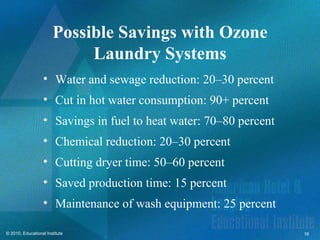
Possible Savings with Ozone
                            Laundry Systems
                   • Water and sewage reduction: 20–30 percent
                   • Cut in hot water consumption: 90+ percent
                   • Savings in fuel to heat water: 70–80 percent
                   • Chemical reduction: 20–30 percent
                   • Cutting dryer time: 50–60 percent
                   • Saved production time: 15 percent
                   • Maintenance of wash equipment: 25 percent

© 2010, Educational Institute                                       16
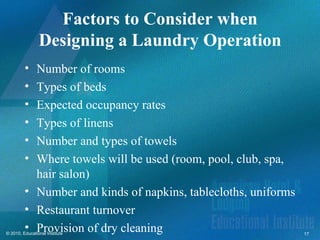
Factors to Consider when
                Designing a Laundry Operation
         • Number of rooms
         • Types of beds
         • Expected occupancy rates
         • Types of linens
         • Number and types of towels
         • Where towels will be used (room, pool, club, spa,
           hair salon)
         • Number and kinds of napkins, tablecloths, uniforms
         • Restaurant turnover
         • Provision of dry cleaning
© 2010, Educational Institute                                   17
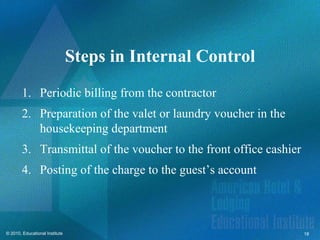
Steps in Internal Control
        1. Periodic billing from the contractor
        2. Preparation of the valet or laundry voucher in the
           housekeeping department
        3. Transmittal of the voucher to the front office cashier
        4. Posting of the charge to the guest’s account


© 2010, Educational Institute                                       18

Chapter 9

  • 1.
    Chapter 9 Heart-of-the-House Management I: Food and Beverage, Housekeeping, Laundry, and Valet Operations World of Resorts: From Development to Management Third Edition (424TXT or 424CIN) © 2010, Educational Institute
  • 2.
    Competencies for Heart-of-the-House Management I 1. Explain why food and beverage facilities are critical to resorts and identify factors that affect a resort’s food and beverage choices. 2. Describe the organization and division of duties in typical resort kitchens and identify current trends in kitchen design and cuisine. 3. Explain the critical importance of the menu and define different menu types and meal plans. 4. Identify and discuss important elements of food and beverage merchandising and of room service at a resort. © 2010, Educational Institute (continued) 2
  • 3.
    Competencies for Heart-of-the-House Management I (continued) 1. Describe the coordination that must exist between a resort’s housekeeping department and all other departments and explain why it is important. 2. Identify housekeeping department staffing and scheduling concepts and tools, and describe the role of housekeeping standards—including factors and trends that may affect those standards. 3. Identify and describe the range of factors that a resort should consider when deciding how it will address its laundry and dry cleaning needs. © 2010, Educational Institute 3
  • 4.
    Types of MealPlans • All-inclusive • American Plan (AP) • Bed and breakfast (B&B) • Continental plan (CP) • Dine-around plan • Flexi-plan • European plan (EP) • Modified American plan (MAP) or half pension © 2010, Educational Institute 4
  • 5.
    Popular Resort EventThemes • International food festivals • Specific country themes • Texas barbecues and outdoor chuck wagons • Hawaiian luaus • Oktoberfest • Scandinavian smorgasbords • English hunt breakfasts © 2010, Educational Institute (continued) 5
  • 6.
    Popular Resort EventThemes (continued) • Holiday celebrations: Valentine’s Day, St. Patrick’s Day, Easter, Chinese New Year, Cinco de Mayo, Fourth of July, Bastille Day, Halloween, Thanksgiving, Christmas, etc. • Wine and cheese parties • Casino nights: Las Vegas, Macau, Monte Carlo, etc. • Picnics • New England clambakes © 2010, Educational Institute 6
  • 7.
    Limiting Factors inPlanning In-Room Menus • The ability of the kitchen to prepare in-room items when the full kitchen is shut down after regular meal hours and between the last meal of the day and breakfast. • The effect of holding time of food quality. Many dishes deteriorate shortly after cooking. For example, pancakes can turn rubbery, steaks ordered rare can continue to cook, and delicate soufflés are not likely to survive the trip from the kitchen to the rooms. • Temperature control and functional delivery equipment. Keeping hot food hot and cold food cold is difficult to achieve consistently. (continued) © 2010, Educational Institute 7
  • 8.
    Limiting Factors inPlanning In-Room Menus (continued) • Time sensitivity of orders and ease of assembly for quick delivery. • Kitchen assembly space for room service cart setups and tray assembly. • Supervision. Supervision of dining room staff is direct, but oversight of room service staff is done remotely and based on trust. © 2010, Educational Institute (continued) 8
  • 9.
    Limiting Factors inPlanning In-Room Menus (continued) • Pricing. Higher prices are required to cover the high overhead of in-room service, but guests do not always understand or appreciate this. • System organization and detailed procedures from order-taking in the kitchen office to expediting orders to guest billing and service follow-up, including complaints handling. © 2010, Educational Institute 9
  • 10.
    Tasks Included inFull Rehabilitation • Stripping the floor and replacing carpet • Stripping and repainting the walls and hanging wallpaper • Rebuilding, repairing, reupholstering, or replacing furniture • Replacing worn, frayed, or stained bedspread, drapes, lamp shades, and other items • Repainting the bath area; checking bathroom plumbing and replacing worn or rusted parts, showerheads, and faucets; and replacing cracked or chipped tiles • Checking the heating, air-conditioning, and ventilation system © 2010, Educational Institute 10
  • 11.
    Procedures for TurndownService 1. Cleaning the bathroom and restocking it with fresh towels. 2. Tidying the guestroom, including emptying wastebaskets. 3. Removing the bed cover and placing it in the closet. 4. Folding back the blanket and top sheet. 5. Fluffing the pillow. 6. Drawing the drapes. 7. Filling the mini-bar ice bucket with fresh ice. © 2010, Educational Institute 11
  • 12.
    Laundry and DryCleaning Requirement Options 1. A complete linen rental service plus outside concessions for other resort and guest laundry and dry cleaning 2. A limited in-house laundry for small items, a linen rental service for large items, and outside concessions for other resort and guest laundry and dry cleaning 3. A combination of a full-service laundry and a dry cleaning plant for resort needs and outside concessions for guest laundry and dry cleaning 4. A complete full-service laundry and dry cleaning plant to serve all needs of the resort and its guests © 2010, Educational Institute 12
  • 13.
    Physical Layout ofLimited Laundry 1. Soiled laundry collection, classification, and counting 2. Washing-extracting 3. Drying 4. Folding and hanging 5. Storing in a portion of the department’s linen and uniform storage room © 2010, Educational Institute 13
  • 14.
    Basic Full-Service In-House Laundry Equipment • Washer-extractors of varying size/load capacities • Tumblers or dryers of varying size/load capacities • Dry cleaner • Flatwork ironer • Folding facilities and automatic folding equipment, with or without ironing capability © 2010, Educational Institute (continued) 14
  • 15.
    Basic Full-Service In-House Laundry Equipment (continued) • Water-conditioning equipment; water-reclaiming system • Pressing equipment, such as automatic steam pressers and shirt pressers • Steam box for finishing uniforms • Miscellaneous equipment such as laundry carts and racks © 2010, Educational Institute 15
  • 16.
    Possible Savings withOzone Laundry Systems • Water and sewage reduction: 20–30 percent • Cut in hot water consumption: 90+ percent • Savings in fuel to heat water: 70–80 percent • Chemical reduction: 20–30 percent • Cutting dryer time: 50–60 percent • Saved production time: 15 percent • Maintenance of wash equipment: 25 percent © 2010, Educational Institute 16
  • 17.
    Factors to Considerwhen Designing a Laundry Operation • Number of rooms • Types of beds • Expected occupancy rates • Types of linens • Number and types of towels • Where towels will be used (room, pool, club, spa, hair salon) • Number and kinds of napkins, tablecloths, uniforms • Restaurant turnover • Provision of dry cleaning © 2010, Educational Institute 17
  • 18.
    Steps in InternalControl 1. Periodic billing from the contractor 2. Preparation of the valet or laundry voucher in the housekeeping department 3. Transmittal of the voucher to the front office cashier 4. Posting of the charge to the guest’s account © 2010, Educational Institute 18