CHAPTER
SAFETY AND SECURITY
BY :- MOHD HAZIQUE. MOHD SAHIL, MOHD ZISHAN,
MOHIT KUMAR & MOHIT SINGH CHAUHAN.
Safety and Security
 Security of guest and his property is of great
importance for the hotel. It is the moral and legal
responsibility of a hotel to protect its guests and
their property against threats posed by human
beings with a conscious intent to harm them.
 Safety: refers prevention from accidents and
adopting preventive measures against accidents,
fire injury, disasters etc. and prevent damage to
property.
 Security: refers to the prevention of theft, fire, and
other emergencies. Safeguarding the guest and
hotel property against any kind of crime, threat
etc.
Safety Management programmes
 Review work procedures and inspect work areas for safety
hazards.
 Make departmental heads aware of the nature and
variety of hazards.
 Establish a safety committee.
 Maintain accurate safety records.
 Conduct periodic in-house safety inspections.
 Train staff members to implement consciousness.
 Motivate staff members to be safety conscious.
 Investigate and analyse all accidents and injuries.
 Practice safety management and monitor follow-ups.
 Review the effectiveness of your own safety management
programme.
Three Es' of Safety
Safety Education: Safety programmes and policies
can only be effective if the staffs are trained to
think and act safely at work.
Safety Engineering: This involves the building in of
safety features into the structure of the
establishment – in the equipment, furniture, and
fittings and in their proper arrangement within the
space.
Safety Rules Enforcement: Rules, when not
implemented are not effective. It is not enough to
know about safety themes and procedures, but
more important to motivate people to put the
knowledge gained into practice.
SECURITY IN HOTELS:-
 -Resident card should be used
 -Key control system should be used
 -Maintain record of master key used by staff.
 -Housekeeper’s occupancy report is to be made regularly.
 - Double lock system , magic eye and a door chain system are to be
used.
 -Proper left luggage system is to be followed.
 - Safety lockers for guest valuables should be provided.
 -Modern and efficient fire fighting systems should be used.
 -Smoke detectors are to be installed.
 -Proper and regular maintenance of equipment, appliances and
building should be done.
 - Close circuit cameras at parking and other strategic areas are to be
installed.
 -Fire escape routes must be displayed in each room.
 -Computerized room keys or magnetic keys must be used.
HOTEL SECURITY STAFF AND SYSTEM
 A hotels security staff may include in house
security personnel and contracted security
officers.
 Hotels generally prefer ex-army or ex-police
officials as their security officers because they are
already well versed with various security aspects
and have a lot of experience in this field. The
security department is responsible for establishing
the details of room keys, security, fire safety
systems etc.
 The security personnel should be trained to
handle situations like vandalism, terrorist attacks,
bomb threats. They may also be trained to
prevent and fight fire.
ROLE OF FRONT OFFICE IN
SECURITY:-
 A front desk professional is required to assume a
variety of roles during a workday –chief among
them being a gate keeper, communication
expert, phone whiz, trouble shooter and
receptionist. As a hotels first contact with guests,
vendors, visitors and delivery people, the front
office staff is the eyes and ears of the
organization.
 A security programme would be more effective if
all the hotel employees participate in the hotels
security efforts. The front office personnel play a
vital role in assessing the hotels security personnel
to carry out their tasks efficiently.
Types of Security:­
 Physical aspects
 Security of persons
 Security of systems
 A} PHYSICAL ASPECTS:­
1) Internal Security:­ Against theft, Fire Security
Proper lighting system, Safeguarding
assets, ­Keeping track of unwanted
guests
2) External Security: ­Proper lighting of
boundary and outside of the building, ­
Proper fencing of the building, ­Fencing of
pool areas to avoid accidents in night.
Manning of service gates to restrict entry,
Fixing of CCTV cameras.
B} Security of persons:­
1.Effective recruitment and selection: Reference
check and proper recruitment through screening.
2.Identification of staff: Issue identity cards and use
distinct uniform
3.Key control­ GRA should carry the key in their
possession and issuance and return should be properly
recorded.
4.Red tag system­ Proper security system for hotel
property to be formulated.
5.Training­ Proper training to employees to note unusual
events, safety drills to be conducted.
6.Adherence to management policy of security
7.Trash handling, Employee parking, ­Locker Inspection,
Inventory records of linen
8.Security consciousness
C} Security aspects of systems:­
 The term systems mean the operations of
the hotel e.g. All the equipment used for
operation, procedures laid down for operations
and policies to be followed.
 Record all losses and missing items immediately
 Inventory control should be proper
 Auditing should be done on regular basis.
 ­Proper system for cash receipts and disbursements
should be made.
SECURITY AND CONTROL
OF KEYS:­
 A guest room is the most important hospitality
product. One of the chief concerns of the hotel
staff is to ensure the security of guest rooms,
which is done by controlling the access to guest
rooms by maintaining a strict control over room
keys. One of the chief concerns of the hotel staff
is to ensure the security of guest rooms, which is
done by controlling the access to guest rooms by
maintaining a strict control over room keys.
 Hotels for the security use three types of room
keys:­
a) ­Emergency Key
b) ­Master Key
c) Guest Room Key
 Emergency Key/Grand Master Key:­­ An
emergency/Grand master Key opens the door locks
of all guest rooms, even if they are double locked.
Double lock is an internal safety locking device, in
which if the door is locked from inside the room, it
cannot be opened from the outside by its own keys or
master key.
 Master Key:­­ A master key opens all those guest room
door locks that are not double locked. This key may
be such that it can unlock all guest room locks or may
open only specific floors guest room locks. The master
key is under the control of the Executive housekeeper
of the hotel.
 Guest Room Key:­­ A guest room key opens the lock of
an individual guest room. These keys are under the
control of the front desk and are issued to guests who
have registered in the hotel. Guests are required to
deposit their room keys when they check­out and
depart from the hotel.
Steps to Key Control:­
  For Metal Keys: The first check on room key is done by the
use of Resident Cards, which are given to guests at the time
of arrival and is used by the guest to collect keys from the
Front desk.
 The second check is the Key Control Sheet made by the
Night Receptionist through the Night Receptionist Report
which shows Vacant, Occupied, Double Locked(DL), not to
be allotted(NTA) etc. types of rooms, As per the check, the
vacant rooms should have keys at Front Desk, and occupied
rooms should not have keys in the Mail and Key Racks.
 A detail of missing key list is made. It could be that the guest
did a self departure and mistakenly taken the key. Such
room numbers are noted down along with the name of the
guest last stayed, and the date and time of departure
 An electronic key system is an investment in guest safety
and security. Hence if a guest carries away the electronic
key with her, it will not pose any security threat.
FIRE SAFETY AND FIRE FIGHTING
 Fire Triangle :­ 3 elements are required
for fire to occur
 Types Of Fires :­
Some unsafe practices
that my lead to fire are:
 Guest smoking in bed.
 The hotel not providing sand urns or sufficient ashtrays
in rooms or public areas.
 Using high wattage light bulbs in lamps.
 Leaving linen chute door open.
 Storing rags and cloths with residues of cleaning
polish still on them.
 Not unplugging electrical appliances when not in
use.
 Using faulty electrical equipment or sockets.
 Using furnishing materials that are easily combustible.
Fire Warning Systems:
 Fire Alarm: These can be set off by smoke
detectors, heat detectors, sprinkler
systems or pull stations.
 Sprinklers: These are found in corridors
and room ceilings which set off by heat.
The sprinkler system have sensitive glass
bulbs that crack with a certain degree of
heat letting loose open water valves that
sprinkles water in the area.
 Smoke Detectors: Most hotel rooms have smoke
detectors. They trip the alarm system if the smoke
exceeds permissible limits. They set alarms in fire
detection panels. There are 2 types of smoke
detectors are photoelectric detectors and
ionization detectors. Photoelectric detectors are
alarms triggered off when smoke blocks a beam
of light emanating from the detector. In
ionization type it sense smoke when there is a
shift of electrical conductivity between two
plates.
What to do in case of fire
emergency: If a fire breaks out do the following:
1. Immediately switch on the nearest fire alarm.
2. If possible, attack the fire with suitable
equipment, remembering to direct the
extinguishers at the base of the flames.
3. Close windows and switch off all electrical
appliances, including fans and lights.
4. Close the door to the affected area and report
to the immediate supervisor for instructions.
5. Carry out instructions.
6. Remain at the assembly point until instructed to
do otherwise.
7. Do not use the lifts.
Fire Fighting Equipment's:
1. Starving:­ Starving is the removal of fuel from the
vicinity of fire so that it does not spread. In
case fire breaks out in an area where wood is
stored, it can be extinguished by removing all
the wood(fuel) from that area
2. Smothering;­ Smothering is the removal of air. Fire
can be extinguished by cutting off the supply
of air (oxygen) which is necessary for the
existence of fire. Throwing a blanket over fire
smothers the air and extinguishes the fire.
3. Cooling­ Heat (ignition temperature) is also
essential for the existence of fire. Cooling by
adding water brings down the temperature and
puts out fire.
Types of Fire Extinguishers:
ACCIDENTS:­ may occur due to
any one of the following reasons.
1. Excessive Haste :­avoid accidents one must not
be in a hurry or run while on the job.
2. Carelessness:­ For Example if a bell boy is
careless with the luggage he may trip or fall.
3. Anxiety:­ Anxiety is a feeling of worry or fear
about something.
4. Lack of Concentration:­ A person may not be
able to concentrate on work due to personal
problems, lack of interest, distractions etc.
5. Failure to apply safety rules:­ Safety rules if
followed prevent accidents. Before operating
any equipment, one should read and follow the
operating instructions given.
Basic guidelines for
Prevention of Accidents:
1. Always follow instructions when using any equipment.
2. Keep floors clean and dry.
3. Place warning and safety signs around the area while cleaning.
4. Always dry hands before touching plugs, sockets, electrical
fittings.
5. Mark faulty equipment as ‘out of order’.
6. Dispose of rubbish carefully.
7. Never place cigarette butts or sharp objects in the trash bag on
the room attendant’s card.
8. Open and shut doors carefully.
9. Clean away broken glasses carefully.
10. Presence of Handrails/guard rails.
Procedure To Follow In
Case Of An Accident:
1. Report the matter immediately to the manager concerned.
2. Either administer first aid or get help from trained personnel.
3. Transport the victim immediately to a hospital, if required. If the
injury is serious, call an ambulance for the same.
4. Begin immediate investigation.
5. Obtain an account of the accident from the injured person if
possible.
6. Collect any evidence of the cause of the accident.
7. Interview witnesses and other people in the area.
8. Look out for clues from the evidence collected.
9. Find out the nature and severity of the injury.
10. Fill in the accident report form and hand it over to the manager
concerned.
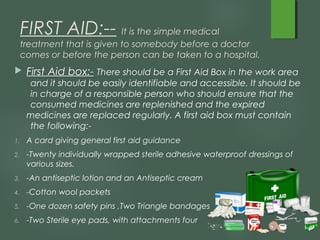
FIRST AID:­­ It is the simple medical
treatment that is given to somebody before a doctor
comes or before the person can be taken to a hospital.
 First Aid box:­ There should be a First Aid Box in the work area
and it should be easily identifiable and accessible. It should be
in charge of a responsible person who should ensure that the
consumed medicines are replenished and the expired
medicines are replaced regularly. A first aid box must contain
the following:­
1. A card giving general first aid guidance
2. ­Twenty individually wrapped sterile adhesive waterproof dressings of
various sizes.
3. ­An antiseptic lotion and an Antiseptic cream
4. ­Cotton wool packets
5. ­One dozen safety pins ,Two Triangle bandages
6. ­Two Sterile eye pads, with attachments four
THANK YOU

Safety and Security

  • 1.
    CHAPTER SAFETY AND SECURITY BY:- MOHD HAZIQUE. MOHD SAHIL, MOHD ZISHAN, MOHIT KUMAR & MOHIT SINGH CHAUHAN.
  • 2.
    Safety and Security Security of guest and his property is of great importance for the hotel. It is the moral and legal responsibility of a hotel to protect its guests and their property against threats posed by human beings with a conscious intent to harm them.  Safety: refers prevention from accidents and adopting preventive measures against accidents, fire injury, disasters etc. and prevent damage to property.  Security: refers to the prevention of theft, fire, and other emergencies. Safeguarding the guest and hotel property against any kind of crime, threat etc.
  • 3.
    Safety Management programmes Review work procedures and inspect work areas for safety hazards.  Make departmental heads aware of the nature and variety of hazards.  Establish a safety committee.  Maintain accurate safety records.  Conduct periodic in-house safety inspections.  Train staff members to implement consciousness.  Motivate staff members to be safety conscious.  Investigate and analyse all accidents and injuries.  Practice safety management and monitor follow-ups.  Review the effectiveness of your own safety management programme.
  • 4.
    Three Es' ofSafety Safety Education: Safety programmes and policies can only be effective if the staffs are trained to think and act safely at work. Safety Engineering: This involves the building in of safety features into the structure of the establishment – in the equipment, furniture, and fittings and in their proper arrangement within the space. Safety Rules Enforcement: Rules, when not implemented are not effective. It is not enough to know about safety themes and procedures, but more important to motivate people to put the knowledge gained into practice.
  • 5.
    SECURITY IN HOTELS:- -Resident card should be used  -Key control system should be used  -Maintain record of master key used by staff.  -Housekeeper’s occupancy report is to be made regularly.  - Double lock system , magic eye and a door chain system are to be used.  -Proper left luggage system is to be followed.  - Safety lockers for guest valuables should be provided.  -Modern and efficient fire fighting systems should be used.  -Smoke detectors are to be installed.  -Proper and regular maintenance of equipment, appliances and building should be done.  - Close circuit cameras at parking and other strategic areas are to be installed.  -Fire escape routes must be displayed in each room.  -Computerized room keys or magnetic keys must be used.
  • 6.
    HOTEL SECURITY STAFFAND SYSTEM  A hotels security staff may include in house security personnel and contracted security officers.  Hotels generally prefer ex-army or ex-police officials as their security officers because they are already well versed with various security aspects and have a lot of experience in this field. The security department is responsible for establishing the details of room keys, security, fire safety systems etc.  The security personnel should be trained to handle situations like vandalism, terrorist attacks, bomb threats. They may also be trained to prevent and fight fire.
  • 7.
    ROLE OF FRONTOFFICE IN SECURITY:-  A front desk professional is required to assume a variety of roles during a workday –chief among them being a gate keeper, communication expert, phone whiz, trouble shooter and receptionist. As a hotels first contact with guests, vendors, visitors and delivery people, the front office staff is the eyes and ears of the organization.  A security programme would be more effective if all the hotel employees participate in the hotels security efforts. The front office personnel play a vital role in assessing the hotels security personnel to carry out their tasks efficiently.
  • 8.
    Types of Security:­ Physical aspects  Security of persons  Security of systems  A} PHYSICAL ASPECTS:­ 1) Internal Security:­ Against theft, Fire Security Proper lighting system, Safeguarding assets, ­Keeping track of unwanted guests 2) External Security: ­Proper lighting of boundary and outside of the building, ­ Proper fencing of the building, ­Fencing of pool areas to avoid accidents in night. Manning of service gates to restrict entry, Fixing of CCTV cameras.
  • 9.
    B} Security ofpersons:­ 1.Effective recruitment and selection: Reference check and proper recruitment through screening. 2.Identification of staff: Issue identity cards and use distinct uniform 3.Key control­ GRA should carry the key in their possession and issuance and return should be properly recorded. 4.Red tag system­ Proper security system for hotel property to be formulated. 5.Training­ Proper training to employees to note unusual events, safety drills to be conducted. 6.Adherence to management policy of security 7.Trash handling, Employee parking, ­Locker Inspection, Inventory records of linen 8.Security consciousness
  • 10.
    C} Security aspectsof systems:­  The term systems mean the operations of the hotel e.g. All the equipment used for operation, procedures laid down for operations and policies to be followed.  Record all losses and missing items immediately  Inventory control should be proper  Auditing should be done on regular basis.  ­Proper system for cash receipts and disbursements should be made.
  • 11.
    SECURITY AND CONTROL OFKEYS:­  A guest room is the most important hospitality product. One of the chief concerns of the hotel staff is to ensure the security of guest rooms, which is done by controlling the access to guest rooms by maintaining a strict control over room keys. One of the chief concerns of the hotel staff is to ensure the security of guest rooms, which is done by controlling the access to guest rooms by maintaining a strict control over room keys.  Hotels for the security use three types of room keys:­ a) ­Emergency Key b) ­Master Key c) Guest Room Key
  • 12.
     Emergency Key/GrandMaster Key:­­ An emergency/Grand master Key opens the door locks of all guest rooms, even if they are double locked. Double lock is an internal safety locking device, in which if the door is locked from inside the room, it cannot be opened from the outside by its own keys or master key.  Master Key:­­ A master key opens all those guest room door locks that are not double locked. This key may be such that it can unlock all guest room locks or may open only specific floors guest room locks. The master key is under the control of the Executive housekeeper of the hotel.  Guest Room Key:­­ A guest room key opens the lock of an individual guest room. These keys are under the control of the front desk and are issued to guests who have registered in the hotel. Guests are required to deposit their room keys when they check­out and depart from the hotel.
  • 13.
    Steps to KeyControl:­   For Metal Keys: The first check on room key is done by the use of Resident Cards, which are given to guests at the time of arrival and is used by the guest to collect keys from the Front desk.  The second check is the Key Control Sheet made by the Night Receptionist through the Night Receptionist Report which shows Vacant, Occupied, Double Locked(DL), not to be allotted(NTA) etc. types of rooms, As per the check, the vacant rooms should have keys at Front Desk, and occupied rooms should not have keys in the Mail and Key Racks.  A detail of missing key list is made. It could be that the guest did a self departure and mistakenly taken the key. Such room numbers are noted down along with the name of the guest last stayed, and the date and time of departure  An electronic key system is an investment in guest safety and security. Hence if a guest carries away the electronic key with her, it will not pose any security threat.
  • 14.
    FIRE SAFETY ANDFIRE FIGHTING  Fire Triangle :­ 3 elements are required for fire to occur  Types Of Fires :­
  • 15.
    Some unsafe practices thatmy lead to fire are:  Guest smoking in bed.  The hotel not providing sand urns or sufficient ashtrays in rooms or public areas.  Using high wattage light bulbs in lamps.  Leaving linen chute door open.  Storing rags and cloths with residues of cleaning polish still on them.  Not unplugging electrical appliances when not in use.  Using faulty electrical equipment or sockets.  Using furnishing materials that are easily combustible.
  • 16.
    Fire Warning Systems: Fire Alarm: These can be set off by smoke detectors, heat detectors, sprinkler systems or pull stations.  Sprinklers: These are found in corridors and room ceilings which set off by heat. The sprinkler system have sensitive glass bulbs that crack with a certain degree of heat letting loose open water valves that sprinkles water in the area.
  • 17.
     Smoke Detectors:Most hotel rooms have smoke detectors. They trip the alarm system if the smoke exceeds permissible limits. They set alarms in fire detection panels. There are 2 types of smoke detectors are photoelectric detectors and ionization detectors. Photoelectric detectors are alarms triggered off when smoke blocks a beam of light emanating from the detector. In ionization type it sense smoke when there is a shift of electrical conductivity between two plates.
  • 18.
    What to doin case of fire emergency: If a fire breaks out do the following: 1. Immediately switch on the nearest fire alarm. 2. If possible, attack the fire with suitable equipment, remembering to direct the extinguishers at the base of the flames. 3. Close windows and switch off all electrical appliances, including fans and lights. 4. Close the door to the affected area and report to the immediate supervisor for instructions. 5. Carry out instructions. 6. Remain at the assembly point until instructed to do otherwise. 7. Do not use the lifts.
  • 19.
    Fire Fighting Equipment's: 1.Starving:­ Starving is the removal of fuel from the vicinity of fire so that it does not spread. In case fire breaks out in an area where wood is stored, it can be extinguished by removing all the wood(fuel) from that area 2. Smothering;­ Smothering is the removal of air. Fire can be extinguished by cutting off the supply of air (oxygen) which is necessary for the existence of fire. Throwing a blanket over fire smothers the air and extinguishes the fire. 3. Cooling­ Heat (ignition temperature) is also essential for the existence of fire. Cooling by adding water brings down the temperature and puts out fire.
  • 20.
    Types of FireExtinguishers:
  • 21.
    ACCIDENTS:­ may occurdue to any one of the following reasons. 1. Excessive Haste :­avoid accidents one must not be in a hurry or run while on the job. 2. Carelessness:­ For Example if a bell boy is careless with the luggage he may trip or fall. 3. Anxiety:­ Anxiety is a feeling of worry or fear about something. 4. Lack of Concentration:­ A person may not be able to concentrate on work due to personal problems, lack of interest, distractions etc. 5. Failure to apply safety rules:­ Safety rules if followed prevent accidents. Before operating any equipment, one should read and follow the operating instructions given.
  • 22.
    Basic guidelines for Preventionof Accidents: 1. Always follow instructions when using any equipment. 2. Keep floors clean and dry. 3. Place warning and safety signs around the area while cleaning. 4. Always dry hands before touching plugs, sockets, electrical fittings. 5. Mark faulty equipment as ‘out of order’. 6. Dispose of rubbish carefully. 7. Never place cigarette butts or sharp objects in the trash bag on the room attendant’s card. 8. Open and shut doors carefully. 9. Clean away broken glasses carefully. 10. Presence of Handrails/guard rails.
  • 23.
    Procedure To FollowIn Case Of An Accident: 1. Report the matter immediately to the manager concerned. 2. Either administer first aid or get help from trained personnel. 3. Transport the victim immediately to a hospital, if required. If the injury is serious, call an ambulance for the same. 4. Begin immediate investigation. 5. Obtain an account of the accident from the injured person if possible. 6. Collect any evidence of the cause of the accident. 7. Interview witnesses and other people in the area. 8. Look out for clues from the evidence collected. 9. Find out the nature and severity of the injury. 10. Fill in the accident report form and hand it over to the manager concerned.
  • 24.
    FIRST AID:­­ Itis the simple medical treatment that is given to somebody before a doctor comes or before the person can be taken to a hospital.  First Aid box:­ There should be a First Aid Box in the work area and it should be easily identifiable and accessible. It should be in charge of a responsible person who should ensure that the consumed medicines are replenished and the expired medicines are replaced regularly. A first aid box must contain the following:­ 1. A card giving general first aid guidance 2. ­Twenty individually wrapped sterile adhesive waterproof dressings of various sizes. 3. ­An antiseptic lotion and an Antiseptic cream 4. ­Cotton wool packets 5. ­One dozen safety pins ,Two Triangle bandages 6. ­Two Sterile eye pads, with attachments four
  • 25.