1
1
Security/Loss
Prevention
Hotel Management
Hospitality Services
2
Targets
Hospitality Businesses are targets for
criminals. The late hours of business,
cash, guests with wallets/purses and
valuables, employees, valuables on the
premises all make the hospitality business
an attractive target!
3
3
Security
Security involves protecting the
guests, employees and the
physical assets of the property
from criminal activities, severe
weather, and emergency
situations.
CREATE a “kid-words” definition of Security
4
4
Activity
Shoulder partners will hotdog/hamburger
fold a piece of paper; each square will be
labeled with people; hazards/accidents;
natural disasters. The 4th square will be
the student names.
Students will work together to create lists of
threats to the security of a hospitality
business and its guests in each of the
categories
5
How did you do?
Check your list and add anything you did not
think of.
People: trespassers, intruders, criminals,
terrorists, arsonists, burglars, employees
and guests
6
• Hazards: fire, slips and falls, illness,
death, floods from broken plumbing,
earthquakes
• Natural disasters: hurricanes, tornadoes,
floods/tsunami, lightening
7
7
Prevention
The emphasis of security is Prevention.
Security is the responsibility of all
employees.
Loss prevention can be defined as the
prevention of inventory loss, employee
work time loss, loss of assets and or cash.
8
Discussion question
Which is better to spend money to prevent
security problems or to wait until problems
occur and then take care of them and
why?
9
9
Security Officer’s ‘To Do list’
Today security officers:
• respond to reports of criminal activity
(theft, vandalism, robbery, etc.)
• assist local law enforcement with on-
property investigations
• provide property security (key control,
foot patrols: perimeter checks, floor
checks, VIP Guests, etc.)
10
10
Today security officers..
• participate in property emergency
planning and management
• monitor for:
– human trafficking
– drug-related activities
– acts of violence
– signs of terrorism
11
11
Security vs. Police
Hotel security does not replace law
enforcement but acts as a watchdog
for guests, employees and property
security. Security staff may be a
private security firm contracted from
outside of the property or be a part of
the hotel staff.
12
12
Clothing optional
Security may be uniformed or plain-
clothes personnel.
Uniformed security can make
guests/employees feel more secure
or make guests and employees feel
uncertain, as if there is something
wrong that needs security
13
Plain-clothes security
The presence of plain-clothes security
can be comforting because they are an
undetectable presence or their presence is
not detected so guests/employees do not
feel protected and secure.
14
General question
Other than hotels what are some
other businesses that employ plain
clothes security/law enforcement?
15
Qualities of a Security Person
The most important characteristic of a
good security officer is honesty. They
must also be:
• trustworthy
• able to stay calm, cool and collected
• able to think quickly on their feet
• able to problem solve
16
Size of the Security department
Department size is dependent upon:
• size of the lodging property
• number of guests & employees
• type of guests- residents, transients, VIPs,
world leaders, etc.
16
17
17
Communication
Communication is a key element in
security as they must communicate
with guests, hotel personnel, law
enforcement officials and other
community agencies to guarantee
that appropriate levels of security are
achieved.
18
18
Reasonable Care
The Security Dept. must provide
Reasonable Care. Reasonable
Care can be defined as “the degree
of care that a cautious person would
use under like circumstances.”
19
Liability
• Liability means responsibility, especially
responsibility to pay for damage or loss?
• In the case of a lodging property who is
responsible for replacing a wallet when it
is stolen?
– Stolen from a guest room?
– Stolen from the hotel lobby where it was
accidentally left by the guest
20
20
Innkeepers Laws
Innkeepers Laws were passed in the
1700s to protect travelers and
overnight guests from inconvenience
and injury. The laws today focus on
the hotel operator’s areas of
responsibility such as guest security,
evictions, and discrimination.
21
Liability
• Most states have rules that protect hotels
by limiting the amount of the liability for
losses.
• Hotels must post signs that state their
legal liability limits and the availability of
safe-deposit boxes and safes.
22
Lawsuits
Most hospitality businesses are at risk for
lawsuits. If the company/property
consistently follows good safety and
security procedures, the company can
reduce the chance of losing a lawsuit.
Proper documentation of safety and security
issues is mandatory by hotel employees.
23
Insurance
Property Insurance – pays for loss or
damage of property owned by the
business due to fire, tornadoes, hail,
accidents, burglary and arson
Liability Insurance – pays if the court
determines the loss or damage is the
responsibility of the lodging property.
24
Crime Insurance - pays for losses due to
crimes such as theft, arson, forgery, and
embezzlement. Theft and arson may be
covered under property insurance too.
25
25
Emergencies
Emergency preparedness involves
planning for an emergency, organize
and equip the hotel with necessary
supplies; train every employee with
their responsibility for a time of
emergency; practice the emergency
responses; evaluate the practices and
work to improve performance
26
4 Major Areas of Security
1. Structural security
2. Security policies
3. Surveillance
4. Safety and emergencies
27
1. Structural Security
The security systems built into the structure:
emergency alarms: fire, smoke, flood, burglar;
door alarms
security lights, motion detectors,
locks on windows and doors,
employee lockers, all keys,
In-room safes, main vault & safe deposit boxes,
guest rooms and corporate technology.
28
2. Security Policies
Rules that employees must be familiar with
and follow:
• Employees wear name badges at all
times on property
• Practice Key Control
• Limiting entrances to property
• Lost and found
• Special procedures
29
3. Surveillance
The process of closely observing what is
going on in an area; looking for trouble
both with people and property; also the
task of locking/unlocking doors at certain
times, turning lights on and off at certain
times.
30
4. Safety & Emergencies
Plans and procedures must be in place for
responses to accidents, bad weather and
other emergencies and disasters.
These plans and procedures must be
practiced frequently so employees know
what they are supposed to do.
31
31
5. Safety and Emergencies
Lock-Out and Luggage Liens - Guests that
do not pay their bill or that are storing
contraband in their rooms will be “locked-
out.”
A luggage lien is also used. The guest’
luggage is kept until payment is made or
the situation is resolved.
32
Current Technology
There are systems used by lodging
properties that alert a central control panel
when the fire alarm goes off. Immediately
guest room phones are rung to alert
guests of emergency; all doors at the
bottom of stairwells are unlocked; a 911
call is made and exhaust fans are
activated to push smoke out of the
building.
33
33
Important Duties
The important duties of a security
officer are to:
1. Patrol all areas of the property at
random times to ensure guest and
employee safety and security
(surveillance)
2. Utilize electronic surveillance of
public and employee areas if
necessary
34
34
Question
Why do security officers look at the
physical conditions of:
–the parking lot?
–entry and lobby?
–guest room hallways & staircases
–all Pull-Stations?
35
35
More important duties
3. Investigate any incidents reported by
guests and employees, determine if
law enforcement should be involved,
and assist law enforcement as
needed.
4. Keep a current and active log of all
“security incidents”
36
Questions
Why is the Security Log kept?
Why are Patrol/Surveillance Logs kept?
Why are Accident Report files kept?
What type of information should be recorded
in an Accident Report?
36
37
37
More important duties
5. Report to management the results of
daily patrols, all investigations, and
other security activities experienced
6. Safeguard sensitive guest
information and confidentiality
7. Keep in touch with Front Desk
personnel at all times
38
Questions
Why must Front Desk and Security be able
to be in-touch at any time?
What are some devices that could be used
to ensure Front Desk and Security were
able to be in-touch?
38
39
39
More important duties
8. Respond to medical emergencies of
guests and employees
9. Respond to the death of a guest or
employee by evacuating the area and
leaving the scene of the death as is
until authorities arrive and take
control
40
40
More important duties
10. Respond to elevator malfunctions,
especially when a guest or employee
is trapped inside the elevator
Time for true elevator stories:
• Decapitation
• Death by falling into the shaft
41
More duties
11. Maintain a Lost-and-Found system
-tag item with date found, place found,
found by __, condition of item found
12. Emergency preparedness
-protocol for emergency situations
13. Key control – (controlling access)
42
42
Policies to Reduce
Employee Theft
• Employees are not allowed on the
property before or after work hours
• Any package that an employee brings
into or takes off of the property must
be inspected
43
43
Policies to Reduce
Employee Theft
• Employees must punch-in and punch-out
with time cards that record the
arrival/departure time/date
• Employees must enter and exit through
the employee entrance. Security will be
posted at this entrance during employee
arrival and departure times.
44
Employee Theft
Theft can be prevented with proper storage
and inventory of all assets.
Locked storage units secure alcoholic
beverages, etc. on a property.
Surveillance cameras at certain areas also
monitor who is accessing the area and
what is being brought in or removed
Requisition systems that require 2+
signatures for certain items
45
Questions
Those of you that are employed is this
protocol for your place of employment?
Does your place of employment have an
employee handbook?
Why are employee handbooks important?
Why not just tell the employees what the
policies are?
Does your employer use a Requisition
System?
46
Questions
Do you know of an employee that was fired
because of theft? (no names, only facts!)
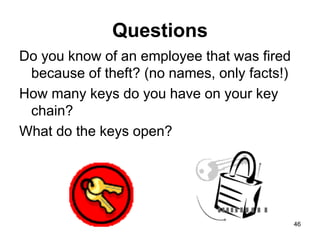
How many keys do you have on your key
chain?
What do the keys open?
47
Hard or Electronic Keys?
• Hard keys are metal, less expensive in
the beginning but can become a security
threat if lost.
• Electronic keys are easily and quickly
changeable; often use a magnetic strip or
RFID.
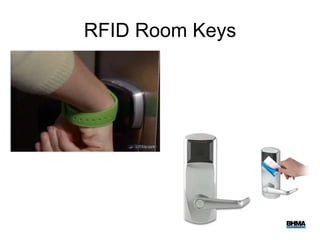
**RFID (radio frequency identification) –
no swiping necessary
Electronic key systems can indicate which
keys have been used to access an area.
48
RFID Room Keys
49
49
Key Control
A strong key control system is needed
in a hotel operation.
• Key Control prevents unauthorized
access of guest areas and back of the
house operations
• It also manages the issuing of keys to
employees
50
50
Key control cont.
• provides security for and control over, who
has access to master keys and
emergency-use keys
• manages all points of access to a
facility/property such as side doors and
vendor entrances
Some hotels use a double door lock for the
guest rooms. There is an entrance key
and then inside there is a flip-bolt.
51
51
4 Specific Responsibilities
of Security Dept.
1. Develop and implement safety and
security policies
2. Train all employees
3. Prepare security staff schedules
4. Maintain all security equipment
52
Go back!
Now using the original hotdog/hamburger
paper you created at the beginning of the
Security ppt. write a system used to
respond to each possibility next to each
possibility.
Use colored pencils for this exercise!

Security.pptindustrial hostile environment

  • 1.
  • 2.
    2 Targets Hospitality Businesses aretargets for criminals. The late hours of business, cash, guests with wallets/purses and valuables, employees, valuables on the premises all make the hospitality business an attractive target!
  • 3.
    3 3 Security Security involves protectingthe guests, employees and the physical assets of the property from criminal activities, severe weather, and emergency situations. CREATE a “kid-words” definition of Security
  • 4.
    4 4 Activity Shoulder partners willhotdog/hamburger fold a piece of paper; each square will be labeled with people; hazards/accidents; natural disasters. The 4th square will be the student names. Students will work together to create lists of threats to the security of a hospitality business and its guests in each of the categories
  • 5.
    5 How did youdo? Check your list and add anything you did not think of. People: trespassers, intruders, criminals, terrorists, arsonists, burglars, employees and guests
  • 6.
    6 • Hazards: fire,slips and falls, illness, death, floods from broken plumbing, earthquakes • Natural disasters: hurricanes, tornadoes, floods/tsunami, lightening
  • 7.
    7 7 Prevention The emphasis ofsecurity is Prevention. Security is the responsibility of all employees. Loss prevention can be defined as the prevention of inventory loss, employee work time loss, loss of assets and or cash.
  • 8.
    8 Discussion question Which isbetter to spend money to prevent security problems or to wait until problems occur and then take care of them and why?
  • 9.
    9 9 Security Officer’s ‘ToDo list’ Today security officers: • respond to reports of criminal activity (theft, vandalism, robbery, etc.) • assist local law enforcement with on- property investigations • provide property security (key control, foot patrols: perimeter checks, floor checks, VIP Guests, etc.)
  • 10.
    10 10 Today security officers.. •participate in property emergency planning and management • monitor for: – human trafficking – drug-related activities – acts of violence – signs of terrorism
  • 11.
    11 11 Security vs. Police Hotelsecurity does not replace law enforcement but acts as a watchdog for guests, employees and property security. Security staff may be a private security firm contracted from outside of the property or be a part of the hotel staff.
  • 12.
    12 12 Clothing optional Security maybe uniformed or plain- clothes personnel. Uniformed security can make guests/employees feel more secure or make guests and employees feel uncertain, as if there is something wrong that needs security
  • 13.
    13 Plain-clothes security The presenceof plain-clothes security can be comforting because they are an undetectable presence or their presence is not detected so guests/employees do not feel protected and secure.
  • 14.
    14 General question Other thanhotels what are some other businesses that employ plain clothes security/law enforcement?
  • 15.
    15 Qualities of aSecurity Person The most important characteristic of a good security officer is honesty. They must also be: • trustworthy • able to stay calm, cool and collected • able to think quickly on their feet • able to problem solve
  • 16.
    16 Size of theSecurity department Department size is dependent upon: • size of the lodging property • number of guests & employees • type of guests- residents, transients, VIPs, world leaders, etc. 16
  • 17.
    17 17 Communication Communication is akey element in security as they must communicate with guests, hotel personnel, law enforcement officials and other community agencies to guarantee that appropriate levels of security are achieved.
  • 18.
    18 18 Reasonable Care The SecurityDept. must provide Reasonable Care. Reasonable Care can be defined as “the degree of care that a cautious person would use under like circumstances.”
  • 19.
    19 Liability • Liability meansresponsibility, especially responsibility to pay for damage or loss? • In the case of a lodging property who is responsible for replacing a wallet when it is stolen? – Stolen from a guest room? – Stolen from the hotel lobby where it was accidentally left by the guest
  • 20.
    20 20 Innkeepers Laws Innkeepers Lawswere passed in the 1700s to protect travelers and overnight guests from inconvenience and injury. The laws today focus on the hotel operator’s areas of responsibility such as guest security, evictions, and discrimination.
  • 21.
    21 Liability • Most stateshave rules that protect hotels by limiting the amount of the liability for losses. • Hotels must post signs that state their legal liability limits and the availability of safe-deposit boxes and safes.
  • 22.
    22 Lawsuits Most hospitality businessesare at risk for lawsuits. If the company/property consistently follows good safety and security procedures, the company can reduce the chance of losing a lawsuit. Proper documentation of safety and security issues is mandatory by hotel employees.
  • 23.
    23 Insurance Property Insurance –pays for loss or damage of property owned by the business due to fire, tornadoes, hail, accidents, burglary and arson Liability Insurance – pays if the court determines the loss or damage is the responsibility of the lodging property.
  • 24.
    24 Crime Insurance -pays for losses due to crimes such as theft, arson, forgery, and embezzlement. Theft and arson may be covered under property insurance too.
  • 25.
    25 25 Emergencies Emergency preparedness involves planningfor an emergency, organize and equip the hotel with necessary supplies; train every employee with their responsibility for a time of emergency; practice the emergency responses; evaluate the practices and work to improve performance
  • 26.
    26 4 Major Areasof Security 1. Structural security 2. Security policies 3. Surveillance 4. Safety and emergencies
  • 27.
    27 1. Structural Security Thesecurity systems built into the structure: emergency alarms: fire, smoke, flood, burglar; door alarms security lights, motion detectors, locks on windows and doors, employee lockers, all keys, In-room safes, main vault & safe deposit boxes, guest rooms and corporate technology.
  • 28.
    28 2. Security Policies Rulesthat employees must be familiar with and follow: • Employees wear name badges at all times on property • Practice Key Control • Limiting entrances to property • Lost and found • Special procedures
  • 29.
    29 3. Surveillance The processof closely observing what is going on in an area; looking for trouble both with people and property; also the task of locking/unlocking doors at certain times, turning lights on and off at certain times.
  • 30.
    30 4. Safety &Emergencies Plans and procedures must be in place for responses to accidents, bad weather and other emergencies and disasters. These plans and procedures must be practiced frequently so employees know what they are supposed to do.
  • 31.
    31 31 5. Safety andEmergencies Lock-Out and Luggage Liens - Guests that do not pay their bill or that are storing contraband in their rooms will be “locked- out.” A luggage lien is also used. The guest’ luggage is kept until payment is made or the situation is resolved.
  • 32.
    32 Current Technology There aresystems used by lodging properties that alert a central control panel when the fire alarm goes off. Immediately guest room phones are rung to alert guests of emergency; all doors at the bottom of stairwells are unlocked; a 911 call is made and exhaust fans are activated to push smoke out of the building.
  • 33.
    33 33 Important Duties The importantduties of a security officer are to: 1. Patrol all areas of the property at random times to ensure guest and employee safety and security (surveillance) 2. Utilize electronic surveillance of public and employee areas if necessary
  • 34.
    34 34 Question Why do securityofficers look at the physical conditions of: –the parking lot? –entry and lobby? –guest room hallways & staircases –all Pull-Stations?
  • 35.
    35 35 More important duties 3.Investigate any incidents reported by guests and employees, determine if law enforcement should be involved, and assist law enforcement as needed. 4. Keep a current and active log of all “security incidents”
  • 36.
    36 Questions Why is theSecurity Log kept? Why are Patrol/Surveillance Logs kept? Why are Accident Report files kept? What type of information should be recorded in an Accident Report? 36
  • 37.
    37 37 More important duties 5.Report to management the results of daily patrols, all investigations, and other security activities experienced 6. Safeguard sensitive guest information and confidentiality 7. Keep in touch with Front Desk personnel at all times
  • 38.
    38 Questions Why must FrontDesk and Security be able to be in-touch at any time? What are some devices that could be used to ensure Front Desk and Security were able to be in-touch? 38
  • 39.
    39 39 More important duties 8.Respond to medical emergencies of guests and employees 9. Respond to the death of a guest or employee by evacuating the area and leaving the scene of the death as is until authorities arrive and take control
  • 40.
    40 40 More important duties 10.Respond to elevator malfunctions, especially when a guest or employee is trapped inside the elevator Time for true elevator stories: • Decapitation • Death by falling into the shaft
  • 41.
    41 More duties 11. Maintaina Lost-and-Found system -tag item with date found, place found, found by __, condition of item found 12. Emergency preparedness -protocol for emergency situations 13. Key control – (controlling access)
  • 42.
    42 42 Policies to Reduce EmployeeTheft • Employees are not allowed on the property before or after work hours • Any package that an employee brings into or takes off of the property must be inspected
  • 43.
    43 43 Policies to Reduce EmployeeTheft • Employees must punch-in and punch-out with time cards that record the arrival/departure time/date • Employees must enter and exit through the employee entrance. Security will be posted at this entrance during employee arrival and departure times.
  • 44.
    44 Employee Theft Theft canbe prevented with proper storage and inventory of all assets. Locked storage units secure alcoholic beverages, etc. on a property. Surveillance cameras at certain areas also monitor who is accessing the area and what is being brought in or removed Requisition systems that require 2+ signatures for certain items
  • 45.
    45 Questions Those of youthat are employed is this protocol for your place of employment? Does your place of employment have an employee handbook? Why are employee handbooks important? Why not just tell the employees what the policies are? Does your employer use a Requisition System?
  • 46.
    46 Questions Do you knowof an employee that was fired because of theft? (no names, only facts!) How many keys do you have on your key chain? What do the keys open?
  • 47.
    47 Hard or ElectronicKeys? • Hard keys are metal, less expensive in the beginning but can become a security threat if lost. • Electronic keys are easily and quickly changeable; often use a magnetic strip or RFID. **RFID (radio frequency identification) – no swiping necessary Electronic key systems can indicate which keys have been used to access an area.
  • 48.
  • 49.
    49 49 Key Control A strongkey control system is needed in a hotel operation. • Key Control prevents unauthorized access of guest areas and back of the house operations • It also manages the issuing of keys to employees
  • 50.
    50 50 Key control cont. •provides security for and control over, who has access to master keys and emergency-use keys • manages all points of access to a facility/property such as side doors and vendor entrances Some hotels use a double door lock for the guest rooms. There is an entrance key and then inside there is a flip-bolt.
  • 51.
    51 51 4 Specific Responsibilities ofSecurity Dept. 1. Develop and implement safety and security policies 2. Train all employees 3. Prepare security staff schedules 4. Maintain all security equipment
  • 52.
    52 Go back! Now usingthe original hotdog/hamburger paper you created at the beginning of the Security ppt. write a system used to respond to each possibility next to each possibility. Use colored pencils for this exercise!