Accommodation
The term accommodation is used
in reference to a room or building
in which an individual may live or
stay.
Types of Accommodation
On the basis of ratings
• One star hotel
• Two star hotel
• Three star hotel
• Four Star Hotel
• Five Star Hotel
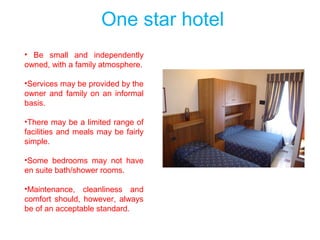
One star hotel
• Be small and independently
owned, with a family atmosphere.
•Services may be provided by the
owner and family on an informal
basis.
•There may be a limited range of
facilities and meals may be fairly
simple.
•Some bedrooms may not have
en suite bath/shower rooms.
•Maintenance, cleanliness and
comfort should, however, always
be of an acceptable standard.
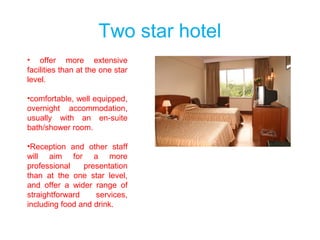
Two star hotel
• offer more extensive
facilities than at the one star
level.
•comfortable, well equipped,
overnight accommodation,
usually with an en-suite
bath/shower room.
•Reception and other staff
will aim for a more
professional presentation
than at the one star level,
and offer a wider range of
straightforward services,
including food and drink.
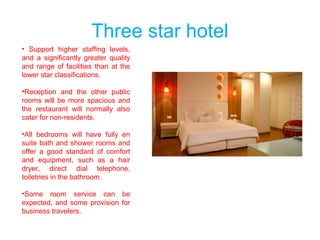
Three star hotel
• Support higher staffing levels,
and a significantly greater quality
and range of facilities than at the
lower star classifications.
•Reception and the other public
rooms will be more spacious and
the restaurant will normally also
cater for non-residents.
•All bedrooms will have fully en
suite bath and shower rooms and
offer a good standard of comfort
and equipment, such as a hair
dryer, direct dial telephone,
toiletries in the bathroom.
•Some room service can be
expected, and some provision for
business travelers.
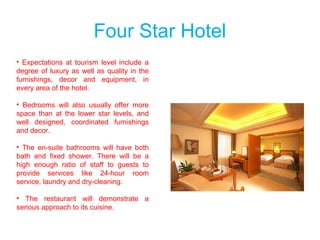
Four Star Hotel
• Expectations at tourism level include a
degree of luxury as well as quality in the
furnishings, decor and equipment, in
every area of the hotel.
• Bedrooms will also usually offer more
space than at the lower star levels, and
well designed, coordinated furnishings
and decor.
• The en-suite bathrooms will have both
bath and fixed shower. There will be a
high enough ratio of staff to guests to
provide services like 24-hour room
service, laundry and dry-cleaning.
• The restaurant will demonstrate a
serious approach to its cuisine.
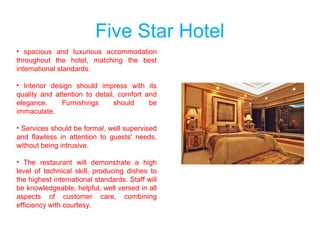
Five Star Hotel
• spacious and luxurious accommodation
throughout the hotel, matching the best
international standards.
• Interior design should impress with its
quality and attention to detail, comfort and
elegance. Furnishings should be
immaculate.
• Services should be formal, well supervised
and flawless in attention to guests' needs,
without being intrusive.
• The restaurant will demonstrate a high
level of technical skill, producing dishes to
the highest international standards. Staff will
be knowledgeable, helpful, well versed in all
aspects of customer care, combining
efficiency with courtesy.
Business Hotels / City Hotels
•Business hotels and City Hotels are everywhere.
•You get a small room with a bed, shower/bath/toilet unit, a TV, and a cup of
tea. Many hotels also throw in a free breakfast.
City Hotels are nicer than Business Hotels, and have a lot more facilities.
•They are also a little more expensive.
•They may be small but they are clean and comfortable, and staying in them
can save you hundreds of dollars.
Business Hotels are targeted at the needs of business travelers.
•Tend to be located in city centers and at airports.
•Guestrooms are equipped with spacious desks, and internet connection.
Capsule hotel
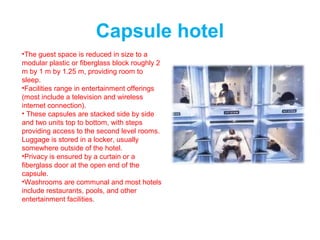
•The guest space is reduced in size to a
modular plastic or fiberglass block roughly 2
m by 1 m by 1.25 m, providing room to
sleep.
•Facilities range in entertainment offerings
(most include a television and wireless
internet connection).
• These capsules are stacked side by side
and two units top to bottom, with steps
providing access to the second level rooms.
Luggage is stored in a locker, usually
somewhere outside of the hotel.
•Privacy is ensured by a curtain or a
fiberglass door at the open end of the
capsule.
•Washrooms are communal and most hotels
include restaurants, pools, and other
entertainment facilities.
Ryokan
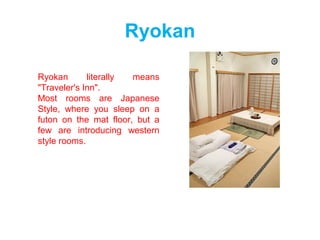
Ryokan literally means
"Traveler's Inn".
Most rooms are Japanese
Style, where you sleep on a
futon on the mat floor, but a
few are introducing western
style rooms.
Resorts
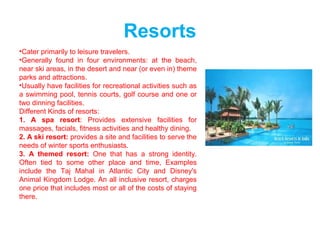
•Cater primarily to leisure travelers.
•Generally found in four environments: at the beach,
near ski areas, in the desert and near (or even in) theme
parks and attractions.
•Usually have facilities for recreational activities such as
a swimming pool, tennis courts, golf course and one or
two dinning facilities.
Different Kinds of resorts:
1. A spa resort: Provides extensive facilities for
massages, facials, fitness activities and healthy dining.
2. A ski resort: provides a site and facilities to serve the
needs of winter sports enthusiasts.
3. A themed resort: One that has a strong identity.
Often tied to some other place and time, Examples
include the Taj Mahal in Atlantic City and Disney's
Animal Kingdom Lodge. An all inclusive resort, charges
one price that includes most or all of the costs of staying
there.
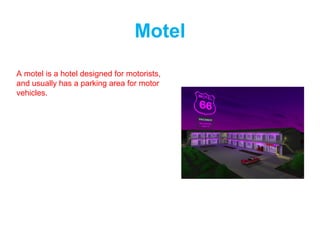
Motel
A motel is a hotel designed for motorists,
and usually has a parking area for motor
vehicles.
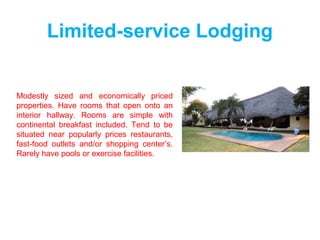
Limited-service Lodging
Modestly sized and economically priced
properties. Have rooms that open onto an
interior hallway. Rooms are simple with
continental breakfast included. Tend to be
situated near popularly prices restaurants,
fast-food outlets and/or shopping center’s.
Rarely have pools or exercise facilities.
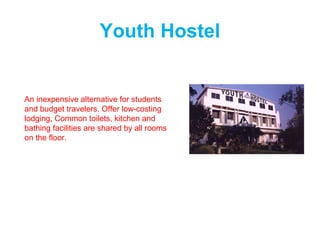
Youth Hostel
An inexpensive alternative for students
and budget travelers. Offer low-costing
lodging, Common toilets, kitchen and
bathing facilities are shared by all rooms
on the floor.
Dude Ranches
A unique form of lodging, Convey a
theme of American West, Usually
located in the resort areas featuring
horseback riding, cattle roundups,
outdoor barbeques and other cow-boy
type activities.
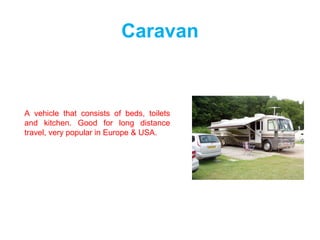
Caravan
A vehicle that consists of beds, toilets
and kitchen. Good for long distance
travel, very popular in Europe & USA.
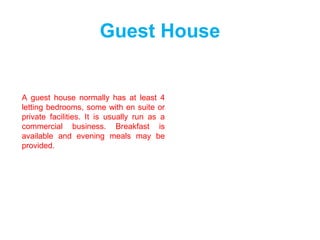
Guest House
A guest house normally has at least 4
letting bedrooms, some with en suite or
private facilities. It is usually run as a
commercial business. Breakfast is
available and evening meals may be
provided.
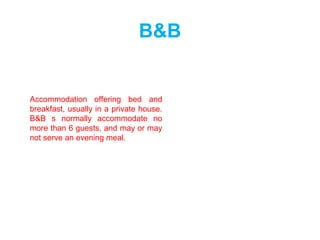
B&B
Accommodation offering bed and
breakfast, usually in a private house.
B&B s normally accommodate no
more than 6 guests, and may or may
not serve an evening meal.
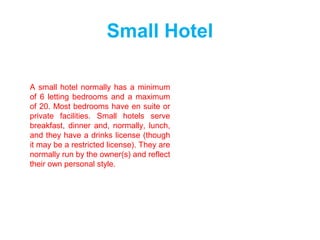
Small Hotel
A small hotel normally has a minimum
of 6 letting bedrooms and a maximum
of 20. Most bedrooms have en suite or
private facilities. Small hotels serve
breakfast, dinner and, normally, lunch,
and they have a drinks license (though
it may be a restricted license). They are
normally run by the owner(s) and reflect
their own personal style.
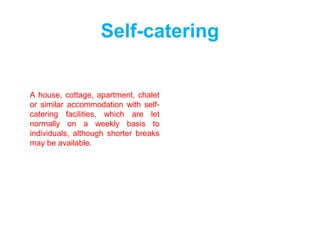
Self-catering
A house, cottage, apartment, chalet
or similar accommodation with self-
catering facilities, which are let
normally on a weekly basis to
individuals, although shorter breaks
may be available.
Inn
Bed and breakfast accommodation
within a traditional inn or pub. The bar
and restaurant is open to non-
residents, and provides food at
lunchtime and in the evening.

Types of accommodation

  • 1.
    Accommodation The term accommodationis used in reference to a room or building in which an individual may live or stay.
  • 2.
    Types of Accommodation Onthe basis of ratings • One star hotel • Two star hotel • Three star hotel • Four Star Hotel • Five Star Hotel
  • 3.
    One star hotel •Be small and independently owned, with a family atmosphere. •Services may be provided by the owner and family on an informal basis. •There may be a limited range of facilities and meals may be fairly simple. •Some bedrooms may not have en suite bath/shower rooms. •Maintenance, cleanliness and comfort should, however, always be of an acceptable standard.
  • 4.
    Two star hotel •offer more extensive facilities than at the one star level. •comfortable, well equipped, overnight accommodation, usually with an en-suite bath/shower room. •Reception and other staff will aim for a more professional presentation than at the one star level, and offer a wider range of straightforward services, including food and drink.
  • 5.
    Three star hotel •Support higher staffing levels, and a significantly greater quality and range of facilities than at the lower star classifications. •Reception and the other public rooms will be more spacious and the restaurant will normally also cater for non-residents. •All bedrooms will have fully en suite bath and shower rooms and offer a good standard of comfort and equipment, such as a hair dryer, direct dial telephone, toiletries in the bathroom. •Some room service can be expected, and some provision for business travelers.
  • 6.
    Four Star Hotel •Expectations at tourism level include a degree of luxury as well as quality in the furnishings, decor and equipment, in every area of the hotel. • Bedrooms will also usually offer more space than at the lower star levels, and well designed, coordinated furnishings and decor. • The en-suite bathrooms will have both bath and fixed shower. There will be a high enough ratio of staff to guests to provide services like 24-hour room service, laundry and dry-cleaning. • The restaurant will demonstrate a serious approach to its cuisine.
  • 7.
    Five Star Hotel •spacious and luxurious accommodation throughout the hotel, matching the best international standards. • Interior design should impress with its quality and attention to detail, comfort and elegance. Furnishings should be immaculate. • Services should be formal, well supervised and flawless in attention to guests' needs, without being intrusive. • The restaurant will demonstrate a high level of technical skill, producing dishes to the highest international standards. Staff will be knowledgeable, helpful, well versed in all aspects of customer care, combining efficiency with courtesy.
  • 8.
    Business Hotels /City Hotels •Business hotels and City Hotels are everywhere. •You get a small room with a bed, shower/bath/toilet unit, a TV, and a cup of tea. Many hotels also throw in a free breakfast. City Hotels are nicer than Business Hotels, and have a lot more facilities. •They are also a little more expensive. •They may be small but they are clean and comfortable, and staying in them can save you hundreds of dollars. Business Hotels are targeted at the needs of business travelers. •Tend to be located in city centers and at airports. •Guestrooms are equipped with spacious desks, and internet connection.
  • 9.
    Capsule hotel •The guestspace is reduced in size to a modular plastic or fiberglass block roughly 2 m by 1 m by 1.25 m, providing room to sleep. •Facilities range in entertainment offerings (most include a television and wireless internet connection). • These capsules are stacked side by side and two units top to bottom, with steps providing access to the second level rooms. Luggage is stored in a locker, usually somewhere outside of the hotel. •Privacy is ensured by a curtain or a fiberglass door at the open end of the capsule. •Washrooms are communal and most hotels include restaurants, pools, and other entertainment facilities.
  • 10.
    Ryokan Ryokan literally means "Traveler'sInn". Most rooms are Japanese Style, where you sleep on a futon on the mat floor, but a few are introducing western style rooms.
  • 11.
    Resorts •Cater primarily toleisure travelers. •Generally found in four environments: at the beach, near ski areas, in the desert and near (or even in) theme parks and attractions. •Usually have facilities for recreational activities such as a swimming pool, tennis courts, golf course and one or two dinning facilities. Different Kinds of resorts: 1. A spa resort: Provides extensive facilities for massages, facials, fitness activities and healthy dining. 2. A ski resort: provides a site and facilities to serve the needs of winter sports enthusiasts. 3. A themed resort: One that has a strong identity. Often tied to some other place and time, Examples include the Taj Mahal in Atlantic City and Disney's Animal Kingdom Lodge. An all inclusive resort, charges one price that includes most or all of the costs of staying there.
  • 12.
    Motel A motel isa hotel designed for motorists, and usually has a parking area for motor vehicles.
  • 13.
    Limited-service Lodging Modestly sizedand economically priced properties. Have rooms that open onto an interior hallway. Rooms are simple with continental breakfast included. Tend to be situated near popularly prices restaurants, fast-food outlets and/or shopping center’s. Rarely have pools or exercise facilities.
  • 14.
    Youth Hostel An inexpensivealternative for students and budget travelers. Offer low-costing lodging, Common toilets, kitchen and bathing facilities are shared by all rooms on the floor.
  • 15.
    Dude Ranches A uniqueform of lodging, Convey a theme of American West, Usually located in the resort areas featuring horseback riding, cattle roundups, outdoor barbeques and other cow-boy type activities.
  • 16.
    Caravan A vehicle thatconsists of beds, toilets and kitchen. Good for long distance travel, very popular in Europe & USA.
  • 17.
    Guest House A guesthouse normally has at least 4 letting bedrooms, some with en suite or private facilities. It is usually run as a commercial business. Breakfast is available and evening meals may be provided.
  • 18.
    B&B Accommodation offering bedand breakfast, usually in a private house. B&B s normally accommodate no more than 6 guests, and may or may not serve an evening meal.
  • 19.
    Small Hotel A smallhotel normally has a minimum of 6 letting bedrooms and a maximum of 20. Most bedrooms have en suite or private facilities. Small hotels serve breakfast, dinner and, normally, lunch, and they have a drinks license (though it may be a restricted license). They are normally run by the owner(s) and reflect their own personal style.
  • 20.
    Self-catering A house, cottage,apartment, chalet or similar accommodation with self- catering facilities, which are let normally on a weekly basis to individuals, although shorter breaks may be available.
  • 21.
    Inn Bed and breakfastaccommodation within a traditional inn or pub. The bar and restaurant is open to non- residents, and provides food at lunchtime and in the evening.