Teaching research methods
Learning from the ESRC NCRM study: The
Pedagogy of Methodological Learning
Melanie Nind, Professor of Education,
University of Southampton
Researching methods pedagogy
Pedagogy is ‘what people do in teaching and
learning situations … what they perceive to be
meaningful, important and relevant’ (Nind, Kilburn &
Luff 2015)
This reflects the view that ‘Pedagogy is never
innocent’ (Bruner 1996)
We can think of pedagogy as specified, enacted and
experienced; we need to recognise that it is ‘hard to
know’ (Nind, Curtin & Hall 2016)
Practical videos
1. The context: How we
have explored the
teaching of advanced
social research
methods - the
methodological
issues of doing that
2. The pedagogic hooks
that methods teachers
use; some ways in
which methods
teachers work
inclusively to reach
diverse learners
… More videos to follow
… Not tips but practical
resources
… Quick Start Guides
Pedagogy of Methodological Learning study
‘a space where I can talk more about my
own pedagogical challenges, I want to
reflect on them with a group of people that
share this with me, and I want to share
resources, I want to share new ideas, to
continue to foster a kind of
interdisciplinary pedagogical culture’
(Sharlene Hesse-Biber, expert panel forum)
We need to consider pedagogy because …
Otherwise:
• We rely on trial-and-error without an evidence or theory-base (Earley 2014)
• People teach as they were taught: ‘I’m constricting myself, because that’s
what quantitative teaching has looked like, both as a student or a teacher’
(focus group teacher)
• The focus can be drawn to mundane, instrumental matters (focus group teacher)
• We miss out on what we can know together
Priorities in this study
• Methods that value the knowledge held
• Methods in which we as researchers could be
‘alongsiders’
• Methods that tease out implicit PCK –
pedagogical content knowledge
• Methods that teach (International Journal of
Research & Method in Education)
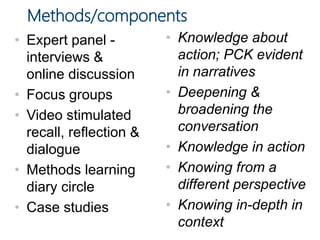
Methods/components
• Expert panel -
interviews &
online discussion
• Focus groups
• Video stimulated
recall, reflection &
dialogue
• Methods learning
diary circle
• Case studies
• Knowledge about
action; PCK evident
in narratives
• Deepening &
broadening the
conversation
• Knowledge in action
• Knowing from a
different perspective
• Knowing in-depth in
context
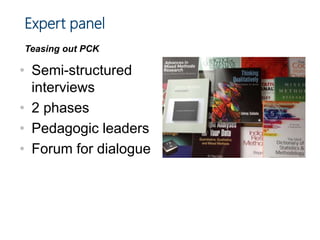
Expert panel
Teasing out PCK
• Semi-structured
interviews
• 2 phases
• Pedagogic leaders
• Forum for dialogue
Focus groups
Deepening & broadening the conversation
• Teachers in universities & social research
organizations
• Teaching face-to-face and online
• Exploring whether approaches and themes from
the experts resonate, pedagogic culture and
resources, pedagogic strategies and tactics
Video stimulated dialogue
Knowledge in action
• Close up component – ‘I did’ - ‘because’
• Teachers and learners together
• Recall, reflection and dialogue
• Surfacing values, beliefs, tactics
• Using video and dialogue to generate pedagogic
knowledge, in International Journal of Social
Research Methodology
Methods learning diary circle
Knowing from a different perspective
• An enriched conversation engaging 10 learners
• A longitudinal lens, blogging diary entries &
discussing together
Case studies
Knowing in-depth in context
• Following vertical and horizontal analysis of the
data, exploring narrative and themes
• Generating a typology of the approaches,
strategies, tactics and tasks
• Testing out in two holistic in-depth case – one
qual, one quants
Recap
• Rationale and methods used in the Pedagogy of
Methodological Learning study
• To generate a substantial dataset about research
methods pedagogy
Recap
• More than 70 methods teachers and 80 methods
learners contributed their insights.
• Papers, Quick Start Guides and videos on the
findings so that methods teachers have more
than trial and error to go on, we have research
evidence and a basis for dialogue and reflection.
Teaching research methods: pedagogy of methods learning

Teaching research methods: pedagogy of methods learning

  • 1.
    Teaching research methods Learningfrom the ESRC NCRM study: The Pedagogy of Methodological Learning Melanie Nind, Professor of Education, University of Southampton
  • 2.
    Researching methods pedagogy Pedagogyis ‘what people do in teaching and learning situations … what they perceive to be meaningful, important and relevant’ (Nind, Kilburn & Luff 2015) This reflects the view that ‘Pedagogy is never innocent’ (Bruner 1996) We can think of pedagogy as specified, enacted and experienced; we need to recognise that it is ‘hard to know’ (Nind, Curtin & Hall 2016)
  • 3.
    Practical videos 1. Thecontext: How we have explored the teaching of advanced social research methods - the methodological issues of doing that 2. The pedagogic hooks that methods teachers use; some ways in which methods teachers work inclusively to reach diverse learners … More videos to follow … Not tips but practical resources … Quick Start Guides
  • 4.
    Pedagogy of MethodologicalLearning study ‘a space where I can talk more about my own pedagogical challenges, I want to reflect on them with a group of people that share this with me, and I want to share resources, I want to share new ideas, to continue to foster a kind of interdisciplinary pedagogical culture’ (Sharlene Hesse-Biber, expert panel forum)
  • 5.
    We need toconsider pedagogy because … Otherwise: • We rely on trial-and-error without an evidence or theory-base (Earley 2014) • People teach as they were taught: ‘I’m constricting myself, because that’s what quantitative teaching has looked like, both as a student or a teacher’ (focus group teacher) • The focus can be drawn to mundane, instrumental matters (focus group teacher) • We miss out on what we can know together
  • 6.
    Priorities in thisstudy • Methods that value the knowledge held • Methods in which we as researchers could be ‘alongsiders’ • Methods that tease out implicit PCK – pedagogical content knowledge • Methods that teach (International Journal of Research & Method in Education)
  • 7.
    Methods/components • Expert panel- interviews & online discussion • Focus groups • Video stimulated recall, reflection & dialogue • Methods learning diary circle • Case studies • Knowledge about action; PCK evident in narratives • Deepening & broadening the conversation • Knowledge in action • Knowing from a different perspective • Knowing in-depth in context
  • 8.
    Expert panel Teasing outPCK • Semi-structured interviews • 2 phases • Pedagogic leaders • Forum for dialogue
  • 9.
    Focus groups Deepening &broadening the conversation • Teachers in universities & social research organizations • Teaching face-to-face and online • Exploring whether approaches and themes from the experts resonate, pedagogic culture and resources, pedagogic strategies and tactics
  • 10.
    Video stimulated dialogue Knowledgein action • Close up component – ‘I did’ - ‘because’ • Teachers and learners together • Recall, reflection and dialogue • Surfacing values, beliefs, tactics • Using video and dialogue to generate pedagogic knowledge, in International Journal of Social Research Methodology
  • 11.
    Methods learning diarycircle Knowing from a different perspective • An enriched conversation engaging 10 learners • A longitudinal lens, blogging diary entries & discussing together
  • 12.
    Case studies Knowing in-depthin context • Following vertical and horizontal analysis of the data, exploring narrative and themes • Generating a typology of the approaches, strategies, tactics and tasks • Testing out in two holistic in-depth case – one qual, one quants
  • 13.
    Recap • Rationale andmethods used in the Pedagogy of Methodological Learning study • To generate a substantial dataset about research methods pedagogy
  • 14.
    Recap • More than70 methods teachers and 80 methods learners contributed their insights. • Papers, Quick Start Guides and videos on the findings so that methods teachers have more than trial and error to go on, we have research evidence and a basis for dialogue and reflection.