Action research in educationHeryYanto TheHost Your Own Webinar - ElluminateAugust 10, 2011
What grade are you teaching right now?K – 67 – 8 9 – 12others
Have you done an action research before?YesNoI am not sure
How do you answer these questions?What can I do to accommodate diversity in learning style of my students?Why most of my students cannot write a good essay?Does doing a classroom presentation effective for this lesson?How can I encourage my students to read their lesson chapter before coming to class?
AgendaAction research approachAction research in educationTypes of action researchTeacher and action researchAction research is a cycleExamples of action research questionAction research report
Action research approach (Denscombe, 2007)Hands-on, small scale research projectOriginally: Social theory – solving immediate social problemsRecently: organization development, education, health and social careImprove practice/professional development – “participation”Involved with practical issues
What is action research?Action research is a process in which participants examine their own educational practice systematically and carefully, using the techniques of research. (Ferrance, 2000)
What is action research in education? Action research is a systematic process that allows you to try out different ways of doing things in your classroom or in your school, until you find something that really works for you and for your students . (Laycock & Long, 2009)
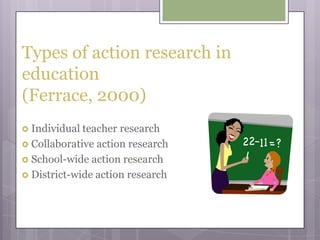
Types of action research in education(Ferrace, 2000)Individual teacher researchCollaborative action researchSchool-wide action researchDistrict-wide action research
Why should teachers do action research? (Laycock & Long, 2009)Examine situationGet input from participatorsCollaborate with colleagues to solve problemsAppraise self-performanceImprove practice and professional knowledge
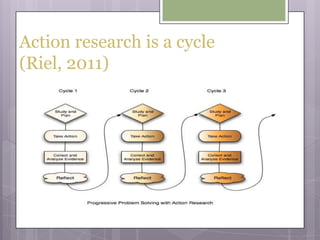
Action research is a cycle(Riel, 2011)
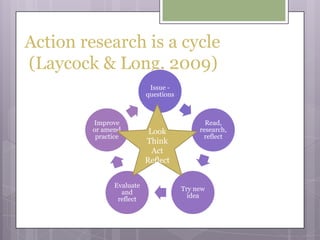
Action research is a cycle (Laycock & Long, 2009)Look ThinkActReflect
Example of action research #1Problem: 9th grade students cannot write a good sentence.Solution form reading: writing workshop, wiki, blog, peer mentor, twitterIdea: students tweet a sentence everyday and peers and instructor give them feedbackEvaluate: quality of writing sentence, discussion, interview student, student evaluationBased on evaluation – next action
Example of action research #2Problem: 12th grade students have low performance on applying power and square rootSolution from reading: math software, supplement with calculator, role play, gameIdea: role play and group presentationEvaluation: using pre-test, quality of project, post-test, students evaluationBased on evaluation – what is going wright and what is going wrong? What is the next action?
How the action research report look like? IntroductionLiterature reviewResearch questionsMethod for data collectionFindingReflectionConclusionReferencesAppendix
Conclusion: A checklist for action research (Denscombe, 2007)…[1]Does the research project address a concrete issue or practical problem?Is there participation by the practitioner in all stages of the research project?Have the grounds for the partnership between practitioner and any outside expert been explicitly negotiated and agreed?
Conclusion: A checklist for action research (Denscombe, 2007)…[2]Is the research part of a continuous cycle of development (rather than a one-off project)?Is there a clear view of how the research findings will feed back directly into practice?Is it clear which kind of action research is being used-’technical’, ‘practical’, or ‘ emancipatory’?
Conclusion: A checklist for action research (Denscombe, 2007)…[3]Has insider knowledge been acknowledged as having disadvantages as well as advantages for the research?Is the research sufficiently small-scale to be combined with a routine workload?Have ethical matters been taken into consideration?
ReferencesDenscombe, M. (2007). The good research guide for small-scale social research projects (p. 310 p.). Open University Press. Retrieved from http://www.amazon.co.uk/Good-Research-Guide-small-scale-research/dp/0335220223Ferrance, E. (2000). Action research. Brown University. Retrieved from http://www.alliance.brown.edu/pubs/themes_ed/act_research.pdfLaycock, D., and Long, M. (2009). Action Research? Anyone can!. IBSC Global Action research Project. Retrieved from http://drjj.uitm.edu.my/DRJJ/MATRIC2010/5.%20Anyone_can_Action_Research-DRJJ-02022010.pdfRiel, M. (2011). Understanding action research. Retrieved from  http://cadres.pepperdine.edu/ccar/define.html
Future questionsHery TheUniversity of Hawaii at Manoaherythe@hotmail.co.ukMAHALO

Action research in education

  • 1.
    Action research ineducationHeryYanto TheHost Your Own Webinar - ElluminateAugust 10, 2011
  • 2.
    What grade areyou teaching right now?K – 67 – 8 9 – 12others
  • 3.
    Have you donean action research before?YesNoI am not sure
  • 4.
    How do youanswer these questions?What can I do to accommodate diversity in learning style of my students?Why most of my students cannot write a good essay?Does doing a classroom presentation effective for this lesson?How can I encourage my students to read their lesson chapter before coming to class?
  • 5.
    AgendaAction research approachActionresearch in educationTypes of action researchTeacher and action researchAction research is a cycleExamples of action research questionAction research report
  • 6.
    Action research approach(Denscombe, 2007)Hands-on, small scale research projectOriginally: Social theory – solving immediate social problemsRecently: organization development, education, health and social careImprove practice/professional development – “participation”Involved with practical issues
  • 7.
    What is actionresearch?Action research is a process in which participants examine their own educational practice systematically and carefully, using the techniques of research. (Ferrance, 2000)
  • 8.
    What is actionresearch in education? Action research is a systematic process that allows you to try out different ways of doing things in your classroom or in your school, until you find something that really works for you and for your students . (Laycock & Long, 2009)
  • 9.
    Types of actionresearch in education(Ferrace, 2000)Individual teacher researchCollaborative action researchSchool-wide action researchDistrict-wide action research
  • 10.
    Why should teachersdo action research? (Laycock & Long, 2009)Examine situationGet input from participatorsCollaborate with colleagues to solve problemsAppraise self-performanceImprove practice and professional knowledge
  • 11.
    Action research isa cycle(Riel, 2011)
  • 12.
    Action research isa cycle (Laycock & Long, 2009)Look ThinkActReflect
  • 13.
    Example of actionresearch #1Problem: 9th grade students cannot write a good sentence.Solution form reading: writing workshop, wiki, blog, peer mentor, twitterIdea: students tweet a sentence everyday and peers and instructor give them feedbackEvaluate: quality of writing sentence, discussion, interview student, student evaluationBased on evaluation – next action
  • 14.
    Example of actionresearch #2Problem: 12th grade students have low performance on applying power and square rootSolution from reading: math software, supplement with calculator, role play, gameIdea: role play and group presentationEvaluation: using pre-test, quality of project, post-test, students evaluationBased on evaluation – what is going wright and what is going wrong? What is the next action?
  • 15.
    How the actionresearch report look like? IntroductionLiterature reviewResearch questionsMethod for data collectionFindingReflectionConclusionReferencesAppendix
  • 16.
    Conclusion: A checklistfor action research (Denscombe, 2007)…[1]Does the research project address a concrete issue or practical problem?Is there participation by the practitioner in all stages of the research project?Have the grounds for the partnership between practitioner and any outside expert been explicitly negotiated and agreed?
  • 17.
    Conclusion: A checklistfor action research (Denscombe, 2007)…[2]Is the research part of a continuous cycle of development (rather than a one-off project)?Is there a clear view of how the research findings will feed back directly into practice?Is it clear which kind of action research is being used-’technical’, ‘practical’, or ‘ emancipatory’?
  • 18.
    Conclusion: A checklistfor action research (Denscombe, 2007)…[3]Has insider knowledge been acknowledged as having disadvantages as well as advantages for the research?Is the research sufficiently small-scale to be combined with a routine workload?Have ethical matters been taken into consideration?
  • 19.
    ReferencesDenscombe, M. (2007).The good research guide for small-scale social research projects (p. 310 p.). Open University Press. Retrieved from http://www.amazon.co.uk/Good-Research-Guide-small-scale-research/dp/0335220223Ferrance, E. (2000). Action research. Brown University. Retrieved from http://www.alliance.brown.edu/pubs/themes_ed/act_research.pdfLaycock, D., and Long, M. (2009). Action Research? Anyone can!. IBSC Global Action research Project. Retrieved from http://drjj.uitm.edu.my/DRJJ/MATRIC2010/5.%20Anyone_can_Action_Research-DRJJ-02022010.pdfRiel, M. (2011). Understanding action research. Retrieved from http://cadres.pepperdine.edu/ccar/define.html
  • 20.
    Future questionsHery TheUniversityof Hawaii at Manoaherythe@hotmail.co.ukMAHALO