Educational Research
Unit 6: Development of Research Proposal
•Dr. Zaheer Ahmad
• Course Coordinator
Objectives of the Unit
• Explain the concept of research proposal;
• Discuss various steps involved in developing the research proposal;
• Describe the importance of hypothesis;
• Evaluate the procedure of study;
• Appreciate a research proposal; and
• Discuss the limitation and delimitation and procedure of study
Importance of research proposal
• Helps examine what the researcher intends t o do.
• Research proposal can serve as a document of contract for the project.
• Research proposals can be effective starting places to discuss projects
with your professors, too.
• The research proposal is able to give an overview of the research
project so that other people understand the scope of the research, the
significance of the research, as well as your proposed methodology
and chosen research method.
advantages
• Fund to support your research
• Allow you to review and critically evaluate your current
research program
• Convince yourself and others that your research is worth
supporting
• Keep you focused on your research program Develop novel
ideas during writing proposal
Relationship of research proposal with
research
• Research proposal is a plan ,and research is action.
• Research proposal is compulsory for approving proposed
research.
• Research proposal is a schedule and research is activity.
• Research proposal is a mirror of research
• Research proposal is a blue print of research.
• Research proposal can serve as a document of contract for the
project.
Steps in developing research proposal
• Introduction
• Identifying a problem
• Purpose of study
• Significance of study
• Review of literature
• Formulation of hypothesis
• Procedure of study
• Outline of research report
introduction
• Research proposal is normally written with a brief descry[tion of the
nature of the study. Its introduction should indicate the type of
research which is
Planned
Field of study and
Purpose of study
Identification of research problem
• Identification of research problem is a matter of asking good, relevant and
important questions in the field of education context.
• Special care is needed in selection a research problem
1. It should be of interest not only to the researcher but also to some recognized
segment of the educational community also.
2. The significance of research problem for education from either a practical or a
theretical viewpoint should be kept in mind.
3. Research problem should relate to the existing knowledge or contribute to
education in a meaningful way
4. Research problem should be selected in the context of information or
experience.
5. The research should be familiar with the area to be reached including relevant
theories.
Purpose of study
• Purpose of study is to find solution
• Statement of problem and purpose of study should be so framed that
the research design for the study could be logically deduced.
Significance of study
• It describes the value of conducting the proposed study.
• The researcher has to state the expected consequences or possible
outcomes of the study and how and who will use and benefit from
the findings
Review of literature
• The important activity in the research proposal is the review of
research literature related to the research problem.
• after the problem has been identified, the information is needed
about the problem so that it can be put in the proper context and the
research can proceed effectively.
• Literature review is
Trivial task
Systematic process
Value of review of literature
• William wiersma (1986) stated that the review may be useful in any or all
of the following
• More specifically limiting and identifying the research problem and
hypothesis.
• Informing the researcher of what has already been done in the area.
• Providing possible research design and methodological procedure that may
be used in the research study.
• Providing suggestions for possible modification in the research to avoid
unanticipated difficulties.
• Identifying possible gaps in the research
• Providing a backdrop interpreting the results of the research study.
Purpose of review of literature.
• It is essential to a well designed research study
• It comes early in the research process, and it can contribute valuable
information to any part of the research study.
Formulation of hypothesis
Characteristics of a good hypothesis:
A good hypothesis has the following basic characteristics:
• It clearly establishes the nature of the problem and the logic
underlying the investigation.
• It gives direction to the data gathering procedure
• It gives an idea of the possible outcomes of the research proposal
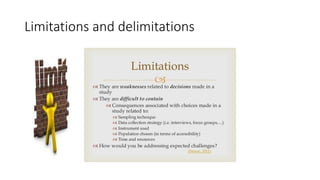
Limitations and delimitations
Procedure of study
• It usually describes the
• Sampling procedure
• Nature and design of study
• Treatment to be administered and
• How any condition regarding use of observers and measurement
instruments to be used
• It includes description of the nature of the data collection instrument
Analysis of data
• This part describes the tests of significance and other statistical
procedures that will be used for the analysisof data.
Definitions of terms and references.
• The meanings of all the terms used in the research must be clearly
mentioned so that the reader be familiar. The terms must be defined
in operational terms.
Dr. Zaheer Ahmad
Course Coordinator
Educational Research
Course Coordinator
oDr. Zaheer Ahmad
Objectives of the Unit
• Explain the main sources of data in education research
• Identify the preliminary sources of information
• Specify the primary sources of information
• Discuss the secondary sources of information; and
• Compare direct and indirect source information available in the form
of education literature
introduction
• sources of information have great importance in educational
research. In order to locate the use of educational research, one must
be familiar with the major sources of information.
• Preliminary, primary and secondary sources
• Preliminary sources are used to locate
• Books, articles and other educational documents that relate to the
research problem.
preliminary sources
• Most preliminary sources are either indexes such as educational
indexes which give the author title and place of publication of
educational writing or abstracts such as psychological abstracts which
give a brief summary and abstracts of each publication listed in
addition to bibliographical data.
• Preliminary sources are usually organized by subjects.
Primary sources
• Like wise primary sources are those publications in which person who
carry out research report their findings.
• Primary sources information is communicated directly from the
researcher to the reader. Most of primary sources in education are
journals. Each article in these journals typically reports on a different
research project.
• Books also frequently contain reports of original research and they
then become primary source information.
Secondary source
• Secondary sources are publications in which the author is reporting
on research that someone else carried out. The most common
secondary source in education are scholarly books and text books.
• The disadvantages of secondary source is that the author may not
accurately report the primary source findings.
• The advantage of secondary source such as textbooks is that they give
the reader a quick and readable overview of research and opinion
related to educational topics covered.
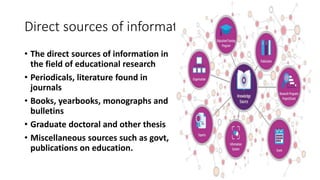
Direct sources of information
• The direct sources of information in
the field of educational research
• Periodicals, literature found in
journals
• Books, yearbooks, monographs and
bulletins
• Graduate doctoral and other thesis
• Miscellaneous sources such as govt,
publications on education.
Direct sources
continued
• Periodical literature
• Books monographs yearbooks and
bulletins
• Thesis and dissertation
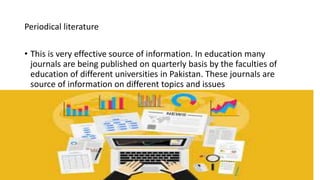
Periodical literature
• This is very effective source of information. In education many
journals are being published on quarterly basis by the faculties of
education of different universities in Pakistan. These journals are
source of information on different topics and issues
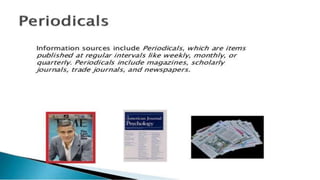
Periodicals continued
• American educational research association has been publishing
periodicals entitles review of educational research since 1931. it
appears regularly five times a year covers a series of eleven major
fields or topics
• Educational resource information center ERIC 1966 is a monthly
periodical. It provides abstracts of current studies, conferences and
projects in education
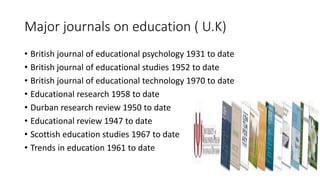
Major journals on education ( U.K)
• British journal of educational psychology 1931 to date
• British journal of educational studies 1952 to date
• British journal of educational technology 1970 to date
• Educational research 1958 to date
• Durban research review 1950 to date
• Educational review 1947 to date
• Scottish education studies 1967 to date
• Trends in education 1961 to date
Books monographs, yearbooks and bulletins
include
1. Hand book in research technology: publisher in 1963 by American
education research association edited by Nathaniel Less Gage
summarizes recent research on teaching and supplies excellent data
regarding methods, subject fields and the like.
2. Mental measurement yearbook: five volume directory edited by Oscar K.
Burros list in two separate section.
a) all educational . Psychological and vocational tests available commercially
b) review of books on testing.
3. International year book on education since 1948 UNESCO, cooperation
with International bureau of education publish annual survey. Provide most
significant events of education in world
4. Cumulative book index: published since 1898. directory provides list
of all books published in English language
5. Yearbook of education: 1932-1940, 1948-1973- published in
association with University of London institute of education and
teachers college Colombia university NewYork. By evans Bros.
Thesis and dissertations
• Theses and dissertations prepared to meet the requirements for
graduate degrees usually contain descriptions of completed research.
Indirect source of information
• Encyclopedia of Education
• Education Indexes
• Education Abstracts
• Bibliographies and Directories
• Biographical references
• Radio/ TV support
• Micro fiche
• Computer search
Encyclopedia of Educational Research and
Education Index
• a project of American educational research Association was first
issued in 1940 and was revised in 1950 under the editorship of Walter
S. Monroe. Most recent edition Chester W. harris encyclopedia is
good source for resesearchers.
• Educational index: h.w Wilson company 1929 to date proved one of
the most useful reference tool available to educators.
• Since june 1961 main attention is given to periodical articles.
Articles over 300 periodicals related to education are indexed.
Education abstracts
• Dissertation abstracts: monthly publication since 1938 by university
Micro films. Offer a bibliographical index and concise abstracts of
doctoral dissertation completed in a number of cooperating
universities.
• Psychological abstracts: monthy since 1927. by APA catalogues new
books and articles on psychology with a short abstract of each.
• Sociological abstracts: quarterly periodical wordwidr=e organization
of sociologists to present abstracts of all sociological works bearing in
education
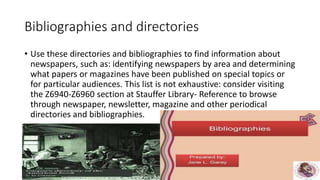
Bibliographies and directories
• Use these directories and bibliographies to find information about
newspapers, such as: identifying newspapers by area and determining
what papers or magazines have been published on special topics or
for particular audiences. This list is not exhaustive: consider visiting
the Z6940-Z6960 section at Stauffer Library- Reference to browse
through newspaper, newsletter, magazine and other periodical
directories and bibliographies.
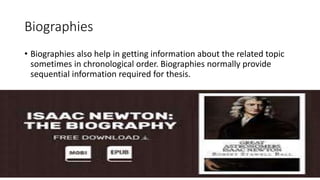
Biographies
• Biographies also help in getting information about the related topic
sometimes in chronological order. Biographies normally provide
sequential information required for thesis.
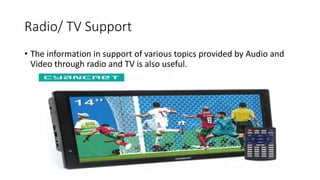
Radio/ TV Support
• The information in support of various topics provided by Audio and
Video through radio and TV is also useful.
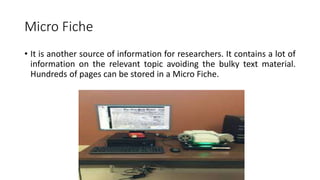
Micro Fiche
• It is another source of information for researchers. It contains a lot of
information on the relevant topic avoiding the bulky text material.
Hundreds of pages can be stored in a Micro Fiche.
Computer search
• In order to conduct a major review of literature or to make an
important educational decision about any research, a manual
research process is time consuming and tiresome.
• In such situation a computer search of the appropriate.
• Preliminary sources is important because of being low cost, speedy
and immediate information provides a printout of the required
aspect/ section and permits simultaneous searching.
aiou code 837

aiou code 837

  • 1.
    Educational Research Unit 6:Development of Research Proposal •Dr. Zaheer Ahmad • Course Coordinator
  • 2.
    Objectives of theUnit • Explain the concept of research proposal; • Discuss various steps involved in developing the research proposal; • Describe the importance of hypothesis; • Evaluate the procedure of study; • Appreciate a research proposal; and • Discuss the limitation and delimitation and procedure of study
  • 6.
    Importance of researchproposal • Helps examine what the researcher intends t o do. • Research proposal can serve as a document of contract for the project. • Research proposals can be effective starting places to discuss projects with your professors, too. • The research proposal is able to give an overview of the research project so that other people understand the scope of the research, the significance of the research, as well as your proposed methodology and chosen research method.
  • 7.
    advantages • Fund tosupport your research • Allow you to review and critically evaluate your current research program • Convince yourself and others that your research is worth supporting • Keep you focused on your research program Develop novel ideas during writing proposal
  • 8.
    Relationship of researchproposal with research • Research proposal is a plan ,and research is action. • Research proposal is compulsory for approving proposed research. • Research proposal is a schedule and research is activity. • Research proposal is a mirror of research • Research proposal is a blue print of research. • Research proposal can serve as a document of contract for the project.
  • 9.
    Steps in developingresearch proposal • Introduction • Identifying a problem • Purpose of study • Significance of study • Review of literature • Formulation of hypothesis • Procedure of study • Outline of research report
  • 10.
    introduction • Research proposalis normally written with a brief descry[tion of the nature of the study. Its introduction should indicate the type of research which is Planned Field of study and Purpose of study
  • 11.
    Identification of researchproblem • Identification of research problem is a matter of asking good, relevant and important questions in the field of education context. • Special care is needed in selection a research problem 1. It should be of interest not only to the researcher but also to some recognized segment of the educational community also. 2. The significance of research problem for education from either a practical or a theretical viewpoint should be kept in mind. 3. Research problem should relate to the existing knowledge or contribute to education in a meaningful way 4. Research problem should be selected in the context of information or experience. 5. The research should be familiar with the area to be reached including relevant theories.
  • 12.
    Purpose of study •Purpose of study is to find solution • Statement of problem and purpose of study should be so framed that the research design for the study could be logically deduced.
  • 13.
    Significance of study •It describes the value of conducting the proposed study. • The researcher has to state the expected consequences or possible outcomes of the study and how and who will use and benefit from the findings
  • 14.
    Review of literature •The important activity in the research proposal is the review of research literature related to the research problem. • after the problem has been identified, the information is needed about the problem so that it can be put in the proper context and the research can proceed effectively. • Literature review is Trivial task Systematic process
  • 15.
    Value of reviewof literature • William wiersma (1986) stated that the review may be useful in any or all of the following • More specifically limiting and identifying the research problem and hypothesis. • Informing the researcher of what has already been done in the area. • Providing possible research design and methodological procedure that may be used in the research study. • Providing suggestions for possible modification in the research to avoid unanticipated difficulties. • Identifying possible gaps in the research • Providing a backdrop interpreting the results of the research study.
  • 16.
    Purpose of reviewof literature. • It is essential to a well designed research study • It comes early in the research process, and it can contribute valuable information to any part of the research study.
  • 17.
    Formulation of hypothesis Characteristicsof a good hypothesis: A good hypothesis has the following basic characteristics: • It clearly establishes the nature of the problem and the logic underlying the investigation. • It gives direction to the data gathering procedure • It gives an idea of the possible outcomes of the research proposal
  • 18.
  • 19.
    Procedure of study •It usually describes the • Sampling procedure • Nature and design of study • Treatment to be administered and • How any condition regarding use of observers and measurement instruments to be used • It includes description of the nature of the data collection instrument
  • 20.
    Analysis of data •This part describes the tests of significance and other statistical procedures that will be used for the analysisof data.
  • 21.
    Definitions of termsand references. • The meanings of all the terms used in the research must be clearly mentioned so that the reader be familiar. The terms must be defined in operational terms.
  • 22.
    Dr. Zaheer Ahmad CourseCoordinator Educational Research Course Coordinator oDr. Zaheer Ahmad
  • 23.
    Objectives of theUnit • Explain the main sources of data in education research • Identify the preliminary sources of information • Specify the primary sources of information • Discuss the secondary sources of information; and • Compare direct and indirect source information available in the form of education literature
  • 24.
    introduction • sources ofinformation have great importance in educational research. In order to locate the use of educational research, one must be familiar with the major sources of information. • Preliminary, primary and secondary sources • Preliminary sources are used to locate • Books, articles and other educational documents that relate to the research problem.
  • 25.
    preliminary sources • Mostpreliminary sources are either indexes such as educational indexes which give the author title and place of publication of educational writing or abstracts such as psychological abstracts which give a brief summary and abstracts of each publication listed in addition to bibliographical data. • Preliminary sources are usually organized by subjects.
  • 26.
    Primary sources • Likewise primary sources are those publications in which person who carry out research report their findings. • Primary sources information is communicated directly from the researcher to the reader. Most of primary sources in education are journals. Each article in these journals typically reports on a different research project. • Books also frequently contain reports of original research and they then become primary source information.
  • 27.
    Secondary source • Secondarysources are publications in which the author is reporting on research that someone else carried out. The most common secondary source in education are scholarly books and text books. • The disadvantages of secondary source is that the author may not accurately report the primary source findings. • The advantage of secondary source such as textbooks is that they give the reader a quick and readable overview of research and opinion related to educational topics covered.
  • 28.
    Direct sources ofinformation • The direct sources of information in the field of educational research • Periodicals, literature found in journals • Books, yearbooks, monographs and bulletins • Graduate doctoral and other thesis • Miscellaneous sources such as govt, publications on education.
  • 29.
    Direct sources continued • Periodicalliterature • Books monographs yearbooks and bulletins • Thesis and dissertation
  • 30.
    Periodical literature • Thisis very effective source of information. In education many journals are being published on quarterly basis by the faculties of education of different universities in Pakistan. These journals are source of information on different topics and issues
  • 32.
    Periodicals continued • Americaneducational research association has been publishing periodicals entitles review of educational research since 1931. it appears regularly five times a year covers a series of eleven major fields or topics • Educational resource information center ERIC 1966 is a monthly periodical. It provides abstracts of current studies, conferences and projects in education
  • 33.
    Major journals oneducation ( U.K) • British journal of educational psychology 1931 to date • British journal of educational studies 1952 to date • British journal of educational technology 1970 to date • Educational research 1958 to date • Durban research review 1950 to date • Educational review 1947 to date • Scottish education studies 1967 to date • Trends in education 1961 to date
  • 34.
    Books monographs, yearbooksand bulletins include 1. Hand book in research technology: publisher in 1963 by American education research association edited by Nathaniel Less Gage summarizes recent research on teaching and supplies excellent data regarding methods, subject fields and the like. 2. Mental measurement yearbook: five volume directory edited by Oscar K. Burros list in two separate section. a) all educational . Psychological and vocational tests available commercially b) review of books on testing. 3. International year book on education since 1948 UNESCO, cooperation with International bureau of education publish annual survey. Provide most significant events of education in world
  • 35.
    4. Cumulative bookindex: published since 1898. directory provides list of all books published in English language 5. Yearbook of education: 1932-1940, 1948-1973- published in association with University of London institute of education and teachers college Colombia university NewYork. By evans Bros.
  • 36.
    Thesis and dissertations •Theses and dissertations prepared to meet the requirements for graduate degrees usually contain descriptions of completed research.
  • 37.
    Indirect source ofinformation • Encyclopedia of Education • Education Indexes • Education Abstracts • Bibliographies and Directories • Biographical references • Radio/ TV support • Micro fiche • Computer search
  • 38.
    Encyclopedia of EducationalResearch and Education Index • a project of American educational research Association was first issued in 1940 and was revised in 1950 under the editorship of Walter S. Monroe. Most recent edition Chester W. harris encyclopedia is good source for resesearchers. • Educational index: h.w Wilson company 1929 to date proved one of the most useful reference tool available to educators. • Since june 1961 main attention is given to periodical articles. Articles over 300 periodicals related to education are indexed.
  • 39.
    Education abstracts • Dissertationabstracts: monthly publication since 1938 by university Micro films. Offer a bibliographical index and concise abstracts of doctoral dissertation completed in a number of cooperating universities. • Psychological abstracts: monthy since 1927. by APA catalogues new books and articles on psychology with a short abstract of each. • Sociological abstracts: quarterly periodical wordwidr=e organization of sociologists to present abstracts of all sociological works bearing in education
  • 40.
    Bibliographies and directories •Use these directories and bibliographies to find information about newspapers, such as: identifying newspapers by area and determining what papers or magazines have been published on special topics or for particular audiences. This list is not exhaustive: consider visiting the Z6940-Z6960 section at Stauffer Library- Reference to browse through newspaper, newsletter, magazine and other periodical directories and bibliographies.
  • 41.
    Biographies • Biographies alsohelp in getting information about the related topic sometimes in chronological order. Biographies normally provide sequential information required for thesis.
  • 42.
    Radio/ TV Support •The information in support of various topics provided by Audio and Video through radio and TV is also useful.
  • 43.
    Micro Fiche • Itis another source of information for researchers. It contains a lot of information on the relevant topic avoiding the bulky text material. Hundreds of pages can be stored in a Micro Fiche.
  • 44.
    Computer search • Inorder to conduct a major review of literature or to make an important educational decision about any research, a manual research process is time consuming and tiresome. • In such situation a computer search of the appropriate. • Preliminary sources is important because of being low cost, speedy and immediate information provides a printout of the required aspect/ section and permits simultaneous searching.