
Developing innovative ways
of analyzing data
Kenan Dikilitaş
EVO’2016
Classroom-based Research for Professional Development
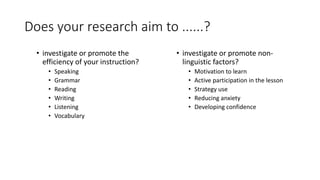
Does your research aim to ......?
• investigate or promote the
efficiency of your instruction?
• Speaking
• Grammar
• Reading
• Writing
• Listening
• Vocabulary
• investigate or promote non-
linguistic factors?
• Motivation to learn
• Active participation in the lesson
• Strategy use
• Reducing anxiety
• Developing confidence
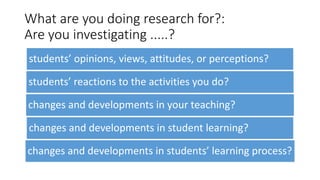
What are you doing research for?:
Are you investigating .....?
students’ opinions, views, attitudes, or perceptions?
students’ reactions to the activities you do?
changes and developments in your teaching?
changes and developments in student learning?
changes and developments in students’ learning process?
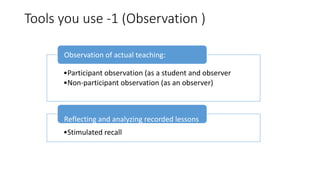
Tools you use -1 (Observation )
•Participant observation (as a student and observer
•Non-participant observation (as an observer)
Observation of actual teaching:
•Stimulated recall
Reflecting and analyzing recorded lessons
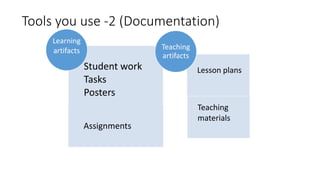
Tools you use -2 (Documentation)
Student work
Tasks
Posters
Assignments
Learning
artifacts
Lesson plans
Teaching
materials
Teaching
artifacts
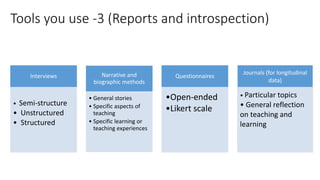
Tools you use -3 (Reports and introspection)
Interviews
• Semi-structure
• Unstructured
• Structured
Narrative and
biographic methods
• General stories
• Specific aspects of
teaching
• Specific learning or
teaching experiences
Questionnaires
•Open-ended
•Likert scale
Journals (for longitudinal
data)
• Particular topics
• General reflection
on teaching and
learning
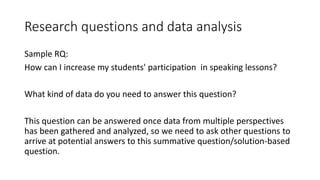
Research questions and data analysis
Sample RQ:
How can I increase my students' participation in speaking lessons?
What kind of data do you need to answer this question?
This question can be answered once data from multiple perspectives
has been gathered and analyzed, so we need to ask other questions to
arrive at potential answers to this summative question/solution-based
question.
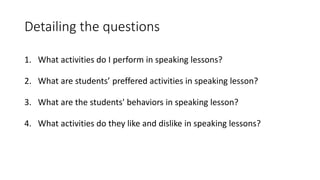
Detailing the questions
1. What activities do I perform in speaking lessons?
2. What are students’ preffered activities in speaking lesson?
3. What are the students' behaviors in speaking lesson?
4. What activities do they like and dislike in speaking lessons?
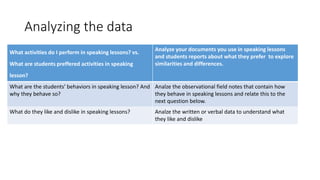
Analyzing the data
What activities do I perform in speaking lessons? vs.
What are students preffered activities in speaking
lesson?
Analyze your documents you use in speaking lessons
and students reports about what they prefer to explore
similarities and differences.
What are the students' behaviors in speaking lesson? And
why they behave so?
Analze the observational field notes that contain how
they behave in speaking lessons and relate this to the
next question below.
What do they like and dislike in speaking lessons? Analze the written or verbal data to understand what
they like and dislike
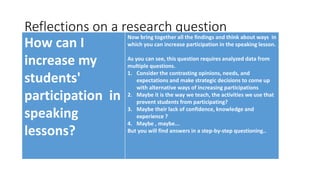
Reflections on a research question
How can I
increase my
students'
participation in
speaking
lessons?
Now bring together all the findings and think about ways in
which you can increase participation in the speaking lesson.
As you can see, this question requires analyzed data from
multiple questions.
1. Consider the contrasting opinions, needs, and
expectations and make strategic decisions to come up
with alternative ways of increasing participations
2. Maybe it is the way we teach, the activities we use that
prevent students from participating?
3. Maybe their lack of confidence, knowledge and
experience ?
4. Maybe , maybe...
But you will find answers in a step-by-step questioning..
Data Analysis
To be able to tabulate the data, numerics can be generated on the basis
of the following calculations:
• Percentages
• Frequency
• Mean scores
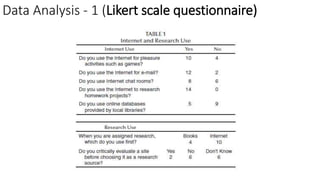
Data Analysis - 1 (Likert scale questionnaire)
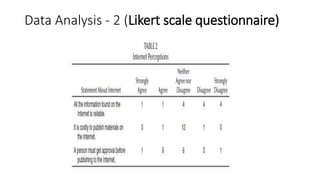
Data Analysis - 2 (Likert scale questionnaire)
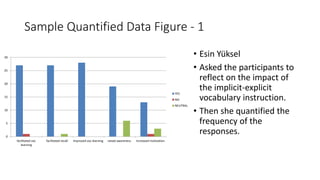
Sample Quantified Data Figure - 1
• Esin Yüksel
• Asked the participants to
reflect on the impact of
the implicit-explicit
vocabulary instruction.
• Then she quantified the
frequency of the
responses.0
5
10
15
20
25
30
facilitated voc
learnıng
facilitated recall improved voc learning raised awareness increased motivation
YES
NO
NEUTRAL
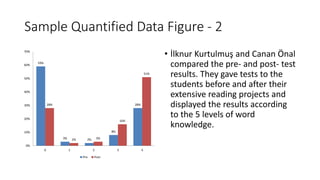
Sample Quantified Data Figure - 2
• İlknur Kurtulmuş and Canan Önal
compared the pre- and post- test
results. They gave tests to the
students before and after their
extensive reading projects and
displayed the results according
to the 5 levels of word
knowledge.
59%
3% 2%
8%
28%28%
2% 3%
16%
51%
0%
10%
20%
30%
40%
50%
60%
70%
0 1 2 3 4
Pre- Post-
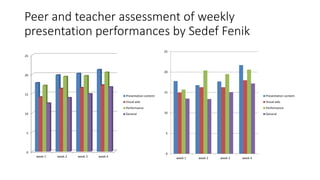
Peer and teacher assessment of weekly
presentation performances by Sedef Fenik
0
5
10
15
20
25
week 1 week 2 week 3 week 4
Presentation content
Visual aids
Performance
General
0
5
10
15
20
25
week 1 week 2 week 3 week 4
Presentation content
Visual aids
Performance
General
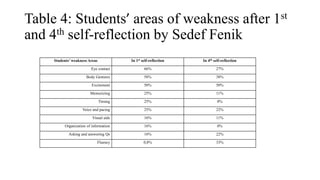
Table 4: Students’ areas of weakness after 1st
and 4th self-reflection by Sedef Fenik
Students’ weakness Areas In 1st self-reflection In 4th self-reflection
Eye contact 66% 27%
Body Gestures 58% 38%
Excitement 50% 50%
Memorizing 25% 11%
Timing 25% 0%
Voice and pacing 25% 22%
Visual aids 16% 11%
Organization of information 16% 0%
Asking and answering Qs 16% 22%
Fluency 0,8% 33%
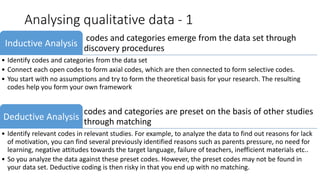
Analysing qualitative data - 1
codes and categories emerge from the data set through
discovery procedures
Inductive Analysis
• Identify codes and categories from the data set
• Connect each open codes to form axial codes, which are then connected to form selective codes.
• You start with no assumptions and try to form the theoretical basis for your research. The resulting
codes help you form your own framework
codes and categories are preset on the basis of other studies
through matching
Deductive Analysis
• Identify relevant codes in relevant studies. For example, to analyze the data to find out reasons for lack
of motivation, you can find several previously identified reasons such as parents pressure, no need for
learning, negative attitudes towards the target language, failure of teachers, inefficient materials etc..
• So you analyze the data against these preset codes. However, the preset codes may not be found in
your data set. Deductive coding is then risky in that you end up with no matching.
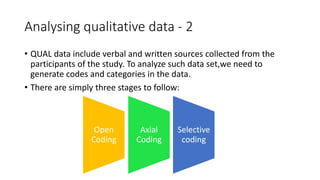
Analysing qualitative data - 2
• QUAL data include verbal and written sources collected from the
participants of the study. To analyze such data set,we need to
generate codes and categories in the data.
• There are simply three stages to follow:
Open
Coding
Axial
Coding
Selective
coding
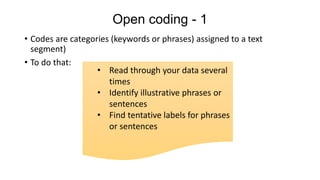
Open coding - 1
• Codes are categories (keywords or phrases) assigned to a text
segment)
• To do that:
• Read through your data several
times
• Identify illustrative phrases or
sentences
• Find tentative labels for phrases
or sentences
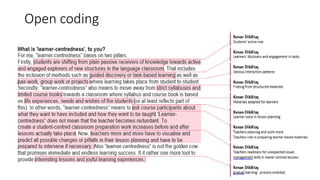
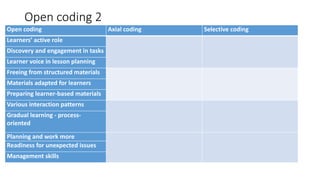
Open coding
Open coding 2
Open coding Axial coding Selective coding
Learners’ active role
Discovery and engagement in tasks
Learner voice in lesson planning
Freeing from structured materials
Materials adapted for learners
Preparing learner-based materials
Various interaction patterns
Gradual learning - process-
oriented
Planning and work more
Readiness for unexpected issues
Management skills
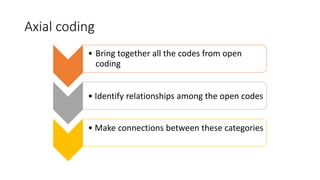
Axial coding
• Bring together all the codes from open
coding
• Identify relationships among the open codes
• Make connections between these categories
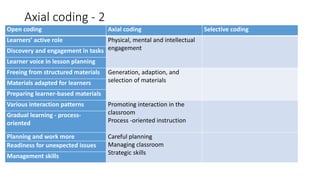
Axial coding - 2
Open coding Axial coding Selective coding
Learners’ active role Physical, mental and intellectual
engagementDiscovery and engagement in tasks
Learner voice in lesson planning
Freeing from structured materials Generation, adaption, and
selection of materialsMaterials adapted for learners
Preparing learner-based materials
Various interaction patterns Promoting interaction in the
classroom
Process -oriented instruction
Gradual learning - process-
oriented
Planning and work more Careful planning
Managing classroom
Strategic skills
Readiness for unexpected issues
Management skills
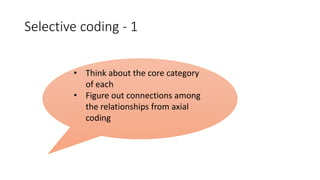
Selective coding - 1
• Think about the core category
of each
• Figure out connections among
the relationships from axial
coding
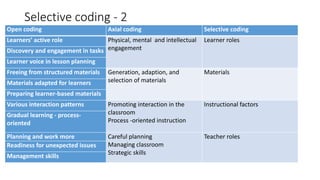
Selective coding - 2
Open coding Axial coding Selective coding
Learners’ active role Physical, mental and intellectual
engagement
Learner roles
Discovery and engagement in tasks
Learner voice in lesson planning
Freeing from structured materials Generation, adaption, and
selection of materials
Materials
Materials adapted for learners
Preparing learner-based materials
Various interaction patterns Promoting interaction in the
classroom
Process -oriented instruction
Instructional factors
Gradual learning - process-
oriented
Planning and work more Careful planning
Managing classroom
Strategic skills
Teacher roles
Readiness for unexpected issues
Management skills
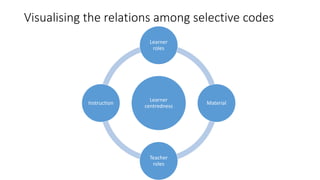
Visualising the relations among selective codes
Learner
centredness
Learner
roles
Material
Teacher
roles
Instruction
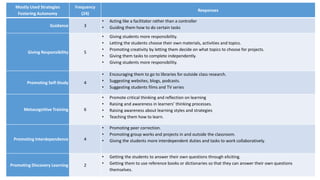
Mostly Used Strategies
Fostering Autonomy
Frequency
(24)
Responses
Guidance 3
• Acting like a facilitator rather than a controller
• Guiding them how to do certain tasks
Giving Responsibility 5
• Giving students more responsibility.
• Letting the students choose their own materials, activities and topics.
• Promoting creativity by letting them decide on what topics to choose for projects.
• Giving them tasks to complete independently.
• Giving students more responsibility.
Promoting Self-Study 4
• Encouraging them to go to libraries for outside class research.
• Suggesting websites, blogs, podcasts.
• Suggesting students films and TV series
Metacognitive Training 6
• Promote critical thinking and reflection on learning
• Raising and awareness in learners’ thinking processes.
• Raising awareness about learning styles and strategies
• Teaching them how to learn.
Promoting Interdependence 4
• Promoting peer correction.
• Promoting group works and projects in and outside the classroom.
• Giving the students more interdependent duties and tasks to work collaboratively.
Promoting Discovery Learning 2
• Getting the students to answer their own questions through eliciting.
• Getting them to use reference books or dictionaries so that they can answer their own questions
themselves.
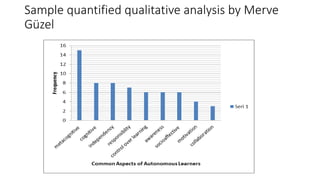
Sample quantified qualitative analysis by Merve
Güzel
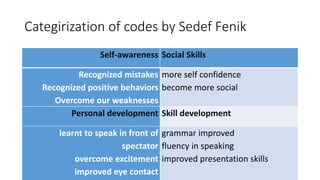
Categirization of codes by Sedef Fenik
Self-awareness Social Skills
Recognized mistakes
Recognized positive behaviors
Overcome our weaknesses
more self confidence
become more social
Personal development Skill development
learnt to speak in front of
spectator
overcome excitement
improved eye contact
grammar improved
fluency in speaking
improved presentation skills
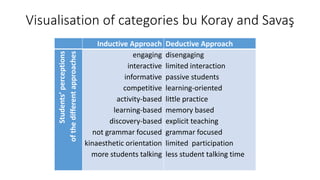
Visualisation of categories bu Koray and Savaş
Inductive Approach Deductive Approach
Students’perceptions
ofthedifferentapproaches
engaging
interactive
informative
competitive
activity-based
learning-based
discovery-based
not grammar focused
kinaesthetic orientation
more students talking
disengaging
limited interaction
passive students
learning-oriented
little practice
memory based
explicit teaching
grammar focused
limited participation
less student talking time
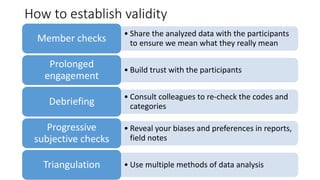
How to establish validity
• Share the analyzed data with the participants
to ensure we mean what they really meanMember checks
• Build trust with the participants
Prolonged
engagement
• Consult colleagues to re-check the codes and
categoriesDebriefing
• Reveal your biases and preferences in reports,
field notes
Progressive
subjective checks
• Use multiple methods of data analysisTriangulation
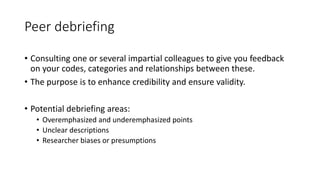
Peer debriefing
• Consulting one or several impartial colleagues to give you feedback
on your codes, categories and relationships between these.
• The purpose is to enhance credibility and ensure validity.
• Potential debriefing areas:
• Overemphasized and underemphasized points
• Unclear descriptions
• Researcher biases or presumptions

Kenan Dikilitas "Developing ways of analyzing data"

  • 1.
    Developing innovative ways ofanalyzing data Kenan Dikilitaş EVO’2016 Classroom-based Research for Professional Development
  • 2.
    Does your researchaim to ......? • investigate or promote the efficiency of your instruction? • Speaking • Grammar • Reading • Writing • Listening • Vocabulary • investigate or promote non- linguistic factors? • Motivation to learn • Active participation in the lesson • Strategy use • Reducing anxiety • Developing confidence
  • 3.
    What are youdoing research for?: Are you investigating .....? students’ opinions, views, attitudes, or perceptions? students’ reactions to the activities you do? changes and developments in your teaching? changes and developments in student learning? changes and developments in students’ learning process?
  • 4.
    Tools you use-1 (Observation ) •Participant observation (as a student and observer •Non-participant observation (as an observer) Observation of actual teaching: •Stimulated recall Reflecting and analyzing recorded lessons
  • 5.
    Tools you use-2 (Documentation) Student work Tasks Posters Assignments Learning artifacts Lesson plans Teaching materials Teaching artifacts
  • 6.
    Tools you use-3 (Reports and introspection) Interviews • Semi-structure • Unstructured • Structured Narrative and biographic methods • General stories • Specific aspects of teaching • Specific learning or teaching experiences Questionnaires •Open-ended •Likert scale Journals (for longitudinal data) • Particular topics • General reflection on teaching and learning
  • 7.
    Research questions anddata analysis Sample RQ: How can I increase my students' participation in speaking lessons? What kind of data do you need to answer this question? This question can be answered once data from multiple perspectives has been gathered and analyzed, so we need to ask other questions to arrive at potential answers to this summative question/solution-based question.
  • 8.
    Detailing the questions 1.What activities do I perform in speaking lessons? 2. What are students’ preffered activities in speaking lesson? 3. What are the students' behaviors in speaking lesson? 4. What activities do they like and dislike in speaking lessons?
  • 9.
    Analyzing the data Whatactivities do I perform in speaking lessons? vs. What are students preffered activities in speaking lesson? Analyze your documents you use in speaking lessons and students reports about what they prefer to explore similarities and differences. What are the students' behaviors in speaking lesson? And why they behave so? Analze the observational field notes that contain how they behave in speaking lessons and relate this to the next question below. What do they like and dislike in speaking lessons? Analze the written or verbal data to understand what they like and dislike
  • 10.
    Reflections on aresearch question How can I increase my students' participation in speaking lessons? Now bring together all the findings and think about ways in which you can increase participation in the speaking lesson. As you can see, this question requires analyzed data from multiple questions. 1. Consider the contrasting opinions, needs, and expectations and make strategic decisions to come up with alternative ways of increasing participations 2. Maybe it is the way we teach, the activities we use that prevent students from participating? 3. Maybe their lack of confidence, knowledge and experience ? 4. Maybe , maybe... But you will find answers in a step-by-step questioning..
  • 11.
    Data Analysis To beable to tabulate the data, numerics can be generated on the basis of the following calculations: • Percentages • Frequency • Mean scores
  • 12.
    Data Analysis -1 (Likert scale questionnaire)
  • 13.
    Data Analysis -2 (Likert scale questionnaire)
  • 14.
    Sample Quantified DataFigure - 1 • Esin Yüksel • Asked the participants to reflect on the impact of the implicit-explicit vocabulary instruction. • Then she quantified the frequency of the responses.0 5 10 15 20 25 30 facilitated voc learnıng facilitated recall improved voc learning raised awareness increased motivation YES NO NEUTRAL
  • 15.
    Sample Quantified DataFigure - 2 • İlknur Kurtulmuş and Canan Önal compared the pre- and post- test results. They gave tests to the students before and after their extensive reading projects and displayed the results according to the 5 levels of word knowledge. 59% 3% 2% 8% 28%28% 2% 3% 16% 51% 0% 10% 20% 30% 40% 50% 60% 70% 0 1 2 3 4 Pre- Post-
  • 16.
    Peer and teacherassessment of weekly presentation performances by Sedef Fenik 0 5 10 15 20 25 week 1 week 2 week 3 week 4 Presentation content Visual aids Performance General 0 5 10 15 20 25 week 1 week 2 week 3 week 4 Presentation content Visual aids Performance General
  • 17.
    Table 4: Students’areas of weakness after 1st and 4th self-reflection by Sedef Fenik Students’ weakness Areas In 1st self-reflection In 4th self-reflection Eye contact 66% 27% Body Gestures 58% 38% Excitement 50% 50% Memorizing 25% 11% Timing 25% 0% Voice and pacing 25% 22% Visual aids 16% 11% Organization of information 16% 0% Asking and answering Qs 16% 22% Fluency 0,8% 33%
  • 18.
    Analysing qualitative data- 1 codes and categories emerge from the data set through discovery procedures Inductive Analysis • Identify codes and categories from the data set • Connect each open codes to form axial codes, which are then connected to form selective codes. • You start with no assumptions and try to form the theoretical basis for your research. The resulting codes help you form your own framework codes and categories are preset on the basis of other studies through matching Deductive Analysis • Identify relevant codes in relevant studies. For example, to analyze the data to find out reasons for lack of motivation, you can find several previously identified reasons such as parents pressure, no need for learning, negative attitudes towards the target language, failure of teachers, inefficient materials etc.. • So you analyze the data against these preset codes. However, the preset codes may not be found in your data set. Deductive coding is then risky in that you end up with no matching.
  • 19.
    Analysing qualitative data- 2 • QUAL data include verbal and written sources collected from the participants of the study. To analyze such data set,we need to generate codes and categories in the data. • There are simply three stages to follow: Open Coding Axial Coding Selective coding
  • 20.
    Open coding -1 • Codes are categories (keywords or phrases) assigned to a text segment) • To do that: • Read through your data several times • Identify illustrative phrases or sentences • Find tentative labels for phrases or sentences
  • 21.
  • 22.
    Open coding 2 Opencoding Axial coding Selective coding Learners’ active role Discovery and engagement in tasks Learner voice in lesson planning Freeing from structured materials Materials adapted for learners Preparing learner-based materials Various interaction patterns Gradual learning - process- oriented Planning and work more Readiness for unexpected issues Management skills
  • 23.
    Axial coding • Bringtogether all the codes from open coding • Identify relationships among the open codes • Make connections between these categories
  • 24.
    Axial coding -2 Open coding Axial coding Selective coding Learners’ active role Physical, mental and intellectual engagementDiscovery and engagement in tasks Learner voice in lesson planning Freeing from structured materials Generation, adaption, and selection of materialsMaterials adapted for learners Preparing learner-based materials Various interaction patterns Promoting interaction in the classroom Process -oriented instruction Gradual learning - process- oriented Planning and work more Careful planning Managing classroom Strategic skills Readiness for unexpected issues Management skills
  • 25.
    Selective coding -1 • Think about the core category of each • Figure out connections among the relationships from axial coding
  • 26.
    Selective coding -2 Open coding Axial coding Selective coding Learners’ active role Physical, mental and intellectual engagement Learner roles Discovery and engagement in tasks Learner voice in lesson planning Freeing from structured materials Generation, adaption, and selection of materials Materials Materials adapted for learners Preparing learner-based materials Various interaction patterns Promoting interaction in the classroom Process -oriented instruction Instructional factors Gradual learning - process- oriented Planning and work more Careful planning Managing classroom Strategic skills Teacher roles Readiness for unexpected issues Management skills
  • 27.
    Visualising the relationsamong selective codes Learner centredness Learner roles Material Teacher roles Instruction
  • 28.
    Mostly Used Strategies FosteringAutonomy Frequency (24) Responses Guidance 3 • Acting like a facilitator rather than a controller • Guiding them how to do certain tasks Giving Responsibility 5 • Giving students more responsibility. • Letting the students choose their own materials, activities and topics. • Promoting creativity by letting them decide on what topics to choose for projects. • Giving them tasks to complete independently. • Giving students more responsibility. Promoting Self-Study 4 • Encouraging them to go to libraries for outside class research. • Suggesting websites, blogs, podcasts. • Suggesting students films and TV series Metacognitive Training 6 • Promote critical thinking and reflection on learning • Raising and awareness in learners’ thinking processes. • Raising awareness about learning styles and strategies • Teaching them how to learn. Promoting Interdependence 4 • Promoting peer correction. • Promoting group works and projects in and outside the classroom. • Giving the students more interdependent duties and tasks to work collaboratively. Promoting Discovery Learning 2 • Getting the students to answer their own questions through eliciting. • Getting them to use reference books or dictionaries so that they can answer their own questions themselves.
  • 29.
    Sample quantified qualitativeanalysis by Merve Güzel
  • 30.
    Categirization of codesby Sedef Fenik Self-awareness Social Skills Recognized mistakes Recognized positive behaviors Overcome our weaknesses more self confidence become more social Personal development Skill development learnt to speak in front of spectator overcome excitement improved eye contact grammar improved fluency in speaking improved presentation skills
  • 31.
    Visualisation of categoriesbu Koray and Savaş Inductive Approach Deductive Approach Students’perceptions ofthedifferentapproaches engaging interactive informative competitive activity-based learning-based discovery-based not grammar focused kinaesthetic orientation more students talking disengaging limited interaction passive students learning-oriented little practice memory based explicit teaching grammar focused limited participation less student talking time
  • 32.
    How to establishvalidity • Share the analyzed data with the participants to ensure we mean what they really meanMember checks • Build trust with the participants Prolonged engagement • Consult colleagues to re-check the codes and categoriesDebriefing • Reveal your biases and preferences in reports, field notes Progressive subjective checks • Use multiple methods of data analysisTriangulation
  • 33.
    Peer debriefing • Consultingone or several impartial colleagues to give you feedback on your codes, categories and relationships between these. • The purpose is to enhance credibility and ensure validity. • Potential debriefing areas: • Overemphasized and underemphasized points • Unclear descriptions • Researcher biases or presumptions