Identification of
Research problem
From,
Mr. nageshv.a
Asst. professor
sdmions
What is research?
It is an organized, systematic, data based,
critical, scientific inquiry or investigation in
to a specific problem, undertaken with the
objectives of finding answers or solutions to
it.
NURSING RESEARCH
Nursing research is “Systematic inquiry
designed to develop knowledge about issues of
importance to the nursing profession,
including nursing practice, education,
administration and informatics”.
(Polit and Beck )
Why we need research in nursing
Validation (accuracy of something) as a
profession: Build a body of nursing knowledge
 Scientific basis for practice: Validate
improvements in nursing practice
 Make health care efficient as well as cost
effective
 Filling gap in knowledge and practice: EBP.
Chorlhexdine mouth wash in mucositis
 Moulding the technical skills and intellectual
competence.
 Fostering commitment and accountability to
the clients
 Identifying new measures in nursing service.
 Helping to improve the standards in nursing
education
 Refining existing theories and discovering
new theories.
what is the importance
of research in nursing?
SIGNIFICANCE OF RESEARCH IN NURSING:
• Develop broad knowledge in their
specialization.
• Evidence based practice
• New technological treatment methods ,
reduces cost of hospital stay, medication etc.
(Cont)
• Improvement in nursing procedures and nursing
care.
• Participate in nursing research and health care
research and conducting research in clinical area
(Clinical nursing research).
• Research utilization and evidence based practice
“Theory into practice”.
Scope of nursing
research
Scope of nursing research
• Nursing Education
• Nursing Practice
• Nursing Administration
NURSING EDUCATION
• Improving new teaching methods in
nursing education
• Helps to update knowledge
• Evaluate teaching learning activities
effectively
• Curriculum revision or innovation
• Helps to put theory into practice
• Identifies issues in teaching learning process
and find out solution for that problem.
NURSING PRACTICE
• It helps to improve quality of care
• It provides innovative and modifies nursing
care
• Helps to meet the needs of the patients in
various care setting
- Home care
- Palliative(relieving pain) and
- Hospice care (terminally ill)
(Practice cont)
• Super speciality hospital
• Community health nursing care
setting
• School based nursing care
• Evidence based practice in treatment
and prevention of disease
NURSING ADMINISTRATION
• Developing new knowledge
regarding nursing administrative concepts
• It helps to provide current concept of
patient care, assignment method, quality
care, supervision technique and motivation
method
• In-service or continuing nursing education
programme to discuss current issues and
concept of nursing care.
• It helps to develop skill in leadership,
administration, communication and
supervision.
• It helps to solve conflicts in health related
problems.
• It helps to improve human resource
management skills in recruitment,
selection etc.
TOPIC IV
research PROBLEM
Identification of Research problem
RESEARCH PROBLEM
INTRODUCTION
 A Research Problem Is A Question That A
Researcher Wants To Answer &Wants To Solve
 First Step
 Depends On Several Factors I,e Knowledge ,
Skills, Interest, expertise, motivation, creativity
etc
DEFINITIONS OF RESEARCH PROBLEM
• A problem is an interrogative sentence or
statement that asks what relation exists
between two or more variables. the answer to
question will provide what is having sought in
the research. -- KERLINGER
• A research problem is an area of concern
where there is a gap in the knowledge base
needed for professional practices.
Research problem
Research problem refers to some difficulty which
a researcher experience in the context of either a
theoretical or practical situations and requires a
solution to that particular problem.
IN IDENTIFYING THE PROBLEM
RESEARCHER SHOULD ASK
“What is the problem?”
Example: Bed sore.
Question is how can I prevent bed sore?
What alternative methods can I use that would be more
effective?
THE RESEARCH PROBLEMS SHOULD BE:
• Verifiable
Collect observable data and verify statistically. One should
also see whether the problem is practical
• Is it needed?
• Is it important?
• Is this study feasible?
• Will it add to nursing knowledge and evidence based
practice?
A WELL DEFINED PROBLEM
SHOULD CONTAIN
What we are going to study
(Variables under study),
How we are going to study (methodology),
On whom the study will be conducted (Population)
Where the study is going to be conducted (Setting).
Do I need a research question?
The research question can be written either
in Interrogative (question form)
or
in Declarative (statement) form.
How do I find a research problem?
Sources
Of
problem
Intuition
Experience
Professional
literature
Social
issues Previous
research
Conferences/
Study tours
Discussion
with experts/
Colleagues
• THANK U
How can I decide
which question/problem to
study?
• Interest and motivation
• A researchable question
• Problem significance
• Time availability
• Research expertise CONT
• Ethical consideration
• Resources available
• Subject availability
• Co-operation of others
• Applicability of the findings
CONDITIONS FOR SELECTING THE
PROBLEM
• There must be some individual/
group/organization which face some difficulty
or problem in a situation or an environment.
• There must be some objectives to be attained.
• Subject areas which are already done or overdone
should not be selected
• Problem should be clearly stated and defined
• The research problem should have utility value,
moral value, social value or any one of them.
• The suitability of the time period should be considered
before defining the problem
FEW TIPS CHOOSING A RESEARCH
TOPIC
1. Brainstorm for ideas. Choose a topic that you
are interested in!
2. Narrow your topic to something manageable.
3. Background reading can help you choose and
limit the scope of your topic (review the literature).
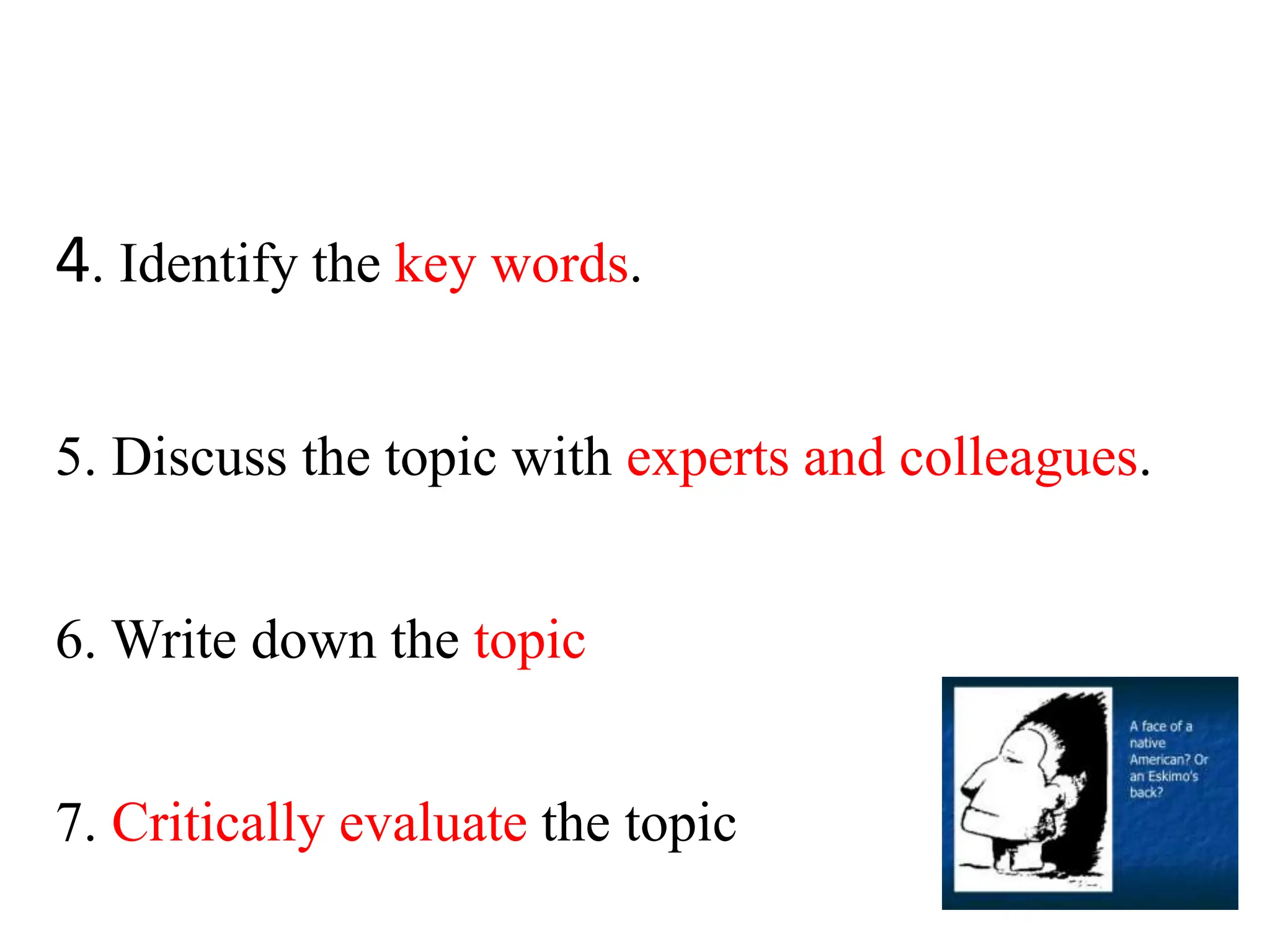
4. Identify the key words.
5. Discuss the topic with experts and colleagues.
6. Write down the topic
7. Critically evaluate the topic
Why, what, who, when and
where of the topic:
• Why did you choose the topic?
• What interests you about it?
• Who are the information providers on this topic?
• Who might publish information about it? Who is
affected by the topic? Do you have institutions or
organizations affiliated with topic?
• What are the major questions for this topic?
• Where is your topic important: individual, at
the community level, local level, national or
international level? Are there specific places
affected by the topic?
• When is/was your topic important? Is it current
event or a historical event?
IN QUANTITY STUDIES HAS SIX
COMPONENTS
1. Relevance of the study
2. Title of the study
3. Operational definition of the variables
4. Objectives of the study
5. Delimitations of the study (the factors, variables not
included in the study Ex. time, size etc)
6. Scope and limitation of the study
CRITERIA FOR SELECTING A GOOD
RESEARCH PROBLEM
• Significance to nursing profession- benefit, purpose,
practical use.
• Original –unique
• Feasible – time, cost,
equipment &supplies, administrative support, peer
support, sample, researchers competence, solvable
,current, interesting.
1.Example for selecting a topic
• Topic: “The environment”. It is very broad.
Different ways to limit the topic are:
• By geographical area: Eg: What
environmental issues are most important in
the north part of Hubli
• By time: What are the most prominent
environmental issues of the last 10 years?
• By discipline: How does environmental
awareness affect health practices?
• By population: What are the effects of
air population on senior citizens?
2.Decubitus ulcer:
• Can care givers involvement prevent bed sore
in immobilized clients?
• Is alcohol rub more effective than soap and
water in preventing bed sore?
• Can frequent change in position prevent bed
sore?
• Who are people more prone for bed sore?
• What are the factors causing bed sore?
3.Hypothermia In Premature Infants:
Can Kangaroo mother care help in maintaining
the temperature of premature infant?
4. Injection pain in infants:
Can breast feeding just before an injection
reduce pain in infants?
These are some of the ways by which we can
find out the research topics.
•Thank-u

1. IDENTIFICATION OF RESEARCH PROBLEUM.ppt

  • 1.
    Identification of Research problem From, Mr.nageshv.a Asst. professor sdmions
  • 2.
    What is research? Itis an organized, systematic, data based, critical, scientific inquiry or investigation in to a specific problem, undertaken with the objectives of finding answers or solutions to it.
  • 3.
    NURSING RESEARCH Nursing researchis “Systematic inquiry designed to develop knowledge about issues of importance to the nursing profession, including nursing practice, education, administration and informatics”. (Polit and Beck )
  • 4.
    Why we needresearch in nursing
  • 5.
    Validation (accuracy ofsomething) as a profession: Build a body of nursing knowledge  Scientific basis for practice: Validate improvements in nursing practice  Make health care efficient as well as cost effective
  • 6.
     Filling gapin knowledge and practice: EBP. Chorlhexdine mouth wash in mucositis  Moulding the technical skills and intellectual competence.  Fostering commitment and accountability to the clients
  • 7.
     Identifying newmeasures in nursing service.  Helping to improve the standards in nursing education  Refining existing theories and discovering new theories.
  • 8.
    what is theimportance of research in nursing?
  • 9.
    SIGNIFICANCE OF RESEARCHIN NURSING: • Develop broad knowledge in their specialization. • Evidence based practice • New technological treatment methods , reduces cost of hospital stay, medication etc.
  • 10.
    (Cont) • Improvement innursing procedures and nursing care. • Participate in nursing research and health care research and conducting research in clinical area (Clinical nursing research). • Research utilization and evidence based practice “Theory into practice”.
  • 11.
  • 12.
    Scope of nursingresearch • Nursing Education • Nursing Practice • Nursing Administration
  • 13.
    NURSING EDUCATION • Improvingnew teaching methods in nursing education • Helps to update knowledge • Evaluate teaching learning activities effectively • Curriculum revision or innovation • Helps to put theory into practice • Identifies issues in teaching learning process and find out solution for that problem.
  • 14.
    NURSING PRACTICE • Ithelps to improve quality of care • It provides innovative and modifies nursing care • Helps to meet the needs of the patients in various care setting - Home care - Palliative(relieving pain) and - Hospice care (terminally ill)
  • 15.
    (Practice cont) • Superspeciality hospital • Community health nursing care setting • School based nursing care • Evidence based practice in treatment and prevention of disease
  • 16.
    NURSING ADMINISTRATION • Developingnew knowledge regarding nursing administrative concepts • It helps to provide current concept of patient care, assignment method, quality care, supervision technique and motivation method • In-service or continuing nursing education programme to discuss current issues and concept of nursing care.
  • 17.
    • It helpsto develop skill in leadership, administration, communication and supervision. • It helps to solve conflicts in health related problems. • It helps to improve human resource management skills in recruitment, selection etc.
  • 18.
  • 19.
  • 20.
    RESEARCH PROBLEM INTRODUCTION  AResearch Problem Is A Question That A Researcher Wants To Answer &Wants To Solve  First Step  Depends On Several Factors I,e Knowledge , Skills, Interest, expertise, motivation, creativity etc
  • 21.
    DEFINITIONS OF RESEARCHPROBLEM • A problem is an interrogative sentence or statement that asks what relation exists between two or more variables. the answer to question will provide what is having sought in the research. -- KERLINGER • A research problem is an area of concern where there is a gap in the knowledge base needed for professional practices.
  • 22.
    Research problem Research problemrefers to some difficulty which a researcher experience in the context of either a theoretical or practical situations and requires a solution to that particular problem.
  • 23.
    IN IDENTIFYING THEPROBLEM RESEARCHER SHOULD ASK “What is the problem?” Example: Bed sore. Question is how can I prevent bed sore? What alternative methods can I use that would be more effective?
  • 24.
    THE RESEARCH PROBLEMSSHOULD BE: • Verifiable Collect observable data and verify statistically. One should also see whether the problem is practical • Is it needed? • Is it important? • Is this study feasible? • Will it add to nursing knowledge and evidence based practice?
  • 25.
    A WELL DEFINEDPROBLEM SHOULD CONTAIN What we are going to study (Variables under study), How we are going to study (methodology), On whom the study will be conducted (Population) Where the study is going to be conducted (Setting).
  • 26.
    Do I needa research question?
  • 27.
    The research questioncan be written either in Interrogative (question form) or in Declarative (statement) form.
  • 28.
    How do Ifind a research problem?
  • 29.
  • 30.
  • 31.
    How can Idecide which question/problem to study?
  • 32.
    • Interest andmotivation • A researchable question • Problem significance • Time availability • Research expertise CONT
  • 33.
    • Ethical consideration •Resources available • Subject availability • Co-operation of others • Applicability of the findings
  • 34.
    CONDITIONS FOR SELECTINGTHE PROBLEM • There must be some individual/ group/organization which face some difficulty or problem in a situation or an environment. • There must be some objectives to be attained.
  • 35.
    • Subject areaswhich are already done or overdone should not be selected • Problem should be clearly stated and defined • The research problem should have utility value, moral value, social value or any one of them. • The suitability of the time period should be considered before defining the problem
  • 36.
    FEW TIPS CHOOSINGA RESEARCH TOPIC
  • 37.
    1. Brainstorm forideas. Choose a topic that you are interested in! 2. Narrow your topic to something manageable. 3. Background reading can help you choose and limit the scope of your topic (review the literature).
  • 38.
    4. Identify thekey words. 5. Discuss the topic with experts and colleagues. 6. Write down the topic 7. Critically evaluate the topic
  • 39.
    Why, what, who,when and where of the topic: • Why did you choose the topic? • What interests you about it? • Who are the information providers on this topic? • Who might publish information about it? Who is affected by the topic? Do you have institutions or organizations affiliated with topic?
  • 40.
    • What arethe major questions for this topic? • Where is your topic important: individual, at the community level, local level, national or international level? Are there specific places affected by the topic? • When is/was your topic important? Is it current event or a historical event?
  • 41.
    IN QUANTITY STUDIESHAS SIX COMPONENTS 1. Relevance of the study 2. Title of the study 3. Operational definition of the variables 4. Objectives of the study 5. Delimitations of the study (the factors, variables not included in the study Ex. time, size etc) 6. Scope and limitation of the study
  • 42.
    CRITERIA FOR SELECTINGA GOOD RESEARCH PROBLEM • Significance to nursing profession- benefit, purpose, practical use. • Original –unique • Feasible – time, cost, equipment &supplies, administrative support, peer support, sample, researchers competence, solvable ,current, interesting.
  • 43.
    1.Example for selectinga topic • Topic: “The environment”. It is very broad. Different ways to limit the topic are: • By geographical area: Eg: What environmental issues are most important in the north part of Hubli • By time: What are the most prominent environmental issues of the last 10 years? • By discipline: How does environmental awareness affect health practices? • By population: What are the effects of air population on senior citizens?
  • 44.
    2.Decubitus ulcer: • Cancare givers involvement prevent bed sore in immobilized clients? • Is alcohol rub more effective than soap and water in preventing bed sore? • Can frequent change in position prevent bed sore? • Who are people more prone for bed sore? • What are the factors causing bed sore?
  • 45.
    3.Hypothermia In PrematureInfants: Can Kangaroo mother care help in maintaining the temperature of premature infant? 4. Injection pain in infants: Can breast feeding just before an injection reduce pain in infants? These are some of the ways by which we can find out the research topics.
  • 47.