MR. JAYESH PATIDAR
www.drjayeshpatidar.blogspot.com
RESEARCH
PROBLEM
INTRODUCTION
A research problem is a question that researcher
wants to answer or a problem that a researcher
wants to solve
Identification & formulation of a research problem is
the first step of the research process.
Selection of research problem depends on several
factors such as researcher’s
knowledge, skills, interest, expertise, motivation &
creativity with respect to the subject of inquiry.
It is believed that most of the good research studies
need lots of time for selection of a research
problem.www.drjayeshpatidar.blogspot.com
DEFINITION
 According to Kerlinger, ‘A problem is an
interrogative sentence or statement that asks what
relation exists between two or more variable. The
answer to question will provide what is having
sought in the research.
 R.S. Woodworth defines problem as ‘a situation for
which we have no ready & successful response by
instinct or by previous acquired habit. We must find
out what to do’, i.e. the solution can be found out
only after an investigation.
 In other words, ‘a research problem is an area of
concern where there is a gap in the knowledge
base needed for professional practices.
www.drjayeshpatidar.blogspot.com
IDENTIFICATION OF RESEARCH
PROBLEM
 Identification of a research problem is the first & most
important step in research process.
 Generally, a broad area is selected & then a broad
topic is delimited or narrowed down to a specific one-
sentence statement of the problem.
 This step of the research process is considered as the
most difficult & challenging, & need slots of time.
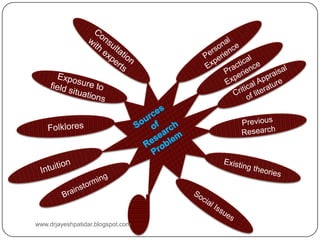
 A research problem may come from several sources:
www.drjayeshpatidar.blogspot.com
Personal Experiences:
Day-to-day personal experience of a research may
serve as good source of ideas to formulate a
research problem.
For example, a researcher observed domestic
violence suffered by wives of alcoholic husbands.
This experience may provide ideas to identity
several research problems related to domestic
violence against women.
There may be so many such life experiences of awww.drjayeshpatidar.blogspot.com
Practical Experiences:
Nurses gets plenty of ideas to formulate research
problems from their clinical experiences.
Every curious nurse has several questions to be
answered which are encountered during clinical
experience.
For example, a nurse finds that unrestricted visiting
hours in surgical wards reduced the analgesic demand
among postoperative patients.
Such clinical experiences could be rich sources of ideas
to identify a significant research problem.
www.drjayeshpatidar.blogspot.com
Critical Appraisal of literature:
When we critically study books & articles relating to the
subject of our interest, including research
report, opinion articles, & summaries of clinical
issues, pertinent questions may arise in our mind.
These may strike reader’s mind indirectly by stimulating
imagination & directly by stating what additional
research is needed.
For example, a nurse reads an article on the prevalence
of the pin site infection among patients with external
fixators; while reading this article nurse learns that there
is lack of consensus about pin site care.
This information may serve as a basis to formulate a
research problem.
www.drjayeshpatidar.blogspot.com
Previous Experience:
A body of knowledge should be developed on a sound
foundation of research findings.
Usually at the end of a research further research
problems are suggested, based on the shortcomings of
previous research, which can be investigated.
In nursing profession, not much research has been yet
done; therefore, this profession needs research who
are willing to replicate or repeat other studies on
different samples & settings where all the essential
elements of the original study are held intact.
www.drjayeshpatidar.blogspot.com
Existing theories:
Research is a process of theory development & theory
testing.
Nurses use many theories from other disciplines in their
practices.
It an existing theory is used in developing a
researchable problem, a specific statement from the
theory must be isolated.
Generally, a part of parts of the theory are subjected to
testing in the clinical situation.www.drjayeshpatidar.blogspot.com
Social issues:
Sometimes, topics are suggested by more global
contemporary social or political issues of relevance to
the health care community.
For example, HIV/AIDS, female foeticide, sexual
harassment, domestic violence, & gender equality in
health care & in research are some of the current
social & political issues of concern for health care
professionals.
www.drjayeshpatidar.blogspot.com
Brainstorming:
Brainstorming sessions are good techniques to find
new questions, where an intensified discussion among
interested people of the profession is conducted to find
more ideas to formulate a good research problem.
For example, ideas for studies may emerge from
reviewing research priorities by having brainstorming
session with other nurses, researchers, or nursing
faculties.
www.drjayeshpatidar.blogspot.com
Intuition:
Traditionally institutions are considered good sources of
knowledge as well as sources to find new research
problems.
It is believed that reflective mind is good sources of
ideas, which may be used to formulate a good research
problem.
www.drjayeshpatidar.blogspot.com
Folklores:
Common beliefs could be right or wrong.
For examples, it is generally believed that studying
just before the test decrease the score.
We believe we should not study just before test to
relax our mind.
Researchers can conduct a research study on
whether one should study before the test or not.
www.drjayeshpatidar.blogspot.com
Exposure to field situations:
During field exposure, researchers get variety of
experiences, which may provide plenty of ideas to
formulate research problems.
For example, while working in field a researcher
observed a specific traditional practice for cure of
disease condition, which can be used as research
problem to investigate its efficacy.
www.drjayeshpatidar.blogspot.com
Consultation with experts:
Experts are believed to have sound experience of
their respective field, which may suggest a
significance problem to be studied.
In addition, expert may help in finding a current
problem of discipline to be solve, which may serve
as basis for formulation of research problem.
www.drjayeshpatidar.blogspot.com
1. Significance to nursing
profession
A problem which a researcher is selecting should
have significance to nursing profession or it will not
serve any purpose.
A research problem is significant for nursing
profession when it is directed to develop or refine the
body of professional knowledge.
www.drjayeshpatidar.blogspot.com
Count…
A research problem could be considered significant for
nursing profession if it fulfils the following criteria:
 Nursing profession & patients, nurses, & health care
fraternity will benefit from the study.
 The results will improve clinical nursing practices.
 Promotes nursing theory development or testing.
 Provides solutions of current nursing practice needs
 Generate information to get practical implications for nursing
profession.
www.drjayeshpatidar.blogspot.com
2. Original
It is fundamentally considered that every research
problem should be new & unique in itself.
Therefore, it is the key responsibility of a researcher
that an innovative knowledge is used for selecting a
research problem, so as to extend the growth of
existing body of knowledge on a profession.
www.drjayeshpatidar.blogspot.com
3. Feasible
Feasibility is an essential consideration of any research
project.
Regardless of how significant or researchable a
problem may be, the feasibility of research problem in
reference to time, availability to subjects, facilities,
equipment & money, & ethical considerations should be
checked.
It will help the researcher to decide whether selected
problem is appropriate or inappropriate & study can bewww.drjayeshpatidar.blogspot.com
Time:
 A nurse might be interested in studying sibling
relationships among quintuplets knowledge of the
incidence of quintuplet birth would certainly
discourage anyone considering research on this
particular population unless the researcher plans to
make this a lifetime project.
 So, time is always a factor to be considered.
 It is wise to allow more time than seems to be
needed because unexpected delays frequently occur.
www.drjayeshpatidar.blogspot.com
Count…
Cost:
 All research projects cost money; some studies are
much more expensive than others.
 The researcher must consider realistically the financial
resources available.
Equipment & supplies:
 All research projects require some type of resources.
 Therefore, before making the final decision to conduct a
study, an accurate determination of the needed
equipment & supplies should be ensured.
 If researcher takes into consideration equipment &
supplies in the early phases of a research project, there
are less chances of the project to be revised or
discarded later because of equipment or supplywww.drjayeshpatidar.blogspot.com
Count…
Administrative support:
 Many research projects require administrative support.
 The nurse researcher may find it very difficult to
conduct research independently.
 Financial as well as psychological support from
administrative is very helpful.
 Knowing that your superiors support your research
efforts can be very powerful motivating force.
www.drjayeshpatidar.blogspot.com
Count…
Peer support:
 Many research ideas have never been developed
because potential researchers received no support
from their peers.
 One of the best ways to determine a researchable
problem is through interactions & discussions with
other nurses.
 A climate of shared interest in nursing research is
essential among the members of the nursing
profession.
www.drjayeshpatidar.blogspot.com
Count…
Availability of subjects:
 A researcher may believe that study subjects are
readily available for the study. But this may not be the
case.
 Potential subjects may not meet the study criteria,
may be unwilling to participate, or may already be
participating in other studies.
Researcher’s competence:
 A research problem can only be feasible if it is in
accordance with researcher’s competence, wherewww.drjayeshpatidar.blogspot.com
Count…
Ethical considerations:
 A researcher must ensure that the research
problem can be considered by the ethical
committee without undue hurdles.
 A very important topic of research cannot be
considered feasible unit & unless it is in
accordance with ethical guideline.
www.drjayeshpatidar.blogspot.com
4. Solvable/researchable:
Problem selected is considered good only if it is
solvable so that chances of insolvability of problem
should be minimized.
It will enhance relevant results.
For example, a researcher selects a research problem
to know the existence of God in this universe.
These sorts of problems are ambiguous & impossible
to solve.
Therefore, the researcher must ensure that a research
www.drjayeshpatidar.blogspot.com
5. Current:
A good research problem must be based on the
current problems & needs of a profession, so that
results generated will be of more use.
Furthermore, more number of the professionals will
be interested in the research conducted on the
current issues of their profession.
www.drjayeshpatidar.blogspot.com
6. Interesting:
A research problem can only be considered good if
it is an accordance with researcher’s field of
interest.
A research problem must be as per the motivation
of the researcher & it should be fascinating to the
researcher, so that research is conducted with full
enthusiasm & not merely for its accomplishment.
www.drjayeshpatidar.blogspot.com
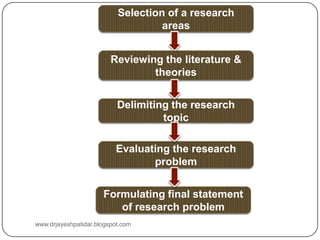
Selection of a research
areas
Formulating final statement
of research problem
Reviewing the literature &
theories
Delimiting the research
topic
Evaluating the research
problem
www.drjayeshpatidar.blogspot.com
Selection of a research area:
Formulate of a research problem begins with selection
of a broad research topic from personal
experience, literature, previous research, & theories in
which researcher is interested & has significance for
nursing profession.
For example, a researcher gets an idea to conduct a
study on the female feticide.
Therefore, he or she initially begins with such broad
research topic.www.drjayeshpatidar.blogspot.com
Reviewing literature & theories:
After getting a broad idea for research, he or she needs
to review the nursing literature & theories.
Literature is reviewed to know what has already been
done in this selected areas of research.
Review of nursing theories provides an opportunity for
nurses researcher to plan a research problem to
contribute towards either testing or development of a
theory/conceptual model.
www.drjayeshpatidar.blogspot.com
Delimiting the research topic:
In this step, researcher proceeds from a general area of
interest to more specific topic of research to conduct a
study.
For example, initially a researcher decide to conduct a
study on female feticide; later in this stage researcher
limits it to specific research topic ‘a study on perception
of women about causes & prevention of female feticide
in selected rural communities of district mehsana,
Gujrat’.www.drjayeshpatidar.blogspot.com
Evaluating the research problem
Once researcher is clear about the specific research
problem, next the research problem must be carefully
evaluated for its significance, researchability, &
feasibility.
Feasibility of the research problem should be
evaluated for time, cost, availability of subjects &
resources, administrative & peer support, ethical
consideration, & researcher’s competence & interest.
www.drjayeshpatidar.blogspot.com
Formulating final statement of research
problem:
After establishing the significance, researchability, &
feasibility, then researcher finally formulates a final
statement of a research problem.
A statement of research problem could be in
declarative or interrogative format
www.drjayeshpatidar.blogspot.com
Count…
a. Declarative format:
In this format, a research problem is
stated in declarative statement.
For example:
 ‘A descriptive study on prevalence of bedsores
among unconscious patients admitted in intensive
care unit of Lions hospital, Mehsana’.
 ‘A exploratory study on contributing factors of
maternal mortality in selected rural communities of
district Mehsana, Gujrat’.
www.drjayeshpatidar.blogspot.com
Count…
b. Interrogative format:
In interrogative format, a research
problem is stated in question form.
For example:
 ‘What is the influence of level of hemoglobin on pin
site infection among patients with external skeletal
fixators admitted in orthopedic wards of Lions
hospital, Mehsana.
 ‘What is the effect of ginger or morning sickness
on pregnant women in selected urban
communities of district Mehsana, Gujrat.
www.drjayeshpatidar.blogspot.com
Count…
The choice of either of these two types of format formulation
of a research problem depends on the researcher’s
preference & institutional policies.
Declarative format much popular among researchers.
For the formulation of a research problem it is preferable it it
fulfils the following features:
 Research problem is clearly, precisely articulated.
 It clearly states the variables, population, & research setting
under study.
 Variable are expressed in measurable terms.
 The type of study also may be included in the statement of
research problem.
www.drjayeshpatidar.blogspot.com
Count…
Example of a well-formulated research problem
“Effectiveness of planned teaching on the knowledge
of staff nurses working in psychiatric unit regarding
Physical Restraints for psychiatric patient in
selected hospital of Vidharbha region”.
It is an example of declarative form
of the statement of problem, where it is precisely &
concisely stated & include most of the required
components of a research statement, which are
 Research study type: Quasi-experiment
 Variable(s): it has two research variable i.e
knowledge & planned teaching
 Population: Nurses working in selected psychiatric
hospital
 Research setting: Psychiatric hospital in
www.drjayeshpatidar.blogspot.com
Thank you
www.drjayeshpatidar.blogspot.com

Researchproblem 130507045232-phpapp01 (2)

  • 1.
  • 2.
    INTRODUCTION A research problemis a question that researcher wants to answer or a problem that a researcher wants to solve Identification & formulation of a research problem is the first step of the research process. Selection of research problem depends on several factors such as researcher’s knowledge, skills, interest, expertise, motivation & creativity with respect to the subject of inquiry. It is believed that most of the good research studies need lots of time for selection of a research problem.www.drjayeshpatidar.blogspot.com
  • 3.
    DEFINITION  According toKerlinger, ‘A problem is an interrogative sentence or statement that asks what relation exists between two or more variable. The answer to question will provide what is having sought in the research.  R.S. Woodworth defines problem as ‘a situation for which we have no ready & successful response by instinct or by previous acquired habit. We must find out what to do’, i.e. the solution can be found out only after an investigation.  In other words, ‘a research problem is an area of concern where there is a gap in the knowledge base needed for professional practices. www.drjayeshpatidar.blogspot.com
  • 4.
    IDENTIFICATION OF RESEARCH PROBLEM Identification of a research problem is the first & most important step in research process.  Generally, a broad area is selected & then a broad topic is delimited or narrowed down to a specific one- sentence statement of the problem.  This step of the research process is considered as the most difficult & challenging, & need slots of time.  A research problem may come from several sources: www.drjayeshpatidar.blogspot.com
  • 5.
  • 6.
    Personal Experiences: Day-to-day personalexperience of a research may serve as good source of ideas to formulate a research problem. For example, a researcher observed domestic violence suffered by wives of alcoholic husbands. This experience may provide ideas to identity several research problems related to domestic violence against women. There may be so many such life experiences of awww.drjayeshpatidar.blogspot.com
  • 7.
    Practical Experiences: Nurses getsplenty of ideas to formulate research problems from their clinical experiences. Every curious nurse has several questions to be answered which are encountered during clinical experience. For example, a nurse finds that unrestricted visiting hours in surgical wards reduced the analgesic demand among postoperative patients. Such clinical experiences could be rich sources of ideas to identify a significant research problem. www.drjayeshpatidar.blogspot.com
  • 8.
    Critical Appraisal ofliterature: When we critically study books & articles relating to the subject of our interest, including research report, opinion articles, & summaries of clinical issues, pertinent questions may arise in our mind. These may strike reader’s mind indirectly by stimulating imagination & directly by stating what additional research is needed. For example, a nurse reads an article on the prevalence of the pin site infection among patients with external fixators; while reading this article nurse learns that there is lack of consensus about pin site care. This information may serve as a basis to formulate a research problem. www.drjayeshpatidar.blogspot.com
  • 9.
    Previous Experience: A bodyof knowledge should be developed on a sound foundation of research findings. Usually at the end of a research further research problems are suggested, based on the shortcomings of previous research, which can be investigated. In nursing profession, not much research has been yet done; therefore, this profession needs research who are willing to replicate or repeat other studies on different samples & settings where all the essential elements of the original study are held intact. www.drjayeshpatidar.blogspot.com
  • 10.
    Existing theories: Research isa process of theory development & theory testing. Nurses use many theories from other disciplines in their practices. It an existing theory is used in developing a researchable problem, a specific statement from the theory must be isolated. Generally, a part of parts of the theory are subjected to testing in the clinical situation.www.drjayeshpatidar.blogspot.com
  • 11.
    Social issues: Sometimes, topicsare suggested by more global contemporary social or political issues of relevance to the health care community. For example, HIV/AIDS, female foeticide, sexual harassment, domestic violence, & gender equality in health care & in research are some of the current social & political issues of concern for health care professionals. www.drjayeshpatidar.blogspot.com
  • 12.
    Brainstorming: Brainstorming sessions aregood techniques to find new questions, where an intensified discussion among interested people of the profession is conducted to find more ideas to formulate a good research problem. For example, ideas for studies may emerge from reviewing research priorities by having brainstorming session with other nurses, researchers, or nursing faculties. www.drjayeshpatidar.blogspot.com
  • 13.
    Intuition: Traditionally institutions areconsidered good sources of knowledge as well as sources to find new research problems. It is believed that reflective mind is good sources of ideas, which may be used to formulate a good research problem. www.drjayeshpatidar.blogspot.com
  • 14.
    Folklores: Common beliefs couldbe right or wrong. For examples, it is generally believed that studying just before the test decrease the score. We believe we should not study just before test to relax our mind. Researchers can conduct a research study on whether one should study before the test or not. www.drjayeshpatidar.blogspot.com
  • 15.
    Exposure to fieldsituations: During field exposure, researchers get variety of experiences, which may provide plenty of ideas to formulate research problems. For example, while working in field a researcher observed a specific traditional practice for cure of disease condition, which can be used as research problem to investigate its efficacy. www.drjayeshpatidar.blogspot.com
  • 16.
    Consultation with experts: Expertsare believed to have sound experience of their respective field, which may suggest a significance problem to be studied. In addition, expert may help in finding a current problem of discipline to be solve, which may serve as basis for formulation of research problem. www.drjayeshpatidar.blogspot.com
  • 17.
  • 18.
    1. Significance tonursing profession A problem which a researcher is selecting should have significance to nursing profession or it will not serve any purpose. A research problem is significant for nursing profession when it is directed to develop or refine the body of professional knowledge. www.drjayeshpatidar.blogspot.com
  • 19.
    Count… A research problemcould be considered significant for nursing profession if it fulfils the following criteria:  Nursing profession & patients, nurses, & health care fraternity will benefit from the study.  The results will improve clinical nursing practices.  Promotes nursing theory development or testing.  Provides solutions of current nursing practice needs  Generate information to get practical implications for nursing profession. www.drjayeshpatidar.blogspot.com
  • 20.
    2. Original It isfundamentally considered that every research problem should be new & unique in itself. Therefore, it is the key responsibility of a researcher that an innovative knowledge is used for selecting a research problem, so as to extend the growth of existing body of knowledge on a profession. www.drjayeshpatidar.blogspot.com
  • 21.
    3. Feasible Feasibility isan essential consideration of any research project. Regardless of how significant or researchable a problem may be, the feasibility of research problem in reference to time, availability to subjects, facilities, equipment & money, & ethical considerations should be checked. It will help the researcher to decide whether selected problem is appropriate or inappropriate & study can bewww.drjayeshpatidar.blogspot.com
  • 22.
    Time:  A nursemight be interested in studying sibling relationships among quintuplets knowledge of the incidence of quintuplet birth would certainly discourage anyone considering research on this particular population unless the researcher plans to make this a lifetime project.  So, time is always a factor to be considered.  It is wise to allow more time than seems to be needed because unexpected delays frequently occur. www.drjayeshpatidar.blogspot.com
  • 23.
    Count… Cost:  All researchprojects cost money; some studies are much more expensive than others.  The researcher must consider realistically the financial resources available. Equipment & supplies:  All research projects require some type of resources.  Therefore, before making the final decision to conduct a study, an accurate determination of the needed equipment & supplies should be ensured.  If researcher takes into consideration equipment & supplies in the early phases of a research project, there are less chances of the project to be revised or discarded later because of equipment or supplywww.drjayeshpatidar.blogspot.com
  • 24.
    Count… Administrative support:  Manyresearch projects require administrative support.  The nurse researcher may find it very difficult to conduct research independently.  Financial as well as psychological support from administrative is very helpful.  Knowing that your superiors support your research efforts can be very powerful motivating force. www.drjayeshpatidar.blogspot.com
  • 25.
    Count… Peer support:  Manyresearch ideas have never been developed because potential researchers received no support from their peers.  One of the best ways to determine a researchable problem is through interactions & discussions with other nurses.  A climate of shared interest in nursing research is essential among the members of the nursing profession. www.drjayeshpatidar.blogspot.com
  • 26.
    Count… Availability of subjects: A researcher may believe that study subjects are readily available for the study. But this may not be the case.  Potential subjects may not meet the study criteria, may be unwilling to participate, or may already be participating in other studies. Researcher’s competence:  A research problem can only be feasible if it is in accordance with researcher’s competence, wherewww.drjayeshpatidar.blogspot.com
  • 27.
    Count… Ethical considerations:  Aresearcher must ensure that the research problem can be considered by the ethical committee without undue hurdles.  A very important topic of research cannot be considered feasible unit & unless it is in accordance with ethical guideline. www.drjayeshpatidar.blogspot.com
  • 28.
    4. Solvable/researchable: Problem selectedis considered good only if it is solvable so that chances of insolvability of problem should be minimized. It will enhance relevant results. For example, a researcher selects a research problem to know the existence of God in this universe. These sorts of problems are ambiguous & impossible to solve. Therefore, the researcher must ensure that a research www.drjayeshpatidar.blogspot.com
  • 29.
    5. Current: A goodresearch problem must be based on the current problems & needs of a profession, so that results generated will be of more use. Furthermore, more number of the professionals will be interested in the research conducted on the current issues of their profession. www.drjayeshpatidar.blogspot.com
  • 30.
    6. Interesting: A researchproblem can only be considered good if it is an accordance with researcher’s field of interest. A research problem must be as per the motivation of the researcher & it should be fascinating to the researcher, so that research is conducted with full enthusiasm & not merely for its accomplishment. www.drjayeshpatidar.blogspot.com
  • 31.
  • 32.
    Selection of aresearch areas Formulating final statement of research problem Reviewing the literature & theories Delimiting the research topic Evaluating the research problem www.drjayeshpatidar.blogspot.com
  • 33.
    Selection of aresearch area: Formulate of a research problem begins with selection of a broad research topic from personal experience, literature, previous research, & theories in which researcher is interested & has significance for nursing profession. For example, a researcher gets an idea to conduct a study on the female feticide. Therefore, he or she initially begins with such broad research topic.www.drjayeshpatidar.blogspot.com
  • 34.
    Reviewing literature &theories: After getting a broad idea for research, he or she needs to review the nursing literature & theories. Literature is reviewed to know what has already been done in this selected areas of research. Review of nursing theories provides an opportunity for nurses researcher to plan a research problem to contribute towards either testing or development of a theory/conceptual model. www.drjayeshpatidar.blogspot.com
  • 35.
    Delimiting the researchtopic: In this step, researcher proceeds from a general area of interest to more specific topic of research to conduct a study. For example, initially a researcher decide to conduct a study on female feticide; later in this stage researcher limits it to specific research topic ‘a study on perception of women about causes & prevention of female feticide in selected rural communities of district mehsana, Gujrat’.www.drjayeshpatidar.blogspot.com
  • 36.
    Evaluating the researchproblem Once researcher is clear about the specific research problem, next the research problem must be carefully evaluated for its significance, researchability, & feasibility. Feasibility of the research problem should be evaluated for time, cost, availability of subjects & resources, administrative & peer support, ethical consideration, & researcher’s competence & interest. www.drjayeshpatidar.blogspot.com
  • 37.
    Formulating final statementof research problem: After establishing the significance, researchability, & feasibility, then researcher finally formulates a final statement of a research problem. A statement of research problem could be in declarative or interrogative format www.drjayeshpatidar.blogspot.com
  • 38.
    Count… a. Declarative format: Inthis format, a research problem is stated in declarative statement. For example:  ‘A descriptive study on prevalence of bedsores among unconscious patients admitted in intensive care unit of Lions hospital, Mehsana’.  ‘A exploratory study on contributing factors of maternal mortality in selected rural communities of district Mehsana, Gujrat’. www.drjayeshpatidar.blogspot.com
  • 39.
    Count… b. Interrogative format: Ininterrogative format, a research problem is stated in question form. For example:  ‘What is the influence of level of hemoglobin on pin site infection among patients with external skeletal fixators admitted in orthopedic wards of Lions hospital, Mehsana.  ‘What is the effect of ginger or morning sickness on pregnant women in selected urban communities of district Mehsana, Gujrat. www.drjayeshpatidar.blogspot.com
  • 40.
    Count… The choice ofeither of these two types of format formulation of a research problem depends on the researcher’s preference & institutional policies. Declarative format much popular among researchers. For the formulation of a research problem it is preferable it it fulfils the following features:  Research problem is clearly, precisely articulated.  It clearly states the variables, population, & research setting under study.  Variable are expressed in measurable terms.  The type of study also may be included in the statement of research problem. www.drjayeshpatidar.blogspot.com
  • 41.
    Count… Example of awell-formulated research problem “Effectiveness of planned teaching on the knowledge of staff nurses working in psychiatric unit regarding Physical Restraints for psychiatric patient in selected hospital of Vidharbha region”. It is an example of declarative form of the statement of problem, where it is precisely & concisely stated & include most of the required components of a research statement, which are  Research study type: Quasi-experiment  Variable(s): it has two research variable i.e knowledge & planned teaching  Population: Nurses working in selected psychiatric hospital  Research setting: Psychiatric hospital in www.drjayeshpatidar.blogspot.com
  • 42.