RESEARCH ETHICS
&
ACADEMIC HONESTY
Dr Mayank Trivedi
University Librarian & Senate Member
The Maharaja Sayajirao University of Baroda
Date : 10th August, 2020
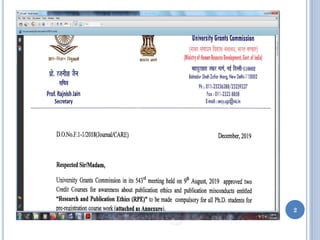
2
TERMINOLOGIES
 Research integrity
 Research misconduct
 Fabrication
 Plagiarism
 Whistle-blowing
 Serious deviation
 Unacceptable research practice
 Falsification
 Committee on Publication Ethics (COPE)
3
4
OUT LINE
 Ethics and success
 Common reasons for unethical behavior
 Concepts of ethics
 Meaning of ethics
 Good research and ethical research
 Ethical theories
 The Nuremberg code of ethics
 Student’s participation in research
 Employees participation in research
 Data collection
 Data presentation
 Authorship
 The process of obtaining funding
 References
WHAT ARE ETHICS?
The connection between ethics, law and
public policy originates from Plato’s
‘Norms’ (Nomoi)
In this treatise he stresses the
importance of
of introductions (proimia)
which are deemed essential to make
laws and regulations understandable
and acceptable to the citizen.
5
ETHOS
 According to Aristotle morality =
ethos provides humans with the basis for
political and legal practice.
 Modern day ethics may have arisen out of human
need to survive within the framework of a
functional society.
 Depend on continuous reflection and re-
assessment of constantly evolving customs,
traditions and manners.
6
RESEARCH ETHICS
“Greek ethos ‘character’ is the
systematic study of value concepts—
good, bad, right, wrong and the
general principles that justify
applying these concepts”.
Joan E. Sieber
Planning Ethically Responsible Research, p. 3
7
RESEARCH ETHICS
“Ethics is the disciplined study or
morality….and morality asks the
question…what should one’s
behavior be”
Basically, there are two types of ethics,
Descriptive Ethics
Which asks what does the culture or society believe is morally correct?
The other type or Prescriptive Ethics asks:
 How should I behave as a researcher?
 What character traits should I cultivate?
Jeff Cooper
Albany Medical Center, Ethical Decision Making, 2001, p. 1
8
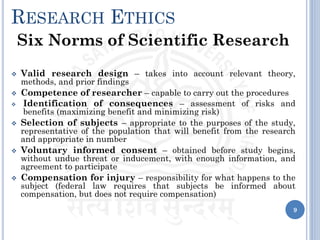
RESEARCH ETHICS
Six Norms of Scientific Research
❖ Valid research design – takes into account relevant theory,
methods, and prior findings
❖ Competence of researcher – capable to carry out the procedures
❖ Identification of consequences – assessment of risks and
benefits (maximizing benefit and minimizing risk)
❖ Selection of subjects – appropriate to the purposes of the study,
representative of the population that will benefit from the research
and appropriate in number
❖ Voluntary informed consent – obtained before study begins,
without undue threat or inducement, with enough information, and
agreement to participate
❖ Compensation for injury – responsibility for what happens to the
subject (federal law requires that subjects be informed about
compensation, but does not require compensation)
9
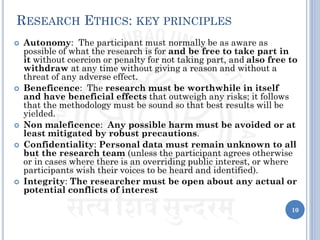
RESEARCH ETHICS: KEY PRINCIPLES
 Autonomy: The participant must normally be as aware as
possible of what the research is for and be free to take part in
it without coercion or penalty for not taking part, and also free to
withdraw at any time without giving a reason and without a
threat of any adverse effect.
 Beneficence: The research must be worthwhile in itself
and have beneficial effects that outweigh any risks; it follows
that the methodology must be sound so that best results will be
yielded.
 Non maleficence: Any possible harm must be avoided or at
least mitigated by robust precautions.
 Confidentiality: Personal data must remain unknown to all
but the research team (unless the participant agrees otherwise
or in cases where there is an overriding public interest, or where
participants wish their voices to be heard and identified).
 Integrity: The researcher must be open about any actual or
potential conflicts of interest
10
11
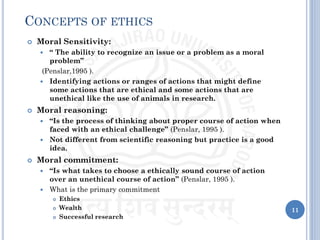
CONCEPTS OF ETHICS
 Moral Sensitivity:
 “ The ability to recognize an issue or a problem as a moral
problem”
(Penslar,1995 ).
 Identifying actions or ranges of actions that might define
some actions that are ethical and some actions that are
unethical like the use of animals in research.
 Moral reasoning:
 “Is the process of thinking about proper course of action when
faced with an ethical challenge” (Penslar, 1995 ).
 Not different from scientific reasoning but practice is a good
idea.
 Moral commitment:
 “Is what takes to choose a ethically sound course of action
over an unethical course of action” (Penslar, 1995 ).
 What is the primary commitment
 Ethics
 Wealth
 Successful research
12
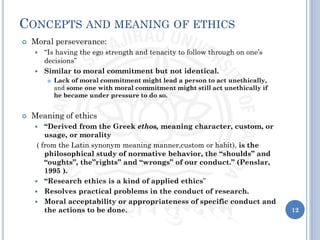
CONCEPTS AND MEANING OF ETHICS
 Moral perseverance:
 “Is having the ego strength and tenacity to follow through on one’s
decisions”
 Similar to moral commitment but not identical.
 Lack of moral commitment might lead a person to act unethically,
and some one with moral commitment might still act unethically if
he became under pressure to do so.
 Meaning of ethics
 “Derived from the Greek ethos, meaning character, custom, or
usage, or morality
( from the Latin synonym meaning manner,custom or habit), is the
philosophical study of normative behavior, the “shoulds” and
“oughts”, the”rights” and “wrongs” of our conduct.” (Penslar,
1995 ).
 “Research ethics is a kind of applied ethics”
 Resolves practical problems in the conduct of research.
 Moral acceptability or appropriateness of specific conduct and
the actions to be done.
RESEARCH MISCONDUCT
► What is it?:
 Fabrication, falsification, or plagiarism in proposing,
performing, or reviewing research results.
► Fabrication: making up results and recording or reporting them
► Falsification: manipulation of research materials, equipment, or
processes, or changing or omitting results such that the research is not
accurately represented in the record.
► Plagiarism: the appropriation of another’s ideas, processes, results, or
words without giving proper credit.
13
CRITERIA FOR RESEARCH MISCONDUCT
▪ Represents a significant departure from
accepted practices
▪ Has been committed intentionally, or
knowingly, or recklessly; and
▪ Can be proven by a preponderance of evidence
▪ What is NOT MISCONDUCT: honest,
unintentional error
14
TOP TEN “POOR” BEHAVIORS
1. Falsifying or ‘cooking’ research data
2. Ignoring major aspects of human-subject requirements
3. Not properly disclosing involvement in firms whose
products are based on one‘s own research
4. Relationships with students, research subjects or
clients that may be interpreted as questionable
5. Using another’s ideas without obtaining
permission or giving due credit (plagiarism)
6. Unauthorized use of confidential information in
connection with one’s own research
7. Failing to present data that contradict one’s own
previous research ????
8. Circumventing certain minor aspects of human-
subject requirements 15
TOP TEN BEHAVIORS
(CONTINUED)
9. Overlooking others' use of flawed data or questionable
interpretation of data
10. Changing the design, methodology or results of a study
in response to pressure from a funding source (falsification)
Other behaviors
11. Publishing the same data or results in two or more
publications
12. Inappropriately assigning authorship credit
13. Withholding details of methodology or results in papers
or proposals
14. Using inadequate or inappropriate research designs
15. Dropping observations or data points from analyses
based on a gut feeling that they were inaccurate
16. Inadequate record keeping related to research projects
16
HOW IS MISCONDUCT IDENTIFIED
► Suspected and reported by a colleague
► Failure to confirm research results
by own lab or others
17
CONSEQUENCES (IF MISCONDUCT IS
SUBSTANTIATED)
► Withdrawal or correction of all pending and
published papers and abstracts affected by the
misconduct
► Reprimand, removal from project, rank and salary
reduction, dismissal
► Restitution of funds to the granting agency
► Ineligibility to apply for Federal grants for years
► Undermine Public Trust
► Misuse of Public funds
► Harms to the health and well-being of research
participants
► Adoption of erroneous policies
► Release of unsafe products
► Tarnishing the reputation of research institutions,
research groups or individual researchers
► I.E. the end of your research career!
18
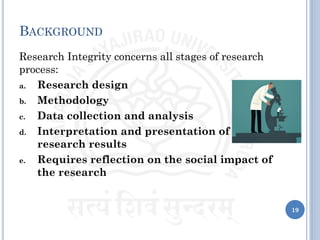
BACKGROUND
Research Integrity concerns all stages of research
process:
a. Research design
b. Methodology
c. Data collection and analysis
d. Interpretation and presentation of
research results
e. Requires reflection on the social impact of
the research
19
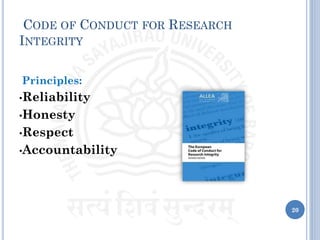
CODE OF CONDUCT FOR RESEARCH
INTEGRITY
•Reliability
•Honesty
•Respect
•Accountability
20
Principles:
SCIENTIFIC PAPER
 A scientific paper is a written and published report
describing original research results.
 An accepted original scientific publication containing
scientific information
 A scientific experiment is not complete until the
results have been published and understood
 A scientific paper is a paper organized to meet
the needs of valid publication.
 The well-written scientific paper should report
its original data in an organized fashion and in
appropriate language....
21
ORIGINALITY
 Not republishing the same findings(except under
special circumstances, with the original source
cited)
 Not submitting the same manuscript to two or more
journals at once
 Not dividing one research project into many little
papers (“salami science”- Salami science is
reporting the results of a single study in 2 or more
manuscripts)
22
ORIGINS OF SCIENTIFIC WRITING
 Knowledge is lost without written records
 Knowledge could not be widely circulated with
no effective duplication
 Knowledge is awareness or understanding of
someone or something, such as facts,
information, descriptions, or skills, which is
acquired through experience or education by
perceiving, discovering, or learning.
23
KNOWLEDGE IS LOST
WITHOUT WRITTEN RECORDS
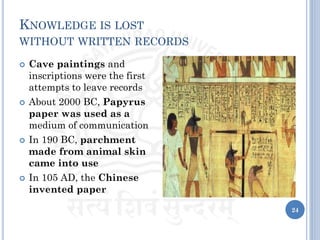
 Cave paintings and
inscriptions were the first
attempts to leave records
 About 2000 BC, Papyrus
paper was used as a
medium of communication
 In 190 BC, parchment
made from animal skin
came into use
 In 105 AD, the Chinese
invented paper
24
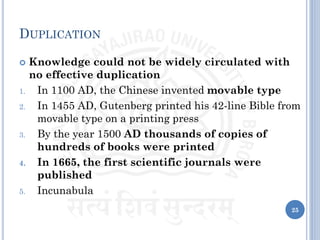
DUPLICATION
 Knowledge could not be widely circulated with
no effective duplication
1. In 1100 AD, the Chinese invented movable type
2. In 1455 AD, Gutenberg printed his 42-line Bible from
movable type on a printing press
3. By the year 1500 AD thousands of copies of
hundreds of books were printed
4. In 1665, the first scientific journals were
published
5. Incunabula
25
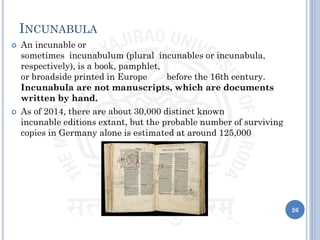
INCUNABULA
 An incunable or
sometimes incunabulum (plural incunables or incunabula,
respectively), is a book, pamphlet,
or broadside printed in Europe before the 16th century.
Incunabula are not manuscripts, which are documents
written by hand.
 As of 2014, there are about 30,000 distinct known
incunable editions extant, but the probable number of surviving
copies in Germany alone is estimated at around 125,000
26
SCIENTIFIC PAPER FORMAT
 A scientific paper is a
written report
describing original
research results whose
format has been
defined by centuries
of developing
tradition, editorial
practice, scientific
ethics and the
interplay with
printing and digital
publishing services.
 Editorial practice
 Scientific Ethics
 Printing/Publishing
Procedures
 The result of this
process is that virtually
every scientific paper
has a title, abstract,
introduction,
materials and
methods, results and
discussion – the so-
called IMRD
structure.
27
RESEARCH PAPER: THE IMRAD FORMAT
 Most scientific papers are prepared according to a
format called IMRAD.
 The term represents the first letters of the words
Introduction, Materials and Methods,
Results, And, Discussion.
 An important point to keep in mind is that there
is no standard or uniform style that is
followed by all journals.
 Each journal has its own style; but they all
have their own Instructions to Authors .
 Once you select a journal to which you wish
to submit your manuscript
 Please follow the Journal’s “INSTRUCTIONS
TO AUTHORS” 28
ORGANIZATION OF A RESEARCH PAPER:
THE IMRAD FORMAT
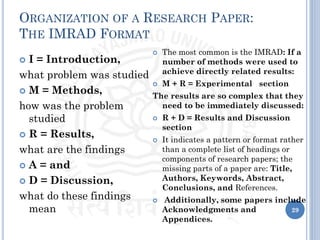
 I = Introduction,
what problem was studied
 M = Methods,
how was the problem
studied
 R = Results,
what are the findings
 A = and
 D = Discussion,
what do these findings
mean
 The most common is the IMRAD: If a
number of methods were used to
achieve directly related results:
 M + R = Experimental section
The results are so complex that they
need to be immediately discussed:
 R + D = Results and Discussion
section
 It indicates a pattern or format rather
than a complete list of headings or
components of research papers; the
missing parts of a paper are: Title,
Authors, Keywords, Abstract,
Conclusions, and References.
 Additionally, some papers include
Acknowledgments and
Appendices.
29
HOW TO PREPARE THE TITLE
 Make a list of the most important keywords
 Think of a title that contains these words
 The title could state the conclusion of the paper
 The title NEVER contains abbreviations,
chemical formulas, proprietary names or jargon
 Think, rethink of the title before submitting the
paper
 Be very careful of the grammatical errors due to
faulty word order
 Avoid the use of the word “using”
30
RESEARCH INTEGRITY
Includes :
 The use of honest and verifiable methods in
proposing, performing, and evaluating
research
 Reporting research results with particular
attention to adherence to rules, regulations,
guidelines, and following commonly
accepted professional codes or norms
(Ethics).
31
MANUSCRIPT SUBMISSION
 Electronic submission of papers for publication: the
days of a complicated, hard-copy paper trail are
gone ... good riddance!
 After deciding on the appropriate journal for
publication of your paper, carefully READ the
“Instructions to Authors” for that particular
journal.
 Pay attention to formatting requirements,
manuscript structure, literature citation style,
and allowable file types for figures,
illustrations, and tables.
 Ignoring the specific requirements for manuscript
formatting and organizational style can result
in your paper being returned for correction or put
reviewers and editors in a bad mood even before they
judge the quality of the science – not a good move!
32
WHAT CAN HAPPEN WHEN RESEARCH
LACKS INTEGRITY?
 Debarment from receipt of agency funding
 Supervision & certification of future research
 Stop research
 Termination
 Cancel the degree
 Formal reprimand and apology
 Ethical training
 Withholding pay
 Loss of Jobs
 High Crimes
 Research Misconduct
 Plagiarism
 Fabrication of data
 Falsification of data
 More egregious acts, such as a doctoral candidate fabricating significant amounts of
data in the dissertation, might result in rescission of a degree or termination.
 Obviously, it is the high crimes of research, or the acts of research misconduct,
that tend to reach the media and threaten public trust in research.
33
GOOD PUBLICATION PRACTICES
 Avoid misrepresentation in publications
 Publish accurate, complete, clear, and unbiased work
 Avoid fragmentary publication
 Publish manuscripts that represent substantial
findings
 Avoid duplicate manuscript submission & publication
 Publish research that will add new contributions to
the field
 Acknowledge prior publications
 A suitable footnote might read: “This article is based on a
study first reported in the [title of journal, with full
reference].”’ – ICJME guidelines
34
 Ignorance
 Why some professors don’t teach ethics??
 The are not qualified
 By the time students go to college their character is already
shaped
 High expectations:
 We teach Mathematics but don’t’ expect students to be
Mathematicians.
 We teach ethics to inform and not to make students ethicists
 Examples
 Students don’t understand how to site references properly and that leads
them to plagiarize.
 Teachers don’t pass on standards and rules.
 Running an experiment and using 96% of results. What do we do with
the remaining 4%
 How much work must be quoted without citation to plagiarize?
 Forgot to include a source or simply negligence. 35
WHAT MIGHT LEAD TO UNETHICAL BEHAVIOR ?
36
IGNORANCE LEADING TO UNETHICAL BEHAVIOR
 Policies and standards of the school or the
institution should be taught to the students.
 Make sure that policies and standards are
followed properly
 Before it used to be monitoring, but now it is not
enough since labs are growing and more money and
dead lines are involved.
 Telling students where to go with ethical
concerns and which dean to talk to if he needs that.
 I must get this grant
 I need to get published
 I must meet this deadline
 Getting some thing done might seem more important than
how to get it done.
 Stress can not be removed but we can teach people how to deal
with it.
 Stress on teaching the virtue of science to pursuit knowledge
 Talk about the outcome of forging data and future consequences
 Patience and immediate result problem
 Teach students to talk to teachers:
 Protest the load of work
 Design the experiment is not working and that is leading to this data.
Change the design.
 Ask for help when they need it and help them when they ask.
 When things are not clear any more, step back and think objectively.
 Reduce the load of work
 Always think that there is an acceptable and ethical outcome
 Teach students to think under stress. 37
STRESS
 What to do when you see some one behaving unethically?
 Relationship with that person will change the way you deal with the
situation
 A fellow faculty or a competitor.
 Students make mistakes, you need to tell them that it is wrong to do it
that way and direct them to the right way.
 Witnessing misconduct
 Make sure that there is abuse by documenting misconduct and try to get
witnesses and facts.
 Prepare a solid foundation.
 Approaching the situation the right way
 Can you explain those anomalies to me? OR How long have you been
forging data?
 If the person denies misconduct you need to go to higher level.
 Students must be taught to:
 Blow the whistle and report misconduct
 Which dean to talk to?
 What are the policies and regulations?
 What is an approved procedure to report misconduct? 38
WHO WILL BLOW THE WHISTLE?
 Drawing the line between good research and ethical research is
not always clear.
 “Good research is concerned with the integrity and the soundness of
data, where as research ethics is concerned with the means the data was
collected”
 Research ethics is concerned with the well being of others( Society,
other people, animals) while standards concerning research does not
necessarily do that.
 Issues in research ethics:
 Conduct of individuals
 Research fraud
 Mistreatment of lab animals
 Accuracy and honesty in reporting results
 Plagiarism
 Violation of intellectual property rights
 Conflict of interests ( researchers among each other or researchers and
universities)
 Principle of the contribution to science as a whole.
 Check if a research is harmful to the society or to individuals.
 How universities should resolve their conflicts among them selves.
39
GOOD RESEARCH AND ETHICAL RESEARCH
 Helpful resources:
 Professional codes
 Statement of moral norms by members of a profession
 American Psychological association
 American Historical association
 Government regulations
 More like laws
 Use of humans as subjects of experiments
 Religion
 Cultural customs
 Ethical theories:
 Consequential ethics
 Deontological ethics
 Casuistical ethics
 Virtue ethics
40
ETHICAL RESEARCH
 The expression “basic ethical principles” refers to those general
judgments that serve as a basic justification for the many
particular ethical prescriptions and evaluations of human
actions.
 Respect for persons:
 The person should be treated as autonomous.
 The person with diminished autonomy is entitled to protection.
 Who is an autonomous person:
 Can think and discuss his personal goals and act under those goals.
 Protect hose who cannot make their own self determination or they are
not eligible for doing so.
 Beneficence:
 Not only respect their decisions and protect them from harm but also
make an effort to secure their well being.
 Think of this as an obligation and not a charity.
 Do not harm , and maximize possible benefits and minimize possible
harms.
 Justice:
 The right to be treated equally.
 Some one is denied benefits for no obvious reason.
 The principle of fairness in distribution.
41
BASIC ETHICAL PRINCIPLES
 The question of whether and in what way students are allowed to
participate in research.
 Student participation can be included as a course component for
course credit
( Commonly included in psychology departments).
 Students agreement to participate in the research might not be
freely given because of a belief that doing so will put them in good
favor with faculty(grades, recommendations , employment).
 However
 Prohibiting students from participating in research will be an over
protective behavior.
 A good approach is that faculty-investigators advertise for subjects
generally, rather than recruit students individually.
 Students participating in research for credits should be given
the fair alternative of either special projects, brief reports, or
brief quizzes for extra readings .
 The papers and the quizzes are no to be graded.
 Confidentiality
 Mental health ,sexual behavior, use of drugs…
42
STUDENT’S PARTICIPATION IN RESEARCH
 Similar to the student situation
 Influence of power.
 Absence of free will because of concerns
about grades (students) , job
advancements( employees).
 Confidentiality .
 Employees of biomedical companies are ideal
subjects for they understand the importance
of their participation
 Case study on the use of alcohol and the
aggressive behavior
43
EMPLOYEE’S PARTICIPATION IN RESEARCH
 Data collection is a crucial factor in reaching a conclusion in an experiment.
 The importance of the tools or artifacts used.
 Identifying the relevant variables and noting the significance of each variable to reach the
experimental outcome.
 Collect data with as much precision as possible.
 The more and various are the steps, the more time and attention is required by the people conducting the
experiment.
 Learning period might yield unreliable data.
 Training and resources.
 What to do with the data collected during the learning period?
 Pressure to produce data within a specific time period to support a hypothesis.
 Overlooking some variables, or sloppiness
 Data selection, analysis and interpretation
 Moving from a set of scientific data to a conclusion.
 Deciding on which data points can be removed and which are critical points of the
experiment results.
 Considering each data point might lead to a question that is of more importance than the
original question.
 Smoking and lung cancer???
 Some people smoke and don’t get lung cancer.
 Data analysis might be influenced by:
 Expectations
 Desires
 Investment of time , effort, and ego.
 Publication pressure.
44
DATA COLLECTION
 Oral presentation
 A scientist is invited to talk about his/her research and may present
some data that has not been published yet. The scientist is looking for
critical feed back and important input.
 By sharing the results an early stage, someone else might carry out
the work and obtain credit for it.
 Restrict the audience to people that you have previous personal
trust for.
 When the research is at a stage to be presented to the outside world, there
are some ethical issues:
 The degree to which one should be open as far as sharing data, experiment
details…etc
 Appropriately credit those who participated.
 Adequately present the results.
 A good way is to include the names of the people that contributed in the
research in the presentation slides.
 Data to present
 Which to present and which to hide ?
 Clear and accurate presentation of the findings.
 The data should be presented in a way that enables them in principle to be
reproduced by another experimenter
45
DATA PRESENTATION
 Searching and identifying the uncontrolled variables that cause variation in
the experiment outcome.
 Peer reviewed does not guarantee that the assumptions are true.
 “The process of attempting to identify critical controls and analytical pitfalls is carried
out in a more formal and considered manner than it usually possible for oral
presentation.
 “A second function of the peer reviewed is to decide on the level of significance of the
findings in the manuscript in relation to the mission of the journal itself.”
 Concerns on the side of the scientist
 If the data and their interpretation are to pass the check from the reviewers prospective
of scientific accuracy and experimental design.
 The content is of sufficient to fit the profile of the journal to which it was
submitted.
 If a reviewers do not accurately understand the aspects of the paper. A
second, third or even a fourth reviewer is introduced.
 Conflict of interest.
 Do you feel comfortable reviewing paper X by author Y?
 Author may choose one or two people that they want to be the reviewers.
 Reviewer taking advantage by delaying a publication to get his paper
published first.
 Written presentation
 Oral presentation does not have the same approval as a peer reviewed
publication.
 Peer reviewed does not make the findings true.
 The underlying assumptions that go into the analysis of the data are shared by the
authors and the reviewers.
46
DATA PRESENTATION
 Post-publication ethical concerns
 Make some agents or results described in the paper available to the
scientific community.
 May be overwhelming for a small lab to respond to a large number of
requests.
 A possible solution might be the creation of a small repository with cost
constraints that supply the issues of interest to the scientific community.
 What about taking the results and working on the next stage that is
already being worked on in a small lab and beating them into the final result?
 Some researchers prefer to explore a problem in depth before any
publication or release of data ,but what about competition?
 What if there is contradictions in the findings and the original study?
 A publication to describe the differences between the current findings and
the original ones is most appropriate.
 An instrument might have caused the error.
 Presentation of scientific data and findings to society
 Presents serious ethical issues to the scientist.
 The pace of publication relative to clear social concern.
 “The findings are of importance to both the public and the
makers“.
 “ To carry out the study to the point where the highest degree of
accuracy have been achieved must be considered”
 Present the data in a way that presents the strengths and the
weaknesses of the study.
47
DATA PRESENTATION
 Primary way for the researchers to communicate their ideas.
 Credit for one’s effort and contributions is allocated.
 A measure for the level of contribution to the scientific community.
 Intentional plagiarism is stealing.
 Assigning the responsibility of one’s findings, and the accuracy of the data
presented.
 More than one author , how will the responsibility and the contribution be
distributed ?
 “Authors are those who made a significant scientific contribution to the original,
new information that is the core of the paper”
 Should technicians, secretaries, programmers be considered authors ? Why ?
Or why not?
 Authorship is contribution and responsibility to the final product.
 Must be able to take public responsibility for the contents of the paper
 Why and how observations were made, and how conclusions follow from the data.
 Quantity and quality of publication
 Small bits of related data points.
 Same idea but different words.
 Credit
 Who should be the author and in what order should the authors be
listed?
 Concept or problem definition , experimentation or observation, and
calculations; and writing.
 Experimental design, data collection, data analysis, and
interpretation. 48
AUTHORSHIP
 Research costs money:
 Salaries , equipment, physical space, other services
 Fund sources
 Government, private non profit organizations, donations
from private individuals, funds from private industry
 Research grant and research contract
 Research grant proposal: “ Justification of the significance
of the question that the scientist proposes to test, the
description of the research strategies and techniques that
will be used to test the hypothesis, and the description of
the methods of data analysis that will be used”
49
FUNDING
 “ One key distinction between research grant and research contract is
responsibility of hypothesis generation.
 ” In the case of the research contract, the hypothesis to be
tested, as well as the line of the investigation to be perused in
terms of method, and strategy, is explicitly laid out by the
organization providing the funding.”
 Ethical issues:
 Same as peer reviewed articles
 Some of the reviewers might be working on the same topic or issue.
 Some research areas are preferred over others ( example AIDS related
research).
 “A scientist might be faced with an ethical dilemma of being
committed to the type of research being conducted but
disagrees to the motivation behind the research.”
 The use of research on marine mammals by the US Navy to be used
for military purposes.
 The is no set of rules to insure fairness since the assessment of
scientific merit is somewhat subjective, and relevance to program
goals of the funding entity.
50
FUNDING
ACADEMIC HONESTY
o Set of values and skills that promote personal integrity
and good practice in teaching, learning, and assessment
o Researchers are expected to comply with all internal
school deadlines: this is for their own benefit and may allow
time for revising work that is of doubtful authorship before the
submission of the final version
o Researchers are expected to review their own work
before submission to identify any passages, data, graphs,
photographs, computer programs, and so on that still require
acknowledgement
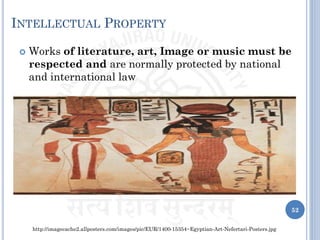
INTELLECTUAL PROPERTY
 Works of literature, art, Image or music must be
respected and are normally protected by national
and international law
http://imagecache2.allposters.com/images/pic/EUR/1400-15354~Egyptian-Art-Nefertari-Posters.jpg
52
AUTHENTICITY
 An authentic piece of work is one that is based on
original ideas with the ideas and work of others
fully acknowledged
 ALL assignments MUST wholly and authentically
use a candidate’s own language and expression
 Where sources are used or referred to, whether in
the form of direct quotation or paraphrase, such
sources must be fully and appropriately
acknowledged
53
MALPRACTICE
 Behaviour that results in, or may result
in, the candidate or any other candidate
gaining an unfair advantage in one or
more assessment component
 Plagiarism
 Collusion
 Duplication of work
 Any other behaviour that gains an unfair
advantage for a candidate or that affects
the results of another candidate
54
PLAGIARISM
 The representation of the ideas or work of
another person as the candidate’s own
 When using the words of another person, use
quotation marks
 The source of the quotation (or paraphrased
text) must be clearly identified along with the
quotation and not reside in the bibliography
alone
55
COLLUSION
 Collusion is a secret cooperation or deceitful
agreement in order to deceive others
 Supporting malpractice by another candidate, as
in allowing one’s work to be copied or
submitted for assessment by another
56
DUPLICATION OF WORK
 The presentation of the same work for different
assessment components and/or diploma
requirements
 For example, if a candidate submits the same or a very
similar piece of work for the in-depth study in history
internal assessment and for an extended essay in history,
this would be viewed as malpractice
 Presentation of scientific data and findings to society
 Presents serious ethical issues to the scientist.
 The pace of publication relative to clear social concern.
 “The findings are of importance to both the public and
the makers“
 “ To carry out the study to the point where the highest
degree of accuracy have been achieved must be
considered”
 Present the data in a way that presents the strengths and
the weaknesses of the study. 57
COLLABORATION
 The final work must be produced independently, despite
the fact that it may be based on similar data
 A piece of work must be written in each candidate’s
own words
 For example, if two or more candidates have exactly
the same introduction to an assignment, the final
award committee will construe this as collusion
58
OTHER FORMS OF MALPRACTICE
 Taking unauthorized material into an examination room
 Misconduct during an examination, including any
attempt to disrupt the examination or distract another
candidate
 Exchanging, or in any way supporting, or attempting to
support, the passing on of information that is related to the
examination
 Copying the work of another candidate
 Failing to comply with the instructions of the
invigilator or other member of the school’s staff responsible
for the conduct of the examination
 Impersonating another candidate
 Stealing examination papers
 Disclosing or discussing the content of an
examination paper with a person outside the immediate
school community within 24 hours of the end of the
examination
 Fabricating data for an assignment 59
SCIENCE: Vol 435|9, p.737 June
2005 COMMENTARY
Scientists behaving badly
“To protect the integrity of science, we must look beyond
falsification, fabrication and plagiarism, to a wider
range of questionable research practices”
Brian C. Martinson, Melissa S. Anderson and
Raymond de Vries.
► Research integrity is essential to ensure the
reliability of research results and to preserve
public support for research
60
BE CAREFUL!
If in doubt, always ask
questions…..…
61
INFORMATION SOURCES
 DHHS 42 CFR Parts 50 and 93; Federal Register/Vol 70, No. 94, 2005.
 “Fraud and the Role of Intensions” On Being A Scientist, Committee on the Conduct of Science, National
Academy of Sciences. National Academy Press, Washington, D.C., 1989, page 15, ISBN 0-309-04091-4
 Martinson, B., Anderson, M.,& de Vries, R., “Scientists behaving badly”. Journal of Nature 435, 737-738, June
2005.
 Office of Research Integrity: Case Summary-Pat J. Palmer. Federal Register: February 17, 2004, 69:31, 7488-
7489.
 Steneck, Nicholas H. (2004) ORI: Introduction to the Responsible Conduct of Research.
 American Psychological Association. (2011). APA style. Retrieved from
http://www.apastyle.org/learn/tutorials/basics-tutorial.aspx
 Bundy, C. (2004). Changing behaviour: Using motivational interviewing technique. The Journal of Royal
Society of Medicine, 97, 42-47.
 Center for Academic Honesty. (n.d.). Retrieved from http://www.academicintegrity.org
 Dix, D. L. (1824). Common things, conversations. [Electronic version]. New York, NY: Munroe & Frances.
 Harris, R. A. (2002). Using sources effectively: Strengthening your writing and avoiding plagiarism. Los
Angeles, CA: Pyrczak Publishers.
 Kinsey, A. C., Pomeroy, W. B., Martin, C. E., & Gebhard, P. H. (1953/1998). Sexual behavior in the
human female. [Electronic version]. Philadelphia: W.B. Saunders; Bloomington,IN: Indiana University Press.
Retrieved from: http://www.kinseyinstitute.org/research/ak-data.html#Findings
 Miller, J., & Garran, A. M. (2008). Racism in the United States: Implications for the helping professions.
Australia: Brooks/Cole.
 Mills, C. W. (1959). The promise. In The Sociological Imagination. New York, NY: Oxford University Press.
 Princeton University. (2008). Academic Integrity. Retrieved from
http://www.princeton.edu/pr/pub/integrity/08/styles
62
 PPTs are available @
https://www.slideshare.net/DrTrivedi1
 My email : librarian-hml@msubaroda.ac.in
63

Research Ethics and Academic Honesty

  • 1.
    RESEARCH ETHICS & ACADEMIC HONESTY DrMayank Trivedi University Librarian & Senate Member The Maharaja Sayajirao University of Baroda Date : 10th August, 2020
  • 2.
  • 3.
    TERMINOLOGIES  Research integrity Research misconduct  Fabrication  Plagiarism  Whistle-blowing  Serious deviation  Unacceptable research practice  Falsification  Committee on Publication Ethics (COPE) 3
  • 4.
    4 OUT LINE  Ethicsand success  Common reasons for unethical behavior  Concepts of ethics  Meaning of ethics  Good research and ethical research  Ethical theories  The Nuremberg code of ethics  Student’s participation in research  Employees participation in research  Data collection  Data presentation  Authorship  The process of obtaining funding  References
  • 5.
    WHAT ARE ETHICS? Theconnection between ethics, law and public policy originates from Plato’s ‘Norms’ (Nomoi) In this treatise he stresses the importance of of introductions (proimia) which are deemed essential to make laws and regulations understandable and acceptable to the citizen. 5
  • 6.
    ETHOS  According toAristotle morality = ethos provides humans with the basis for political and legal practice.  Modern day ethics may have arisen out of human need to survive within the framework of a functional society.  Depend on continuous reflection and re- assessment of constantly evolving customs, traditions and manners. 6
  • 7.
    RESEARCH ETHICS “Greek ethos‘character’ is the systematic study of value concepts— good, bad, right, wrong and the general principles that justify applying these concepts”. Joan E. Sieber Planning Ethically Responsible Research, p. 3 7
  • 8.
    RESEARCH ETHICS “Ethics isthe disciplined study or morality….and morality asks the question…what should one’s behavior be” Basically, there are two types of ethics, Descriptive Ethics Which asks what does the culture or society believe is morally correct? The other type or Prescriptive Ethics asks:  How should I behave as a researcher?  What character traits should I cultivate? Jeff Cooper Albany Medical Center, Ethical Decision Making, 2001, p. 1 8
  • 9.
    RESEARCH ETHICS Six Normsof Scientific Research ❖ Valid research design – takes into account relevant theory, methods, and prior findings ❖ Competence of researcher – capable to carry out the procedures ❖ Identification of consequences – assessment of risks and benefits (maximizing benefit and minimizing risk) ❖ Selection of subjects – appropriate to the purposes of the study, representative of the population that will benefit from the research and appropriate in number ❖ Voluntary informed consent – obtained before study begins, without undue threat or inducement, with enough information, and agreement to participate ❖ Compensation for injury – responsibility for what happens to the subject (federal law requires that subjects be informed about compensation, but does not require compensation) 9
  • 10.
    RESEARCH ETHICS: KEYPRINCIPLES  Autonomy: The participant must normally be as aware as possible of what the research is for and be free to take part in it without coercion or penalty for not taking part, and also free to withdraw at any time without giving a reason and without a threat of any adverse effect.  Beneficence: The research must be worthwhile in itself and have beneficial effects that outweigh any risks; it follows that the methodology must be sound so that best results will be yielded.  Non maleficence: Any possible harm must be avoided or at least mitigated by robust precautions.  Confidentiality: Personal data must remain unknown to all but the research team (unless the participant agrees otherwise or in cases where there is an overriding public interest, or where participants wish their voices to be heard and identified).  Integrity: The researcher must be open about any actual or potential conflicts of interest 10
  • 11.
    11 CONCEPTS OF ETHICS Moral Sensitivity:  “ The ability to recognize an issue or a problem as a moral problem” (Penslar,1995 ).  Identifying actions or ranges of actions that might define some actions that are ethical and some actions that are unethical like the use of animals in research.  Moral reasoning:  “Is the process of thinking about proper course of action when faced with an ethical challenge” (Penslar, 1995 ).  Not different from scientific reasoning but practice is a good idea.  Moral commitment:  “Is what takes to choose a ethically sound course of action over an unethical course of action” (Penslar, 1995 ).  What is the primary commitment  Ethics  Wealth  Successful research
  • 12.
    12 CONCEPTS AND MEANINGOF ETHICS  Moral perseverance:  “Is having the ego strength and tenacity to follow through on one’s decisions”  Similar to moral commitment but not identical.  Lack of moral commitment might lead a person to act unethically, and some one with moral commitment might still act unethically if he became under pressure to do so.  Meaning of ethics  “Derived from the Greek ethos, meaning character, custom, or usage, or morality ( from the Latin synonym meaning manner,custom or habit), is the philosophical study of normative behavior, the “shoulds” and “oughts”, the”rights” and “wrongs” of our conduct.” (Penslar, 1995 ).  “Research ethics is a kind of applied ethics”  Resolves practical problems in the conduct of research.  Moral acceptability or appropriateness of specific conduct and the actions to be done.
  • 13.
    RESEARCH MISCONDUCT ► Whatis it?:  Fabrication, falsification, or plagiarism in proposing, performing, or reviewing research results. ► Fabrication: making up results and recording or reporting them ► Falsification: manipulation of research materials, equipment, or processes, or changing or omitting results such that the research is not accurately represented in the record. ► Plagiarism: the appropriation of another’s ideas, processes, results, or words without giving proper credit. 13
  • 14.
    CRITERIA FOR RESEARCHMISCONDUCT ▪ Represents a significant departure from accepted practices ▪ Has been committed intentionally, or knowingly, or recklessly; and ▪ Can be proven by a preponderance of evidence ▪ What is NOT MISCONDUCT: honest, unintentional error 14
  • 15.
    TOP TEN “POOR”BEHAVIORS 1. Falsifying or ‘cooking’ research data 2. Ignoring major aspects of human-subject requirements 3. Not properly disclosing involvement in firms whose products are based on one‘s own research 4. Relationships with students, research subjects or clients that may be interpreted as questionable 5. Using another’s ideas without obtaining permission or giving due credit (plagiarism) 6. Unauthorized use of confidential information in connection with one’s own research 7. Failing to present data that contradict one’s own previous research ???? 8. Circumventing certain minor aspects of human- subject requirements 15
  • 16.
    TOP TEN BEHAVIORS (CONTINUED) 9.Overlooking others' use of flawed data or questionable interpretation of data 10. Changing the design, methodology or results of a study in response to pressure from a funding source (falsification) Other behaviors 11. Publishing the same data or results in two or more publications 12. Inappropriately assigning authorship credit 13. Withholding details of methodology or results in papers or proposals 14. Using inadequate or inappropriate research designs 15. Dropping observations or data points from analyses based on a gut feeling that they were inaccurate 16. Inadequate record keeping related to research projects 16
  • 17.
    HOW IS MISCONDUCTIDENTIFIED ► Suspected and reported by a colleague ► Failure to confirm research results by own lab or others 17
  • 18.
    CONSEQUENCES (IF MISCONDUCTIS SUBSTANTIATED) ► Withdrawal or correction of all pending and published papers and abstracts affected by the misconduct ► Reprimand, removal from project, rank and salary reduction, dismissal ► Restitution of funds to the granting agency ► Ineligibility to apply for Federal grants for years ► Undermine Public Trust ► Misuse of Public funds ► Harms to the health and well-being of research participants ► Adoption of erroneous policies ► Release of unsafe products ► Tarnishing the reputation of research institutions, research groups or individual researchers ► I.E. the end of your research career! 18
  • 19.
    BACKGROUND Research Integrity concernsall stages of research process: a. Research design b. Methodology c. Data collection and analysis d. Interpretation and presentation of research results e. Requires reflection on the social impact of the research 19
  • 20.
    CODE OF CONDUCTFOR RESEARCH INTEGRITY •Reliability •Honesty •Respect •Accountability 20 Principles:
  • 21.
    SCIENTIFIC PAPER  Ascientific paper is a written and published report describing original research results.  An accepted original scientific publication containing scientific information  A scientific experiment is not complete until the results have been published and understood  A scientific paper is a paper organized to meet the needs of valid publication.  The well-written scientific paper should report its original data in an organized fashion and in appropriate language.... 21
  • 22.
    ORIGINALITY  Not republishingthe same findings(except under special circumstances, with the original source cited)  Not submitting the same manuscript to two or more journals at once  Not dividing one research project into many little papers (“salami science”- Salami science is reporting the results of a single study in 2 or more manuscripts) 22
  • 23.
    ORIGINS OF SCIENTIFICWRITING  Knowledge is lost without written records  Knowledge could not be widely circulated with no effective duplication  Knowledge is awareness or understanding of someone or something, such as facts, information, descriptions, or skills, which is acquired through experience or education by perceiving, discovering, or learning. 23
  • 24.
    KNOWLEDGE IS LOST WITHOUTWRITTEN RECORDS  Cave paintings and inscriptions were the first attempts to leave records  About 2000 BC, Papyrus paper was used as a medium of communication  In 190 BC, parchment made from animal skin came into use  In 105 AD, the Chinese invented paper 24
  • 25.
    DUPLICATION  Knowledge couldnot be widely circulated with no effective duplication 1. In 1100 AD, the Chinese invented movable type 2. In 1455 AD, Gutenberg printed his 42-line Bible from movable type on a printing press 3. By the year 1500 AD thousands of copies of hundreds of books were printed 4. In 1665, the first scientific journals were published 5. Incunabula 25
  • 26.
    INCUNABULA  An incunableor sometimes incunabulum (plural incunables or incunabula, respectively), is a book, pamphlet, or broadside printed in Europe before the 16th century. Incunabula are not manuscripts, which are documents written by hand.  As of 2014, there are about 30,000 distinct known incunable editions extant, but the probable number of surviving copies in Germany alone is estimated at around 125,000 26
  • 27.
    SCIENTIFIC PAPER FORMAT A scientific paper is a written report describing original research results whose format has been defined by centuries of developing tradition, editorial practice, scientific ethics and the interplay with printing and digital publishing services.  Editorial practice  Scientific Ethics  Printing/Publishing Procedures  The result of this process is that virtually every scientific paper has a title, abstract, introduction, materials and methods, results and discussion – the so- called IMRD structure. 27
  • 28.
    RESEARCH PAPER: THEIMRAD FORMAT  Most scientific papers are prepared according to a format called IMRAD.  The term represents the first letters of the words Introduction, Materials and Methods, Results, And, Discussion.  An important point to keep in mind is that there is no standard or uniform style that is followed by all journals.  Each journal has its own style; but they all have their own Instructions to Authors .  Once you select a journal to which you wish to submit your manuscript  Please follow the Journal’s “INSTRUCTIONS TO AUTHORS” 28
  • 29.
    ORGANIZATION OF ARESEARCH PAPER: THE IMRAD FORMAT  I = Introduction, what problem was studied  M = Methods, how was the problem studied  R = Results, what are the findings  A = and  D = Discussion, what do these findings mean  The most common is the IMRAD: If a number of methods were used to achieve directly related results:  M + R = Experimental section The results are so complex that they need to be immediately discussed:  R + D = Results and Discussion section  It indicates a pattern or format rather than a complete list of headings or components of research papers; the missing parts of a paper are: Title, Authors, Keywords, Abstract, Conclusions, and References.  Additionally, some papers include Acknowledgments and Appendices. 29
  • 30.
    HOW TO PREPARETHE TITLE  Make a list of the most important keywords  Think of a title that contains these words  The title could state the conclusion of the paper  The title NEVER contains abbreviations, chemical formulas, proprietary names or jargon  Think, rethink of the title before submitting the paper  Be very careful of the grammatical errors due to faulty word order  Avoid the use of the word “using” 30
  • 31.
    RESEARCH INTEGRITY Includes : The use of honest and verifiable methods in proposing, performing, and evaluating research  Reporting research results with particular attention to adherence to rules, regulations, guidelines, and following commonly accepted professional codes or norms (Ethics). 31
  • 32.
    MANUSCRIPT SUBMISSION  Electronicsubmission of papers for publication: the days of a complicated, hard-copy paper trail are gone ... good riddance!  After deciding on the appropriate journal for publication of your paper, carefully READ the “Instructions to Authors” for that particular journal.  Pay attention to formatting requirements, manuscript structure, literature citation style, and allowable file types for figures, illustrations, and tables.  Ignoring the specific requirements for manuscript formatting and organizational style can result in your paper being returned for correction or put reviewers and editors in a bad mood even before they judge the quality of the science – not a good move! 32
  • 33.
    WHAT CAN HAPPENWHEN RESEARCH LACKS INTEGRITY?  Debarment from receipt of agency funding  Supervision & certification of future research  Stop research  Termination  Cancel the degree  Formal reprimand and apology  Ethical training  Withholding pay  Loss of Jobs  High Crimes  Research Misconduct  Plagiarism  Fabrication of data  Falsification of data  More egregious acts, such as a doctoral candidate fabricating significant amounts of data in the dissertation, might result in rescission of a degree or termination.  Obviously, it is the high crimes of research, or the acts of research misconduct, that tend to reach the media and threaten public trust in research. 33
  • 34.
    GOOD PUBLICATION PRACTICES Avoid misrepresentation in publications  Publish accurate, complete, clear, and unbiased work  Avoid fragmentary publication  Publish manuscripts that represent substantial findings  Avoid duplicate manuscript submission & publication  Publish research that will add new contributions to the field  Acknowledge prior publications  A suitable footnote might read: “This article is based on a study first reported in the [title of journal, with full reference].”’ – ICJME guidelines 34
  • 35.
     Ignorance  Whysome professors don’t teach ethics??  The are not qualified  By the time students go to college their character is already shaped  High expectations:  We teach Mathematics but don’t’ expect students to be Mathematicians.  We teach ethics to inform and not to make students ethicists  Examples  Students don’t understand how to site references properly and that leads them to plagiarize.  Teachers don’t pass on standards and rules.  Running an experiment and using 96% of results. What do we do with the remaining 4%  How much work must be quoted without citation to plagiarize?  Forgot to include a source or simply negligence. 35 WHAT MIGHT LEAD TO UNETHICAL BEHAVIOR ?
  • 36.
    36 IGNORANCE LEADING TOUNETHICAL BEHAVIOR  Policies and standards of the school or the institution should be taught to the students.  Make sure that policies and standards are followed properly  Before it used to be monitoring, but now it is not enough since labs are growing and more money and dead lines are involved.  Telling students where to go with ethical concerns and which dean to talk to if he needs that.
  • 37.
     I mustget this grant  I need to get published  I must meet this deadline  Getting some thing done might seem more important than how to get it done.  Stress can not be removed but we can teach people how to deal with it.  Stress on teaching the virtue of science to pursuit knowledge  Talk about the outcome of forging data and future consequences  Patience and immediate result problem  Teach students to talk to teachers:  Protest the load of work  Design the experiment is not working and that is leading to this data. Change the design.  Ask for help when they need it and help them when they ask.  When things are not clear any more, step back and think objectively.  Reduce the load of work  Always think that there is an acceptable and ethical outcome  Teach students to think under stress. 37 STRESS
  • 38.
     What todo when you see some one behaving unethically?  Relationship with that person will change the way you deal with the situation  A fellow faculty or a competitor.  Students make mistakes, you need to tell them that it is wrong to do it that way and direct them to the right way.  Witnessing misconduct  Make sure that there is abuse by documenting misconduct and try to get witnesses and facts.  Prepare a solid foundation.  Approaching the situation the right way  Can you explain those anomalies to me? OR How long have you been forging data?  If the person denies misconduct you need to go to higher level.  Students must be taught to:  Blow the whistle and report misconduct  Which dean to talk to?  What are the policies and regulations?  What is an approved procedure to report misconduct? 38 WHO WILL BLOW THE WHISTLE?
  • 39.
     Drawing theline between good research and ethical research is not always clear.  “Good research is concerned with the integrity and the soundness of data, where as research ethics is concerned with the means the data was collected”  Research ethics is concerned with the well being of others( Society, other people, animals) while standards concerning research does not necessarily do that.  Issues in research ethics:  Conduct of individuals  Research fraud  Mistreatment of lab animals  Accuracy and honesty in reporting results  Plagiarism  Violation of intellectual property rights  Conflict of interests ( researchers among each other or researchers and universities)  Principle of the contribution to science as a whole.  Check if a research is harmful to the society or to individuals.  How universities should resolve their conflicts among them selves. 39 GOOD RESEARCH AND ETHICAL RESEARCH
  • 40.
     Helpful resources: Professional codes  Statement of moral norms by members of a profession  American Psychological association  American Historical association  Government regulations  More like laws  Use of humans as subjects of experiments  Religion  Cultural customs  Ethical theories:  Consequential ethics  Deontological ethics  Casuistical ethics  Virtue ethics 40 ETHICAL RESEARCH
  • 41.
     The expression“basic ethical principles” refers to those general judgments that serve as a basic justification for the many particular ethical prescriptions and evaluations of human actions.  Respect for persons:  The person should be treated as autonomous.  The person with diminished autonomy is entitled to protection.  Who is an autonomous person:  Can think and discuss his personal goals and act under those goals.  Protect hose who cannot make their own self determination or they are not eligible for doing so.  Beneficence:  Not only respect their decisions and protect them from harm but also make an effort to secure their well being.  Think of this as an obligation and not a charity.  Do not harm , and maximize possible benefits and minimize possible harms.  Justice:  The right to be treated equally.  Some one is denied benefits for no obvious reason.  The principle of fairness in distribution. 41 BASIC ETHICAL PRINCIPLES
  • 42.
     The questionof whether and in what way students are allowed to participate in research.  Student participation can be included as a course component for course credit ( Commonly included in psychology departments).  Students agreement to participate in the research might not be freely given because of a belief that doing so will put them in good favor with faculty(grades, recommendations , employment).  However  Prohibiting students from participating in research will be an over protective behavior.  A good approach is that faculty-investigators advertise for subjects generally, rather than recruit students individually.  Students participating in research for credits should be given the fair alternative of either special projects, brief reports, or brief quizzes for extra readings .  The papers and the quizzes are no to be graded.  Confidentiality  Mental health ,sexual behavior, use of drugs… 42 STUDENT’S PARTICIPATION IN RESEARCH
  • 43.
     Similar tothe student situation  Influence of power.  Absence of free will because of concerns about grades (students) , job advancements( employees).  Confidentiality .  Employees of biomedical companies are ideal subjects for they understand the importance of their participation  Case study on the use of alcohol and the aggressive behavior 43 EMPLOYEE’S PARTICIPATION IN RESEARCH
  • 44.
     Data collectionis a crucial factor in reaching a conclusion in an experiment.  The importance of the tools or artifacts used.  Identifying the relevant variables and noting the significance of each variable to reach the experimental outcome.  Collect data with as much precision as possible.  The more and various are the steps, the more time and attention is required by the people conducting the experiment.  Learning period might yield unreliable data.  Training and resources.  What to do with the data collected during the learning period?  Pressure to produce data within a specific time period to support a hypothesis.  Overlooking some variables, or sloppiness  Data selection, analysis and interpretation  Moving from a set of scientific data to a conclusion.  Deciding on which data points can be removed and which are critical points of the experiment results.  Considering each data point might lead to a question that is of more importance than the original question.  Smoking and lung cancer???  Some people smoke and don’t get lung cancer.  Data analysis might be influenced by:  Expectations  Desires  Investment of time , effort, and ego.  Publication pressure. 44 DATA COLLECTION
  • 45.
     Oral presentation A scientist is invited to talk about his/her research and may present some data that has not been published yet. The scientist is looking for critical feed back and important input.  By sharing the results an early stage, someone else might carry out the work and obtain credit for it.  Restrict the audience to people that you have previous personal trust for.  When the research is at a stage to be presented to the outside world, there are some ethical issues:  The degree to which one should be open as far as sharing data, experiment details…etc  Appropriately credit those who participated.  Adequately present the results.  A good way is to include the names of the people that contributed in the research in the presentation slides.  Data to present  Which to present and which to hide ?  Clear and accurate presentation of the findings.  The data should be presented in a way that enables them in principle to be reproduced by another experimenter 45 DATA PRESENTATION
  • 46.
     Searching andidentifying the uncontrolled variables that cause variation in the experiment outcome.  Peer reviewed does not guarantee that the assumptions are true.  “The process of attempting to identify critical controls and analytical pitfalls is carried out in a more formal and considered manner than it usually possible for oral presentation.  “A second function of the peer reviewed is to decide on the level of significance of the findings in the manuscript in relation to the mission of the journal itself.”  Concerns on the side of the scientist  If the data and their interpretation are to pass the check from the reviewers prospective of scientific accuracy and experimental design.  The content is of sufficient to fit the profile of the journal to which it was submitted.  If a reviewers do not accurately understand the aspects of the paper. A second, third or even a fourth reviewer is introduced.  Conflict of interest.  Do you feel comfortable reviewing paper X by author Y?  Author may choose one or two people that they want to be the reviewers.  Reviewer taking advantage by delaying a publication to get his paper published first.  Written presentation  Oral presentation does not have the same approval as a peer reviewed publication.  Peer reviewed does not make the findings true.  The underlying assumptions that go into the analysis of the data are shared by the authors and the reviewers. 46 DATA PRESENTATION
  • 47.
     Post-publication ethicalconcerns  Make some agents or results described in the paper available to the scientific community.  May be overwhelming for a small lab to respond to a large number of requests.  A possible solution might be the creation of a small repository with cost constraints that supply the issues of interest to the scientific community.  What about taking the results and working on the next stage that is already being worked on in a small lab and beating them into the final result?  Some researchers prefer to explore a problem in depth before any publication or release of data ,but what about competition?  What if there is contradictions in the findings and the original study?  A publication to describe the differences between the current findings and the original ones is most appropriate.  An instrument might have caused the error.  Presentation of scientific data and findings to society  Presents serious ethical issues to the scientist.  The pace of publication relative to clear social concern.  “The findings are of importance to both the public and the makers“.  “ To carry out the study to the point where the highest degree of accuracy have been achieved must be considered”  Present the data in a way that presents the strengths and the weaknesses of the study. 47 DATA PRESENTATION
  • 48.
     Primary wayfor the researchers to communicate their ideas.  Credit for one’s effort and contributions is allocated.  A measure for the level of contribution to the scientific community.  Intentional plagiarism is stealing.  Assigning the responsibility of one’s findings, and the accuracy of the data presented.  More than one author , how will the responsibility and the contribution be distributed ?  “Authors are those who made a significant scientific contribution to the original, new information that is the core of the paper”  Should technicians, secretaries, programmers be considered authors ? Why ? Or why not?  Authorship is contribution and responsibility to the final product.  Must be able to take public responsibility for the contents of the paper  Why and how observations were made, and how conclusions follow from the data.  Quantity and quality of publication  Small bits of related data points.  Same idea but different words.  Credit  Who should be the author and in what order should the authors be listed?  Concept or problem definition , experimentation or observation, and calculations; and writing.  Experimental design, data collection, data analysis, and interpretation. 48 AUTHORSHIP
  • 49.
     Research costsmoney:  Salaries , equipment, physical space, other services  Fund sources  Government, private non profit organizations, donations from private individuals, funds from private industry  Research grant and research contract  Research grant proposal: “ Justification of the significance of the question that the scientist proposes to test, the description of the research strategies and techniques that will be used to test the hypothesis, and the description of the methods of data analysis that will be used” 49 FUNDING
  • 50.
     “ Onekey distinction between research grant and research contract is responsibility of hypothesis generation.  ” In the case of the research contract, the hypothesis to be tested, as well as the line of the investigation to be perused in terms of method, and strategy, is explicitly laid out by the organization providing the funding.”  Ethical issues:  Same as peer reviewed articles  Some of the reviewers might be working on the same topic or issue.  Some research areas are preferred over others ( example AIDS related research).  “A scientist might be faced with an ethical dilemma of being committed to the type of research being conducted but disagrees to the motivation behind the research.”  The use of research on marine mammals by the US Navy to be used for military purposes.  The is no set of rules to insure fairness since the assessment of scientific merit is somewhat subjective, and relevance to program goals of the funding entity. 50 FUNDING
  • 51.
    ACADEMIC HONESTY o Setof values and skills that promote personal integrity and good practice in teaching, learning, and assessment o Researchers are expected to comply with all internal school deadlines: this is for their own benefit and may allow time for revising work that is of doubtful authorship before the submission of the final version o Researchers are expected to review their own work before submission to identify any passages, data, graphs, photographs, computer programs, and so on that still require acknowledgement
  • 52.
    INTELLECTUAL PROPERTY  Worksof literature, art, Image or music must be respected and are normally protected by national and international law http://imagecache2.allposters.com/images/pic/EUR/1400-15354~Egyptian-Art-Nefertari-Posters.jpg 52
  • 53.
    AUTHENTICITY  An authenticpiece of work is one that is based on original ideas with the ideas and work of others fully acknowledged  ALL assignments MUST wholly and authentically use a candidate’s own language and expression  Where sources are used or referred to, whether in the form of direct quotation or paraphrase, such sources must be fully and appropriately acknowledged 53
  • 54.
    MALPRACTICE  Behaviour thatresults in, or may result in, the candidate or any other candidate gaining an unfair advantage in one or more assessment component  Plagiarism  Collusion  Duplication of work  Any other behaviour that gains an unfair advantage for a candidate or that affects the results of another candidate 54
  • 55.
    PLAGIARISM  The representationof the ideas or work of another person as the candidate’s own  When using the words of another person, use quotation marks  The source of the quotation (or paraphrased text) must be clearly identified along with the quotation and not reside in the bibliography alone 55
  • 56.
    COLLUSION  Collusion isa secret cooperation or deceitful agreement in order to deceive others  Supporting malpractice by another candidate, as in allowing one’s work to be copied or submitted for assessment by another 56
  • 57.
    DUPLICATION OF WORK The presentation of the same work for different assessment components and/or diploma requirements  For example, if a candidate submits the same or a very similar piece of work for the in-depth study in history internal assessment and for an extended essay in history, this would be viewed as malpractice  Presentation of scientific data and findings to society  Presents serious ethical issues to the scientist.  The pace of publication relative to clear social concern.  “The findings are of importance to both the public and the makers“  “ To carry out the study to the point where the highest degree of accuracy have been achieved must be considered”  Present the data in a way that presents the strengths and the weaknesses of the study. 57
  • 58.
    COLLABORATION  The finalwork must be produced independently, despite the fact that it may be based on similar data  A piece of work must be written in each candidate’s own words  For example, if two or more candidates have exactly the same introduction to an assignment, the final award committee will construe this as collusion 58
  • 59.
    OTHER FORMS OFMALPRACTICE  Taking unauthorized material into an examination room  Misconduct during an examination, including any attempt to disrupt the examination or distract another candidate  Exchanging, or in any way supporting, or attempting to support, the passing on of information that is related to the examination  Copying the work of another candidate  Failing to comply with the instructions of the invigilator or other member of the school’s staff responsible for the conduct of the examination  Impersonating another candidate  Stealing examination papers  Disclosing or discussing the content of an examination paper with a person outside the immediate school community within 24 hours of the end of the examination  Fabricating data for an assignment 59
  • 60.
    SCIENCE: Vol 435|9,p.737 June 2005 COMMENTARY Scientists behaving badly “To protect the integrity of science, we must look beyond falsification, fabrication and plagiarism, to a wider range of questionable research practices” Brian C. Martinson, Melissa S. Anderson and Raymond de Vries. ► Research integrity is essential to ensure the reliability of research results and to preserve public support for research 60
  • 61.
    BE CAREFUL! If indoubt, always ask questions…..… 61
  • 62.
    INFORMATION SOURCES  DHHS42 CFR Parts 50 and 93; Federal Register/Vol 70, No. 94, 2005.  “Fraud and the Role of Intensions” On Being A Scientist, Committee on the Conduct of Science, National Academy of Sciences. National Academy Press, Washington, D.C., 1989, page 15, ISBN 0-309-04091-4  Martinson, B., Anderson, M.,& de Vries, R., “Scientists behaving badly”. Journal of Nature 435, 737-738, June 2005.  Office of Research Integrity: Case Summary-Pat J. Palmer. Federal Register: February 17, 2004, 69:31, 7488- 7489.  Steneck, Nicholas H. (2004) ORI: Introduction to the Responsible Conduct of Research.  American Psychological Association. (2011). APA style. Retrieved from http://www.apastyle.org/learn/tutorials/basics-tutorial.aspx  Bundy, C. (2004). Changing behaviour: Using motivational interviewing technique. The Journal of Royal Society of Medicine, 97, 42-47.  Center for Academic Honesty. (n.d.). Retrieved from http://www.academicintegrity.org  Dix, D. L. (1824). Common things, conversations. [Electronic version]. New York, NY: Munroe & Frances.  Harris, R. A. (2002). Using sources effectively: Strengthening your writing and avoiding plagiarism. Los Angeles, CA: Pyrczak Publishers.  Kinsey, A. C., Pomeroy, W. B., Martin, C. E., & Gebhard, P. H. (1953/1998). Sexual behavior in the human female. [Electronic version]. Philadelphia: W.B. Saunders; Bloomington,IN: Indiana University Press. Retrieved from: http://www.kinseyinstitute.org/research/ak-data.html#Findings  Miller, J., & Garran, A. M. (2008). Racism in the United States: Implications for the helping professions. Australia: Brooks/Cole.  Mills, C. W. (1959). The promise. In The Sociological Imagination. New York, NY: Oxford University Press.  Princeton University. (2008). Academic Integrity. Retrieved from http://www.princeton.edu/pr/pub/integrity/08/styles 62
  • 63.
     PPTs areavailable @ https://www.slideshare.net/DrTrivedi1  My email : librarian-hml@msubaroda.ac.in 63