Research
Methodology
Ethical Issues in Research
1
Chapter Three
Mr. Abdiqani M. Aden
July, 2021
By the end of this chapter, students should be able
to:
1. Explain the meaning of ethics as used in
research.
2. Identify the common ethical issues in research.
3. Familiar with other ethical issues in research.
2
Chapter objectives
Mr. Abdiqani M. Aden
July, 2021
Introduction
 In all organizations or groups, whether formal or
informal, there are systems of accepted beliefs
which control the behavior of members on what is
morally right or wrong within the organization or
group. Such systems of behavior broadly define the
ethical requirements of an organization or group.
 Researchers, being a universal family of people
concerned with generation of new knowledge, also
have systems of beliefs which control their
behavior. This is what is referred to as ethics in
research.
3
The Concept of Research Ethics
 Decision to undertake a research must rest upon a
considered judgment about how best to contribute to
knowledge and human welfare.
 Researchers are concerned not just with the benefits of
the research findings, but also with the rights of the
subjects or participants in the research process.
Because research helps to improve lives - it remains an
integral part of human endeavor. However, its value
need not be stretched beyond the dignity of the
human society. This creates the need for ethics in
research.
4
Cont…
 The balance between search for knowledge and respect for
the community of people (or things) is what is called
ethics.
 Researchers carry out their investigations with respect and
concern for the dignity and welfare of the people (or
things) who participate in a study.
 Research ethics are the set of ethics that govern how
scientific and other research is performed at research
institutions such as universities, and how it is
disseminated.
5
Basic Ethical Issues in Research
 The basic ethical issues in research can be obtained from
The American Psychological Association; The
American/British Sociological Association Code of
Ethics; The American/British Anthropological Association
Code of Ethics; The American/ British Education
Research Association Ethical Standards; and The
American/British Nurses Association Code of Ethics for
Nurses, etc.
 There are four common key ethical issues in research:
informed consent, privacy and confidentiality, anonymity,
and researchers‟ responsibilities.
6
I) Informed Consent
 The philosophy of informed consent is that subjects in
a research must make their decisions to participate in
the research based on adequate knowledge of the
research undertaking.
 Informed consent is one of the founding principles of
research ethics. Its intent is that human participants
can enter research freely (voluntarily) with full
information about what it means for them to take part,
and that they give consent before they enter the
research.
7
Cont…
 Consent should be obtained before the participant
enters the research (prospectively).
 The minimum requirements for consent to be
informed are that the participant understands what the
research is and what they are consenting to.
8
II) Privacy and Confidentiality
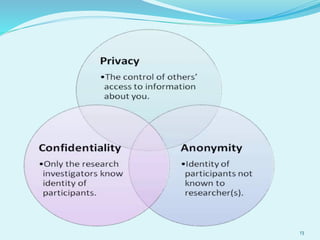
Privacy;
 Privacy refers to persons and defines the rights of the
participants to keep from the public certain
information about themselves.
 Privacy is maintained when people can control who
has information about them or who may intrude in
their lives.
 Privacy as an ethical principle is the requirement that
participants’ territories be respected and entry into
such territories can only be by their permission.
9
Cont…
Confidentiality;
 Confidentiality is about data (or information) rather
than about people.
 It is an agreement between individuals that limit’s
others access to privileged information by defining
who will have access to data.
 Confidentiality as an ethical principle is the
requirement that information provided by a
participant, or that data collected from a study unit is
not passed to a third party unless with their express
permission.
10
III) Anonymity
 Researchers are generally concerned with information
provided rather than with the person who provided it
(though the source of information is also important).
 But researchers accept information without bothering
so much about personal details, and without insisting
that respondents provide their personal details as well.
Respondents can provide information without giving
their personal details, unless they wish to provide such
details. This is the idea of anonymity.
11
Cont…
 Anonymity as ethical principle is the requirement that
participants in research have a right that their
individual identities are not made salient features in
the research process.
 Researchers ensure anonymity of participants by
identifying subjects by tags rather than by names
whenever possible, avoiding personal questions, and
by giving the respondents the option of not indicating
their identities.
12
13
IV) Researcher’s Responsibility
 The conduct of a researcher prior to, during and after a
research undertaking is a major ethical issue.
 Participants in research have a right to expect that a
researcher be sensitive to human dignity and be well-
meaning in his or her intentions throughout the
investigation.
 Further, researchers are expected not to allow their
personal judgments to prejudice the collection, analysis
and interpretation of data, nor to give into fudging effect
by directing results to conform to some preconceived
notions. Their integrity is foremost.
14
Cont…
 Over and above this, researcher must ensure accuracy of
information and that results are based on data, give
feedback to be researched, admit shortcomings and not
report issues that are not based on the findings of the
study.
 They should also show maximum respect for the
researched populations and the research sites.
 A research site should be left as undisturbed as possible at
the end of the study.
15
Cont…
 Scientific methods involve observations that can be
repeated and verified by others. Hence researchers do
not make up data or modify results to fit preconceived
hypotheses. Neither are errors of commission or
omission allowed.
 Nevertheless, errors can occur, but it is the
responsibility of the researcher to make such errors or
short-comings known if they are detected.
16
Other Ethical Issues in Research
 Apart from the major ethical issues discussed above,
there are other ethical concerns which are also as
important in research. Some of these include:
i. Behaviour modification is the concept that
participants or respondents in research tend to
adjust their behaviours if they are aware they are
being researched.
ii. Deception refers to misinforming research
participants about the major issues in the research
process in order to win their consent.
17
Cont…
iii. Concealment refers to withholding information from
the participants or providing only part information about
the major issues in the research process in order to win
participants‟ consent.
iv. Plagiarism (or intellectual theft) is the presentation of
somebody else’s work as one’s own. Every work referred
to must be recognized accordingly in a format acceptable
to the institution or organization for which the report is
being prepared. It is unethical for a researcher to claim
the words or ideas of another person as his or her own
without giving credit where it is due. The key issue in
plagiarism is that a researcher should not present the
work of another person (be they written work or just
ideas) as if they were his or her own.
18
How could you harm research
participants?
 Physically.
 By damaging their development or self-esteem.
 By causing stress.
 By hurting their career prospects or employment
opportunities.
 By breaking confidentiality.
 By revealing their identity
19
THANK YOU FOR
YOUR
ATTENSION
20

Ch3 research methods

  • 1.
    Research Methodology Ethical Issues inResearch 1 Chapter Three Mr. Abdiqani M. Aden July, 2021
  • 2.
    By the endof this chapter, students should be able to: 1. Explain the meaning of ethics as used in research. 2. Identify the common ethical issues in research. 3. Familiar with other ethical issues in research. 2 Chapter objectives Mr. Abdiqani M. Aden July, 2021
  • 3.
    Introduction  In allorganizations or groups, whether formal or informal, there are systems of accepted beliefs which control the behavior of members on what is morally right or wrong within the organization or group. Such systems of behavior broadly define the ethical requirements of an organization or group.  Researchers, being a universal family of people concerned with generation of new knowledge, also have systems of beliefs which control their behavior. This is what is referred to as ethics in research. 3
  • 4.
    The Concept ofResearch Ethics  Decision to undertake a research must rest upon a considered judgment about how best to contribute to knowledge and human welfare.  Researchers are concerned not just with the benefits of the research findings, but also with the rights of the subjects or participants in the research process. Because research helps to improve lives - it remains an integral part of human endeavor. However, its value need not be stretched beyond the dignity of the human society. This creates the need for ethics in research. 4
  • 5.
    Cont…  The balancebetween search for knowledge and respect for the community of people (or things) is what is called ethics.  Researchers carry out their investigations with respect and concern for the dignity and welfare of the people (or things) who participate in a study.  Research ethics are the set of ethics that govern how scientific and other research is performed at research institutions such as universities, and how it is disseminated. 5
  • 6.
    Basic Ethical Issuesin Research  The basic ethical issues in research can be obtained from The American Psychological Association; The American/British Sociological Association Code of Ethics; The American/British Anthropological Association Code of Ethics; The American/ British Education Research Association Ethical Standards; and The American/British Nurses Association Code of Ethics for Nurses, etc.  There are four common key ethical issues in research: informed consent, privacy and confidentiality, anonymity, and researchers‟ responsibilities. 6
  • 7.
    I) Informed Consent The philosophy of informed consent is that subjects in a research must make their decisions to participate in the research based on adequate knowledge of the research undertaking.  Informed consent is one of the founding principles of research ethics. Its intent is that human participants can enter research freely (voluntarily) with full information about what it means for them to take part, and that they give consent before they enter the research. 7
  • 8.
    Cont…  Consent shouldbe obtained before the participant enters the research (prospectively).  The minimum requirements for consent to be informed are that the participant understands what the research is and what they are consenting to. 8
  • 9.
    II) Privacy andConfidentiality Privacy;  Privacy refers to persons and defines the rights of the participants to keep from the public certain information about themselves.  Privacy is maintained when people can control who has information about them or who may intrude in their lives.  Privacy as an ethical principle is the requirement that participants’ territories be respected and entry into such territories can only be by their permission. 9
  • 10.
    Cont… Confidentiality;  Confidentiality isabout data (or information) rather than about people.  It is an agreement between individuals that limit’s others access to privileged information by defining who will have access to data.  Confidentiality as an ethical principle is the requirement that information provided by a participant, or that data collected from a study unit is not passed to a third party unless with their express permission. 10
  • 11.
    III) Anonymity  Researchersare generally concerned with information provided rather than with the person who provided it (though the source of information is also important).  But researchers accept information without bothering so much about personal details, and without insisting that respondents provide their personal details as well. Respondents can provide information without giving their personal details, unless they wish to provide such details. This is the idea of anonymity. 11
  • 12.
    Cont…  Anonymity asethical principle is the requirement that participants in research have a right that their individual identities are not made salient features in the research process.  Researchers ensure anonymity of participants by identifying subjects by tags rather than by names whenever possible, avoiding personal questions, and by giving the respondents the option of not indicating their identities. 12
  • 13.
  • 14.
    IV) Researcher’s Responsibility The conduct of a researcher prior to, during and after a research undertaking is a major ethical issue.  Participants in research have a right to expect that a researcher be sensitive to human dignity and be well- meaning in his or her intentions throughout the investigation.  Further, researchers are expected not to allow their personal judgments to prejudice the collection, analysis and interpretation of data, nor to give into fudging effect by directing results to conform to some preconceived notions. Their integrity is foremost. 14
  • 15.
    Cont…  Over andabove this, researcher must ensure accuracy of information and that results are based on data, give feedback to be researched, admit shortcomings and not report issues that are not based on the findings of the study.  They should also show maximum respect for the researched populations and the research sites.  A research site should be left as undisturbed as possible at the end of the study. 15
  • 16.
    Cont…  Scientific methodsinvolve observations that can be repeated and verified by others. Hence researchers do not make up data or modify results to fit preconceived hypotheses. Neither are errors of commission or omission allowed.  Nevertheless, errors can occur, but it is the responsibility of the researcher to make such errors or short-comings known if they are detected. 16
  • 17.
    Other Ethical Issuesin Research  Apart from the major ethical issues discussed above, there are other ethical concerns which are also as important in research. Some of these include: i. Behaviour modification is the concept that participants or respondents in research tend to adjust their behaviours if they are aware they are being researched. ii. Deception refers to misinforming research participants about the major issues in the research process in order to win their consent. 17
  • 18.
    Cont… iii. Concealment refersto withholding information from the participants or providing only part information about the major issues in the research process in order to win participants‟ consent. iv. Plagiarism (or intellectual theft) is the presentation of somebody else’s work as one’s own. Every work referred to must be recognized accordingly in a format acceptable to the institution or organization for which the report is being prepared. It is unethical for a researcher to claim the words or ideas of another person as his or her own without giving credit where it is due. The key issue in plagiarism is that a researcher should not present the work of another person (be they written work or just ideas) as if they were his or her own. 18
  • 19.
    How could youharm research participants?  Physically.  By damaging their development or self-esteem.  By causing stress.  By hurting their career prospects or employment opportunities.  By breaking confidentiality.  By revealing their identity 19
  • 20.