JAWAHARLAL NEHRU KRISHI VISHWA VIDAYALAYA
COLLEGE OF AGRICULTURE TIKAMGARGH (MP)
Agricultural Research Research Ethics
and Rural Development
TOPIC
RESEARCH ETHICS AND RESEARCH
INTIGRITY
SUMMITED TO
DEPT. OF AGRICULTURAL EXTENSION
SUBMMITED BY
RAVINDRA DOHLE
DISCIPLINE OF AGRICULTURAL
EXTENSION
Research Integrity
Research integrity may be defined as active
adherence to the ethical principles and
professional standards essential for the
trustworthy practice of research.
By active adherence we mean adoption of the
principles and exercises as a personal credo,
not simply accepting them as impositions by
rule makers
Research is a scientific approach to answering questions, often
involving human participants to test health care treatments or
medicines. It is not always possible to know what will happen to
the participants; sometimes unexpected or undesirable results
happen. The participation of native community representatives in
planning and conducting research is, therefore, key. Communities
should be informed of the research, possible outcomes (positive
and negative), and the results of the research. Research findings
belong to participants and their communities as well as the
researchers and the examine community. Community
representatives and researchers can work together to make sure that
research is conducted in the most appropriate way
Research and Research Ethics
Characterize responsible research conduct
1. Honesty and fairness in proposing, performing, and reporting research;
2. Accuracy and fairness in representing contributions to research proposals
and reports . Proficiency and fairness in peer review;
3. Collegiality in scientific interactions, communications and sharing of
resources; Disclosure of conflicts of interest;
4. Protection of human subjects in the conduct of research;
5. Humane care of animals in the conduct of research; Adherence to the mutual
responsibilities of mentors and trainees
Ethics
Ethics as discussed in this section refers to doing
what is morally and legally right in the conducting of
research. This requires the researcher to be
knowledgeable about what is being done; to use
reasoning when making decisions; to be both
intellectual and truthful in approach and reporting; and
to consider the consequences, in particular, to be sure
that the outcome of the research outweighs any negatives
that might occur. Using this approach, ethical decisions
are much easier.
The Researcher’s Role
Contrary to popular belief, the justician or
criminologist who conducts research is considered
a scientist. Ignoring the distinctions made between
a natural scientist and a social scientist, both are
scientists who are governed by the laws of inquiry
(Kaplan, 1963). Both require an ethically neutral,
objective approach to research. As mentioned in,
ethical neutrality requires that the researcher’s
moral or ethical beliefs not be allowed to influence
the gathering of data or the conclusions that are
made from analyzing the data.
Ethical Deliberations
Conducting research in and of itself can
be problematic. Accessibility, funding,
timing, and other factors may all impose
problems. The reality is there can be
ethical concerns at every step of the
research process
Ethical Ramifications
One of the first things to consider is whether the
topic to be studied has innate ethical ramifications.
Some topics are controversial by their very nature.
For instance, the individual interested in gangs
might decide that the best way to gain data is to
become a participant observer. As such, chances
are that the researcher may have to witness or
even be asked to participate in illegal activity.
Ethically as well as legally
Harm to Others
Another consideration is what effects the research might
have on the research targets. When the research involves
direct human contact, ethics plays an important role.
Whether the targets are victims, accused offenders,
convicted offenders, practitioners, or the general public
Privacy Concerns
The right to privacy is another ethical
consideration. Individuals in America have a
basic right to privacy. In many cases,
research efforts may violate that right
Voluntary Participation
As should have been noted in the previous
example, not only did the researchers seek
to obtain consent, they also informed
prospective respondents that participation
was voluntary
Deception
Some types of research (particularly field research
that requires the researcher to in essence “go
undercover”) cannot be conducted if the subjects
are aware that they are being studied. Such
research is controversial and must be care- fully
thought out before it is undertaken
The Professionalism of Research
According to Merriam-Webster’s Online
Search (2009), a professional is one
whose “conduct, aims, or qualities . . .
characterize or mark a profession or a
pro- fessional person”
Ethical Research Criteria
Even though there is no universally
recognized research code of ethics, there are
some specifically identified criteria that,
when applied or followed, assist in
producing ethical research.
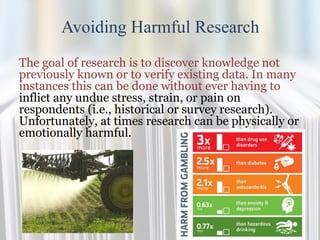
Avoiding Harmful Research
The goal of research is to discover knowledge not
previously known or to verify existing data. In many
instances this can be done without ever having to
inflict any undue stress, strain, or pain on
respondents (i.e., historical or survey research).
Unfortunately, at times research can be physically or
emotionally harmful.
Being Objective
Biases can be detrimental to a research project.
One such bias deals with objectivity. Assume you
do not like drinkers, that you perceive them as
weak willed and careless. Your research deals
with individuals convicted of driving while
intoxicated
Using Integrity
The last thing a researcher wants is for the
results not to meet expectations. Sometimes,
because of how important the research is
perceived to be, there may be a tendency to
manipulate the data and report it in a
manner that shows the research was
successful
Protecting Confidentiality
One of the biggest concerns in conducting
research is the issue of confidentiality or
privacy. As it has been suggested, privacy
and confidentiality are two ethical issues
that are crucial to social researchers who, by
the very nature of their research
Research ethics rests on the following 3
fundamental principles:
1. Respect for persons
2. Beneficence
3. Justice
Disclosure
The informed consent document must make clear that
the study is a research study, and not clinical therapy.
The potential participant must be informed as fully as
possible of the nature and purpose of the research, the
procedures to be used, the expected benefits to the
participant and/or society, the potential of reasonably
foreseeable risks, stresses, and discomforts, and
alternatives to participating in the research
Understanding
The participant must understand what has been
explained and must be given the opportunity to
ask questions and have them answered by
someone fully conversant in the study particulars
Plagiarism
Plagiarism is the "unfair appropriation" and
"stealing and publication" of another author's
"language, thoughts, ideas, or expressions" and
the representation of them as one's own original
work
Components of ethically valid informed
consent for research
.Given the appreciation that informed consent is at
the crux of human subjects protection, it is not
surprising that the regulations reflect extensively
upon the necessary elements of the consent
document itself as well as on the informed consent
process
THANK YOU

Introduction of Research Integrity

  • 1.
    JAWAHARLAL NEHRU KRISHIVISHWA VIDAYALAYA COLLEGE OF AGRICULTURE TIKAMGARGH (MP) Agricultural Research Research Ethics and Rural Development TOPIC RESEARCH ETHICS AND RESEARCH INTIGRITY SUMMITED TO DEPT. OF AGRICULTURAL EXTENSION SUBMMITED BY RAVINDRA DOHLE DISCIPLINE OF AGRICULTURAL EXTENSION
  • 2.
    Research Integrity Research integritymay be defined as active adherence to the ethical principles and professional standards essential for the trustworthy practice of research. By active adherence we mean adoption of the principles and exercises as a personal credo, not simply accepting them as impositions by rule makers
  • 3.
    Research is ascientific approach to answering questions, often involving human participants to test health care treatments or medicines. It is not always possible to know what will happen to the participants; sometimes unexpected or undesirable results happen. The participation of native community representatives in planning and conducting research is, therefore, key. Communities should be informed of the research, possible outcomes (positive and negative), and the results of the research. Research findings belong to participants and their communities as well as the researchers and the examine community. Community representatives and researchers can work together to make sure that research is conducted in the most appropriate way Research and Research Ethics
  • 4.
    Characterize responsible researchconduct 1. Honesty and fairness in proposing, performing, and reporting research; 2. Accuracy and fairness in representing contributions to research proposals and reports . Proficiency and fairness in peer review; 3. Collegiality in scientific interactions, communications and sharing of resources; Disclosure of conflicts of interest; 4. Protection of human subjects in the conduct of research; 5. Humane care of animals in the conduct of research; Adherence to the mutual responsibilities of mentors and trainees
  • 5.
    Ethics Ethics as discussedin this section refers to doing what is morally and legally right in the conducting of research. This requires the researcher to be knowledgeable about what is being done; to use reasoning when making decisions; to be both intellectual and truthful in approach and reporting; and to consider the consequences, in particular, to be sure that the outcome of the research outweighs any negatives that might occur. Using this approach, ethical decisions are much easier.
  • 6.
    The Researcher’s Role Contraryto popular belief, the justician or criminologist who conducts research is considered a scientist. Ignoring the distinctions made between a natural scientist and a social scientist, both are scientists who are governed by the laws of inquiry (Kaplan, 1963). Both require an ethically neutral, objective approach to research. As mentioned in, ethical neutrality requires that the researcher’s moral or ethical beliefs not be allowed to influence the gathering of data or the conclusions that are made from analyzing the data.
  • 7.
    Ethical Deliberations Conducting researchin and of itself can be problematic. Accessibility, funding, timing, and other factors may all impose problems. The reality is there can be ethical concerns at every step of the research process
  • 9.
    Ethical Ramifications One ofthe first things to consider is whether the topic to be studied has innate ethical ramifications. Some topics are controversial by their very nature. For instance, the individual interested in gangs might decide that the best way to gain data is to become a participant observer. As such, chances are that the researcher may have to witness or even be asked to participate in illegal activity. Ethically as well as legally
  • 10.
    Harm to Others Anotherconsideration is what effects the research might have on the research targets. When the research involves direct human contact, ethics plays an important role. Whether the targets are victims, accused offenders, convicted offenders, practitioners, or the general public
  • 11.
    Privacy Concerns The rightto privacy is another ethical consideration. Individuals in America have a basic right to privacy. In many cases, research efforts may violate that right
  • 12.
    Voluntary Participation As shouldhave been noted in the previous example, not only did the researchers seek to obtain consent, they also informed prospective respondents that participation was voluntary
  • 13.
    Deception Some types ofresearch (particularly field research that requires the researcher to in essence “go undercover”) cannot be conducted if the subjects are aware that they are being studied. Such research is controversial and must be care- fully thought out before it is undertaken
  • 14.
    The Professionalism ofResearch According to Merriam-Webster’s Online Search (2009), a professional is one whose “conduct, aims, or qualities . . . characterize or mark a profession or a pro- fessional person”
  • 15.
    Ethical Research Criteria Eventhough there is no universally recognized research code of ethics, there are some specifically identified criteria that, when applied or followed, assist in producing ethical research.
  • 16.
    Avoiding Harmful Research Thegoal of research is to discover knowledge not previously known or to verify existing data. In many instances this can be done without ever having to inflict any undue stress, strain, or pain on respondents (i.e., historical or survey research). Unfortunately, at times research can be physically or emotionally harmful.
  • 17.
    Being Objective Biases canbe detrimental to a research project. One such bias deals with objectivity. Assume you do not like drinkers, that you perceive them as weak willed and careless. Your research deals with individuals convicted of driving while intoxicated
  • 18.
    Using Integrity The lastthing a researcher wants is for the results not to meet expectations. Sometimes, because of how important the research is perceived to be, there may be a tendency to manipulate the data and report it in a manner that shows the research was successful
  • 19.
    Protecting Confidentiality One ofthe biggest concerns in conducting research is the issue of confidentiality or privacy. As it has been suggested, privacy and confidentiality are two ethical issues that are crucial to social researchers who, by the very nature of their research
  • 20.
    Research ethics restson the following 3 fundamental principles: 1. Respect for persons 2. Beneficence 3. Justice
  • 21.
    Disclosure The informed consentdocument must make clear that the study is a research study, and not clinical therapy. The potential participant must be informed as fully as possible of the nature and purpose of the research, the procedures to be used, the expected benefits to the participant and/or society, the potential of reasonably foreseeable risks, stresses, and discomforts, and alternatives to participating in the research
  • 22.
    Understanding The participant mustunderstand what has been explained and must be given the opportunity to ask questions and have them answered by someone fully conversant in the study particulars
  • 23.
    Plagiarism Plagiarism is the"unfair appropriation" and "stealing and publication" of another author's "language, thoughts, ideas, or expressions" and the representation of them as one's own original work
  • 24.
    Components of ethicallyvalid informed consent for research .Given the appreciation that informed consent is at the crux of human subjects protection, it is not surprising that the regulations reflect extensively upon the necessary elements of the consent document itself as well as on the informed consent process
  • 25.