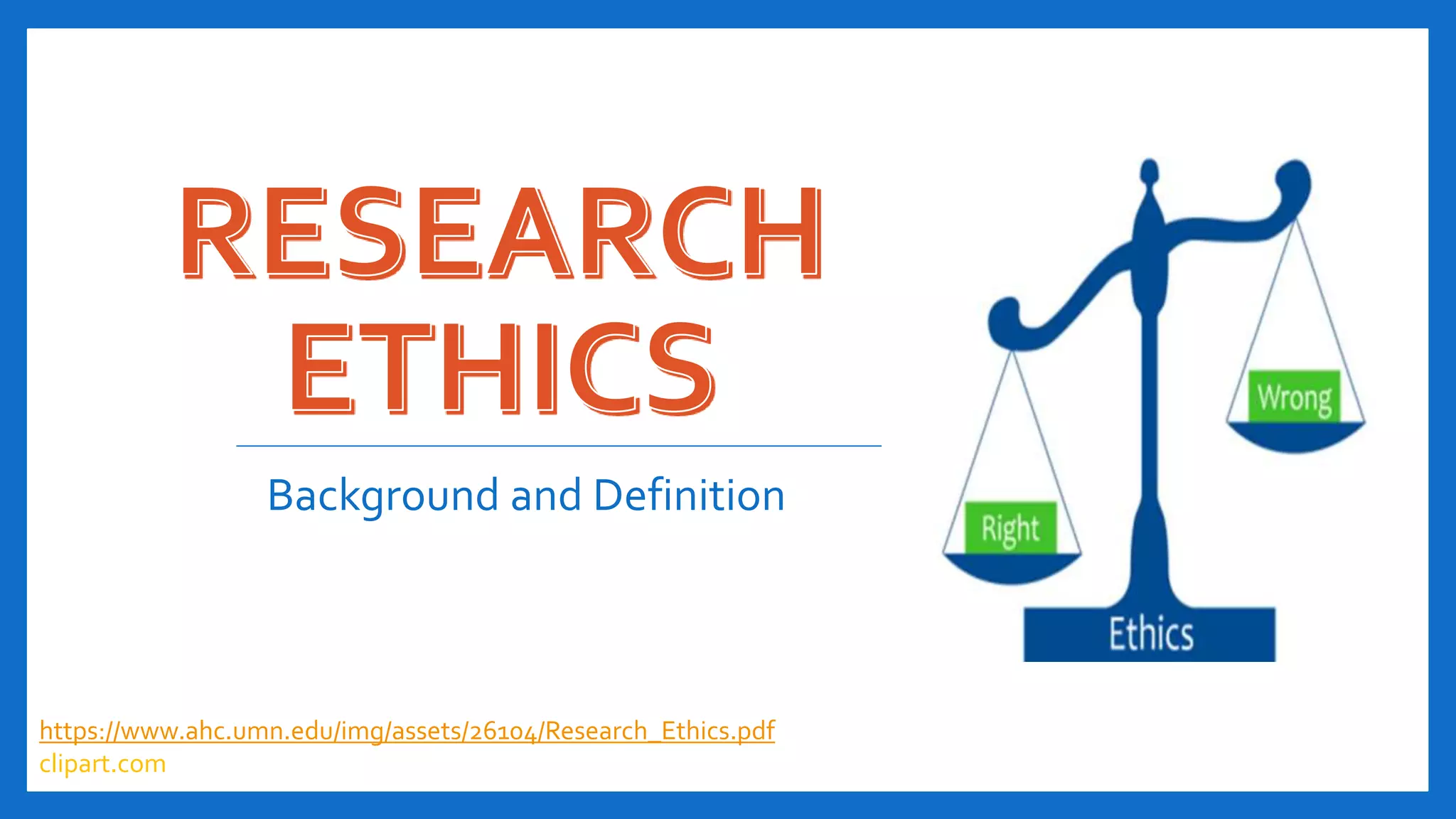
Background and Definition
https://www.ahc.umn.edu/img/assets/26104/Research_Ethics.pdf
clipart.com
KWL chart: RESEARCH ETHICS
K W L
What’s New?
ETHICS: Definition
Greek word “ethos” or “way
of life”, “social norms for
conduct that distinguishes
between acceptable and
unacceptable behavior”
(Shah, 2011, p.205; Akaranga & Ongong’a, 2013,p.8)
Journal of Educational Policy and Entrepreneurial Research ISSN: 2408-770X (Print), ISSN: 2408-6231
(Online)Vol. 3, N0.12. 2016. Pp 1-9
ETHICS: Definition
branch philosophy that deals
with the conduct of people
and guides the norms or
standards of behavior of
people and relationships with
each other (Kovacs, 1985; Blumberg et al, 2005)
Journal of Educational Policy and Entrepreneurial Research ISSN: 2408-770X (Print), ISSN: 2408-6231 (Online) Vol. 3, N0.12. 2016. Pp 1-9
ETHICS: Definition
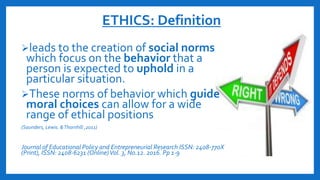
leads to the creation of social norms
which focus on the behavior that a
person is expected to uphold in a
particular situation.
These norms of behavior which guide
moral choices can allow for a wide
range of ethical positions
(Saunders, Lewis. &Thornhill ,2011)
Journal of Educational Policy and Entrepreneurial Research ISSN: 2408-770X
(Print), ISSN: 2408-6231 (Online)Vol. 3, N0.12. 2016. Pp 1-9
RESEARCH ETHICS
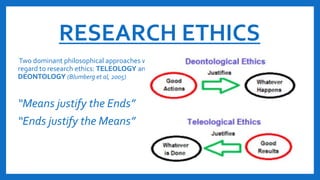
Two dominant philosophical approaches with
regard to research ethics: TELEOLOGY and
DEONTOLOGY (Blumberg et al, 2005)
“Means justify the Ends”
“Ends justify the Means”
RESEARCH ETHICS
rules and guidelines that
defines the conduct of a
researcher
 researchers should protect the
dignity of their subjects and
publish well the information that
is researched (Fouka & Mantzorou, 2011)
Journal of Educational Policy and Entrepreneurial Research ISSN: 2408-770X (Print), ISSN: 2408-6231 (Online)Vol. 3, N0.12. 2016. Pp 1-9
RESEARCH ETHICS
provides guidelines for the
responsible conduct of
biomedical research
educates and monitors
scientists conducting
research to ensure a high
ethical standard
Research Ethics: BRIEF HISTORY
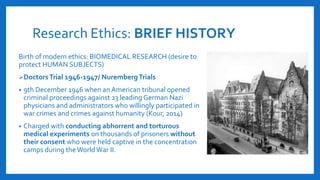
Birth of modern ethics: BIOMEDICAL RESEARCH (desire to
protect HUMAN SUBJECTS)
DoctorsTrial 1946-1947/ NurembergTrials
• 9th December 1946 when an American tribunal opened
criminal proceedings against 23 leading German Nazi
physicians and administrators who willingly participated in
war crimes and crimes against humanity (Kour, 2014)
• Charged with conducting abhorrent and torturous
medical experiments on thousands of prisoners without
their consent who were held captive in the concentration
camps during theWorld War II.
Research Ethics: BRIEF HISTORY
• experiments led to many of these subjects dying, while others were
crippled permanently
• gathering scientific information about the limits of the human
body by exposing victims to extreme temperatures and altitudes
• experiments tested how quickly a human could be euthanatized in
order to carry out the Nazi racial purification policies most
efficiently
• results of the trial led to the establishment of the NUREMBERG
CODE IN 1948 because, human beings were being exploited in
various cases
NUREMBERG CODE: 10 Ethical Principles
1. Research participants must voluntarily consent to research participation
2. Research aims should contribute to the good of society
3. Research must be based on sound theory and prior animal testing
4. Research must avoid unnecessary physical and mental suffering
5. No research projects can go forward where serious injury and/or death are
potential outcomes
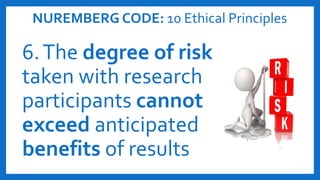
6. The degree of risk taken with research participants cannot exceed anticipated
benefits of results
7. Proper environment and protection for participants is necessary
8. Experiments can be conducted only by scientifically qualified persons
9. Human subjects must be allowed to discontinue their participation at any time
10. Scientists must be prepared to terminate the experiment if there is cause to
believe that continuation will be harmful or result in injury or death
NUREMBERG CODE: 10 Ethical Principles
1. Research
participants must
voluntarily
consent to
research
participation
NUREMBERG CODE: 10 Ethical Principles
2. Research aims
should
contribute to the
good of society
NUREMBERG CODE: 10 Ethical Principles
3. Research must
be based on
sound theory
and prior animal
testing
NUREMBERG CODE: 10 Ethical Principles
4. Research must
avoid unnecessary
physical and mental
suffering
NUREMBERG CODE: 10 Ethical Principles
5. No research
projects can go
forward where
serious injury and/or
death are potential
outcomes
NUREMBERG CODE: 10 Ethical Principles
6.The degree of risk
taken with research
participants cannot
exceed anticipated
benefits of results
NUREMBERG CODE: 10 Ethical Principles
7. Proper
environment
and protection
for participants
is necessary
NUREMBERG CODE: 10 Ethical Principles
8. Experiments can
be conducted only
by scientifically
qualified persons
NUREMBERG CODE: 10 Ethical Principles
9. Human subjects
must be allowed
to discontinue
their participation
at any time
NUREMBERG CODE: 10 Ethical Principles
10. Scientists must be
prepared to terminate
the experiment if there
is cause to believe that
continuation will be
harmful or result in
injury or death
Other
Controversial
Researches
Tuskegee Experiment:The
Infamous Syphilis Study(1932-1972)
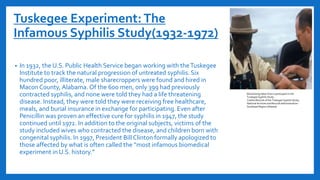
• In 1932, the U.S. Public Health Service began working with theTuskegee
Institute to track the natural progression of untreated syphilis. Six
hundred poor, illiterate, male sharecroppers were found and hired in
MaconCounty, Alabama.Of the 600 men, only 399 had previously
contracted syphilis, and none were told they had a life threatening
disease. Instead, they were told they were receiving free healthcare,
meals, and burial insurance in exchange for participating. Even after
Penicillin was proven an effective cure for syphilis in 1947, the study
continued until 1972. In addition to the original subjects, victims of the
study included wives who contracted the disease, and children born with
congenital syphilis. In 1997, President Bill Clinton formally apologized to
those affected by what is often called the “most infamous biomedical
experiment in U.S. history.”
Blood being taken from a participant in the
Tuskegee Syphilis Study.
Credits:Records of the Tuskegee Syphilis Study,
National Archives and Records Administration--
Southeast Region (Atlanta)
The Monster
Study
• In 1939, 22 orphans living in Davenport, Iowa became the test
subjects ofWendell Johnson and MaryTudor, two researchers
from the University of Iowa.The study was about stuttering,
but it didn’t go quite the way you might think.The children
were separated into two groups. Members of one group
received positive speech therapy and was consistently
praised for their speech fluency.The other group received
negative speech therapy, which included being belittled for
any speech imperfection they happened to make. In the end,
children in the second group who spoke normally before the
experiment developed speech problems that they reportedly
retained for the rest of their lives. Johnson andTudor never
published the results of their study out of fear they would be
compared to the human experimenters among the Nazis.
Dr.William Beaumont and the Stomach
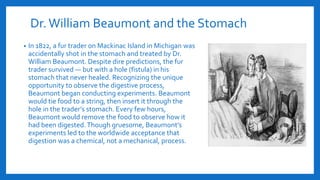
• In 1822, a fur trader on Mackinac Island in Michigan was
accidentally shot in the stomach and treated by Dr.
William Beaumont. Despite dire predictions, the fur
trader survived — but with a hole (fistula) in his
stomach that never healed. Recognizing the unique
opportunity to observe the digestive process,
Beaumont began conducting experiments. Beaumont
would tie food to a string, then insert it through the
hole in the trader’s stomach. Every few hours,
Beaumont would remove the food to observe how it
had been digested.Though gruesome, Beaumont’s
experiments led to the worldwide acceptance that
digestion was a chemical, not a mechanical, process.
Helsinki Declaration
• developed by the World Medical Association and has
been revised and updated periodically since 1964, with
the last update occurring in 2013.
• contains all the basic ethical elements specified in the
Nuremberg Code but then advances further guidelines
specifically designed to address the unique
vulnerabilities of human subjects solicited to
participate in clinical research projects.
Helsinki Declaration
• The necessity of using an independent investigator to review potential
research projects
• Employing a medically qualified person to supervise the research and
assume responsibility for the health and welfare of human subjects
• The importance of preserving the accuracy of research results
• Suggestions on how to obtain informed consent from research
participants
• Rules concerning research with children and mentally incompetent
persons
• Evaluating and using experimental treatments on patients
• The importance of determining which medical situations and conditions
are appropriate and safe for research
Belmont Report of 1979
•from the National Commission for the Protection of
Human Subjects of Biomedical and Behavioral
Research
•created as a result of the National Research Act of 1974,
was charged with identifying the basic ethical principles
that should underlie the conduct of biomedical and
behavioral research involving human subjects and
developing guidelines to assure that such research is
conducted in accordance with those principles
Belmont Report of 1979
•The ethical principles for research with human subjects
•Boundaries between medical practice and research
•The concepts of respect for persons, beneficence, and
justice
•Applications of these 3 ethical principles in informed
consent (respect for persons), assessing risks and
benefits (beneficence), and subject selection (justice)
BELMONT REPORT OF 1979
3 ethical principles
Respect for persons
Beneficence
Justice
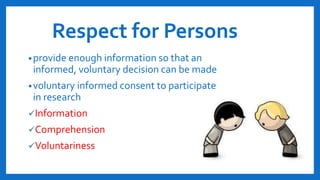
Respect for Persons
•provide enough information so that an
informed, voluntary decision can be made
•voluntary informed consent to participate
in research
Information
Comprehension
Voluntariness
Beneficence
•to do no harm, minimize risk
of harm and maximize the
benefits of research to
protect human welfare
•analyzing the risks and
benefits
Justice
•fair and equitable distribution of benefits
and burdens of research
•research participants are selected fairly,
with all segments of the population
having an opportunity to be included in a
study, provided that inclusion is
scientifically and ethically justifiable
•The Nuremberg, Helsinki, and
Belmont guidelines provided the
foundation of more ethically
uniform research to which stringent
rules and consequences for violation
were attached.
AnimalWelfare Act
•The Animal Welfare Act
provides guidelines and
regulations for research with
animals.
•It goes into detail about sale,
licensure, facilities, transport,
and other care instructions.
The Protection of Human Subjects
Regulations
•For research with human subjects Title 45,
Part 46 from the Code of Federal
Regulations (45 CFR 46):The Protection of
Human Subjects Regulations outlines the
purpose and policies of Institutional Review
Board (IRB) oversight and approval,
informed consent, and protections and
policies for research with children, pregnant
women, fetuses, prisoners, and mentally
incompetent individuals.
REMEMBER!
•All researchers should be familiar with
the basic ethical principles and have up-
to-date knowledge about policies and
procedures designed to ensure the
safety of research subjects and to
prevent sloppy or irresponsible research,
because ignorance of policies designed to
protect research subjects is not
considered a viable excuse for ethically
questionable projects.
HW #2
Define
•Plagiarism
•Self Plagiarism
•Fabrication
•Falsification
What I Learned (SW5)

Research Ethics

  • 1.
  • 2.
    KWL chart: RESEARCHETHICS K W L
  • 3.
  • 4.
    ETHICS: Definition Greek word“ethos” or “way of life”, “social norms for conduct that distinguishes between acceptable and unacceptable behavior” (Shah, 2011, p.205; Akaranga & Ongong’a, 2013,p.8) Journal of Educational Policy and Entrepreneurial Research ISSN: 2408-770X (Print), ISSN: 2408-6231 (Online)Vol. 3, N0.12. 2016. Pp 1-9
  • 5.
    ETHICS: Definition branch philosophythat deals with the conduct of people and guides the norms or standards of behavior of people and relationships with each other (Kovacs, 1985; Blumberg et al, 2005) Journal of Educational Policy and Entrepreneurial Research ISSN: 2408-770X (Print), ISSN: 2408-6231 (Online) Vol. 3, N0.12. 2016. Pp 1-9
  • 6.
    ETHICS: Definition leads tothe creation of social norms which focus on the behavior that a person is expected to uphold in a particular situation. These norms of behavior which guide moral choices can allow for a wide range of ethical positions (Saunders, Lewis. &Thornhill ,2011) Journal of Educational Policy and Entrepreneurial Research ISSN: 2408-770X (Print), ISSN: 2408-6231 (Online)Vol. 3, N0.12. 2016. Pp 1-9
  • 7.
    RESEARCH ETHICS Two dominantphilosophical approaches with regard to research ethics: TELEOLOGY and DEONTOLOGY (Blumberg et al, 2005) “Means justify the Ends” “Ends justify the Means”
  • 8.
    RESEARCH ETHICS rules andguidelines that defines the conduct of a researcher  researchers should protect the dignity of their subjects and publish well the information that is researched (Fouka & Mantzorou, 2011) Journal of Educational Policy and Entrepreneurial Research ISSN: 2408-770X (Print), ISSN: 2408-6231 (Online)Vol. 3, N0.12. 2016. Pp 1-9
  • 9.
    RESEARCH ETHICS provides guidelinesfor the responsible conduct of biomedical research educates and monitors scientists conducting research to ensure a high ethical standard
  • 10.
    Research Ethics: BRIEFHISTORY Birth of modern ethics: BIOMEDICAL RESEARCH (desire to protect HUMAN SUBJECTS) DoctorsTrial 1946-1947/ NurembergTrials • 9th December 1946 when an American tribunal opened criminal proceedings against 23 leading German Nazi physicians and administrators who willingly participated in war crimes and crimes against humanity (Kour, 2014) • Charged with conducting abhorrent and torturous medical experiments on thousands of prisoners without their consent who were held captive in the concentration camps during theWorld War II.
  • 11.
    Research Ethics: BRIEFHISTORY • experiments led to many of these subjects dying, while others were crippled permanently • gathering scientific information about the limits of the human body by exposing victims to extreme temperatures and altitudes • experiments tested how quickly a human could be euthanatized in order to carry out the Nazi racial purification policies most efficiently • results of the trial led to the establishment of the NUREMBERG CODE IN 1948 because, human beings were being exploited in various cases
  • 12.
    NUREMBERG CODE: 10Ethical Principles 1. Research participants must voluntarily consent to research participation 2. Research aims should contribute to the good of society 3. Research must be based on sound theory and prior animal testing 4. Research must avoid unnecessary physical and mental suffering 5. No research projects can go forward where serious injury and/or death are potential outcomes 6. The degree of risk taken with research participants cannot exceed anticipated benefits of results 7. Proper environment and protection for participants is necessary 8. Experiments can be conducted only by scientifically qualified persons 9. Human subjects must be allowed to discontinue their participation at any time 10. Scientists must be prepared to terminate the experiment if there is cause to believe that continuation will be harmful or result in injury or death
  • 13.
    NUREMBERG CODE: 10Ethical Principles 1. Research participants must voluntarily consent to research participation
  • 14.
    NUREMBERG CODE: 10Ethical Principles 2. Research aims should contribute to the good of society
  • 15.
    NUREMBERG CODE: 10Ethical Principles 3. Research must be based on sound theory and prior animal testing
  • 16.
    NUREMBERG CODE: 10Ethical Principles 4. Research must avoid unnecessary physical and mental suffering
  • 17.
    NUREMBERG CODE: 10Ethical Principles 5. No research projects can go forward where serious injury and/or death are potential outcomes
  • 18.
    NUREMBERG CODE: 10Ethical Principles 6.The degree of risk taken with research participants cannot exceed anticipated benefits of results
  • 19.
    NUREMBERG CODE: 10Ethical Principles 7. Proper environment and protection for participants is necessary
  • 20.
    NUREMBERG CODE: 10Ethical Principles 8. Experiments can be conducted only by scientifically qualified persons
  • 21.
    NUREMBERG CODE: 10Ethical Principles 9. Human subjects must be allowed to discontinue their participation at any time
  • 22.
    NUREMBERG CODE: 10Ethical Principles 10. Scientists must be prepared to terminate the experiment if there is cause to believe that continuation will be harmful or result in injury or death
  • 23.
  • 24.
    Tuskegee Experiment:The Infamous SyphilisStudy(1932-1972) • In 1932, the U.S. Public Health Service began working with theTuskegee Institute to track the natural progression of untreated syphilis. Six hundred poor, illiterate, male sharecroppers were found and hired in MaconCounty, Alabama.Of the 600 men, only 399 had previously contracted syphilis, and none were told they had a life threatening disease. Instead, they were told they were receiving free healthcare, meals, and burial insurance in exchange for participating. Even after Penicillin was proven an effective cure for syphilis in 1947, the study continued until 1972. In addition to the original subjects, victims of the study included wives who contracted the disease, and children born with congenital syphilis. In 1997, President Bill Clinton formally apologized to those affected by what is often called the “most infamous biomedical experiment in U.S. history.” Blood being taken from a participant in the Tuskegee Syphilis Study. Credits:Records of the Tuskegee Syphilis Study, National Archives and Records Administration-- Southeast Region (Atlanta)
  • 25.
    The Monster Study • In1939, 22 orphans living in Davenport, Iowa became the test subjects ofWendell Johnson and MaryTudor, two researchers from the University of Iowa.The study was about stuttering, but it didn’t go quite the way you might think.The children were separated into two groups. Members of one group received positive speech therapy and was consistently praised for their speech fluency.The other group received negative speech therapy, which included being belittled for any speech imperfection they happened to make. In the end, children in the second group who spoke normally before the experiment developed speech problems that they reportedly retained for the rest of their lives. Johnson andTudor never published the results of their study out of fear they would be compared to the human experimenters among the Nazis.
  • 26.
    Dr.William Beaumont andthe Stomach • In 1822, a fur trader on Mackinac Island in Michigan was accidentally shot in the stomach and treated by Dr. William Beaumont. Despite dire predictions, the fur trader survived — but with a hole (fistula) in his stomach that never healed. Recognizing the unique opportunity to observe the digestive process, Beaumont began conducting experiments. Beaumont would tie food to a string, then insert it through the hole in the trader’s stomach. Every few hours, Beaumont would remove the food to observe how it had been digested.Though gruesome, Beaumont’s experiments led to the worldwide acceptance that digestion was a chemical, not a mechanical, process.
  • 27.
    Helsinki Declaration • developedby the World Medical Association and has been revised and updated periodically since 1964, with the last update occurring in 2013. • contains all the basic ethical elements specified in the Nuremberg Code but then advances further guidelines specifically designed to address the unique vulnerabilities of human subjects solicited to participate in clinical research projects.
  • 28.
    Helsinki Declaration • Thenecessity of using an independent investigator to review potential research projects • Employing a medically qualified person to supervise the research and assume responsibility for the health and welfare of human subjects • The importance of preserving the accuracy of research results • Suggestions on how to obtain informed consent from research participants • Rules concerning research with children and mentally incompetent persons • Evaluating and using experimental treatments on patients • The importance of determining which medical situations and conditions are appropriate and safe for research
  • 29.
    Belmont Report of1979 •from the National Commission for the Protection of Human Subjects of Biomedical and Behavioral Research •created as a result of the National Research Act of 1974, was charged with identifying the basic ethical principles that should underlie the conduct of biomedical and behavioral research involving human subjects and developing guidelines to assure that such research is conducted in accordance with those principles
  • 30.
    Belmont Report of1979 •The ethical principles for research with human subjects •Boundaries between medical practice and research •The concepts of respect for persons, beneficence, and justice •Applications of these 3 ethical principles in informed consent (respect for persons), assessing risks and benefits (beneficence), and subject selection (justice)
  • 31.
    BELMONT REPORT OF1979 3 ethical principles Respect for persons Beneficence Justice
  • 32.
    Respect for Persons •provideenough information so that an informed, voluntary decision can be made •voluntary informed consent to participate in research Information Comprehension Voluntariness
  • 33.
    Beneficence •to do noharm, minimize risk of harm and maximize the benefits of research to protect human welfare •analyzing the risks and benefits
  • 34.
    Justice •fair and equitabledistribution of benefits and burdens of research •research participants are selected fairly, with all segments of the population having an opportunity to be included in a study, provided that inclusion is scientifically and ethically justifiable
  • 35.
    •The Nuremberg, Helsinki,and Belmont guidelines provided the foundation of more ethically uniform research to which stringent rules and consequences for violation were attached.
  • 36.
    AnimalWelfare Act •The AnimalWelfare Act provides guidelines and regulations for research with animals. •It goes into detail about sale, licensure, facilities, transport, and other care instructions.
  • 37.
    The Protection ofHuman Subjects Regulations •For research with human subjects Title 45, Part 46 from the Code of Federal Regulations (45 CFR 46):The Protection of Human Subjects Regulations outlines the purpose and policies of Institutional Review Board (IRB) oversight and approval, informed consent, and protections and policies for research with children, pregnant women, fetuses, prisoners, and mentally incompetent individuals.
  • 38.
    REMEMBER! •All researchers shouldbe familiar with the basic ethical principles and have up- to-date knowledge about policies and procedures designed to ensure the safety of research subjects and to prevent sloppy or irresponsible research, because ignorance of policies designed to protect research subjects is not considered a viable excuse for ethically questionable projects.
  • 39.

Editor's Notes

  • #8 the research justify the means. This implies that the benefits of the research findings could be weighed against the costs of acting unethically. But, this depends on the comparison made about the relative good over the evil produced (Frankena, 2001). While the deontological theories which are the opposite of teleological theories state that the ends served by the research can never justify the use of research which is unethical. They assert that there are considerations which make an action or rule right besides the goodness or badness of its consequences (Frankena, 2001). An action can be morally right even if it does not promote the greatest balance of good over evil. Hence, one cannot use deception to ensure validity and reliability of data. Having discussed the meaning of ethics and the two major standpoints that could be used in conceptualizing research ethics, it is vital to examine the origin of research ethics and the theories related to it in contemporary research.