Submitted To:
Dr. Riaz Hussain
Assistant Professor
The Islamia University of Bahawalpur, Pakistan
Submitted By:
Syed Nadeem Abbas
Arif Hussain
Contents…
Section One
 The definition
 Ethics in common
 Ethics in research
 Ethics according to Islam
 Objectives of Ethics in Research
 Different Ethics to be used while doing research
Section Two
 Ethic Field
 Informed Consent
 Access and Acceptance
 Sources of tension
 Ethical Dilemma
 Responsibilities to research community
 Conclusion
What is meant by Ethics
Ethics comes from Greek Word ‘Ethos” which means
‘Character’
The branch of philosophy that deals with moral
principles
Principles and Guidelines for doing an activity
Moral principles of right and wrong.
Ethics refers to where a particular practice is right or
wrong
Ethics History According to
Islam
Our Prophet ‘Adam’ is the first and oldest pioneer of
ethics in this world
According to Islamic Ethical Philosophy, Humans are
the key factors that influence ethics itself
Our Prophet Muhammad (s.a.w) emphasized the
importance of family nurturing when
“Command your children to pray when they become
seven years old and discipline them for it
(prayer)when they become ten years old”
Research Ethics
Incorporating ethical principles into research practice
May involve a balance between and with in principles
and practices
All stages, all those involved, from inception of
research through to completion and publication of
results and beyond
“The value of research depends as much on its
ethnical veracity as on the novelty of its discoveries”.
(William, 2006)
Regardless of the type of research conducted,
research ethics is an important consideration. Most
professional organizations have their own codes of
ethics (as American Psychological Association and the
American Sociological Association) in addition,
colleges, universities and other institutions that
conduct research have Institutional Review Boards
(IRBs) whose members review proposals for research
to determine if ethical issues have been considered.
For Instance
If you are conducting research in a non-college
setting, in an Elementary or Secondary School or a
Community Organization, there may not be a
committee called an “IRB”.
In this case you’ll need to find out who will review
your proposal and procedures you will need to follow
to obtain approval.
Louis Cohen (2007, p.16)
A major ethical dilemma is that which requires
researcher to strike a balance between demands
placed on them as professional scientists in pursuit of
truth and their subjects’ rights and values potentially
threatened by research.
Louis Cohen (2007,51)
Objective of Ethics in Research
Helps in bringing out truth
Avoidance of Errors
Promotes the values of Research
Promotes the collaborative work
Holds in building public support
Help in getting participants
Avoid any Manipulation
Make research report trustworthy
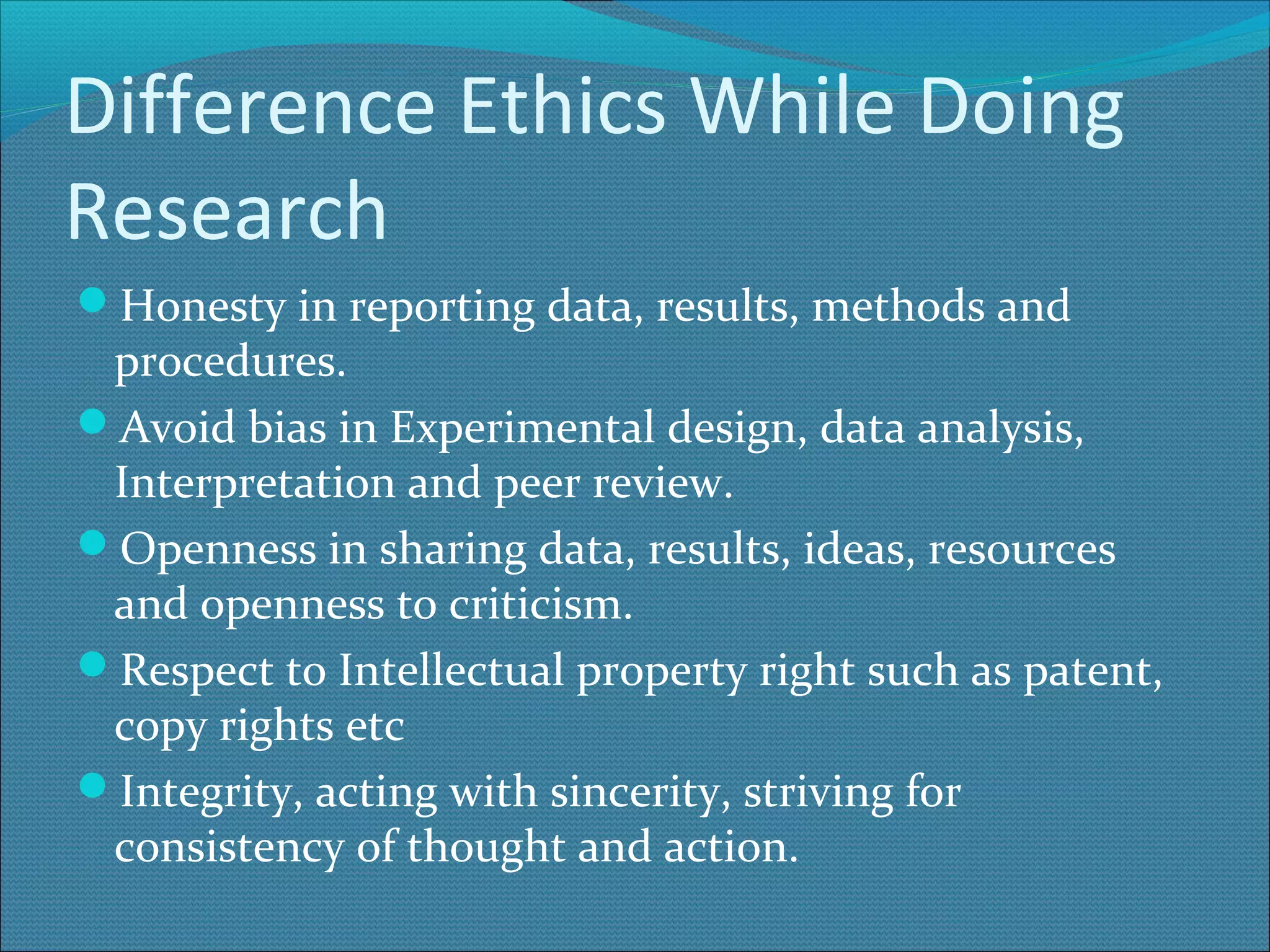
Difference Ethics While Doing
Research
Honesty in reporting data, results, methods and
procedures.
Avoid bias in Experimental design, data analysis,
Interpretation and peer review.
Openness in sharing data, results, ideas, resources
and openness to criticism.
Respect to Intellectual property right such as patent,
copy rights etc
Integrity, acting with sincerity, striving for
consistency of thought and action.
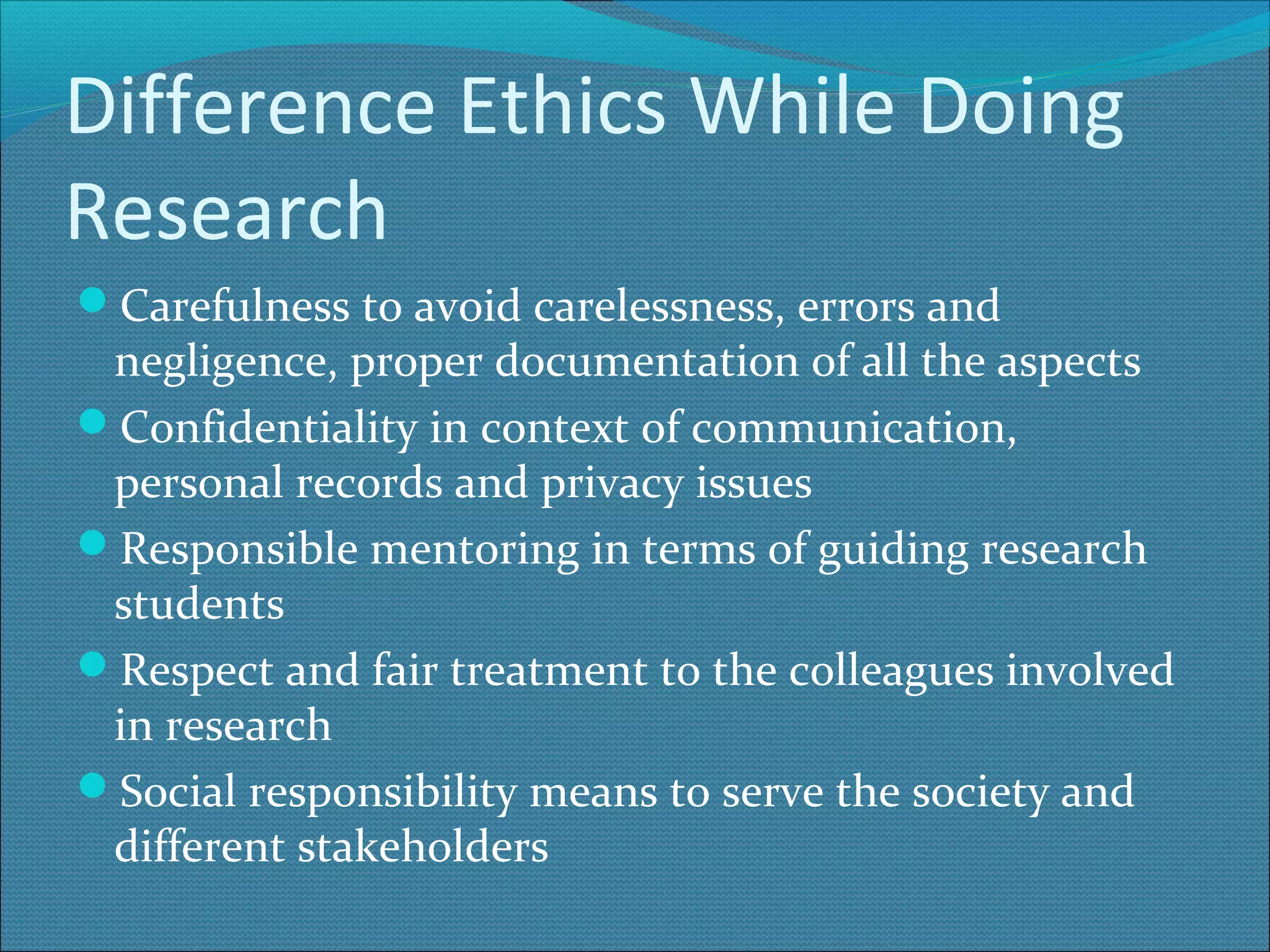
Difference Ethics While Doing
Research
Carefulness to avoid carelessness, errors and
negligence, proper documentation of all the aspects
Confidentiality in context of communication,
personal records and privacy issues
Responsible mentoring in terms of guiding research
students
Respect and fair treatment to the colleagues involved
in research
Social responsibility means to serve the society and
different stakeholders
Difference Ethics While Doing
Research
No discrimination against colleagues and students
Ensuring the legality of whole process by observing
relevant laws that institutional and Governmental
policies
Animal care through proper experimental design
Section Two
In this section we are going to review several issues in
the Ethic Field.
Informed Consent
It has been defined by Diener and Crandall (1978) as,
The procedure in which individuals choose whether to
participate in an investigation after being informed of
facts that would likely to influence their decisions.
 This definition goes with the following four elements
 Competence
Responsible and mature individuals will make correct decisions after given relevant
information.
 Voluntarism
Entails applying the principle of informed consent and thus ensuring that participants
freely choose to take or not to take part in resarch
 Full Information
That means consent is fully informed though in practice it is often impossible for
researchers to inform subject on everything. Sometimes researchers may not know
everything.
 Comprehension
Refers to that participants fully understand the nature of the research project even
when procedures are complicated and entail risks. Suggestions have been made to
ensure the subjects fully comprehend the situation they are putting themselves into.
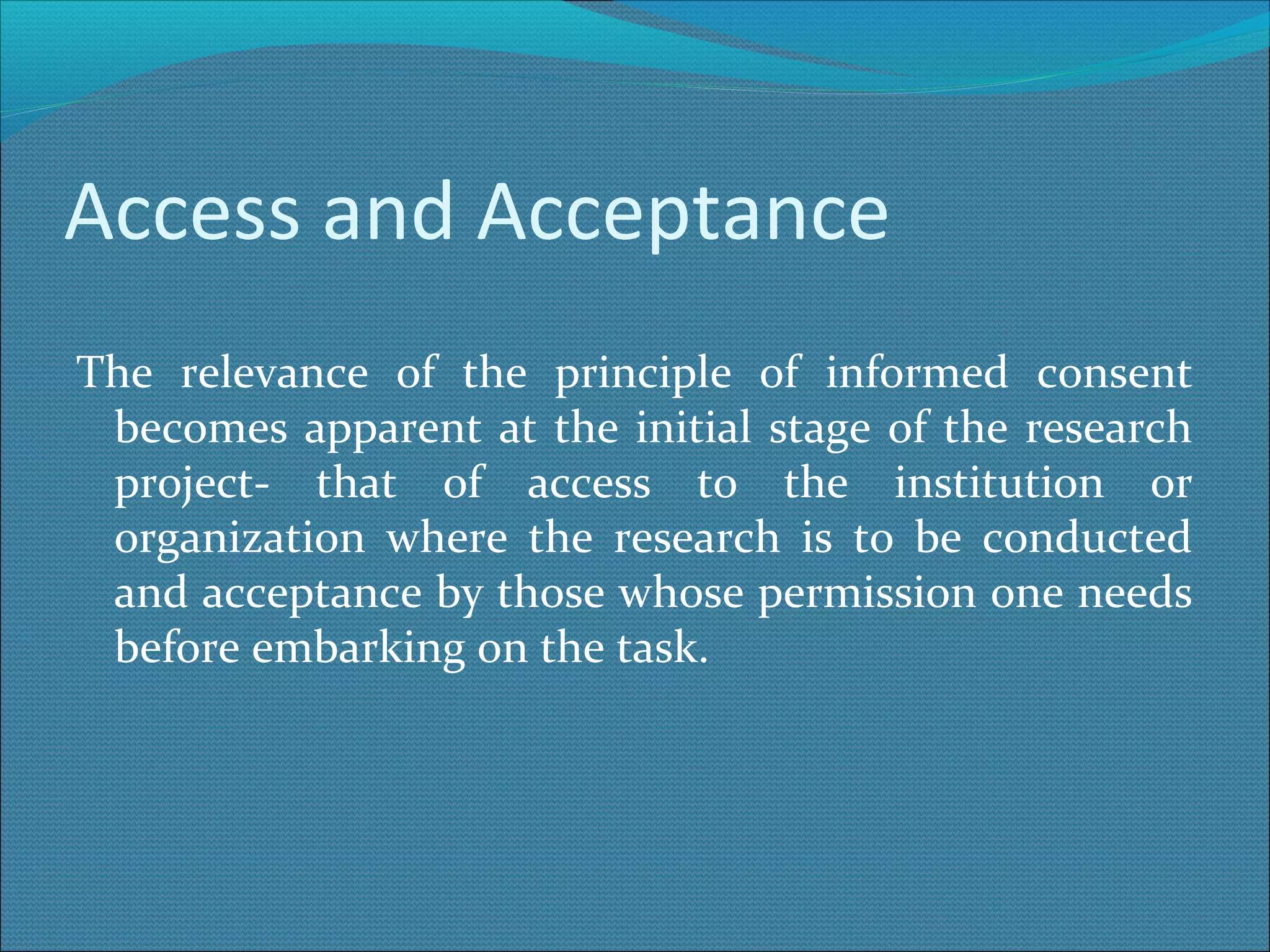
Access and Acceptance
The relevance of the principle of informed consent
becomes apparent at the initial stage of the research
project- that of access to the institution or
organization where the research is to be conducted
and acceptance by those whose permission one needs
before embarking on the task.
Sources of Tensions
Non-maleficence, beneficence and human dignity
The first tension, as expressed by Arnson and Carlsmith (1969), is that
which exists between two sets of related values held by society; a
belief in the value of free scientific inquiry in pursuit of truth an
knowledge and a belief in the dignity of individuals and their right to
those considerations that follow from it.
Non- maleficence means first of all do not harm is held as guiding
precept. So also with research. At first sight this seems uncontentious;
of course we do not wish to bring harm to our research subject.
Beneficence is the corollary of non-maleficence which is
what benefits will the research bring, and to whom?
The later point requires researchers to do more than pay lip
service to the notion of treating research participants as subjects
rather than objects to be used instrumentally.
Absolutist and Relativist
Second source of tension in this context is that
generating by the competing absolutist and relativist
position
Absolutist view hold that clear, set principles should
guide the researchers in their work and those should
determine what ought and what ought not to be done
Relativist there can be no absolute guidelines and that
ethical consider actions will arise from the very nature
of the particular research being done pursued at the
time.
Ethical Dilemma
Frankfort-Nachmias and Nachmias (1992) express
that here is conflict between two rights: the rights to
conduct research in order to gain knowledge versus
the rights of participants to self-determination,
privacy and dignity. This constitute the fundamental
ethical dilemma of the social scientists for whom
there are no absolute right or wrong answers. Which
proportion is favorite, or how a balance between the
two is struck will depend very much on the
background, experience and personal value of the
individual researcher.
Privacy
Individual’s “right to privacy” is usually contrasted with
‘public right to know’ (Pring 1984). It gives individual
the freedom to decide, in what circumstance and to
what extent their personal attitudes are to be
communicated
Which simply means that the person has the right not
to take part in research, not to answer a question or
even not to be interviewed.
Anonymity
Frankfort-Nachmias and Nachmias (1992) underline
the need for confidentiality of participants’ identities
and that any violations to this should be made with
the agreement of participants.
The essence of anonymity is that information
provided by participant should in no way reveal their
identity.
Confidentiality
Another way of protecting a participant’s right to
privacy is through the promise of confidentiality. This
means that although researchers know who has
provided the information they will in no way make
the connection publicly. The boundaries surrounding
the share secrets will be protected.
Betrayal
“Betrayal” is usually applied to those occasions where
data disclosed in confidence are reveal publicly in
such a way as to cause embarrassment, anxiety or
perhaps suffering to the subject or participant
disclosing the information.
It is a breach of trust, in contrast to confidentiality
and is often a consequence of selfish motives of either
a personal or professional nature.
Deception
Deception may lie in not telling people that they are
being researched, not telling the truth, telling lies or
compromising the truth.
The deception lies in not telling the whole truth.
A study says
80% of 457 was totally based on deception
Responsibilities to Research
Community
The researcher has responsibilities to the research
community, for example not to jeopardize the
reputation of the research community (e.g the
institute/university) or spoil the opportunities for
further research
Thus a novice researcher working for a higher degree
may approach a school directly, using a clumsy
approach, with inadequate data collection
instruments and a poor research design, and then
proceed to publicize results as though they are valid
and reliable. This researcher does not deserve the
degree.
Moreover researcher has a responsibility to colleagues to
Protect their safety
Protect their well-being
Protect their reputation
Enable further research to be conducted
Expect them to behave ethically
Ensure that they adhere to correct and agreed procedures
Protect the anonymity and confidentiality of sponsors if so
agreed.
Conclusion
Here as an attempt has been made to acquaint
readers with some of the ethical difficulties they are
likely to experience in the conduct of such research.
It is almost near to impossible to identify all potential
ethical questions.
It is hoped that now readers will make a sincere effort
that will enable them to approach their own projects
with a greater awareness and fuller understanding of
the ethical dilemma and moral issues lurking in the
interstices of the research process.
Thanks for yourThanks for your
kindkind
Attention.Attention.

Ethics in research

  • 1.
    Submitted To: Dr. RiazHussain Assistant Professor The Islamia University of Bahawalpur, Pakistan Submitted By: Syed Nadeem Abbas Arif Hussain
  • 2.
    Contents… Section One  Thedefinition  Ethics in common  Ethics in research  Ethics according to Islam  Objectives of Ethics in Research  Different Ethics to be used while doing research Section Two  Ethic Field  Informed Consent  Access and Acceptance  Sources of tension  Ethical Dilemma  Responsibilities to research community  Conclusion
  • 4.
    What is meantby Ethics Ethics comes from Greek Word ‘Ethos” which means ‘Character’ The branch of philosophy that deals with moral principles Principles and Guidelines for doing an activity Moral principles of right and wrong. Ethics refers to where a particular practice is right or wrong
  • 5.
    Ethics History Accordingto Islam Our Prophet ‘Adam’ is the first and oldest pioneer of ethics in this world According to Islamic Ethical Philosophy, Humans are the key factors that influence ethics itself Our Prophet Muhammad (s.a.w) emphasized the importance of family nurturing when “Command your children to pray when they become seven years old and discipline them for it (prayer)when they become ten years old”
  • 6.
    Research Ethics Incorporating ethicalprinciples into research practice May involve a balance between and with in principles and practices All stages, all those involved, from inception of research through to completion and publication of results and beyond
  • 7.
    “The value ofresearch depends as much on its ethnical veracity as on the novelty of its discoveries”. (William, 2006)
  • 8.
    Regardless of thetype of research conducted, research ethics is an important consideration. Most professional organizations have their own codes of ethics (as American Psychological Association and the American Sociological Association) in addition, colleges, universities and other institutions that conduct research have Institutional Review Boards (IRBs) whose members review proposals for research to determine if ethical issues have been considered.
  • 9.
    For Instance If youare conducting research in a non-college setting, in an Elementary or Secondary School or a Community Organization, there may not be a committee called an “IRB”. In this case you’ll need to find out who will review your proposal and procedures you will need to follow to obtain approval. Louis Cohen (2007, p.16)
  • 10.
    A major ethicaldilemma is that which requires researcher to strike a balance between demands placed on them as professional scientists in pursuit of truth and their subjects’ rights and values potentially threatened by research. Louis Cohen (2007,51)
  • 11.
    Objective of Ethicsin Research Helps in bringing out truth Avoidance of Errors Promotes the values of Research Promotes the collaborative work Holds in building public support Help in getting participants Avoid any Manipulation Make research report trustworthy
  • 12.
    Difference Ethics WhileDoing Research Honesty in reporting data, results, methods and procedures. Avoid bias in Experimental design, data analysis, Interpretation and peer review. Openness in sharing data, results, ideas, resources and openness to criticism. Respect to Intellectual property right such as patent, copy rights etc Integrity, acting with sincerity, striving for consistency of thought and action.
  • 13.
    Difference Ethics WhileDoing Research Carefulness to avoid carelessness, errors and negligence, proper documentation of all the aspects Confidentiality in context of communication, personal records and privacy issues Responsible mentoring in terms of guiding research students Respect and fair treatment to the colleagues involved in research Social responsibility means to serve the society and different stakeholders
  • 14.
    Difference Ethics WhileDoing Research No discrimination against colleagues and students Ensuring the legality of whole process by observing relevant laws that institutional and Governmental policies Animal care through proper experimental design
  • 15.
    Section Two In thissection we are going to review several issues in the Ethic Field.
  • 16.
    Informed Consent It hasbeen defined by Diener and Crandall (1978) as, The procedure in which individuals choose whether to participate in an investigation after being informed of facts that would likely to influence their decisions.
  • 17.
     This definitiongoes with the following four elements  Competence Responsible and mature individuals will make correct decisions after given relevant information.  Voluntarism Entails applying the principle of informed consent and thus ensuring that participants freely choose to take or not to take part in resarch  Full Information That means consent is fully informed though in practice it is often impossible for researchers to inform subject on everything. Sometimes researchers may not know everything.  Comprehension Refers to that participants fully understand the nature of the research project even when procedures are complicated and entail risks. Suggestions have been made to ensure the subjects fully comprehend the situation they are putting themselves into.
  • 18.
    Access and Acceptance Therelevance of the principle of informed consent becomes apparent at the initial stage of the research project- that of access to the institution or organization where the research is to be conducted and acceptance by those whose permission one needs before embarking on the task.
  • 19.
    Sources of Tensions Non-maleficence,beneficence and human dignity The first tension, as expressed by Arnson and Carlsmith (1969), is that which exists between two sets of related values held by society; a belief in the value of free scientific inquiry in pursuit of truth an knowledge and a belief in the dignity of individuals and their right to those considerations that follow from it. Non- maleficence means first of all do not harm is held as guiding precept. So also with research. At first sight this seems uncontentious; of course we do not wish to bring harm to our research subject. Beneficence is the corollary of non-maleficence which is what benefits will the research bring, and to whom? The later point requires researchers to do more than pay lip service to the notion of treating research participants as subjects rather than objects to be used instrumentally.
  • 20.
    Absolutist and Relativist Secondsource of tension in this context is that generating by the competing absolutist and relativist position Absolutist view hold that clear, set principles should guide the researchers in their work and those should determine what ought and what ought not to be done Relativist there can be no absolute guidelines and that ethical consider actions will arise from the very nature of the particular research being done pursued at the time.
  • 21.
    Ethical Dilemma Frankfort-Nachmias andNachmias (1992) express that here is conflict between two rights: the rights to conduct research in order to gain knowledge versus the rights of participants to self-determination, privacy and dignity. This constitute the fundamental ethical dilemma of the social scientists for whom there are no absolute right or wrong answers. Which proportion is favorite, or how a balance between the two is struck will depend very much on the background, experience and personal value of the individual researcher.
  • 22.
    Privacy Individual’s “right toprivacy” is usually contrasted with ‘public right to know’ (Pring 1984). It gives individual the freedom to decide, in what circumstance and to what extent their personal attitudes are to be communicated Which simply means that the person has the right not to take part in research, not to answer a question or even not to be interviewed.
  • 23.
    Anonymity Frankfort-Nachmias and Nachmias(1992) underline the need for confidentiality of participants’ identities and that any violations to this should be made with the agreement of participants. The essence of anonymity is that information provided by participant should in no way reveal their identity.
  • 24.
    Confidentiality Another way ofprotecting a participant’s right to privacy is through the promise of confidentiality. This means that although researchers know who has provided the information they will in no way make the connection publicly. The boundaries surrounding the share secrets will be protected.
  • 25.
    Betrayal “Betrayal” is usuallyapplied to those occasions where data disclosed in confidence are reveal publicly in such a way as to cause embarrassment, anxiety or perhaps suffering to the subject or participant disclosing the information. It is a breach of trust, in contrast to confidentiality and is often a consequence of selfish motives of either a personal or professional nature.
  • 26.
    Deception Deception may liein not telling people that they are being researched, not telling the truth, telling lies or compromising the truth. The deception lies in not telling the whole truth. A study says 80% of 457 was totally based on deception
  • 27.
    Responsibilities to Research Community Theresearcher has responsibilities to the research community, for example not to jeopardize the reputation of the research community (e.g the institute/university) or spoil the opportunities for further research Thus a novice researcher working for a higher degree may approach a school directly, using a clumsy approach, with inadequate data collection instruments and a poor research design, and then proceed to publicize results as though they are valid and reliable. This researcher does not deserve the degree.
  • 28.
    Moreover researcher hasa responsibility to colleagues to Protect their safety Protect their well-being Protect their reputation Enable further research to be conducted Expect them to behave ethically Ensure that they adhere to correct and agreed procedures Protect the anonymity and confidentiality of sponsors if so agreed.
  • 29.
    Conclusion Here as anattempt has been made to acquaint readers with some of the ethical difficulties they are likely to experience in the conduct of such research. It is almost near to impossible to identify all potential ethical questions. It is hoped that now readers will make a sincere effort that will enable them to approach their own projects with a greater awareness and fuller understanding of the ethical dilemma and moral issues lurking in the interstices of the research process.
  • 30.
    Thanks for yourThanksfor your kindkind Attention.Attention.

Editor's Notes

  • #18 All above mentioned elements ensure that subjects’ rights will have been given appropriate consideration.