RESEARCH DESIGN
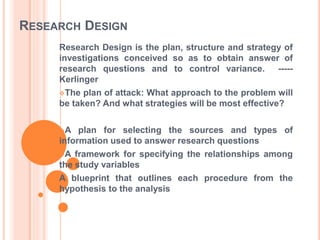
Research Design is the plan, structure and strategy of
investigations conceived so as to obtain answer of
research questions and to control variance. -----
Kerlinger
The plan of attack: What approach to the problem will
be taken? And what strategies will be most effective?
A plan for selecting the sources and types of
information used to answer research questions
A framework for specifying the relationships among
the study variables
A blueprint that outlines each procedure from the
hypothesis to the analysis
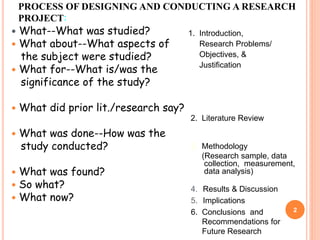
PROCESS OF DESIGNING AND CONDUCTING A RESEARCH
PROJECT:
 What--What was studied?
 What about--What aspects of
the subject were studied?
 What for--What is/was the
significance of the study?
 What did prior lit./research say?
 What was done--How was the
study conducted?
 What was found?
 So what?
 What now?
2
1. Introduction,
Research Problems/
Objectives, &
Justification
2. Literature Review
3. Methodology
(Research sample, data
collection, measurement,
data analysis)
4. Results & Discussion
5. Implications
6. Conclusions and
Recommendations for
Future Research
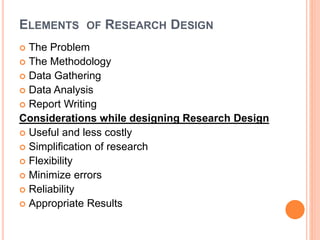
ELEMENTS OF RESEARCH DESIGN
 The Problem
 The Methodology
 Data Gathering
 Data Analysis
 Report Writing
Considerations while designing Research Design
 Useful and less costly
 Simplification of research
 Flexibility
 Minimize errors
 Reliability
 Appropriate Results
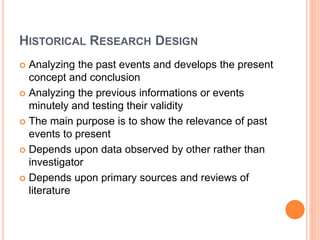
HISTORICAL RESEARCH DESIGN
 Analyzing the past events and develops the present
concept and conclusion
 Analyzing the previous informations or events
minutely and testing their validity
 The main purpose is to show the relevance of past
events to present
 Depends upon data observed by other rather than
investigator
 Depends upon primary sources and reviews of
literature
DESCRIPTIVE RESEARCH DESIGN
 Fact finding from analyzing informations
 Assessing opinions, behaviors and to describe the
situations and events.
 Process of accumulating facts
 Researcher collects, classifies and correlates data
to describe what exists
 Related to prediction and explanation of facts
DEVELOPMENTAL RESEARCH
 Purpose is to predict future trends
 Concentrates on variables, their rate of changes,
directions, sequences and other interrelated factors over
a period of time
 1. Longitudinal growth study: study people or events at
different time periods.
 2. Cross sectional growth study: Data are gathered just
once: perhaps over a period of time.One shot study.
 3. Trend study: Data are collected after a certain time
interval
 4. Cohort Study:Study of a group of people who have
similar characteristics or experience.
EXPLORATORY RESEARCH DESIGN
 Identify problem and analysis of problem where is less
knowledge
 Find new idea in the area developing concepts more
clearly
 Less structured and more flexible
 Gaining knowledge reviewing literatures, enquiring and
interviewing and analyzing qualitative data
 The area may be vague or new
CASE STUDY RESEARCH
 Detail and Intensive analysis of any single events or
units or social issues
 Analyzing the events through observation
 Sources are individual record, diary, letters,
document of office, meeting and seminars etc.
 An intensive, integrated and insightful method of of
studying the social phenomenon
 A generalization drawn from a single case cannot
be applied to all cases..
CORRELATIONAL STUDY
 To ascertain the extent to which two variables are
related
 Changes in one variable accompany changes in
another
 Positive/ Negetive and Zero correlation
Causal Comparative Research
 Investigating the possible causes affecting a
particular situation by observing existing
consequences and searching for the possible
factors leading to this results
 Ex post facto; data are collected after all the events
of interest have occurred
 Considers to one or more Independent variables
EXPERIMENTAL RESEARCH
 Provides strong basis for causal relationship
 Controlling all other variables considering to a few
through observation or experiment
 Can be used in laboratory and work field
 It has manipulation, control and randomization
Quasi Experimental design
 When difficult to apply real experiment research in
social science it can be used
 Strictly control is impossible in social science

Research design

  • 1.
    RESEARCH DESIGN Research Designis the plan, structure and strategy of investigations conceived so as to obtain answer of research questions and to control variance. ----- Kerlinger The plan of attack: What approach to the problem will be taken? And what strategies will be most effective? A plan for selecting the sources and types of information used to answer research questions A framework for specifying the relationships among the study variables A blueprint that outlines each procedure from the hypothesis to the analysis
  • 2.
    PROCESS OF DESIGNINGAND CONDUCTING A RESEARCH PROJECT:  What--What was studied?  What about--What aspects of the subject were studied?  What for--What is/was the significance of the study?  What did prior lit./research say?  What was done--How was the study conducted?  What was found?  So what?  What now? 2 1. Introduction, Research Problems/ Objectives, & Justification 2. Literature Review 3. Methodology (Research sample, data collection, measurement, data analysis) 4. Results & Discussion 5. Implications 6. Conclusions and Recommendations for Future Research
  • 3.
    ELEMENTS OF RESEARCHDESIGN  The Problem  The Methodology  Data Gathering  Data Analysis  Report Writing Considerations while designing Research Design  Useful and less costly  Simplification of research  Flexibility  Minimize errors  Reliability  Appropriate Results
  • 4.
    HISTORICAL RESEARCH DESIGN Analyzing the past events and develops the present concept and conclusion  Analyzing the previous informations or events minutely and testing their validity  The main purpose is to show the relevance of past events to present  Depends upon data observed by other rather than investigator  Depends upon primary sources and reviews of literature
  • 5.
    DESCRIPTIVE RESEARCH DESIGN Fact finding from analyzing informations  Assessing opinions, behaviors and to describe the situations and events.  Process of accumulating facts  Researcher collects, classifies and correlates data to describe what exists  Related to prediction and explanation of facts
  • 6.
    DEVELOPMENTAL RESEARCH  Purposeis to predict future trends  Concentrates on variables, their rate of changes, directions, sequences and other interrelated factors over a period of time  1. Longitudinal growth study: study people or events at different time periods.  2. Cross sectional growth study: Data are gathered just once: perhaps over a period of time.One shot study.  3. Trend study: Data are collected after a certain time interval  4. Cohort Study:Study of a group of people who have similar characteristics or experience.
  • 7.
    EXPLORATORY RESEARCH DESIGN Identify problem and analysis of problem where is less knowledge  Find new idea in the area developing concepts more clearly  Less structured and more flexible  Gaining knowledge reviewing literatures, enquiring and interviewing and analyzing qualitative data  The area may be vague or new
  • 8.
    CASE STUDY RESEARCH Detail and Intensive analysis of any single events or units or social issues  Analyzing the events through observation  Sources are individual record, diary, letters, document of office, meeting and seminars etc.  An intensive, integrated and insightful method of of studying the social phenomenon  A generalization drawn from a single case cannot be applied to all cases..
  • 9.
    CORRELATIONAL STUDY  Toascertain the extent to which two variables are related  Changes in one variable accompany changes in another  Positive/ Negetive and Zero correlation Causal Comparative Research  Investigating the possible causes affecting a particular situation by observing existing consequences and searching for the possible factors leading to this results  Ex post facto; data are collected after all the events of interest have occurred  Considers to one or more Independent variables
  • 10.
    EXPERIMENTAL RESEARCH  Providesstrong basis for causal relationship  Controlling all other variables considering to a few through observation or experiment  Can be used in laboratory and work field  It has manipulation, control and randomization Quasi Experimental design  When difficult to apply real experiment research in social science it can be used  Strictly control is impossible in social science