Sikandar Azam
Presentation about 5 types of research designs
Please share and help other students
sikandarazam866@yahoo.com
The most common research designs used by
natural and social science are:
1. Experimental designs
2. Cross sectional or social survey design
3. Longitudinal design
4. Case study design, and
5. Comparative design
 Common in natural science and positivist paradigms
 Sometime are used in assessing impacts of new reforms or
policies
 Trustworthy and give more confidence in findings
 True experiments tend to be very strong in terms of internal
validity
 With all these strong points of this design why social science is
not making big use of this design?
 The reason is simple: in order to conduct a true experiment, it is
necessary to manipulate independent variable in order to
determine whether it have an influence on the dependent
variable.
 This kind of research deals with one or more groups, each of
which represent different types or levels of variables
 This help how different groups are responsible for variations in
the levels of dependent variable
 In such design, the researcher intervene in the natural set up
 However, in social science it is very hard to manipulate most of
the independent variables
 For example if you are interested in some variation among the
social groups or gender etc you simply cannot designate male as
female or special ethnic group
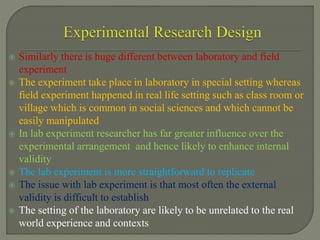
 Similarly there is huge different between laboratory and field
experiment
 The experiment take place in laboratory in special setting whereas
field experiment happened in real life setting such as class room or
village which is common in social sciences and which cannot be
easily manipulated
 In lab experiment researcher has far greater influence over the
experimental arrangement and hence likely to enhance internal
validity
 The lab experiment is more straightforward to replicate
 The issue with lab experiment is that most often the external
validity is difficult to establish
 The setting of the laboratory are likely to be unrelated to the real
world experience and contexts
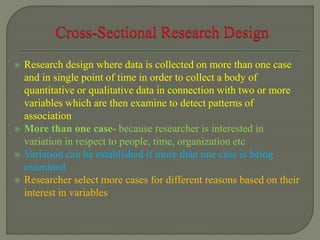
 Research design where data is collected on more than one case
and in single point of time in order to collect a body of
quantitative or qualitative data in connection with two or more
variables which are then examine to detect patterns of
association
 More than one case- because researcher is interested in
variation in respect to people, time, organization etc
 Variation can be established if more than one case is being
examined
 Researcher select more cases for different reasons based on their
interest in variables
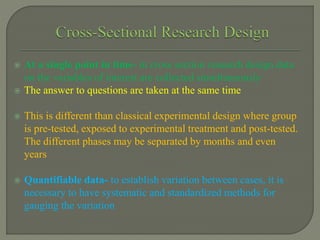
 At a single point in time- in cross section research design data
on the variables of interest are collected simultaneously
 The answer to questions are taken at the same time
 This is different than classical experimental design where group
is pre-tested, exposed to experimental treatment and post-tested.
The different phases may be separated by months and even
years
 Quantifiable data- to establish variation between cases, it is
necessary to have systematic and standardized methods for
gauging the variation
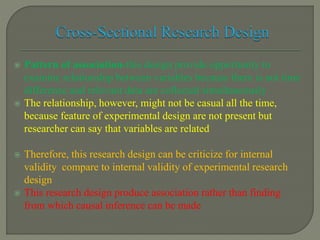
 Pattern of association-this design provide opportunity to
examine relationship between variables because there is not time
difference and relevant data are collected simultaneously
 The relationship, however, might not be casual all the time,
because feature of experimental design are not present but
researcher can say that variables are related
 Therefore, this research design can be criticize for internal
validity compare to internal validity of experimental research
design
 This research design produce association rather than finding
from which causal inference can be made
 The external validity of this research design is strong
 This research design often use variety of research instrument
such as questionnaire, interviews and observations etc therefore,
the ecological validity may be jeopardized because every
instrument disrupt the natural habitat
 This is usually an extended form of cross-sectional research
design based on self-administered questionnaire, structured
interview etc
 In term of validity, replication and reliability is little different
than the cross-sectional design
 This research design, however, can allow some insight into the
time order of variables and hence more able to allow casual
inferences from it
 In this design a sample is surveyed and is survey again on at
least one further occasion
 The longitudinal research design could be panel study, cohort
study and case study
 In panel, researcher observe exactly the same people, group,
organization across time period
 This type of research is formidable and costly, as tracking
people over time is often difficult as some might die or cannot
be located
 However, the result of such study is valuable
 The cohort study under the longitudinal research is similar to
panel study, but rather than observing exactly the same people, a
category of people who share a similar life experience in a
specified time period is studied
 Here the focus is on cohort and not specific individual, such as
people born in the same year, all students who graduate from
Oxford in the same semester could be your cohort
 Unlike panel, researcher do not have to locate exactly same
people for cohort study
 Detail and intensive analysis of a single case
 A single community, school, family, person, event or
organization etc
 In case study, a researcher examine features on many people or
units either at one time period or across time period
 In both cases a researcher examine a common set of features on
many cases
 The researcher examine in-depth, many features of a few cases
over a duration of time
 The data of such research could be in detail and varied
 Here the research select one or few cases to illustrate the issue
 It connect the micro level action with macro level structure
 The emphasis is on intensive examination of the setting
 Common in qualitative research as one need detail data about the
individual or phenomenon but it could be used in quantitative
research
 Sometime placed within the cross-sectional research and it could
also be in any other research design
 For example someone study couples in a single location to
examine the ‘impact of male employment on family and marital
status’
 Critical cases (for example studying group believe on end of the
world which did not happened and now you want to study how
people respond to the thwarted expectations)
 Unique cases (common in clinical study but with restricted
external validity)
 General Cases (it could be any case within the broad group of
people)
 Examining a case in relation to which one get engage in
theoretical analysis
 The central issue of concern is the quality of the theoretical
reasoning in which the case study researcher engages
 How well the do the data support the theoretical arguments that
are generated?
 The crucial question is not whether the findings can be
generalized to a wider universe, but how well the researcher
generate theory out of the findings
 This view put case study research in the inductive tradition of
the relationship between theory and research but the design is
not always like this as case study be located in both ‘theory
generation’ and ‘theory testing’
 The study using more or less identical methods of two
contrasting cases
 It embodies the logic of comparison and implies that we can
understand social phenomenon better when they are compared
in relation to two or more contrasting cases or situation
 For example studying same phenomenon in two different
countries, institutions, customs, life styles etc)
 This design use the same research instruments
 The logic of comparison can be applied to variety of situations
 This research design help improve theory building, by
comparing two or more cases and where the research argue
whether the theory will hold or not

Research Designs

  • 1.
    Sikandar Azam Presentation about5 types of research designs Please share and help other students sikandarazam866@yahoo.com
  • 2.
    The most commonresearch designs used by natural and social science are: 1. Experimental designs 2. Cross sectional or social survey design 3. Longitudinal design 4. Case study design, and 5. Comparative design
  • 3.
     Common innatural science and positivist paradigms  Sometime are used in assessing impacts of new reforms or policies  Trustworthy and give more confidence in findings  True experiments tend to be very strong in terms of internal validity  With all these strong points of this design why social science is not making big use of this design?  The reason is simple: in order to conduct a true experiment, it is necessary to manipulate independent variable in order to determine whether it have an influence on the dependent variable.
  • 4.
     This kindof research deals with one or more groups, each of which represent different types or levels of variables  This help how different groups are responsible for variations in the levels of dependent variable  In such design, the researcher intervene in the natural set up  However, in social science it is very hard to manipulate most of the independent variables  For example if you are interested in some variation among the social groups or gender etc you simply cannot designate male as female or special ethnic group
  • 5.
     Similarly thereis huge different between laboratory and field experiment  The experiment take place in laboratory in special setting whereas field experiment happened in real life setting such as class room or village which is common in social sciences and which cannot be easily manipulated  In lab experiment researcher has far greater influence over the experimental arrangement and hence likely to enhance internal validity  The lab experiment is more straightforward to replicate  The issue with lab experiment is that most often the external validity is difficult to establish  The setting of the laboratory are likely to be unrelated to the real world experience and contexts
  • 6.
     Research designwhere data is collected on more than one case and in single point of time in order to collect a body of quantitative or qualitative data in connection with two or more variables which are then examine to detect patterns of association  More than one case- because researcher is interested in variation in respect to people, time, organization etc  Variation can be established if more than one case is being examined  Researcher select more cases for different reasons based on their interest in variables
  • 7.
     At asingle point in time- in cross section research design data on the variables of interest are collected simultaneously  The answer to questions are taken at the same time  This is different than classical experimental design where group is pre-tested, exposed to experimental treatment and post-tested. The different phases may be separated by months and even years  Quantifiable data- to establish variation between cases, it is necessary to have systematic and standardized methods for gauging the variation
  • 8.
     Pattern ofassociation-this design provide opportunity to examine relationship between variables because there is not time difference and relevant data are collected simultaneously  The relationship, however, might not be casual all the time, because feature of experimental design are not present but researcher can say that variables are related  Therefore, this research design can be criticize for internal validity compare to internal validity of experimental research design  This research design produce association rather than finding from which causal inference can be made
  • 9.
     The externalvalidity of this research design is strong  This research design often use variety of research instrument such as questionnaire, interviews and observations etc therefore, the ecological validity may be jeopardized because every instrument disrupt the natural habitat
  • 10.
     This isusually an extended form of cross-sectional research design based on self-administered questionnaire, structured interview etc  In term of validity, replication and reliability is little different than the cross-sectional design  This research design, however, can allow some insight into the time order of variables and hence more able to allow casual inferences from it  In this design a sample is surveyed and is survey again on at least one further occasion
  • 11.
     The longitudinalresearch design could be panel study, cohort study and case study  In panel, researcher observe exactly the same people, group, organization across time period  This type of research is formidable and costly, as tracking people over time is often difficult as some might die or cannot be located  However, the result of such study is valuable
  • 12.
     The cohortstudy under the longitudinal research is similar to panel study, but rather than observing exactly the same people, a category of people who share a similar life experience in a specified time period is studied  Here the focus is on cohort and not specific individual, such as people born in the same year, all students who graduate from Oxford in the same semester could be your cohort  Unlike panel, researcher do not have to locate exactly same people for cohort study
  • 13.
     Detail andintensive analysis of a single case  A single community, school, family, person, event or organization etc  In case study, a researcher examine features on many people or units either at one time period or across time period  In both cases a researcher examine a common set of features on many cases  The researcher examine in-depth, many features of a few cases over a duration of time  The data of such research could be in detail and varied  Here the research select one or few cases to illustrate the issue  It connect the micro level action with macro level structure
  • 14.
     The emphasisis on intensive examination of the setting  Common in qualitative research as one need detail data about the individual or phenomenon but it could be used in quantitative research  Sometime placed within the cross-sectional research and it could also be in any other research design  For example someone study couples in a single location to examine the ‘impact of male employment on family and marital status’  Critical cases (for example studying group believe on end of the world which did not happened and now you want to study how people respond to the thwarted expectations)  Unique cases (common in clinical study but with restricted external validity)  General Cases (it could be any case within the broad group of people)
  • 15.
     Examining acase in relation to which one get engage in theoretical analysis  The central issue of concern is the quality of the theoretical reasoning in which the case study researcher engages  How well the do the data support the theoretical arguments that are generated?  The crucial question is not whether the findings can be generalized to a wider universe, but how well the researcher generate theory out of the findings  This view put case study research in the inductive tradition of the relationship between theory and research but the design is not always like this as case study be located in both ‘theory generation’ and ‘theory testing’
  • 16.
     The studyusing more or less identical methods of two contrasting cases  It embodies the logic of comparison and implies that we can understand social phenomenon better when they are compared in relation to two or more contrasting cases or situation  For example studying same phenomenon in two different countries, institutions, customs, life styles etc)  This design use the same research instruments  The logic of comparison can be applied to variety of situations  This research design help improve theory building, by comparing two or more cases and where the research argue whether the theory will hold or not