

Qualitative Research
Narrative method
Narrative Research
By Dr. Neha Deo
Qualitative research Methods
• Researchers describe the lives of individuals, collect and tell
stories about people‘s lives & write narratives of individual
experiences .(Connelly & Clandinin, 1990)
What is Narrative research?
• People live storied lives. They tell stories to share their lives with others
and to provide their personal accounts about classrooms, schools,
educational issues, and the settings in which they work.
• Cresswell
What is Narrative research?
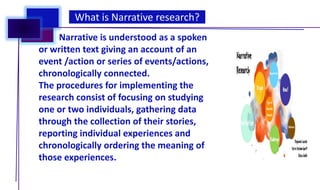
Narrative is understood as a spoken
or written text giving an account of an
event /action or series of events/actions,
chronologically connected.
The procedures for implementing the
research consist of focusing on studying
one or two individuals, gathering data
through the collection of their stories,
reporting individual experiences and
chronologically ordering the meaning of
those experiences.
• Willing to tell & report someone stories & the stories follow a
chronology of events.
• When we want to describe life of any
Individual, collect & tell story about people
Lives & write narratives of individual
experiences.
• When anyone wants to use a viable way
to study teachers, students & educators.
When to use narrative research?
• Development of Narrative Research
Narrative research emerged as a
popular form of qualitative
research. It has become viable
way to study teachers, students
& educators in educational
settings.
Development of Narrative Research
• Development of Narrative Research
Narrative inquiries describe the lives of
individuals, collect & tell stories about
people’s lives, and write narratives of
individual experiences. A researcher
uses narrative designs when
individuals are willing to provide their
stories ,when their stories follow a
chronology.
Development of Narrative Research
1. Who writes or Records The Story?
2. How Much of a Life is Recorded &
Presented?
3. Who Provides the Story?
4. Is a Theoretical Lens Being Used?
5. Can Narrative Forms Be Combined
Determining type of Narrative Study
Examples of type of Narrative Research
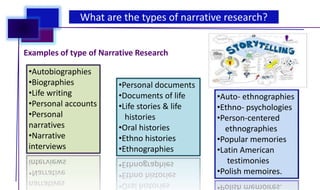
What are the types of narrative research?
•Autobiographies
•Biographies
•Life writing
•Personal accounts
•Personal
narratives
•Narrative
interviews
•Personal documents
•Documents of life
•Life stories & life
histories
•Oral histories
•Ethno histories
•Ethnographies
•Auto- ethnographies
•Ethno- psychologies
•Person-centered
ethnographies
•Popular memories
•Latin American
testimonies
•Polish memoires.
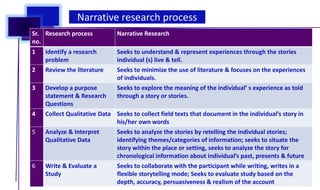
Sr.
no.
Research process Narrative Research
1 Identify a research
problem
Seeks to understand & represent experiences through the stories
individual (s) live & tell.
2 Review the literature Seeks to minimize the use of literature & focuses on the experiences
of individuals.
3 Develop a purpose
statement & Research
Questions
Seeks to explore the meaning of the individual’ s experience as told
through a story or stories.
4 Collect Qualitative Data Seeks to collect field texts that document in the individual’s story in
his/her own words
5 Analyze & Interpret
Qualitative Data
Seeks to analyze the stories by retelling the individual stories;
identifying themes/categories of information; seeks to situate the
story within the place or setting, seeks to analyze the story for
chronological information about individual’s past, presents & future
6 Write & Evaluate a
Study
Seeks to collaborate with the participant while writing, writes in a
flexible storytelling mode; Seeks to evaluate study based on the
depth, accuracy, persuasiveness & realism of the account
Narrative research process
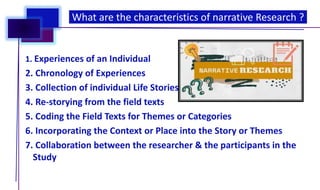
1. Experiences of an Individual
2. Chronology of Experiences
3. Collection of individual Life Stories
4. Re-storying from the field texts
5. Coding the Field Texts for Themes or Categories
6. Incorporating the Context or Place into the Story or Themes
7. Collaboration between the researcher & the participants in the
Study
What are the characteristics of narrative Research ?
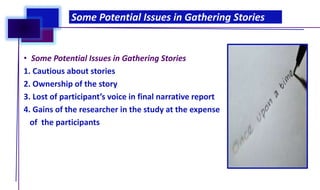
• Some Potential Issues in Gathering Stories
1. Cautious about stories
2. Ownership of the story
3. Lost of participant’s voice in final narrative report
4. Gains of the researcher in the study at the expense
of the participants
Some Potential Issues in Gathering Stories
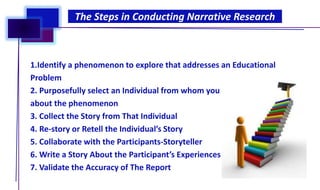
1.Identify a phenomenon to explore that addresses an Educational
Problem
2. Purposefully select an Individual from whom you can learn
about the phenomenon
3. Collect the Story from That Individual
4. Re-story or Retell the Individual’s Story
5. Collaborate with the Participants-Storyteller
6. Write a Story About the Participant’s Experiences
7. Validate the Accuracy of The Report
The Steps in Conducting Narrative Research
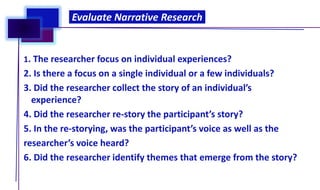
1. The researcher focus on individual experiences?
2. Is there a focus on a single individual or a few individuals?
3. Did the researcher collect the story of an individual’s
experience?
4. Did the researcher re-story the participant’s story?
5. In the re-storying, was the participant’s voice as well as the
researcher’s voice heard?
6. Did the researcher identify themes that emerge from the story?
Evaluate Narrative Research
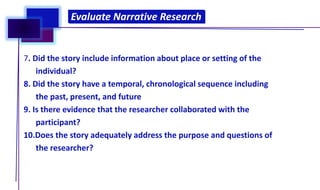
7. Did the story include information about place or setting of the
individual?
8. Did the story have a temporal, chronological sequence including
the past, present, and future
9. Is there evidence that the researcher collaborated with the
participant?
10.Does the story adequately address the purpose and questions of
the researcher?
Evaluate Narrative Research
Reference
Cresswell,J.W.(2011). Educational Research: New Delhi ;Prentice Hall of
India learning private limited (4th edn)
Narrative Research

Narrative research for slideshare upload.pptx

  • 1.
    Qualitative Research Narrative method NarrativeResearch By Dr. Neha Deo Qualitative research Methods
  • 2.
    • Researchers describethe lives of individuals, collect and tell stories about people‘s lives & write narratives of individual experiences .(Connelly & Clandinin, 1990) What is Narrative research?
  • 3.
    • People livestoried lives. They tell stories to share their lives with others and to provide their personal accounts about classrooms, schools, educational issues, and the settings in which they work. • Cresswell What is Narrative research?
  • 4.
    What is Narrativeresearch? Narrative is understood as a spoken or written text giving an account of an event /action or series of events/actions, chronologically connected. The procedures for implementing the research consist of focusing on studying one or two individuals, gathering data through the collection of their stories, reporting individual experiences and chronologically ordering the meaning of those experiences.
  • 5.
    • Willing totell & report someone stories & the stories follow a chronology of events. • When we want to describe life of any Individual, collect & tell story about people Lives & write narratives of individual experiences. • When anyone wants to use a viable way to study teachers, students & educators. When to use narrative research?
  • 6.
    • Development ofNarrative Research Narrative research emerged as a popular form of qualitative research. It has become viable way to study teachers, students & educators in educational settings. Development of Narrative Research
  • 7.
    • Development ofNarrative Research Narrative inquiries describe the lives of individuals, collect & tell stories about people’s lives, and write narratives of individual experiences. A researcher uses narrative designs when individuals are willing to provide their stories ,when their stories follow a chronology. Development of Narrative Research
  • 8.
    1. Who writesor Records The Story? 2. How Much of a Life is Recorded & Presented? 3. Who Provides the Story? 4. Is a Theoretical Lens Being Used? 5. Can Narrative Forms Be Combined Determining type of Narrative Study
  • 9.
    Examples of typeof Narrative Research What are the types of narrative research? •Autobiographies •Biographies •Life writing •Personal accounts •Personal narratives •Narrative interviews •Personal documents •Documents of life •Life stories & life histories •Oral histories •Ethno histories •Ethnographies •Auto- ethnographies •Ethno- psychologies •Person-centered ethnographies •Popular memories •Latin American testimonies •Polish memoires.
  • 10.
    Sr. no. Research process NarrativeResearch 1 Identify a research problem Seeks to understand & represent experiences through the stories individual (s) live & tell. 2 Review the literature Seeks to minimize the use of literature & focuses on the experiences of individuals. 3 Develop a purpose statement & Research Questions Seeks to explore the meaning of the individual’ s experience as told through a story or stories. 4 Collect Qualitative Data Seeks to collect field texts that document in the individual’s story in his/her own words 5 Analyze & Interpret Qualitative Data Seeks to analyze the stories by retelling the individual stories; identifying themes/categories of information; seeks to situate the story within the place or setting, seeks to analyze the story for chronological information about individual’s past, presents & future 6 Write & Evaluate a Study Seeks to collaborate with the participant while writing, writes in a flexible storytelling mode; Seeks to evaluate study based on the depth, accuracy, persuasiveness & realism of the account Narrative research process
  • 11.
    1. Experiences ofan Individual 2. Chronology of Experiences 3. Collection of individual Life Stories 4. Re-storying from the field texts 5. Coding the Field Texts for Themes or Categories 6. Incorporating the Context or Place into the Story or Themes 7. Collaboration between the researcher & the participants in the Study What are the characteristics of narrative Research ?
  • 12.
    • Some PotentialIssues in Gathering Stories 1. Cautious about stories 2. Ownership of the story 3. Lost of participant’s voice in final narrative report 4. Gains of the researcher in the study at the expense of the participants Some Potential Issues in Gathering Stories
  • 13.
    1.Identify a phenomenonto explore that addresses an Educational Problem 2. Purposefully select an Individual from whom you can learn about the phenomenon 3. Collect the Story from That Individual 4. Re-story or Retell the Individual’s Story 5. Collaborate with the Participants-Storyteller 6. Write a Story About the Participant’s Experiences 7. Validate the Accuracy of The Report The Steps in Conducting Narrative Research
  • 14.
    1. The researcherfocus on individual experiences? 2. Is there a focus on a single individual or a few individuals? 3. Did the researcher collect the story of an individual’s experience? 4. Did the researcher re-story the participant’s story? 5. In the re-storying, was the participant’s voice as well as the researcher’s voice heard? 6. Did the researcher identify themes that emerge from the story? Evaluate Narrative Research
  • 15.
    7. Did thestory include information about place or setting of the individual? 8. Did the story have a temporal, chronological sequence including the past, present, and future 9. Is there evidence that the researcher collaborated with the participant? 10.Does the story adequately address the purpose and questions of the researcher? Evaluate Narrative Research Evaluate Narrative Research
  • 16.
    Reference Cresswell,J.W.(2011). Educational Research:New Delhi ;Prentice Hall of India learning private limited (4th edn)
  • 17.