RESEARCH DESIGN
• Theconceptual structure within which research is
conducted; it constitutes the collection, measurement, and
analysis of data.
• The research design provides the backbone structure of the
study; it supports the study and holds it together.
3.
RESEARCH DESIGN
The researcher’soverall plan for answering the research questions
or testing the research hypotheses.
A framework or blueprint for the research plan of action.
The planned sequence of the entire process involved in conducting
a research study
4.
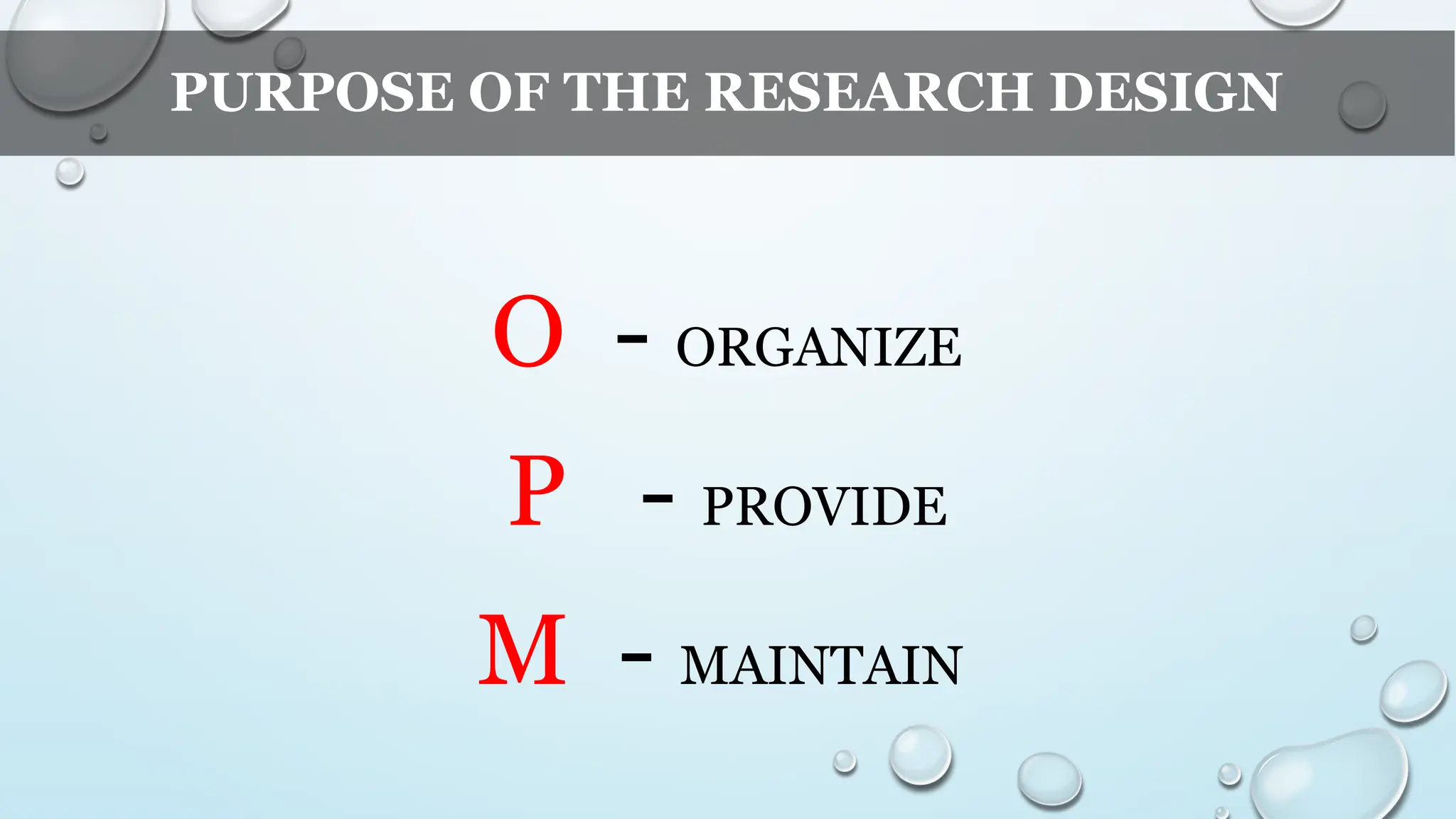
PURPOSE OF THERESEARCH DESIGN
O - ORGANIZE
P - PROVIDE
M - MAINTAIN
5.
PARTS OF RESEARCHDESIGN
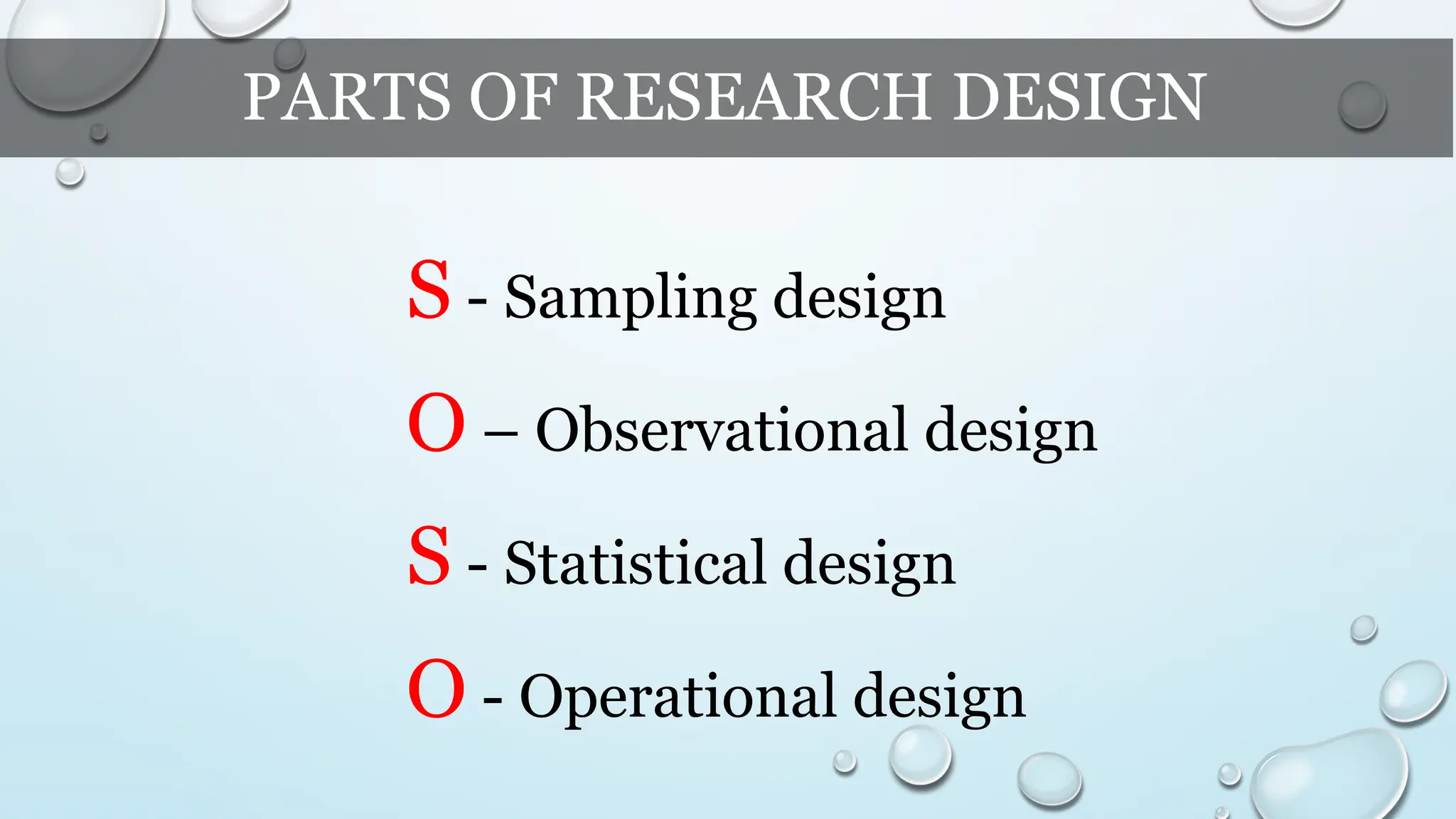
S - Sampling design
O – Observational design
S - Statistical design
O - Operational design
6.
ADVANTAGES OF RESEARCHDESIGN
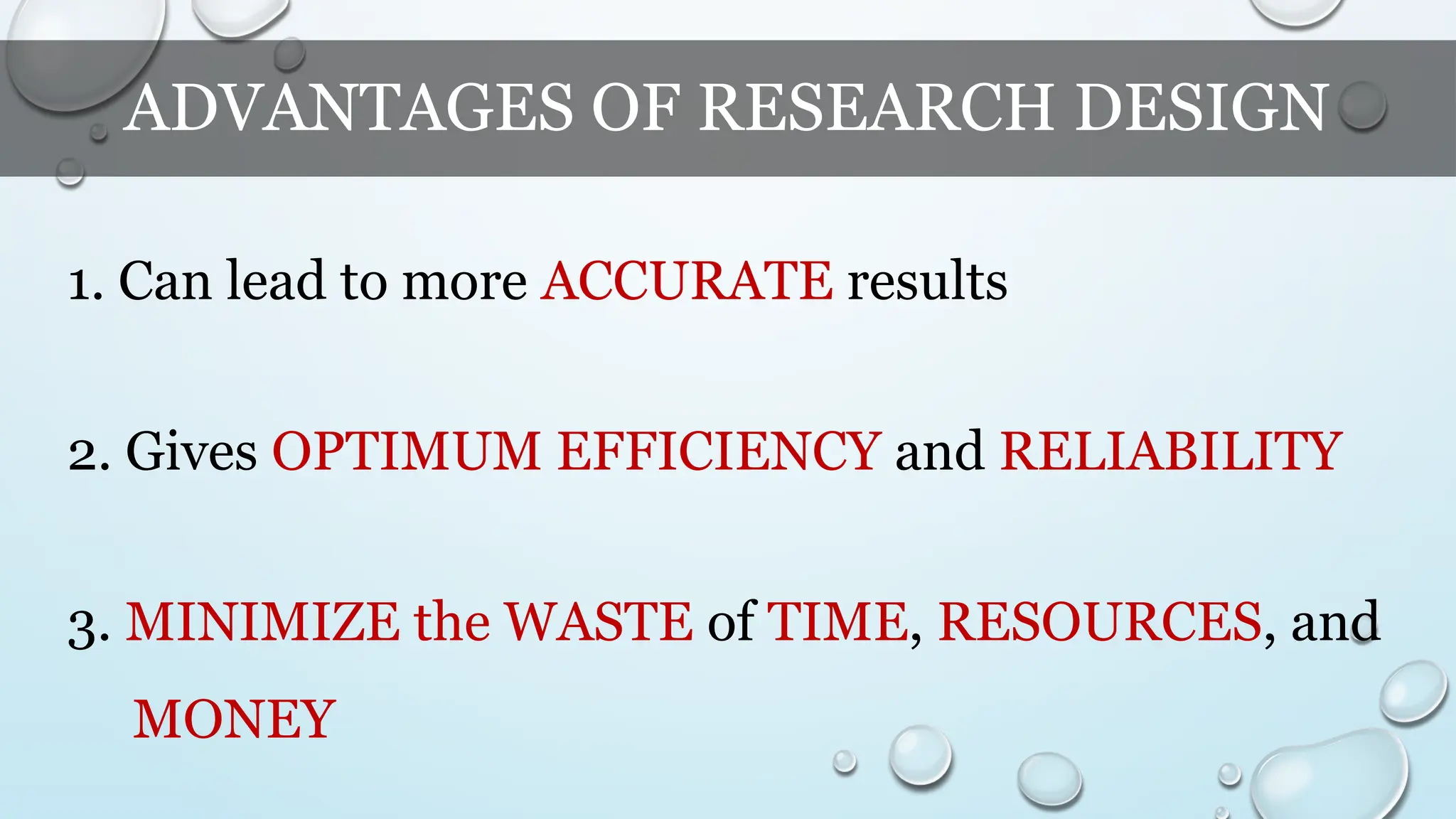
1. Can lead to more ACCURATE results
2. Gives OPTIMUM EFFICIENCY and RELIABILITY
3. MINIMIZE the WASTE of TIME, RESOURCES, and
MONEY
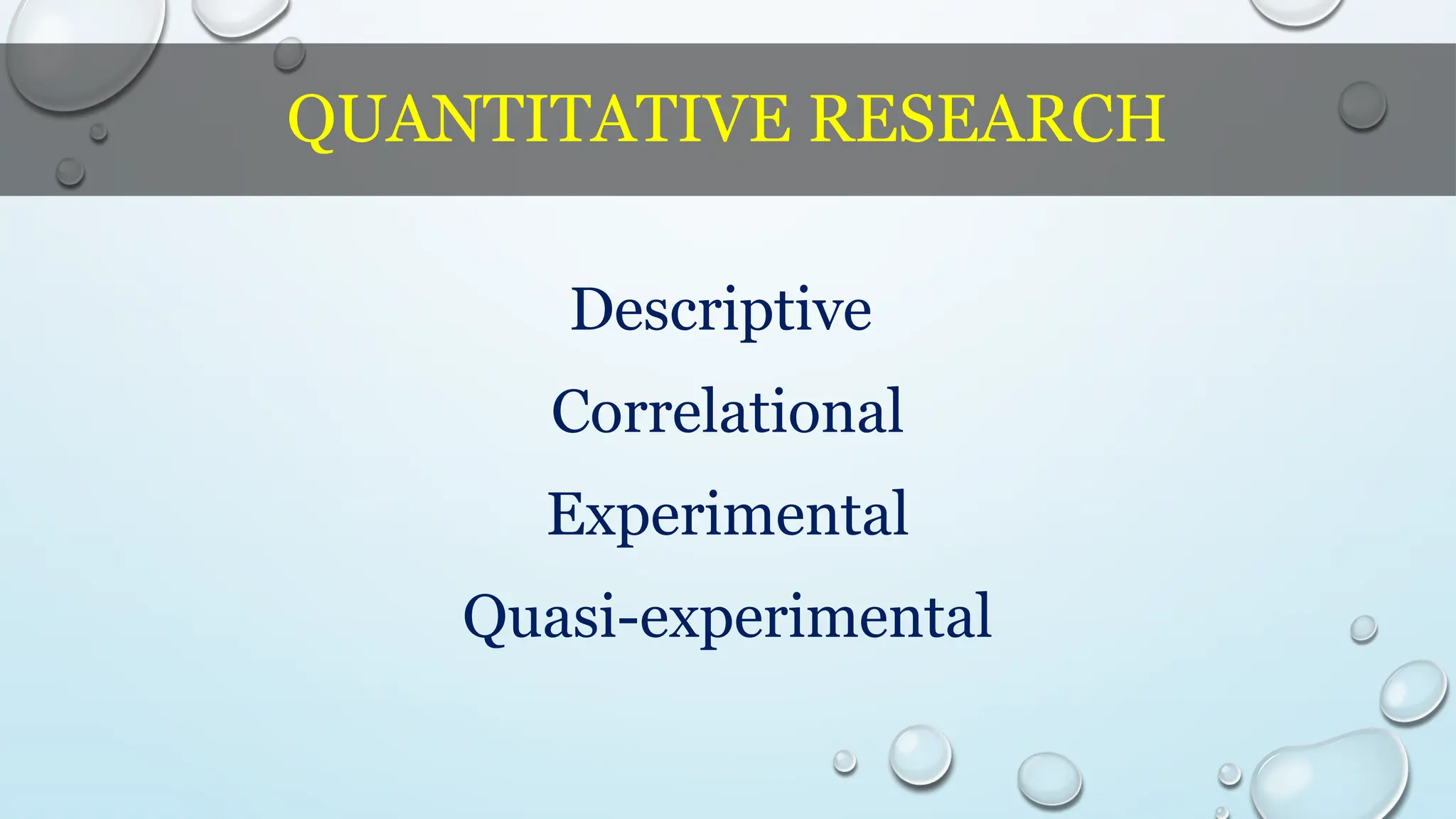
DESCRIPTIVE RESEARCH DESIGN
Describing existing conditions, behaviors, or
characteristics by systemically gathering information
without manipulating variables.
There are no intervention on the researcher’s part –
only data collection.
10.
KEY ATTRIBUTES:
It purelydescribes the situation.
It does not explore potential relationships between
different variables or the causes that may underlie
those relationships.
Useful for generating insight into a research
problem by describing its characteristics.
11.
CORRELATIONAL RESEARCH DESIGN
Identifyand measure the relationship between two
or more variables without manipulating them.
Type of research design that is useful when you
want to know whether a change in one thing tends to
be accompanied by a change in another thing.
12.
KEY ATTRIBUTES:
Useful whenexploring potential relationships between
variables that cannot be manipulated or controlled for
ethical, practical, and logistical reason.
Helpful in developing predictions.
Can be implemented at a large scale.
13.
EXPERIMENTAL RESEARCH DESIGN
Useto determine if there is a causal relationship
between two or more variables.
Type of research design that allows the researcher to
manipulate one variable (the independent variable)
while controlling others (dependent variables).
14.
KEY ATTRIBUTES:
Provides researcherswith a powerful way to identify
and measure causal relationships between variables.
Small sample sizes
Reduced statistical power
Random assignment
15.
QUASI-EXPERIMENTAL
Used whenthe research aims to identify causal
relations but one cannot or doesn’t want to
randomly assign participants to different groups
for practical or ethical reasons.
16.
KEY ATTRIBUTES:
Moredifficult to confidently establish causality
between variables.
The researcher has less control over other variables
that may impact the findings.
Can be undertaken on a much larger scale than
experimental research design.
PHENOMENOLOGICAL R-DESIGN
Explores themeaning of lived experiences.
Seeks to understand people’s perspectives, emotions, and
behaviors in specific situations.
Aim to uncover the essence of human experience without
making any assumptions or imposing preconceived ideas on
their subjects.
GROUNDED THEORY R-DESIGN
Alsoknow as “GT” aims to develop theories by
continuously and iteratively analyzing and comparing data
collected from a relatively large number of participants in a
study.
Letting the data to speak for itself without being influenced
by preexisting theories 0r the researcher’s preconceptions.
21.
GROUNDED THEORY R-DESIGN
Typicallyinvolves collecting data through interviews or
observations and then analyzing it to identify patterns and
themes that emerge from the data.
These emerging ideas are then validated by collecting more
data until a saturation point is reached (i.e., no new
information can be squeezed from the data). From that
base, a theory can then be developed.
22.
GROUNDED THEORY R-DESIGN
Suitedto studies where the research aims involve theory
generation, especially in under-researched areas.
Type of research design can be quite time-intensive, given
the need for multiple rounds of data collection and analysis
23.
ETHNOGRAPHIC RESEARCH DESIGN
Involvesobserving and studying a culture-sharing
group of people in their natural setting to gain insight
into their behaviors, beliefs, and values.
The focus is to observe participants in their natural
environment (as opposed to a controlled environment).
24.
ETHNOGRAPHIC RESEARCH DESIGN
Thistypically involves the researcher spending an
extended period of time with the participants in
their environment, carefully observing and taking
field notes.
25.
ETHNOGRAPHIC RESEARCH DESIGN
Alsoinvolves in-depth interviews to explore
participants’ views, beliefs, etc.
However, unobtrusive observation is a core
component of the ethnographic approach.
26.
CASE STUDY RESEARCHDESIGN
The researcher, investigates a single individual
(or a single group of individuals) to gain an in-
depth understanding of their experiences,
behaviors, or outcomes in this design.
27.
CASE STUDY RESEARCHDESIGN
Unlike other research designs that are aimed at
larger sample sizes, case studies offer a deep dive
into the specific circumstances surrounding a
person, group of people, event, or phenomenon,
generally within a bounded setting or context.
28.
CASE STUDY RESEARCHDESIGN
Case study research designs can have different
variations;
- single-case
- multiple-case
- longitudinal case
29.
CASE STUDY RESEARCHDESIGN
Single-case design involves intensely
examining a single entity to understand its
unique characteristics and complexities.
30.
CASE STUDY RESEARCHDESIGN
Multiple-case design, multiple cases are
compared and contrasted to identify
patterns and commonalities
31.
CASE STUDY RESEARCHDESIGN
Longitudinal case design, a single case or
multiple cases are studied over an
extended period of time to understand how
factors develop over time. In longitudinal
32.
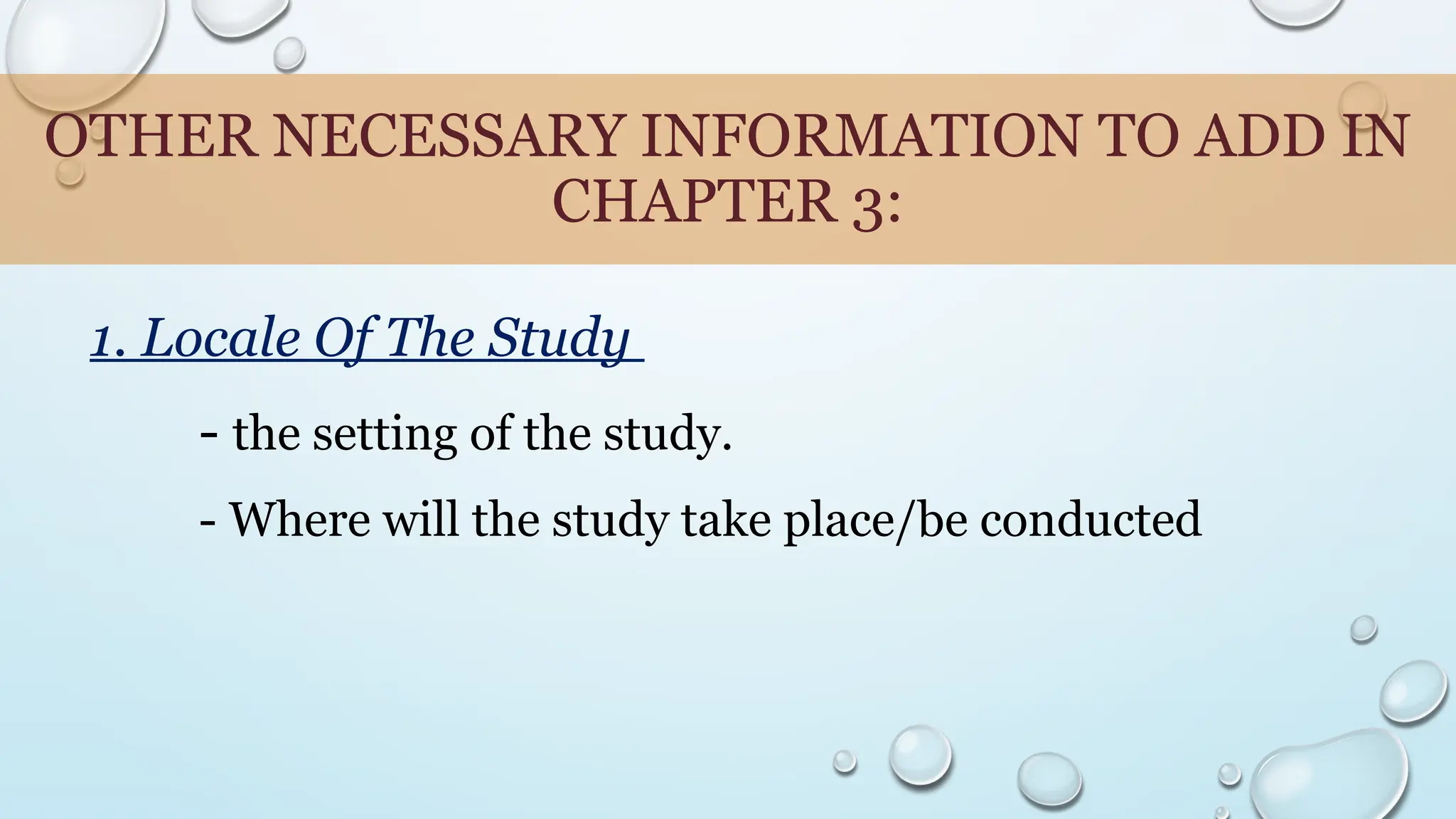
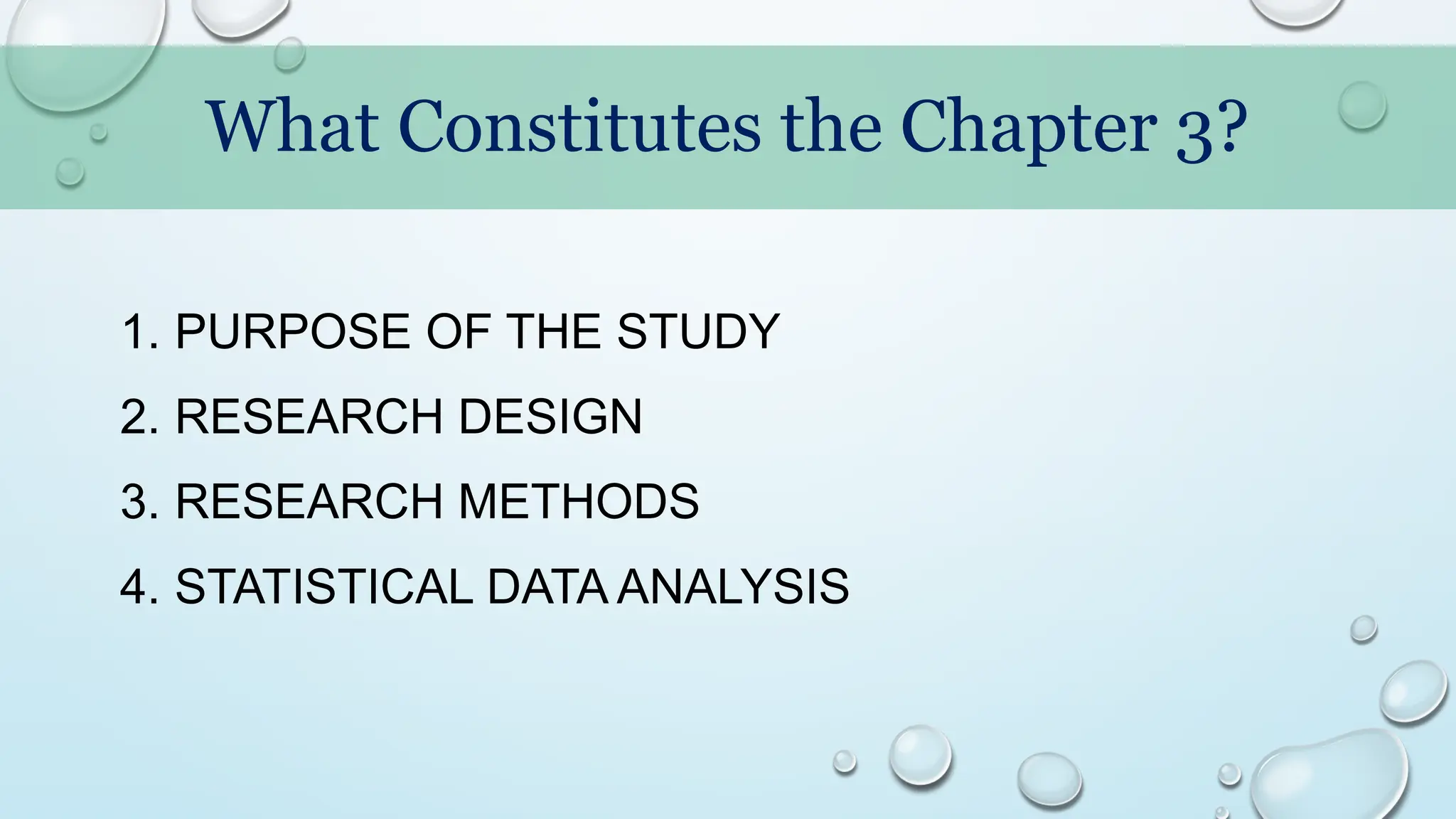
OTHER NECESSARY INFORMATIONTO ADD IN
CHAPTER 3:
Locale Of The Study
Population And Sampling Techniques
Data Gathering Procedure
Research Instrument
Statistical Analysis/Treatment
33.
OTHER NECESSARY INFORMATIONTO ADD IN
CHAPTER 3:
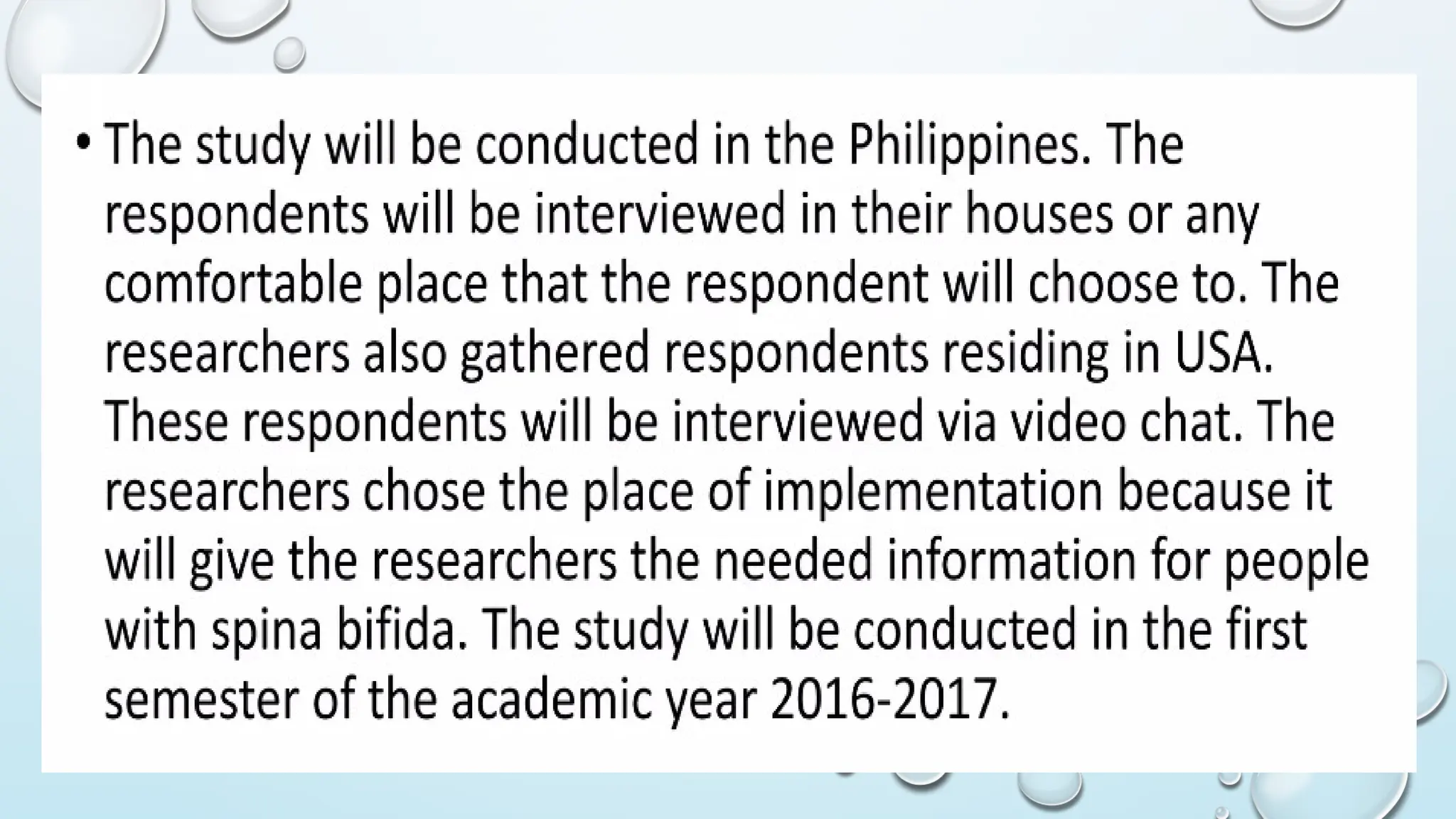
1. Locale Of The Study
- the setting of the study.
- Where will the study take place/be conducted
35.
OTHER NECESSARY INFORMATIONTO ADD IN
CHAPTER 3:
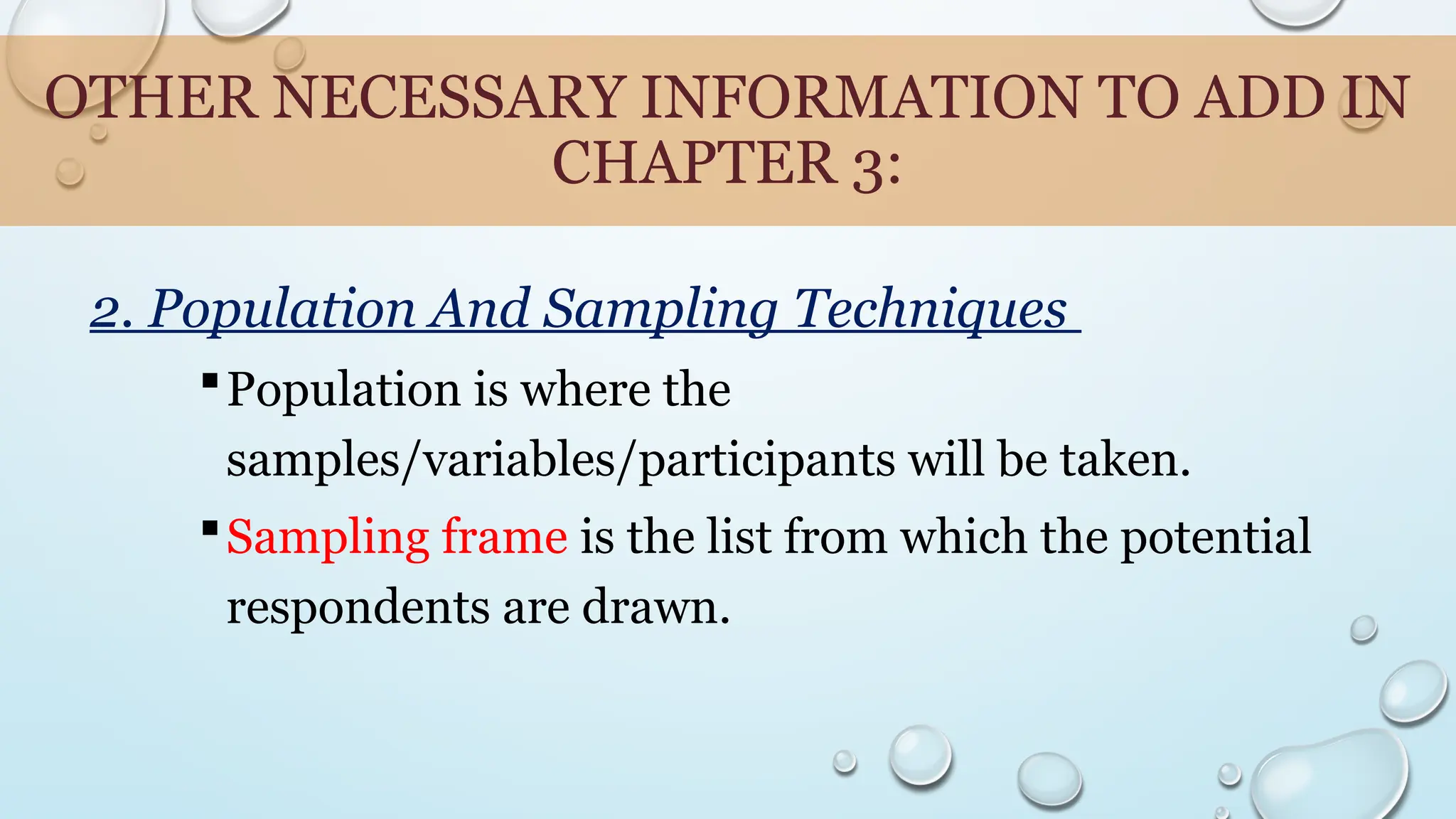
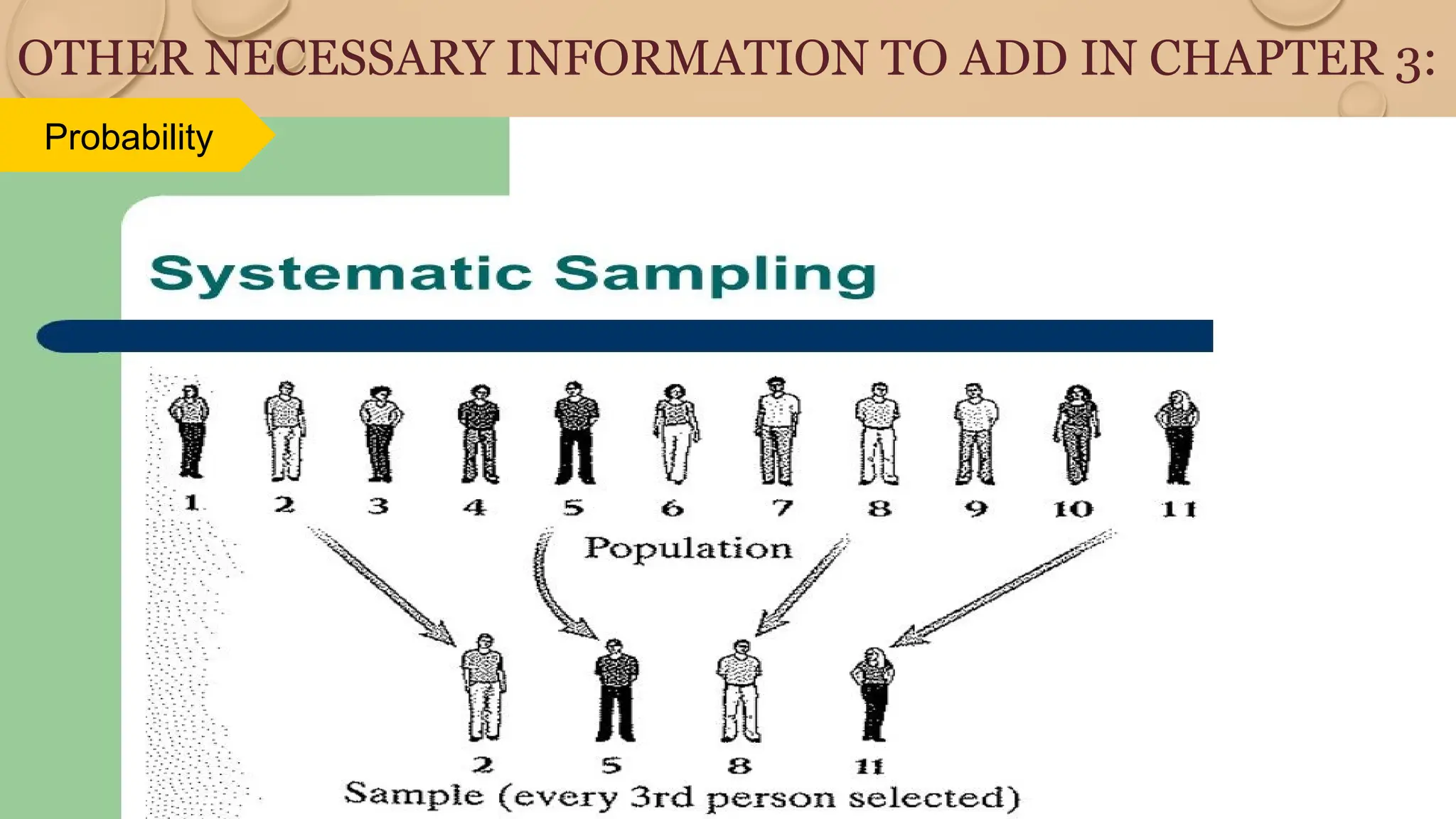
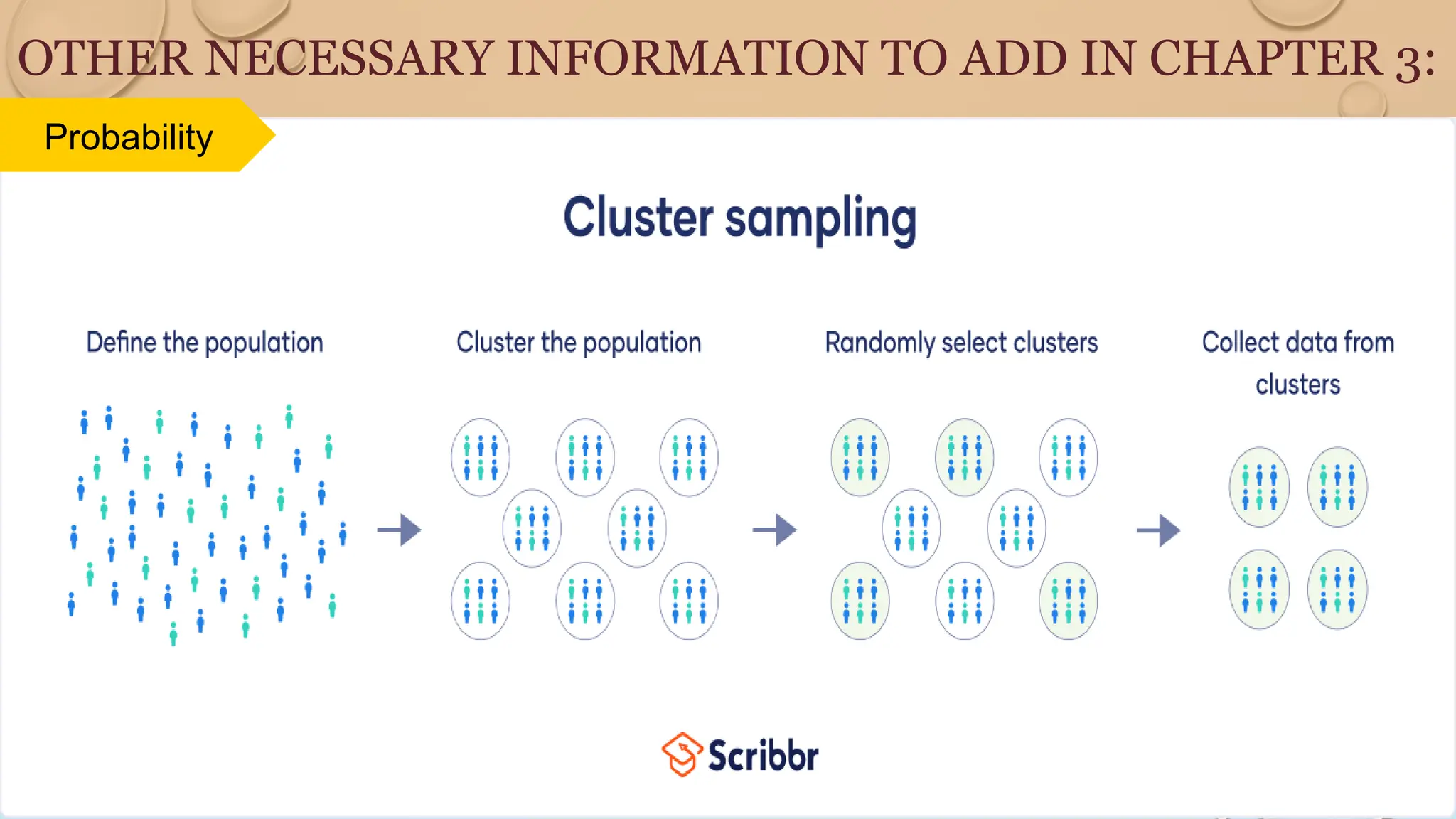
2. Population And Sampling Techniques
Population is where the
samples/variables/participants will be taken.
Sampling frame is the list from which the potential
respondents are drawn.
36.
OTHER NECESSARY INFORMATIONTO ADD IN
CHAPTER 3:
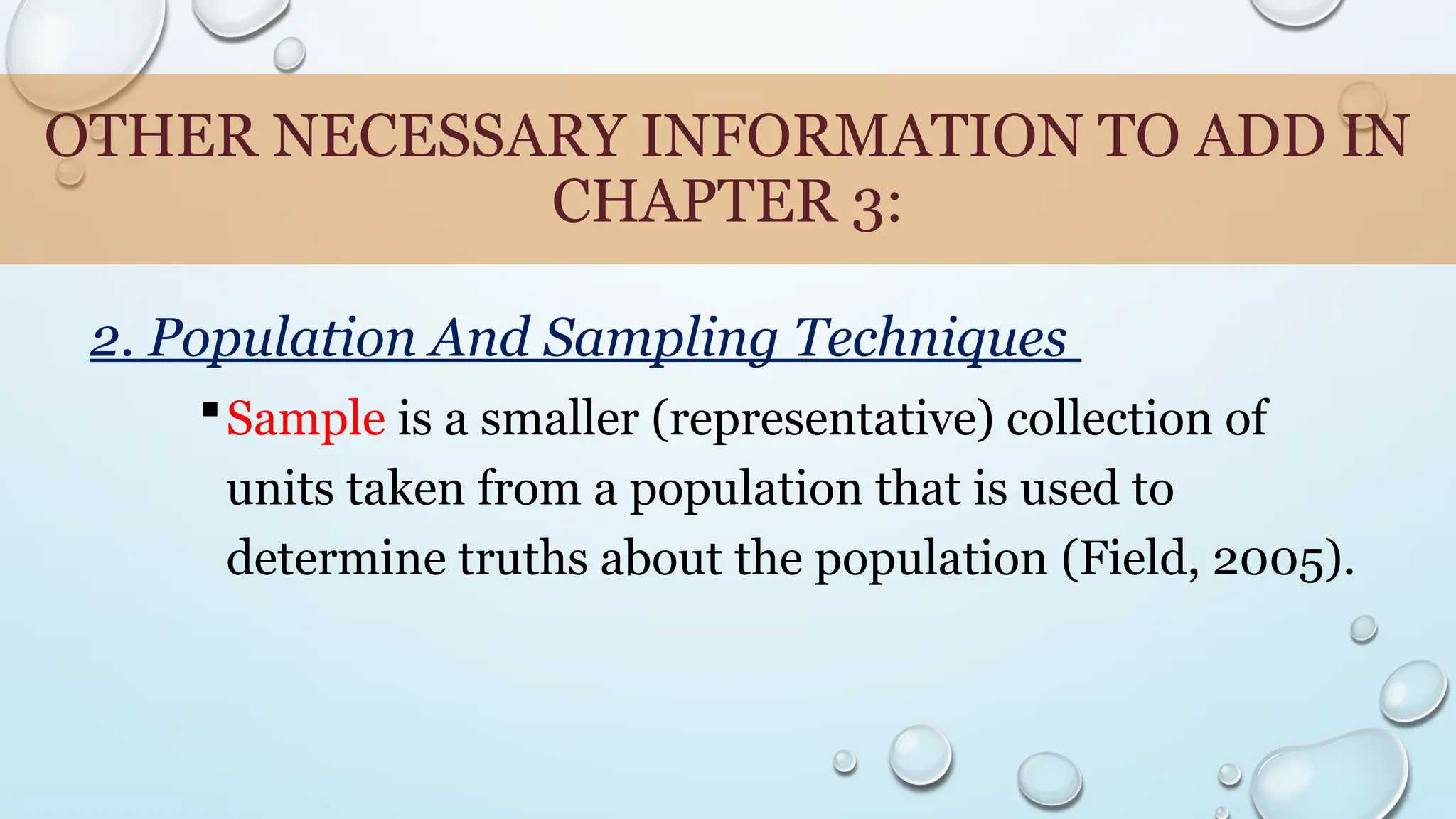
2. Population And Sampling Techniques
Sample is a smaller (representative) collection of
units taken from a population that is used to
determine truths about the population (Field, 2005).
37.
OTHER NECESSARY INFORMATIONTO ADD IN
CHAPTER 3:
2. Population And Sampling Techniques
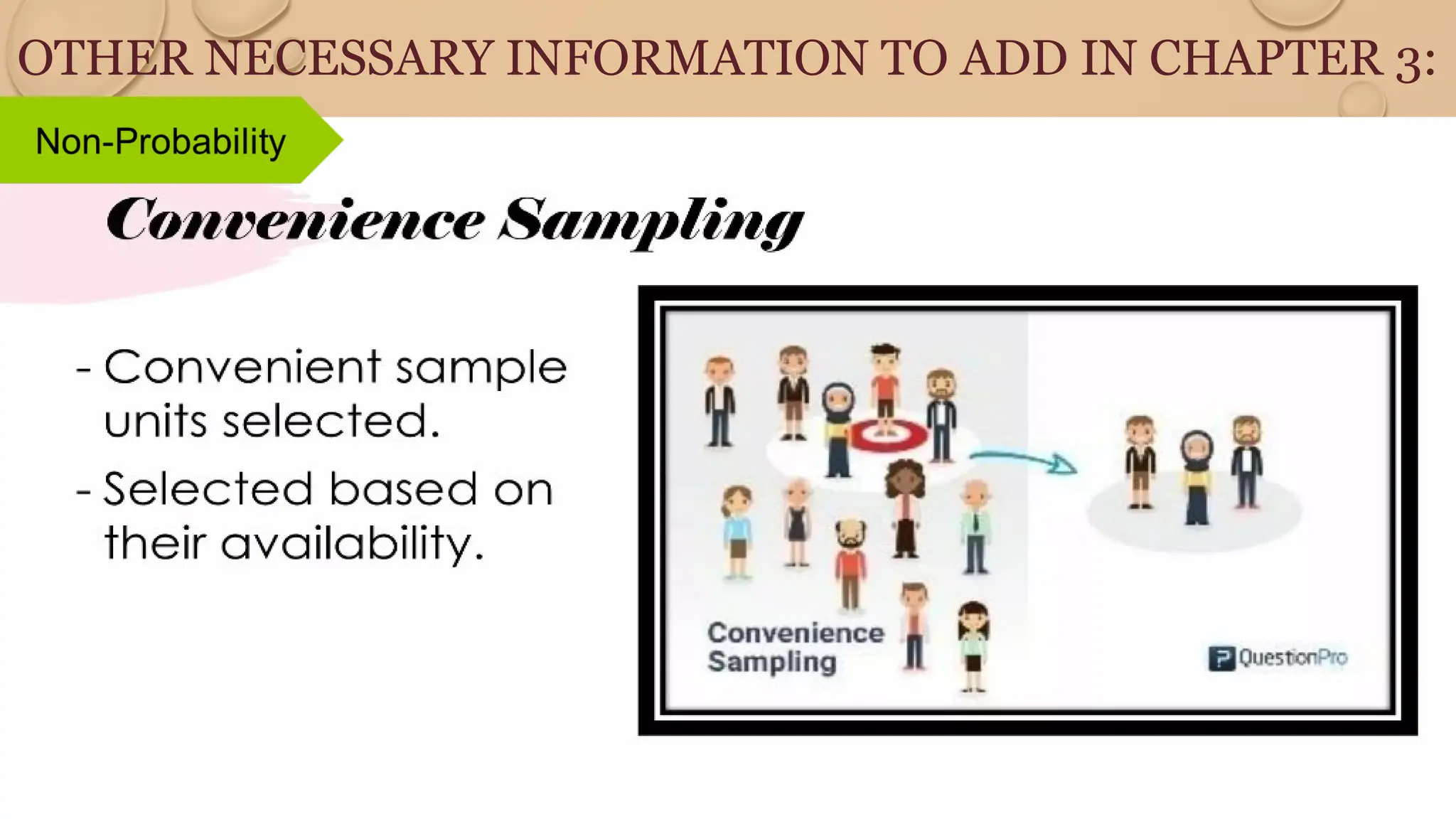
Sampling is the process of learning about the
population on the basis of a sample drawn from it.
OTHER NECESSARY INFORMATIONTO ADD IN
CHAPTER 3:
3. Data Gathering Procedure
Data collection is a systematic process of gathering
observations or measurements.
The primary and most important part of research.
48.
OTHER NECESSARY INFORMATIONTO ADD IN
CHAPTER 3:
3. Data Gathering Procedure
Step 1: Define the aim of your research
Step 2: Choose your data collection method
Step 3: Plan your data collection procedures
Step 4: Collect the data
49.
OTHER NECESSARY INFORMATIONTO ADD IN
CHAPTER 3:
4. Research Instrument
A tool used to obtain, measure, and analyze data
from the subjects around the research topic.
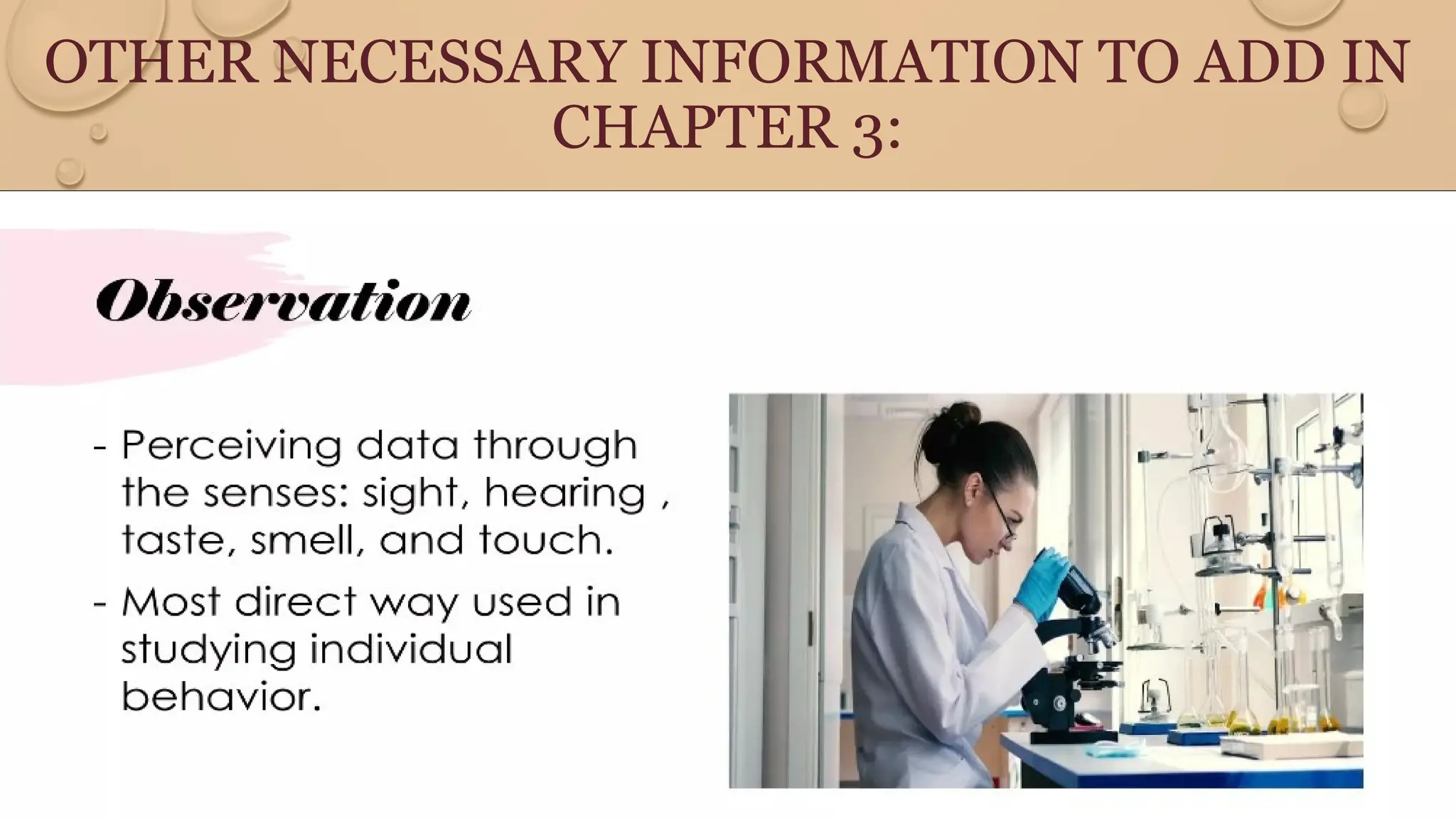
The tools are Questionnaire, Interview, Observation,
and Checklist.
OTHER NECESSARY INFORMATIONTO ADD IN
CHAPTER 3:
5. Statistical Treatment
A way of removing bias to the study by interpreting
data statistically.
a process of taking raw data and turning it into
something that can be interpreted and used to make
decisions.
55.
OTHER NECESSARY INFORMATIONTO ADD IN
CHAPTER 3:
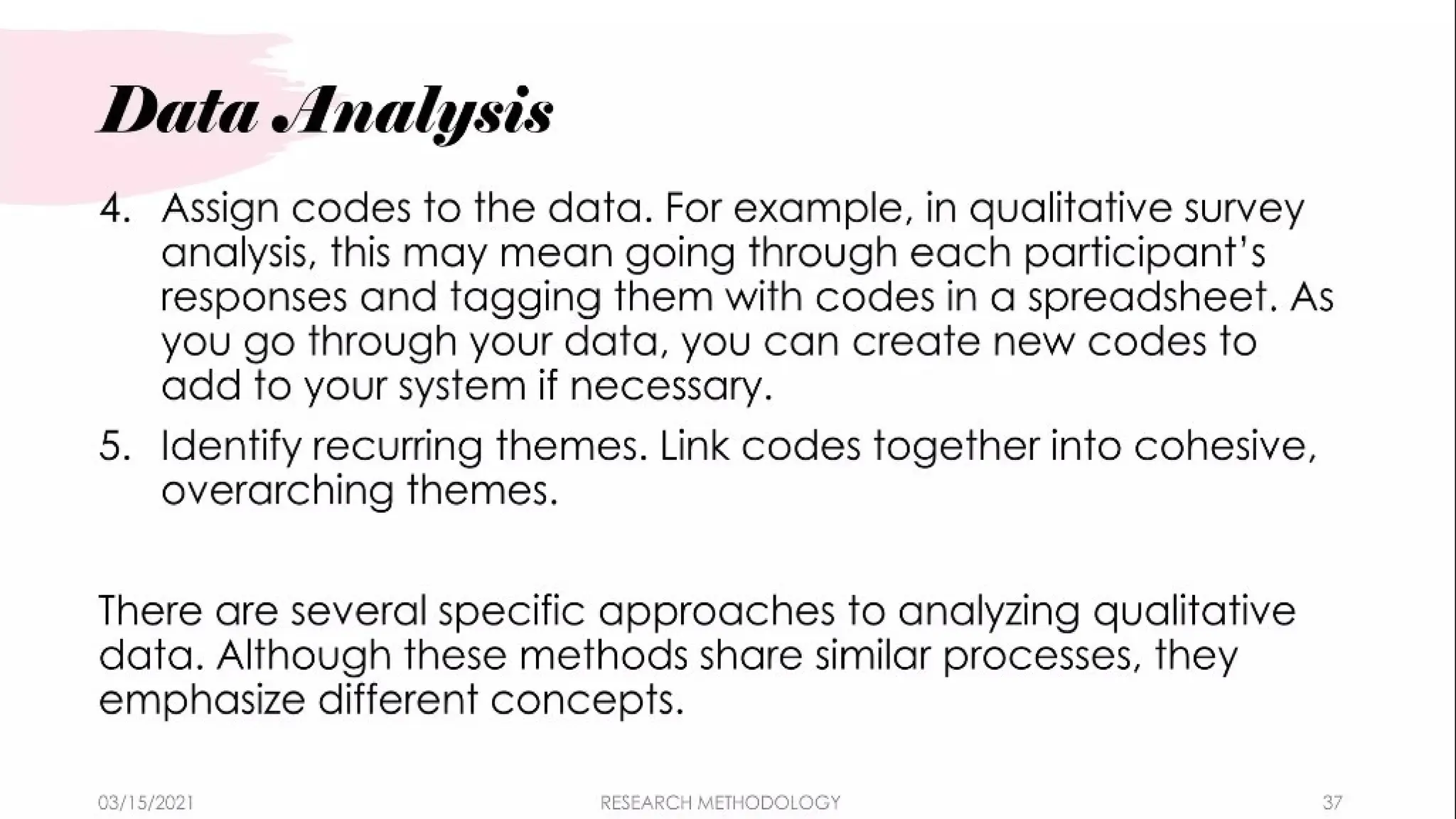
DATA ANALYSIS - The process of inspecting,
cleansing, transforming, and modeling data with
the goal of discovering useful information,
informing conclusions, and supporting decision-
making.