Statement of Research Problem
A research problem is a definite or
clear expression [statement] about :
• an area of concern
• a condition to be improved
• a difficulty to be eliminated
Research problems refer to questions
raised in a research project which clearly
reflects what kind of answers is
expected to be discovered through the
process of research (Ary, Jacobs,
Razavieh, 1979:42).
A Problem Statement Must Pass ROC Test.
 Researchable - the problem can be answered by
collecting and analyzing data. (Doable)
 Original.
Can be a repetitive study with new
population/passage of time.
 Contributory.
Make a difference in profession.
In society.
Your Problem Statement
What is the overriding problem?
Retention; inability to adapt to change; poor
working conditions; inequities; lack of
evaluation of a program; conflict in: ethics,
values,morals…
Where is the problem found?
Manufacturing; education; health
government; society; corporate America…
What needs to be done to solve the
problem?
Survey; interview; create a new model;
what experts believe; evaluate; meta-analyze,
conduct experiment; benchmark…
Problem Statement
 In 200 words or less (about 1-2 paragraphs) you need to
convince the reader that this study MUST be done!
 Society, or one of its institutions has some pressing
problem that needs closer attention. You will provide
evidence that this problem is serious and in need of
investigation.
 You will convince the reader that the problem can be
solved.
Problem Statement
The researcher (you) will solve some part of this
serious problem in a unique and clever way.
You will explain what specific methodology will be
used to solve the problem.
The reader will know that it is important that this
study be done!
A Problem Statement Must Elucidate:
Importance- needs to have theoretical or practical importance.
What type of research will be employed?
What population will be investigated? - Why was this
population chosen?
Specify the variables- how are the variables related and how
they will be measured?
And it must be: clear, concise, and lucid.
The purpose of a problem statement is to:
Introduce the reader to the importance of
the topic being studied.
The reader is oriented to the significance of
the study and the research questions,
hypotheses, or assumptions to follow.
Place the topic into a particular context
that defines the parameters of what is to be
investigated.
Provide the framework for reporting the results
indicates what is probably necessary to
conduct the study and explain how the
findings will present this information.
Problem statements can be:
•formal (e.g., thesis statements), or
•informal (e.g., a sentence that tells
readers how a new development or
discovery will effect them)
An example of a formal problem statement
would be the thesis statement that should
appear at the outset of your document.
For Example:
One of the problems faced by college admissions
offices is whether to give precedence to applicants
with strong test scores or to applicants with a
variety of extracurricular activities
Formal Problem Statements
When using formal problem statements
be sure to keep them specific, state only
what you:
•Will be discussing in text of the
document, and
•Can support with evidence.
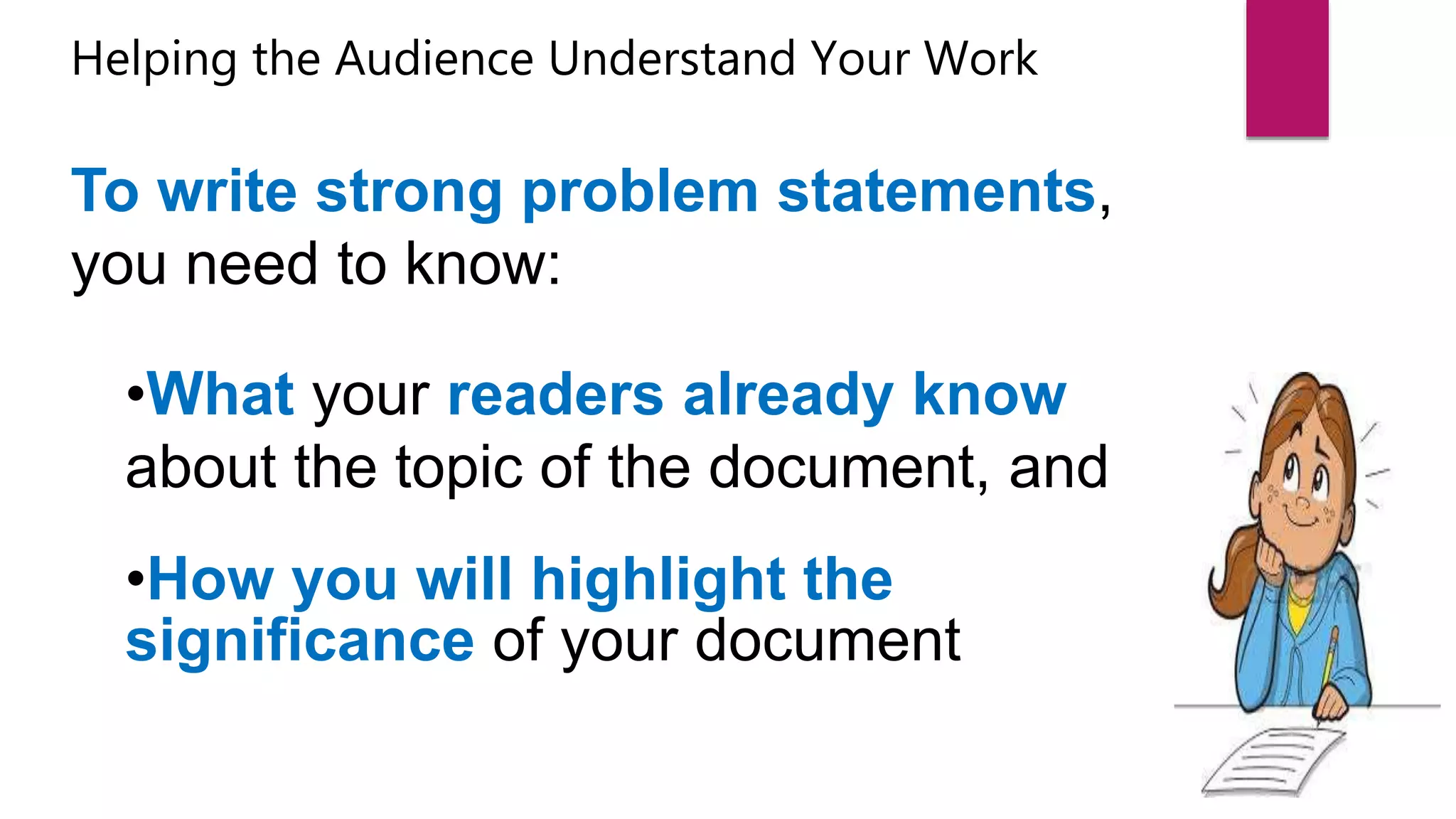
Helping the Audience Understand Your Work
To write strong problem statements,
you need to know:
•What your readers already know
about the topic of the document, and
•How you will highlight the
significance of your document
Kinds of Knowledge
You need to analyze your audience and
gauge their knowledge of the following areas:
•Terminology
•Shared beliefs/mindsets
•Canonical works
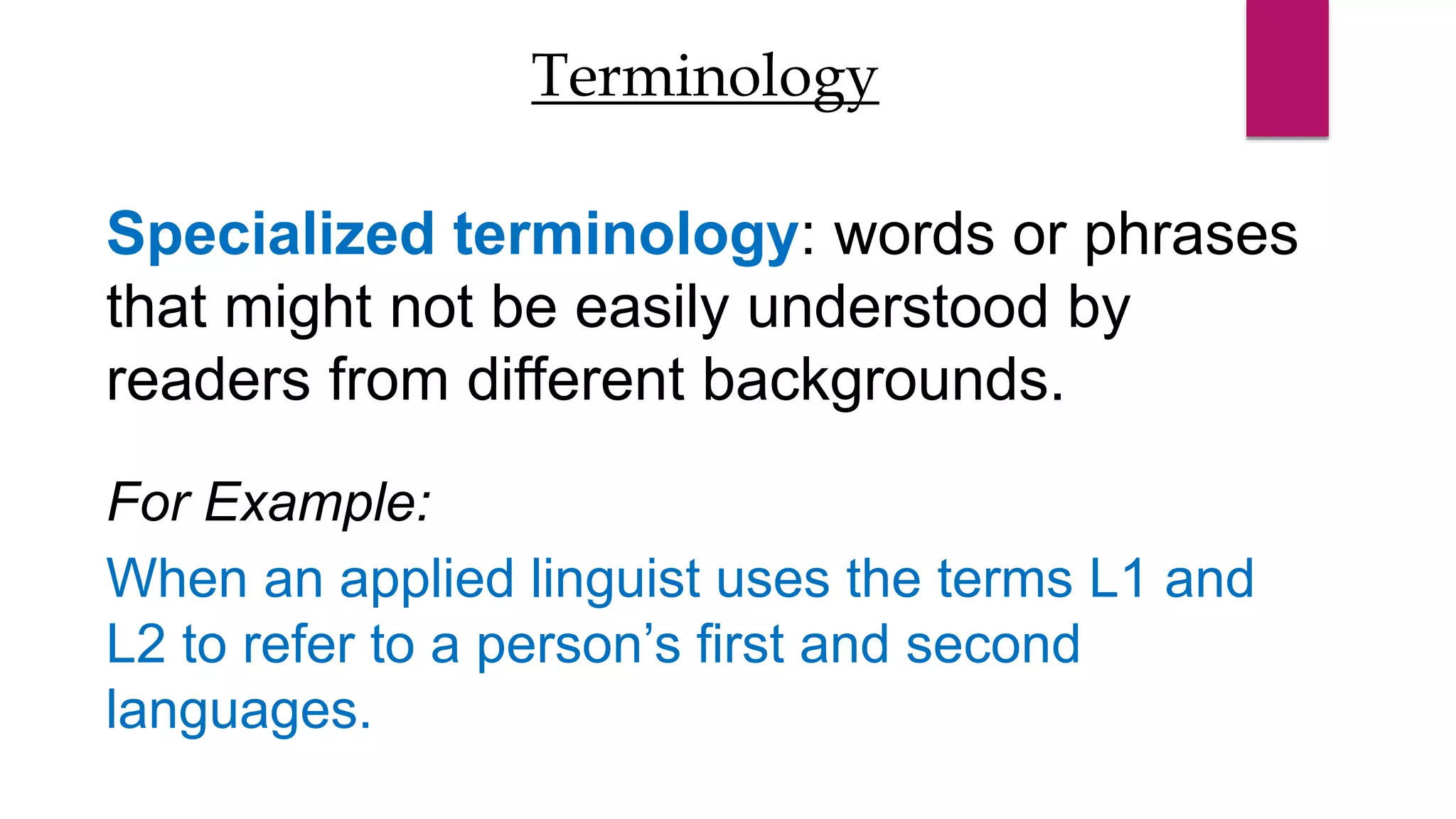
Specialized terminology: words or phrases
that might not be easily understood by
readers from different backgrounds.
For Example:
When an applied linguist uses the terms L1 and
L2 to refer to a person’s first and second
languages.
Terminology
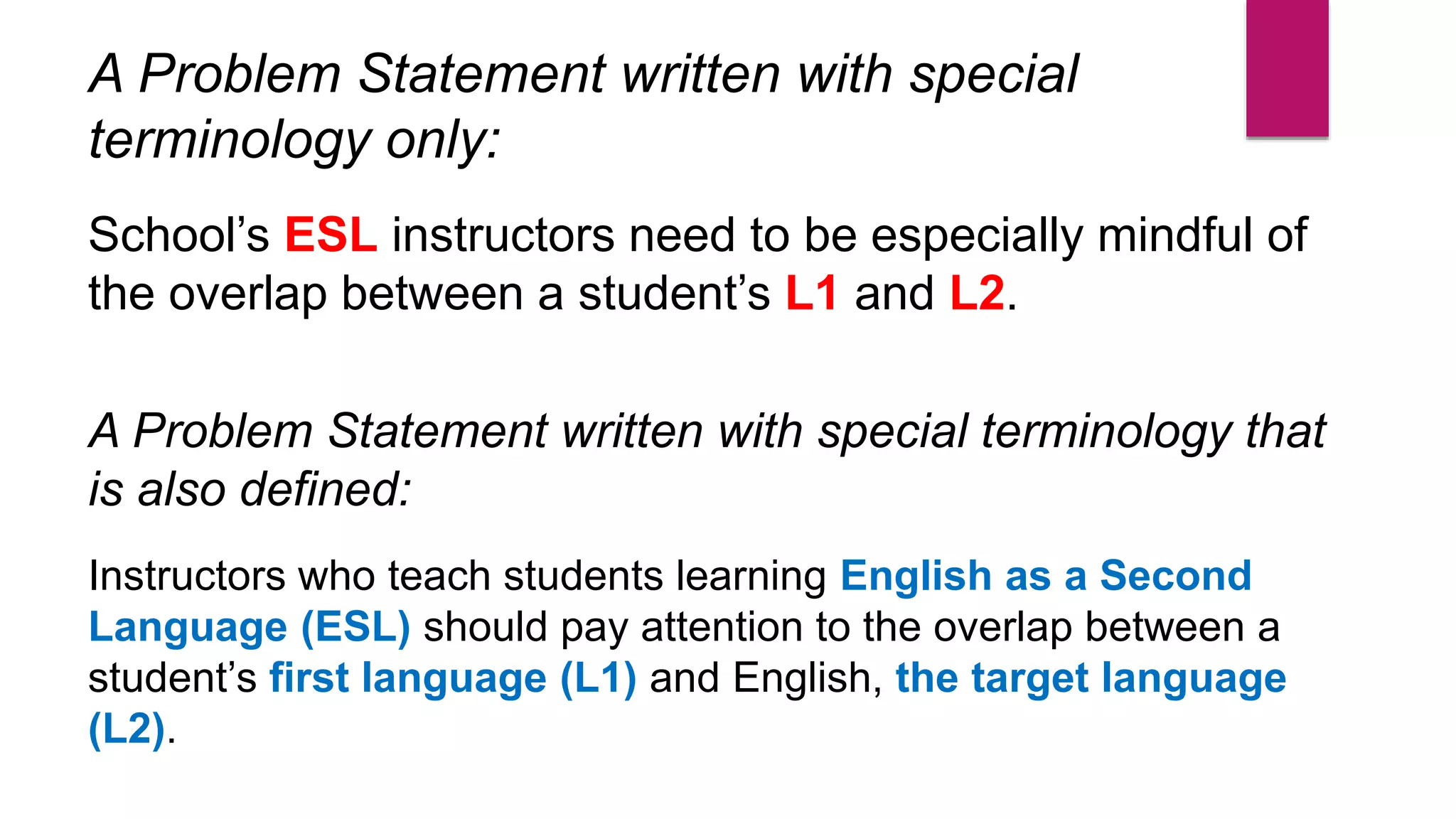
A Problem Statement written with special
terminology only:
School’s ESL instructors need to be especially mindful of
the overlap between a student’s L1 and L2.
A Problem Statement written with special terminology that
is also defined:
Instructors who teach students learning English as a Second
Language (ESL) should pay attention to the overlap between a
student’s first language (L1) and English, the target language
(L2).
The idea of shared beliefs and mindsets
relates to the values an audience holds
and how these can change the way that
they interpret or understand the
statements you make. Shared beliefs and
mindsets often appear in the
assumptions that underlie a text.
Shared Beliefs and Mindsets
1. Contains underlying assumptions about shared beliefs:
“We believe this research could lead to a development of more
specialized techniques for treating the autism spectrum.”
2. States the underlying assumptions in specific terms:
“…and such techniques are important because the autism spectrum
encompasses a number of disorders, and right now there is not
enough specialized treatment for each specific disorder.”
Shared Beliefs and Mindsets - Examples
Canonical research refers to texts or theories that
the majority of experts in a field accept as
significant.
For Example:
• Einstein's theory of general relativity in physics
• Ferris’ and Trustcott’s competing views on error
correction in second language writing
• The Pythagorean Theorem in geometry
Canonical Research
Problem Statement 1
 The Department of Justice (DOJ) found that minority
applicants are disproportionately denied business
loans (Boyd, 2002). It is important to investigate how
the required monitoring data, reported by decision
(accept/deny) and geography (Census tract,) and the
means of obtaining the loan (face-to-face/electronic)
could be used to develop strategies to correct unfair
lending practices.
Problem Statement 2
 Alternative education programs offer an option for disaffected and
disenfranchised students who would otherwise dropout or be
pushed out of school. For the past 30 years, a growing number of
alternative education programs across the United States have helped
at-risk students achieve academic success (Duke & Griesdorn, 1999;
Freeman, 2000; Meyers, 2001). There has been extensive inquiry into
a variety of alternative education programs describing alternative
education programs by approach (i.e., type I, transformative; type II,
punitive; and, type III, therapeutic) (Kellmayer, 1995; Lehr & Lange,
2000, 2003; Raywid, 1994).
Problem Statement F
There, however, has been little formal inquiry into the leadership
and managerial practices that advance transitioning an alternative
education program from a marginally effective type III to a more
effective type I approach as presented by Raywid’s (1994)
alternative school typology. To confirm, challenge, or extend this
typology in a natural and unique setting, and provide a holistic
understanding of this cultural system of action to leaders involved in
alternative education programs and policy it is important that a case
study be conducted.
References
PROBLEM STATEMENTS
By Patti Poblete and Tristan Abbott
Brought to you in cooperation with the Purdue Online Writing Lab
https://www.academia.edu/Papers/Upload?cb=https%3A%2F%2Fwww.aca
demia.edu%2FNotifications&section=Papers
http://www.slideshare.net/drjayeshpatidar/research-problem-20719286

Statement of research problem

  • 1.
  • 2.
    A research problemis a definite or clear expression [statement] about : • an area of concern • a condition to be improved • a difficulty to be eliminated
  • 3.
    Research problems referto questions raised in a research project which clearly reflects what kind of answers is expected to be discovered through the process of research (Ary, Jacobs, Razavieh, 1979:42).
  • 4.
    A Problem StatementMust Pass ROC Test.  Researchable - the problem can be answered by collecting and analyzing data. (Doable)  Original. Can be a repetitive study with new population/passage of time.  Contributory. Make a difference in profession. In society.
  • 5.
    Your Problem Statement Whatis the overriding problem? Retention; inability to adapt to change; poor working conditions; inequities; lack of evaluation of a program; conflict in: ethics, values,morals…
  • 6.
    Where is theproblem found? Manufacturing; education; health government; society; corporate America… What needs to be done to solve the problem? Survey; interview; create a new model; what experts believe; evaluate; meta-analyze, conduct experiment; benchmark…
  • 7.
    Problem Statement  In200 words or less (about 1-2 paragraphs) you need to convince the reader that this study MUST be done!  Society, or one of its institutions has some pressing problem that needs closer attention. You will provide evidence that this problem is serious and in need of investigation.  You will convince the reader that the problem can be solved.
  • 8.
    Problem Statement The researcher(you) will solve some part of this serious problem in a unique and clever way. You will explain what specific methodology will be used to solve the problem. The reader will know that it is important that this study be done!
  • 9.
    A Problem StatementMust Elucidate: Importance- needs to have theoretical or practical importance. What type of research will be employed? What population will be investigated? - Why was this population chosen? Specify the variables- how are the variables related and how they will be measured? And it must be: clear, concise, and lucid.
  • 10.
    The purpose ofa problem statement is to: Introduce the reader to the importance of the topic being studied. The reader is oriented to the significance of the study and the research questions, hypotheses, or assumptions to follow.
  • 11.
    Place the topicinto a particular context that defines the parameters of what is to be investigated. Provide the framework for reporting the results indicates what is probably necessary to conduct the study and explain how the findings will present this information.
  • 12.
    Problem statements canbe: •formal (e.g., thesis statements), or •informal (e.g., a sentence that tells readers how a new development or discovery will effect them)
  • 13.
    An example ofa formal problem statement would be the thesis statement that should appear at the outset of your document. For Example: One of the problems faced by college admissions offices is whether to give precedence to applicants with strong test scores or to applicants with a variety of extracurricular activities
  • 14.
    Formal Problem Statements Whenusing formal problem statements be sure to keep them specific, state only what you: •Will be discussing in text of the document, and •Can support with evidence.
  • 15.
    Helping the AudienceUnderstand Your Work To write strong problem statements, you need to know: •What your readers already know about the topic of the document, and •How you will highlight the significance of your document
  • 16.
    Kinds of Knowledge Youneed to analyze your audience and gauge their knowledge of the following areas: •Terminology •Shared beliefs/mindsets •Canonical works
  • 17.
    Specialized terminology: wordsor phrases that might not be easily understood by readers from different backgrounds. For Example: When an applied linguist uses the terms L1 and L2 to refer to a person’s first and second languages. Terminology
  • 18.
    A Problem Statementwritten with special terminology only: School’s ESL instructors need to be especially mindful of the overlap between a student’s L1 and L2. A Problem Statement written with special terminology that is also defined: Instructors who teach students learning English as a Second Language (ESL) should pay attention to the overlap between a student’s first language (L1) and English, the target language (L2).
  • 19.
    The idea ofshared beliefs and mindsets relates to the values an audience holds and how these can change the way that they interpret or understand the statements you make. Shared beliefs and mindsets often appear in the assumptions that underlie a text. Shared Beliefs and Mindsets
  • 20.
    1. Contains underlyingassumptions about shared beliefs: “We believe this research could lead to a development of more specialized techniques for treating the autism spectrum.” 2. States the underlying assumptions in specific terms: “…and such techniques are important because the autism spectrum encompasses a number of disorders, and right now there is not enough specialized treatment for each specific disorder.” Shared Beliefs and Mindsets - Examples
  • 21.
    Canonical research refersto texts or theories that the majority of experts in a field accept as significant. For Example: • Einstein's theory of general relativity in physics • Ferris’ and Trustcott’s competing views on error correction in second language writing • The Pythagorean Theorem in geometry Canonical Research
  • 22.
    Problem Statement 1 The Department of Justice (DOJ) found that minority applicants are disproportionately denied business loans (Boyd, 2002). It is important to investigate how the required monitoring data, reported by decision (accept/deny) and geography (Census tract,) and the means of obtaining the loan (face-to-face/electronic) could be used to develop strategies to correct unfair lending practices.
  • 23.
    Problem Statement 2 Alternative education programs offer an option for disaffected and disenfranchised students who would otherwise dropout or be pushed out of school. For the past 30 years, a growing number of alternative education programs across the United States have helped at-risk students achieve academic success (Duke & Griesdorn, 1999; Freeman, 2000; Meyers, 2001). There has been extensive inquiry into a variety of alternative education programs describing alternative education programs by approach (i.e., type I, transformative; type II, punitive; and, type III, therapeutic) (Kellmayer, 1995; Lehr & Lange, 2000, 2003; Raywid, 1994).
  • 24.
    Problem Statement F There,however, has been little formal inquiry into the leadership and managerial practices that advance transitioning an alternative education program from a marginally effective type III to a more effective type I approach as presented by Raywid’s (1994) alternative school typology. To confirm, challenge, or extend this typology in a natural and unique setting, and provide a holistic understanding of this cultural system of action to leaders involved in alternative education programs and policy it is important that a case study be conducted.
  • 25.
    References PROBLEM STATEMENTS By PattiPoblete and Tristan Abbott Brought to you in cooperation with the Purdue Online Writing Lab https://www.academia.edu/Papers/Upload?cb=https%3A%2F%2Fwww.aca demia.edu%2FNotifications&section=Papers http://www.slideshare.net/drjayeshpatidar/research-problem-20719286