4 Steps to follow when
writing an original
research article
Original research articles
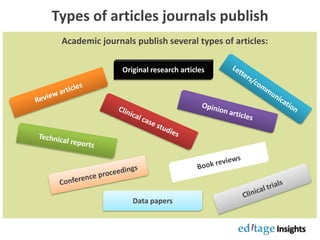
Types of articles journals publish
Academic journals publish several types of articles:
Data papers
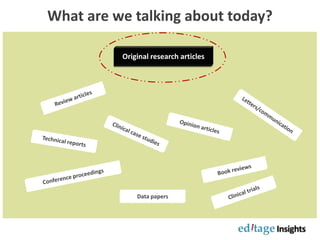
What are we talking about today?
Original research articles
Data papers
What is an original research article?
An original article is the product of original research.
“Original research articles are primary sources of
scientific literature and present an original study.
Authors have to conduct research on a particular
topic through experiments, surveys, observation,
etc. and report the findings of their study through
original research articles.”
A young researcher's guide to writing an original research
article – By Kakoli Majumder*
http://www.editage.com/insights/a-young-researchers-guide-to-writing-an-original-research-article*
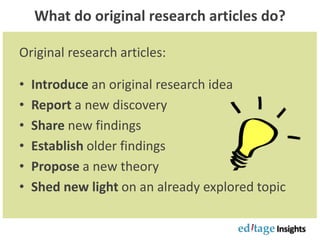
What do original research articles do?
Original research articles:
• Introduce an original research idea
• Report a new discovery
• Share new findings
• Establish older findings
• Propose a new theory
• Shed new light on an already explored topic
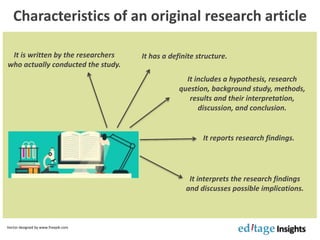
Characteristics of an original research article
It includes a hypothesis, research
question, background study, methods,
results and their interpretation,
discussion, and conclusion.
It has a definite structure.
It interprets the research findings
and discusses possible implications.
It reports research findings.
It is written by the researchers
who actually conducted the study.
Vector designed by www.freepik.com
Can original articles report negative results?
YES!
• The results of a study can be positive (supporting the existing hypothesis
about a topic) or negative (proving that the existing hypothesis about a
topic is wrong).
• Negative results are as important as positive results and MUST be
published.
• If your study has produced negative results, do not be afraid to publish
them.
• Check whether your target journal is open to publishing negative results.
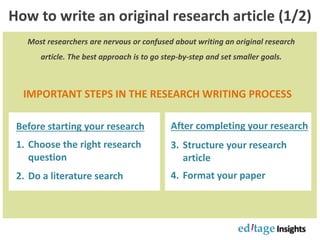
How to write an original research article (1/2)
Most researchers are nervous or confused about writing an original research
article. The best approach is to go step-by-step and set smaller goals.
Before starting your research
1. Choose the right research
question
2. Do a literature search
After completing your research
3. Structure your research
article
4. Format your paper
IMPORTANT STEPS IN THE RESEARCH WRITING PROCESS
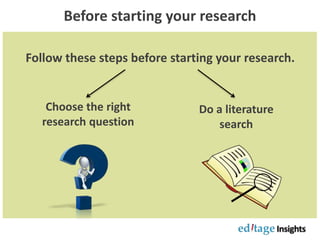
Before starting your research
Follow these steps before starting your research.
Choose the right
research question
Do a literature
search
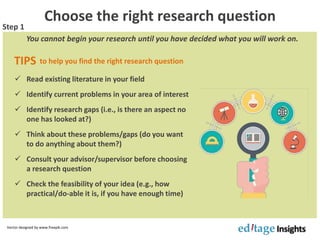
Choose the right research question
Vector designed by www.freepik.com
You cannot begin your research until you have decided what you will work on.
 Read existing literature in your field
 Identify current problems in your area of interest
 Identify research gaps (i.e., is there an aspect no
one has looked at?)
 Think about these problems/gaps (do you want
to do anything about them?)
 Consult your advisor/supervisor before choosing
a research question
 Check the feasibility of your idea (e.g., how
practical/do-able it is, if you have enough time)
Step 1
TIPS to help you find the right research question
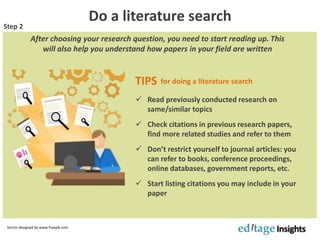
Do a literature search
After choosing your research question, you need to start reading up. This
will also help you understand how papers in your field are written
 Read previously conducted research on
same/similar topics
 Check citations in previous research papers,
find more related studies and refer to them
 Don’t restrict yourself to journal articles: you
can refer to books, conference proceedings,
online databases, government reports, etc.
 Start listing citations you may include in your
paper
Vector designed by www.freepik.com
Step 2
TIPS for doing a literature search
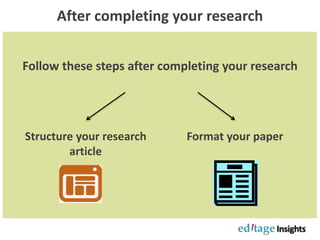
After completing your research
Follow these steps after completing your research
Structure your research
article
Format your paper
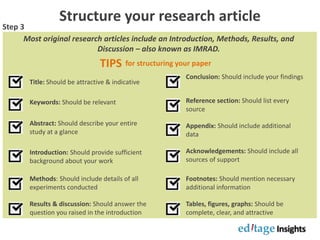
Structure your research article
Most original research articles include an Introduction, Methods, Results, and
Discussion – also known as IMRAD.
Step 3
Title: Should be attractive & indicative
Keywords: Should be relevant
Abstract: Should describe your entire
study at a glance
Introduction: Should provide sufficient
background about your work
Methods: Should include details of all
experiments conducted
Results & discussion: Should answer the
question you raised in the introduction
Conclusion: Should include your findings
Reference section: Should list every
source
Appendix: Should include additional
data
Acknowledgements: Should include all
sources of support
Footnotes: Should mention necessary
additional information
Tables, figures, graphs: Should be
complete, clear, and attractive
TIPS for structuring your paper
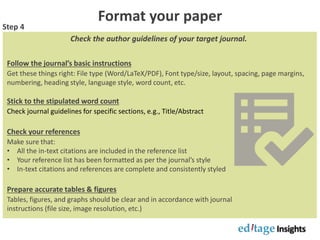
Format your paper
Step 4
Check the author guidelines of your target journal.
Stick to the stipulated word count
Check your references
Follow the journal’s basic instructions
Get these things right: File type (Word/LaTeX/PDF), Font type/size, layout, spacing, page margins,
numbering, heading style, language style, word count, etc.
Check journal guidelines for specific sections, e.g., Title/Abstract
Make sure that:
• All the in-text citations are included in the reference list
• Your reference list has been formatted as per the journal’s style
• In-text citations and references are complete and consistently styled
Prepare accurate tables & figures
Tables, figures, and graphs should be clear and in accordance with journal
instructions (file size, image resolution, etc.)
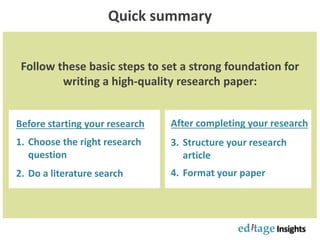
Quick summary
Follow these basic steps to set a strong foundation for
writing a high-quality research paper:
Before starting your research
1. Choose the right research
question
2. Do a literature search
After completing your research
3. Structure your research
article
4. Format your paper
Need more help?
Some more useful articles on manuscript writing and submission:
• A young researcher's guide to writing an original research article:
http://www.editage.com/insights/a-young-researchers-guide-to-writing-an-original-research-article
• How to choose a research question:
http://www.editage.com/insights/how-to-choose-a-research-question
• Guidelines for researchers on key aspects of scientific publishing:
http://www.editage.com/insights/guidelines-for-researchers-on-key-aspects-of-scientific-publishing
• 5 Basic mistakes in manuscript writing that can lead to rejection:
http://www.editage.com/insights/5-basic-mistakes-in-manuscript-writing-that-can-lead-to-rejection
• Tackling the task of writing text:
http://www.editage.com/insights/tackling-the-task-of-writing-text
• Tips for writing the perfect IMRAD manuscript:
http://www.editage.com/insights/tips-for-writing-the-perfect-imrad-manuscript
• Tips on general manuscript formatting:
http://www.editage.com/insights/tips-on-general-manuscript-formatting
GOOD LUCK WITH YOUR PAPER!
www.editage.com/insights
@EditageInsights
Connect with us
For more useful resources and tips on publication, visit our website:

How to write an original research article

  • 1.
    4 Steps tofollow when writing an original research article
  • 2.
    Original research articles Typesof articles journals publish Academic journals publish several types of articles: Data papers
  • 3.
    What are wetalking about today? Original research articles Data papers
  • 4.
    What is anoriginal research article? An original article is the product of original research. “Original research articles are primary sources of scientific literature and present an original study. Authors have to conduct research on a particular topic through experiments, surveys, observation, etc. and report the findings of their study through original research articles.” A young researcher's guide to writing an original research article – By Kakoli Majumder* http://www.editage.com/insights/a-young-researchers-guide-to-writing-an-original-research-article*
  • 5.
    What do originalresearch articles do? Original research articles: • Introduce an original research idea • Report a new discovery • Share new findings • Establish older findings • Propose a new theory • Shed new light on an already explored topic
  • 6.
    Characteristics of anoriginal research article It includes a hypothesis, research question, background study, methods, results and their interpretation, discussion, and conclusion. It has a definite structure. It interprets the research findings and discusses possible implications. It reports research findings. It is written by the researchers who actually conducted the study. Vector designed by www.freepik.com
  • 7.
    Can original articlesreport negative results? YES! • The results of a study can be positive (supporting the existing hypothesis about a topic) or negative (proving that the existing hypothesis about a topic is wrong). • Negative results are as important as positive results and MUST be published. • If your study has produced negative results, do not be afraid to publish them. • Check whether your target journal is open to publishing negative results.
  • 8.
    How to writean original research article (1/2) Most researchers are nervous or confused about writing an original research article. The best approach is to go step-by-step and set smaller goals. Before starting your research 1. Choose the right research question 2. Do a literature search After completing your research 3. Structure your research article 4. Format your paper IMPORTANT STEPS IN THE RESEARCH WRITING PROCESS
  • 9.
    Before starting yourresearch Follow these steps before starting your research. Choose the right research question Do a literature search
  • 10.
    Choose the rightresearch question Vector designed by www.freepik.com You cannot begin your research until you have decided what you will work on.  Read existing literature in your field  Identify current problems in your area of interest  Identify research gaps (i.e., is there an aspect no one has looked at?)  Think about these problems/gaps (do you want to do anything about them?)  Consult your advisor/supervisor before choosing a research question  Check the feasibility of your idea (e.g., how practical/do-able it is, if you have enough time) Step 1 TIPS to help you find the right research question
  • 11.
    Do a literaturesearch After choosing your research question, you need to start reading up. This will also help you understand how papers in your field are written  Read previously conducted research on same/similar topics  Check citations in previous research papers, find more related studies and refer to them  Don’t restrict yourself to journal articles: you can refer to books, conference proceedings, online databases, government reports, etc.  Start listing citations you may include in your paper Vector designed by www.freepik.com Step 2 TIPS for doing a literature search
  • 12.
    After completing yourresearch Follow these steps after completing your research Structure your research article Format your paper
  • 13.
    Structure your researcharticle Most original research articles include an Introduction, Methods, Results, and Discussion – also known as IMRAD. Step 3 Title: Should be attractive & indicative Keywords: Should be relevant Abstract: Should describe your entire study at a glance Introduction: Should provide sufficient background about your work Methods: Should include details of all experiments conducted Results & discussion: Should answer the question you raised in the introduction Conclusion: Should include your findings Reference section: Should list every source Appendix: Should include additional data Acknowledgements: Should include all sources of support Footnotes: Should mention necessary additional information Tables, figures, graphs: Should be complete, clear, and attractive TIPS for structuring your paper
  • 14.
    Format your paper Step4 Check the author guidelines of your target journal. Stick to the stipulated word count Check your references Follow the journal’s basic instructions Get these things right: File type (Word/LaTeX/PDF), Font type/size, layout, spacing, page margins, numbering, heading style, language style, word count, etc. Check journal guidelines for specific sections, e.g., Title/Abstract Make sure that: • All the in-text citations are included in the reference list • Your reference list has been formatted as per the journal’s style • In-text citations and references are complete and consistently styled Prepare accurate tables & figures Tables, figures, and graphs should be clear and in accordance with journal instructions (file size, image resolution, etc.)
  • 15.
    Quick summary Follow thesebasic steps to set a strong foundation for writing a high-quality research paper: Before starting your research 1. Choose the right research question 2. Do a literature search After completing your research 3. Structure your research article 4. Format your paper
  • 16.
    Need more help? Somemore useful articles on manuscript writing and submission: • A young researcher's guide to writing an original research article: http://www.editage.com/insights/a-young-researchers-guide-to-writing-an-original-research-article • How to choose a research question: http://www.editage.com/insights/how-to-choose-a-research-question • Guidelines for researchers on key aspects of scientific publishing: http://www.editage.com/insights/guidelines-for-researchers-on-key-aspects-of-scientific-publishing • 5 Basic mistakes in manuscript writing that can lead to rejection: http://www.editage.com/insights/5-basic-mistakes-in-manuscript-writing-that-can-lead-to-rejection • Tackling the task of writing text: http://www.editage.com/insights/tackling-the-task-of-writing-text • Tips for writing the perfect IMRAD manuscript: http://www.editage.com/insights/tips-for-writing-the-perfect-imrad-manuscript • Tips on general manuscript formatting: http://www.editage.com/insights/tips-on-general-manuscript-formatting
  • 17.
    GOOD LUCK WITHYOUR PAPER!
  • 18.
    www.editage.com/insights @EditageInsights Connect with us Formore useful resources and tips on publication, visit our website: