PARADIGM
Research Method in Education and Social
Qualitative Research
Prepared by
Prepared by
Ramesh prasad
M. Phil in Education
Roll No. 75152120
Nepal Open University
2019
PARADIGM
Research Method in Education and Social Science
Qualitative Research Method
Prepared by
Prepared by
prasad lamichhane
M. Phil in Education
Roll No. 75152120
Nepal Open University
2019
MEANING OF PARADIGM
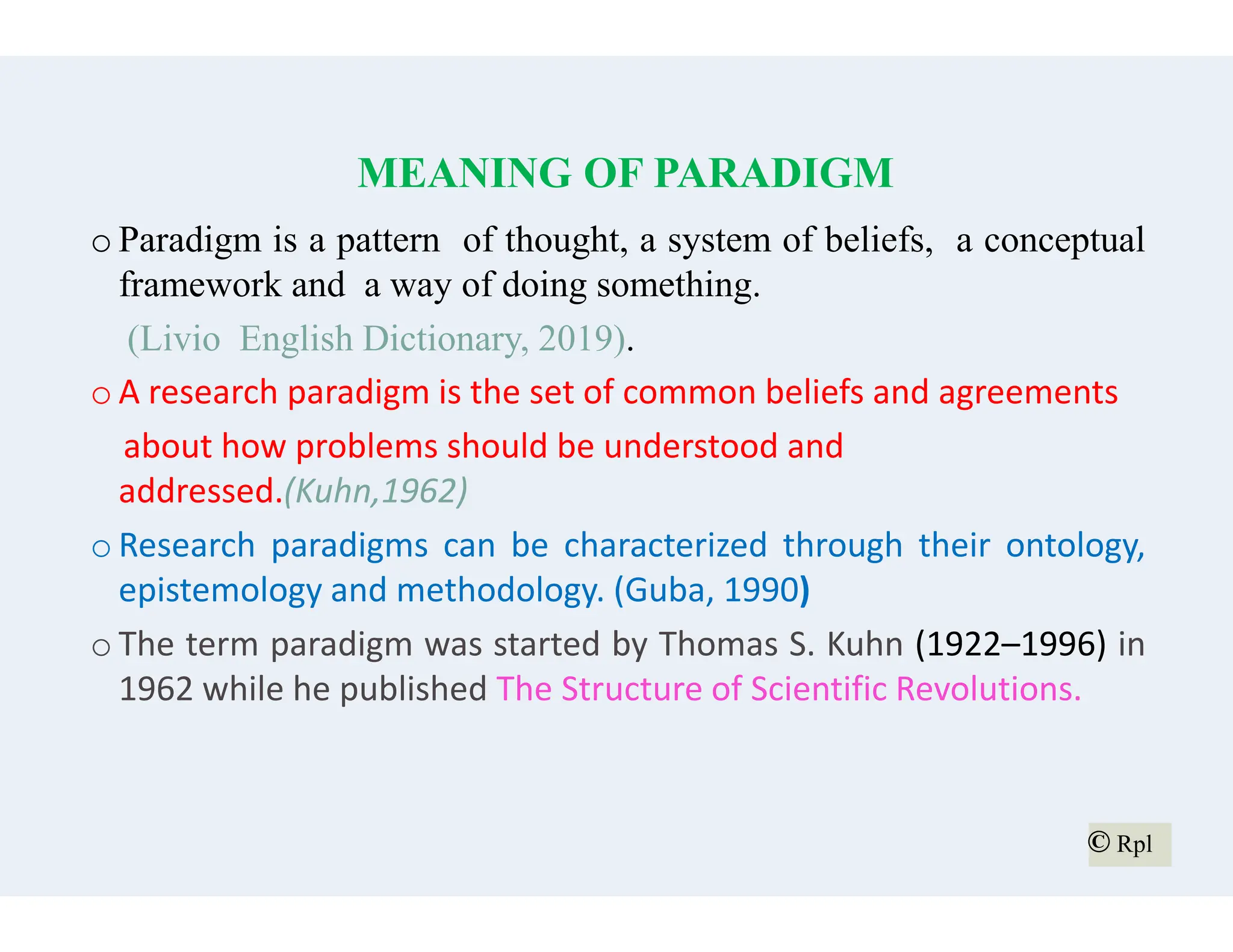
o Paradigm is a pattern of thought,
framework and a way of doing something
(Livio English Dictionary, 2019)
o A research paradigm is the set of common beliefs and
about how problems should be understood
addressed.(Kuhn,1962)
o Research paradigms can be characterized
epistemology and methodology. (Guba,
o The term paradigm was started by
1962 while he published The Structure
MEANING OF PARADIGM
thought, a system of beliefs, a conceptual
something.
).
A research paradigm is the set of common beliefs and agreements
about how problems should be understood and
characterized through their ontology,
(Guba, 1990)
by Thomas S. Kuhn (1922–1996) in
Structure of Scientific Revolutions.
© Rpl
© Rpl
MEANING OF PARADIGM
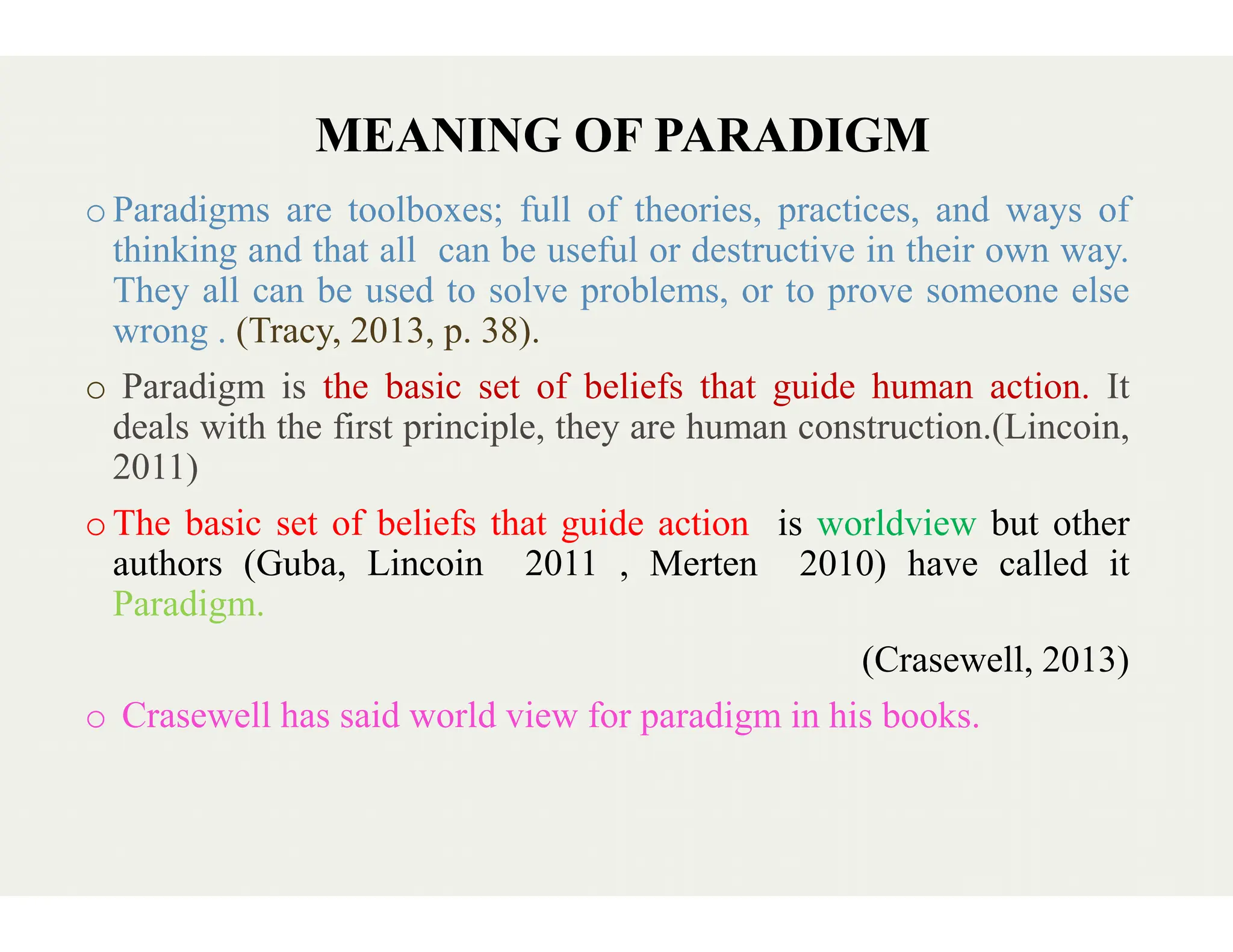
oParadigms are toolboxes; full of
thinking and that all can be useful
They all can be used to solve problems,
wrong . (Tracy, 2013, p. 38).
o Paradigm is the basic set of beliefs
deals with the first principle, they
2011)
2011)
oThe basic set of beliefs that guide
authors (Guba, Lincoin 2011
Paradigm.
o Crasewell has said world view for paradigm in his books.
MEANING OF PARADIGM
of theories, practices, and ways of
useful or destructive in their own way.
problems, or to prove someone else
beliefs that guide human action. It
they are human construction.(Lincoin,
guide action is worldview but other
, Merten 2010) have called it
(Crasewell, 2013)
Crasewell has said world view for paradigm in his books.
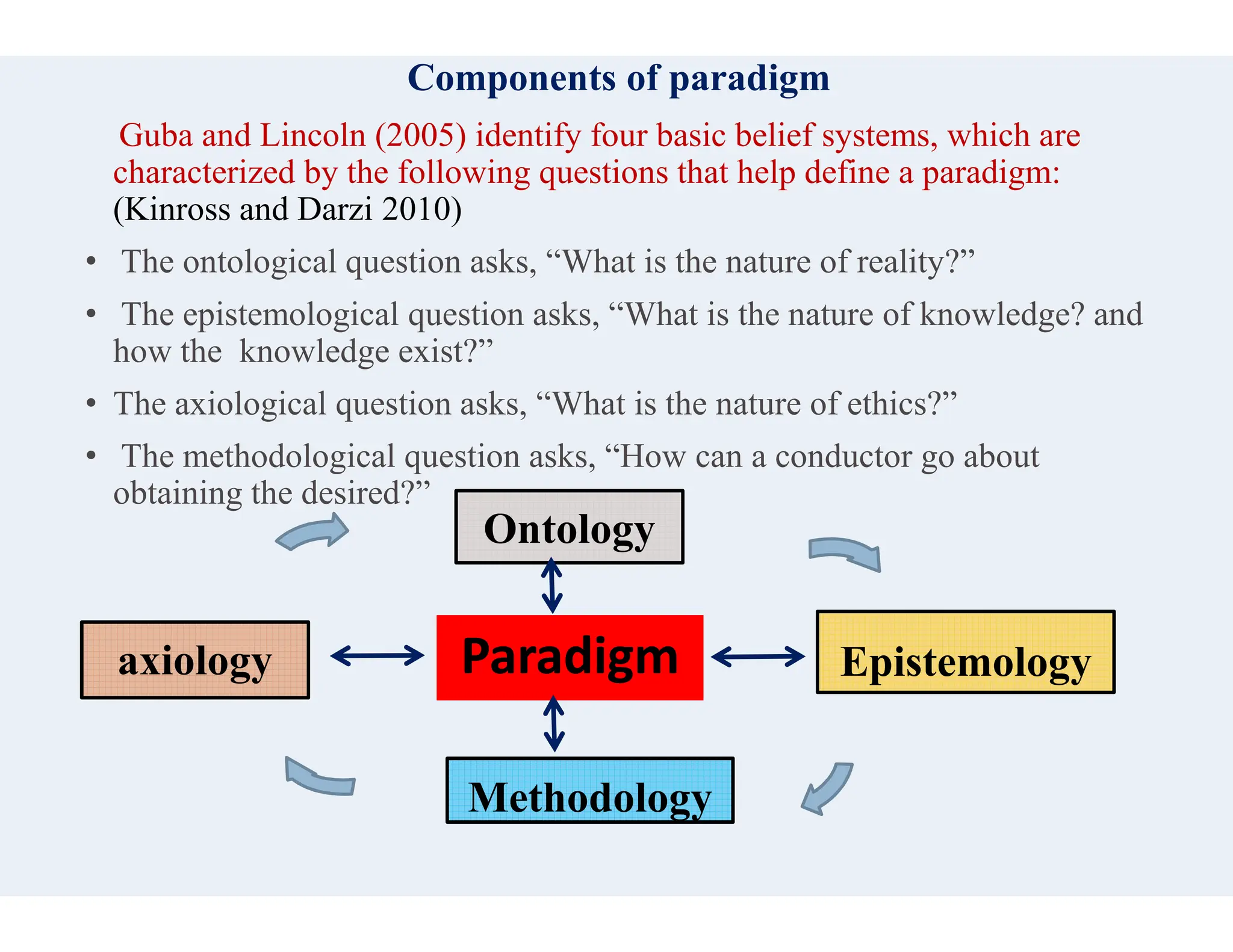
Components of paradigm
Guba and Lincoln (2005) identify four basic belief systems, which are
characterized by the following questions that help define a paradigm:
(Kinross and Darzi 2010)
• The ontological question asks, “What is the nature of reality?”
• The epistemological question asks, “What is the nature of knowledge? and
how the knowledge exist?”
• The axiological question asks, “What is the nature of ethics?”
• The methodological question asks, “How can a conductor go about
obtaining the desired?”
Methodology
axiology Paradigm
Ontology
Components of paradigm
Guba and Lincoln (2005) identify four basic belief systems, which are
characterized by the following questions that help define a paradigm:
The ontological question asks, “What is the nature of reality?”
The epistemological question asks, “What is the nature of knowledge? and
axiological question asks, “What is the nature of ethics?”
The methodological question asks, “How can a conductor go about
Methodology
Paradigm Epistemology
Ontology
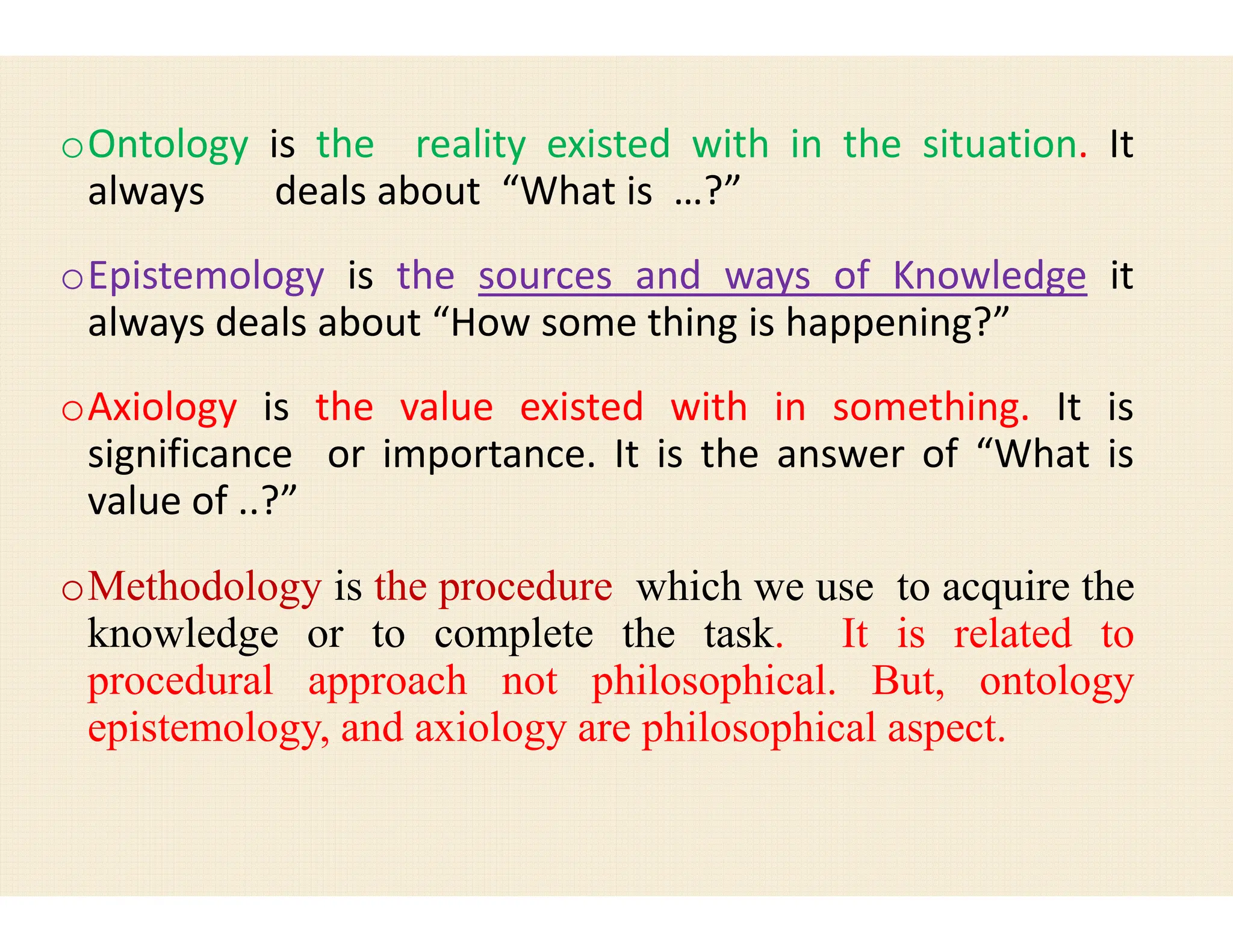
oOntology is the reality existed
always deals about “What
oEpistemology is the sources
always deals about “How some
oAxiology is the value existed
significance or importance. It
value of ..?”
significance or importance. It
value of ..?”
oMethodology is the procedure
knowledge or to complete
procedural approach not philosophical
epistemology, and axiology are
existed with in the situation. It
is …?”
and ways of Knowledge it
some thing is happening?”
existed with in something. It is
It is the answer of “What is
which we use to acquire the
the task. It is related to
philosophical. But, ontology
are philosophical aspect.
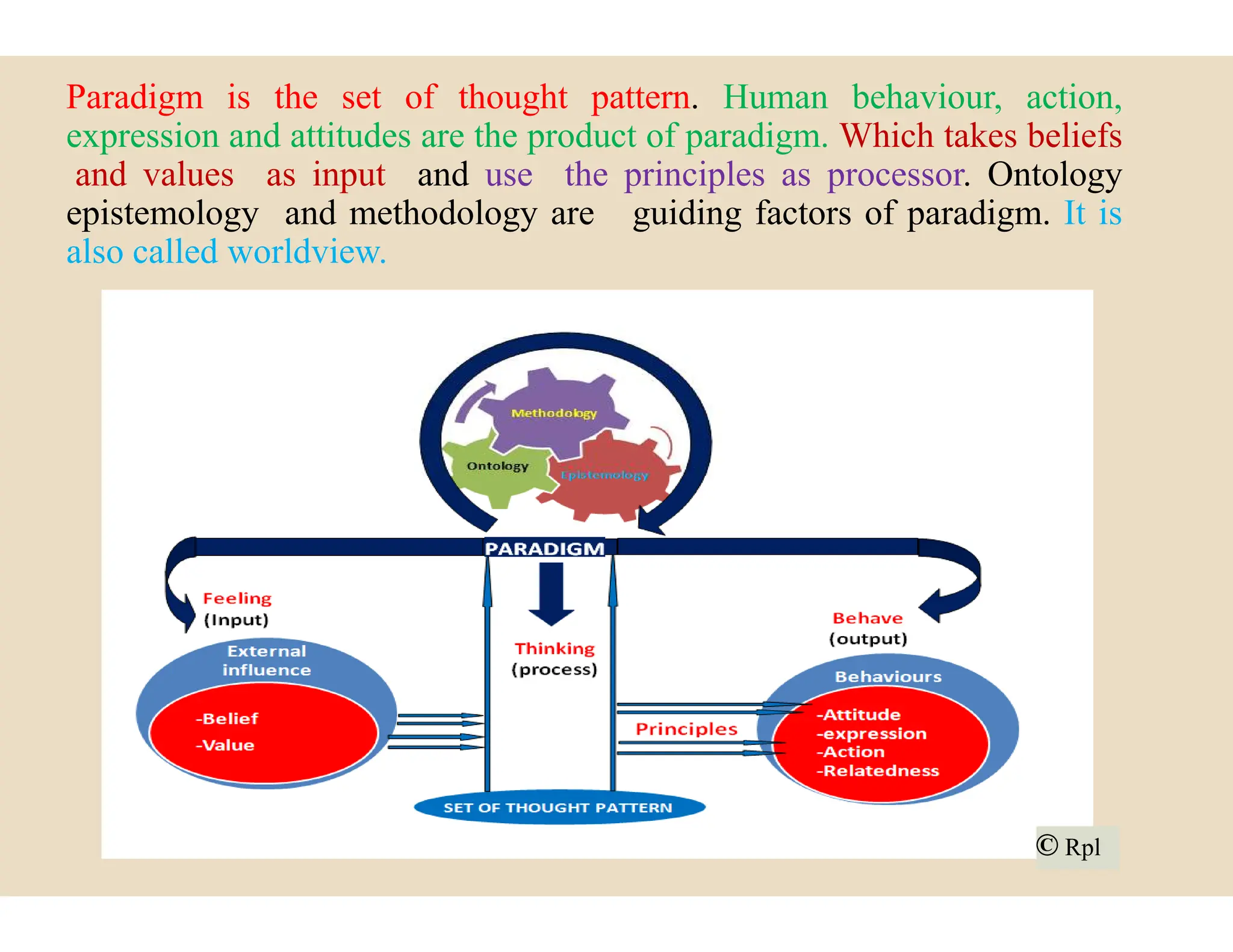
Paradigm is the set of thought pattern
expression and attitudes are the product
and values as input and use the
epistemology and methodology are
also called worldview.
pattern. Human behaviour, action,
product of paradigm. Which takes beliefs
principles as processor. Ontology
guiding factors of paradigm. It is
© Rpl
© Rpl
Types of paradigm
Guba and
Lincoln
(1994-2005)
J. Kinross and
L. Darzi (2010)
Classificatio
n
 Positivist
Constructivist
Transformative
 Pragmatic
Creswell said
Creswell said
world
world-
-
View for these
View for these
paradigm
paradigm
 Positivist
Constructivist
Transformative
 Pragmatic
Creswell said
Creswell said
world
world-
-
View for these
View for these
paradigm
paradigm
 Positivist
Constructivist
 Criticalist
ref. corresponding books of authors’ maintained in boxes above.
paradigm
Burrel
Burrel and
and
Morgan, (
Morgan, (1979
1979 )
)
Classificatio
n
Tracy, sarah j.
2013
 (post)-
 (post)-
 (post)-
positivist
 interpretive
 Critical
 post
modernist /
post structuralist
 (post)-
positivist
 interpretive
 Critical
 post
modernist /
post structuralist
Functionalist
Interpretive
Radical
humanist
 Radical-
structuralist
corresponding books of authors’ maintained in boxes above.
corresponding books of authors’ maintained in boxes above. © Rpl
© Rpl
Types of paradigm
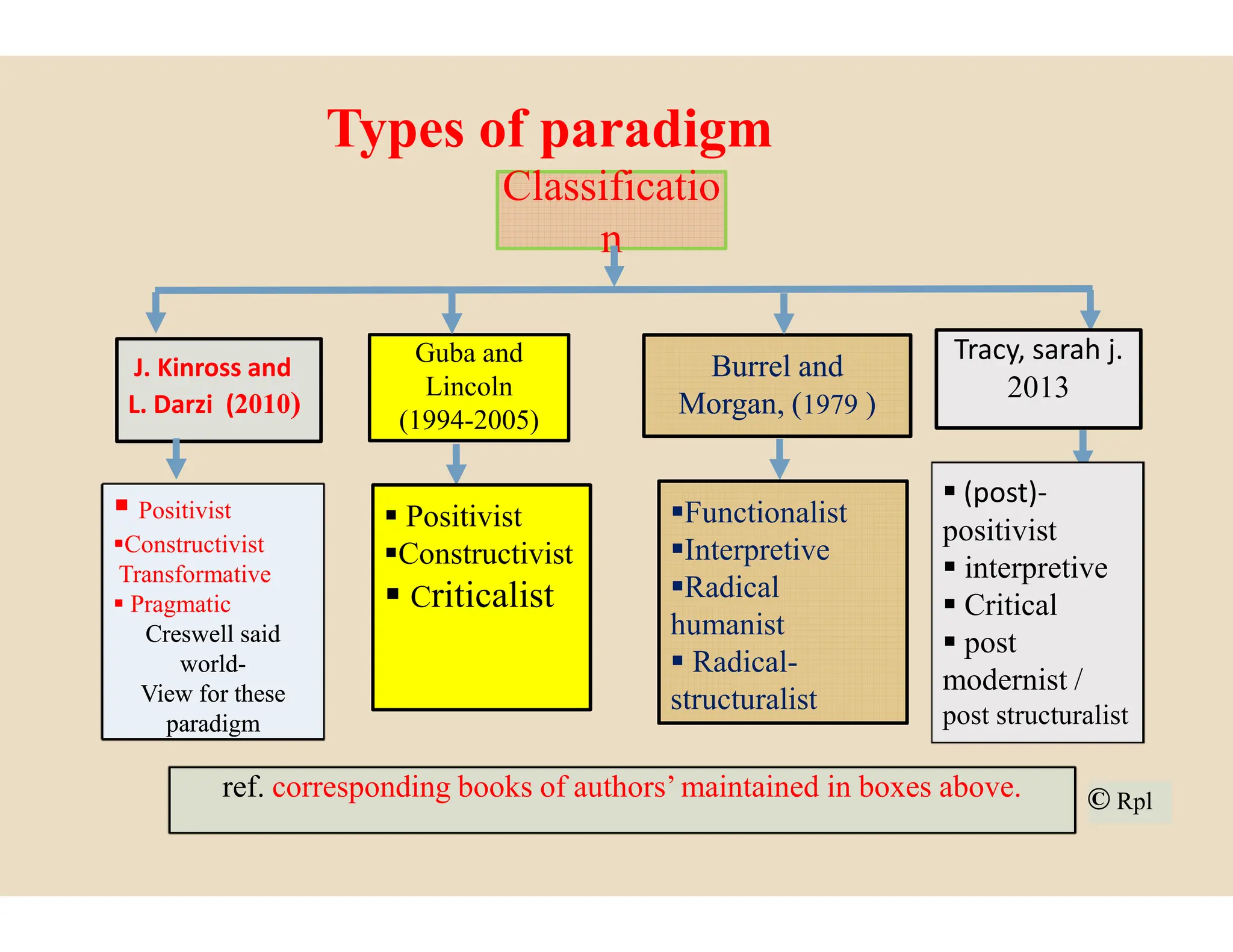
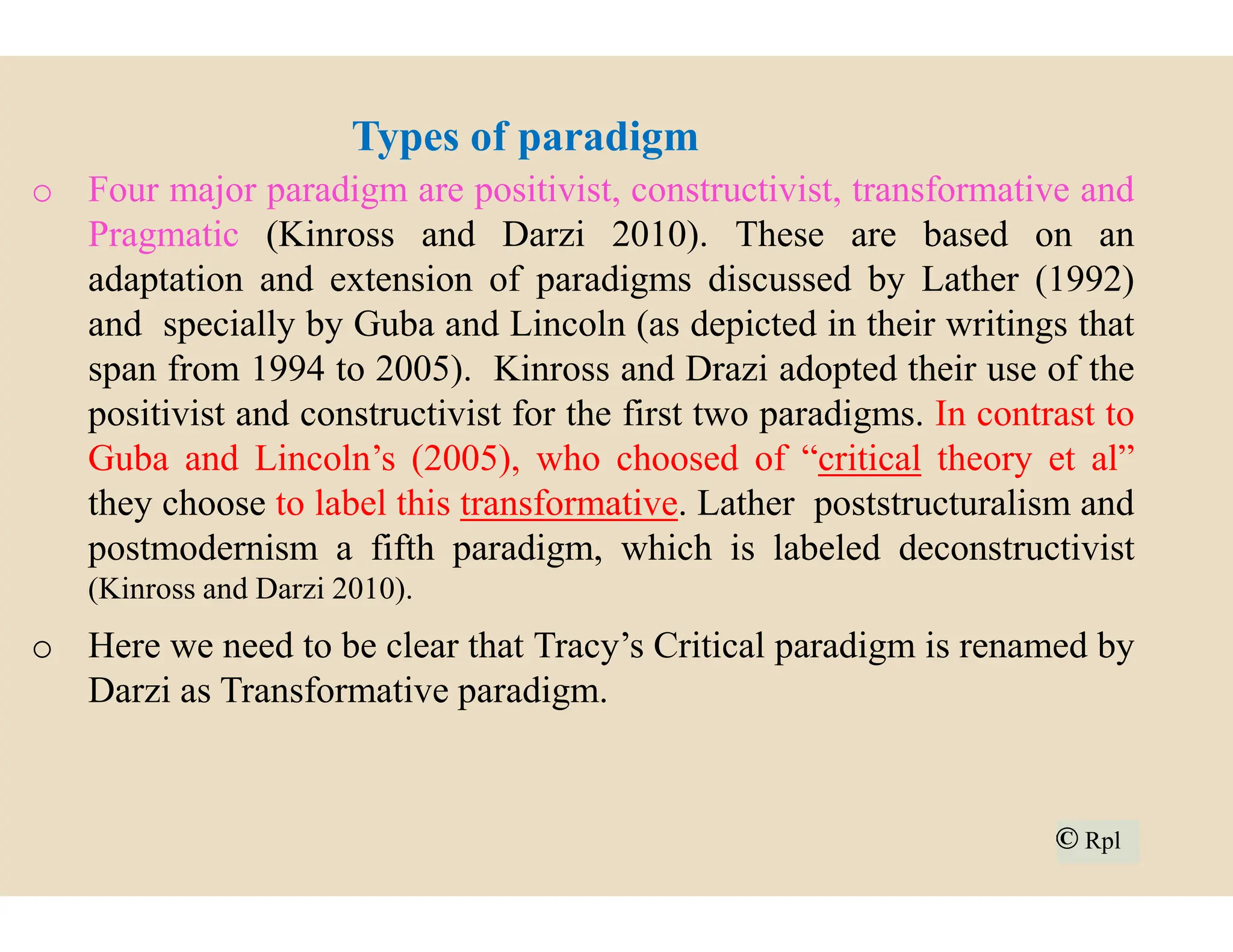
o Four major paradigm are positivist,
Pragmatic (Kinross and Darzi 2010
adaptation and extension of paradigms
and specially by Guba and Lincoln
span from 1994 to 2005). Kinross
positivist and constructivist for the
Guba and Lincoln’s (2005), who choosed
they choose to label this transformative
postmodernism a fifth paradigm,
(Kinross and Darzi 2010).
o Here we need to be clear that Tracy’s
Darzi as Transformative paradigm.
Types of paradigm
positivist, constructivist, transformative and
2010). These are based on an
paradigms discussed by Lather (1992)
Lincoln (as depicted in their writings that
and Drazi adopted their use of the
first two paradigms. In contrast to
choosed of “critical theory et al”
transformative. Lather poststructuralism and
which is labeled deconstructivist
Tracy’s Critical paradigm is renamed by
© Rpl
© Rpl
Positivist paradigm
o Positivists believe that there is a single
and known, and therefore they are more
methods to measure this reality. It is
paradigm.
o Positivist also referred to as a realist
that a single reality already exists “out
waiting be discovered.
o Positivists conduct research in order
empirical phenomena and build tangible
They strive for research to mirror reality
Being examined. (Kinross and Darzi,
Positivist paradigm
single reality, which can be measured
more likely to use quantitative
is also called realistic or functional
or functional paradigm, it assumes
“out there” in the world and is
to observe, measure, and predict
tangible and material knowledge.
reality to represent clearly what is
Darzi, 2010).
Positivist and Post-positivist paradigm
opost-positivist paradigm is similar
aiming toward knowing a single material
to positivists, post-positivists believe
reality is inherently partial.
o post-positivist point of view, qualitative
garnering(banking) representative samples
to the question, “What is happening
to this question, researchers from
triangulate – to use multiple types
methods of collection, various theoretical
researchers (Denzin, 1978) in order
happening
positivist paradigm
to a positivist one in terms of
material reality. However, in contrast
believe that humans’ understanding of
qualitative methods aim toward
samples that provide a clear answer
here?” In the quest for an answer
these approaches are likely to
types and sources of data, diverse
theoretical frames, and multiple
order to settle upon what is “really”
happening.
Constructivists paradigm
 Constructivists believe that there
Reality needs to be interpreted,
likely to use qualitative methods
realities.
 The constructivist; which is also
constructionist says that: reality
which a researcher can clearly explain,
into a research report.
 Both reality and knowledge are
through communication, interaction,
about reality is therefore always
researcher.
Constructivists paradigm
there is no single reality or truth.
interpreted, and therefore they are more
methods to get those multiple
also termed as interpretive or
reality is not something “out there,”
explain, describe, or translate
are constructed and reproduced
interaction, and practice. Knowledge
always mediated through the
Transformative paradigm
 The constructivist paradigm has been
and post-positivists, but also by another
This group i.e. transformative includes
action researcher, Marxists, feminists,
and persons with disabilities, among
 Concerned about a number of different
to the development of the transformative
 Transformative researchers acknowledge
dominance or minority, inequities
disability, sexual orientation, and
included. This theory has comes in
may differ the conclusion.
Transformative paradigm
been criticized not only by positivists
another group i.e. Transformative.
includes critical theorists, participatory
feminists, racial and ethnic minorities
among others.
different issues and events contributed
transformative paradigm.
acknowledge that Political actions,
based on gender, race or ethnicity,
socioeconomic oppressed must be
in the vision of inclusion. Inclusion
Pragmatic Paradigm
• Pragmatists believe that reality is constantly renegotiated, debated,
interpreted, and therefore the best method to use is the one, that
solves the problem.
• In a pragmatic approach, there is no problem with asserting that
there is a single “real world” and that all individuals have their own
unique interpretations of that world.
• It is the way where people can see something by their point of view,
frame of reference, or by their belief. Ontology epistemology and
Methodology are the major deteminors of paradigm.
Pragmatic Paradigm
believe that reality is constantly renegotiated, debated,
interpreted, and therefore the best method to use is the one, that
In a pragmatic approach, there is no problem with asserting that -
there is a single “real world” and that all individuals have their own
It is the way where people can see something by their point of view,
frame of reference, or by their belief. Ontology epistemology and
Methodology are the major deteminors of paradigm.
Interpretive Paradigm
 interpretive paradigm is also
constructionist.
 reality is not something “out
can clearly explain, describe,
report.
 Rather, both reality and knowledge
reproduced through communication,
practice.
 Knowledge about reality is
through the researcher.
Interpretive Paradigm
also termed constructivist or
“out there,” which a researcher
describe, or translate into a research
knowledge are constructed and
communication, interaction, and
is therefore always mediated
Critical research paradigm
 Critical research is based on the idea that thought
power relations and that data cannot be separated
myths, and beliefs that guide and have power
(Kinchloe & McLaren, 2000).
 Hierarchical power differences. (It suggests
head of social organization).
 Critical researchers view cultural life as
resistance, and they frame language as a type
 Thus ideas and knowledge can both control
 Knowledge is constructed through communication
At the very least, critical research brings
and, by doing so, provides space
Critical research paradigm
thought is fundamentally mediated by
separated from ideology – a set of doctrines,
power over individuals, groups, and societies
suggests that males should be at the center and
as a constant tension between control and
type of power.
control and liberate.
communication and historical power relations..
brings power relations to conscious awareness
for questioning and transformation.
Postmodernist / Poststructuralists Paradigm
 postmodern scholars’ approach, knowledge
un-stable, and plural. As such, the paradigm
domination and self-subordination, but
and change.
 Poststructuralists assume that all people have space for agency (the ability to act
in a scene) and free will (the ability to choose among alternatives)
ref to: ( paradimetic reflect and theory)
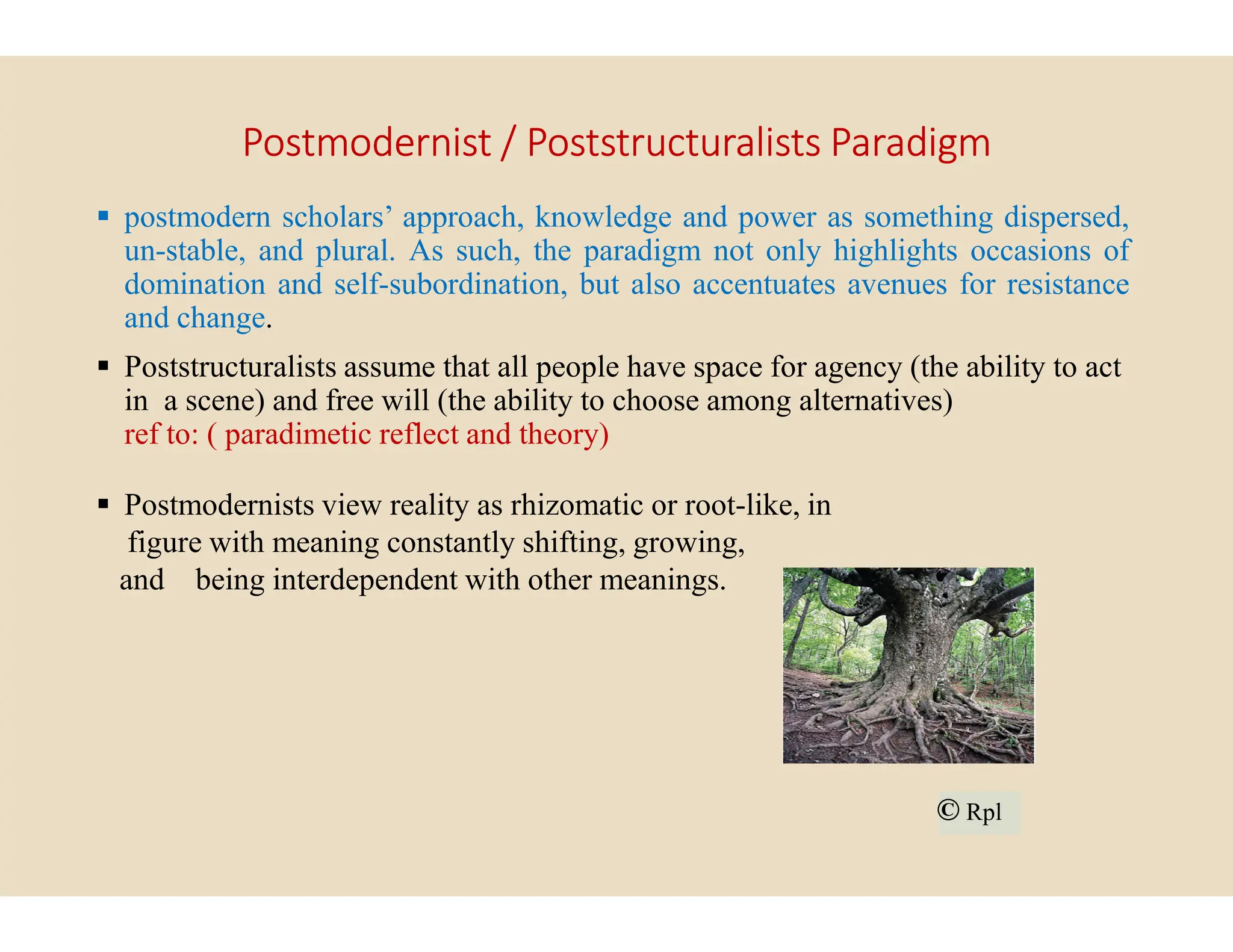
 Postmodernists view reality as rhizomatic
figure with meaning constantly shifting,
and being interdependent with other meanings
Postmodernist / Poststructuralists Paradigm
knowledge and power as something dispersed,
paradigm not only highlights occasions of
but also accentuates avenues for resistance
Poststructuralists assume that all people have space for agency (the ability to act
in a scene) and free will (the ability to choose among alternatives)
rhizomatic or root-like, in
shifting, growing,
meanings.
© Rpl
© Rpl
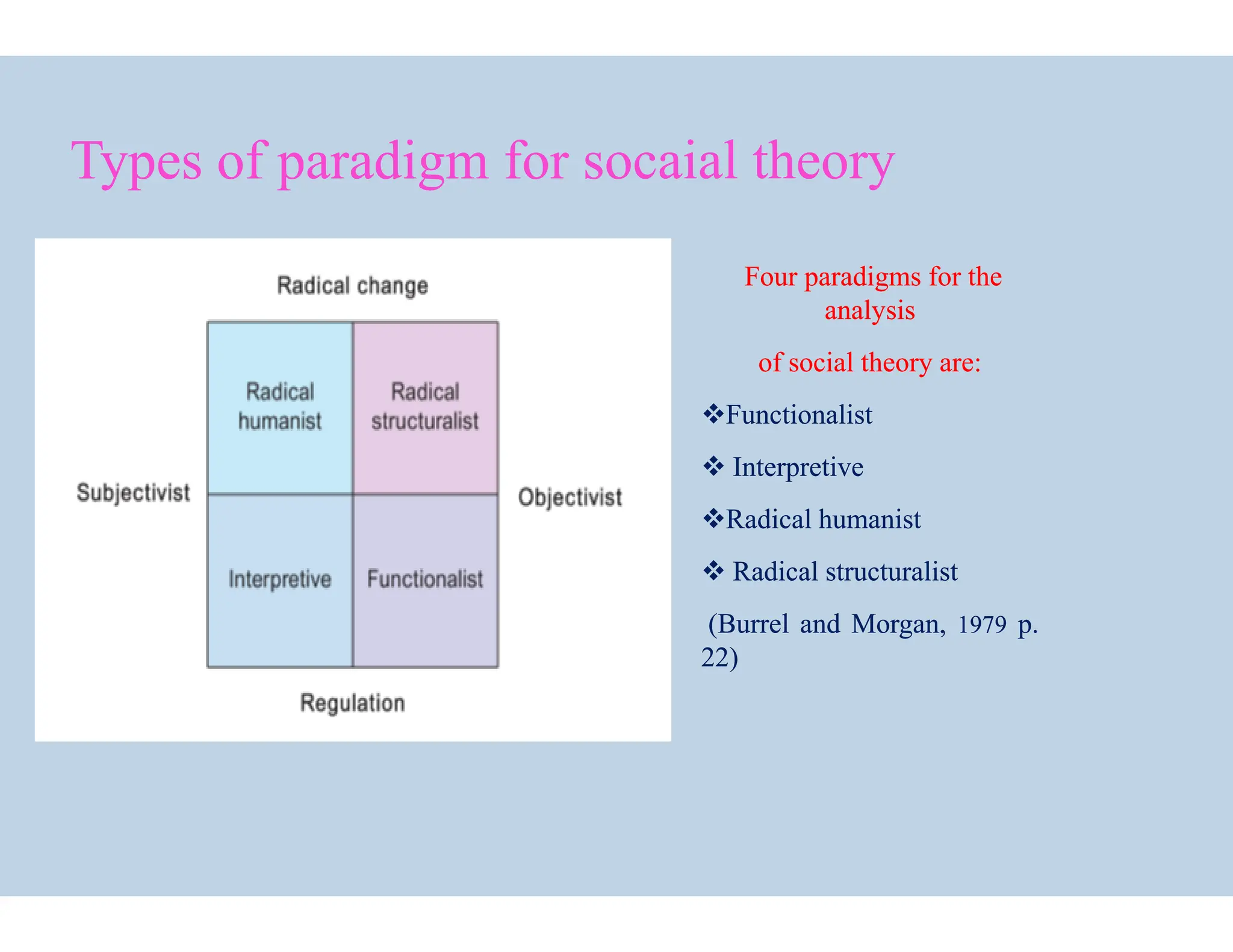
Types of paradigm for
Types of paradigm for socaial
socaial
socaial
socaial theory
theory
Four paradigms for the
analysis
analysis
of social theory are:

Functionalist
Functionalist

 Interpretive
Interpretive
Four paradigms for the
analysis
analysis
of social theory are:

Functionalist
Functionalist

 Interpretive
Interpretive

 Interpretive
Interpretive

Radical
Radical humanist
humanist

 Radical
Radical structuralist
structuralist
(
(Burrel
Burrel and
and Morgan,
Morgan, 1979
1979 p
p.
.
22
22)
)

 Interpretive
Interpretive

Radical
Radical humanist
humanist

 Radical
Radical structuralist
structuralist
(
(Burrel
Burrel and
and Morgan,
Morgan, 1979
1979 p
p.
.
22
22)
)
Summary
 Paradigm is axiomatic thought or it is
behaviour, action, expression and attitudes
intakes beliefs and values as input and
epistemology and methodology are guiding
(2013) has used the term worldview for
as synonym for world view and paradigm
 Eg: As the grammatical paradigm of a word
paradigm about the mother of someone
fertilized at least once and they are irreversible
 Positivist, Constructivist, Criticalist or Transformative
major research paradigm. It has also divided
Interpretive, radical humanist and radical
social theory.
is the set of thought pattern. Human
attitudes are the product of paradigm. Which
and principles as processor. Ontology
guiding factors of paradigm. Crasewell
paradigm. Oxford dictionary has taken
paradigm.
word ‘go’ is “go, went, gone”; the social
is that: she is feminine, married and
irreversible change in her life.
Transformative and pragmatist are
divided into functionalist,
radical structurelist for the analysis of
References
• Guba. (1990). In options for inquiry.
• Khun. (1962). In Research Dilemmas: Paradigm, method and methodology.
• Lincoin, N. k. (1998). In D. a. Lincoin, Hand books of qualitative research.
• Crasewell. 2013. “Philosophical Assumption and Interpretive Framework.”
in Philosophical assumption and interpretive framework
• Kinross, James and Lord Ara Darzi. 2010. “Before Beginning Research: A
Philosophic Perspective.” Pp. 207–28 in
Methodology.
• Tracy, sarah j. 2013. Qualitative Research Method: Collecting Evidence,
Certifying Analysis, Communicating Impact
Publication Ltd.
References
Research Dilemmas: Paradigm, method and methodology.
Hand books of qualitative research.
Crasewell. 2013. “Philosophical Assumption and Interpretive Framework.”
Philosophical assumption and interpretive framework.
Kinross, James and Lord Ara Darzi. 2010. “Before Beginning Research: A
28 in Key Topics in Surgical Research and
Qualitative Research Method: Collecting Evidence,
Certifying Analysis, Communicating Impact. 2013th ed. Blackwell
Query
Critical research can fall either into the modern
camp, depending on its emphasis. Illustrate
 If a researcher want to conduct a research
stability in teaching job of different subject
Which of the research paradigm should he
and research approach which can be used
- Untimely and rapid change of teachers specially
 Guba and Lincoin (1994) told, “Questions
important to the questions of which paradigm
Discuss .
Query
modern (positivist) or into the postmodern
Illustrate this sentences with a suitable example.
research work in titled “Job satisfaction and
subject teacher in secondary level in Nepal”
he follow? Discuss about research paradigm
for proposed research. [ Research problem
specially in technical subjects ]
“Questions of research methods are secondary
paradigm is applicable to your research.”
Thank you
Thank you

Research Paradigm - Ramesh pd lamichhane.pdf

  • 1.
    PARADIGM Research Method inEducation and Social Qualitative Research Prepared by Prepared by Ramesh prasad M. Phil in Education Roll No. 75152120 Nepal Open University 2019 PARADIGM Research Method in Education and Social Science Qualitative Research Method Prepared by Prepared by prasad lamichhane M. Phil in Education Roll No. 75152120 Nepal Open University 2019
  • 2.
    MEANING OF PARADIGM oParadigm is a pattern of thought, framework and a way of doing something (Livio English Dictionary, 2019) o A research paradigm is the set of common beliefs and about how problems should be understood addressed.(Kuhn,1962) addressed.(Kuhn,1962) o Research paradigms can be characterized epistemology and methodology. (Guba, o The term paradigm was started by 1962 while he published The Structure MEANING OF PARADIGM thought, a system of beliefs, a conceptual something. ). A research paradigm is the set of common beliefs and agreements about how problems should be understood and characterized through their ontology, (Guba, 1990) by Thomas S. Kuhn (1922–1996) in Structure of Scientific Revolutions. © Rpl © Rpl
  • 3.
    MEANING OF PARADIGM oParadigmsare toolboxes; full of thinking and that all can be useful They all can be used to solve problems, wrong . (Tracy, 2013, p. 38). o Paradigm is the basic set of beliefs deals with the first principle, they 2011) 2011) oThe basic set of beliefs that guide authors (Guba, Lincoin 2011 Paradigm. o Crasewell has said world view for paradigm in his books. MEANING OF PARADIGM of theories, practices, and ways of useful or destructive in their own way. problems, or to prove someone else beliefs that guide human action. It they are human construction.(Lincoin, guide action is worldview but other , Merten 2010) have called it (Crasewell, 2013) Crasewell has said world view for paradigm in his books.
  • 4.
    Components of paradigm Gubaand Lincoln (2005) identify four basic belief systems, which are characterized by the following questions that help define a paradigm: (Kinross and Darzi 2010) • The ontological question asks, “What is the nature of reality?” • The epistemological question asks, “What is the nature of knowledge? and how the knowledge exist?” • The axiological question asks, “What is the nature of ethics?” • The methodological question asks, “How can a conductor go about obtaining the desired?” obtaining the desired?” Methodology axiology Paradigm Ontology Components of paradigm Guba and Lincoln (2005) identify four basic belief systems, which are characterized by the following questions that help define a paradigm: The ontological question asks, “What is the nature of reality?” The epistemological question asks, “What is the nature of knowledge? and axiological question asks, “What is the nature of ethics?” The methodological question asks, “How can a conductor go about Methodology Paradigm Epistemology Ontology
  • 5.
    oOntology is thereality existed always deals about “What oEpistemology is the sources always deals about “How some oAxiology is the value existed significance or importance. It value of ..?” significance or importance. It value of ..?” oMethodology is the procedure knowledge or to complete procedural approach not philosophical epistemology, and axiology are existed with in the situation. It is …?” and ways of Knowledge it some thing is happening?” existed with in something. It is It is the answer of “What is It is the answer of “What is which we use to acquire the the task. It is related to philosophical. But, ontology are philosophical aspect.
  • 6.
    Paradigm is theset of thought pattern expression and attitudes are the product and values as input and use the epistemology and methodology are also called worldview. pattern. Human behaviour, action, product of paradigm. Which takes beliefs principles as processor. Ontology guiding factors of paradigm. It is © Rpl © Rpl
  • 7.
    Types of paradigm Gubaand Lincoln (1994-2005) J. Kinross and L. Darzi (2010) Classificatio n  Positivist Constructivist Transformative  Pragmatic Creswell said Creswell said world world- - View for these View for these paradigm paradigm  Positivist Constructivist Transformative  Pragmatic Creswell said Creswell said world world- - View for these View for these paradigm paradigm  Positivist Constructivist  Criticalist ref. corresponding books of authors’ maintained in boxes above. ref. corresponding books of authors’ maintained in boxes above. paradigm Burrel Burrel and and Morgan, ( Morgan, (1979 1979 ) ) Classificatio n Tracy, sarah j. 2013  (post)-  (post)-  (post)- positivist  interpretive  Critical  post modernist / post structuralist  (post)- positivist  interpretive  Critical  post modernist / post structuralist Functionalist Interpretive Radical humanist  Radical- structuralist corresponding books of authors’ maintained in boxes above. corresponding books of authors’ maintained in boxes above. © Rpl © Rpl
  • 8.
    Types of paradigm oFour major paradigm are positivist, Pragmatic (Kinross and Darzi 2010 adaptation and extension of paradigms and specially by Guba and Lincoln span from 1994 to 2005). Kinross positivist and constructivist for the Guba and Lincoln’s (2005), who choosed Guba and Lincoln’s (2005), who choosed they choose to label this transformative postmodernism a fifth paradigm, (Kinross and Darzi 2010). o Here we need to be clear that Tracy’s Darzi as Transformative paradigm. Types of paradigm positivist, constructivist, transformative and 2010). These are based on an paradigms discussed by Lather (1992) Lincoln (as depicted in their writings that and Drazi adopted their use of the first two paradigms. In contrast to choosed of “critical theory et al” choosed of “critical theory et al” transformative. Lather poststructuralism and which is labeled deconstructivist Tracy’s Critical paradigm is renamed by © Rpl © Rpl
  • 9.
    Positivist paradigm o Positivistsbelieve that there is a single and known, and therefore they are more methods to measure this reality. It is paradigm. o Positivist also referred to as a realist that a single reality already exists “out that a single reality already exists “out waiting be discovered. o Positivists conduct research in order empirical phenomena and build tangible They strive for research to mirror reality Being examined. (Kinross and Darzi, Positivist paradigm single reality, which can be measured more likely to use quantitative is also called realistic or functional or functional paradigm, it assumes “out there” in the world and is “out there” in the world and is to observe, measure, and predict tangible and material knowledge. reality to represent clearly what is Darzi, 2010).
  • 10.
    Positivist and Post-positivistparadigm opost-positivist paradigm is similar aiming toward knowing a single material to positivists, post-positivists believe reality is inherently partial. o post-positivist point of view, qualitative garnering(banking) representative samples garnering(banking) representative samples to the question, “What is happening to this question, researchers from triangulate – to use multiple types methods of collection, various theoretical researchers (Denzin, 1978) in order happening positivist paradigm to a positivist one in terms of material reality. However, in contrast believe that humans’ understanding of qualitative methods aim toward samples that provide a clear answer samples that provide a clear answer here?” In the quest for an answer these approaches are likely to types and sources of data, diverse theoretical frames, and multiple order to settle upon what is “really” happening.
  • 11.
    Constructivists paradigm  Constructivistsbelieve that there Reality needs to be interpreted, likely to use qualitative methods realities.  The constructivist; which is also  The constructivist; which is also constructionist says that: reality which a researcher can clearly explain, into a research report.  Both reality and knowledge are through communication, interaction, about reality is therefore always researcher. Constructivists paradigm there is no single reality or truth. interpreted, and therefore they are more methods to get those multiple also termed as interpretive or also termed as interpretive or reality is not something “out there,” explain, describe, or translate are constructed and reproduced interaction, and practice. Knowledge always mediated through the
  • 12.
    Transformative paradigm  Theconstructivist paradigm has been and post-positivists, but also by another This group i.e. transformative includes action researcher, Marxists, feminists, and persons with disabilities, among  Concerned about a number of different  Concerned about a number of different to the development of the transformative  Transformative researchers acknowledge dominance or minority, inequities disability, sexual orientation, and included. This theory has comes in may differ the conclusion. Transformative paradigm been criticized not only by positivists another group i.e. Transformative. includes critical theorists, participatory feminists, racial and ethnic minorities among others. different issues and events contributed different issues and events contributed transformative paradigm. acknowledge that Political actions, based on gender, race or ethnicity, socioeconomic oppressed must be in the vision of inclusion. Inclusion
  • 13.
    Pragmatic Paradigm • Pragmatistsbelieve that reality is constantly renegotiated, debated, interpreted, and therefore the best method to use is the one, that solves the problem. • In a pragmatic approach, there is no problem with asserting that there is a single “real world” and that all individuals have their own there is a single “real world” and that all individuals have their own unique interpretations of that world. • It is the way where people can see something by their point of view, frame of reference, or by their belief. Ontology epistemology and Methodology are the major deteminors of paradigm. Pragmatic Paradigm believe that reality is constantly renegotiated, debated, interpreted, and therefore the best method to use is the one, that In a pragmatic approach, there is no problem with asserting that - there is a single “real world” and that all individuals have their own there is a single “real world” and that all individuals have their own It is the way where people can see something by their point of view, frame of reference, or by their belief. Ontology epistemology and Methodology are the major deteminors of paradigm.
  • 14.
    Interpretive Paradigm  interpretiveparadigm is also constructionist.  reality is not something “out can clearly explain, describe, report.  Rather, both reality and knowledge  Rather, both reality and knowledge reproduced through communication, practice.  Knowledge about reality is through the researcher. Interpretive Paradigm also termed constructivist or “out there,” which a researcher describe, or translate into a research knowledge are constructed and knowledge are constructed and communication, interaction, and is therefore always mediated
  • 15.
    Critical research paradigm Critical research is based on the idea that thought power relations and that data cannot be separated myths, and beliefs that guide and have power (Kinchloe & McLaren, 2000).  Hierarchical power differences. (It suggests head of social organization).  Critical researchers view cultural life as resistance, and they frame language as a type  Thus ideas and knowledge can both control  Knowledge is constructed through communication At the very least, critical research brings and, by doing so, provides space Critical research paradigm thought is fundamentally mediated by separated from ideology – a set of doctrines, power over individuals, groups, and societies suggests that males should be at the center and as a constant tension between control and type of power. control and liberate. communication and historical power relations.. brings power relations to conscious awareness for questioning and transformation.
  • 16.
    Postmodernist / PoststructuralistsParadigm  postmodern scholars’ approach, knowledge un-stable, and plural. As such, the paradigm domination and self-subordination, but and change.  Poststructuralists assume that all people have space for agency (the ability to act in a scene) and free will (the ability to choose among alternatives) ref to: ( paradimetic reflect and theory)  Postmodernists view reality as rhizomatic figure with meaning constantly shifting, and being interdependent with other meanings Postmodernist / Poststructuralists Paradigm knowledge and power as something dispersed, paradigm not only highlights occasions of but also accentuates avenues for resistance Poststructuralists assume that all people have space for agency (the ability to act in a scene) and free will (the ability to choose among alternatives) rhizomatic or root-like, in shifting, growing, meanings. © Rpl © Rpl
  • 17.
    Types of paradigmfor Types of paradigm for socaial socaial socaial socaial theory theory Four paradigms for the Four paradigms for the analysis analysis of social theory are: of social theory are:  Functionalist Functionalist   Interpretive Interpretive Four paradigms for the Four paradigms for the analysis analysis of social theory are: of social theory are:  Functionalist Functionalist   Interpretive Interpretive   Interpretive Interpretive  Radical Radical humanist humanist   Radical Radical structuralist structuralist ( (Burrel Burrel and and Morgan, Morgan, 1979 1979 p p. . 22 22) )   Interpretive Interpretive  Radical Radical humanist humanist   Radical Radical structuralist structuralist ( (Burrel Burrel and and Morgan, Morgan, 1979 1979 p p. . 22 22) )
  • 18.
    Summary  Paradigm isaxiomatic thought or it is behaviour, action, expression and attitudes intakes beliefs and values as input and epistemology and methodology are guiding (2013) has used the term worldview for as synonym for world view and paradigm  Eg: As the grammatical paradigm of a word paradigm about the mother of someone paradigm about the mother of someone fertilized at least once and they are irreversible  Positivist, Constructivist, Criticalist or Transformative major research paradigm. It has also divided Interpretive, radical humanist and radical social theory. is the set of thought pattern. Human attitudes are the product of paradigm. Which and principles as processor. Ontology guiding factors of paradigm. Crasewell paradigm. Oxford dictionary has taken paradigm. word ‘go’ is “go, went, gone”; the social is that: she is feminine, married and is that: she is feminine, married and irreversible change in her life. Transformative and pragmatist are divided into functionalist, radical structurelist for the analysis of
  • 19.
    References • Guba. (1990).In options for inquiry. • Khun. (1962). In Research Dilemmas: Paradigm, method and methodology. • Lincoin, N. k. (1998). In D. a. Lincoin, Hand books of qualitative research. • Crasewell. 2013. “Philosophical Assumption and Interpretive Framework.” in Philosophical assumption and interpretive framework in Philosophical assumption and interpretive framework • Kinross, James and Lord Ara Darzi. 2010. “Before Beginning Research: A Philosophic Perspective.” Pp. 207–28 in Methodology. • Tracy, sarah j. 2013. Qualitative Research Method: Collecting Evidence, Certifying Analysis, Communicating Impact Publication Ltd. References Research Dilemmas: Paradigm, method and methodology. Hand books of qualitative research. Crasewell. 2013. “Philosophical Assumption and Interpretive Framework.” Philosophical assumption and interpretive framework. Philosophical assumption and interpretive framework. Kinross, James and Lord Ara Darzi. 2010. “Before Beginning Research: A 28 in Key Topics in Surgical Research and Qualitative Research Method: Collecting Evidence, Certifying Analysis, Communicating Impact. 2013th ed. Blackwell
  • 20.
    Query Critical research canfall either into the modern camp, depending on its emphasis. Illustrate  If a researcher want to conduct a research stability in teaching job of different subject Which of the research paradigm should he and research approach which can be used and research approach which can be used - Untimely and rapid change of teachers specially  Guba and Lincoin (1994) told, “Questions important to the questions of which paradigm Discuss . Query modern (positivist) or into the postmodern Illustrate this sentences with a suitable example. research work in titled “Job satisfaction and subject teacher in secondary level in Nepal” he follow? Discuss about research paradigm for proposed research. [ Research problem for proposed research. [ Research problem specially in technical subjects ] “Questions of research methods are secondary paradigm is applicable to your research.”
  • 21.