RESEARCH
PARADIGMS
DR. SUNETHRA PERERA
SENIORLECTURER, DEPARTMENT OF DEMOGRAPHY
, UNIVERSITY OF
COLOMBO
SUNETHRAE@GMAIL.COM
WORKSHOP O N RESEARCH METHODOLOGY
2N D AUGUST 2018 (11.15 A.M. -12.45 P.M.)
2.
LEARNING
OUTCOME
•At the endof this session participant will be able
• to know „what is a research paradigm?‟ and
the importance of research paradigms
• to describe different research paradigms used in
natural sciences & Social Sciences
• to apply appropriate research paradigms for their
own research
3.
OUTLINE
• What ismeant by a paradigm?
• What is a research paradigm?
• What are three basic questions on Ontology, epistemology &
methodology?
• Paradigm debate/ different paradigms
• Which research paradigm your research belong to?
• Paradigms, theory and social research
• Activity
4.
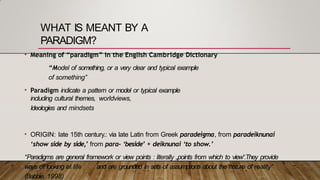
WHAT IS MEANTBY A
PARADIGM?
• Meaning of “paradigm” in the English Cambridge Dictionary
“Model of something, or a very clear and typical example
of something”
• Paradigm indicate a pattern or model or typical example
including cultural themes, worldviews,
Ideologies and mindsets
• ORIGIN: late 15th century.: via late Latin from Greek paradeigma, from paradeiknunai
‘show side by side,’ from para- ‘beside’ + deiknunai ‘to show.’
“Paradigms are general framework or view points : literally „points from which to view.They
‟ provide
ways of looking at life and are grounded in sets of assumptions about the nature of reality”
(Babbie, 1998)
5.
WHAT IS ARESEARCH
PARADIGM?
• A research paradigm is “the set of common beliefs and agreements shared between
scientist about how problems should be understood and addressed” (Kuhn, 1970)
• “Research paradigms can be characterized by the way Scientists respond to three basic questions:
ontological, epistemological and methodological questions” (Guba, 1990)
• “Social scientists can ground their inquires in any number of paradigms. None is write
or wrong, merely more or less useful in particular situation. They each shape the kind
of theory created for general understanding”
(Babbie, 1998)
6.
ACCORDING TO KUHN(1970)
PARADIGM CONTAINS
"universally recognized scientific
achievements that, for a time, provide model
problems and solutions for a community of
researchers", i.e.,
• what is to be observed and scrutinised
• the kind of questions that are supposed to be asked and probed for answers
in relation to this subject
• how these questions are to be structured
• how the results of scientific investigations should be interpreted
• how is an experiment to be conducted, and what equipment is available to
conduct
the experiment.
7.
RESEARCH PHILOSOPHY
, PARADIGMSAND
LOGIC OF RESEARCH
Plato
c. 348–347 BC
Logic/ Ethics
“Objects are inherently good, just”
“Things are beautiful, unified,
equal”
Socrates
c. 469 / 470 BC
Contribution to Epistemology, Ethics, Logic:
“I know that I know nothing”
“Knowledge is always proportionate to the
realm from which it is gained.”
8.
WHAT IS ARESEARCH
PARADIGM?
• Three basic questions (Guba,
1990):
Ontological
questions
What is
reality?
Methodological questions
How do you go about finding
it out?
Epistemological questions
How do you
know something?
Ontological :What is
the nature of the
“knowable”? Or ,
What is the nature
of
reality
?
Epistemological: What is
the nature of the
relationship between the
knower (inquirer) and
known (or knowable) ?
Methodological: How
should the inquirer
go about finding out
knowledge?
9.
ACCORDING TO CHALMERS
(2002):
•Ontology is the study of beings or their being
• What is reality ?
• Epistemology is the study of knowledge
• How we know ?
• Logic is the study of valid reasoning
• How we reason ?
• Ethics is the study of right and wrong
• How we should act ?
• Phenomenology is the study of our
experience
• How we experience ?
SOME OTHER SOCIALSCIENCE
PARADIGMS
• Macrotheory and
Microtheory
• Conflict Paradigm
• Role Theory
• Functionalism
• Naturalism
• Marxism
• Neo- Marxism
• Feminist Paradigm
• Ethnomethodology
• Structural
• Post
foundationalism
• Post structuralism
• Post colonialism
• Existentialism
• Post modernism
• New ageism
12.
W H IC H RESEARCH PARADIGM YOUR
RESEARCH BELONG TO?
Positivists
Constructivist
s
Best method
to use is the
one that
solves the
problem
Reality is
constantly
renegotiated,
debated,
interpreted
Pragmatists
There is a single
reality
There is no single
reality or truth/
There is multiple
realities
Reality needs
to be
interpreted
Can be
measured and
known
Quantitative
methods
Quantitative
methods
Consider
the
practical
effects of
the objects
of your
conception
13.
Assumptions of
Approach
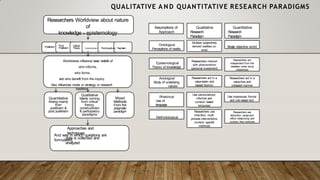
QUALITATIVE AN D QUANTITATIVE RESEARCH PARADIGMS
Researchers Worldview about nature
of
knowledge - epistemology
Approaches and
techniques
And way in which questions are
formulated,
data is collected and
analyzed
Ontological
Perceptions of reality
Positivism Post
Positivism
Critical
Theory
Worldviews influence basic beliefs of
who informs,
who forms
and who benefit from the inquiry
Also influences mode or strategy or research
tradition
Quantitative
Arising mainly
from
positivism &
post positivism
Qualitative
Mainly coming
from critical
theory,
constructivism
& participatory
paradigms
Mixed
Methods
From the
pragmatic
paradigm
Qualitative
Research
Paradigm
Quantitative
Research
Paradigm
Multiple subjectively
derived realities co-
exist
Single objective world
Epistemological
Theory of knowledge
Researchers interact
with phenomenon
(personal investment)
Researchers are
independent from the
variables under study
(detached)
Axiological
Study of underlying
values
Researchers act in a
value-laden and
biased fashion
Researchers act in a
value-free and
unbiased manner
Rhetorical
Use of
language
Use personalized,
informal and
context- based
language
Use impersonal, formal
and rule-based text
Methodological
Researchers use
induction, multi-
process interventions,
context- specific
methods
Researchers use
deduction, cause-and-
effect relationship and
context- free methods
Constructivism Participatory Pragmatism
14.
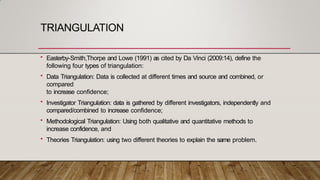
TRIANGULATION
• Easterby-Smith,Thorpe andLowe (1991) as cited by Da Vinci (2009:14), define the
following four types of triangulation:
• Data Triangulation: Data is collected at different times and source and combined, or
compared
to increase confidence;
• Investigator Triangulation: data is gathered by different investigators, independently and
compared/combined to increase confidence;
• Methodological Triangulation: Using both qualitative and quantitative methods to
increase confidence, and
• Theories Triangulation: using two different theories to explain the same problem.
15.
ACTIVITY
Read the paperwritten by Scotland (2012) and discuss the following
aspects of educational research paradigms:
1. What are the three educational paradigms had been explored in this
paper ?
2. “ Every paradigm is based upon its own ontological and epistemological
assumptions” . Do you agree with this statement ? Give reasons for your
answer.
3. What are the major differences that you have observed between
positivism and post-positivism.
4. How would you describe ontological & epistemological positions of the
Scientific paradigm and the Interpretive paradigm ?
5. Describe methodological underpinning of the critical paradigm and how it
differ from the scientific and the interpretive paradigms.
16.
REQUIRED
READING
• Babbie E.(1998). The Practice of Social Research 98th Edition). Wadsworth Thomson.
London.
• Kuhn, T. S. (1970) The Structure of Scientific Revolutions (2nd Edition) University of Chicago Press. Section V, pp. 43-
51
• Crotty, M. (1989). The foundations of social research. London: Sage.
• Guba, E. G., & Lincoln, Y. S. (1994). Competing paradigms in qualitative research. In N. K. Denzin, & Y. S. Lincoln (Eds.), Handbook of qualitative research
(pp. 105-117). London: Sage.
• Scotland, J. (2012). Exploring the Philosophical Underpinnings of Research: Relating Ontology and Epistemology to the Methodology and Methods of the
Scientific, Interpretive, and Critical Research Paradigms. English Language Teaching; Vol. 5, (9), pp. 9-16
• Uyangoda J. (2015). Social Research: Philosophical and Methodological Foundations. Social Scientists‟ Association. Colombo