Urogenital System
Term refers to the Excretory System and
Reproductive Systems
Excretory System sometimes called Urinary
System
Two systems are often discussed at the same
time because of similar location in body cavity
Excretory System
Excretion: process which metabolic wastes are
eliminated
Functions:
1) Homeostasis
2) Removes waste from blood
3) Maintain pH blood
4) Regulate water content of blood
Excretory Organs:
Skin – removes excess water, salts, and small amount
urea in sweat
Lungs – eliminate CO2
Liver (digestive organ as well) – converts amino acids
into other compounds and takes toxic nitrogen compounds
and converts to urea
Kidneys – removes urea and other metabolic wastes
from bloodstream
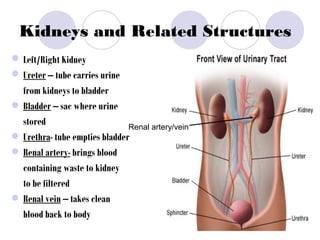
Kidneys and Related Structures
Left/Right Kidney
Ureter – tube carries urine
from kidneys to bladder
• Bladder – sac where urine
stored
• Urethra- tube empties bladder
• Renal artery- brings blood
containing waste to kidney
to be filtered
• Renal vein – takes clean
blood back to body
Renal artery/vein
Control of Kidney Function
Activity of kidney controlled by:
1) Composition of blood
2) Hormones
•Drink glass water/Eat Salty Food:
1) water absorbed into bloodstream from capillaries near digestive tract = concentration
water blood increases
2) kidneys respond by slowing rate water reabsorption
3) Less water returned to blood, excess water sent to bladder
•Kidney Function controls blood composition regulating the environment for the body
cells (preventing swelling/shrinking)
•Dialysis- process blood removed from body and filtered through special tubing that
simulates the kidneys removing urea and excess salts (waste)
Kindney Function
1) Filtration- removing wastes
-smaller particles diffuse out of the blood
-filtrate particles include: water, urea, glucose, salts, amino acids, and
vitamins
-Large particles remain in blood: plasma proteins, platelets, RBC, and
WBC
•2) Reabsorption-
-purified blood returned bloodstream
-urine emptied into ureters (leads to bladder)
*kidney stones- salts from urine crystallize blocking ureter
Human Reproductive System
Reproduction- process creates new individual
Only system that if it fails, will not cause death.
2 Basic Functions:
1) production gametes
2) secretion sex horomones
The Male Reproductive System
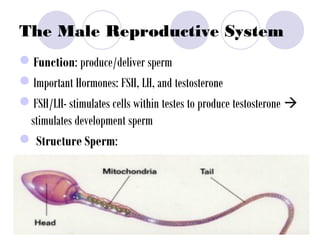
Function: produce/deliver sperm
Important Hormones: FSH, LH, and testosterone
FSH/LH- stimulates cells within testes to produce testosterone 
stimulates development sperm
 Structure Sperm:
“The Pathway of Sperm”
Sperm cells are produced in seminiferous tubules inside testes
After sperm cells are produced in testes, stored/mature in area above testes
called epididymis
In order to fertilize the egg, sperm must exit the body
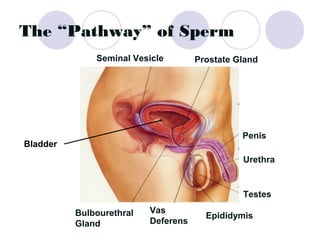
1) Vas deferens- tube connects epididymis to urethra
2) Urethra- tube urine/semen exit the body
3) Glands add fluid as sperm exit the body:
- Seminal vesicles -nourishes sperm
- Bulbourethral gland/prostate gland – secrete fluid protects
sperm from acid in vagina
• Sperm + Glandular secretions = SEMEN
The “Pathway” of Sperm
Penis
Urethra
Testes
Epididymis
Vas
Deferens
Bulbourethral
Gland
Seminal Vesicle Prostate Gland
Bladder
The Female Reproductive System
Function: produce egg cell/nourish baby
After puberty, females produce one egg month until mid-
40’s when females reach a state called menopause.
Menopause- ovulation/mestruation stop/having children no
longer possible
Menstrual cycle is regulated by several hormones made in
hypothalamus, pituitary gland, and ovaries.
Overview of Menstrual Cycle
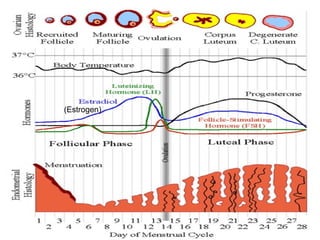
Menstrual cycle (average 28 days) includes:
-Development egg
-Release egg
-Preparation uterus
•Each month 2 possible results:
1) Egg fertilized by sperm, implants uterus = pregnancy
2) Egg NOT fertilized, lining uterus/dead egg/blood
discharged = “period”
4 Phases of Menstrual Cycle
1) Follicular Phase (Day 1-10):
-Level of hormone called estrogen is very low
-Low estrogen level causes hypothalamus 
pituitary gland release FSH/LH (hormones)
-Stimulates follicle (cluster of cells around egg cell) to
mature
-Level estrogen begins to rise end of this phase, which
thickens the lining uterus
4 Phases of Menstrual Cycle
2) Ovulation (Day 11-15)
-Shortest phase in cycle lasting 3-4 days on average
-Occurs “midpoint” in cycle
-Time period when most “fertile”
-Hypothalamus  sends releasing hormone to pituitary
 causes rise in FSH/LH  causes follicle to rupture
releasing egg into fallopian tube
-Egg must be fertilized few days for pregnancy occur (while
in
the fallopian tube)
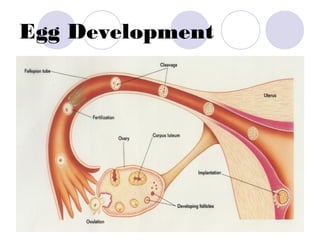
Egg Development
4 Phases of Menstrual Cycle
3) Luteal Phase (Day 16-25)
-After egg released
-Follicle (area where egg was) becomes corpus luteum
 releasing estrogen/progesterone as well
-Estrogen causes tissue lining uterus thicken
-Progesterone increases blood supply to uterus
-Uterus must prepare for possible “implantation” (pregnancy)
4 Phases of Menstrual Cycle
4) Menstruation (Days 25-28)
-Phase only occurs if egg not fertilized
-2-3 days after ovulation if egg not fertilized, follicle
disintegrates causing levels of estrogen and progesterone
to drop
-Estrogen level drops low enough  lining uterus
begins die/detach
-Menstrual period = blood and tissue released (lasting 3-7
days/new cycle begins with day 1 menstruation)
(Estrogen)
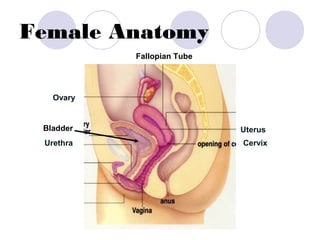
Female Anatomy
Urethra
Ovary
Uterus
Cervix
Bladder
Fallopian Tube

Reproduction.ppt2013

  • 2.
    Urogenital System Term refersto the Excretory System and Reproductive Systems Excretory System sometimes called Urinary System Two systems are often discussed at the same time because of similar location in body cavity
  • 3.
    Excretory System Excretion: processwhich metabolic wastes are eliminated Functions: 1) Homeostasis 2) Removes waste from blood 3) Maintain pH blood 4) Regulate water content of blood
  • 4.
    Excretory Organs: Skin –removes excess water, salts, and small amount urea in sweat Lungs – eliminate CO2 Liver (digestive organ as well) – converts amino acids into other compounds and takes toxic nitrogen compounds and converts to urea Kidneys – removes urea and other metabolic wastes from bloodstream
  • 5.
    Kidneys and RelatedStructures Left/Right Kidney Ureter – tube carries urine from kidneys to bladder • Bladder – sac where urine stored • Urethra- tube empties bladder • Renal artery- brings blood containing waste to kidney to be filtered • Renal vein – takes clean blood back to body Renal artery/vein
  • 6.
    Control of KidneyFunction Activity of kidney controlled by: 1) Composition of blood 2) Hormones •Drink glass water/Eat Salty Food: 1) water absorbed into bloodstream from capillaries near digestive tract = concentration water blood increases 2) kidneys respond by slowing rate water reabsorption 3) Less water returned to blood, excess water sent to bladder •Kidney Function controls blood composition regulating the environment for the body cells (preventing swelling/shrinking) •Dialysis- process blood removed from body and filtered through special tubing that simulates the kidneys removing urea and excess salts (waste)
  • 7.
    Kindney Function 1) Filtration-removing wastes -smaller particles diffuse out of the blood -filtrate particles include: water, urea, glucose, salts, amino acids, and vitamins -Large particles remain in blood: plasma proteins, platelets, RBC, and WBC •2) Reabsorption- -purified blood returned bloodstream -urine emptied into ureters (leads to bladder) *kidney stones- salts from urine crystallize blocking ureter
  • 8.
    Human Reproductive System Reproduction-process creates new individual Only system that if it fails, will not cause death. 2 Basic Functions: 1) production gametes 2) secretion sex horomones
  • 9.
    The Male ReproductiveSystem Function: produce/deliver sperm Important Hormones: FSH, LH, and testosterone FSH/LH- stimulates cells within testes to produce testosterone  stimulates development sperm  Structure Sperm:
  • 10.
    “The Pathway ofSperm” Sperm cells are produced in seminiferous tubules inside testes After sperm cells are produced in testes, stored/mature in area above testes called epididymis In order to fertilize the egg, sperm must exit the body 1) Vas deferens- tube connects epididymis to urethra 2) Urethra- tube urine/semen exit the body 3) Glands add fluid as sperm exit the body: - Seminal vesicles -nourishes sperm - Bulbourethral gland/prostate gland – secrete fluid protects sperm from acid in vagina • Sperm + Glandular secretions = SEMEN
  • 11.
    The “Pathway” ofSperm Penis Urethra Testes Epididymis Vas Deferens Bulbourethral Gland Seminal Vesicle Prostate Gland Bladder
  • 12.
    The Female ReproductiveSystem Function: produce egg cell/nourish baby After puberty, females produce one egg month until mid- 40’s when females reach a state called menopause. Menopause- ovulation/mestruation stop/having children no longer possible Menstrual cycle is regulated by several hormones made in hypothalamus, pituitary gland, and ovaries.
  • 13.
    Overview of MenstrualCycle Menstrual cycle (average 28 days) includes: -Development egg -Release egg -Preparation uterus •Each month 2 possible results: 1) Egg fertilized by sperm, implants uterus = pregnancy 2) Egg NOT fertilized, lining uterus/dead egg/blood discharged = “period”
  • 14.
    4 Phases ofMenstrual Cycle 1) Follicular Phase (Day 1-10): -Level of hormone called estrogen is very low -Low estrogen level causes hypothalamus  pituitary gland release FSH/LH (hormones) -Stimulates follicle (cluster of cells around egg cell) to mature -Level estrogen begins to rise end of this phase, which thickens the lining uterus
  • 15.
    4 Phases ofMenstrual Cycle 2) Ovulation (Day 11-15) -Shortest phase in cycle lasting 3-4 days on average -Occurs “midpoint” in cycle -Time period when most “fertile” -Hypothalamus  sends releasing hormone to pituitary  causes rise in FSH/LH  causes follicle to rupture releasing egg into fallopian tube -Egg must be fertilized few days for pregnancy occur (while in the fallopian tube)
  • 16.
  • 17.
    4 Phases ofMenstrual Cycle 3) Luteal Phase (Day 16-25) -After egg released -Follicle (area where egg was) becomes corpus luteum  releasing estrogen/progesterone as well -Estrogen causes tissue lining uterus thicken -Progesterone increases blood supply to uterus -Uterus must prepare for possible “implantation” (pregnancy)
  • 18.
    4 Phases ofMenstrual Cycle 4) Menstruation (Days 25-28) -Phase only occurs if egg not fertilized -2-3 days after ovulation if egg not fertilized, follicle disintegrates causing levels of estrogen and progesterone to drop -Estrogen level drops low enough  lining uterus begins die/detach -Menstrual period = blood and tissue released (lasting 3-7 days/new cycle begins with day 1 menstruation)
  • 19.
  • 20.